Heads up: This post contains affiliate links. As an Amazon Associate I earn from qualifying purchases, at no extra cost to you. Learn more
Specs are compiled from manufacturer listings and verified buyer reviews and can change over time — please confirm the key details on the product page before buying.
You want a path you can walk on barefoot or in yard shoes — something that ends the mud slog between the back door and the garden, drains after rain, and does not turn into a wobbly trip hazard by July. The short answer: most people should buy a lightweight rubber or faux-stone paver you can lay straight over grass or dirt. Reach for loose decorative rock only once the path itself is already solid. This guide separates the walkable surfaces from the pretty-but-slippery piles, so you buy the right thing once.
This guide is built by comparing the manufacturers’ published specifications and the patterns across verified customer reviews, so you get each pick’s real strengths and trade-offs instead of marketing spin.
A walkable path needs a stable base, real traction, and a way for water to escape instead of pooling. Below are the seven strongest options, sorted by what each one is genuinely good at. These are the landscape rocks to walk on that hold up to daily footsteps, wet weather, and a hose-down without falling apart underfoot.
Top Picks

How To Choose The Best Landscape Rocks to Walk On
The one question that decides everything: is the surface itself the walking path, or is it decoration sitting next to the walking path? A pavers-style stepping stone carries your weight directly. A bag of loose river rock does not — it shifts, rolls underfoot, and needs something solid underneath or glue on top. Get that distinction right and the rest of the decision gets easy.
Coverage per piece is what actually costs you
A 12″x12″ stone and an 18″x22″ stone are not close cousins — the bigger one covers far more ground in a single set-down. For a walking path you want roughly one stone per stride, so a step that spans 18 inches means fewer pieces to buy and fewer edges to catch a heel on. Measure your stride first, then count stones, not bags.
Traction beats looks on a wet morning
Polished river pebbles look gorgeous and turn slick the second dew lands on them. A textured or molded surface gives your sole something to grip. If the path leads anywhere near a spigot, a pool, or a shaded north-facing lawn, prioritize texture over shine.
Drainage: where does the water go?
Solid pavers can trap water against the soil and make a mud pocket. Permeable mats with a mesh base, or a rubber paver laid over gravel, let water pass through and dry out. If your walkway floods after storms, drainage matters as much as the stone itself.
Side-by-Side Comparison
| Model | Best For | Format | Coverage / Size | Weight | Amazon |
|---|---|---|---|---|---|
| Unocho Natural Slate Stones 20 lb★ Best Overall | Best for stacking and borders | Natural slate stone | 2-8 inches, 20 lb | 19.8 pounds | Amazon |
| TierraVerde Rubber Stepping Stones 4-PackAlso Great | Best Overall everyday path | Rubber paver, natural rock look | 18″L x 22″W each (4-pack) | — | Amazon |
| Arcadia Garden Products 4-Piece Fiberclay Pavers | Best faux-flagstone look | Fiberclay paver | 15.7″ x 16.9″ x 1.2″ each | 12.87 pounds (set) | Amazon |
| Multy Home Stomp Stone 4-Pack | Best budget no-fuss set-down | Rubber stomp stone | 12″L x 12″W each | 1.9 pounds (per piece) | Amazon |
| PetraMax Lockscape Rock Glue | Best for locking loose stone | Ready-to-spray liquid adhesive | Up to 200 sq ft | — | Amazon |
| Pulovin 40 lbs River Rocks | Best decorative fill | Loose river stone | 2″-3″ stones, 40 lbs | 40 lbs | Amazon |
| Xindian 6-Piece River Rock Mats | Best instant path look | River rock on mesh backing | 16″L x 5.5″W each (6-pack) | — | Amazon |
Detailed Reviews
1. Aquarium Rock 20lb Natural Slate Stones
Our pick — 4.0+★ from 400+ verified ratings; the strongest balance of quality and price.
Flat, stacked slate that builds solid ledges and borders — not a finished walking surface.
You get 20 pounds of natural black slate, sized 2 to 8 inches, arriving flat and layered so you can stack, trim, or bond it into place. That flat-and-stackable shape is the whole point. Build a low border flanking your walkway, a ledge, a step edge, or arrange it as a rockery, and the individual pieces lock together much better than round river stone ever would. Each piece varies in shape and thickness, so no two layouts look the same.
On the sourcing side it is clean natural stone in deep gray-to-black tones with layered texture, and it is hard and wear-resistant enough for freshwater and saltwater tanks and reptile enclosures. For the garden it arrives pre-washed — a rinse and it is ready — and it also suits bonsai, succulent planters, and miniature landscapes. At 19.8 pounds, expect a firm lift.
Comparing the weight is where the practical read lives: this bag is 19.8 pounds versus the Multy Home’s 1.9 pounds per paver, so this is the heavy, permanent-built border while that is the light, movable surface. The most-mentioned point is that it arrives as described — real stone, real quality. The catch is what it is not: loose slate in 2-to-8-inch chunks is not a smooth surface to walk on directly, and some buyers found the size mix ran larger or smaller than they pictured. Use it to frame a path in stone; use a flat paver to be the path.
Where it does its best work
- Flat, layered slate stacks and bonds into borders, ledges, and rockery
- Hard, wear-resistant natural stone for tanks and enclosures alike
- Pre-washed — a quick rinse and it is ready to place
- Each piece differs in shape and thickness for a natural look
Worth knowing
- 19.8 pounds is a firm lift and a permanent placement
- 2-to-8-inch chunks make a border, not a smooth walkable surface
- Piece sizes vary; the mix may not match a picture in your head
Right for: framing a path with a solid flat-stone border, edging a bed, or building rockery where flat stacked slate matters.
Not for: being the walking surface itself — stack this to the sides, and lay a flat paver where your feet land.
2. TierraVerde Rubber Stepping Stones 4-Pack
The oversized rubber paver that swallows a whole stride and still hoses clean.
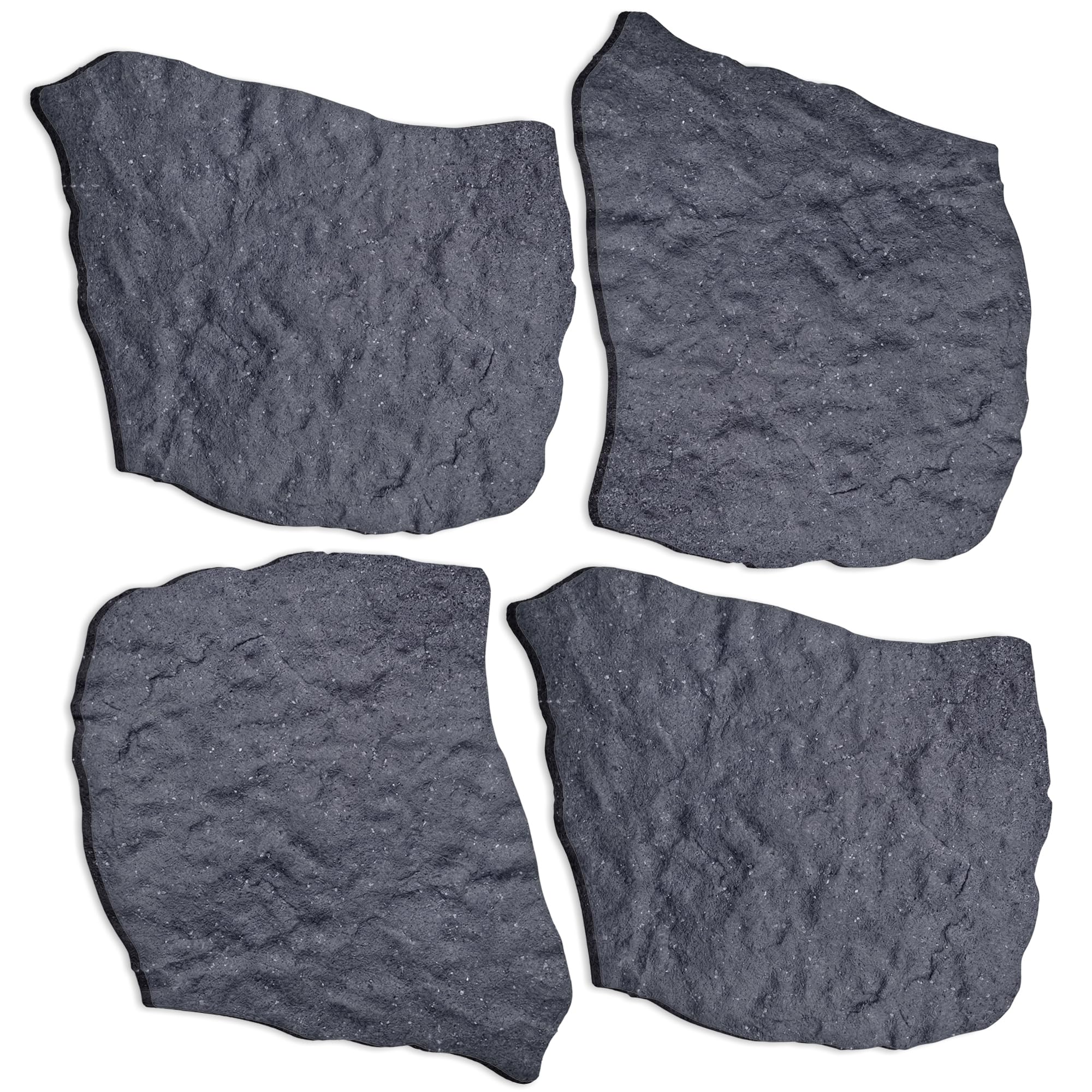
Four stones that each measure 18″L x 22″W — that is the number that matters here. One stone roughly matches a full adult stride, so you are not stitching a path out of tiny squares or catching a heel on a gap between them. You lay them over grass, dirt, gravel, or mulch with no digging and no tools, which means a muddy back-door run gets a real surface in an afternoon rather than a weekend.
The surface is textured, so your sole has something to press against when the dew is still on it. Because they are made from REDU material — a mix of diverted recycled content — they shrug off rain, frost, and seasonal temperature swings without splitting apart. Reviewers consistently praise how well these rubber pavers hold up and stay comfortable underfoot, which is why this set takes the top slot.
Set it against the Multy Home stomp stone and the size gap is the whole story: 18″L x 22″W here versus 12″L x 12″W there. Fewer pieces, fewer shifted edges, more actual walkable surface. The honest catch is that this is still a surface layer — over soft, uneven ground it will follow the lumps rather than fix them, so a rough yard benefits from a quick rake-and-tamp first. It is also the priciest way to cover ground per square foot among the rubber options, so it rewards people laying a real path rather than a few decorative hops.
What earns it first place
- An 18″L x 22″W footprint per stone covers a full stride in one set-down
- No digging or tools — drops straight onto grass, dirt, gravel, or mulch
- Textured walking face gives grip on damp mornings
- Weather-resistant recycled construction handles rain and frost without cracking
Where it asks a little of you
- Over lumpy ground it mirrors the bumps unless you prep the base
- Four-stone pack only stretches so far on a long run
Reach for this if: you want a fast, comfortable, hose-cleanable path over a lawn or dirt track and value stride-sized coverage over piece count.
Think twice if: your ground is very uneven — rake and tamp first, or the pavers will rock along with it.
3. Arcadia Garden Products Set of 4 Stepping Stone
Faux flagstone that fools the eye and stays light enough to shift one-handed.
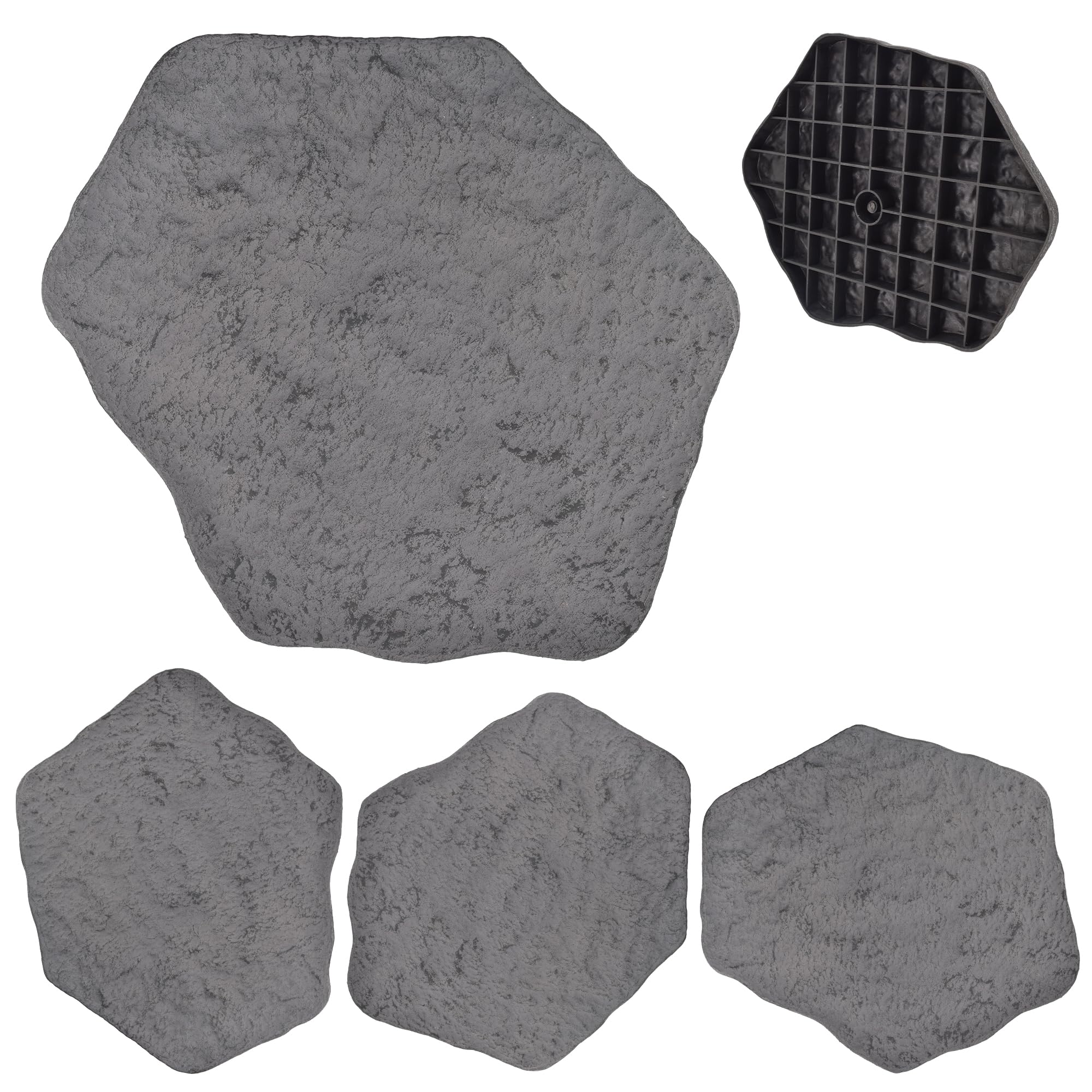
If your paths already have a weathered-stone character and you want the new stones to disappear into the look, this is the set built for that. Each paver measures 15.7″ x 16.9″ x 1.2″ with an irregular shape and textured face, so it reads as aged flagstone rather than a molded square. The dark gray finish carries subtle color variation that mimics stone that has been outside for years.
Fiberclay is the reason the whole set weighs 12.87 pounds — light enough that laying a path is a one-person job with no wheelbarrow and no cement mixing. They resist weather and UV, so the gray does not bleach out over a season. Arrange them individually for a stepping look or butt several together into a continuous decorative run; the repeatable pattern lets you keep adding pieces to stretch across a bigger area.
Here is the real trade-off between this set and the TierraVerde at the top: the Arcadia gives you a truer natural-stone face and a lighter carry. But each piece is smaller at 15.7″ x 16.9″ versus the TierraVerde’s 18″L x 22″W, so you need more of them to span the same distance. On very soft or freshly turned soil, a fiberclay paver (a molded stone-look tile) also wants a firmer footing than the rubber alternative. Buy this for the finish, not for the fastest full-path mileage.
The look: The faux-flagstone face is the headline — irregular, textured, and convincingly weathered in dark gray, so it blends into an established garden instead of reading as new plastic.
The catch: Smaller footprint per piece and a lighter build mean more pieces per metre and a firmer base required than a rubber paver.
The right buy for: gardeners chasing an authentic weathered-stone look who do not mind buying a few extra pieces to complete the run.
Pass it by when: your ground is loose or spongy — set them on a tamped base so the fiberclay does not settle unevenly.
4. Multy Home MT5100000 4-Pack Stomp Stone

Featherweight square pavers you can drop in place and forget.
At 1.9 pounds a piece, these are about as easy to lay as a rug tile — set them down, nudge them into line, done. Each measures 12″L x 12″W with a skid-resistant slate-colored face, and they are made from 98% recycled materials. For a small run like a spigot path or a gap between patio and shed, that lightness is genuinely pleasant: no lifting, no overstrain, no help needed.
Put them up against the Aquarium Rock slate stones and the contrast is stark — 1.9 pounds a paver versus 19.8 pounds for that bag. Which is exactly why these are the friendly choice for a patio, play area, or planter-side hop. They are scratch- and moss-resistant, so a shaded spot will not go green on you the way a bare stone surface might.
The fair caveat is sturdiness: these are a surface layer, not a foundation. On soft or freshly dug ground they can feel giving and shift a little under foot traffic over time. A couple of buyers report they suit lighter or temporary use better than a heavy daily route. Fine for a garden border; ask them to bear a family’s constant comings and goings and they will show the strain. Set them on a level base and they settle in happily.
Why it earns its spot: The lowest-lift way onto a walkable surface — 1.9 pounds per 12″x12″ tile, 98% recycled build, and a skid-resistant face that holds up better than the weight suggests.
The honest limit: Not a heavy-traffic foundation; plan on a compacted base and lighter use rather than a busy main walkway.
Best for: quick coverage around a spigot, play area, or patio edge where light weight and easy set-down matter most.
Not for: a high-traffic main path over loose soil — tamp the base or expect some give underfoot.
5. PetraMax Lockscape Rock Glue 1 Gallon
The glue that turns a loose pebble heap into something you can actually stand on.
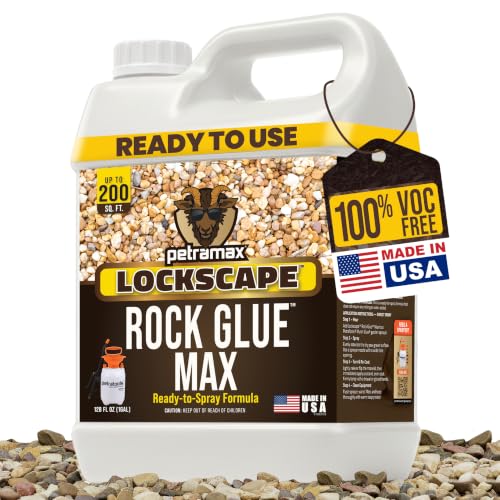
Loose river rock rolls, that is just physics — and this is the solution for anyone who already has decorative stone and wants it stable enough to walk across. It comes ready to spray, so you pour it into your sprayer and go with no measuring and no mixing. One gallon covers up to 200 sq ft of rock, pea gravel, pebbles, or decomposed granite, and it dries clear so the stone keeps its natural color.
The formula is 100% permeable, which is the key detail for a walking surface: water still passes through to the soil underneath instead of pooling on top and turning to a puddle. Being VOC-free means no heavy solvent smell while you work. Applied correctly to fully dried rock, the hold is rated up to a year, with a light semiannual reapplication to keep it performing.
Reviewers agree it locks loose rock in place and keeps the stones from scattering. Where it asks for care is durability over the long haul: some applications hold beautifully while others break down faster than hoped, so the prep matters. It also explicitly is not for high-traffic areas, which is the biggest caveat — treat this as a stabilizer for decorative stone you cross now and then, not as the foundation of your main garden path. Apply it only to fully dried rock and let it cure for 24 hours before walking on it.
What it does well
- Ready-to-spray jug covers up to 200 sq ft with no mixing
- 100% permeable — water drains through instead of pooling
- Dries clear and is VOC-free, so the look stays natural
- Rated to hold up to a year, with a light semiannual reapplication
What to know before spraying
- Not for high-traffic areas — it stabilizes, it does not pave
- Only works on fully dried rock; wet stone undermines the bond
- Holds for up to a year, so plan on occasional reapplication
The move for loose stone: have a bed of pea gravel or river rock you want to stop scattering? Spray this once the rock is fully dry.
Wrong tool if: you are paving an actual daily walkway — that needs solid pavers, not adhesive-locked pebbles.
6. 40 lbs River Rocks
Genuine smooth river stone that looks different wet than dry — for beds, not barefoot paths.
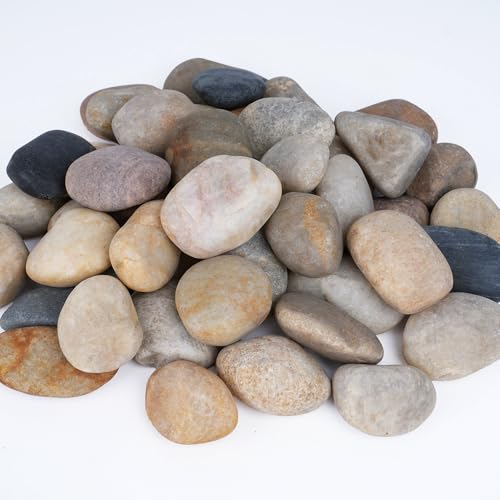
Forty pounds of unpolished river stones in the 2″-3″ range, with mixed coloring that shifts between wet and dry. They are clean, non-toxic, and additive-free, which is why they turn up as much in aquariums and terrariums as in flower beds. Use them as a top layer around trees, in a meditation garden, or around a fire pit, and they also work as drainage material that helps hold soil moisture and suppress weeds.
Buyers praise the stone itself — well-shaped, natural-looking pieces rather than dyed or chipped filler — and the natural colors come up almost as often. The trick to walking on them is set in the size: 2″-3″ stones are small enough to roll and shift under a heel. On their own they do not make a stable walking surface. Pair a bed of these with a landscape adhesive like the PetraMax and the surface firms up, but a path you cross every day still wants solid pavers.
The most-discussed point is size — some buyers expected bigger pieces, so check the 2″-3″ range against the look you want before ordering. Use these where they shine: decorative beds, planter dressing, an aquarium, a bare patch between pavers that needs finishing. As a filler edge around the strides of a walking path, they finish it off beautifully; as the path itself, they come up short.
Where it shines: Real river stone with wet-and-dry color variation, clean enough for aquariums and good as a weed-suppressing bed topping at 40 pounds a bag.
Where it falls short as a path: The 2″-3″ size rolls underfoot, and some buyers find the pieces smaller than pictured — good decoration, not standalone pavement.
Choose it for: dressing planter beds, aquarium floors, tree rings, and the decorative gaps between real pavers.
skip it if: you want the stone itself to be the walking surface — loose 2″-3″ rock will move under your feet.
7. 6 Pcs River Rock Stepping Stones, 16″ L x 5.5″ W Rectangles
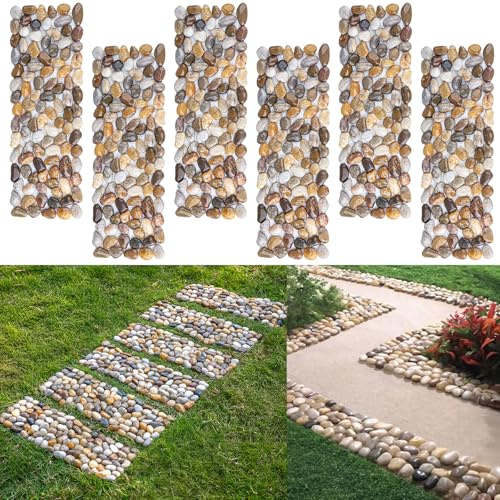
The fastest way to a real river-rock look, laid down in seconds.
Six pre-assembled mats, each 16″L x 5.5″W, made from genuine polished river pebbles on a flexible PVC mesh base. Unroll them onto grass, mulch, gravel, or soil and you have a definition path with no digging and no cement. The mesh is invisible once down, contours to uneven ground, and lets water drain while grass grows through — so it integrates into a lawn over time rather than sitting on top of it like a mat.
The natural earth-toned pebbles are the standout, a finish plastic or rubber alternatives struggle to match. It lays fast, and for a decorative border around flower beds or a wander path to the patio, the speed and the look together are hard to argue with.
The honest limit is the build. The stones are glued to a mesh backing, and over a season that bond is where wear shows first — some mats shed their pebbles and the backing breaks down faster than a solid paver would. The 5.5″ width also means you are laying a ribbon, not a wide stride. For a dry decorative path with light use, it does the job and looks lovely doing it. For anything your household tramples daily through wet weather, a solid rubber or fiberclay paver will outlast it.
What it nails: Real polished river pebbles on a flexible, water-draining mesh — an instantly pretty path that lays in seconds and needs no tools.
What to weigh: Glue-and-mesh construction is the wear point; the bond can loosen and the backing degrade sooner than solid pavers.
The pick for: a decorative path or flower-bed border where you want a natural river-stone look up fast, for light foot traffic.
Look elsewhere if: it will be a daily high-traffic route — the mesh bonding is the weak link.
Know the Specs
Coverage and footprint (12″x12″ vs 18″x22″)
Footprint is the size of each piece as it lies on the ground — a 12″x12″ paver covers a square foot, while an 18″L x 22″W paver covers considerably more. That difference decides how many pieces you buy for the same path length and how often you cross a joint. Step onto one in your normal stride, and a stone that spans your full step keeps a heel from snagging an edge. Match the footprint to your stride, then count the pieces you need.
Permeability and mesh backing
Permeable means water drains straight through the surface instead of pooling against the soil. Some stepping systems use a mesh base — a net that the stone sits on — which lets rain and irrigation pass through while the edge holds the stone in place. On a shaded or flood-prone path, this is the difference between a surface that dries out and one that stays a mud pocket, so check the build for drainage before you buy.
Weight and lift (1.9 lb vs 19.8 lb)
Weight governs how easy the stone is to lay and how permanent it feels. A rubber paver around 1.9 pounds can be carried and nudged into place with one hand, so a DIY job needs no wheelbarrow. A natural slate bag near 19.8 pounds is a firm lift and a fixed placement — heavier, more stable under foot, and harder to shift later. Choose the weight that matches how often you plan to rearrange the layout.
Adhesion: glue-locked loose stone
Loose rock like pea gravel or river pebbles shifts and rolls unless something binds it. A permeable landscape adhesive sprays over fully dried stone and locks the pieces together, drying clear so the natural color shows, while still letting water through. It stabilizes the surface you walk across without paving it — so it suits a decorative bed or occasional crossing, not a daily high-traffic route that needs solid pavers.
Common Questions
Can I lay landscape rocks directly over grass?
How do I stop loose river rocks from rolling when I walk on them?
What size stepping stone should cover a normal stride?
Are stepping stones slippery when wet?
Do I need a base under rubber or fiberclay pavers?
Will a river-rock path survive winter frost?
What is the difference between flat pavers and loose decorative rock for a walkway?
Can I use slate stones from the landscape bag as a walkway step?
How long does glued landscape rock last before it needs recoating?
Are these rocks safe to walk on barefoot?
The Bottom Line
For most people, the pick that makes the best landscape rocks to walk on is the TierraVerde Rubber Stepping Stones. Its 18″L x 22″W stride-sized pavers lay over grass in minutes and stay comfortable and grippy underfoot through rain and frost. If a weathered flagstone finish is what your garden wants, the Arcadia Fiberclay Pavers deliver the look in a lightweight 12.87-pound set. For a quick, budget-friendly hop around a spigot or patio edge, the Multy Home Stomp Stone keeps things light and simple. And if you already have a heap of loose decorative stone, a spray of PetraMax Lockscape rock glue firms it up enough to cross. The smart buy here is measured in stride, not in weight — a surface your whole foot lands on beats a prettier pile you tiptoe across.
How we choose
We do not accept paid placement. Every pick is matched to a real buyer and a real use-case; we do not hands-on test units.
Sources
Specifications: manufacturer listings and product documentation. Review insights: verified customer reviews, as of November 2026. Pricing: not shown on this page (it changes often); check the current price via the retailer link.
As an Amazon Associate, My Heart Lives Here earns from qualifying purchases. This does not affect which products we feature.