Heads up: This post contains affiliate links. As an Amazon Associate I earn from qualifying purchases, at no extra cost to you. Learn more
Specs are compiled from manufacturer listings and verified buyer reviews and can change over time — please confirm the key details on the product page before buying.
If you only buy one thing for field botany, make it a lens that stays clear with leaves pressed behind it. The wrong hand lens fogs, scratches, or leaves you squinting at leaf hairs you cannot actually resolve. The picks below all use real glass optics, and they cover the whole spread of jobs — a classroom set, a pocket loupe with its own light, a brass heirloom, a wallet-sized 3X.
This guide is built by comparing the manufacturers’ published specifications and the patterns across verified customer reviews, so you get each pick’s real strengths and trade-offs instead of marketing spin.
Start with magnification and lens width, because those two numbers decide whether you can read a stipule or count a trichome. Each pick below is matched to the field work it actually handles — the hands-on shortlist of the best hand lens for botany.
Top Picks

How To Choose The Best Hand Lens for Botany
A hand lens for botany is a single-purpose tool: you hold it an inch from a leaf, bring the leaf toward the lens until the image snaps sharp, and read the fine structure — leaf hairs, gland dots, stipules, the tiny teeth along a margin. That one job sets every choice you make. Here is what actually matters.
Magnification: 10X is the working standard
Most field keys are written around 10X, which magnifies the leaf ten times and gives you a wide enough view to see a whole small flower while it is still sharp. Higher power sounds better, but a 30X or 60X loupe gives a much tighter view, so you are hunting across the leaf to find the feature instead of reading it. Buy a 10X first and add a higher-power loupe only for detail work like counting tiny glands.
Lens diameter and field of view
Two lenses at the same 10X do not show the same amount of leaf. A wider glass element — the round piece of glass in the lens — shows more of the leaf at once, so you spend less time repositioning. A small pocket element is easier to carry but forces you to slide it around more. If you examine whole flowers rather than single hairs, favor the wider lens.
Glass lens versus plastic
A real glass lens resists scratching far better than acrylic and stays clear when your hands are damp. Leaf sap and grit are brutal on plastic. Glass also keeps its image crisp at the edges. Check the listing for “glass” in the lens material line — that one word is the dividing line between a tool that lasts seasons and one that hazes over.
Housing, grip, and carry
The frame protects the glass when the lens rides loose in a pocket or pack. A rubber handle is gentle on sweaty hands and cushions the lens on a knock. A brass body is heavier but feels solid and takes a lanyard. A folding housing tucks the glass away entirely. Whichever you pick, a storage case or pouch keeps grit off the lens between stops on the trail.
Illumination and UV light
An LED is the quiet upgrade for forest-floor work: it puts light directly where you are looking, so a shaded leaf or a deep flower throat stops being a guessing game. UV light is a separate switch and helps in some inspection tasks. If you survey in dim understory or under a hand-held shade, a lit loupe earns its place.
Side-by-Side Comparison
| Model | Best For | Magnification | Lens Material | Lens / Body Notes | Amazon |
|---|---|---|---|---|---|
| Xuhal 48 Pcs 10X Magnifying Glass★ Best Overall | Class sets and group field trips | 10 x | Glass | 50mm lens, rubber handle, 48 pieces | Amazon |
| Opticron LED Hand Magnifier 10xBest for Dim Woods | Shaded understory and dim trails | 10 x | Glass | 26mm lens, LED lit, ABS handle | Amazon |
| VIVOSUN 2-Pack Jewelry Loupe | Fine detail and UV checks | 30 x / 60 x | Glass | Zinc alloy housing, LED + UV, 2-pack | Amazon |
| Hastings 10X Loupe | A lens that lives in a pocket for years | 10 x | Glass | Brass body, leatherette pouch, lanyard loop | Amazon |
| Galco Magnifier | Quick reads and wallet carry | 3 x | Glass | Metal rim, leather case, compact | Amazon |
Detailed Reviews
1. Xuhal 48 Pcs 10X Magnifying Glass
Our pick — 4.5+★ from 150+ verified ratings; the strongest balance of quality and price.
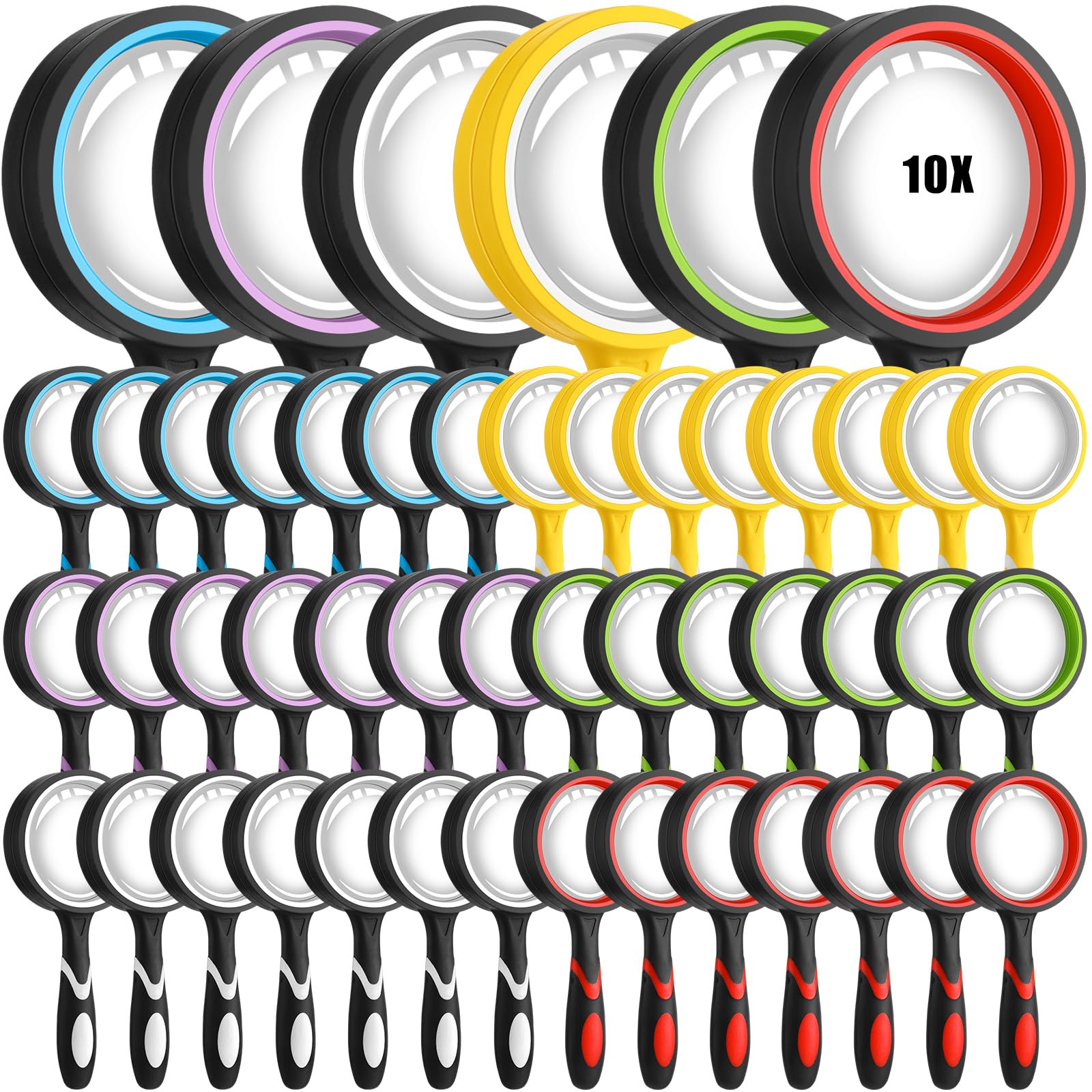
Forty-eight glass lenses in six colors — a whole botany class can hunt leaf hairs at once.
If you teach, run a nature club, or take a group of kids into the woods, the arithmetic here is hard to argue with. You get 48 magnifying glasses in six colors, eight of each, so a group can be handed one apiece without anyone sharing a sweaty handle. Each one is a 10X lens in a rubber grip, which is the standard power for good reason.
The lens is real glass, not acrylic, and at 50mm across it frames a small flower in one look instead of hunting around the leaf. The rubber frame wraps the glass edge, so a dropped lens on a rocky trail is a shrug rather than a loss. It is the crowd favorite here at 4.5+ stars across 150+ owners, and what wins people over is the glass lens quality at this set price.
Set against the single-lens picks, the VIVOSUN covers far less magnification — 10 x against the VIVOSUN’s 30 x — and the Hastings is one glass element where this is 48. That bulk is the point when you need to equip a group; it is also the whole trade-off. Counting leaf hairs and reading a simple key works fine at 10 power. If you need to see the surface of a lichen up close, this is the wrong power, and you reach for a higher-magnification loupe instead.
Where this set wins
- 49 pieces in the box — six colors, eight of each — so a whole group gets a lens.
- 50mm glass element gives a wide, clear view of a whole small flower.
- Rubber frame cushions the glass if it gets dropped on a trail.
- 10X is the standard field power keys are written around.
When it is not the answer
- 10X only — no zoom for gland-level detail work.
- Forty-eight lenses is far more than one botanist needs.
- No LED light for deep shade.
Reach for this if: you are equipping a class, a nature walk, or a family of curious kids rather than one solo backpack.
Look elsewhere if: you want a single lensed tool with higher power or a light for dim understory.
2. Opticron LED Hand Magnifier 10x 26mm (1.02″)
A pocket lens that brings its own light to leaves in deep shade.
Half the botany work you do happens under a forest canopy where the light is already gone. This is the answer to that: an LED sits right at the lens, lighting exactly what you are inspecting. The magnifier is built for close inspection of plants and insects, and it magnifies 10 times like the field standard.
The glass lens is 1.02 inches across — a genuinely pocketable element, not a wide field lens. That is the compact size that makes it easy to slip into a pocket and keep there.
Compare it honestly against the Hastings: that brass loupe carries a wider lens and an heirloom feel, while this one wins on the built-in LED and stays lighter to carry all day. The 10X power leaves the 30X VIVOSUN far sharper for micro-detail. If what trips you up is the field light — shaded understory, a deep flower throat — the LED here is the whole point of the pick.
Where it fits: a field botanist who surveys in dense canopy, does a lot of evening or early-morning walks, or reads tiny print in low light. The LED is the reason to pick it over a plain loupe.
The trade-off: a 26mm lens is a narrow window — you study a feature rather than a whole flower, so expect to slide it around a bit. No customer-review consensus is provided for this model, so the call rests on the published specs.
Choose it for: light, not power — the LED earns its keep wherever the canopy blocks the sun.
Think twice if: you want a wide, unlit field-of-view lens for sweeping over whole flowers.
3. VIVOSUN 2-Pack Jewelry Loupe
Thirty and sixty power in your pocket — for the leaf detail a 10X simply cannot reach.
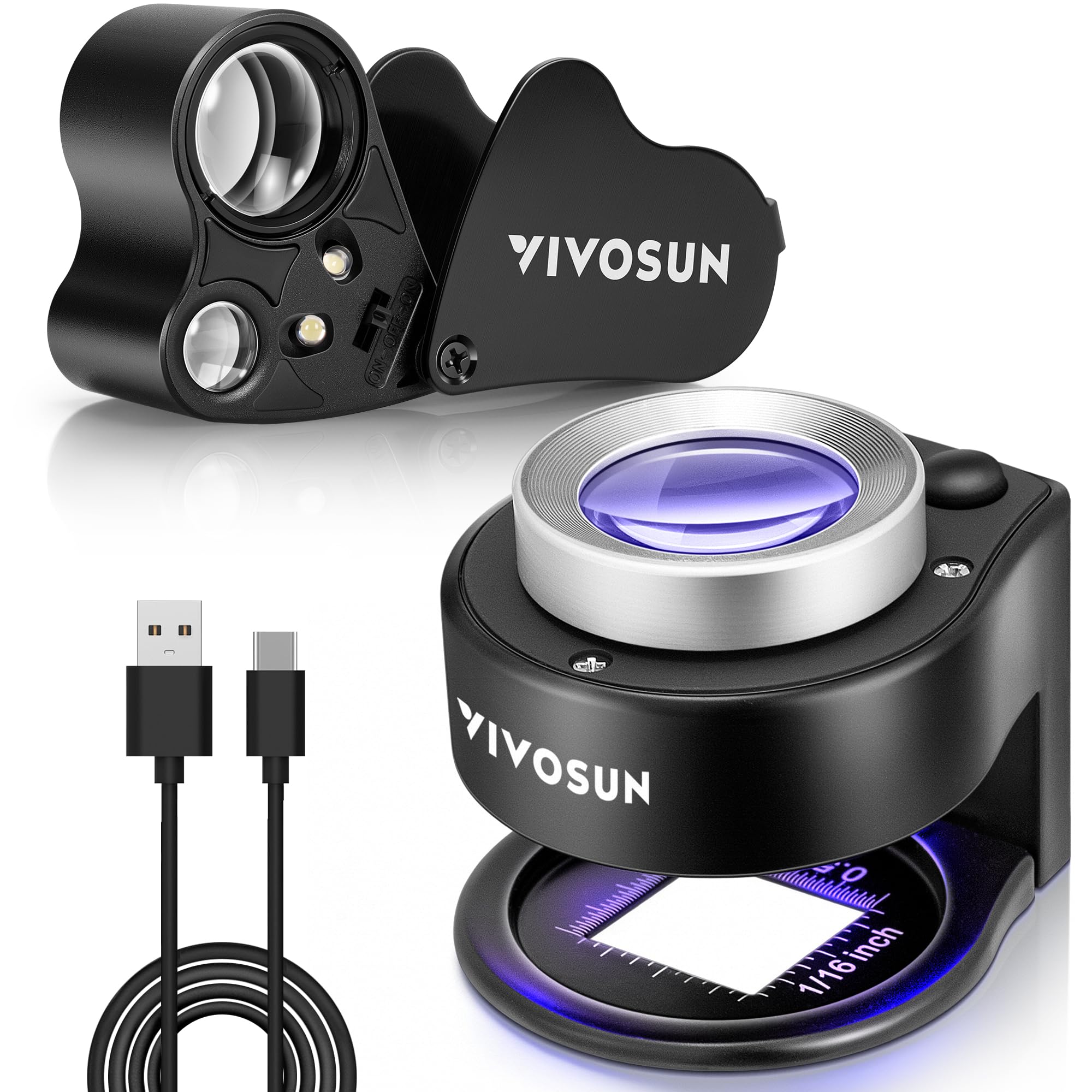
When 10X leaves you guessing at a gland dot or a leaf hair, this is the step up. The set gives you two loupes, both with optical-grade glass lenses and built-in illumination, and one of them offers two power levels of 30X and 60X. The lower-power loupe runs on a USB-charged battery with 3 LED lights plus 3 UV lights, and it comes with a leather storage case and a charging cable.
The folding loupe is housed in aluminum alloy and plastic, and its two bright LEDs mean you are not stuck squinting in shade. Inside the box you also get a lens wiping cloth and a second storage case. On the fine-detail front, buyers call it accurate for reading micro-print and examining small features — the magnification does what the label promises. It is the rival that humbles the Galco’s 3 x: 30 power against 3, and it will show you surface texture the naked eye never sees.
The honest note sits in the durability column, which comes out mixed in owner feedback — some find the housing sturdy, some find it fragile, so treat the folding mechanism with care. There are also two loupes in this pack, so if you only wanted one fine-detail lens you have a spare. The 60X view is very tight, so you use it on a single hair rather than a whole leaf.
Why it earns a spot
- 30X and 60X power shows detail a 10X field lens cannot resolve.
- 3 LED lights on the USB loupe and 2 LED on the folding loupe for shaded work.
- 3 UV lights for inspection tasks on the USB loupe.
- Comes with leather storage case, lens cloth, and USB charging cable.
The honest caveats
- Durability feedback is mixed — the folding housing needs some care.
- The very high power makes the 60X view hard to aim on a whole leaf.
- It is detail gear, not a wide field lens — you still want a 10X too.
Best for: the botanist who already has a 10X and wants a second lens to study the finest surface features, with its own light and a spare in the box.
Not for: a lone first lens — start at 10X and add this for the close work.
4. Hastings 10X Loupe Highest Optical Grade Glass Element Lens

The brass pocket loupe that feels like it was made to be carried for a decade.
This is the lens you buy once. Ten-times magnification in a chrome or black triple-plated brass body, with a bezel ring bale loop so you can hang it on a lanyard and never fumble for it in a pack. The folding housing tucks the glass away when it is not in use, so grit stays off the element between stops. It ships in a leatherette pouch that owners describe as fitting the loupe like a glove.
The image is the star: a clear, wide field of view at 10X. It delivers a clear, wide field of view, and the solid construction reads as quality the moment you hold it — one to put next to the Opticron’s plastic body and feel the difference. Owners call it worth the price and say they would buy it again. Where the VIVOSUN reaches for 30X micro-detail, this stays at 10X with cleaner optics, which is the right call for whole-leaf and whole-flower reading.
There is no LED here, so deep shade is a real limitation — bright it up with a headlamp or step into a gap in the canopy. And unlike the 48-piece Xuhal set, this is a single lens for one careful owner, not a kit. For field biology that means a lens you will still be using long after a plastic one has scratched and stiffened.
The verdict: a 10X glass element in a brass body with a lanyard loop and a good pouch — a brass-bodied field lens built to be used hard and long, at 4.0+ stars across 130+ owners.
The one limit: no light of its own, so dense understory needs a separate light source. Bring a headlamp and you are set.
The confident choice: botanists who want a lens that becomes part of their field kit and outlives the price tag anxiety — carry it on a lanyard and forget about it.
Skip if: you need self-contained lighting for shaded survey work or a set to share around a group.
5. Galco Magnifier
A genuine glass lens and a leather case — the small one that rides in a wallet.
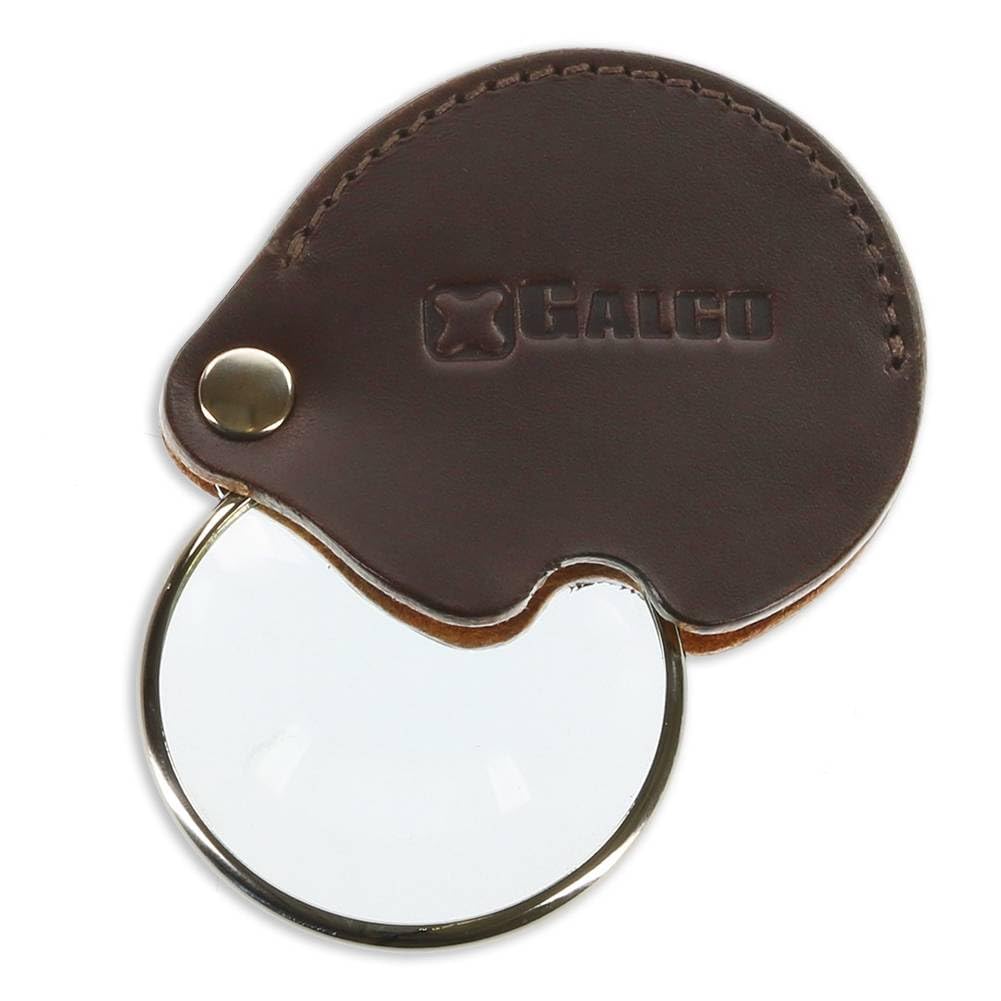
Not every read in the field needs 10 power. This is a metal-rimmed 3X glass lens with a dark Havana leather case, small enough to live in a pocket or purse and be there when you want a quick look. Move it toward a thing and it makes it larger and clearer, which is exactly what you want for reading a label, checking a flower from arm’s length, or getting the gist of a field note in low light.
The 3X power puts it in a different class from the Hastings’ 10 x — this shows you more of the scene at once, while the Hastings shows you finer detail. Build is what keeps owners loyal: real glass rather than plastic, a genuine leather case, and tidy good looks add up to a lens you keep rather than toss. It is small enough to carry, and the sizes here — 2.5 inches by 0.38 inches — are pocket proportions, which is the whole idea.
The trade-off is honest: 3X is not enough for counting leaf hairs or keying out a species, and some owners find the value is a stretch for what is a simple lens. If you want one lens to identify plants, do not start here — start with a 10X. If you want a handsome everyday lens to keep in a bag, the glass-and-leather build is the whole appeal.
It wins on: build and portability — a real glass lens in a leather case that goes anywhere.
Pass it over if: your goal is plant identification, which needs 10X or more, not 3X.
Know the Specs
Magnification (the X number)
An “X” figure tells you how many times the lens enlarges what you see. A 10X lens makes a leaf hair ten times its size, and a 30X or 60X loupe pushes the view much closer. Higher power sounds better, but it comes with a narrower window, so you point at a single feature rather than a whole flower. In botany, 10X is the workhorse power; 30X and 60X are detail tools.
Lens diameter
The diameter is how wide the piece of glass is. A wider lens — like the 50mm element on the Xuhal — shows more of the leaf at once, while a 26mm pocket lens shows less and asks you to slide it around. If you examine whole small flowers, favor the wider element. If portability rules, a smaller pocket lens earns the space it takes.
Glass versus plastic
Glass resists scratching and holds a clear image; plastic acrylic hazes and scratches with use. Leaf sap, grit, and pocket keys are hard on a lens, so a true glass element is what keeps the view sharp across seasons. Look for “glass” in the lens material line before you buy.
Light, UV, and the housing
An LED puts illumination right at what you are inspecting, so canopy shade stops being a barrier; UV light is a separate switch used for inspection tasks. The housing protects the glass and determines how comfortable it is to hold — rubber for grip, brass for weight and durability, plastic for lightness. A storage case keeps grit off the lens between stops.
Common Questions
What magnification hand lens is best for botany?
Is a glass lens really better than plastic for a hand lens?
Do I need an LED-lit hand lens for botany?
What is the difference between 10X and 30X magnification?
How long will a hand lens last?
Can I use a jewelry loupe for plants?
What is the field of view on a hand lens?
Should I buy a set of magnifying glasses or a single loupe?
What is the UV light on a loupe used for?
How should I clean a glass hand lens in the field?
The Bottom Line
For a group of field botanists or a class of young naturalists, the Xuhal 48-piece set is the pick that gets a 10X glass lens into everyone’s hand at once. If your work happens under canopy or you want a lens that lights itself, the Opticron LED Hand Magnifier earns its spot. And for one careful owner who wants a glass lens in a brass body to carry for years, the Hastings 10X Loupe is the lens to reach for.
How we choose
We do not accept paid placement. Every pick is matched to a real buyer and a real use-case; we do not hands-on test units.
Sources
Specifications: manufacturer listings and product documentation. Review insights: verified customer reviews, as of November 2026. Pricing: not shown on this page (it changes often); check the current price via the retailer link.
As an Amazon Associate, My Heart Lives Here earns from qualifying purchases. This does not affect which products we feature.