Heads up: This post contains affiliate links. As an Amazon Associate I earn from qualifying purchases, at no extra cost to you. Learn more
Specs are compiled from manufacturer listings and verified buyer reviews and can change over time — please confirm the key details on the product page before buying.
Bagworms don’t announce themselves. You find them when a branch is already bare and a cone-shaped sac is hanging there like a tiny pine cone that shouldn’t exist. The fix is to spray while the larvae are still small and feeding — and that is exactly what the picks below are chosen to do.
This guide is built by comparing the manufacturers’ published specifications and the patterns across verified customer reviews, so you get each pick’s real strengths and trade-offs instead of marketing spin.
What separates these five is the active ingredient, how far one bottle stretches, and whether you can spray a tall evergreen without hauling a pump. Here is the honest breakdown of the insecticide for bagworms.
Top Picks

How To Choose The Best Insecticide for Bagworms
Timing beats brand here. Bagworm larvae are vulnerable while they are small and still crawling toward a leaf to build their case. Once that case is woven, contact sprays bounce off it — so the spray you buy has to land on the larva or the foliage it eats.
Match the active ingredient to the job
Spinosad is a compound produced by fermentation of a naturally occurring bacterium, and it hits foliage-feeding worms and caterpillars on contact and through what they eat. B.t. — Bacillus thuringiensis — is a bacterium that works mainly through the gut, so the larva has to ingest treated foliage for it to matter. If you are spraying a plant you want to protect rather than leaf-by-leaf precision work, Spinosad tends to be the more forgiving choice.
Work out how many gallons a bottle makes
Concentrate is the value play, but only if you read the dilution. The ferti-lome label directs 4 tablespoons per gallon of water, which means one 16 fluid ounce bottle can cover a real number of refills instead of a single tank. A ready-to-spray or hose-end bottle trades that stretch for speed. On a single shrub, either works; on a row of arborvitae, the concentrate math wins.
Decide whether organic listing matters to you
If you grow vegetables, or you want to keep honeybees and earthworms out of the collateral damage, look for the OMRI listing. OMRI stands for the Organic Materials Review Institute, which reviews a product against the USDA National Organic Program standards. Several of the picks here carry that listing, and it is the clearest single marker that a gardener can read without a chemistry background.
Pick your sprayer before you pick your bottle
A tall spruce changes the buying decision. Trigger sprayers work fine on ornamentals at chest height. For anything above that, you want a bottle that feeds a hand-held, backpack, or hose-end sprayer, because reaching the top of a mature evergreen with a quart trigger bottle is the step most people skip — and it is the step that decides whether the infestation breaks.
Side-by-Side Comparison
| Model | Best For | Active Ingredient | Bottle Size | Item Form | Amazon |
|---|---|---|---|---|---|
| ferti-lome 16062 Spinosad★ Best Overall | All-round pick for trees and vegetables | Spinosad | 16 fluid ounces | Concentrate | Amazon |
| Summit Caterpillar & Webworm ControlBest for Tall Trees | Tall trees and pecan groves | — | 32 fluid ounces | Liquid concentrate | Amazon |
| Monterey Spinosad Garden Spray | Small gardens and spot spraying | Spinosad | 8 fluid ounces | Concentrate | Amazon |
| Monterey B.t. Caterpillar Killer | Bee-conscious food gardeners | B.t. | 32 fluid ounces | Concentrate | Amazon |
| Southern Ag Conserve Naturalyte | Mixing larger batches of spray | Spinosad | 16 fluid ounces | Spray concentrate | Amazon |
Detailed Reviews
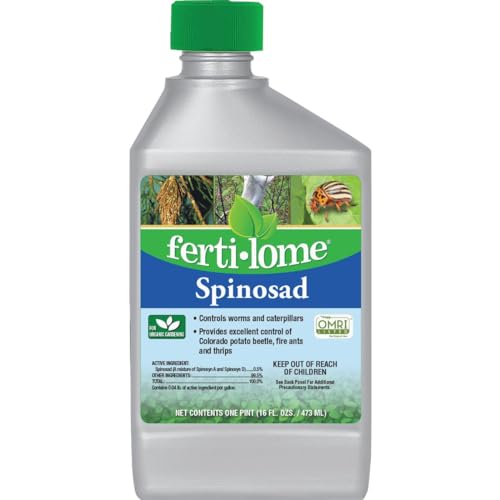
1. ferti-lome (16062) Spinosad Insecticide
Our pick — 4.5+★ from 150+ verified ratings; the strongest balance of quality and price.
One Spinosad concentrate labeled for bagworms, tent caterpillars, leafminers and thrips on ornamentals and edibles alike.
If your bagworm problem sits on a mixed property — an arborvitae by the drive, tomatoes in the back — a single broad-label bottle makes more sense than three narrow ones. The ferti-lome 16062 carries a Spinosad label that names bagworms, tent caterpillars, leafminers, borers, thrips, armyworms, sod webworms and Colorado potato beetles. That range is the reason it earns the top spot here.
The strength side is straightforward. Sixteen fluid ounces of concentrate, diluted at 4 tablespoons per gallon of water as the label directs, and it is listed by OMRI — the Organic Materials Review Institute — which reviews a product against the USDA National Organic Program standards. In practical terms, you can spray a shade tree and then walk to the vegetable bed without reaching for a different bottle.
Now the honest limit. It is a concentrate, so you need a sprayer and you need to measure. The 16 fluid ounce bottle is smaller than the Summit and Monterey B.t. bottles at 32 fluid ounces — half their size on paper — so if you are mixing tank after tank for a long row of evergreens, you will refill sooner. The upside is the dilution rate is printed clearly and the measuring spoons in your kitchen already do the work.
What the label actually covers
- Bagworms, tent caterpillars, leafminers and thrips on one label
- Cleared for vegetables, trees, shrubs, flowers, fruits and citrus
- OMRI listed for organic production and handling
- Water-soluble concentrate that mixes at 4 tablespoons per gallon
Where it asks more of you
- 16 fluid ounce bottle is half the size of the 32 fluid ounce options
- Concentrate only — you supply the sprayer and the measuring
Buy this one if: you want one bottle for ornamentals and edibles, and you don’t mind a two-minute mixing step before you spray.
Look elsewhere if: your job is a long hedge and you want the biggest bottle on the shelf — the 32 fluid ounce options stretch further per refill.
2. Summit Caterpillar and Webworm Control, Hose End
A 32-ounce liquid concentrate made to feed a hose-end sprayer up into a canopy you cannot reach.
Start with the number that decides this one: 32 fluid ounces of liquid concentrate in the bottle, which is double the 16 fluid ounces you get from the ferti-lome and the Southern Ag. That volume is what makes a hose-end setup viable, because you are drawing from a reservoir rather than pumping a quart bottle dry halfway up a tree.
The buyers here are clear about what it does. Pecan growers in particular keep coming back to it for webworms and bagworms, and effectiveness is the thing this bottle is known for — far and away the most-discussed topic on its listing. Safety lands as a secondary note: the recurring language is that it is human-safe and pet-safe when used as directed. What it does not do is win on price. Value is the one genuinely split topic on this listing, with roughly two-thirds of that discussion landing positive and the rest calling it poor value.
Two things to know before you commit. First, this is a concentrate for a hose-end sprayer, not a ready-to-spray jug — the hose attachment does the diluting. Second, the listing itself is thin on the label details you would want, so read the bottle when it arrives before you mix. Compared with the Monterey Spinosad at 8 fluid ounces, you are working with four times the liquid, which is the whole argument for a big tree.
Who it is built for: anyone spraying above head height. A 32 fluid ounce concentrate feeding a hose-end sprayer is the practical answer to a mature pecan or a tall evergreen, and the webworm and bagworm results are the reason people keep buying it.
The catch to weigh: the pricing conversation on this listing is genuinely divided, and the label detail published here is minimal. If you want full mixing guidance printed in front of you before you buy, the ferti-lome listing spells out its 4 tablespoons per gallon rate; this one asks you to read the bottle.
Reach for this if: your bagworms are up in a canopy and a hose-end sprayer is how you plan to get there.
Think twice if: you are spot-treating one small shrub — you would be buying volume and a hose fitting you don’t need.
3. Monterey Spinosad Insecticide Garden Spray, 8 oz
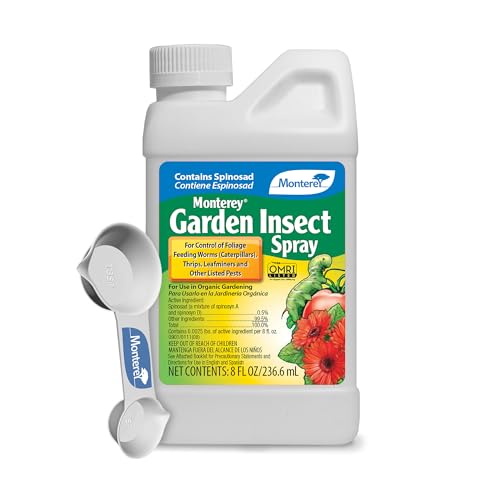
An 8-ounce Spinosad concentrate that sprays odorless and runs on trigger, hand-held, backpack or hose-end sprayers.
Eight fluid ounces does not sound like much next to a 32 fluid ounce jug, and it isn’t — but concentrate goes further than the bottle suggests. This is the pick for a person with two shrubs and one unhappy juniper, not a windbreak. It names caterpillars, leafminers, codling moths, tent caterpillars, gypsy moths, thrips, borers and fire ants on the label, so bagworm larvae fall inside its range.
The two practical wins are the ones you notice in use. It is odorless, because Spinosad here is a bacterial product made by fermentation rather than a solvent-heavy brew — you can spray near a patio without clearing the yard. And it is flexible about the sprayer: trigger, hand-held, backpack or hose-end all work, so the same bottle follows you from a potted plant to the back fence.
What you give up is volume. It is also OMRI listed for organic gardening, which is worth knowing if you rotate it through a vegetable patch — the listing follows the Organic Materials Review Institute review against the USDA National Organic Program. Treat this as a starter bottle, and it makes good sense.
The real argument for it: no odor and four sprayer options in one 8 fluid ounce bottle. That combination is what makes it easy to actually use rather than leaving it on a shelf.
The honest trade: smallest bottle of the five. Budget for a second order if the infestation turns out to be bigger than the one branch you spotted.
Good match for: a small yard, a few ornamentals, and anyone who wants to spray without a lingering smell.
Less suited to: a full row of arborvitae — the 8 fluid ounce bottle will run dry before the job finishes.
4. Monterey B.t. Organic Caterpillar Killer Spray, 32 oz
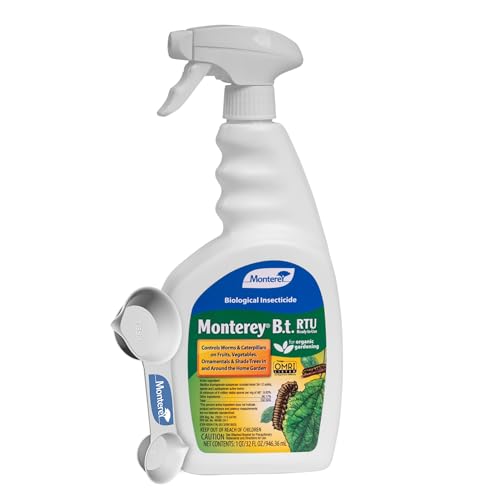
A 32-ounce B.t. concentrate labeled for bagworm and gypsy moth that states it leaves honeybees and ladybugs unaffected when used as directed.
Here is the split that matters against the other Monterey bottle: this one uses B.t., not Spinosad. Bacillus thuringiensis is a bacterium that has to be eaten by the larva to work, and the label is aimed squarely at worm-type insects — cabbage looper, bagworm, gypsy moth, fall cankerworm, elm spanworm. If you are spraying a plant you intend to harvest, that narrow target is a feature, not a limitation.
The label claim worth reading twice is the beneficial-insect line. When used as directed, Monterey states it has no effect on birds, earthworms, or beneficial insects such as honeybees or ladybugs. That is a published label statement, not a promise about your specific yard — but it is the reason this bottle lands in a pollinator garden where a broad-contact spray would give you pause.
Volume is where it wins outright. Thirty-two fluid ounces of concentrate, double the 16 fluid ounces of the ferti-lome Spinosad and the Southern Ag, so the bottle keeps going across a vegetable row and a shade tree. The coverage list is wide too: broccoli, celery, cabbage, turnip greens, mustard greens, cauliflower, melons, lettuce, tomatoes, shade trees and ornamentals. What it does not give you is the fastest knockdown — B.t. works through the gut, so the larva has to keep feeding for it to matter. Spray while the bagworms are small.
Why food gardeners pick it
- Labeled for bagworm, gypsy moth, cabbage looper and fall cankerworm
- Stated to leave birds, earthworms, honeybees and ladybugs unaffected when used as directed
- 32 fluid ounces of concentrate — twice the 16 fluid ounce bottles
- OMRI listed for organic gardening under the USDA National Organic Program
Slow by design
- Gut-action formula, so larvae must ingest treated foliage rather than pick it up on contact
- Only effective on caterpillars and worms — it will not touch beetles or mites
The right call for: edible gardens and pollinator-friendly yards where the worm is the enemy and everything else is a guest.
Not the right call for: a mixed pest problem — the B.t. label stays on caterpillars and worms, so you would need a second product for anything else.
5. Southern Ag Conserve Naturalyte Insect Control, 16 oz

A 16-ounce Spinosad concentrate the label says yields up to 8 gallons of finished spray.
Concentrate economics are easy to miss until you run the numbers. The Southern Ag Conserve is a 16 fluid ounce bottle that the label says makes up to 8 gallons of spray. Compare that with the Monterey B.t. at 32 fluid ounces and the point of this bottle becomes obvious: it is not about how much liquid arrives, it is about how far the liquid reaches once diluted.
The label covers foliage-feeding worms and caterpillars, plus citrus leafminers and fire ant control in ornamentals, and it is Spinosad-based. Buyers here talk about results more than anything else — effectiveness is the dominant theme on this listing by a wide margin, with fire ants named specifically again and again. Safety is a smaller but consistently positive thread. The one genuinely split note is cost, where a portion of the commentary argues it is priced high for what arrives.
Two facts to hold straight, because the listing does not make them obvious. The performance number is 8 gallons of mixed spray, not 8 gallons of product — what ships is a 16 fluid ounce concentrate. And the technical fields on this listing are inconsistent, listing the unit count as 1 fluid ounce while the liquid volume reads 16 fluid ounces; trust the 16 and the 8-gallon yield. For a whole-property spray that goes on all season, this is the bottle that keeps giving.
The standout fact: up to 8 gallons of finished spray from a single 16 fluid ounce concentrate. That is the highest yield-per-bottle figure in this group, and it is why it suits someone planning repeat sprays rather than a one-off.
Worth knowing first: you must dilute it yourself, and the price conversation on this listing is genuinely mixed. If you want to open a bottle and spray, the Monterey options are simpler.
Pick it when: you are spraying a whole property through the season and want the fewest bottles on the shelf.
Skip the bulk math if: you only have one shrub — 8 gallons of mixed spray is far more than a single plant will ever need.
Know the Specs
Active ingredient: Spinosad vs B.t.
Spinosad is a compound made by fermenting a naturally occurring bacterium, and it works both on contact and through what an insect eats. B.t. — Bacillus thuringiensis — is the bacterium itself, and it works mainly in the gut, so the larva has to feed on treated foliage for it to take effect. In practice, Spinosad tends to be the more forgiving choice on foliage, while B.t. is the narrower, more targeted pick for caterpillars and worms on food crops. Both appear on this list and both are labeled for bagworms.
Concentrate vs ready-to-spray
A concentrate is a bottle of active liquid you dilute with water yourself — the ferti-lome label directs 4 tablespoons per gallon. A ready-to-spray bottle arrives pre-mixed, and a hose-end version connects to your garden hose and dilutes as it sprays. Concentrate stretches farther and costs less per gallon of finished spray; hose-end saves time on tall plants. Your sprayer and your plant height should decide which format you buy, not the bottle size alone.
What OMRI listed means
OMRI stands for the Organic Materials Review Institute, a nonprofit that reviews a product’s ingredients and labeling against the USDA National Organic Program standards. A bottle carrying the OMRI listing has been checked against those rules, which is the clearest single marker for a home gardener who wants to spray food crops or a pollinator garden without auditing the label line by line. It is a compliance listing, not a performance rating — it tells you what a product is made of, not how fast it kills.
Bagworm timing and sprayer choice
Bagworm larvae are most vulnerable while they are small and still feeding on foliage. Once a larva builds its case, contact sprays have a hard time reaching it. That makes two decisions matter more than brand: spray early in the season, and pick a sprayer that actually reaches the top of the plant. A trigger bottle is fine for an ornamental at chest height; a mature evergreen or a pecan needs a backpack or hose-end setup, which is why several picks here are labeled for those sprayers.
Common Questions
Will these products actually kill bagworms once the cases are already formed?
Is Spinosad or B.t. better for bagworms on a tree I want to keep?
How much spray does one bottle of concentrate make?
Can I spray these on vegetables I plan to eat?
Do these harm bees and earthworms?
What does it mean if a bottle is not labeled for bagworms?
Will one bottle be enough for a row of arborvitae?
Does the product need to be reapplied after rain?
What is the difference between a hose-end bottle and a standard concentrate?
Can I use these products on fire ants as well as bagworms?
The Bottom Line
The insecticide for bagworms that makes the most sense for most yards is the ferti-lome 16062 Spinosad. It names bagworms on the label, mixes at a clear 4 tablespoons per gallon, carries the OMRI listing, and covers ornamentals and edibles from one bottle. If your bagworms are up in a pecan or a tall evergreen, reach for the Summit hose-end concentrate — 32 fluid ounces feeding a hose-end sprayer is how you get water where a trigger bottle cannot go. And if the yard has bees in it and the garden is for eating, the Monterey B.t. is the targeted pick, with a label that stays on caterpillars and worms.
Spray small larvae, read the dilution rate on your own bottle, and match the sprayer to the height of the plant — those three habits do more for the result than any single brand choice.
How we choose
We do not accept paid placement. Every pick is matched to a real buyer and a real use-case; we do not hands-on test units.
Sources
Specifications: manufacturer listings and product documentation. Review insights: verified customer reviews, as of November 2026. Pricing: not shown on this page (it changes often); check the current price via the retailer link.
As an Amazon Associate, My Heart Lives Here earns from qualifying purchases. This does not affect which products we feature.