Heads up: This post contains affiliate links. As an Amazon Associate I earn from qualifying purchases, at no extra cost to you. Learn more
Specs are compiled from manufacturer listings and verified buyer reviews and can change over time — please confirm the key details on the product page before buying.
If your movies hit hard but your subwoofer cabinet buzzes, rattles, or gives up when the explosion lands, the fix is usually a better-built sub rather than more watts. The picks below are all American-made subwoofers that pair real low-end power with cabinets and drivers built to stay clean. You will see which ones suit a living-room theater, which suit a car or truck, and which belong on a live-music stage.
This guide is built by comparing the manufacturers’ published specifications and the patterns across verified customer reviews, so you get each pick’s real strengths and trade-offs instead of marketing spin.
You will see exactly where each model earns its place, from an 8-inch studio sub that keeps mixes honest to a 12-inch that shoves bass through walls. These are the American Made Subwoofers that stay clean when the volume climbs.
Top Picks


How To Choose The Best American Made Subwoofers
Start with the room, not the spec sheet. A small bedroom theater and an open-plan living room need very different amounts of low-end output, and picking a sub that is too big for the space can leave you with bass that booms instead of hits. Decide where the sub will sit, then match driver size and power to that space.
Sealed or ported, and why it changes the sound
A sealed cabinet has no vent, so the air inside acts like a spring that pushes back on the driver. That gives you tight, fast, accurate bass — the kind you want for music where you need to hear distinct notes. A ported cabinet adds a tuned vent that lets the driver move more air at low frequencies, so it digs deeper and louder for movie explosions. The SVS SB-1000 Pro is sealed, while the SVS PB-1000 Pro is ported; same driver size, different character.
Wattage: what RMS actually tells you
RMS watts are the continuous power the amplifier can deliver, while peak watts are short bursts. A 325 Watt RMS amplifier (as on both SVS models) is a far more honest indicator of real output than a huge peak number alone. Big peak figures can be a sign of a competition-style driver built for short, violent hits rather than hours of home-theater playback.
The connections matter as much as the driver
Check the inputs on the back before you buy. Most home theater subs use RCA or LFE inputs (the dedicated subwoofer output on your AV receiver), while a car sub may need a Molex plug or a signal harness that matches your head unit. A studio sub like the Yamaha HS8 uses XLR connections (the round three-pin pro-audio plug) so it plugs straight into studio monitors.
Side-by-Side Comparison
| Model | Best For | Driver Size | Power Rating | Cabinet Type | Amazon |
|---|---|---|---|---|---|
| Yamaha HS8 Studio Subwoofer★ Best Overall | Studio mixing | 8 inches | 150W amplifier | Bass-reflex | Amazon |
| KICKER 51HS10 HideawayBest for Trucks | Truck and car upgrades | 10 inches | 400 watts max | All-aluminum compact | Amazon |
| Rockville Destroyer 12D2Most Powerful | Competition car audio | 12 inches | 2000W RMS | Car enclosure | Amazon |
| Klipsch Reference Front-Firing | Home theater bass on a budget | 12 inches | All-digital amplifier | Front-firing | Amazon |
| Klipsch SPL-120 | Big-room movie bass | 12 inches | 600 Watts | MDF enclosure | Amazon |
| Alpine SBV-10-WRA | Jeep Wrangler JKU | 10 inches | 300W RMS / 900W max | Sealed custom-fit | Amazon |
| SVS SB-1000 Pro | Sealed accuracy in medium rooms | 12 inches | 325W RMS | Sealed | Amazon |
| SVS PB-1000 Pro | Deep movie bass in large rooms | 12 inches | 325W RMS | Dual ported | Amazon |
| Sonos Sub 4 | Sonos soundbar owners | 5 inches | Dual drivers | Ported | Amazon |
| Bose Sub 1 | Live music and PA rigs | 7 inches | Powered module | Compact portable | Amazon |
| KEF KC62 | Small rooms, high-end music | 6.5 inches | Dual opposing drivers | Sealed compact | Amazon |
Detailed Reviews
1. Yamaha HS8 Studio Subwoofer, Black
Our pick — 4.5+★ from 350+ verified ratings; the strongest balance of quality and price.
The 8-inch studio sub that keeps your mix honest down to 22Hz.
Here is the number that decides it: a frequency response of 22Hz to 150Hz. That low 22Hz floor means this sub reaches the very bottom of what human ears can feel, so kick drums and synth bass land with weight instead of thinning out. If you mix music on studio monitors, that accuracy is what separates a usable reference sub from a party toy.
The 8-inch driver runs through a 150W amplifier (150 watts of continuous power) in a bass-reflex cabinet, which uses a tuned vent to push more low-end out of a modest box. It is the smallest driver on this list, and that is deliberate — a studio sub has to sit under your desk and integrate with your nearfield monitors, not shake the building. Owners consistently report it pairs cleanly with the Yamaha HS5 monitors and holds its composure at loud playback.
The controls are what make it a studio tool rather than a consumer box. A LOW CUT switch and a LOW CUT control sweep from 80Hz to 120Hz to strip rumble below your monitors. A HIGH CUT control runs the same 80Hz to 120Hz range to hand off the top of the sub’s range. A PHASE switch keeps it aligned with your main speakers. The catch is that it is a studio product first — it uses XLR connections (round three-pin pro-audio plugs), so a plain home-theater receiver without an XLR sub out will need adapters to hook up.
What earns it the top spot
- Frequency response reaches 22Hz, deep enough to feel kick drums and synth bass
- LOW CUT and HIGH CUT controls both sweep 80Hz to 120Hz so you can blend it precisely with monitors
- XLR connectivity plugs straight into a studio signal chain
- PHASE switch keeps timing aligned with your main speakers
Where it asks something of you
- 8-inch driver is the smallest here, so it suits a studio or small room over a large theater
- XLR-based connections may need adapters for a standard home-theater receiver
Built for: anyone recording or mixing music who needs bass they can trust, not just bass they can feel.
Think twice if: you want the deepest movie rumble in a big room — that job belongs to a larger ported sub.
2. KICKER 51HS10 Hideaway Compact Powered Subwoofer, 10-Inch
The sub that tucks under a truck seat and fills the bass void a stock radio leaves.
Anyone who has driven a pickup with a factory stereo knows the hollow feeling when the bass just disappears. This one is built to slot under a seat and fix exactly that. It measures 5.25 inches deep, 13 inches wide and 16.75 inches tall, which is why it fits where a conventional box will not. The all-aluminum frame means the cabinet stays rigid instead of flexing.
The 10-inch driver is powered by a 400-watt maximum output amplifier, and the frequency response reaches down to 25Hz. A 400-watt max rating is a burst figure, not a continuous one, so treat it as headroom rather than a duty rating. For a compact under-seat box, that reach to 25Hz is genuinely useful in a vehicle cabin. Reviewers describe it as filling the low-end gap left by a stock radio, and the recurring theme is how simple it is to live with — a compact footprint and a straightforward install.
The included remote is the quiet win here. It lets you dial the bass level up or down without touching the radio volume, so you can add punch on the highway and pull it back in a quiet neighborhood. There is an adjustable low-pass crossover, a variable +6dB bass boost, a phase switch, and two auto turn-on options — DC-offset or signal sensing. A quick-connect Molex plug carries power, signal and remote turn-on in one harness, and high- and low-level inputs mean it mates with almost any factory or aftermarket head unit. The trade-off is that this is a compact sub built for a cabin, so it will not deliver the room-moving output of a full-size home theater box.
Level control from the driver’s seat: The remote bass knob is the feature that turns this from a set-and-walk-away install into something you actually adjust on the road.
Reach for this if: you want real low-end in a truck or car without giving up cabin or cargo space.
Look elsewhere if: you are outfitting a large home theater, where its compact cabin-focused output will feel modest.
3. Rockville Destroyer 12D2 12″ Dual 2-Ohm Subwoofer
A competition-grade 12-inch built to take power that would shred a normal driver.
One number stands far above everything else on this list: 2000W RMS, with 8000W peak and 4000W program power. Put that next to the Alpine Jeep sub below at 300W RMS and the gap is enormous — this is a driver built for competition-level output, not background listening. The USA-made 3-inch four-layer aluminum voice coils are the parts that convert electrical power into cone motion, and building them from aluminum with four layers is about surviving heat when you feed it that much current.
The cone is black non-pressed paper with an ultra-stiff reinforced design, held by silver stitching and a thick foam surround. Behind it sit triple-stacked 300 oz Y35 magnets and a cast aluminum basket, with 30mm XMAX (the distance the cone can travel in and out) for big excursion. Sensitivity is rated at 86.2 dB and frequency response runs 37Hz to 1kHz, with an 8.66-inch mounting depth so you can plan the enclosure. The deep bass output here is what buyers keep coming back to, along with the value you get from a driver with these internals.
Know what you are signing up for. This is a raw car-audio driver, so it needs an enclosure built for it — it does not come as a finished home sub. The durability story has some mixed reports, including a cone separating from the spider, which points to feeding it more power or a rougher enclosure than it wants. Treat the power rating as a ceiling to build toward carefully, not a target to push blindly past.
Built for the meter: If you want violent, competition-style output from a single 12, the 2000W RMS rating is the reason this one makes the list.
Made for: car-audio builders chasing maximum output who will pair it with a proper enclosure and amplifier.
Not your pick if: you want a plug-and-play sub for movies — this needs a build-out to sound its best.
4. Klipsch Reference Front-Firing Subwoofer

A front-firing 12-inch that frees you to place it almost anywhere in the room.
That makes room placement flexible, which is half of how good a sub sounds in a real living room. The 12-inch spun-copper thermoformed crystalline polymer woofer is built to stay light while still moving enough air to produce low frequencies with minimal cone breakup.
The built-in all-digital amplifier is there to deliver power efficiently and keep the sound true to the source. A low-pass crossover lets you match the sub’s top end to your other speakers, and phase control gets the timing right so bass does not cancel itself out. Line and LFE inputs mean it hooks up to the AV receiver you already own. Owners describe it as adding real bass to a surround setup without turning muddy or overwhelming.
Where it gives ground to the SPL-120 below is raw power: that model lists 600 Watts and a 118dB maximum acoustic output, while this Reference model leans on its digital amplifier without a published wattage to match. For a mid-size room and a typical receiver, that difference rarely shows up in daily use — but if you are chasing maximum output, the SPL-120 is the louder of the two Klipsch picks.
What makes it easy to live with
- Front-firing 12-inch driver gives you flexible room placement
- Line and LFE inputs match the AV receiver you already have
- Low-pass crossover and phase control blend it with your other speakers
- Spun-copper polymer woofer keeps cone breakup and distortion low
The honest give-and-take
- No published wattage as high as the SPL-120’s 600 Watts, so it is the softer of the two Klipsch picks
- Suits a mid-size room better than a huge open living space
Pick it for: a first serious home-theater sub where placement flexibility and clean bass matter more than maximum volume.
Pass if: you need the loudest output available — step up to the SPL-120.
5. Klipsch SPL-120 Powered Subwoofer, 12 inches, Black

The 600-watt Klipsch that turns movie night into something you feel through the floor.
Two figures set this one apart from the Reference model above: 600 Watts of power and a maximum acoustic output of 118dB. Decibels measure sound pressure, so 118dB is a genuinely loud ceiling — the kind that reaches through walls rather than just into the room. The 12-inch long-throw cerametallic woofer is built to move further and push more air, which is exactly what deep movie bass demands.
The MDF enclosure (medium-density fiberboard, a dense wood-composite cabinet material) keeps the box from rattling, and a bass boost, low-pass crossover, phase control and a scratch-resistant ebony finish round it out. Add the optional Klipsch WA-2 accessory and it works wirelessly, so you can place it across the room without running a cable. Owners describe feeling the bass and hearing it travel through walls.
The honest catch is that this much output can overwhelm a small room or a thin-walled apartment — the noise and long-term reliability notes show up as mixed in owner feedback. In a dedicated theater room it earns its keep; in a tight bedroom you may find yourself turning it down more than up.
The number that sells it: 118dB of maximum output is the figure that puts this in big-room territory, well past casual listening levels.
Suits you if: you have a dedicated media room and want bass you can feel in your chest.
Reconsider if: your space is small or shares walls with neighbors — 600 watts can be a lot to tame.
6. Alpine SBV-10-WRA 10-Inch Subwoofer

A sealed 10-inch built to drop under the front passenger seat of a Jeep Wrangler JKU.
This one is defined by fit, not just sound. It is a pre-loaded 10-inch sub in a sealed, custom-fit enclosure designed to pressure-fit under the front passenger seat rails with no mounting hardware required. If you drive a 2007-2018 Jeep Wrangler JKU, that means you add bass without losing a single inch of cargo space. Its 300W RMS and 900W max power rating is matched to the KTA-30MW Mono Tough Power Pack amplifiers, which are sold separately.
This sub earns its keep in the rough stuff. An IP66 rating (a sealed enclosure that keeps out all dust and water from any direction) matters when your Jeep has no roof. The OEM-grade weather-resistant Molex 2-pin connector with pigtail wire harness (a factory-style plug with a short wire lead) makes the wiring clean and factory-like. Buyers report it sounds like a much bigger system than a single 10-inch would suggest. Sound quality and the perfect under-seat fit are the two things that win people over.
The trade-off is money and noise. Value opinions land mixed, so this is not the budget route — you are paying for the exact-fit enclosure and the IP66 build. Noise is the other mixed note. Neither is a reason to walk away if you own the Jeep it was engineered for; both simply mean the value is in the fit, not the raw specs.
Where the Jeep owner wins
- Pressure-fits under the front passenger seat rails with no mounting hardware
- IP66 rating resists total dust ingress and water from any direction
- OEM-grade weather-resistant Molex connector keeps the wiring factory-clean
- 300W RMS / 900W max pair with the matching Alpine amplifier
Weigh before you buy
- Value opinions are mixed — you pay a premium for the exact-fit design
- Noise level draws mixed feedback from owners
Right for: a 2007-2018 Jeep Wrangler JKU owner who wants bass without sacrificing space or trail durability.
Wrong for: anyone who does not drive that exact vehicle — the fit is the whole point here.
7. SVS SB-1000 Pro Subwoofer (Black Ash)
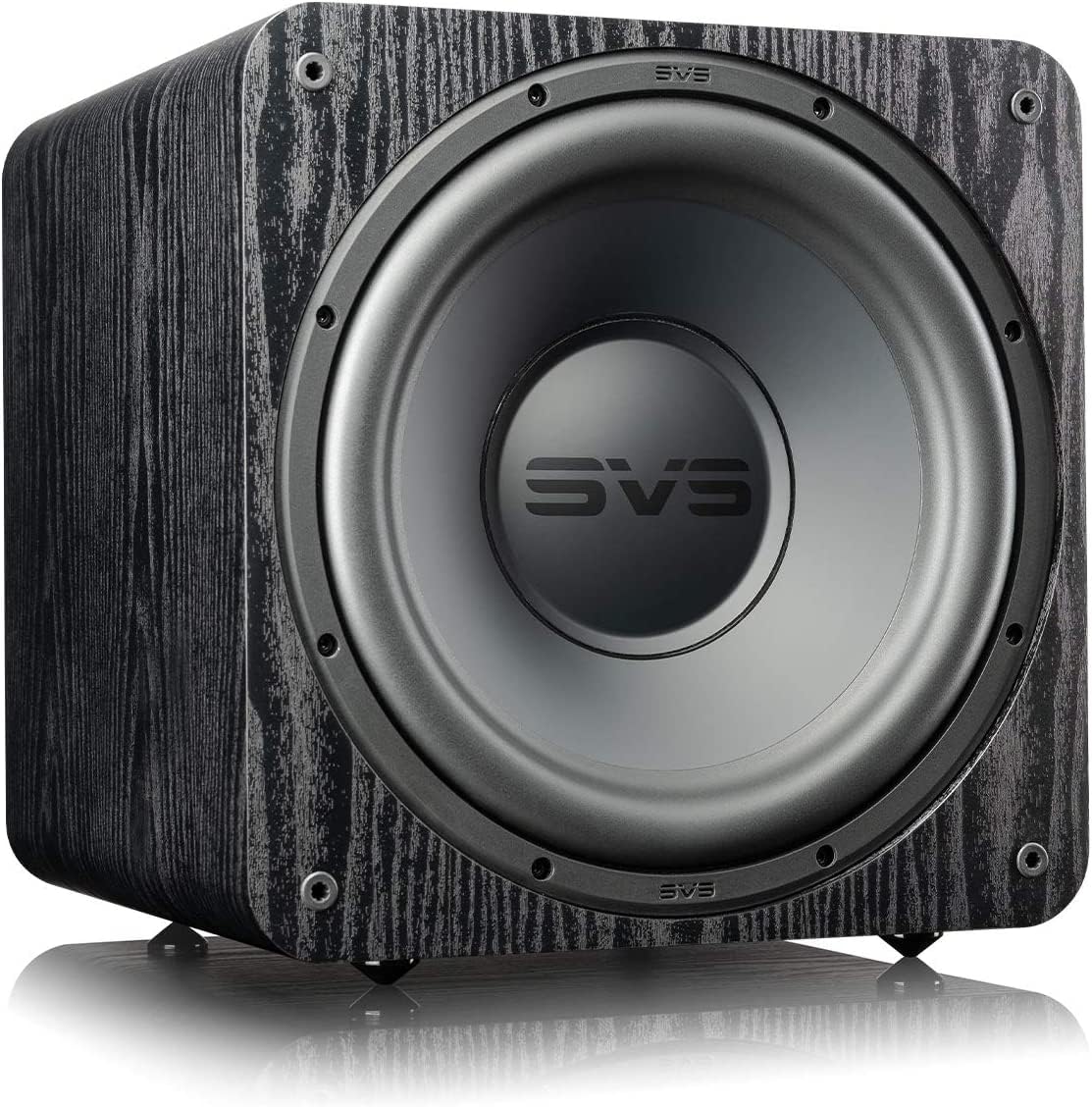
A sealed 12-inch with an app that lets you tune the bass without leaving your seat.
The Sledge STA-325D amplifier delivers 325 Watts RMS and 820+ Watts peak, and it pairs discrete MOSFETs with Class D efficiency — which in plain terms means it puts out big current while running cool and accurate. The 12-inch driver uses a dual ferrite magnet motor and a long-throw parabolic surround so it can move far without losing control. The sealed cabinet is the key design choice: it favors tight, accurate bass over the room-filling boom a ported box gives you.
What genuinely separates it is the control. A 50MHz Analog Devices Audio DSP (a processor that shapes the sound signal) manages custom presets and in-room tuning, and the SVS smartphone app lets you change volume and fine-tune from where you sit. That matters because bass is about the room as much as the sub, and adjusting from the couch beats crawling behind the cabinet with a flashlight.
The acoustic-inert cabinet uses an extra-thick MDF front baffle and rigid internal bracing to keep the box from resonating, and it stays compact enough to fit in most rooms. Owners mention it fills large rooms with deep bass while staying controlled. Set against the PB-1000 Pro below, this is the accuracy-first pick — same 325W RMS amplifier and 12-inch driver, sealed instead of ported.
Tune from the sofa: The SVS app turns room-shaping into a phone task, so you can dial in the bass to your space without remounting anything.
Best for: listeners who want fast, accurate bass and app control in a medium room.
Look past it if: your priority is maximum deep-movie rumble — the ported PB-1000 Pro digs lower.
8. SVS PB-1000 Pro Subwoofer (Black Ash)

The ported SVS that trades a little cabinet space for deeper movie bass.
Same amplifier, same driver as the sealed SB-1000 Pro, with one crucial change: an acoustically tuned dual-port cabinet. Those two tuned vents let the driver move maximum airflow without distortion, which adds both the amount and the quality of bass at every volume level. If the sealed model is about accuracy, this one is about reach — owners describe it extending their listening to subsonic frequencies, the low end below what you consciously hear but still feel.
The rest of the recipe is shared with its siblings. The Sledge STA-325D amplifier runs 325 Watts RMS and 820+ Watts peak. The 12-inch driver keeps the dual ferrite magnet motor and long-throw surround. The 50MHz Analog Devices Audio DSP handles in-room tuning, and the SVS app lets you adjust settings wirelessly instead of reaching behind the box. Clear separation between bass notes comes up again and again — the low end stays articulate instead of turning to mush.
The one thing to plan for is size. The ported cabinet is bigger than the sealed version, and owner feedback on size lands mixed for that reason. That extra volume is exactly what buys you the deeper reach, so it is a conscious trade rather than a flaw. If floor space is tight, the sealed SB-1000 Pro fits easier; if you have room and want the deepest output, this is the one.
Why it reaches deeper
- Dual tuned ports boost airflow without distortion for deeper bass
- Same 325W RMS Sledge amplifier and 12-inch driver as the sealed model
- App control lets you adjust wirelessly from the listening position
- DSP keeps bass notes clearly separated and articulate
What you live with
- Ported cabinet is larger, so it needs more floor space
- Size draws mixed feedback for exactly that reason
Choose it when: you have the floor space and want movie bass that reaches lower than a sealed box can.
Skip if: your room is tight — the sealed SB-1000 Pro fits more easily.
9. Sonos Sub 4 – Wireless Subwoofer – Black

The wireless sub that turns a Sonos soundbar into a full home-theater system.
This is a system piece, and it earns its spot on that basis alone. Dual Sonos-engineered drivers sit in a force-canceling arrangement (the two drivers face opposite directions so their vibrations cancel out), which is why you get deep bass without the cabinet buzzing or rattling. A ported enclosure adds low-frequency output on top of that. The 5-inch driver size looks small on paper, but the force-canceling design is doing the heavy lifting here, not cone area.
The setup is where it wins. It connects to your Sonos soundbar or speaker over Wi-Fi, so there is no cable run across the floor — you can stand it upright, lay it on its side, or tuck it under the sofa. A single power cable and the Sonos app handle the rest. Pair it with a Sonos Arc Ultra, Arc or Beam and it transforms the home-theater experience, and pairing two with an Arc Ultra or Arc adds another layer of presence.
The catch is the ecosystem. It is built to live inside Sonos, so pairing with a non-Sonos receiver is not the point. Value opinions land mixed — you are paying for the wireless integration and the design as much as raw output. If you already own a Sonos soundbar, that integration is the whole reason to buy it.
Vibration control first: The force-canceling architecture is the real story here — it kills the buzz and rattle that make a sub sound cheap.
Pick it if: you already run a Sonos soundbar and want to add bass with zero cable clutter.
Forget it if: you use a traditional AV receiver — this sub is built for the Sonos world.
10. Bose Sub 1 Powered Bass Module for L1 PRO Systems
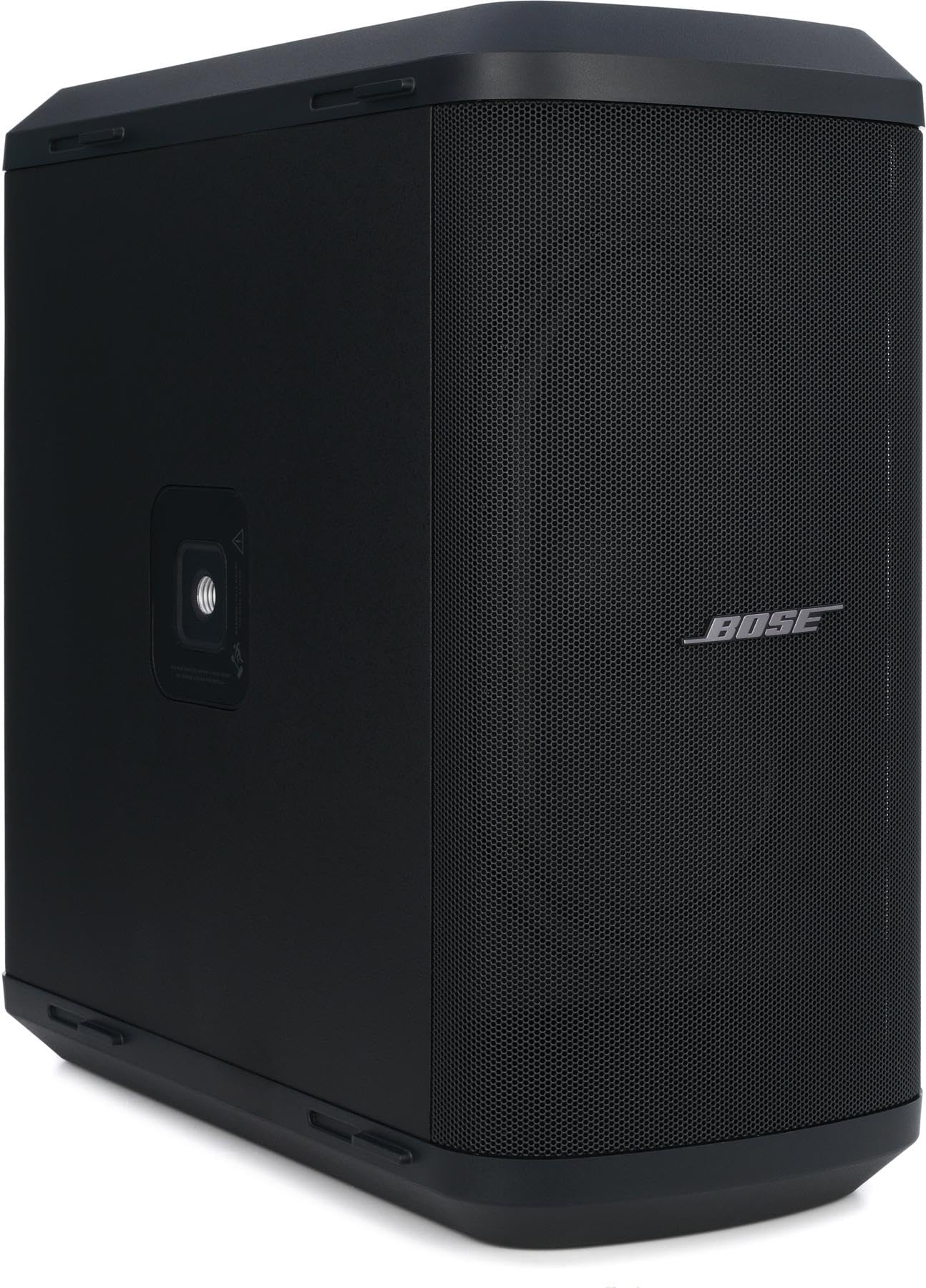
The portable PA sub that brings 40Hz bass to live gigs and speaking events.
This one is aimed at a stage, not a sofa. It is a powered bass module that adds low end down to 40Hz to a portable PA system, and its compact footprint makes it practical to carry to a gig. The unusual part is the 7-inch by 13-inch high-excursion RaceTrack driver — an oval-shaped cone that, per Bose, delivers performance to rival a traditional 12-inch subwoofer, all from a smaller body.
For live sound, the controls are the draw. The independent sub level control knob lets you add bass when you need it and pull it back when you do not, which is a real advantage in a room with tricky acoustics. Stack multiple Sub 1 units and you get more bass, and Cardioid Mode focuses the bass out front and cuts feedback — the howling that can ruin a live set. It combines with the Bose L1 Pro32 line array over a proprietary SubMatch cable, or pairs with other powered loudspeakers through line input and output with selectable crossover modes.
What customers note most is the quality and realism of the bass. The trade-off is narrow purpose: this is a professional PA module first. In a home theater it will do the job, but you are paying for stage features like Cardioid Mode and the SubMatch integration that a living-room setup will never use.
Stage-first features
- Low end reaches down to 40Hz for real presence in a room
- Independent sub level knob adjusts bass on the fly during a set
- Cardioid Mode focuses bass out front and reduces feedback
- Oval RaceTrack driver keeps the cabinet compact and carry-friendly
The narrow-purpose caveat
- Built around Bose PA pairing, so the best features need that ecosystem
- A home theater will not use Cardioid Mode or SubMatch integration
Built for: musicians and presenters running a portable PA who want solid low end without a huge rig.
Not for: living-room movie setups — you would pay for stage features you never touch.
11. KEF KC62 Uni-Core Compact Powered Subwoofer, Black

A tiny high-end sub that is designed to sound far bigger than its footprint suggests.
Here is the head-scratcher of the list: a 6.5-inch driver size that seems small, yet KEF positions the KC62 as delivering the depth and scale of a much larger conventional subwoofer. It does that with dual opposing bass drivers in a force-canceling design that eliminates cabinet vibration and coloration, plus advanced DSP (a processor that shapes the signal) and massive built-in amplification. This is a compact sub built for people who cannot give up floor space but still want serious bass.
The tuning tools fit a small room well. Smart Bass EQ profiles let you tune performance depending on whether the sub sits in a corner, against a wall, or in free space, so you can place it where it fits and still get balanced sound. Standard RCA inputs connect it to any AV receiver or powered speaker system. Owners describe it adding a great foundation of musical bass and deepening the soundstage.
What you accept is the price of the engineering. Value opinions land mixed — you are paying for the compact cabinet and the driver technology, not raw output. It suits a smaller room where a big ported box would never fit. In a large open theater, it will run out of steam before a full-size 12-inch does.
The engineering story: Force-canceling drivers and DSP are how KEF gets big-sub behavior out of a small cabinet, and that is the whole reason it belongs here.
Best suited to: a small room or high-end music system where floor space is precious and quality beats brute output.
Think again if: you have a big theater to fill — a full-size 12-inch will go louder for less.
Know the Specs
Driver Size (Inches)
The driver is the cone that moves air to make bass, and its size in inches is the most visible spec. A larger driver pushes more air and tends to go louder and deeper — but it is not the whole story. A 6.5-inch driver in a clever force-canceling cabinet (like the KEF KC62) can punch well above its size, while a 12-inch driver in a flimsy box can rattle. Match the size to your room: small rooms often do fine with a compact driver, while big spaces benefit from a 12-inch.
RMS vs Peak Watts
RMS watts are the continuous power a sub’s amplifier can deliver hour after hour, while peak watts are brief bursts. When you compare subs, the RMS figure tells you the honest sustained output. The Rockville’s 2000W RMS rating is a competition-style number meant for short violent hits, while the SVS models’ 325W RMS is the steady power a home-theater sub delivers for a whole movie. A huge peak number without a matching RMS figure is a red flag, not a bragging point.
Frequency Response (Hz)
Hertz (Hz) measures how many times per second the driver vibrates — lower numbers mean deeper bass. A response that reaches down to 22Hz (like the Yamaha HS8) means the sub can reproduce the very bottom of the audible range. Most movie explosions and bass drops live in the low end, so a lower figure matters more for cinema than for music. Look for a sub that reaches at least into the 20s if deep movie bass is your goal.
Sealed vs Ported Cabinets
A sealed cabinet has no vent, so the trapped air acts as a spring that gives tight, fast bass — ideal for music accuracy. A ported cabinet has a tuned opening that lets the driver move more air for deeper, louder output — ideal for movie effects. The SVS SB-1000 Pro is sealed, the PB-1000 Pro is ported, and that single difference explains why one is tighter and the other goes lower. Neither is better; they solve different problems.
Common Questions
Will a 12-inch subwoofer be too much for a small bedroom?
What is the difference between a sealed and a ported subwoofer?
Can I use a home subwoofer in my car or a car sub in my living room?
Does the Yamaha HS8 subwoofer work with a normal AV receiver?
What does IP66 mean on the Alpine Jeep subwoofer?
Is a dual 2-ohm subwoofer harder to wire than a single voice coil one?
Can I add a second Sonos Sub 4 later?
How much floor space does a ported subwoofer need compared with a sealed one?
Do I need the matching amplifier for the Alpine Jeep subwoofer?
Why does the KEF KC62 use a smaller driver than most subs on this list?
Is Cardioid Mode useful outside a live music setup?
The Bottom Line
Start with the Yamaha HS8 Studio Subwoofer if you want the safest pick among american made subwoofers. It is the crowd favorite at 4.5+ stars across 300+ ratings, and its 22Hz to 150Hz response reaches lower than anything else here while staying clean. If movie night comes first, the SVS PB-1000 Pro trades a little floor space for the deepest ported bass (a cabinet with a tuned air vent). The SVS SB-1000 Pro gives you the same 325W RMS amplifier (continuous power output) in a tighter sealed cabinet. Jeep owners should go straight to the Alpine SBV-10-WRA, where the IP66 build and pressure-fit enclosure do the work no generic sub can. Whichever way you lean, start with the room and the connections — that is what decides which of these subs sounds best in your space.
How we choose
We do not accept paid placement. Every pick is matched to a real buyer and a real use-case; we do not hands-on test units.
Sources
Specifications: manufacturer listings and product documentation. Review insights: verified customer reviews, as of November 2026. Pricing: not shown on this page (it changes often); check the current price via the retailer link.
As an Amazon Associate, My Heart Lives Here earns from qualifying purchases. This does not affect which products we feature.