Heads up: This post contains affiliate links. As an Amazon Associate I earn from qualifying purchases, at no extra cost to you. Learn more
Specs are compiled from manufacturer listings and verified buyer reviews and can change over time — please confirm the key details on the product page before buying.
Cigarette smoke does not just smell. It leaves a brown, tacky film on your walls and ceiling called third-hand smoke residue, and ordinary soap smears it around instead of lifting it. A degreaser-based cleaner dissolves that tar film so it wipes away instead of smearing, and the picks below are the ones that actually do it. For most homes, the Wall Wash with Biosolv is the one to buy — it is the crowd favorite at 4.0+ stars across 900+ ratings, and nicotine film is the exact job it was built for.
This guide is built by comparing the manufacturers’ published specifications and the patterns across verified customer reviews, so you get each pick’s real strengths and trade-offs instead of marketing spin.
Some of these products wash tar off the paint itself, others neutralize the smell in the air and in soft surfaces, and one is a glass-first formula for stove doors. Below you will find the honest differences between them, laid out so you can pick the right cleaner to remove cigarette smoke from walls and ceiling.
Top Picks

How To Choose The Best Cleaner to Remove Cigarette Smoke From Walls and Ceiling
Smoke residue is not soot alone. It is a mix of tar and nicotine that bonds to paint and drywall, which is why a cloth and warm water only spreads a brown streak. A cleaner for this job has to break that film down chemically. The trick is matching degreaser strength to the surface: a strong cut for tile and glass, a gentler dilution for flat ceiling paint.
Concentrate versus ready-to-use
A concentrate is a bottle you dilute with water before you spray. That matters on a ceiling job, where one gallon of concentrate stretches into several gallons of working solution and you are not refilling halfway across the room. One gallon of concentrate can stretch into several gallons of working solution, so read the label for the mix ratio before you start.
Degreaser strength against delicate paint
Tar is oily, so a degreaser — not soap — is what dissolves it. Stronger degreasers cut the film faster but can dull a flat ceiling paint if you leave them sitting. Test a small patch in a corner first, then work in sections and rinse with clean water so no residue is left to attract new dust.
Washing versus neutralizing the smell
Washing removes the visible film. It does not always remove the odor trapped in carpet, curtains, and soft furnishings. If the smell lingers after the walls are clean, an odor neutralizer handles the air and fabric side while the wash handles the hard surfaces. Most full restorations wash the hard surfaces first, then treat the fabrics and air.
Side-by-Side Comparison
| Model | Best For | Form | Size | Weight | Amazon |
|---|---|---|---|---|---|
| Wall Wash with Biosolv★ Best Overall | Whole-room wall and ceiling washing | Liquid concentrate | 1 gallon | 8.5 pounds | Amazon |
| Dakota Non-SmokeOdor Neutralizer | Killing lingering odor in rooms and cars | Liquid odor eliminator | — | — | Amazon |
| Instagone Stain Remover | Ceilings and hard surfaces with a spray bottle | Powder refill packs plus spray bottle | 2 packs plus 24 oz bottle | 7.2 ounces | Amazon |
| Hearth & Stove Glass Cleaner | Glass and stone around a fireplace | Liquid spray | — | 2 pounds | Amazon |
| Rust-Oleum Jomax | Large exterior and siding jobs | Liquid concentrate | 1 gallon | 3.8 pounds | Amazon |
Detailed Reviews
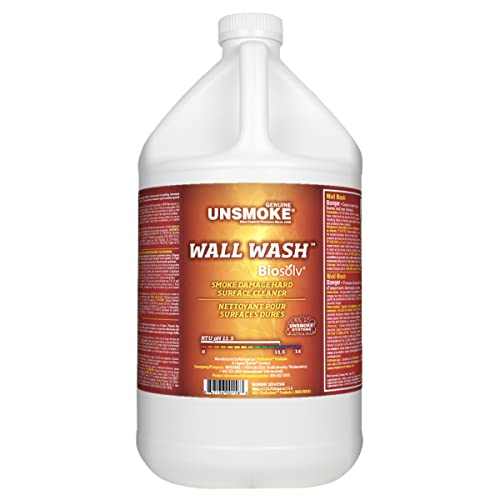
1. Wall Wash with Biosolv, Smoke Damage Degreaser, 1 Gallon
Our pick — 4.0+★ from 900+ verified ratings; the strongest balance of quality and price.
The one jug built for smoke film, not for dishes — a full gallon of concentrate aimed straight at tar.
If you have brown streaks running down a white ceiling, this is the pick that treats that job as its main purpose. It is a concentrated liquid degreaser in a 1-gallon jug, made by Unsmoke under Legend Brands, and it is listed as a paint prep cleaner too. That second use matters: it means the formula is designed to leave a surface clean enough to repaint, not to leave an oily film behind.
What wins people over is simply how much tar it lifts. The film that stains a smoker’s wall is oily and bonded, and this is a degreaser cutting a grease — so it breaks up instead of smearing. Owners describe minimal scrubbing on the way to the surface underneath. The scent is a citrus one, which is a far easier thing to breathe during a full room wash than a heavy chemical smell.
The honest catch is bulk and cost. At 8.5 pounds for the gallon, it is a heavy jug to haul up a ladder, so plan on decanting a working amount into a spray bottle. Value is a split question here — plenty of buyers feel the big jug earns its keep across a whole house, while others find it a stretch for a single small room. Dilute to the label ratio and one jug covers a lot more wall than the price suggests.
What earns its place
- Concentrated degreaser that dissolves tar film rather than smearing it
- Gallon size covers a whole room’s walls and ceiling
- Citrus scent is far easier to breathe than harsh solvent fumes
- Doubles as a paint prep wash before you recoat
What to weigh up
- 8.5-pound jug is heavy to carry up a ladder — decant first
- Not every buyer feels a full gallon is worth it for one small room
Go for it when: you are washing every wall and ceiling in a smoke-damaged room and want one jug that handles the lot.
Think smaller if: you only need one stubborn patch, because the gallon format is built for volume.
2. Dakota Non-Smoke Smoke Odor Eliminator-Non-Smoke
A wall wash handles the tar film; this handles the smoke odor left in carpet, drapes, and air after the film is gone.
Cleaning walls removes the source, but a smoker’s room usually keeps a smell in the carpet, the drapes, and the soft furniture. Dakota built Non-Smoke for exactly that leftover layer.
Where buyers are happiest is on the hardest assignment of all: a used car with smoke baked into it. It has been sold since 2003 under model number DAK-50, and buyers report the odor-fighting job is what it does best. In practice that means treating the space after you wash, then giving it time to work through the air and fabrics.
The trade-off is the scent of the product itself. Owner opinion splits right down the middle — some find it works while the car smells clean, others find the treatment’s own smell heavy or unpleasant at first. Strength is a second split: it is potent on first application, and the effect is not permanent. Plan on retreating over time, and check the cap on arrival, since a few shipments have shown up with a damaged tip.
Where it fits in a full clean: this is a companion, not a wall washer — use it on rugs, upholstery, curtains, and the air once the tar film is off the paint.
The straight answer on the smell: expect a strong application scent that fades, and expect to reapply. It is a treatment, not a one-time switch.
Reach for this if: the walls look clean but the room still smells like an ashtray, especially in a car or camper.
Look elsewhere if: you expect a single dose to end the odor for good — this is a repeat-application product.
3. Stain Remover 2 Pack + 24oz Spray Bottle
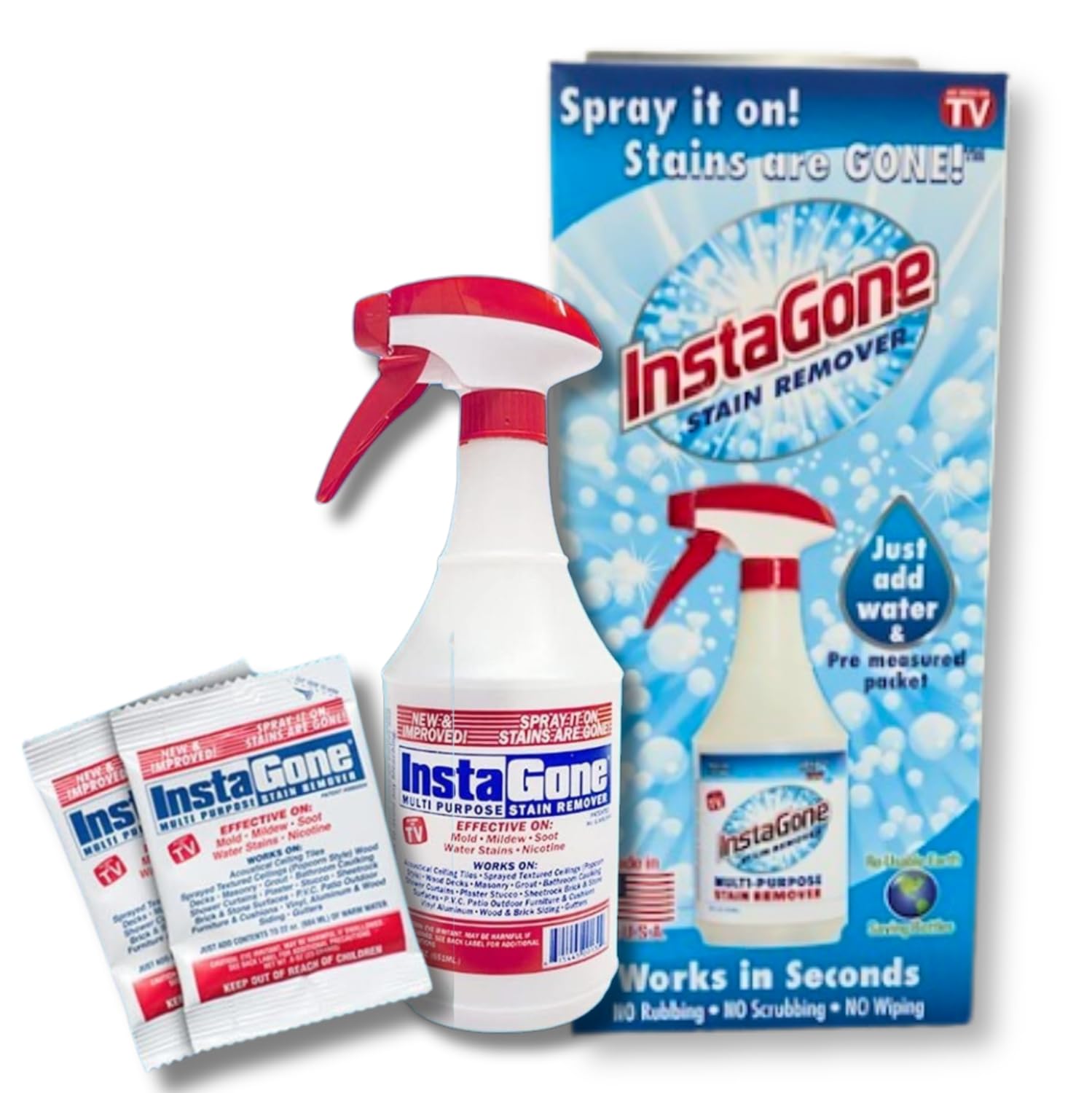
The lightest kit here by a wide margin — 7.2 ounces of product, with the water coming from your tap.
The format is what makes this one interesting. You get two refill packs of 0.8 oz each plus a 24 oz spray bottle, and you mix the powder with water yourself. That keeps the shipping box light — this kit runs 7.2 ounces against the 2 pounds of the Hearth & Stove bottle, and a fraction of the 8.5-pound Biosolv jug. The kit measures 9 x 5 x 4 inches, so it stores on a shelf between jobs.
What it does well is ceilings. Instagone lists ceilings, walls, bathrooms, roofs, and showers as fair game, and it is aimed at the kind of staining that makes a surface look tired. Buyers who get a result describe surfaces coming back to looking new, with bathrooms coming up bright again. The other thing it gets right is reach: with your own spray bottle and a long handle, spraying a ceiling is easier than hauling a bucket up a stepladder.
The part you need to know before buying is that results are genuinely mixed, and the smell is the loudest complaint. The formula has a strong pungent odor and fumes that many buyers dislike, so ventilate and wear protection. Quite a few users also report it falls short of their expectations on tougher staining, and some find the bottle or trigger fragile in early use. It is a fair gamble on a big outdoor job, less of a sure thing on heavy indoor tar.
Best reason to buy it: a light, mix-it-yourself spray kit for ceilings and hard surfaces where you want to reach high with a bottle, not a bucket.
The trade-off to plan for: strong fumes and a mixed hit rate on stubborn stains — test a patch before you commit a whole ceiling.
Right pick for: a light-weight, shelf-friendly spray setup for ceilings and bathroom surfaces.
Not your match if: you need a heavy-duty cut through thick tar, or you are sensitive to strong chemical fumes.
4. Cleaner

A spray-and-wipe soot remover for the one surface a wall wash cannot help: the glass door.
This is a narrow tool, and it says so — the listing reads simply Hearth & Stove Glass Cleaner. It is made by Northline and sold in a 12 x 4 x 4 inch bottle at 2 pounds. It belongs in a smoke cleanup for a specific reason. A wood stove or fireplace in a smoked-in room holds soot on the glass, and no wall degreaser will fix a baked-on black panel.
Soot lifting is the whole job, and it is the job this one does. The chemistry is matched to the carbon film that clings to glass, so it needs only a spray and a wipe. Buyers describe glass coming back to looking new, and fireplace slate brightening up with it. Speed is a real plus on a job like this — the cleaner works fast, so you are not scrubbing a hot door for a half hour.
Be clear about the scope before you order. This is a 2-pound bottle for glass, stone, and metal around a hearth, not a gallon of wall wash — if your ceiling is the target, the Biosolv pick above is the one you want. A handful of buyers also feel it is overpriced for what comes in the bottle. For the fireplace and glass surfaces, though, the trade is a small bottle that does its one task well.
The case for the spray bottle
- Designed for soot on glass, which wall cleaners cannot touch
- Spray and wipe — no scrubbing marathon
- Fast working and leaves fireplace glass and slate looking new
- Light 2-pound bottle is easy to handle one-handed
Where it stops
- Not made for drywall or ceiling paint
- Some find the small bottle pricey for the volume
Buy it for: the glass door, the hearth stone, and the metal trim — the soot-heavy surfaces in a smoked-in room.
Skip it for: wall and ceiling coverage, which needs a wash concentrate in a much larger volume.
5. Rust-Oleum Jomax 308764 Spray Once, 1 gallon

A gallon that turns into five gallons of wash — for siding, decks, and roofs where the smoke sat outside.
Smoke stains do not stop at the front door. A covered porch ceiling, vinyl siding, a deck rail, and roof shingles all collect the same yellow-brown film, and this is the pick aimed at those exterior surfaces. Rust-Oleum’s Jomax is a bleach-free concentrate in a 1-gallon jug weighing 3.8 pounds, and the label says it mixes up to 5 gallons of cleaning solution and covers up to 1,500 sq. ft.
Application is deliberately simple. You dilute it, load a pump-up garden sprayer, and spray — the label promises no scrubbing and no rinsing required. The formula is also made to work with natural weather over time, which is a different approach from a scrubbed wash: you apply it and let the elements finish the job. The 1,500 sq. ft. coverage figure is what makes it a value on a large house, where a small spray bottle would be hopeless.
Now the honest half. Effectiveness is decidedly split — owners mention strong results on siding and even shower grout, while others say it did nothing at all and needed extra scrubbing in spots. Some also question whether the volume justifies the spend. Read the surface before you commit: it is built for exterior siding and roofs, not for the inside of a painted ceiling, and interior use of a weather-activated formula is the wrong tool for the room.
Where it earns the gallon: exterior siding, fences, decks, patios, and roofs — 1 gallon of concentrate making up to 5 gallons of solution covers a large exterior run.
Where it disappoints: results are uneven and some surfaces need a second pass; this is not the product for indoor painted walls.
Choose it for: the outside of a smoke-affected house — siding, decks, and roofs where you can spray and walk away.
Look past it if: your target is an interior ceiling or wall, where a degreaser wash does the job better.
Know the Specs
Concentrate and dilution
A concentrate is a strong liquid you mix with water before spraying. Buying concentrate usually means more finished cleaner per bottle, which matters on a ceiling job with a lot of square footage to cover. Always follow the printed mix ratio — too strong can dull paint, too weak just wets the tar.
Degreaser strength
Tar and nicotine are oily, so a degreaser is what dissolves them. A stronger degreaser cuts the film faster but needs a quick rinse on delicate paint. On flat ceiling paint, work in sections and rinse with clean water so nothing sticky is left behind to catch dust.
Liquid volume and jug weight
The volume tells you how far a bottle will go; the weight tells you how hard it is to carry up a ladder. A full gallon runs heavy, so plan to decant a working amount into a spray bottle before you climb.
Odor neutralizers versus cleaners
A cleaner removes the tar film from hard surfaces. An odor neutralizer works on the smell left in carpet, curtains, and the air. A full cleanup usually needs both, because a spotless wall can still leave a room that smells of old smoke.
Common Questions
Will a wall degreaser remove the yellow stain or just the smell?
Can I use a smoke film cleaner on a painted ceiling without damaging the paint?
How do I wash a ceiling without a huge mess?
Do I need a separate product for the smell after I wash?
Is a bleach-free exterior cleaner like Jomax safe to use indoors on walls?
How much cleaner do I need for a whole room?
Will these cleaners work on tar residue on glass fireplace doors?
Do I have to rinse after applying a smoke degreaser?
Can one cleaner handle both walls and soft furniture?
The Bottom Line
For most homes, the cleaner to remove cigarette smoke from walls and ceiling winner is the Wall Wash with Biosolv because it is a concentrated degreaser made for smoke tar, with a gallon that covers a whole room. If the room still smells after the walls are clean, add the Dakota Non-Smoke to reach the carpet and air. And for the fireplace glass nobody can scrub clean, the Hearth & Stove Glass Cleaner handles the one surface a wall wash never touches.
How we choose
We do not accept paid placement. Every pick is matched to a real buyer and a real use-case; we do not hands-on test units.
Sources
Specifications: manufacturer listings and product documentation. Review insights: verified customer reviews, as of November 2026. Pricing: not shown on this page (it changes often); check the current price via the retailer link.
As an Amazon Associate, My Heart Lives Here earns from qualifying purchases. This does not affect which products we feature.