Heads up: This post contains affiliate links. As an Amazon Associate I earn from qualifying purchases, at no extra cost to you. Learn more
Specs are compiled from manufacturer listings and verified buyer reviews and can change over time — please confirm the key details on the product page before buying.
Most cattle mineral problems are not mystery illnesses — they are gaps. Your hay comes up short on trace minerals, your pasture swings with the season, and the loose mineral you bought last spring sat in the trough and caked. That is why cattle mineral matters: it is cheap insurance against coats dulling, appetites slipping, and a herd going quietly deficient. Below are seven mineral formats — pellets, blocks, licks, and boluses — and each one fits a different setup.
This guide is built by comparing the manufacturers’ published specifications and the patterns across verified customer reviews, so you get each pick’s real strengths and trade-offs instead of marketing spin.
The format you choose changes how much mineral actually gets into the animal, and that one decision matters more than brand loyalty here. Every pick below is weighed on delivery method, mineral content, and how much labor it costs you each week — the practical answer to any cattle mineral search.
Top Picks

How To Choose The Best Cattle Mineral
The first thing to settle is how the mineral gets into the cow. A block has to be licked. A pellet has to be eaten from a trough. A bolus is swallowed once with a tool and sits in the rumen (the big fermentation stomach) releasing copper over time. Pick the delivery method you can actually keep up with, then compare labels.
Match the format to your feeding routine
If you walk a pasture daily, loose mineral in a covered feeder is easy to refill and easy to monitor. If your cattle range across a big allotment and you see them rarely, a hard 50-pound salt block or a roped lick hung at the right height keeps working between visits. If you are working calves and adults through a chute anyway, a bolus gives you a known dose delivered once.
Read the mineral panel, not the front of the bag
Trace minerals like copper, zinc, selenium, and iron are listed in parts per million, and those numbers are small on purpose — cattle need them in tiny amounts. Selenium is the one to watch closely. It is listed in very fine increments because the safe range is narrow, so compare the exact figure on any two labels before you assume one is stronger than the other.
Think about salt as the intake lever
Cattle crave salt, and salt is what pulls them to a mineral source. A plain salt block keeps them coming back but adds no trace minerals. A trace-mineral block uses that same salt craving to draw cattle into the minerals. Neither works if the block is so hard that tongues wear out before the cattle get a useful amount.
Side-by-Side Comparison
| Model | Best For | Format | Size / Weight | Species Named | Amazon |
|---|---|---|---|---|---|
| Horse Guard 4.6 lb Equine Vitamin Mineral Supplement★ Best Overall | Daily pellet feeding with biotin and probiotics | Pellet | 4.6 lb | Horse | Amazon |
| Salt Block Selenium 50LBLongest Supply | Big pasture, minimal refills | Block | 50 lb | Horses, cattle, goats, deer | Amazon |
| Nevlers 3 Pack Himalayan Salt Licks | Hanging licks in stalls and small paddocks | Hanging lick (ropes included) | 4.5–6.5 lb each, 3 pack | Horses, cows, deer, camel | Amazon |
| MUYG 3 Pack Himalayan Salt Lick | Adjustable-height roped licks for varied stock | Hanging lick (adjustable rope) | 7.2–9.9 lb each, 3 pack | Horses, deer, cattle, goats | Amazon |
| KALMBACH Feeds Vitamin and Mineral Goat Supplement | Goat and small-stock pens | Block | 25 lb | Goats | Amazon |
| The Original Salt Company Pink Himalayan Salt Lick 4 Pack | Hanging licks with a clean-ingredient label | Hanging block (rope handle) | 4.4 lb each, 4 pack | Cattle, goats, horses, sheep, wildlife | Amazon |
| UltraCruz Cattle Copper Bolus | Copper dosing at chute time | Slow-release capsule (bolus) | 12.5 g each, 25 count | Cattle | Amazon |
Detailed Reviews
1. Horse Guard Equine Vitamin Mineral Supplement
Our pick — 4.5+★ from 350+ verified ratings; the strongest balance of quality and price.
The pellet that covers the hay gap — with biotin built in for hooves.
Here is the number that earns this one the top slot: 4.5 mg of biotin in every dose. Biotin is a B vitamin for hoof and coat condition, and 4.5 mg per serving is a real dose, not a token sprinkle. Add probiotics and prebiotics (gut-supporting bugs and the fiber that feeds them) and you get a supplement aimed at digestion and nutrient uptake, not just mineral replacement.
It arrives as a 4.6-pound tub of pellets with a 2oz scoop included, so dosing is a scoop rather than a guess. The maker states it was formulated by a certified equine nutritionist and uses pharmaceutical-grade ingredients. Whether that matters to you depends on how carefully you already balance your ration — but the scoop-plus-pellet setup keeps the routine simple either way.
The honest catch is the target species: this is listed for horses, not cattle. If you keep both, that is one more tub on the shelf. Feeding one supplement across a mixed herd is not something this product’s label claims to support, so treat it as a horse-specific tool. For a horse owner who wants minerals, gut support, and hoof support in one scoop, that trade-off is just part of the routine.
What holds up in the barn
- 4.5 mg of biotin per dose gives hooves and coats a defined daily input
- Probiotics and prebiotics target digestion, so feed is used more fully
- 2oz scoop takes the measurement guesswork out of the routine
- Pellet form holds up in a bucket without caking like loose powder
Where it narrows
- Labeled for horses — it is not a cattle mineral
- A 4.6 lb tub is a smaller supply than a 25 or 50 lb block
Made for: horse owners feeding a daily scoop who want minerals, gut support, and hoof support in one tub.
Not your pick if: you are mineralizing a cattle herd — the label is equine-only.
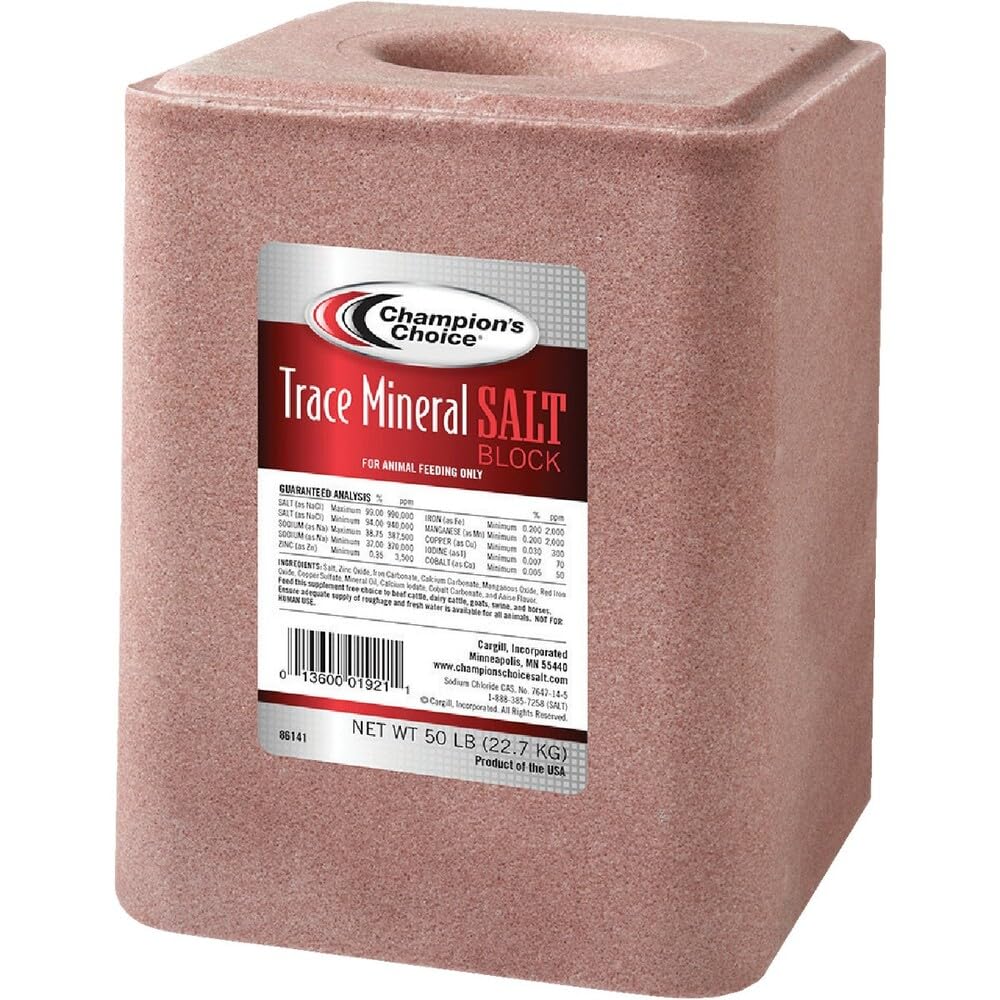
2. Salt Block Selenium 50LB
Fifty pounds of salt that stays put between pasture checks.
Weight is the whole argument here. At 50 pounds, this block is roughly 11 times the weight of a single block in the 4.4 lb pink salt four-pack below — the kind of size that sits in a holder and keeps offering salt through a grazing rotation without you hauling a fresh block every week. It is made in the United States by Cargill Salt, and it is listed as suitable for horses, cattle, goats, and deer.
What it does well is the everyday job of a salt block: it draws animals in to lick, keeps them hydrated, and gives them a reason to come to the same spot in the pasture. That licking behavior is the delivery system. The block erodes gradually as tongues work it down, so how long it lasts depends on your herd size, not on a fixed timetable.
Set expectations on the mineral side. This listing describes it as a selenium salt block and general livestock mineral block, but the published specs name the manufacturer, weight, and dimensions — not a mineral analysis. If you need to know exactly how much copper or zinc your cattle are getting, add a loose mineral program alongside it. As a cheap, long-wearing salt source, it does the simple job well.
Why it earns a slot: A single 50-pound block is the least fussy way to keep salt in front of cattle across a big pasture, and the holder-friendly shape means it stays where you put it.
Know before you buy: The benefits are salt and licking behavior. Treat it as a salt block, not as a complete trace-mineral program.
Buy this when: you want one heavy block to cover salt needs over a long stretch of pasture season.
Pair it with: a loose trace-mineral feeder if copper and zinc are part of your plan.
3. Nevlers Himalayan Salt Licks
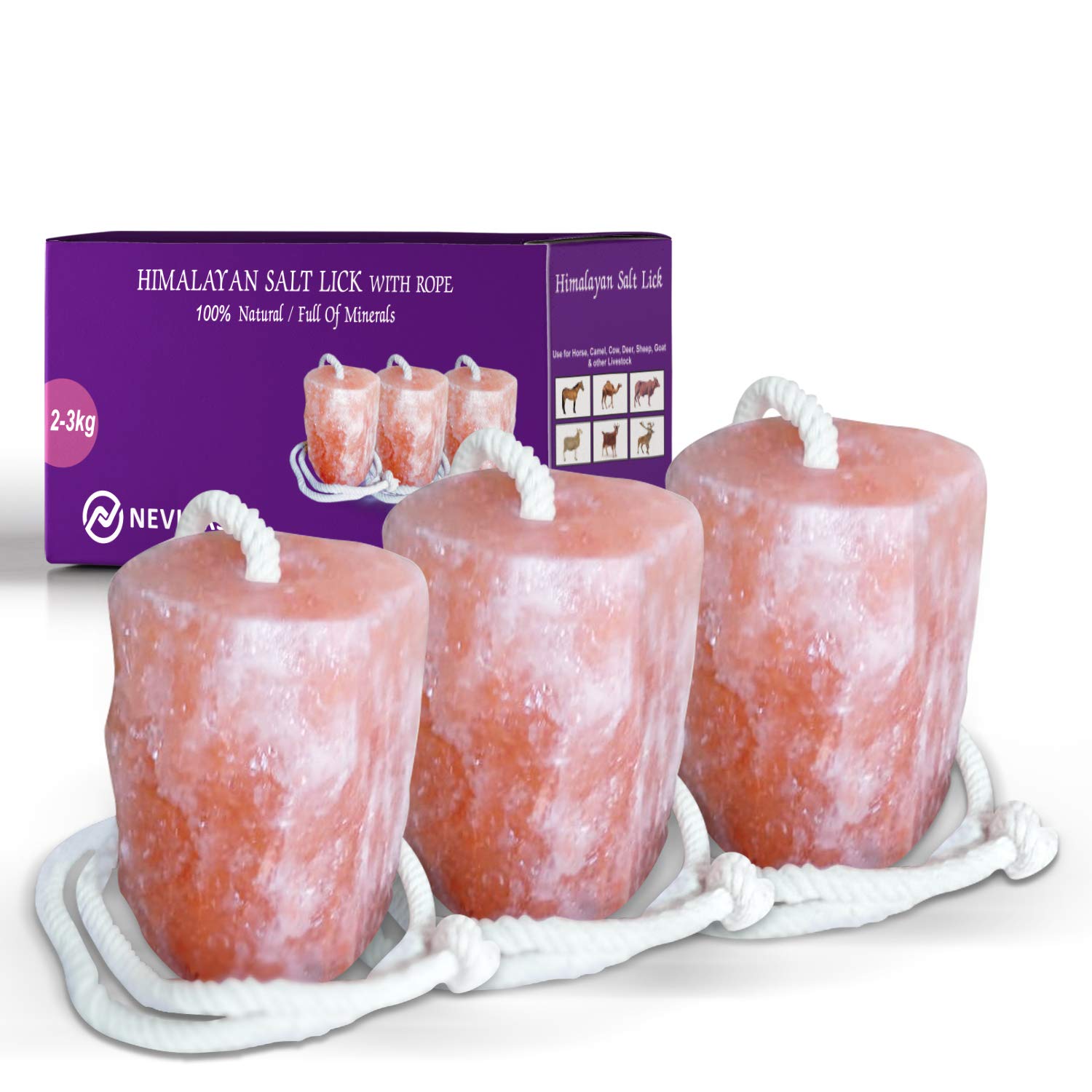
Three rock licks on ropes — hang one in every stall.
Three licks in one bag suits a barn with several stalls, because each one hangs on its own rope instead of sharing a single mount point. Each block runs roughly 4.5 to 6.5 pounds, and the included ropes measure about 2.5 to 3 feet, long enough to tie off at a sensible height. The salt itself is listed as all-natural Himalayan, handcrafted in Pakistan, with the maker citing up to 84 trace elements.
What wins people over is how fast animals take to them — horses, cows, and draft crosses start licking right away, and the blocks wear down at a pace that shows they are being used. That is the whole point of a salt lick: it gives livestock something to work at and keeps salt in front of them without you mixing a bucket.
The trade-off to plan for is wear. Because these are natural rock salt rather than a compressed commercial block, they erode on the animal’s schedule, and how long one lasts will vary with how hard your stock licks. Buy the three-pack with the expectation that you will rotate in replacements. Sizing also varies block to block, since each one is hand-cut.
The real selling points
- Three separate ropes mean three hang points — one per stall or paddock
- Himalayan salt with the maker’s cited 84 trace elements
- Handcrafted, natural rock salt with no additives claimed
- Ropes of roughly 2.5 to 3 feet make height adjustment simple
Set your expectations
- Natural blocks wear down faster than a pressed commercial block
- Each block is hand-cut, so weight and shape vary from piece to piece
Suits: barn owners who want a lick hanging in every stall without buying a feeder.
Heads-up: natural rock wears at its own pace — keep a spare in the tack room.
4. MUYG Himalayan Salt Lick
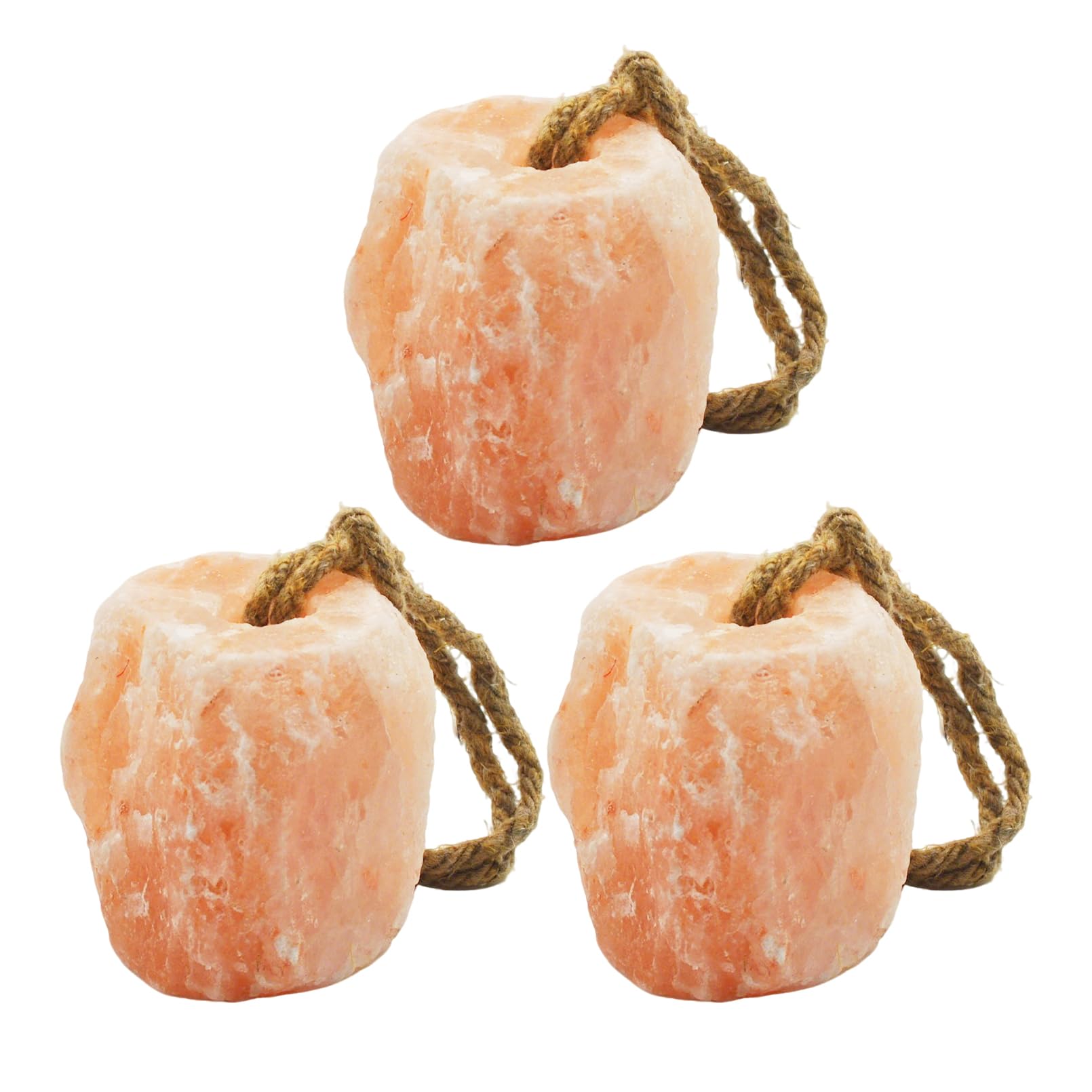
Heavier rocks and a rope you can shorten for smaller stock.
Where the Nevlers set tops out around 6.5 pounds, this three-pack runs from 7.2 to 9.9 pounds per block — bigger pieces that last longer between replacements and give a full-grown cow or horse more to work against. The salt is listed at 98% sodium chloride with the maker citing 84 trace minerals and no preservatives or additives.
The adjustable rope is the practical difference. Salt rope can be shortened or lengthened to suit the animal, so the same block works for a goat at knee height and a horse at chest height. That flexibility matters if your herd is mixed, because a lick hung too low gets dirtied and one hung too high gets ignored.
Buyers report that horses, goats, deer, and chickens all go for these blocks, drawn by the saltiness. The mixed feedback is on size, since hand-mined blocks vary piece to piece, and on whether the value holds up per block. Neither is a reason to pass it up; it is a reason to buy knowing exactly what you are getting: three big, irregular, natural salt rocks.
Where it beats the lighter set: At 7.2 to 9.9 pounds per block, these outlast the 4.5 to 6.5 pound Nevlers licks — worth it if your stock is heavy on the salt and you would rather not hang replacements monthly.
The trust check: The listing states 98% sodium chloride, which is high even for Himalayan salt — read the label when it lands if exact mineral balance is critical for your ration.
Good fit for: mixed herds where one lick has to serve a goat and a horse at different heights.
The caveat: hand-mined blocks vary in size, so plan for irregular pieces rather than uniform cubes.
5. KALMBACH Goat Supplement
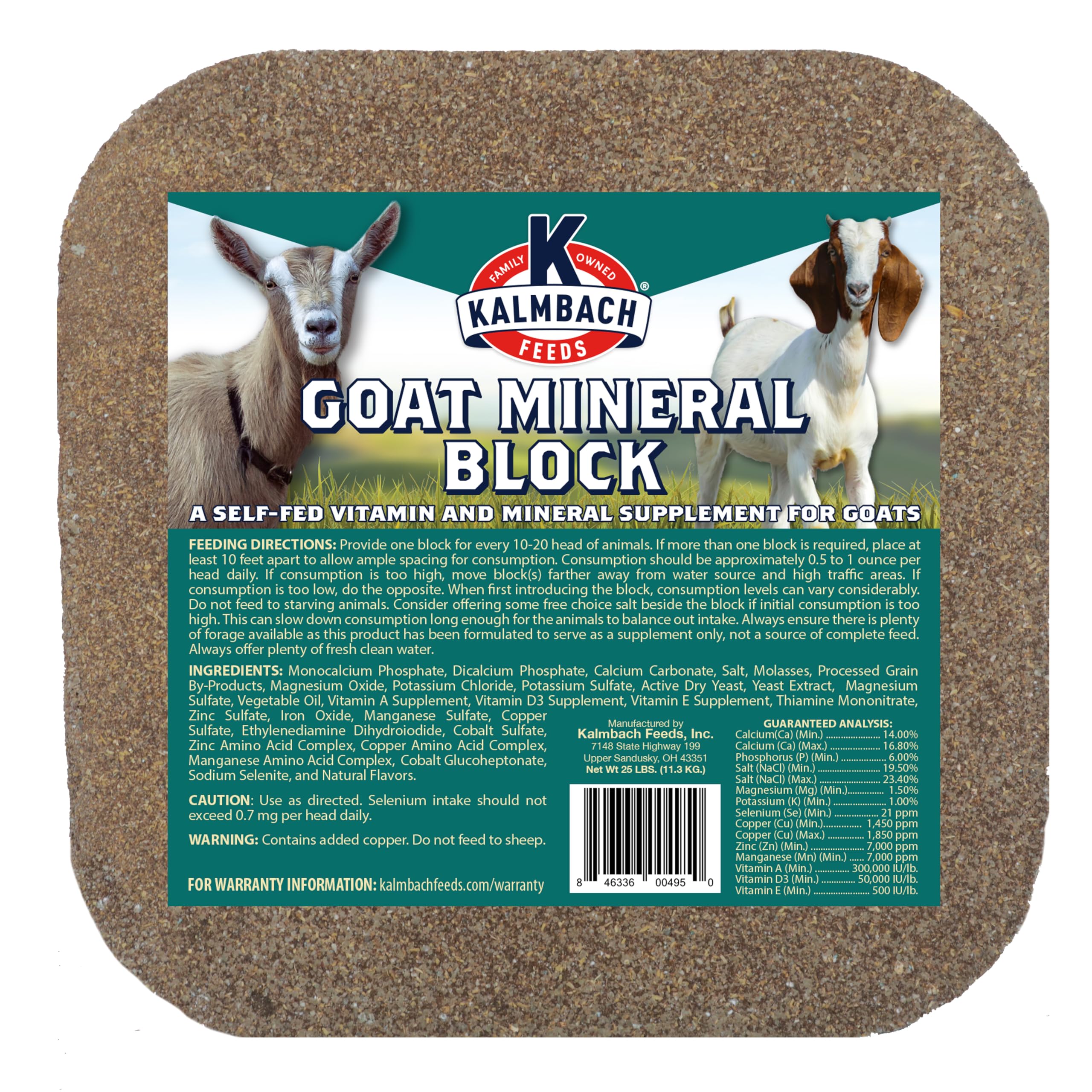
A goat block built for goats — not a catch-all livestock lick.
This one is a 25-pound pressed block measuring 9 x 9 x 5 inches, and its real advantage is that it was formulated for goats rather than for whatever animal happens to find it. At 25 pounds it weighs half the 50-pound salt block above, so one person can lift it into a pen-side feeder without help.
Kalmbach Feeds builds this as a vitamin and mineral block, not a plain salt lick. The label is short and to the point: goat supplement, 25-pound block. That bluntness tells you to check the mineral panel on delivery if you need specifics on copper or selenium, because the listing itself does not spell them out.
The catch with any pressed block is that goats only get what they can wear down with their tongues. Goats are good at this and will work a block steadily, but a block in an open pasture with rain on it will slump. Set it under cover in a feeder and it does its job. For a goat pen, this is a straightforward, correctly targeted option.
Pick it for: a goat herd where you want a mineral block sized for the pen, not for the whole farm.
Check first: the mineral analysis on the bag — this listing gives weight and dimensions but not the trace-mineral breakdown.
6. Salt Company Himalayan Salt Lick
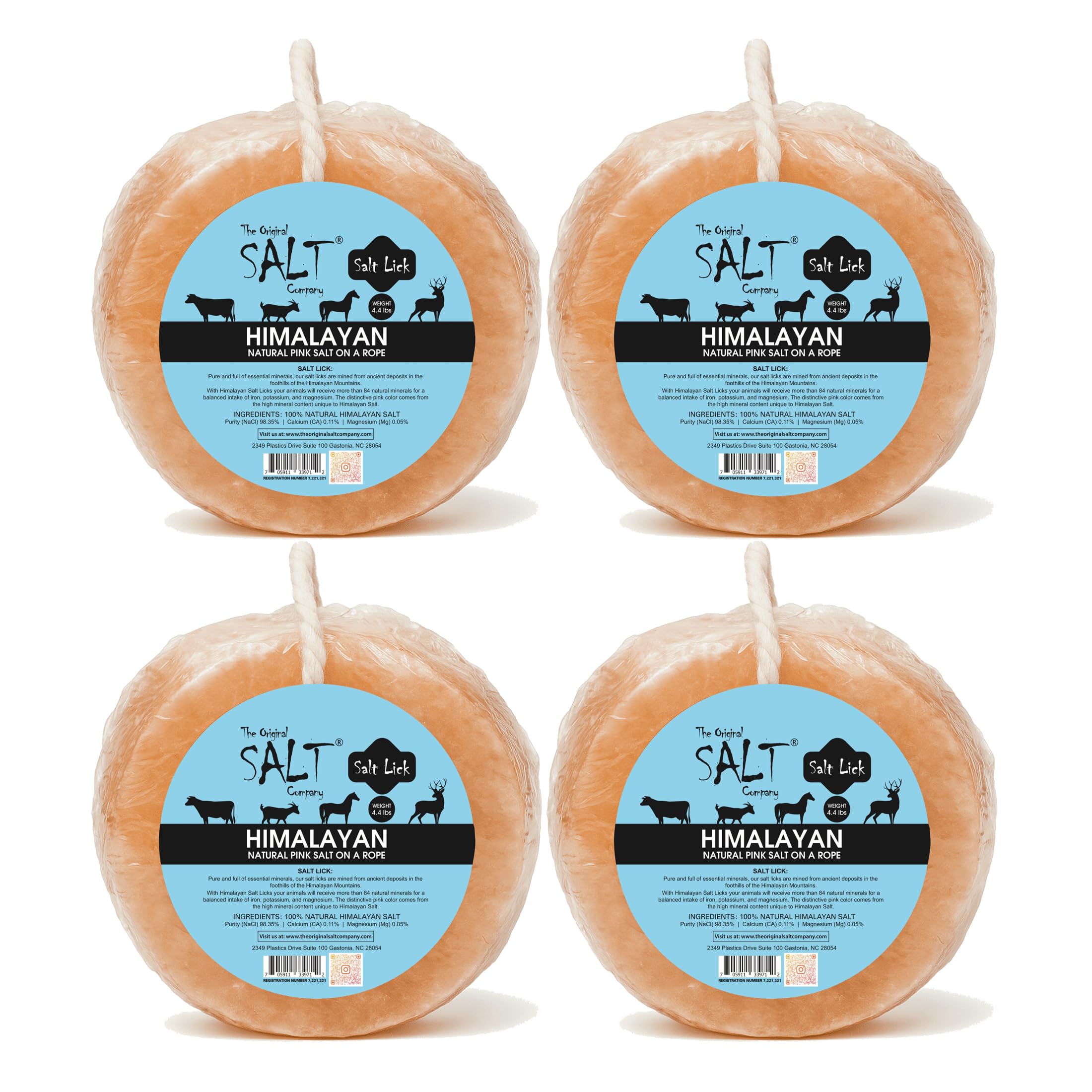
Four rope-handled blocks with the shortest ingredient list in the lineup.
Four blocks at 4.4 pounds each — a total of four rope-handled licks in one box — makes this the easiest set to spread across a fence line or a row of stables. Each block is a compact cylinder with a rope handle, so it hangs or sits on a post without extra hardware.
The reason this one stands out on paper is the claims list. It is listed as organic, additive-free, non-GMO, with no artificial colors or flavors, and allergen-free, dairy-free, and gluten-free. For a buyer who wants a plain pink salt block and nothing else, that is the clearest ingredient statement in this group. The source is stated as the foothills of the Himalayas, with sodium, iron, and calcium named as the minerals it contributes.
The maker calls them long-lasting because the dense block erodes gradually, and the rope handle lets one hang in a stable, a pasture, or a feeding area. The one thing to weigh is capacity: four 4.4-pound blocks add up to less salt than the single 50-pound block, so if you are managing a big herd through a hard winter, you will be reordering. For a small holding or a few animals, the smaller format is easier to hang and easier to move.
Why the label matters: Organic, non-GMO, additive-free, and free of artificial colors and flavors — a short, clean claim list that is easy to verify against the block you receive.
The size math: 4.4 pounds per block is manageable to hang, but a large herd will go through a four-pack quickly compared with a 50-pound single block.
Reach for this if: a clean ingredient list and rope handles matter more to you than maximum pounds per order.
Look elsewhere if: you want one heavy block to cover a whole herd for a season.
7. UltraCruz Cattle Copper Bolus Supplement

One swallow, slow release — copper dosed at the chute instead of the trough.
Twenty-five capsules at 12.5 grams each is a completely different delivery model from a lick. Each bolus is a gelatin capsule packed with copper oxide particles. It is swallowed with a balling gun, the capsule dissolves in the stomach, and the copper particles lodge in the rumen and dissolve slowly over time. Adults are the target — the maker recommends it for cattle weighing over 500 lbs.
Why a bolus instead of a lick: it gives you a known dose delivered once, rather than hoping each cow gets her share from a shared block. The maker lists it as a copper source for beef and dairy cattle, with copper named as an essential trace mineral for coat and immune support. It is intended for cattle only, and the listing notes that balling guns suited to administering it are available separately.
The catch is that it is not a whole mineral program — it is copper, a capsule, and a job to do in the chute. If your cattle are fine on copper and your gap is selenium or zinc, this does not cover it. But if copper is the specific deficiency you are addressing, dosing each animal once is cleaner than watching who licks what.
Right for: producers with a chute setup who want a known copper dose per animal rather than a shared lick.
Mind the gaps: it is a copper bolus, not a complete mineral program, and it is labeled for cattle weighing over 500 lbs.
Know the Specs
Format: Block vs Pellet vs Bolus
Format decides how the mineral gets in. A block relies on licking, so intake depends on how hard the block is and how often the animal tries. A pellet is eaten from a bucket at a measured scoop, so you control the dose but you have to feed it. A bolus is swallowed once and releases over time, so one dose covers a stretch without either. Choose the format that matches the labor you can actually do.
Selenium and Trace Minerals
Trace minerals are listed in very small units — parts per million — because cattle need only tiny amounts. Selenium sits in the middle of that narrow band: too little causes deficiency, too much causes problems, which is why labels list it in fine increments. Compare the exact figure between any two products before assuming one is stronger.
Size and Weight on the Label
Weight is the simplest predictor of how often you reorder. A 50-pound block is a long-season supply for a small herd, while a 4.4-pound lick may not survive a week with heavy stock. The weight on the box is per block or per pack, so read carefully: a 4-pack of 4.4-pound blocks is a different order of magnitude from a 50-pound single block.
Species Fit
A goat block and a cattle bolus are not interchangeable, and neither is a horse pellet. Species fit decides the mineral ratios and the delivery method. Buy for the animal you are actually feeding, and if you run a mixed herd, plan on more than one product.
Common Questions
Can I use a horse mineral pellet for cattle?
How long does a 50 pound salt block last?
Is a salt lick the same as a mineral block?
Why is the selenium number on cattle mineral so small?
Can I give cattle a copper bolus without a balling gun?
Will goats and cattle share the same salt lick?
Do Himalayan salt licks actually contain trace minerals?
Should I put a mineral block under cover?
What is the difference between a Himalayan salt lick and a mineral block?
Can I hang a salt lick on a fence line?
The Bottom Line
The best pick for most horses here is the Horse Guard 4.6 lb Equine Vitamin Mineral Supplement, because 4.5 mg of biotin per dose plus probiotics and prebiotics covers minerals, digestion, and hooves in one scoop — a favorite with owners at 4.5+ stars across 300+ ratings. For a cattle operation, the UltraCruz Cattle Copper Bolus delivers a known dose of copper at the chute. Want salt in front of the herd with the least fuss? The Salt Block Selenium 50LB is 50 pounds of set-it-and-leave-it salt. Whatever you pick, read the mineral panel on arrival and dose for the species you actually keep.
How we choose
We do not accept paid placement. Every pick is matched to a real buyer and a real use-case; we do not hands-on test units.
Sources
Specifications: manufacturer listings and product documentation. Review insights: verified customer reviews, as of November 2026. Pricing: not shown on this page (it changes often); check the current price via the retailer link.
As an Amazon Associate, My Heart Lives Here earns from qualifying purchases. This does not affect which products we feature.