Heads up: This post contains affiliate links. As an Amazon Associate I earn from qualifying purchases, at no extra cost to you. Learn more
Specs are compiled from manufacturer listings and verified buyer reviews and can change over time — please confirm the key details on the product page before buying.
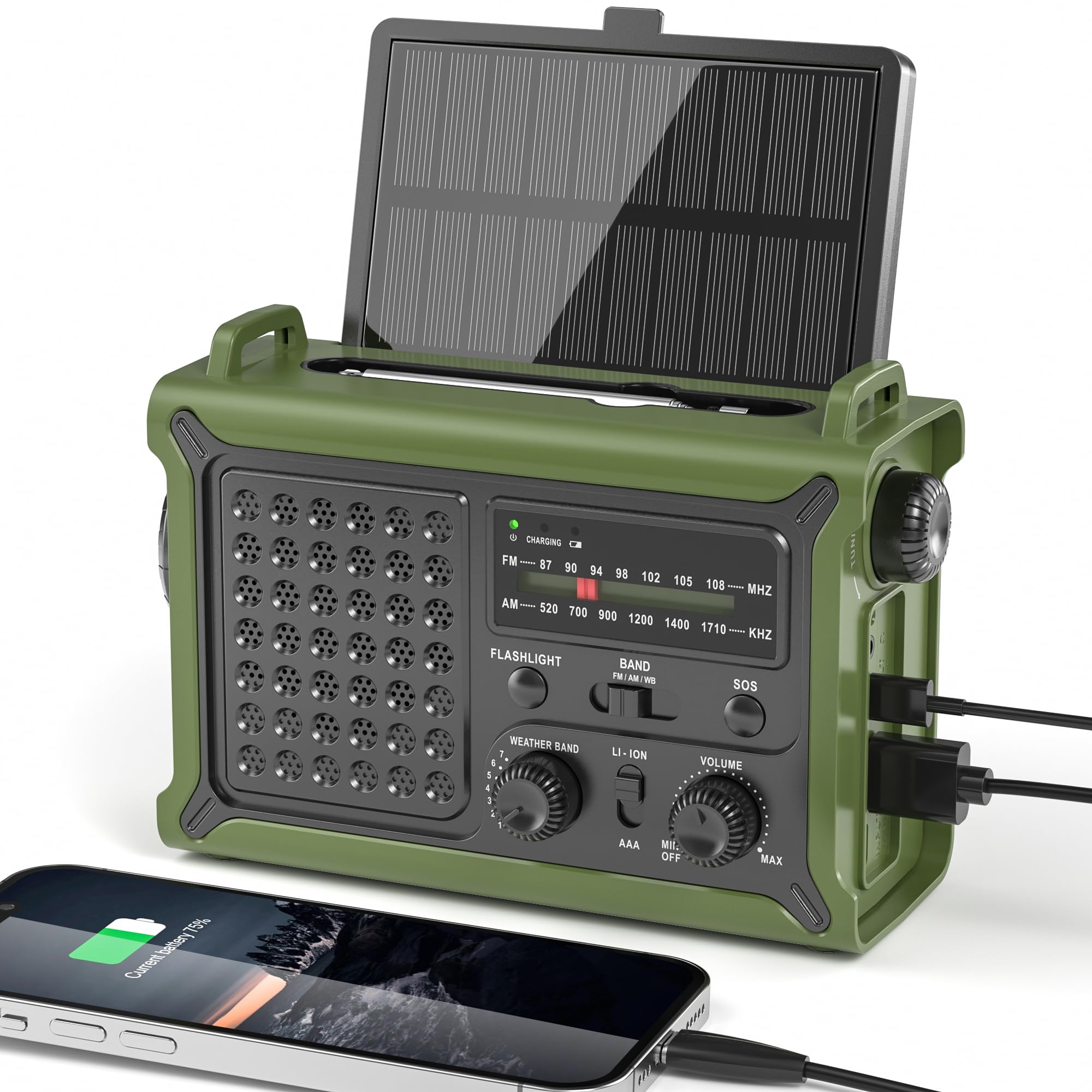
When the grid goes down, your phone becomes a paperweight within hours. What you actually need is a radio that keeps pulling in weather alerts and news after the household power is gone. The seven picks below all run on their own batteries and each has at least two backup ways to recharge — solar, a hand crank, or plain USB. The one that suits most households is the Mesqool Solar Radio, with its real 12000mAh battery and oversized solar panel.
This guide is built by comparing the manufacturers’ published specifications and the patterns across verified customer reviews, so you get each pick’s real strengths and trade-offs instead of marketing spin.
You will see how capacity, charging options, and reception quality actually change what a radio does for you in a blackout. Below, every pick is lined up against the same three specs so you can compare them at a glance and choose the best battery operated radio for emergencies for your own home kit.
Top Picks
How To Choose The Best Battery Operated Radio for Emergencies
Most people buy an emergency radio and never touch it until the night it matters. That is exactly why the choices below matter more than they look. A radio that needs a wall outlet is useless in a blackout, and a 10000mAh pack runs dry long before a multi-day storm does.
Start with stored power, not features
Capacity is listed in mAh, which stands for milliamp-hours — think of it as the size of the fuel tank. A 20000mAh pack runs the radio and tops up a phone far longer than a 10000mAh one. A 20000mAh unit holds noticeably more than a 12000mAh one, so it lasts further into a multi-day outage.
Count your backup charging paths
Look for at least two ways to refill the battery without a wall socket. A hand crank works in total darkness, while a solar panel needs daylight. Crank at night, solar by day, and USB-C when a socket is available — three paths so no single failure strands you.
Check the weather band coverage
NOAA is the US National Oceanic and Atmospheric Administration, and its weather broadcasts run on dedicated channels. A radio that tunes those channels tells you about tornadoes, floods, and hurricanes as they develop. Note that alerts only arrive when the radio is switched on and tuned to a weather station — it does not wake itself.
Side-by-Side Comparison
| Model | Best For | Battery Capacity | Charging Methods | Flashlight / Light | Amazon |
|---|---|---|---|---|---|
| Mesqool Solar Radio Emergency Hand Crank★ Best Overall | Most households | 12000mAh | Solar, hand crank, USB-C | 2-mode LED + reading lamp | Amazon |
| QAUYYW 20000mAh NOAA Weather RadioBiggest Reserve | Long outages | 20000mAh | USB-C, hand crank, solar | 3W flashlight + 3.5W reading lamp | Amazon |
| OnLyee Emergency Radio with Hand Crank & Solar | Clear AM/FM sound | 12000mAh | Solar, hand crank, Type-C | 5W flashlight + 12-LED lamp | Amazon |
| Raynic 12000mAh Weather Radio | Big buttons, easy grip | 12000mAh | USB, USB-C, solar, hand crank | 5W flashlight + lamp | Amazon |
| Vokida Emergency Radio Survival Kit | Bug-out bags | 37000mWh | Hand crank, solar, internal battery | Built-in flashlight | Amazon |
| Rychi 10000mAh Emergency Radio | Best sound quality | 10000mAh | USB-C, solar, hand crank, AAA | 3W flashlight + LED lamp | Amazon |
| PPLEE 12000mAh NOAA Weather Radio | Longest run time | 12000mAh | USB-C, solar, hand crank, AAA | 300-lumen flashlight + reading light | Amazon |
Detailed Reviews
1. Mesqool Solar Radio Emergency Hand Crank 12000mAh
Our pick — 4.5+★ from 1,000+ verified ratings; the strongest balance of quality and price.
A real 12000mAh tank with a solar panel big enough to actually do something.
You get a true 12000mAh lithium battery (a measure of stored power) that the maker says is not inflated. That reserve runs the radio, lights, and phone charging through a long storm. It beats the Vokida kit below, which lists 37000mWh (a different energy unit) instead of the raw mAh figure used here.
The solar side is where it separates from the pack. Its 8500mm² monocrystalline panel is described by the maker as more than four times the size of the typical 2000mm² decorative panels found elsewhere, and it captures usable light even when skies are dim. The crank has been reworked too, with a larger copper coil and reinforced magnet, and the longer arm makes manual winding low-effort. Owners talk about the alert tone and SOS siren as genuinely loud, and the compact body slips into a drawer or tote without a fight.
At 6.8 x 2.9 x 4.7 inches and 1.6 pounds, it is easy to carry and grip. A large tuning knob and labels you can read in the dark help you find stations by feel. A frosted reading lamp flips up for a soft glow, and the main flashlight throws a beam up to 260 feet (about 80 meters). The catch: the analog display is plain, so you tune by feel rather than reading a digital frequency. Also, the manual asks you to fully charge it before first use, so do that the day it arrives, not the night you need it.
crank plus big battery
- True 12000mAh battery keeps radio, lights, and phone running for days
- 8500mm² monocrystalline solar panel charges even in low light
- 260-foot flashlight beam plus a soft flip-up reading lamp
- Loud SOS siren and alert tone owners describe as unmissable
hand crank takes effort
- Analog tuning means you dial stations in by ear, not by a digital readout
- Needs a full charge from the start before it performs at its best
top pick overall: you want one radio that handles a multi-day blackout for a whole household, lights included.
crank fatigue risk: a digital frequency display matters to you — this one tunes the old-fashioned analog way.
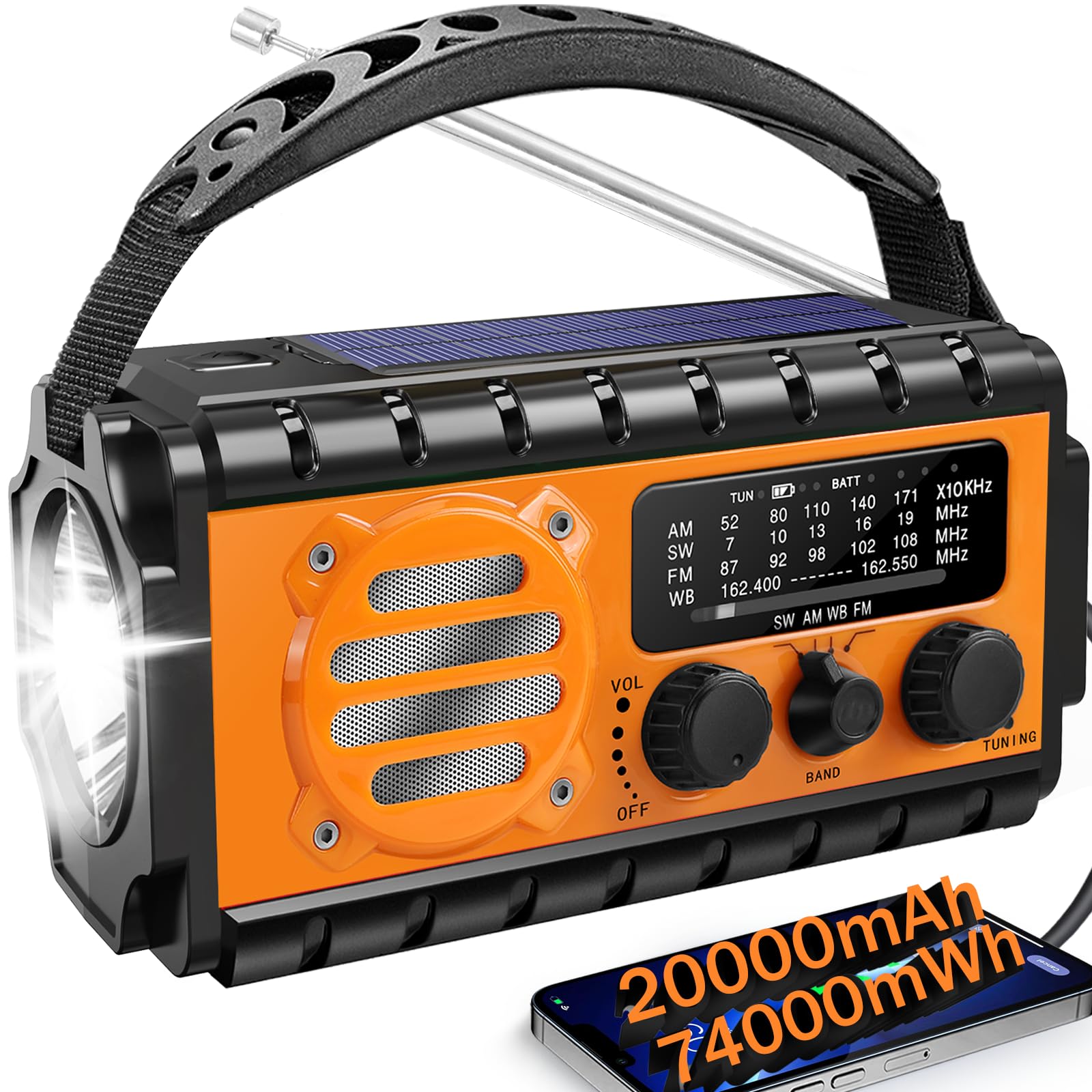
2. QAUYYW Solar Hand Crank Emergency Radio, 20000mAh
The fuel tank here is the largest in the lineup by a wide margin.
If the storm knocks out power for a week, stored energy is what keeps you informed. This QAUYYW holds 20000mAh — a 67% larger reserve than the 12000mAh Mesqool above — so it can feed the radio, the 3W flashlight, the 3.5W reading lamp, and a phone charge for far longer between top-ups. It also squeezes that capacity into a body just 6.2 inches long by 2.2 wide by 2.8 tall, making it the more packable of the two big-battery picks.
Build quality is what wins people over according to the owner feedback, with value for money running a close second in how buyers talk about it. A 52 cm extended antenna pulls in signal, and the IPX6 rating means it shrugs off rain and splashes — a real plus if it lives in a bug-out bag or on a boat.
Here is the honest wrinkle: reception splits opinion. AM, FM, and weather stations come through clearly for many owners, while others find the signal spotty depending on where they sit relative to the transmitter. The 3 charging paths (USB-C, hand crank, solar) all work, and the SOS alarm is loud enough to wake a sleeping house. Just know the analog NOAA tuning means you select the weather channel yourself, and alerts only arrive with the radio powered on.
largest power reserve: 20000mAh is the biggest battery in this whole comparison, and 67% more stored charge than the 12000mAh Mesqool translates into extra days of listening.
bulky to carry: radio reception is the one mixed note — great in some spots, patchy in others — so test it at home before you rely on it in the field.
capacity first choice: maximum stored power is your priority and you want a radio that outlasts a long outage on one fill.
weight matters more: you need guaranteed reception in a fringe signal area — the reception experience varies by location.
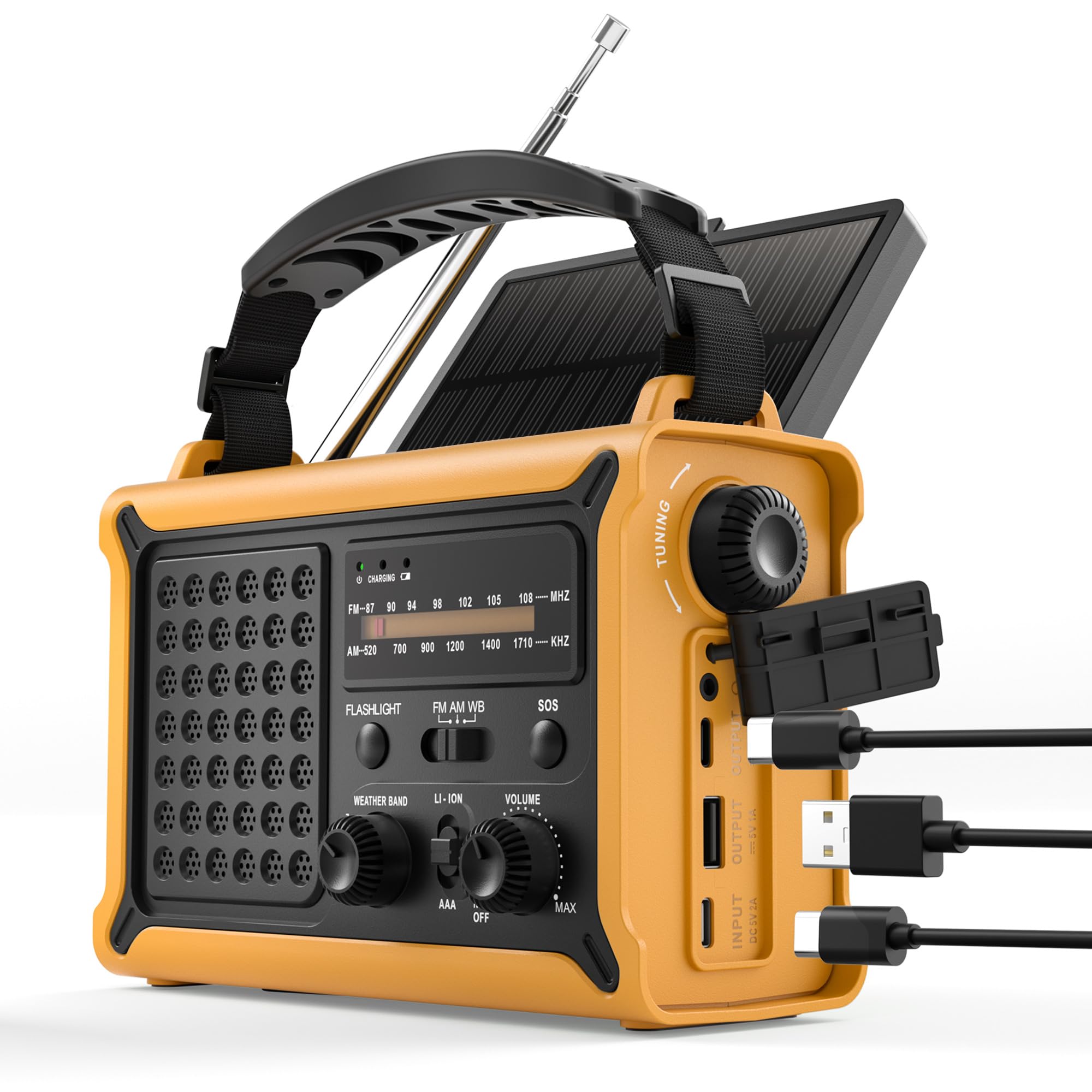
3. OnLyee Emergency Radio with Hand Crank & Solar, 12000mAh
Weather broadcasts you can hear across a room, not just with an ear pressed to the grille.
What owners bring up most with the OnLyee is simply that it works — functionality is the top thing they talk about, with sound quality right behind it. That pairing makes sense once you look at the hardware. A 57mm speaker handles the audio, and DSP signal processing (digital filtering that cuts background hiss and static) keeps AM, FM, and weather-band reception cleaner than a basic analog set. You get 7 NOAA weather channels plus AM and FM.
It shares the same 12000mAh battery as the Mesqool and runs the same 8500mm² solar panel size, with hand crank and Type-C as the other ways back to full. The lighting package is a touch brighter: a 5W LED flashlight, which is 67% more wattage than the 3W light on the QAUYYW, along with a 12-LED reading lamp for blackout hours. A 120dB SOS alarm rounds it out for when you need to signal.
Dimension-wise it measures 6.81 x 2.91 x 4.76 inches — about 10% more on the length than the more compact QAUYYW — so it wants a little more shelf or drawer room. The IPX6 water-resistant shell handles rain and splashes. At 6.81 inches long, it suits hurricane season, camping, and car kits rather than pocket carry.
budget friendly pick: clearer audio and a brighter 5W flashlight than most of the field, in a body that still fits a kitchen drawer.
wants more features: it is a bit longer than the tightest packs here, so check your emergency bag has the room.
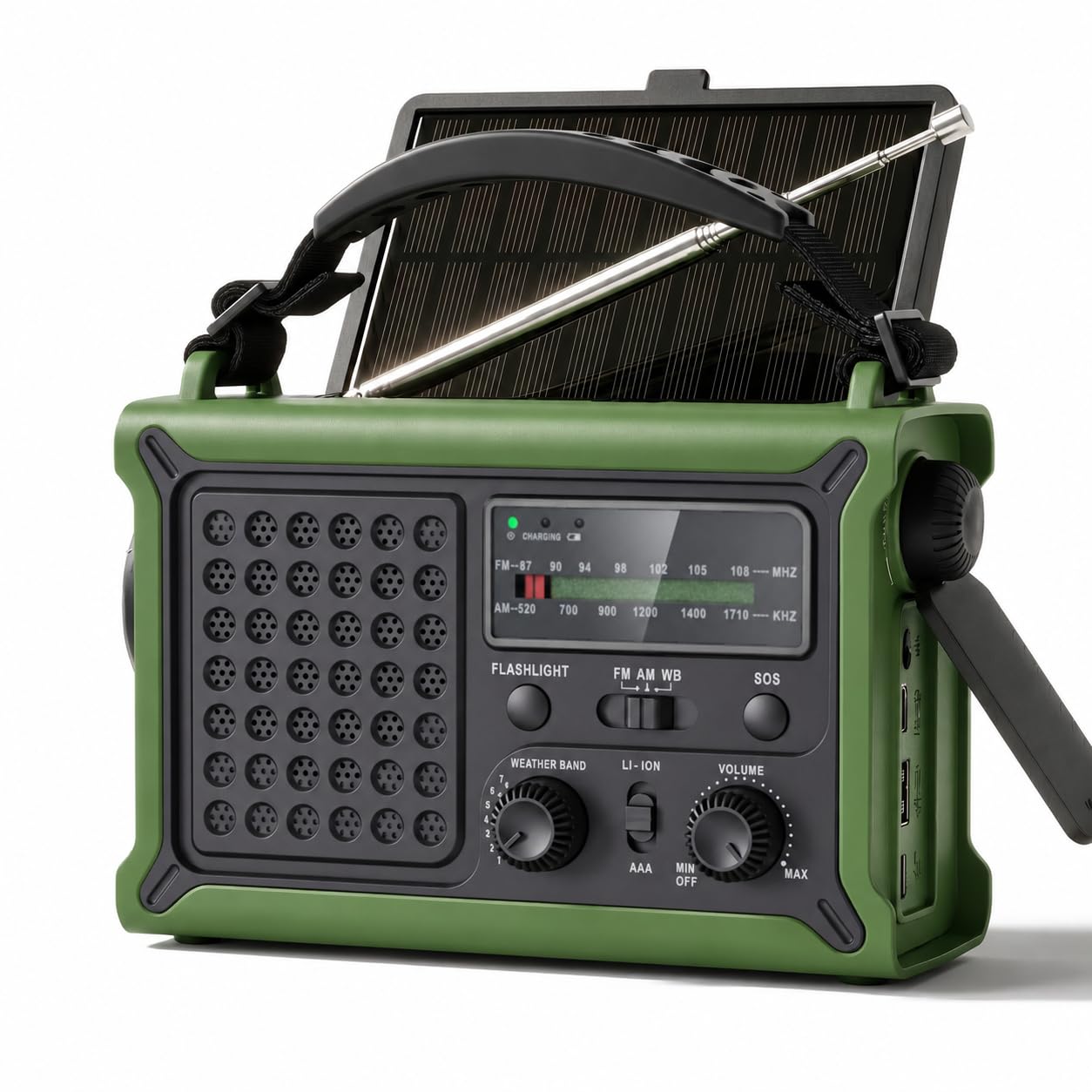
4. Raynic 12000mAh Emergency Weather Radio
Built for fumbling hands in the dark — bigger buttons, grippier knobs, a strap to hold it by.
The Raynic is the pick for anyone who wants a radio an older parent can actually operate during a blackout. Its body is described as 30% larger than a standard frame, and the buttons and anti-slip knobs grow with it, so cold or shaky hands can find them by touch. A soft silicone strap lets you hang onto it or loop it over a hook.
What buyers reward most is the overall quality of the build, followed by the sound. A 57mm full-range speaker handles the audio, and the 5W flashlight pairs with a reading lamp for lighting a dark room. On the power side you get a 12000mAh battery with both USB and Type-C outputs, so a phone can top up from either port, plus solar and hand crank for off-grid refills.
The 120dB SOS siren is the loud, attention-grabbing kind, and the LCD display makes tuning easier to read than an analog dial. Reception draws on a high-sensitivity receiver and a precision-tuned antenna, and it holds up whether you are indoors during a storm or camped somewhere remote. It measures 6.81 x 2.91 x 4.76 inches, matching the OnLyee footprint, so give it real drawer space.
grippy rugged shell: oversized controls and anti-slip knobs make it the friendliest radio here for older users or anyone operating by feel.
heavier than rivals: the larger body is a plus for grip but costs you storage room compared with the smallest picks in this lineup.
built for rough use: an elderly family member, a garage kit, or anyone who wants big controls that work without looking.
needs light carry: you need the most pocketable radio and every inch of bag space counts.
5. Vokida Emergency Radio Hand Crank Solar Survival Kit
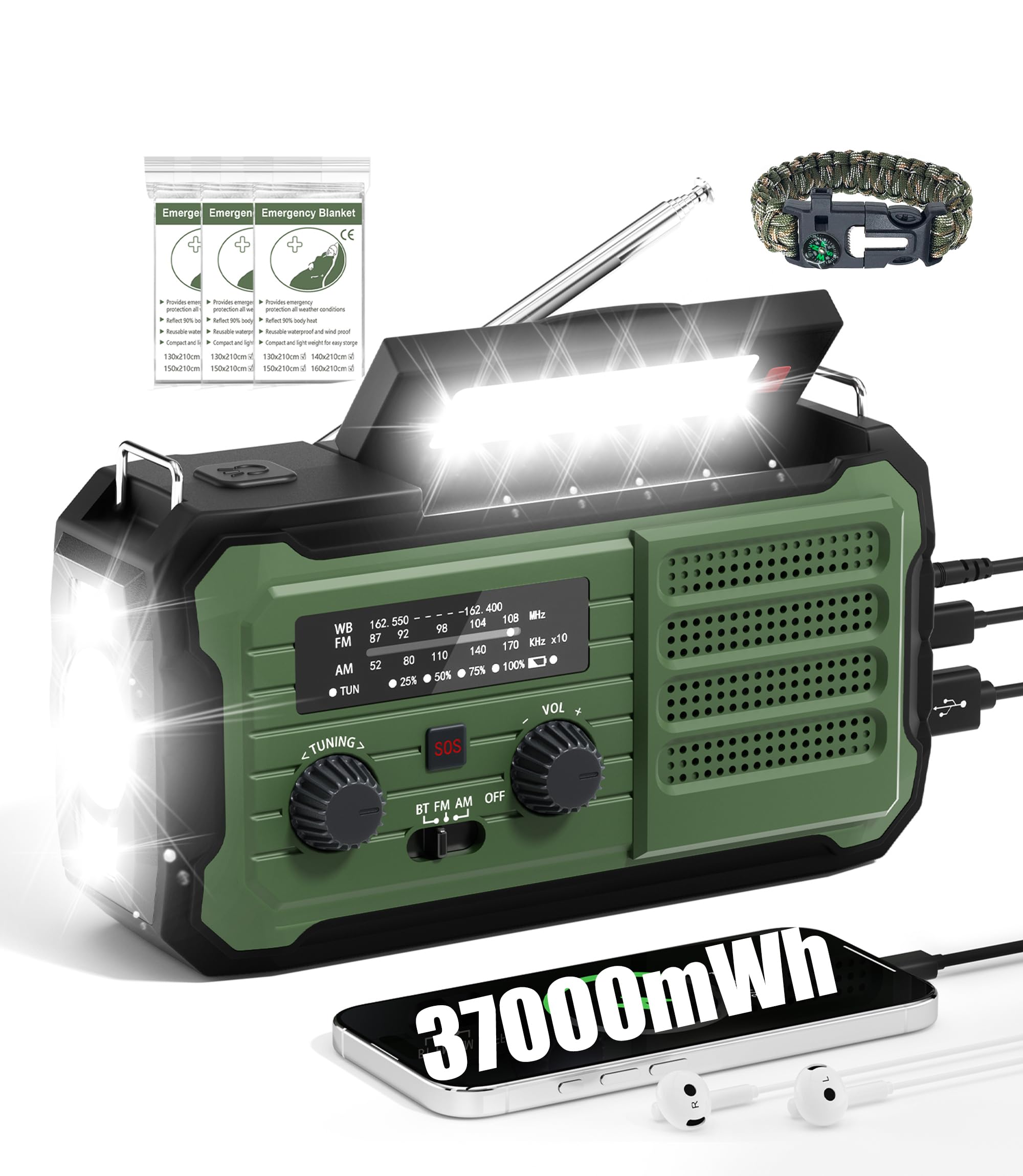
A radio that arrives as a whole go-bag starter kit, not just a box with an antenna.
This is the only pick here that ships with survival gear alongside the radio. The bundle includes three thermal blankets — aluminized sheets that weigh 55g each and reflect body heat — plus a 5-in-1 paracord bracelet. That bracelet packs 10 feet of military-grade cord with a compass, a cutting blade, an emergency whistle, and a waterproof magnesium fire rod built in.
On the radio side, the capacity is listed as 37000mWh rather than in mAh, which is a different unit of measure from the rest of this lineup, so do not read it as the biggest battery here. Three charging paths keep it alive: hand crank, solar panel, and the internal battery. An automatic weather scan sweeps the 7 weather band channels when activated or in standby, watching for alerts so you catch one even while sleeping.
A headphone jack lets you listen without disturbing others, and the USB port charges a phone. The SOS button fires a loud siren with a flashing red light. Buyers report it is a compact device that charges well in the sun, and they often praise the three included blankets. At 6.5 x 2.4 x 3.5 inches, it fits easily in a car or camp kit. The flip side: it is a basics-first radio, so if crisp audio and a big flashlight matter most, the OnLyee above beats it on both.
kit for beginners: you are building a from-scratch emergency bag and want the radio plus blankets and tools in one purchase.
radio only please: you already own survival gear and just want a stronger radio for the same shelf space.
6. Rychi 10000mAh Emergency Radio with 4 Charging Modes

The one the review pages rave about for sound — and it costs the least ear effort to enjoy.
Sound quality is the runaway favorite among buyers, far ahead of anything else they mention. So if you want a radio that doubles as a decent kitchen companion when the power is on, this is the one to consider. A 10000mAh battery backs that up with specific run times: up to 25 hours of radio playback at medium volume, 30 hours of reading-lamp use, and 40 hours of flashlight operation on a single charge.
It gives you four ways to refill — USB-C, solar, hand crank, and AAA batteries (sold separately). That last option is the rare one in this lineup: drop in standard AAA cells and the radio works even if the internal battery is flat and the sun is gone. An extended 7-section antenna improves signal, and the LCD band display makes tuning easy, covering AM 520-1710 kHz, FM 87-108 MHz, and weather band 162.400-162.550 MHz.
The smaller 10000mAh cell is the honest trade-off — it is the least stored power here, so a very long outage will ask more of the crank or sun than the bigger-battery picks. At 1.19 pounds and 6.69 x 2.83 x 3.27 inches it is easy to carry, and the 3W flashlight with LED reading lamp covers the lighting side. Brightness and lighting draw mixed notes, so treat the lamp as a convenience, not a floodlight.
flexible charging pick: the best pure listening in this comparison, backed by the flexibility of AAA batteries as a last-resort power source.
needs bigger reserve: with the smallest battery here at 10000mAh, you will lean on the crank and solar panel more during a long blackout.
7. PPLEE 12000mAh NOAA Weather Radio with Hand Crank & Solar
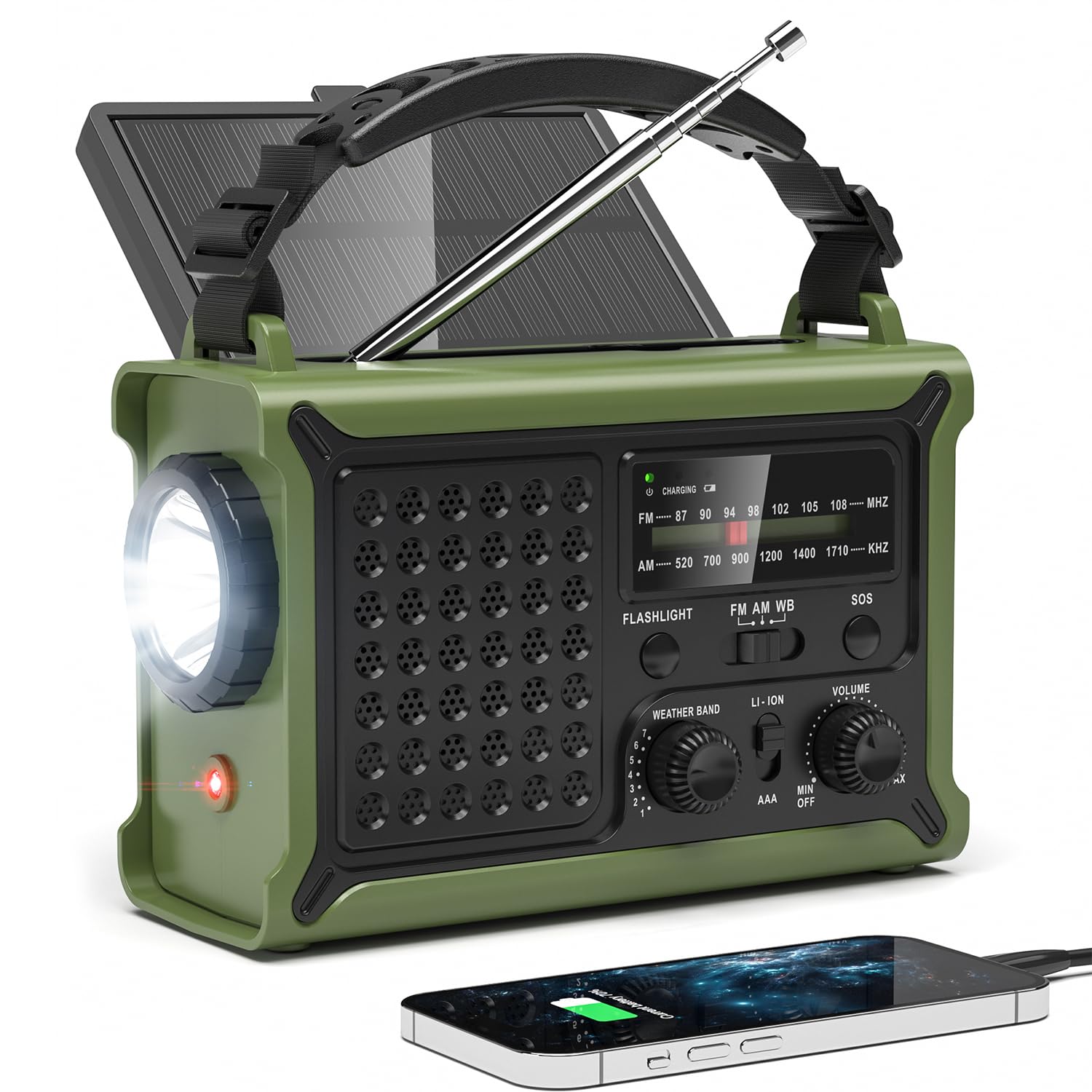
Sixty hours of FM listening on one charge — the endurance king of this lineup.
Where most radios here tell you capacity in mAh, the PPLEE tells you what that battery actually delivers: up to 60 hours of FM listening at 50% volume. That is the longest quoted run time in this whole comparison, and it comes from a true 12000mAh pack the maker says is tested rather than inflated. Quality is what owners appreciate most, with battery life close behind, which lines up with a radio that just keeps going.
It gives you four ways to stay powered — USB-C, solar, hand crank, or 3 AAA batteries — and the 8500mm² solar panel grabs more sunlight while the extended crank eases manual charging. The lighting is the brightest of the group. A 300-lumen flashlight throws up to 70 meters, and a 250-lumen reading light covers a room or tent wide, backed by a 115dB SOS siren.
It receives 7 NOAA weather channels plus AM and FM, with a high-sensitivity chip and noise-reduction circuitry for stable sound. One piece of housekeeping: the USB-C cable is included but a wall adapter is not, so plan how you will charge it the first time.
long NOAA runtime
- Up to 60 hours of FM listening at 50% volume on one charge
- 300-lumen flashlight reaching up to 70 meters — the strongest beam here
- Four power paths including 3 AAA batteries as a fallback
- 250-lumen reading light throws a wide, room-filling glow
fiddly small controls
- No wall adapter in the box — only the USB-C cable ships
- A taller upright body that wants counter space, not a slim drawer
endurance favorite: run time and a powerful flashlight top your list and you want a radio that stands ready for days.
prefers simpler dials: you want the top-rated sound in a lighter, smaller-footprint body.
Know the Specs
Battery capacity in mAh
mAh (milliamp-hours) is the size of the stored charge, and it sets how long the radio runs and how much phone backup it can give. A 12000mAh pack outlasts a 10000mAh one, and a 20000mAh unit lasts further still. In an outage, a 20000mAh pack buys several more nights of listening than a 10000mAh one before the crank comes out.
Solar panel size in mm²
The panel is measured in square millimeters, and bigger tends to mean a faster trickle of charge from the same sunlight. An 8500mm² monocrystalline panel gathers more light than a small decorative one, which matters on overcast days. Treat solar as a slow top-up, not a fast fill — an 8500mm² panel trickles charge over a day rather than refilling in an hour.
Noaa weather band coverage
NOAA weather radio broadcasts run on dedicated channels, and these units tune 7 of them plus AM and FM. Tuned to one of those channels, the radio delivers tornado, flood, and hurricane updates with no cell service at all. The important caveat: alerts only arrive when the radio is switched on and tuned to a weather station — it does not turn itself on to warn you.
Light output in lumens and watts
Flashlight strength is quoted in lumens (total visible light) or watts (power draw). A 300-lumen beam reaches farther than a 3W light, and the PPLEE’s quoted 70-meter throw shows the difference. Match the output to your use — a bright throw for outdoors, a soft lamp for reading in a dark room.
Common Questions
Will an emergency radio work when the power and internet are both out?
Do these radios turn on automatically to warn me of a storm?
How many hours does a 12000mAh emergency radio actually run?
Is a hand crank or a solar panel the better backup?
Can an emergency radio charge my phone during a blackout?
Will a solar emergency radio charge in cloudy weather?
What does the SOS alarm do and when should I use it?
Should I use AAA batteries or the built-in rechargeable cell?
How do I get the clearest reception from a hand crank radio?
Will an IPX6 radio survive being left outside in the rain?
The Bottom Line
For most households, the battery operated radio for emergencies that covers the most ground is the Mesqool Solar Radio. Its real 12000mAh battery, oversized 8500mm² solar panel, and twin lights make it the all-rounder to keep in a kitchen drawer. If a longer outage worries you most, the QAUYYW 20000mAh holds the biggest reserve in this comparison. Want the best pure listening? The Rychi wins on sound. And for building a survival kit from scratch, the Vokida bundle arrives with blankets and tools included. Match the pick to your storage space and expected outage length, then charge it fully and leave it ready.
How we choose
We do not accept paid placement. Every pick is matched to a real buyer and a real use-case; we do not hands-on test units.
Sources
Specifications: manufacturer listings and product documentation. Review insights: verified customer reviews, as of November 2026. Pricing: not shown on this page (it changes often); check the current price via the retailer link.
As an Amazon Associate, My Heart Lives Here earns from qualifying purchases. This does not affect which products we feature.