Heads up: This post contains affiliate links. As an Amazon Associate I earn from qualifying purchases, at no extra cost to you. Learn more
Specs are compiled from manufacturer listings and verified buyer reviews and can change over time — please confirm the key details on the product page before buying.
A radio box that promises 10 miles of coverage rarely delivers it in the real world. What separates a good pair from a frustrating one is how it holds up at the distances you actually use it — a campsite loop, a ski slope, a warehouse floor — and whether it survives a drop in the mud.
This guide is built by comparing the manufacturers’ published specifications and the patterns across verified customer reviews, so you get each pick’s real strengths and trade-offs instead of marketing spin.
That is why this breakdown of the 10 mile walkie talkie focuses on what survives a real trail.
Top Picks

How To Choose The Best 10 Mile Walkie Talkie
Start with one blunt fact: a 10-mile walkie talkie is a marketing number, not a promise. The range printed on the box assumes flat, open ground with nothing between the antennas. Add trees, a hill, a vehicle body, or a building wall and the usable distance drops quickly. So instead of hunting for the biggest number on the box, pick a radio whose real strengths match your terrain.
Read the range claim for what it is
Radio waves at FRS power travel roughly line of sight — meaning they want a clear path between you and the other handset. A pair rated for 25 miles can still struggle at two miles in a dense forest or inside a mall. The useful number in any listing is the one the maker admits for everyday conditions, not the ideal-condition maximum.
Understand FRS versus GMRS licensing
FRS (Family Radio Service) radios are license free — you buy them and talk, no paperwork. GMRS (General Mobile Radio Service) radios can reach further on some channels but generally require a license in the United States. If you want zero friction on a family trip, stay with FRS handsets and check that every radio in your group runs the same service.
Match battery and charging to your trip length
A day hike needs a radio that lasts a full outing; a week-long camping trip needs one you can top up from a power bank. A 1200mAh battery rated for 72 hours of standby behaves nothing like an 800mAh pack rated for 12 hours. If you plan to be off the grid, confirm there is a USB-C or drop-in dock option before you commit.
Weigh ruggedness honestly
An IP rating tells you how well a radio resists water and dust — IP67 means it is sealed against dust and can survive a dunk. MIL-STD-810H is a military durability standard covering drops, vibration, heat, and cold. Neither is essential for a shopping mall, but both matter on a wet ridge line. Heavier radios usually pay for that toughness in bulk, so a 16-ounce radio feels very different on a belt than a 3.8-ounce one.
Side-by-Side Comparison
| Model | Best For | Rated Range | Battery | Pack Size | Amazon |
|---|---|---|---|---|---|
| Midland T77VP5 X-Talker★ Best Overall | Families wanting a full starter kit | Up to 38 miles | 15 hours | 2 pack | Amazon |
| NXGKET Long Rang 5 MilesBest Value | Group trips and kid-friendly crews | 5 miles | 1800mAh | 4 pack | Amazon |
| Cobra ACXT390 | Lightweight hunting and hiking carry | 25 miles | AA NiMH | 2 pack | Amazon |
| MaxTalker MT10 6Pack | Large crews that need a radio each | 5 miles ideal | 1200mAh / 72 hr standby | 6 pack | Amazon |
| Retevis RB48 | Wet, rough field work | 25 floors / 300,000 sq.ft. | 2000mAh / 20 hr | 2 pack | Amazon |
| Motorola Talkabout T475 | Cruise ships and family outings | FRS line of sight | 800mAh / up to 12 hr | 2 pack | Amazon |
| Motorola T605_H2O | Water sports and emergency kits | 35 miles | 9 hours | 2 pack | Amazon |
Detailed Reviews
1. Midland T77VP5 X-Talker FRS Walkie Talkie
Our pick — 4.5+★ from 950+ verified ratings; the strongest balance of quality and price.
A two-radio FRS kit with a hard carry case, desk charger, car adapter, and two boom mic headsets in the box.
What you get here is a complete two-radio setup rather than a bare pair. The box holds two radios with rechargeable battery packs, a desk charger, a USB car adapter, a hard carrying case, and two boom mic headsets.
The privacy setup is the standout spec on paper. You get 121 CTCSS privacy codes (tone codes that filter out other people on the same channel), which the maker pairs with 36 channels — they describe 2,662 channel combinations in total. In practice that means on a crowded ski hill or a busy event lot you can pick a quiet corner of the band and not hear every other family on the mountain. NOAA Weather Scan auto-scans the 10 available weather band channels and locks onto the strongest one, so a storm warning reaches you without you hunting for it.
Build quality is what wins owners over, with durability and reliability the next things they mention. Buyers report it charges fully in just 3 hours, and you can drop in standard alkaline batteries when there is no outlet — the listing’s USB and car adapter paths both work. Range is the one split subject, and it behaves like every FRS radio (a licence-free family band): fine over open water or a clear road, shorter once trees and hills get involved. The weight is an honest cost too — at 16 ounces this is the heaviest pick on this list, and the Cobra below weighs just 3.8 ounces. If belt comfort matters more than features, that is a real fork in the road.
What earns its place
- Two boom mic headsets and a hard case included — hands-free talk without buying extras
- 121 privacy codes across 36 channels gives you a quiet channel on a busy hill
- Runs on rechargeable packs or standard alkaline when you are off the grid
- NOAA Weather Scan locks onto the strongest of 10 weather channels automatically
Where it asks you to compromise
- At 16 ounces it is the chunkiest radio in this guide — a long day on a belt clip feels it
- Real range shortens sharply once terrain gets in the way, like all FRS handsets
Reach for this if: you want one box that outfits a carload of people with headsets, chargers, and a case on day one.
Look elsewhere if: you need a featherweight radio for a long hike — 16 ounces against the Cobra’s 3.8 ounces is a big difference on a shoulder strap.
2. NXGKET Walkie Talkies Long Rang 5 Miles
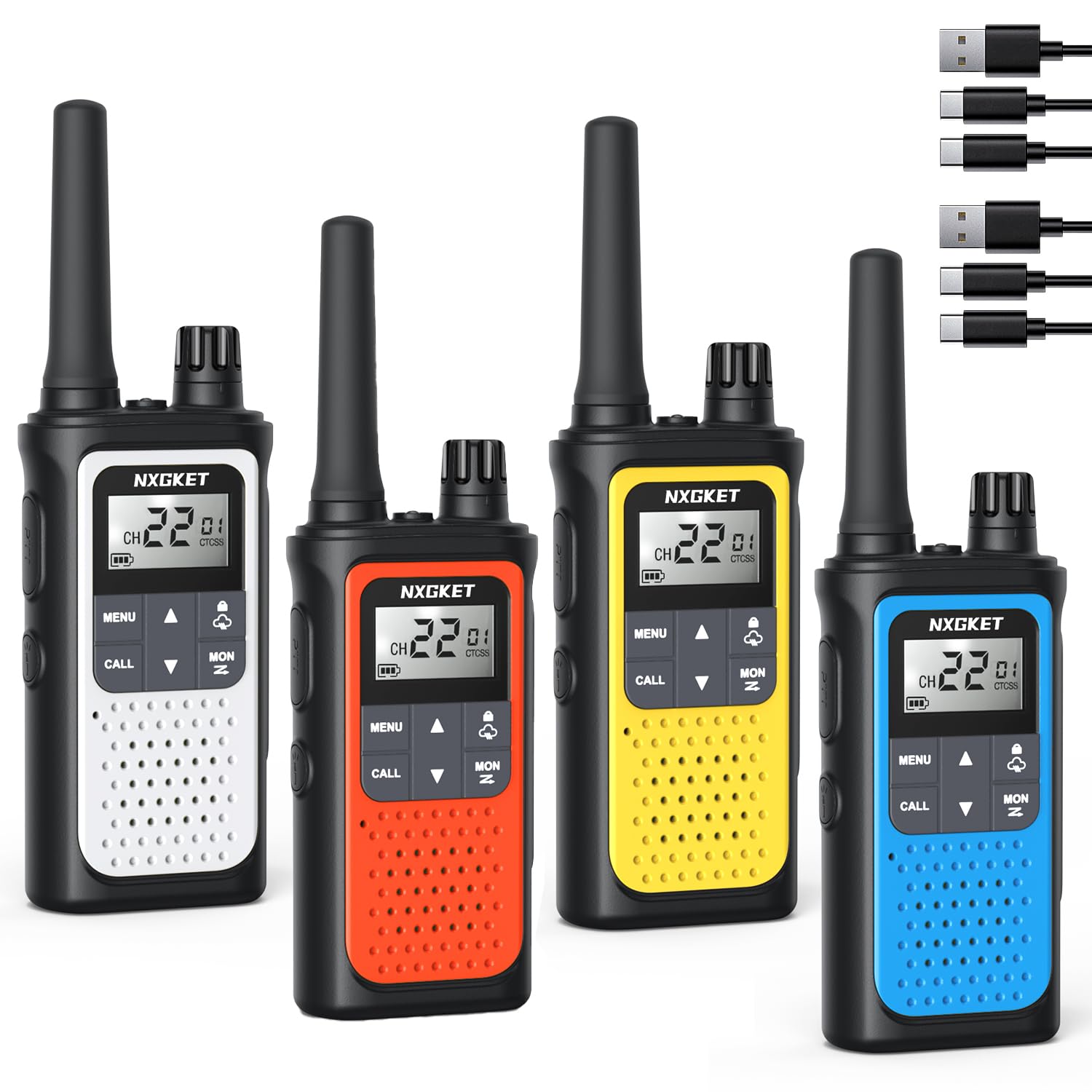
Four IP65-rated FRS handsets with built-in 1800mAh batteries, so a family of four each gets a radio.
Four handsets make this the practical answer when your trips involve more than two people. Each radio has a built-in 1800mAh lithium battery (a rechargeable power pack) — the biggest capacity in this guide, versus 1200mAh on the MaxTalker below. That means no hunting for AA packs and no bin full of dead cells after every outing. A 2-in-1 USB-C cable charges two radios at once, so one power bank covers the whole family overnight.
The speaker gets a volume bump the maker states as a 150% increase, which does help when you are shouting over wind or an engine. Handsfree works two ways: nine levels of VOX (voice-activated transmission, where the radio sends when you start speaking) plus a vibrate alert so a call reaches you without a loud beep. The IP65 rating means it shrugs off dust and splashing water — a rain shower on a campsite is not a problem.
Build and value are what owners talk about most, and battery life that stretches for several days comes up repeatedly. The most common honest note is range: 5 miles is the listed ideal, and short-range chatter is where this radio lives happily. That is fine for a campsite, a cruise deck, or a bike trail where you can see each other — less fine if you are picturing a ridge-to-ridge call. Compare it to the Cobra above and the range numbers read 5 miles versus 25 miles on paper, though both are real-world much shorter than the box suggests.
The group-trip math: four radios for the price of a single premium pair is the whole argument. A family of four each gets their own handset, and the 150% louder speaker keeps the chatter audible over wind and engine noise.
Size it honestly: 5 miles is the ideal-condition figure. Across a valley or through a treeline, expect far less — so treat this as a campsite and cruise-deck radio rather than a search-and-rescue tool.
Suits you when: four people need radios and you want rechargeable batteries built in rather than a drawer full of AA spares.
Skip this one for: long-distance terrain calling — the 5-mile ideal claim is the smallest reach on this list.
3. Cobra ACXT390 Walkie Talkies

A 3.8-ounce FRS handset with 22 channels, 121 privacy codes, and a 25-mile open-sky range claim.
At 3.8 ounces, this is the lightest radio in the lineup — the Midland above weighs 16 ounces, so this is a very different carry feel on a long hike. The shell is built to take knocks, and the compact body slips into a jacket pocket or a pack pocket without a second thought. For hunting, hiking, or a job site where you are moving all day, that lightness is the reason to pick it.
Owners split on how far it reaches in real use. Some say it works well at long distances with clear audio; others find it only holds up to about two miles and report garbled sound at the edge of range. That is terrain, not a defect, but you should plan around a shorter practical leash than the label suggests.
Where it delivers reliably is convenience. There are 22 channels and 121 privacy codes to dodge other users, 5 selectable call tones so you know who is calling, and a channel scan that sweeps for incoming traffic. VOX (voice-activated transmission) keeps your hands free when you are climbing or working, and 24/7 NOAA weather access means storm warnings reach you on the trail. Add six included AA NiMH rechargeable batteries and the running cost stays low.
Reasons this earns a spot
- 3.8 ounces — roughly a quarter of the Midland’s 16-ounce frame on your belt
- Claims up to 25 miles, far beyond the 5-mile NXGKET on paper
- 5 call tones plus channel scan make group use easy to sort out
- VOX handsfree and 24/7 NOAA weather keep you moving and informed
The honest counterweight
- Real-world reach is inconsistent — some users land well short of the box claim
- Belt clips have been a weak point for a small number of buyers
Best matched to: hikers and hunters who want the lightest radio on the belt and value the 25-mile claim as a ceiling rather than a promise.
Think twice if: you need consistent long-distance contact — plan on roughly line-of-sight performance no matter what the box says.
4. MaxTalker MT10 Rechargeable 22 FRS Channel 6 Pack

Six FRS handsets with 1200mAh rechargeable packs rated for 72 hours of standby, no AAAs required.
Six radios in one order is the whole point here, and the battery inside is the upgrade that makes it work. Each handset carries a 1200mAh rechargeable lithium pack rated for up to 72 hours of standby — the maker explicitly replaced the older AAA design with it. On the battery front the spread against the competition is wide: the MaxTalker’s 72 hours compares to 15 hours on the Midland, so a weekend trip does not need a charger at all if usage is light.
What the box admits about range is refreshing. The maker states 0.6–1.5 miles in regular conditions and up to 5 miles only in ideal ones, which is closer to the truth than most listings. If your group stays within sight of each other — a campsite, a boat, an ATV trail — that is plenty. If you expect a ridge-to-ridge call, no FRS radio at this battery level will deliver it.
The extras round it out for outdoor use: NOAA weather alerts, a VOX setting for handsfree talk, and an integrated LED flashlight that saves you digging out a torch at dusk. The 22 channels and 121 sub-channels let you switch to a clear frequency, and the radios work with other brands’ handsets on the same channel and privacy code, so a mixed group is fine. It is also sold as a gift magnet — owners mention it as a hit for camping and ATV riding families.
Scale, in one number: six radios on 1200mAh each, USB-C rechargeable, and 72 hours of standby. For a scout troop, a tour group, or a big extended family, this is the clearest way to get a radio into every hand.
Set the range expectation: the maker’s own 0.6–1.5 mile everyday figure is the honest number. If you need to cross a valley, this is the wrong tool.
Go for it when: the group is large and staying roughly together — six rechargeable radios beat buying AA cells in bulk.
Look past it if: any pair in your group needs to talk across a real valley — the honest everyday figure is under a mile to a mile and a half.
5. Retevis RB48 FRS Walkie Talkies
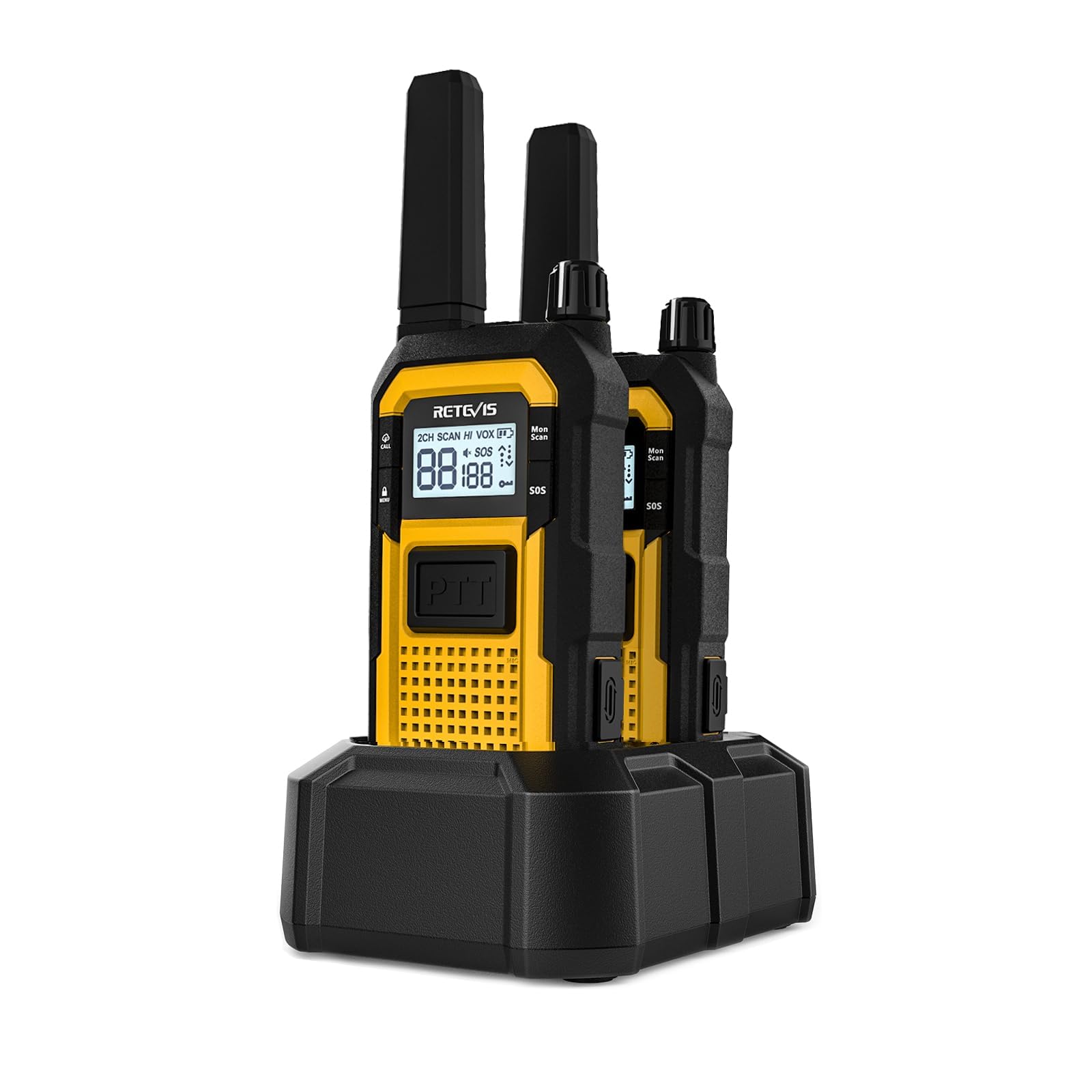
A 730 g FRS handset tested to MIL-STD-810H and sealed to IP67 for drops, dust, and immersion.
It is tested to MIL-STD-810H, the military durability standard covering drops, dust, vibration, heat, and cold. On top of that is IP67 sealing — dustproof and rated against immersion — and the maker states it passed 1000 drops from 2 meters without breaking. If your radios live in a toolbox, a truck bed, or a wet field, this is the one built for that life.
A 2000mAh battery pack (a rechargeable power pack) gives this radio the longest run time in this guide, and the 20-hour figure is a full working day plus change. You charge it two ways: USB-C or a drop-in charging dock that holds both radios at once. The maker also states a range of up to 300,000 sq.ft. and 25 floors — a building-coverage figure, so pick this one for warehouse, hotel, or multi-floor site work rather than a canyon.
Practical touches show it was meant for gloved hands and grim weather. There are dual PTT buttons, silicone button covers, and an optional roger beep that confirms your message sent. The bright yellow housing is easy to spot on a shelf or in a truck cab. Owners are consistently pleased — quality and functionality are what come up most, followed by range, and the durability holds up in genuinely rough use. One caveat to weigh: at 730 g it is a substantial brick compared to the Cobra’s 3.8 ounces, so this is not the radio for a long hike.
Built to take punishment
- MIL-STD-810H tested, IP67 sealed, and rated for 2-meter drops
- 2000mAh battery with a stated 20-hour life — the longest in this guide
- Dual PTT and silicone buttons work with gloves on a wet job site
- Charges by USB-C or a two-radio dock
What you give up
- 730 g is heavy — a real trade-off for anyone used to a pocket-sized radio
- The 300,000 sq.ft. range figure is a building-coverage spec, not an outdoor trail claim
Made for: job sites, warehouses, farms, and wet weather where a dropped radio cannot be the end of it.
Leave it on the shelf if: you want a light hiking radio — 730 g in a chest pocket gets old fast.
6. Motorola Talkabout T475 Extreme Two-Way Radio
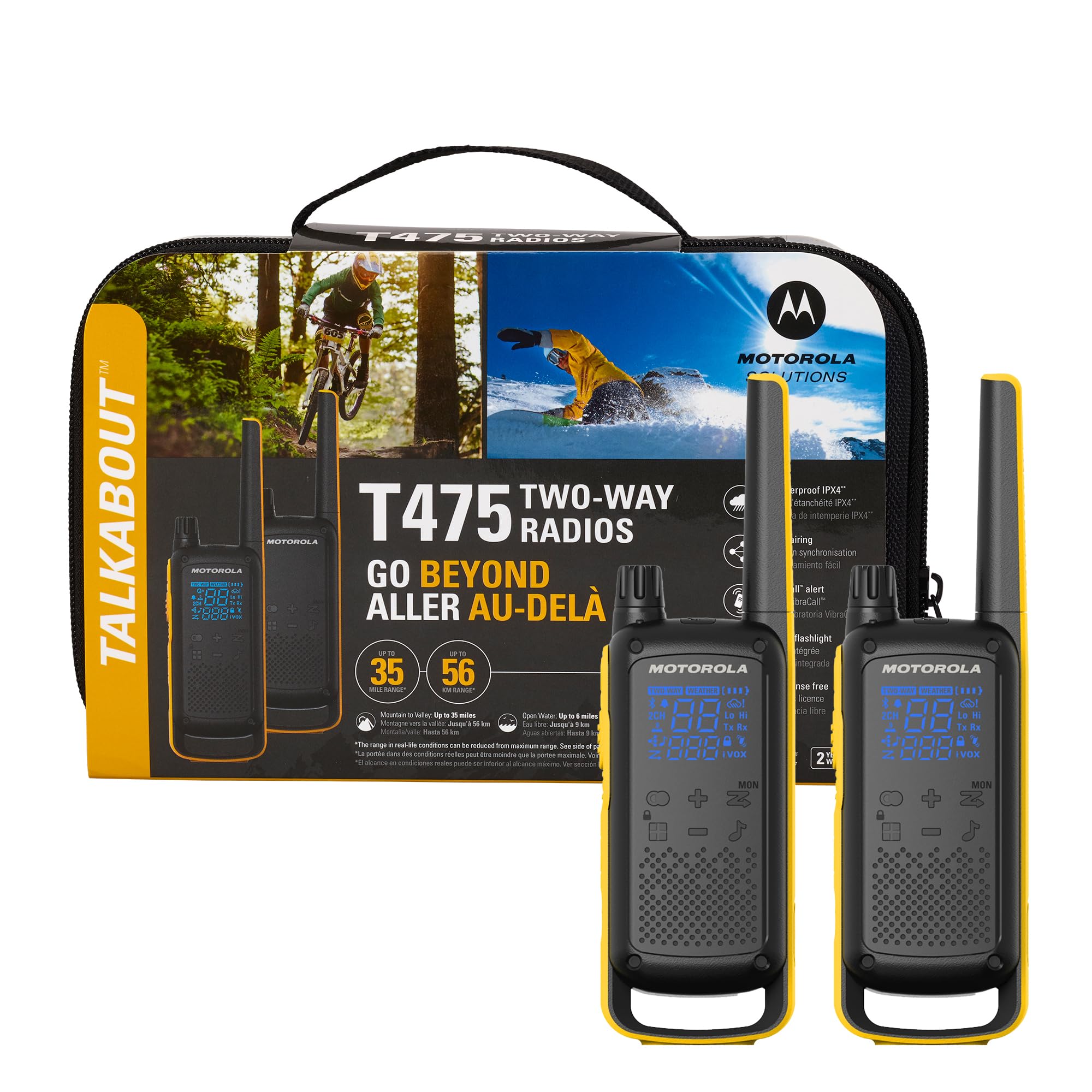
An FRS two-pack with VibraCall silent alerts, a built-in flashlight, and IPx4 splash resistance.
On a cruise ship or in a busy resort, a loud beep is unwelcome — a vibrate alert is the feature people end up loving. The VibraCall setting buzzes your radio instead of blaring at you, and that small detail is what makes it a favorite for travel. Add a built-in flashlight, a lanyard, and a carry case in the box, and it is ready to go straight from the cabin.
The licensing side is simple: FRS radios are license free, so there is no paperwork. You get 22 channels and 121 privacy codes for 2,662 channel combinations, easy pairing between the two handsets, and NOAA weather radio with alerts. The 800mAh NiMH rechargeable pack is rated up to 12 hours, and dual power means you can also drop in AA batteries if the pack runs flat. IPx4 weather-proofing handles a splash, though it is not built for a dunk.
Owners find it high-quality and easy to use, especially for family cruises — the use case it was clearly designed around. Battery and range get a more mixed reaction: some find both plenty for around the ship, while others report the batteries not holding a charge long and the range falling short of the advertised figure. If your plan is a deck, a resort, or a theme park, that trade-off is easy to live with. It is the least rugged of the premium picks, so keep it out of the pool.
The quiet-cabin win: VibraCall alerts plus a built-in flashlight make this feel tailor-made for cruise decks and hotel corridors where a beeping radio earns dirty looks.
Battery, sized plainly: the 800mAh pack is rated up to 12 hours and dual power gives you an AA fallback — but the gap to the Midland’s 15 hours is on the shorter side of this list.
Fits the trip when: you are on a cruise, at a resort, or anywhere a silent buzz beats a loud beep and the radios stay near each other.
Not the pick if: you plan to get the radios wet — IPx4 handles a splash but not immersion.
7. Motorola T605_H2O Waterproof Walkie Talkie
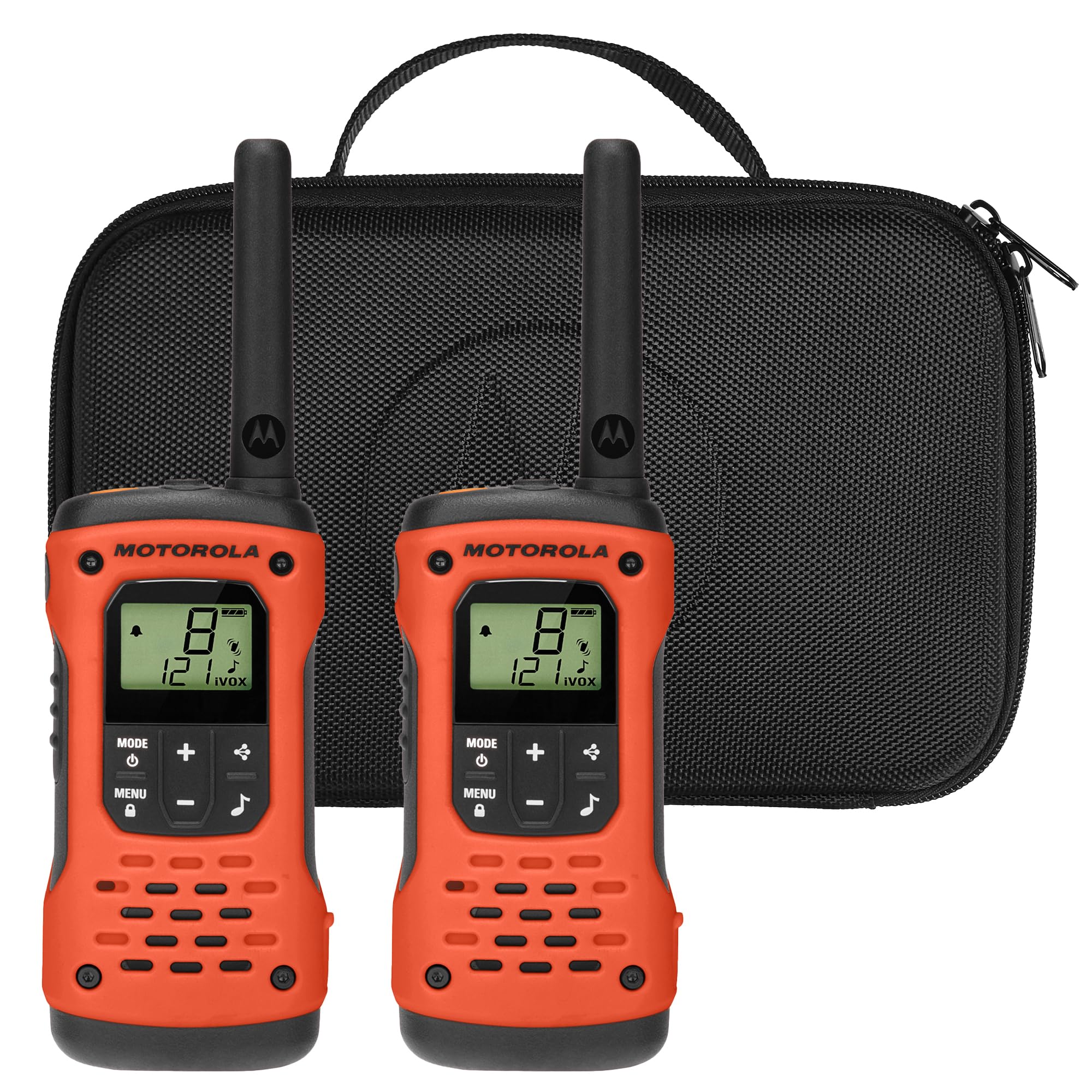
An IP67 FRS two-pack that floats face up and triggers a water-activated flashlight on a dunk.
If your radios go anywhere near water — a kayak, a jet ski, a fishing boat, a rainy trail — this is the radio that answers the question. IP67 sealing means full dust protection and immersion survival, and the float design keeps it on the surface with the controls up. It even has a water-activated flashlight, so a dunk triggers the light and helps you find it in the dark or the chop.
It is a full FRS setup: 22 channels and 121 privacy codes for 2,662 channel combinations, easy pairing, and a backlit display that stays readable at dusk. Charging runs through USB-C, so one cable covers it alongside your phone. It is rated for 9 hours of battery and shipped as a two-radio pack with rechargeable batteries and cables. The maker lists 35 miles of range, though that is an open-sky figure — treat it as a ceiling, not a floor.
Owners find it simple to use with very clear audio. The functionality and range side is more mixed: some say it works well with good range, while others have had a unit stop working or found it short of the advertised distance. Those are real, but for a two-pack of sealed, floating radios with USB-C charging, the tough-to-argue-with part is the water protection. If you mainly need a dry-land or cruise-deck pair, the cheaper T475 above does the same job without paying for the waterproofing. At 7.84 ounces it stays light on a life jacket strap.
The overboard insurance: IP67 sealing plus a float-face-up body and a water-activated flashlight — this is the only radio here built to come back from a dunk.
Weigh the spend: USB-C charging and 9 hours of battery are solid, but if the radios never touch water, the T475 does the same FRS job for less.
Your pick when: water is on the itinerary — kayaks, boats, jet skis, or a family that loses things overboard.
Pass it by if: the radios live on dry land — IP67 and float design are the main reason it costs more than the T475.
Know the Specs
Listed Range vs. Real Range
The big number on the box — 25 miles, 35 miles, up to 38 miles — is the maker’s best-case figure over open, unobstructed ground. Radio waves at FRS power travel close to line of sight, so trees, hills, buildings, and vehicle bodies eat into that fast. A radio rated for 25 miles might manage two miles in a dense forest. When comparing models, look for a maker who states a realistic everyday figure like 0.6–1.5 miles, because that number tells you far more about what you will actually experience.
Water and Drop Ratings
An IP rating describes how well a radio resists water and dust. IP65 means dust-tight and protected against water jets; IP67 adds immersion survival, which matters on a boat. IPx4 covers splashes only. Separately, MIL-STD-810H is a military standard that tests for drops, vibration, heat, and cold. A radio carrying both — like the Retevis RB48 — is built for rough field work. A splash-rated radio is fine on a cruise deck but should not go in the pool.
Battery Capacity and Chemistry
Battery capacity in mAh (milliamp-hours) measures how much charge the pack holds, and chemistry decides how it behaves. A 1200mAh lithium pack with 72 hours of standby behaves very differently from an 800mAh NiMH rated for 12 hours. Lithium packs generally hold charge longer between uses; NiMH packs work but often need a top-up before a long trip. Dual power — a rechargeable pack plus an AA fallback — is the safety net for off-grid trips.
Channels, Privacy Codes, and Licensing
Channels are the frequencies you can talk on; privacy codes are tone filters that silence anyone not using the same code. A radio with 22 channels and 121 privacy codes gives 2,662 combinations — plenty to find a quiet channel on a busy mountain. FRS radios are license free, so you buy and use them without paperwork. GMRS radios can reach further on some channels but generally require a license in the United States. For a family trip, keep everyone on FRS.
Common Questions
Will a walkie talkie actually reach 10 miles in the woods?
Do I need a license to use an FRS walkie talkie?
Can I mix brands of walkie talkies in one group?
What does IP67 mean on a walkie talkie?
How long does a walkie talkie battery last on a camping trip?
Are NOAA weather alerts worth it on a walkie talkie?
Is a heavier radio more durable than a light one?
Will privacy codes stop other people hearing my conversation?
Can I use rechargeable batteries or do I need alkaline?
What is the difference between VOX and a normal push-to-talk button?
The Bottom Line
The best pick in this lineup is the Midland T77VP5 X-Talker, because it lands with two radios, rechargeable packs, a hard case, and two boom mic headsets — the most complete kit in the group. If the trip involves more than two people, the NXGKET 4 Pack puts four rechargeable handsets in everyone’s glove, while the Retevis RB48 is the one to reach for on a wet, rough job site where a drop cannot end the day. Whatever you pick, remember that real range is terrain, not the box — the Motorola T605_H2O will float back to you, but no FRS radio crosses a mountain.
How we choose
We do not accept paid placement. Every pick is matched to a real buyer and a real use-case; we do not hands-on test units.
Sources
Specifications: manufacturer listings and product documentation. Review insights: verified customer reviews, as of November 2026. Pricing: not shown on this page (it changes often); check the current price via the retailer link.
As an Amazon Associate, My Heart Lives Here earns from qualifying purchases. This does not affect which products we feature.