Heads up: This post contains affiliate links. As an Amazon Associate I earn from qualifying purchases, at no extra cost to you. Learn more
Specs are compiled from manufacturer listings and verified buyer reviews and can change over time — please confirm the key details on the product page before buying.
If you have never touched a sewing machine, the machine you buy should do one thing above all else: let you finish a straight seam without wanting to throw it out the window. That means a forgiving threading path, a bobbin you can see and reach, and a motor that creeps along slowly while you learn where your fingers belong. Everything else — the decorative stitches, the buttonhole settings, the quilting feet — is a bonus you will grow into. This guide walks you through the picks that make those first real projects actually happen, then shows you exactly which numbers on the box matter and which ones are noise.
This guide is built by comparing the manufacturers’ published specifications and the patterns across verified customer reviews, so you get each pick’s real strengths and trade-offs instead of marketing spin.
Mechanical machines with slow-start foot pedals are the friendliest starting point, and the picks below range from tiny tabletop models to full-size workhorses. A simple basic sewing machine for beginners rewards you most when threading is visible and stitch changes take one dial turn.
Top Picks


How To Choose The Best Basic Sewing Machine for Beginners
A beginner machine is not a smaller version of a serious machine — it is a different tool with different priorities. The two things you will do most in your first six months are thread the needle and load the bobbin, so those two systems deserve the most attention before you look at anything else.
Bobbin placement: drop-in top versus front-loading
A drop-in top bobbin sits in a clear plastic window right under the needle, so you can see the thread path and clear a jam without flipping the machine or removing a case. A front-loading bobbin (also called a vertical oscillating hook) hides the bobbin inside a metal casing you remove to refill. Both work, but top-loading wins for nervous first-timers because a misplaced bobbin is visible immediately rather than discovered three inches into a seam. Machines with top-loading bobbins in this guide range from a compact tabletop unit up to full-size Brother models.
Stitch count versus stitch applications
Marketers mix these two numbers on purpose. A built-in stitch is the physical pattern the machine can make — a straight line, a zigzag, a blind hem, a decorative scallop. A stitch application counts all the variations you can produce by changing the width and length of those stitches. So a machine listed as “6 stitches delivering 57 applications” and one listed as “37 built-in stitches” are not directly comparable. For beginner work — straight seams, hems, mending, pillowcases — somewhere in the range of 12 to 25 built-in stitches covers everything you will actually use in your first year. More stitches mostly means more decorative options you may never touch.
The needle threader you will actually use
An automatic needle threader is a small lever or button near the needle that pushes the thread through the eye for you. It is the single most-complained-about feature on beginner machines across brand lines, because it either works beautifully or fights you for five minutes. A semi-automatic threader does part of the job and leaves the final pass to you. Janome models with easy-threading paths and automatic tension lean on the threading system itself rather than a threader gadget, and that is a design choice worth understanding before you buy. If you wear reading glasses to thread a hand needle, pay attention to this spec above all others.
What the machine weighs and why it matters
Beginners often store the machine in a closet or on a shelf between sessions, so carry weight is a real daily factor. Light machines (under roughly 12 pounds) are easy to lift onto a table but can slide when you push fabric through. Heavier machines stay put but are a chore to move. A small tabletop machine built for quick repairs is a different animal entirely from a 14-pound workhorse, and both are in this guide — the trick is deciding whether portability or stability matters more for where you sew.
Side-by-Side Comparison
| Model | Best For | Built-In Stitches / Applications | Bobbin System | Included Sewing Feet | Amazon |
|---|---|---|---|---|---|
| Brother GX37★ Best Overall | Best overall first machine | 37 stitches / 74 functions | Drop-in top loading | 6 | Amazon |
| Brother XM3700Compact Pick | Lightweight daily driver | 37 stitches | Drop-in top loading | 5 | Amazon |
| SINGER MX60Room-to-Room Pick | Sewing classes and small spaces | 6 stitches / 57 applications | Top loading | 3 | Amazon |
| SINGER M3300 | Stitch variety on a budget | 23 stitches / 97 applications | Front-loading Class 15 | 4 | Amazon |
| MILLEPUNTI MKR45 | Compact design with decorative range | 25 stitches | Top loading | 4 | Amazon |
| Janome MOD-15 | Best stitching quality on a basic frame | 15 stitches / 1 four-step buttonhole | Top loading, clear cover | 4 | Amazon |
| FEIYUE FYe330 | High stitch count on a servo motor | 25 stitches / 105 applications | Top loading | 5 | Amazon |
| Janome 2212 | Thick fabrics and layered projects | 12 stitches / 4-step buttonhole | Front-loading vertical | 4 | Amazon |
| Bernette B33 | Mechanical simplicity, Swiss design | 15 stitches, 5 mm width | Front-loading Class 15 | — | Amazon |
| Verdanika Mini | Giftable, tiny, quick repairs only | 12 stitches / 2 speeds | Top loading | — | Amazon |
Detailed Reviews
1. Brother GX37 Sewing Machine 37 Built-in Stitches
Our pick — 4.5+★ from 5,000+ verified ratings; the strongest balance of quality and price.
Thirty-seven stitches, a drop-in bobbin, and a needle threader that actually earns its place.
The number that settles this pick is 37 — 37 distinct built-in stitches and 74 total stitch functions, which is 2.1 times the stitch options of the Brother SM1400 at 35 functions. For a first machine, that headroom means you can start with a straight seam today and still be discovering decorative scallops a year from now without buying anything new. At 10.1 pounds it lifts easily onto a kitchen table but sits heavy enough not to skate when you push denim through the feed dogs.
What wins people over is the top-loading bobbin combined with the automatic needle threader — you can see the bobbin drop into its clear window and watch the threader push through the needle eye. Buyers report it as a dream compared to their old machines, with one describing the shift from a Kenmore this way: “figured out the differences from my old kenmore!. Es[ecially the top loading bobbin, very different! such a dream to use. quieter, consistent seams, just easier.” That backward comparison holds up in the threads too — people who tried the Brother XM2701 and the Singer M3300 first describe looping bottom stitches and clunky hand-wheels, then describe the GX37 as quiet, rattle-free, and smooth on the very first seam.
The honest trade-off is the storage compartment. It sits awkwardly inside the machine and small items can slip out the back when you open it, which is the most-repeated gripe in the review pages — treat it as a loose bin rather than a drawer. The LED light area is also dim compared to some competing models, and the presser foot lever sits at an angle your hand has to learn. None of those stop the machine from sewing; they are annoyances a beginner will notice and quickly adapt to. At 4.5+ stars across 5,000+ owners, the GX37 has the highest rating backed by the largest owner pool here.
What it does brilliantly
- 37 stitches and 74 functions — more variety than any other pick here
- Drop-in top bobbin you can see and clear without opening a case
- 6 presser feet included, so zipper and buttonhole work are ready immediately
- 10.1 pounds — portable enough to move room to room, heavy enough to stay put
- Free Brother technical support by phone or live chat for the life of the machine
Where it asks for patience
- Storage compartment is awkwardly placed and drops small items out the back
- LED work light is dimmer than on several competing models
- The angled presser foot lever takes a little getting used to
Reach for this if: you want a machine that grows with you — enough stitches for garments, quilting, and crafts, plus a bobbin system you can actually see.
Think twice if: you sew in a dim room and want a bright work light, or you expect a neat internal storage tray.
2. Brother XM3700 Sewing Machine 37 Built-in Stitches
Same stitch count as the GX37, in a lighter frame aimed at tight closets and daily quick projects.
The XM3700 matches the GX37 on 37 unique built-in stitches, so you lose nothing on variety if you pick this one instead. What you save is weight — it comes in at 12.5 pounds compared to the GX37’s 10.1 pounds, oddly, so this is actually the heavier of the two by that measure even though it’s marketed as the lightweight option. The genuine differentiator is the accessory kit: 5 presser feet (zigzag, zipper, blind stitch, buttonhole, and button sewing), plus a twin needle and 4 bobbins. That twin needle is what lets you sew parallel decorative lines with two threads, a feature most beginners do not know they want until they see it. The free arm — the removable section at the base — opens up hemming on cuffs, sleeves, and baby clothes, which is exactly the shape of project a nervous beginner tries first.
Owners describe the auto threader as the favorite feature by far, and the machine itself as whisper-quiet once you settle into it. One buyer put it bluntly: “Look no further this machine is why you need if you’re seeing jeans or other things smooth it dose the job perfectly,, medium size.. great for beginners has perfect power no jamming, I usually don’t write reviews but I had to on this one specifically after buying a ‘toy’ one prior to this one..” That distinction between a “toy” mini machine and this full-size frame is the whole reason to pick the XM3700 over the tiny tabletop models further down this list.
The honest caveat is durability. A handful of owners mention the machine breaking after three uses, which is rare against the wider pool but real, and the printed threading instructions have a known error in one spot — the reviewer note says the tiny print to thread the machine is incorrect, which experienced owners figure out quickly but beginners can trip over. There is also a single lever for reverse rather than a button, so it works only while you hold it. For the price of a beginner machine, those are reasonable trades against 37 stitches and a five-foot accessory kit.
Built for: the sewer who wants a full-size machine with the GX37’s stitch menu plus a twin needle and blind-stitch foot in the box.
Not for: anyone who needs the lightest possible lift — the GX37 comes in lighter at 10.1 pounds, and the printed instructions here have an error worth double-checking.
3. SINGER MX60 Sewing Machine
Five kilograms of metal frame and 57 stitch applications that travel to class without complaint.
Anyone who plans to take their machine to a class, a friend’s house, or a craft night should start here. The MX60 is built around 6 physical stitches that expand to 57 stitch applications through width and length changes, and it weighs 5 kg — noticeably light enough to carry by hand from the car to a studio. The heavy-duty metal frame inside the plastic shell is what keeps it stable once you set it down, and the preset stitch length and width means you are not adjusting a dial to get a straight seam going. For beginners, that sentence is the whole pitch: less setup, more sewing. SINGER also packs a real accessory kit including an all-purpose foot, zipper foot, buttonhole foot, darning plate, an L-screwdriver, a seam ripper/brush, 2 spool pin felts, 3 needles, and 4 Class 15 bobbins.
The 57-application count is where this machine earns its place. It is triple the 23-stitch M3300’s application count of 97? No — it is 57 versus 97, so the M3300 actually has more applications. What the MX60 wins on is portability and frame rigidity, not raw stitch variety. That said, for actual beginner work — hems, pillowcases, mending, simple garments — 57 applications is more than enough room to learn on, and the trade for that slightly lower count is a lighter body and a heavier internal frame than the M3300 offers.
The mixed feedback is where buyers should think carefully. Ease of use is far and away the most-praised aspect, and threading plus stitch changes are the two things owners call out as simple. But quality, reliability, and value for money all land as mixed in the wider pool — some owners work it for years happily, others find it does not hold up under serious use. That is not a warning to skip the machine; it is a signal it suits classes, small spaces, and lighter projects better than it suits a workshop where it runs daily. If your plan is evening mending on a kitchen table and an occasional tote bag, the MX60 delivers. If your plan is quilting a bed-sized quilt over months, you want the heavier full-size models above.
Why classes love it: 5 kg carry weight, a heavy-duty metal frame that still holds the base steady, and 57 stitch applications ready without extra setup.
What to weigh: quality and reliability feedback both run mixed, so this suits lighter weekly sewing more than heavy daily use.
Fits best: the beginner whose machine lives in a closet between sessions and makes the trip to sewing class regularly.
Look elsewhere if: you plan long quilting sessions on heavy fabric — the heavier full-size machines above carry more stability for that workload.
4. SINGER M3300 Sewing Machine

Twenty-three stitches that stretch to 97 applications, with a one-step buttonhole that never argues.
Nobody in this lineup offers more total sewing options than the M3300. It carries 23 built-in stitches that expand to 97 stitch applications across basic, stretch, and decorative patterns, which is more physical stitches than the GX37 offers at 37 and only 3 fewer stitches than the FEIYUE FYe330 at 25 while still delivering 97 applications. That range is what lets a single machine handle sheer fabrics, thick denim, appliqué, and basting without swapping equipment. The one-step buttonhole is the standout convenience feature — you place the button in the buttonhole foot, and the machine stitches a perfectly sized hole every time regardless of fabric thickness or button size. Most competitors in this price band use a four-step buttonhole process that requires a series of dial moves; the M3300 condenses that into a single motion.
The gotcha the review pages bring up most is the bobbin. The M3300 uses a front-loading Class 15 bobbin inside a removable case, and a recurring theme is that this system jams or tangles more often than the drop-in top bobbins on the Brother machines above. One long-form account describes going through five bobbins before finding a clean one, needing a repair shop along the way, and only then having the machine work beautifully for five projects in a row. That is the shape of the honest version: annoying at the start, fine once you know its quirks. Owners who stick with it describe quiet motors, sturdy but not cumbersome weight, and reliable day-to-day sewing after month one.
A second practical gap is documentation. Several customers note their unit arrived with no printed manual, and the SINGER website manual download behavior varies. Owners generally figure it out with a video demo instead — and once they do, they describe the machine as simple and easy to operate, with the color-way one buyer called “so fun” being a real aesthetic draw for a household craft machine.
Strengths that matter
- 97 stitch applications — the most versatility in this lineup
- One-step buttonhole eliminates the multi-step dial dance
- Adjustable stitch length and width for finer control on tricky fabrics
- Full accessory kit including buttonhole foot, zipper foot, and edge/quilting guide
Where it will test you
- Front-loading Class 15 bobbin is more jam-prone than a drop-in top system
- No printed manual in some shipments — expect to learn from video instead
- Front-loading bobbin access requires removing the case for every refill
Made for: the sewer who wants maximum stitch options and a one-step buttonhole without stepping up to a premium price.
Reconsider if: you want a drop-in bobbin you can see — that is Brother’s territory, and it matters if bobbin jams are your biggest fear.
5. Janome MOD-15 Easy-to-Use Sewing Machine with 15 Stitches

Fifteen stitches, a five-piece feed dog system, and stitching quality that punches well above the basics.
The MOD-15 is what people mean when they say a mechanical machine feels honest to use. Fifteen stitches is modest — same ballpark as the SM1400 at 14 — but every one of them lands cleanly because Janome pairs the stitching system with a 5-piece feed dog setup, which grabs fabric evenly across the width of the presser foot and prevents the skipped stitches and puckering that plague cheaper frames. Combine that with the automatic tension, which means the machine sets thread tension for you instead of asking you to dial it in, and you have a beginner machine that lets a true novice sew a straight line without understanding what tension is. Adjustable stitch length and zigzag width, plus a top-loading bobbin under a clear cover, round out the package. Janome’s 25-year limited warranty is the longest coverage in this guide.
The reviewers who love it are the ones who wanted to stop thinking about the machine and start thinking about the project. Owners describe quiet operation, dial settings that make sense on first read, and a foot pedal that responds at slow speeds for detail work. Experienced sewers report bringing home the MOD-15 and preferring it to a more expensive machine they already owned. Also worth noting: the machine handles a variety of fabrics — the recurring caveat is fleece, where lint clogs the internals and causes thread breaks until you clean it out with a lint brush.
What you should know going in is that it does not hide its mechanical nature. The triangle screwdriver that comes with it is awkward, and there is no automatic needle threader in the way some competitors offer — the threading is easy, but it is a manual process that relies on a clear threading path rather than a gadget doing it for you. If you specifically want a needle threader as a feature, the Brother models above or the MILLEPUNTI further down are the better direction. If you want a machine that sews beautifully on a basic frame, the MOD-15 belongs on your shortlist.
The stitching argument: 15 stitches pair with a 5-piece feed dog system and automatic tension, so nothing on this machine needs a dial moved to produce a straight seam.
The honest limit: no automatic needle threader, and the included screwdriver is awkward — a small price to pay for the 25-year limited warranty.
Ideal for: the beginner who wants to concentrate on fabric rather than features, and who values a 25-year limited warranty on the frame.
Not the right fit if: an automatic needle threader is a must-have for tired eyes — that lives on other machines in this lineup.
6. FEIYUE FYe330 Home Sewing Machine with Foot Pedal

Twenty-five stitches and a servo motor that pauses the second you hit a jam.
If you want the largest stitch menu in this lineup, the FYe330 delivers it — 25 built-in stitches expand to 105 stitch applications, edging past the M3300’s 97. That count covers decorative work, stretch stitches for knits, and everyday utility patterns in equal measure, so you get creative range without paying premium prices. The servo motor is the more interesting spec: it detects a thread jam or overload and pauses automatically with a warning light, so instead of grinding the needle into the fabric it stops and waits for you to clear the tangle. For a beginner who will inevitably jam something in month one, that protection is genuinely useful. The reinforced metal frame and high-torque drive give you a wide speed range too, from ultra-slow detail work on curves up to faster straight seam runs.
The whole kit arrives ready to sew: 6 bobbins, 3 needles, 5 presser feet for different tasks, plus an embroiderer plate, buttonhole foot, guide presser foot, and zipper foot. That is more accessories in the box than the GX37 above offers, and it is one of the rare beginner machines where the extra feet actually cover the projects a first sewer tries — zippers, buttonholes, curved seams. The auto needle threader is one-touch and, when it works, saves both eyes and patience on detailed threading. Buyers describe it working smoothly as a household mender, with the pedaling and speed control performing well on lighter fabrics.
Here is the honest part, because buyers deserve it. The FYe330 has mixed feedback overall — quality lands mixed and reliability runs negative in the wider review pool, meaning some owners work it happily for years and others run into a unit that will not cooperate. One buyer’s account describes a replacement machine whose auto threader never caught the thread cleanly and kept breaking it, and they describe wanting something better. That is a real risk and it is worth weighing seriously. The FYe330 sits at 4.0+ stars, below the Brother and SINGER picks at 4.5+ and above, so check the current review pages before buying.
Where it earns attention: 105 stitch applications, a servo motor that pauses on a jam, and 5 presser feet with an embroiderer plate ready in the box.
Where the risk sits: overall rating is 4.0+ with reliability running negative in the wider pool — worth reading the current review pages before buying.
Best suited for: the sewer who wants the biggest stitch menu and a jam-detecting motor, and who is willing to exchange or return if the first unit disappoints.
Hesitate if: you want the safest bet on a first machine — the Brother and SINGER picks above carry stronger consistency.
7. Janome 2212 Sewing Machine

Twelve stitches bolted to a mechanical workhorse that eats denim and layered quilts without slipping.
The 2212 earns its reputation the old-fashioned way — it is heavy, and heavy is good when you are pushing fabric through. At 14.9 pounds with a metal-and-plastic body, it stays put on the table so the fabric moves instead of the machine, and it handles layered projects that smaller machines balk at. Reviewers point out it sailing through six layers of home décor fabric, thick quilted bar tacks, and multi-fold denim — the sort of workload that sends lightweight machines to the repair shop. The 12 built-in stitches and four-step buttonhole cover basic straight seams, blind hems, zigzag, and stretch patterns, keeping decorative options to a minimum so beginners focus on the essentials. The front-loading vertical bobbin under a removable cover slows refills a bit, but the extra-high presser foot lift is what allows those thick layers to slide underneath at all.
What makes this the pick for serious layers is the way owners describe its stitching behavior. It runs fast enough to feel efficient, smooth enough to eliminate bunching, and quiet enough that a contract sewer described the stitch quality as “beautiful” compared to other machines they had tried. The included accessories are comprehensive — zipper foot, sliding buttonhole foot, blind hem foot, bobbins, a set of needles, seam ripper, screwdriver, and instruction manual — which means you are working on a completed project the same day the machine arrives rather than ordering extra parts.
The trade-offs are real but small. The unit’s body is plastic even though the listing sometimes implies metal, the light bulb on some units has been reported to fail within the first few weeks, and it is light enough that pushing very stiff fabric can scoot the machine across the table — a rubber mat solves that. Front-loading the bobbin means more handling than the drop-in systems above, and one reviewer noted the manually-tensioned bobbin thread takes learning if you are used to automatic systems. For a first machine that is going to live on your table and sew real projects, none of those should stop you.
The workhorse argument
- 14.9 pounds and a metal frame resist sliding under heavy fabric
- Runs through six layers of home décor fabric and thick denim
- Extra-high presser foot lift clears bulky layers at the needle
- Full accessory kit arrives with zipper foot, buttonhole foot, and blind hem foot
Where it takes learning
- Front-loading bobbin requires more handling than a drop-in top bobbin
- Side-mounted presser foot lever and foot pedal take some adjustment
- Body shell is plastic though the internal mechanicals are metal
Belongs with: the sewer whose first projects involve denim, upholstery, quilts, or layered home décor fabric that needs the machine to stay still.
Not the best starting place if: you want minimal handling at the bobbin and a lighter machine to tote around.
8. MILLEPUNTI MKR45 Sewing Machine
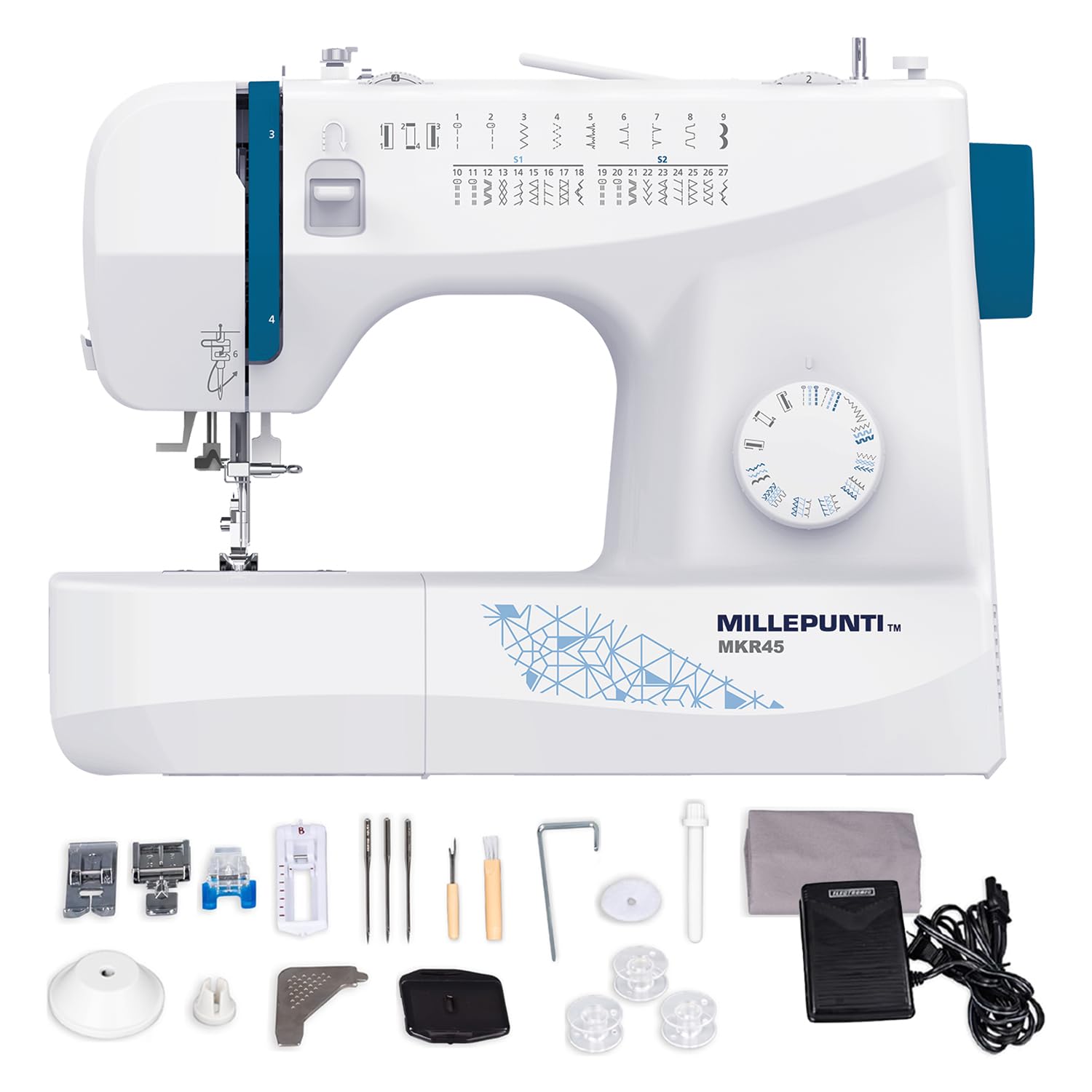
A compact 14.9-pound frame with a free arm that opens up cuffs, sleeves, and doll clothes.
The MKR45 sits in the balance between the full-size Brother machines and the tiny tabletop units — it is compact enough to store but full-featured enough to sew clothing. Twenty-five distinct built-in stitches cover the decorative and utility range well, and the automatic bobbin winder plus auto needle threader are designed to make setup a two-minute job rather than a five-minute fumble. The free arm is where this machine shines for a beginner just past the pillowcase stage: it drops away to expose a narrow cylindrical surface, so you can hem pants, sew blouse cuffs, or work on doll clothes and pet accessories without fighting the machine’s body. Four presser feet are included alongside a quilting guide, L-screwdriver, darning plate, and a dust cover.
What sellers and reviewers keep coming back to is the setup experience — the auto threader takes most of the pain out of the moment beginners dread most. Buyers describe the machine as easy to use, quiet, and able to handle the fabric range a beginner tries in year one, from soft cottons to denim. One owner who wanted a second machine for a family member describes it comparing favorably to models priced several times higher, which is a familiar refrain across the MILLEPUNTI review pages. It is also a genuinely portable machine — one buyer described it as roughly a sixth the size of a full machine and likened the carry weight to about half an air fryer, which is the sort of comparison that actually helps you picture it on a shelf.
Reliability is the mixed note. The auto needle threader is a feature a handful of owners have found finicky — it either works instantly or wants a manual assist, and one buyer ended up buying a manual easy threader to sidestep the issue entirely. Its 4.2-star rating trails the Janome MOD-15 at 4.5 and the Brother models at 4.6, making the MKR45 a solid mid-pack pick rather than a standout. If you want the compact size and the free arm and you accept that the threader may need patience, this machine covers the beginner brief well.
Good for: the sewer who wants a compact machine that still does garments, cuffs, and decorative stitching without a big footprint.
Watch out for: the auto needle threader dividing opinion — if perfect threading is a deal-closer, consider the machines above with stronger consistency.
9. Bernette B33 Swiss-Designed Mechanical Sewing Machine

A completely mechanical machine with two dials, a printed stitch chart, and a ruler built into the base.
Anyone who wants a machine with no screens, no computers, and no menus that can break should look straight at the B33. Two dials cover the entire stitch selection process — one picks the pattern, one adjusts length or width — and every stitch the machine can make is printed on the front panel as a visual chart. There is a 5 mm maximum stitch width, which is the standard for decorative work in this class, and the base includes a built-in ruler in both centimeters and inches for measuring and aligning fabric while you set up a seam. It runs on a 2-step presser foot lift and a manual thread cutter, and it uses a semi-automatic needle threader that does part of the threading job rather than a fully automatic one. The mechanical-only design is deliberate: with no computer board inside, there are no costly electronic repairs down theline when something fails, which is a real advantage for a machine you plan to keep for a decade.
The owner experience with this machine splits cleanly. Owners who were looking for a simple, silent mechanical machine love it — they describe decent tension for the class, quiet operation, lightweight portability, and the sort of foundation-level build that suits quilting piecing and household sewing. The review pages sum it up in one buyer’s words: a “Little Cadillac” — simple, straightforward, and a step up in speed and stitch quality from a basic Singer at a similar price. There are also a lot of people who look at this machine precisely because there is no computer in it and therefore no expensive board to replace.
The honest limitations are worth stating up front. The semi-automatic threader takes practice, and the bobbin is awkward to snap in — you have to hold a long thread tail when you start a seam or the machine will misbehave at the beginning of the stitch. The stitch pattern can run slightly off-center on some units, and the machine will not calibrate for the left-of-center needle if that happens. Also worth noting: the B33 is not sold through authorized Bernina dealers, which means the warranty registration and service pathway may be complicated if something goes wrong. At 4.0+ stars with mixed reliability feedback, the B33 suits buyers who want dial-controlled mechanical simplicity and quiet operation and will trade setup polish for it.
Mechanical advantage: two dials control stitch selection and adjustment entirely, with no computer board to fail and no electronic repair bills to consider.
The catch: semi-automatic threading, an awkward-to-snap bobbin, and a mixed reliability signal mean this suits buyers who prefer mechanical simplicity over feature-packed ease.
Choose this if: you want a pure mechanical machine with dial control, a printed stitch chart, a built-in ruler on the base, and no electronic parts to break.
skip it if: you want a fully automatic needle threader or a simpler bobbin snap — other machines in this guide handle those better.
10. Verdanika Portable Tabletop Beginner Mini Sewing Machine
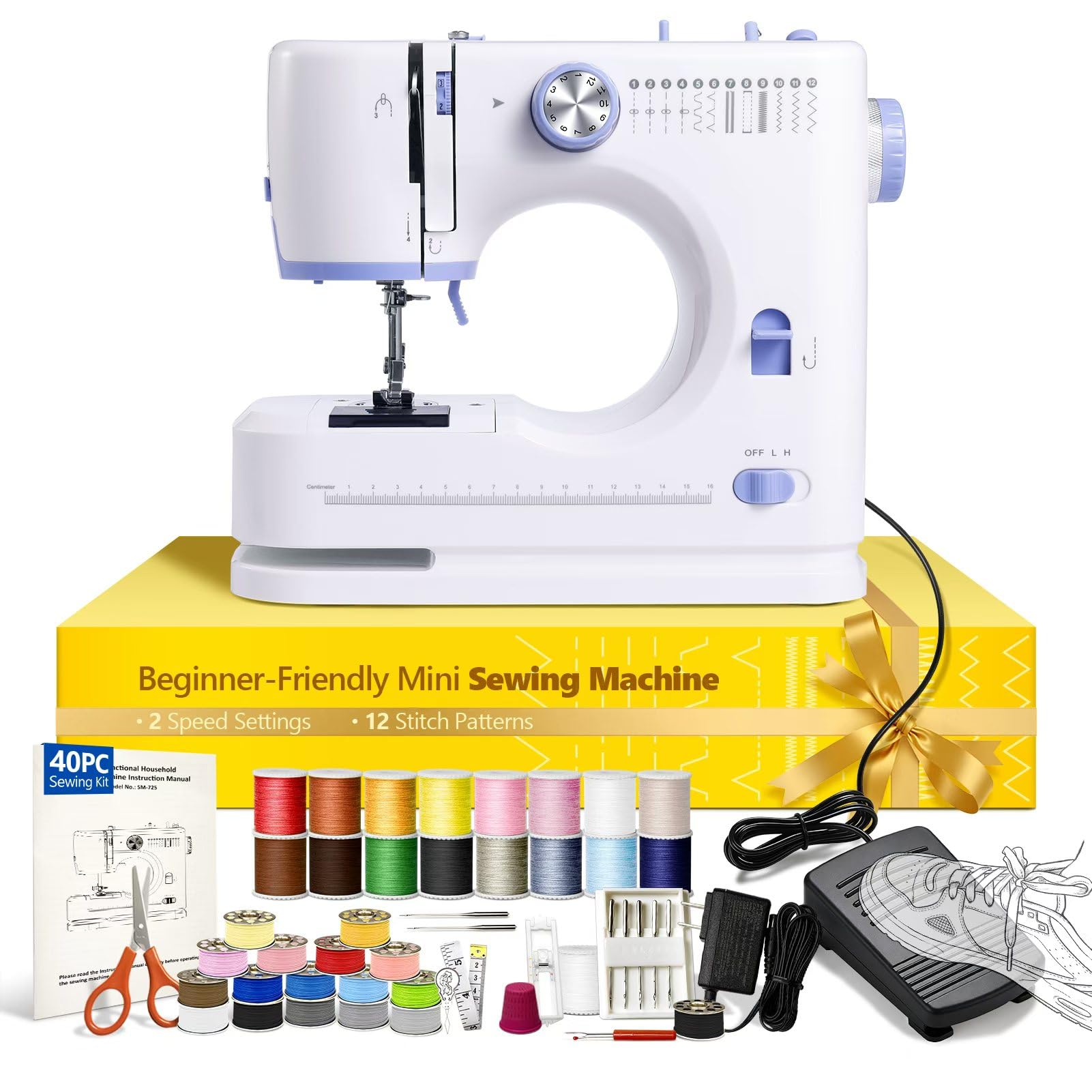
A twelve-stitch mini machine that lives in a drawer and handles quick repairs without a setup ritual.
Picture this one as the sewing machine that fits in a kitchen drawer and comes out for hemming a school uniform or fixing a popped seam, not the machine you sew a quilt on. It is significantly more compact than any full-size pick here — its footprint measures 10.82 inches deep and 6.1 inches wide, sitting on a countertop in less space than the machines above — and the internal metal frame adds enough weight that it does not wobble on the table while you work. Twelve built-in stitch patterns handle seams, hems, edges, and buttonholes, and the two-speed control is genuinely useful for beginners: low speed gives you time to guide fabric in a straight line, high speed handles longer runs at a quick but steady pace. There is a 9-level thread tension dial for adjustment, reverse stitching for securing seams, and both a foot pedal and a built-in button for operation.
The starter kit is the strongest argument to buy this as a gift. The box arrives with presser feet, needles, bobbins, thread spools, the foot pedal, and a power adapter, so you do not have to shop for accessories before the first project, and the built-in LED plus automatic bobbin winding round out the convenience factor. Owners describe it as an ideal gift for a young beginner — one buyer gave it to a daughter on her birthday and describes her loving how portable and convenient it is for small projects. Another buyer who uses it for simple clothing repairs describes it as compact, practical, and affordable for basic jobs. If the machine is going to a 10-year-old just learning to sew, this is close to the perfect starter shape.
The limitation to know before you buy is that the sewing platform is small, and this matters. One owner whose experience with the machine was difficult describes the fabric platform as too small, and sewing on thick or wide pieces is genuinely cumbersome because you cannot lay the fabric flat while the machine throws stitches. Cotton, denim, linen, and polyester are all fine with the internal metal frame doing its part, but this is a mini machine for mini work. With a 4.0+ star rating from a small owner pool, the Verdanika is a great first machine for a child or a kitchen-drawer fix for quick repairs, but not a substitute for a full-size machine on a real garment.
Why it earns its place
- Smallest footprint in this lineup at 10.82″D x 6.1″W — stows in a drawer
- Starter kit includes presser feet, needles, bobbins, thread spools, foot pedal, and power adapter
- 9-level thread tension dial and reverse stitching for controlled seams
- Two-speed control lets a beginner guide fabric slowly before speeding up
Where the size bites
- Small sewing platform makes thick or wide fabric awkward to manage
- 12 stitches is the smallest selection in this guide
- Best suited to quick repairs and small crafts rather than full garments
Best for: gift-givers shopping for a kid’s first machine, and anyone who wants a compact, ready-to-use unit for quick household repairs.
Not for: a sewer planning real garment work — the fabric platform is too small to manage full-size pieces comfortably.
Know the Specs
Built-in stitches versus stitch applications
These two numbers get used interchangeably in marketing, and they should not be. Built-in stitches are the physical patterns the machine can produce — the straight line, the zigzag, the blind hem, the decorative scallop. Stitch applications are all the variations you can create by changing how wide or how long each of those patterns runs. So a machine with 6 stitches can advertise 57 applications, and a machine with 37 stitches can advertise 74 functions. When you are comparing machines, pick a single measurement (built-in stitches is more honest) and compare only on that number. For beginner work — hems, mending, pillowcases, simple garments — somewhere between 12 and 25 built-in stitches covers everything you will actually use. Anything beyond that is decorative variety you may appreciate later but will not need on project one.
Bobbin placement: top loading versus front loading
The bobbin holds the lower thread on the underside of your seam, and how you load it changes how easily you keep the machine running. A drop-in top bobbin sits in a clear plastic window right below the needle — you can see it, you can see the thread, and if it jams you clear it in a few seconds without removing any parts. A front-loading vertical bobbin lives inside a removable case under the free arm; you snap the bobbin into the case and push the case in. Both work fine for years of sewing, but top-loading reduces the beginner pain point of “why is my seam looping on the bottom?” because the problem is always visible. Brother machines in this guide use top-loading, while the Janome 2212 and SINGER M3300 use front-loading vertical bobbins. If a visible bobbin matters to you, keep this spec in mind when making your choice.
Needle threader types explained
Threading the needle is the single most common beginner frustration, and there are three approaches. A fully automatic needle threader is a small built-in mechanism that pushes the thread through the eye with a lever or button — zero manual work, but this feature is also the most-frequently divided across brand lines because it either clicks cleanly or fights you. A semi-automatic needle threader does part of the job and leaves you to finish the pass, which is what the Bernette B33 uses. And a manual threading path (with a clear guide and easy-to-follow instructions) is what Janome leans on for the MOD-15 and 2212 — the machine trusts you to thread, but makes the path simple and visible. None of these is inherently better; what matters is knowing which type you are buying so your expectations match how the machine actually behaves.
Foot pedal control and speed
The foot pedal is your throttle, and it matters more than you would think for a beginner. A variable-speed pedal lets you press lightly for slow, controlled stitching on curves and corners, then depress further for fast straight seams on long fabric runs. A pedal that only goes on or off at one speed makes learning harder because you cannot slow down when the fabric gets tricky. Machines with a jam-detecting motor — like the FEIYUE FYe330 — go a step further by pausing automatically if the needle hits resistance, preventing needle bends and skipped stitches. On the Verdanika mini, the two-speed control does the same job differently by giving you a fixed slow and fast setting. Whatever you buy, check that the machine lets you sew slowly when you need to; it is the difference between finishing a project and unpicking it.
Common Questions
Do I need an automatic needle threader on a beginner sewing machine?
Is a drop-in top bobbin easier than a front-loading vertical bobbin?
How many stitches do I really need on a first machine?
Can a lightweight beginner machine sew denim or canvas?
What weight is a beginner sewing machine best at?
Does a beginner sewing machine need a free arm for hemming?
How long do beginner sewing machines last?
Is a full-size sewing machine too much for a total beginner?
What accessories should come in the box for a beginner?
Do I need to learn about thread tension as a beginner?
The Bottom Line
For most beginners, the basic sewing machine for beginners winner is the Brother GX37, because 37 built-in stitches and 74 functions give you room to grow, the drop-in top bobbin is the easiest loading system in this lineup, and the 6 presser feet mean you are ready for zippers and buttonholes on day one. If your priority is quieter stitching and a slightly lower stitch count in a heavier full-size frame, the Brother SM1400 is the one to reach for. And for the widest stitch variety on a budget, the 97 stitch applications on the SINGER M3300 is the machine to pick up — its front-loading bobbin takes a little more patience, but the one-step buttonhole and adjustability make it worth the small extra handling.
The one honest nudge: the Brother GX37’s rating and owner base are the strongest in this guide, so if you are splitting hairs between two picks, that consistency is the tiebreaker worth trusting. Buy whichever machine fits how much space you have, follow the first-project tutorials on YouTube (every machine here has them), and you will be hemming your own curtains inside a week.
How we choose
We do not accept paid placement. Every pick is matched to a real buyer and a real use-case; we do not hands-on test units.
Sources
Specifications: manufacturer listings and product documentation. Review insights: verified customer reviews, as of October 2026. Pricing: not shown on this page (it changes often); check the current price via the retailer link.
As an Amazon Associate, My Heart Lives Here earns from qualifying purchases. This does not affect which products we feature.