Heads up: This post contains affiliate links. As an Amazon Associate I earn from qualifying purchases, at no extra cost to you. Learn more
Specs are compiled from manufacturer listings and verified buyer reviews and can change over time — please confirm the key details on the product page before buying.
You want to get low on the drops without buying a second bike, and a clip-on set that rattles or slips under load will cost you confidence every time the road turns rough. The short answer: buy for fit range and clamp security first, weight second, and looks last. A bar that rattles at speed or slips a millimetre under load is worse than no bar at all.
This guide is built by comparing the manufacturers’ published specifications and the patterns across verified customer reviews, so you get each pick’s real strengths and trade-offs instead of marketing spin.
You will see which extension bends suit your reach, why handlebar diameter decides whether a set even mounts, and where armrest padding actually matters on a long ride. Every pick below earns its place — the trick is matching the clamp to your bar diameter and the armrests to your shoulders.
Top Picks

How To Choose The Best Aero Bars for Road Bike
Clip-on aerobars turn the road bike you already own into something that can hold a low, narrow tuck for a stretch of open road. They mount to your existing handlebar, they lift your forearms onto padded rests, and they give your hands a forward extension to grip. The choice that decides whether you love them or take them off after a week is not the brand name. It is whether the clamp fits your bar, whether the armrests adjust to your shoulders, and whether the whole assembly stays put when you press down on it.
Start with your handlebar diameter, not the price tier
The clamp size is the first gate you have to pass. A 31.8 mm clamp is the modern oversize standard and fits most current road handlebars directly. If your bar measures 26.0 mm, you need shims or a shim kit, and those are often sold separately. Measure your bar with calipers before you buy anything. A set that does not clamp cleanly is not adjustable into safety — it is just loose.
Clamp style matters too. A quick-release bracket lets you pop the bars on and off without tools, which is the difference between using them on a fast group ride and leaving them bolted on all season. A fixed bolt-on clamp is simpler and usually cheaper, but you will want an Allen key handy if you share the bike or swap setups.
Match the extension bend to your wrists
L-Bend extensions rise gently and sit close to neutral, which most riders find the easiest entry point. S-Bend and J-Bend shapes push your hands into a more tucked position, and they ask more of your wrist flexibility. If you have never ridden in an aero tuck for long stretches, start with the gentler bend and let your body adapt. A gentle L-Bend you can hold for a full pull beats an aggressive S-Bend you have to bail out of after five minutes.
Armrest adjustability is where fit lives
Width, fore-aft, and height are the three axes that set your shoulder position. Width adjustment moves your elbows in or out and changes how narrow your chest gets. Fore-aft slides the pads toward or away from the extensions so your reach matches your arm length. Height is often the least adjustable and sometimes needs a separate riser kit. Buy the most armrest width and fore-aft adjustment your budget allows, because a shoulder pinned too wide will ache long before your legs do.
Padding and clamp security beat grams
A few grams of weight difference disappears the moment you are in the tuck; a clamp that shifts under load does not. What you feel instead is whether the pads spread pressure across your forearms and whether the clamp holds firm under load. Foam and EVA padding are common and comfortable for shorter efforts. Thin padding lets more road buzz through on long rides. Prioritise comfort and a solid clamp, then worry about the scale.
Side-by-Side Comparison
| Model | Best For | Clamp Size | Weight | Adjustability | Amazon |
|---|---|---|---|---|---|
| REDSHIFT Quick-Release Clip-On Alum Aerobars★ Best Overall | Riders who switch between road and aero mid-ride | 31.8 mm (26.0 mm with shims) | 1.4 pounds | Length, pad fore-aft, pad width | Amazon |
| BBB Cycling AeroComfort BHB-59Comfort Pick | Comfort-first riding and indoor trainer sessions | 22.2 / 25.4 / 31.8 mm | 540 g | Extension length, armrest width | Amazon |
| Full Speed Ahead Vision Team Clip-on | Budget entry to a J-Bend aero tuck | 31.8 mm | 1.4 pounds | Length 230 mm to 270 mm | Amazon |
| Profile Design Legacy II Aerobars | Long rides where armrest tuning matters | 31.8 mm (26.0 mm with shim kit) | 450 g | Width and rotational armrest | Amazon |
| Profile Design Airstryke V2 | Triathlon riders who want flip-up brackets | 31.8 mm | 1.7 pounds | Adjustable stack and reach | Amazon |
Detailed Reviews
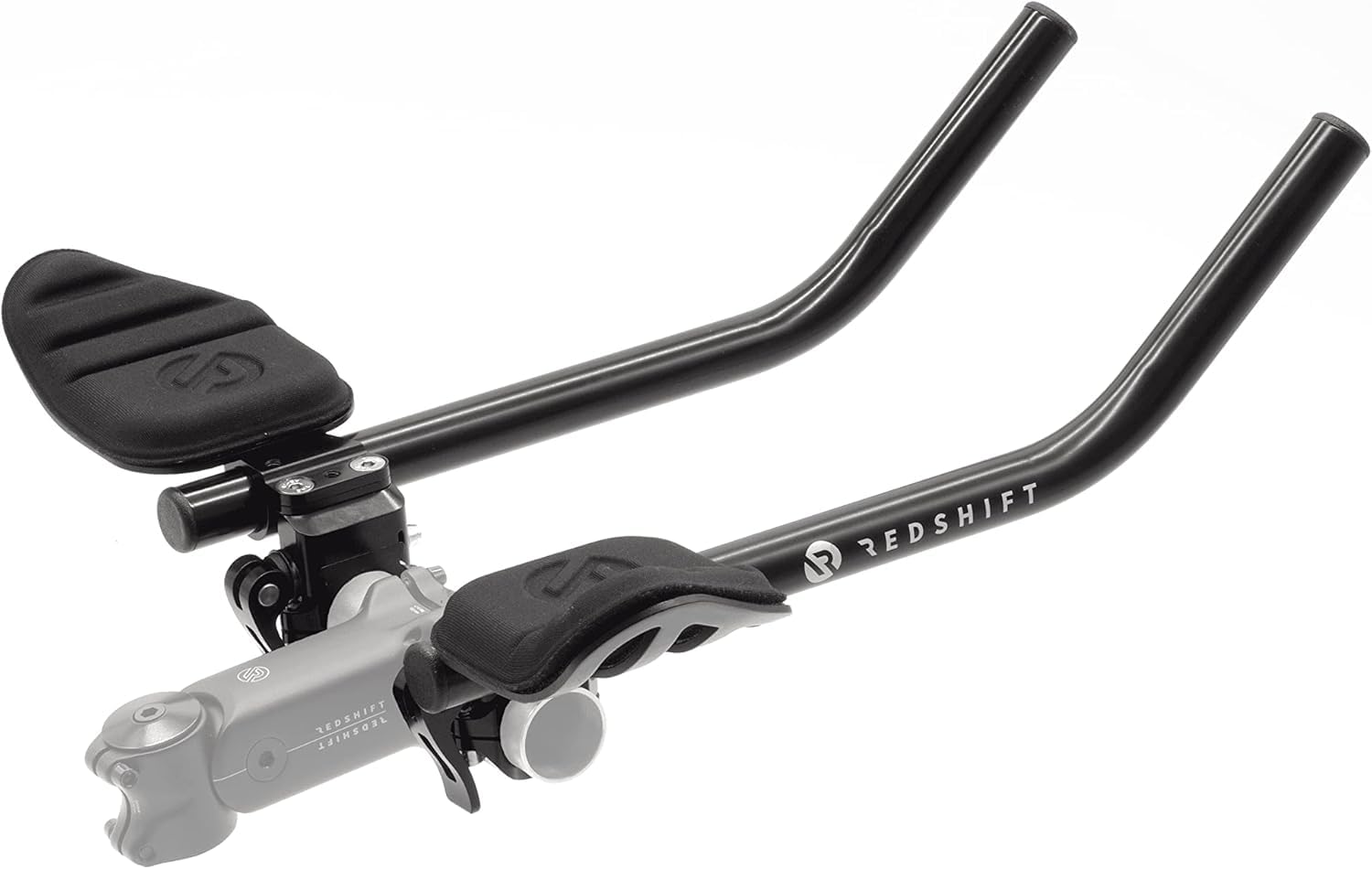
1. REDSHIFT Quick-Release Clip-On Alum Aerobars
Our pick — 4.0+★ from 150+ verified ratings; the strongest balance of quality and price.
The set that comes off in seconds, so your road bike stays a road bike
What makes this the pick to beat is the switching, not the weight. A patented quick-release bracket lets you move between your normal road hand position and a full aero tuck while you are still riding. You can also pull the whole assembly off, then refit it into the same setup, with no tools at any point. For a rider who wants clip-ons for a fast stretch and a clean bar for everything else, that single feature does more than any gram count.
Fit range is generous for a bar this compact. You get extension length, arm pad fore-aft, and arm pad width adjustment, which covers shoulder width and reach without adding parts. Height needs an extension riser, and that is sold separately. At 1.4 pounds it also sits lighter on the bar, against 1.7 pounds for the Profile Design Airstryke V2.
The honest catch is noise. The bars are known to rattle during use, and that rattle is the recurring gripe rather than an isolated one. Padding is thinner than the plush armrests on a long-ride set, so if your plan is multi-hour comfort above all else, look at the Profile Design Legacy II instead. What wins people over here is the quick-release bracket: it goes on, comes off, and refits to the same position without tools. It arrives in L-Bend or S-Bend aluminum, and fits 31.8 mm bars directly with shims for 26.0 mm sold separately.
Where it earns its keep
- Tool-free quick-release bracket swaps road and aero positions in seconds
- Refits into the exact same setup once you have dialled it in
- Length, pad fore-aft, and pad width adjustment cover a wide range of riders
- 1.4 pounds keeps the front end from feeling leaden
What you should know going in
- Rattle during use is the most-discussed drawback
- Height adjustment needs a riser, and that is a separate buy
- Padding is thinner than the comfort-first options below
Reach for this if: you want one bike to do road duty and aero duty without a workshop session every time you swap.
Think again if: a silent setup matters more to you than a tool-free one — the rattle is the trade you make.
2. BBB Cycling AeroComfort BHB-59 Two-Piece Aero Bars
Built around a 35mm lift so your back does not pay for the tuck
Most clip-ons ask your spine to fold to meet the bar. This one closes the gap for you. The AeroComfort design raises the resting position by 35mm, which takes the sting out of the drop and makes a long, low hold feel less like a stretch and more like a posture you can actually settle into. For a rider who has tried a low-slung set and felt their lower back complain, that extra height is the whole pitch.
Padding is the second piece of the comfort story. Foam sleeves sit on the armrests in EVA material, a closed-cell foam that cushions without going soggy, and there are foam sleeves around the steerer tubes as well. Fit is the strength that gets talked about most here — the clamping mechanism is designed to attach to 22.2, 25.4, and 31.8 mm diameter handlebars, which is broad compatibility across older and newer bars in one set. Extension length and armrest width adjust to your preferences, so you are not locked into one position.
Two things to weigh honestly. The two-piece aluminum build comes in at 540 g, which is heavier than the 450 g Profile Design Legacy II — you feel that on a climb, not on the flat. Value is also a mixed read: the hardware is straightforward, and the ask is higher than the simplest bolt-on sets in this list. The upside is that this is the set most likely to get used on a trainer through the winter rather than shoved in a drawer, because the comfort holds up when you spend real time in position.
Who it fits: riders with a stiff lower back, older frames, or a trainer setup where comfort beats aerodynamics on the priority list.
What to expect: 540 g of aluminum and a 35mm lift — a touch heavier than the Legacy II, and easier on your body for it.
Best for: anyone who wants to finish a ride without their shoulders aching.
Look elsewhere if: you are chasing the lowest, most aggressive tuck and want the grams down near 450.
3. Full Speed Ahead Vision Team Clip-on 31.8mm

The compact J-Bend set that gets you low without the fuss
This is a narrow, tidy set built for one job — putting your hands into a J-Bend time trial position on a 31.8 mm basebar. The J-Bend shape curves your wrists downward and inward for a tucked profile, which is exactly the shape triathlon and time trial riders choose. Adjustable length runs from 230mm to 270mm, so you can dial reach to your arm length instead of living with one setting.
The physical footprint is the smallest in this list. At 9.06 in long and 3.15 in wide, the Vision Team is a full 73% shorter than the 15.7 in REDSHIFT and a fraction of the 10 in width of the Profile Design Airstryke V2. On a crowded cockpit or a narrow bar, that compactness is a genuine advantage — and the alloy build keeps it at a listed 1.4 pounds, matching the REDSHIFT on the scale.
The trade is adjustability. Length moves, but you do not get the armrest width and rotational tuning that the Legacy II offers, and there is no quick-release bracket for mid-ride switching. The finish is a clean black, and the build reads simple and solid rather than plush. If you are new to aero positioning and want to find out whether a tuck suits your body before you commit to a premium set, this is a sensible first step, and it stays out of the way when you are not using it.
The plain read: a purpose-built J-Bend that does one thing cleanly. Small dimensions and real length adjustment for riders who already know they want a tucked position.
What it is not: a fit laboratory. No armrest width tuning, no tool-free removal, no padding upgrades — those live on the pricier picks.
Pick it when: your bar is 31.8 mm and you want a compact J-Bend tuck without paying for features you will not use.
Pass on it if: your shoulders need armrest width adjustment to feel right — this set does not offer it.
4. Profile Design Legacy II Aerobars

The one that disappears under your forearms at hour three
What gets talked about most with the Legacy II is how straightforward it is to bolt on. That is not a glamorous headline, but it is the right one for a set you will install once and then forget about. Forged 6061-T6 aluminum, a strong alloy heat-treated for durability, forms the structure, and the Venturi-style armrests give you multiple hand positions so your arms are not locked in one place for the whole ride.
Ergonomics is where this one pulls ahead on distance. Width-adjustable and rotationally adjustable armrests let you tune the angle your elbows sit at, which changes the load on your shoulders over a couple of hours. At 450 g it is the lightest full set in this list — it saves 90 g against the 540 g BBB Cycling AeroComfort, and that is a real reduction on a climbing route. Fit 31.8 mm bars directly, or 26.0 mm with a shim kit that sells separately. Note that it is not intended for use with Aerobar Bracket Riser kits.
Two caveats keep it honest. Fit is a genuine split — riders on 26.0 mm bars hit issues unless they source the right shims. Stability is a mixed report rather than a universal strength, and durability draws some negative notes, so treat it as a set to check and re-torque rather than one you install and abandon for years. Even so, the install story and the ergonomic tuning carry the day for most owners.
Why long-distance riders gravitate here
- Width and rotational armrest adjustment protects shoulders on multi-hour rides
- 450 g is the lightest complete set on this list
- Venturi armrests open up several hand positions
- Forged 6061-T6 aluminum construction
The fine print
- 26.0 mm bars need a shim kit, and fit is a split experience
- Not compatible with Aerobar Bracket Riser kits
- Stability and durability reports are not uniformly glowing
Suits you if: your priorities are armrest tuning and low weight for long days in the saddle.
Look elsewhere if: you ride a 26.0 mm bar and do not want to hunt down a shim kit before you can mount up.
5. Profile Design Airstryke V2 Aluminum Clip-on Aerobars

Flip-up brackets that swing the armrests out of the way on the climbs
The detail that separates the Airstryke V2 from every other set here is the flip-up bracket. Those brackets hinge the armrests upward so the whole aero setup lifts clear of the bar when you sit up to climb or decelerate. In a triathlon or a mixed road route, that means you are not dragging your forearms across the pads every time you want out of the tuck. It is a small mechanical thing that changes the character of a ride once you have used it.
Stack and reach both adjust, which puts the shoulder position in your hands rather than the factory’s. You get extension, flip-up brackets, Ergo armrests, and 10mm Ergo armrest pads in the box, so it is ready to mount without chasing hardware. The pads are the comfortable kind that spread pressure across the forearm rather than digging in. What wins people over here is adjustable stack and reach paired with Ergo armrest pads you can actually settle onto.
The honest limit is bulk. At 1.7 pounds and 14 in long, it is the heaviest and one of the widest sets on the list — it measures 10 in across, against the 3.15 in width of the compact Full Speed Ahead Vision Team. Fit is also a mixed report rather than a guaranteed one, so riders between sizes should expect to spend some time on setup. What you are buying is the flip-up function and the tuning range. Budget for a longer fitting session than you would on a simpler bolt-on set.
Where the value sits: flip-up brackets plus full stack and reach adjustment — a setup built for riders who move in and out of the tuck constantly.
What weighs against it: 1.7 pounds and 10 in of width, and a fit that is not automatic for every rider.
The right call for: triathlon riders who want their armrests to swing clear on climbs and a position they can tune precisely.
Not the one for: weight-focused road riders who want the lightest, narrowest set they can fit — the flip-up hardware costs both grams and inches.
Know the Specs
Clamp Diameter
Clamp diameter is the measurement around your handlebar where the aerobar attaches, and it has to match or the set will not sit securely. A 31.8 mm clamp fits most modern oversize road bars directly. A 26.0 mm bar needs shims, which are usually sold separately, so factor that in before you choose. The BBB Cycling AeroComfort is the flexible one here, clamping to 22.2, 25.4, and 31.8 mm bars. Measure your bar with calipers — it takes a minute and saves a return.
Extension Bend
The bend is the curve of the forward extension your hands grip. L-Bend rises gently and suits riders new to a tuck. S-Bend and J-Bend push the hands into a lower, more tucked profile, with J-Bend shaping the wrist downward and inward for time trial and triathlon. The REDSHIFT comes in L-Bend or S-Bend, and the FSA uses a J-Bend. There is no objectively better bend — only the one that matches your wrist flexibility and how low you want to sit.
Adjustability
Adjustability is the range of movement in the armrests and extensions, and it is where fit is decided. Width moves your elbows in or out, which changes how narrow your chest gets. Fore-aft slides the pads toward your reach hand position. Height raises the whole assembly and often needs a separate riser kit. The Profile Design Airstryke V2 offers adjustable stack and reach. The Legacy II adds rotational armrest adjustment. More adjustment means more time at setup and a better position once you are done.
Weight and Padding
Weight is listed in grams or pounds, and while it matters on climbs, it is the least emotional spec of the group. Padding is the more felt one. EVA foam and foam sleeves spread pressure across your forearms, and thicker pads make long rides kinder. Thinner padding lets more road buzz through. The Legacy II comes in at 450 g, the BBB at 540 g, and the Airstryke V2 at 1.7 pounds. Match padding to your ride length and weight to your terrain.
Common Questions
Will 31.8 mm aerobars fit my existing road handlebar?
Can I switch between road and aero position without stopping?
Do clip-on aerobars work on a carbon handlebar?
What is the difference between L-Bend, S-Bend, and J-Bend extensions?
How much weight do aero bars add to the front of the bike?
Can I raise the armrest height on clip-on aerobars?
Are clip-on aerobars legal in group rides and races?
What does a quick-release mechanism actually save me?
Why do some aerobars rattle and can I stop it?
Should I choose a two-piece or a fixed one-piece aerobar?
The Bottom Line
The aero bars for road bike pick that makes the most sense for most riders is the REDSHIFT Quick-Release Clip-On Alum Aerobars, because the tool-free bracket lets you keep one bike in road trim and still take a full aero tuck whenever the road opens up. If armrest tuning and a lighter build matter more than mid-ride switching, the Profile Design Legacy II Aerobars at 450 g gives you width and rotational adjustment on a forged aluminum frame. And for triathlon riders who want their armrests to hinge clear on every climb, the Profile Design Airstryke V2 is the one built around that exact motion. Take your handlebar measurement first — the right set is the one that clamps cleanly and adjusts to your shoulders.
How we choose
We do not accept paid placement. Every pick is matched to a real buyer and a real use-case; we do not hands-on test units.
Sources
Specifications: manufacturer listings and product documentation. Review insights: verified customer reviews, as of November 2026. Pricing: not shown on this page (it changes often); check the current price via the retailer link.
As an Amazon Associate, My Heart Lives Here earns from qualifying purchases. This does not affect which products we feature.