Heads up: This post contains affiliate links. As an Amazon Associate I earn from qualifying purchases, at no extra cost to you. Learn more
Specs are compiled from manufacturer listings and verified buyer reviews and can change over time — please confirm the key details on the product page before buying.
Most people assume a big-screen projector means drilling a bracket into the ceiling and living with a picture that only looks right after dark. The picks below break both habits. Every one of them either rotates, tilts, or throws its image from inches away, so you can point the picture at a wall, a ceiling, or the back of a camper without touching a tool. The short answer: the ONOAYO ONO5Pro 2.0 is the one to beat for most rooms, and the rest of this list covers the specific jobs it does not.
This guide is built by comparing the manufacturers’ published specifications and the patterns across verified customer reviews, so you get each pick’s real strengths and trade-offs instead of marketing spin.
Angle, throw distance, and auto-correction decide whether a rotating projector actually works in your room, so the sections below walk through each of those before the picks. Everything here earns its place on this list of the 360 degree projector options worth owning.
Top Picks

How To Choose The Best 360 Degree Projector
You want to put the projector where it suits the room, not where the wall forces you. That freedom depends on three things: how the unit pivots, how far the lens must sit from the wall, and how well the software fixes a crooked image. Get those three right and the picture lands where you want it. Get them wrong and you are back to a fixed box facing one wall.
Rotation and tilt, not just a tripod thread
A built-in rotating stand lets you swing the lens toward a side wall or straight up at the ceiling without moving the base. The PUTRIMS P66 uses a 360° rotatable stand for exactly this, and the AuKing adds a removable stand with 360° horizontal rotation plus 180° vertical tilt. A plain 1/4-inch screw hole only lets you bolt the unit to a tripod — useful, but it does not aim the picture for you.
Throw ratio decides your room
Throw ratio is the relationship between how far the lens sits from the wall and how wide the picture gets. A standard-throw unit like the ViewSonic LX700-4K puts a 100-inch image up from 7.7 feet away, which suits a normal living room. An ultra-short-throw model like the AWOL VISION Aetherion Max sits at 0.2:1, meaning inches from the wall. In a narrow bedroom, that difference is the whole purchase.
Auto correction has limits worth knowing
Auto keystone (the software that squares a tilted image) and auto focus save you endless fiddling, but they are not magic. HAPPRUN states its autofocus will fail if the projector sits at an angle greater than 15°, so a level, perpendicular placement still matters. Look for obstacle avoidance and screen-fit too — both let the projector dodge a light switch or a picture frame on the wall.
Native resolution versus 4K support
Many units here are native 1080P panels that accept a 4K signal and downscale it — ONOAYO and PUTRIMS both say so plainly. Laser models like the JMGO N1S Ultra and NEBULA X1 carry true 3840 x 2160 panels. Decide which you need before you compare brightness figures, because a bright 1080P projector and a true 4K one solve different problems.
Side-by-Side Comparison
| Model | Best For | Native Resolution | Brightness | Placement Flexibility | Amazon |
|---|---|---|---|---|---|
| ONOAYO ONO5Pro 2.0★ Best Overall | All-round home cinema | 1080P, 4K support | — | Ceiling mount, auto calibration | Amazon |
| AuKing 4K ProjectorBudget Ceiling Pick | Budget ceiling viewing | 1080P, 4K support | 4000 ANSI lumens | 360° rotate, 180° tilt stand | Amazon |
| HAPPRUN 2000 ANSIBackyard Favorite | Backyard movie nights | 1080P | 2000 ANSI lumens | Table, bedside, wall or ceiling mount | Amazon |
| SAMSUNG The Freestyle 2nd Gen | Portable everyday carry | 1080P | 230 lm | Portable form factor | Amazon |
| PUTRIMS P66 Smart | Ceiling projection in small rooms | 1080P, 4K decoding | 500 lm | 360° rotatable stand, 1.17:1 short throw | Amazon |
| ViewSonic LX700-4K | Console gaming | 4K UHD | 3500 lm | Ceiling mount, 360° and curved screen | Amazon |
| JMGO N1S Ultra | True 4K in a lit room | 4K | 2800 ISO lumens | Integrated gimbal | Amazon |
| NEBULA X1 | Surround sound cinema | 4K | 3500 ANSI lumens | Motorized 25° micro gimbal | Amazon |
| AWOL VISION Aetherion Max | Replacing a living-room TV | 4K | 3300 ISO lumens | 0.2:1 ultra short throw, desktop | Amazon |
Detailed Reviews
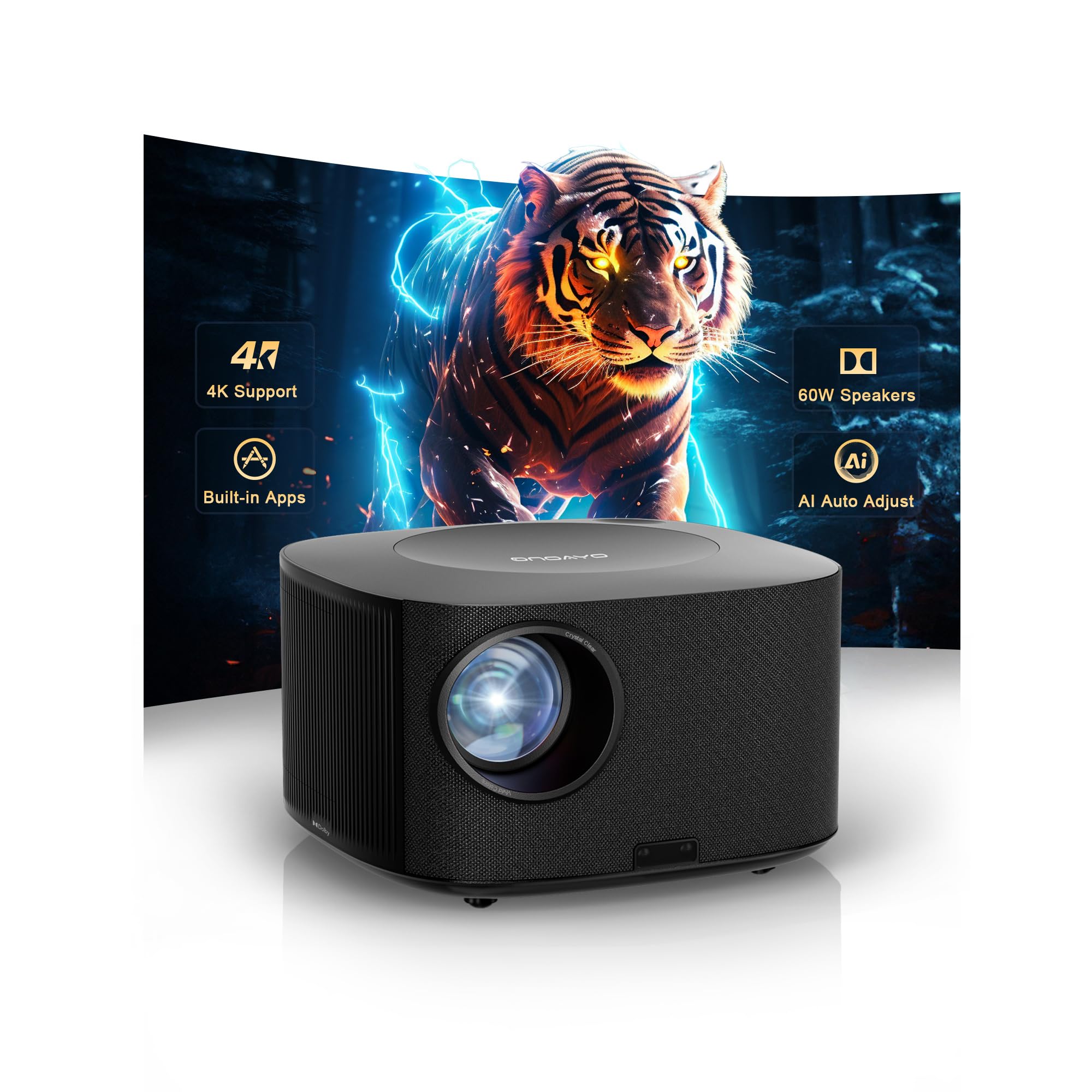
1. ONOAYO ONO5Pro 2.0 4K Projector
Our pick — 4.5+★ from 450+ verified ratings; the strongest balance of quality and price.
Two speakers, one box, and a picture that squares itself up in the time it takes to sit down.
Its 60W of Dolby-tuned audio covers a claimed 540 sq.ft, so the projector is the sound system and you skip the soundbar entirely. It takes the top slot on 4.5+ stars across 400+ ratings, the largest review base here. The single most-cited strength is how it performs as a whole package rather than any one trick, with picture quality running close behind.
Picture-side, the VisionlQ calibration system handles auto focus, keystone, obstacle avoidance and screen-fit, and ONOAYO claims a 3-second alignment. That matters most for a ceiling-mounted setup, where you cannot easily reach up and twist a focus ring. You also get 98% NTSC color coverage and 1.07 billion colors, which is the reason skin tones do not go orange in a dark-room movie. Brightness reads well enough that you can start a film before the sun is fully down.
Gaming gets a dedicated mode with 18ms input latency over HDMI 2.1, and WiFi 6 handles the streaming side. The honest catch is connectivity — it is the one area owners treat as mixed rather than glowing, so plan on the wired HDMI route for anything mission-critical. The other thing to know is that this is a native 1080P panel accepting a 4K signal, not a true 4K chassis. Against the small AuKing 4K Projector down this list, the panel spec gap is a 3840 x 2160 maximum versus 1920 x 1080.
What earns the top spot
- Dual 60W Dolby-tuned speakers make a separate soundbar unnecessary
- 3-second auto calibration for focus, keystone, obstacle avoidance and screen-fit
- 18ms input latency in game mode for PS5 and Xbox
- Sealed optical engine resists the dust that clouds a picture over time
Where it stops short
- Native 1080P panel — 4K content arrives downscaled
- Wireless connectivity is the least-loved part of the package
- The built-in remote needs a battery you supply yourself
Reach for this if: you want one box to handle picture and sound in a living room or on a patio, with mounting flexibility for a ceiling job.
Look elsewhere if: true 4K pixel density is non-negotiable — that is a laser-price conversation.
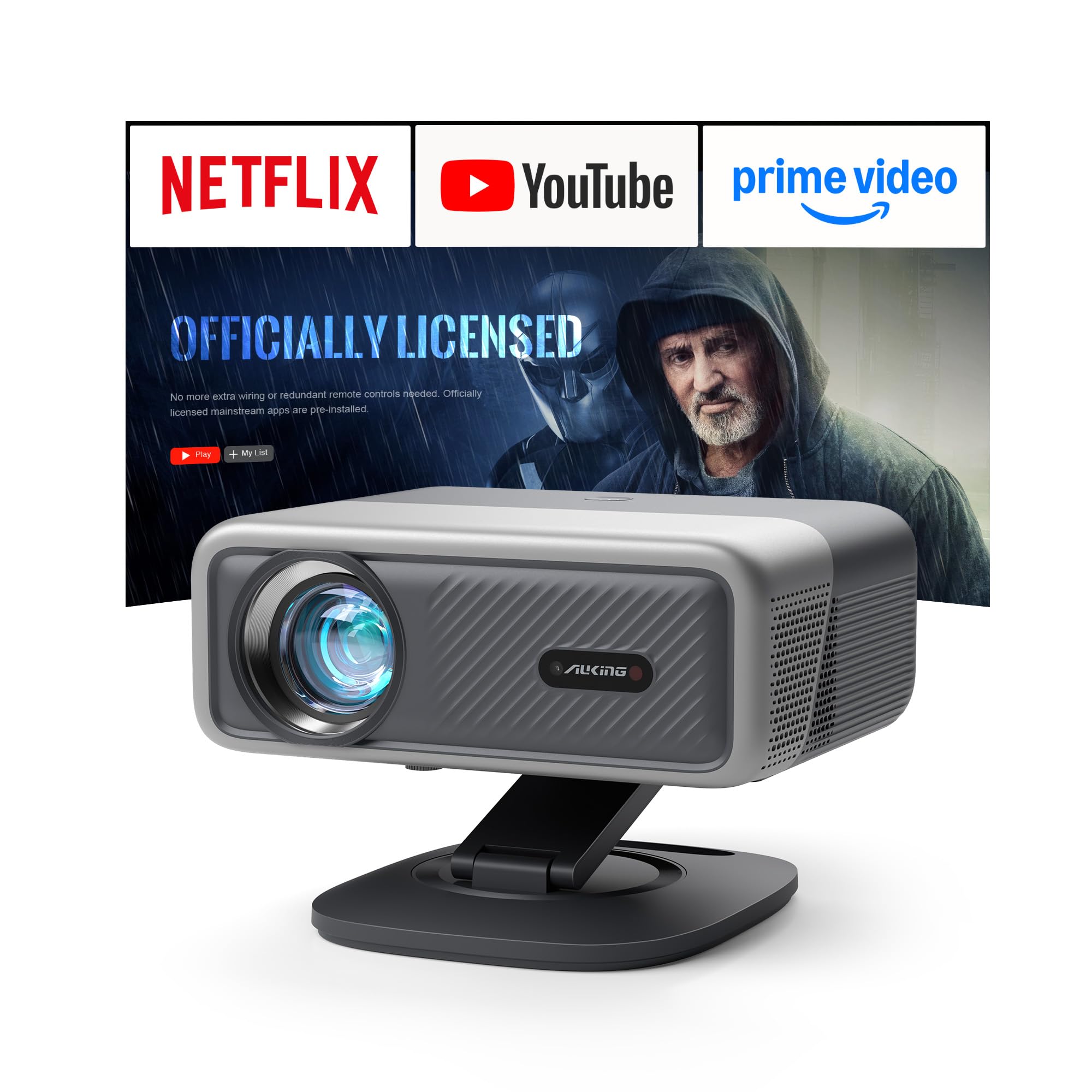
2. AuKing 4K Projector with WiFi Bluetooth
A stand that folds flat and swings the picture at a ceiling — without a single tool.
This is the cheapest way into real placement freedom on the list, and the mechanism is the whole story: a removable stand with 360° horizontal rotation and 180° vertical tilt that collapses flat in seconds. Set it on a shelf, swing it at the wall, then fold it away. The trade-off appears the moment you put a number next to the brightness claim. The listing states 4000 ANSI lumens while the specification block reads 40000 lm, and owners split on whether it delivers that brightness. Treat the brightness figure as a dark-room number, not a daylight one.
What does hold up is the picture itself. Buyers rate the quality and the video sharpness highly — the sharpness feedback is the kind that makes you stop looking for flaws. Autofocus runs on TOF laser tech at 0.2 seconds, and the streamlined Linux OS boots straight into apps with no loading screens or bloatware to navigate. Officially licensed Prime Video and YouTube come pre-installed, so you are not sideloading anything unstable.
Sound is handled by an enhanced Dolby Audio chamber, and WiFi 6 with Bluetooth 5.2 covers mirroring from AirPlay, Miracast and DLNA devices. Note that native resolution is 1920 x 1080, with 4K signals accepted and downscaled — the listing says so directly. This is the pick for a spare room or a camper where you want the picture on the ceiling and you are watching after dark.
Its real job: bedroom and camper ceiling projection on a tight budget, where the foldable stand does the work a mount would otherwise do.
Know before you buy: the brightness headroom is not what the headline implies, so this is a dim-room performer.
Best for: anyone whose main wish is to angle a picture upward without hardware.
Think twice if: you plan to watch with the curtains open.
3. HAPPRUN 2000 ANSI 4K Decoding Projector
Straightens its own picture in five seconds, then doubles as a Bluetooth speaker when the film ends.
Start with the 2000 ANSI lumens figure, because it is the number that keeps this projector usable after the sun drops and the yard lights come on. Contrast sits at 20000:1 with a 95% color gamut, and the picture reads bright and clear enough that owners happily run it with lights on. Setup is the other half of the appeal: 6D auto keystone plus auto focus gets you a rectangular image within 5 seconds, with obstacle avoidance and screen alignment doing the fiddly work.
The angle ceiling matters here, and HAPPRUN is upfront about it. Autofocus fails if you tilt past 15°, so a level table perpendicular to the wall is still the starting point — this is auto-corrected, not auto-magical. Placement options are genuinely broad, though: table, bedside, wall mount or ceiling mount all work.
Audio is an 8W HiFi system, and bidirectional Bluetooth 5.2 means the projector can flip roles and play music from your phone as a speaker. WiFi 6 at up to 9.6G bps handles mirroring from iOS and Android, and the 300-inch maximum with 50% zoom covers everything from a bedroom to a birthday party. Two HDMI, two USB, AV and a 3.5mm jack mean a PS5 or a streaming stick plugs in without an adapter hunt.
The standing-out feature: 6D auto keystone correcting in 5 seconds is the closest thing here to a set-and-forget outdoor setup.
The honest limit: the 15° autofocus cutoff means steep ceiling angles need a manual touch.
Pick this one if: your projection plans run to backyard nights and parties where the picture moves around.
Skip the ceiling-mount angle if: you cannot get the body within 15° of level.
4. SAMSUNG The Freestyle 2nd Gen

A 230-lumen portable that disappears into a bag and travels to whatever wall you find.
The Freestyle is the smallest idea on this list: a white, portable DLP unit built to be carried, not mounted. It is a certified refurbished model, fully tested and backed by a 90-day warranty. Where owners light up is the quality of the build and the image — the picture lines up perfectly on a wall, which is exactly what you want from a unit you reposition constantly. The Freestyle handles 30 to 100 inches, runs FHD with HDR, and includes Gaming Hub and Smart Calibration.
Here is the number that governs everything: 230 lm of brightness. That is a dark-room projector, full stop, and you should not expect it to fight a lit living room. Adaptive Sound and 360 Sound cover the audio, and voice control runs the remote so you are not hunting for buttons in the dark.
The refurbished angle deserves a straight word. Reliability is the mixed note in the feedback — most units work exactly like new, and an occasional one does not, which is the nature of buying a tested return rather than a sealed box. Weigh that against the portability you cannot get from any other pick here, and the fit becomes clear. This is the one that goes in the suitcase.
Why it made the list: genuine carry-anywhere portability with a wall-aligned picture and 90-day coverage on a refurbished unit.
The trade-off: 230 lm needs a dark room, and a refurbished unit carries occasional reliability variance.
The right call for: renters, travellers, and anyone who moves the projector between rooms weekly.
Not the right call for: a permanent living-room setup where brightness carries the day.
5. PUTRIMS P66 Smart 4K Projector
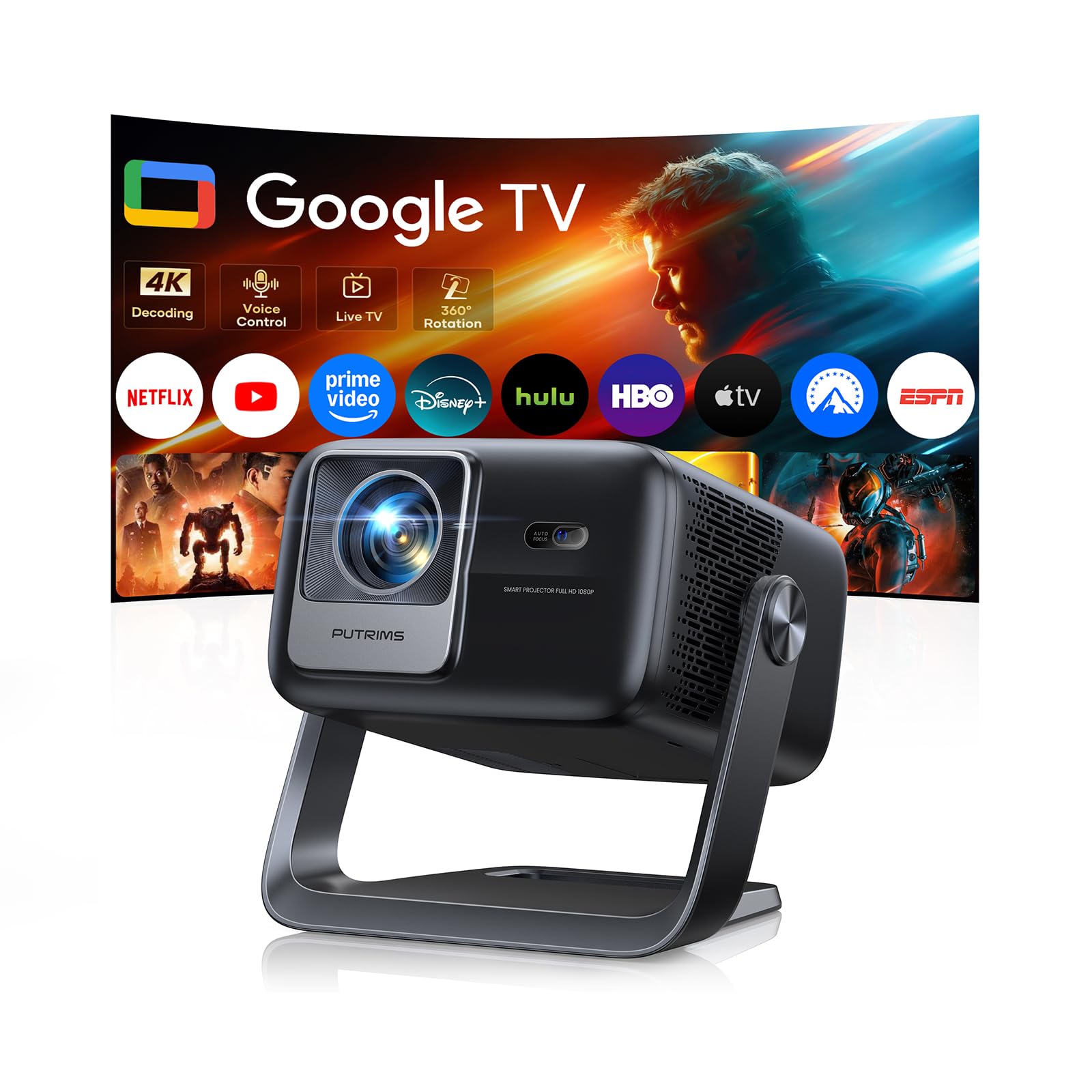
The built-in 360° stand aims straight at the ceiling — the literal answer to this category.
Two specs make this the most on-topic pick here. The first is a built-in 360° rotatable stand that swings the lens at a wall, a ceiling, or an attic space without moving the base. The second is a 1.17:1 ultra short throw ratio, which means a huge picture from inches away — the thing that makes a bedroom work. Toss in a 1/4-inch screw hole for a tripod, bracket or ceiling mount and placement stops being a constraint at all.
Google TV is built in with no stick required, covering 10,000+ apps and 800+ live channels, with a voice remote running Google Assistant. Audio is 30W of HiFi stereo with bidirectional Bluetooth 5.3, so it can serve as a speaker for your phone as well. That sound figure is the mixed note in the feedback — plenty of punch, but not every owner is equally taken with it.
You get a sharp, detailed picture from a native 1080P engine (1920×1080 pixels) that accepts 4K input and supports HDR10 (a standard for richer contrast and color). PUTRIMS lists true 500 ANSI lumens (a standard brightness measure), so the image stays visible in a dim room. Setup is easy with AI auto focus and auto keystone (automatic image shaping), plus 50%–100% zoom to fit your wall. A neat detail: leave it in one fixed spot and turn the auto features off, and it remembers your adjustments between power cycles. Update the firmware before first use, since the maker flags audio and EQ tuning in that release.
The ceiling case
- 360° rotatable stand points at walls, ceilings and tight attic spaces
- 1.17:1 ultra short throw fills a big screen from inches away
- Google TV built in — 10,000+ apps, no streaming stick needed
- Settings memory keeps your adjustment once it is dialled in
Before you commit
- 5,000-plus words of features aside, it is a 1080P native panel
- Built-in audio draws a mixed reception rather than unanimous praise
- Firmware must be updated first for the tuned audio
Made for: bedroom ceiling viewing where the projector sits on a nightstand and fires upward.
Walk away if: you want true 4K pixels — this one decodes 4K rather than displaying it natively.
6. ViewSonic LX700-4K Laser Gaming Projector

Built for the Xbox crowd: 240Hz and 4.2ms input lag on a 4K UHD laser image.
Gamers should start at 4.2ms. That input lag figure, paired with a 240Hz refresh rate and 1440p at 120Hz support, is what separates this from every projector on the list that merely accepts a console signal. Designed for Xbox certification and CEC control mean the console wakes the projector with the controller. The resolution is genuine 4K UHD at 3840 x 2160, not downscaled, and the laser light source drives 3,500 lumens against a 3,000,000:1 contrast ratio.
Picture quality is what owners praise, and brightness comes in strong enough to stay watchable in medium room lighting — a real advantage over dark-room-only units. HDR and HLG compatibility with SuperColor handling adds the depth that makes a game world feel like a place rather than a texture. There is also a dedicated Golf Mode that tunes greens and blues for simulator setups, which is a niche touch but a thoughtful one.
The placement story is standard-throw but flexible: 1.3x optical zoom, horizontal and vertical keystone, four-corner adjustment, and 360-degree plus curved screen projection. A 100-inch image lands from 7.7 feet, and the PJ-WMK-007 mount handles ceiling duty. The fair caveat is that color accuracy and fan noise both draw mixed notes — not dealbreakers, but worth hearing the unit in person if you can.
The gaming argument: 4.2ms lag at 240Hz on a 4K UHD laser panel is the spec sheet every console owner should read first.
The caveat worth knowing: color tuning and fan noise divide opinion, so placement away from the seating area helps.
Match it to: PS5 and Xbox Series X owners who care more about response time than built-in apps.
Leave it for later if: you want a smart OS built in — this one leans on your console and stick.
7. JMGO N1S Ultra 4K Triple Laser Projector
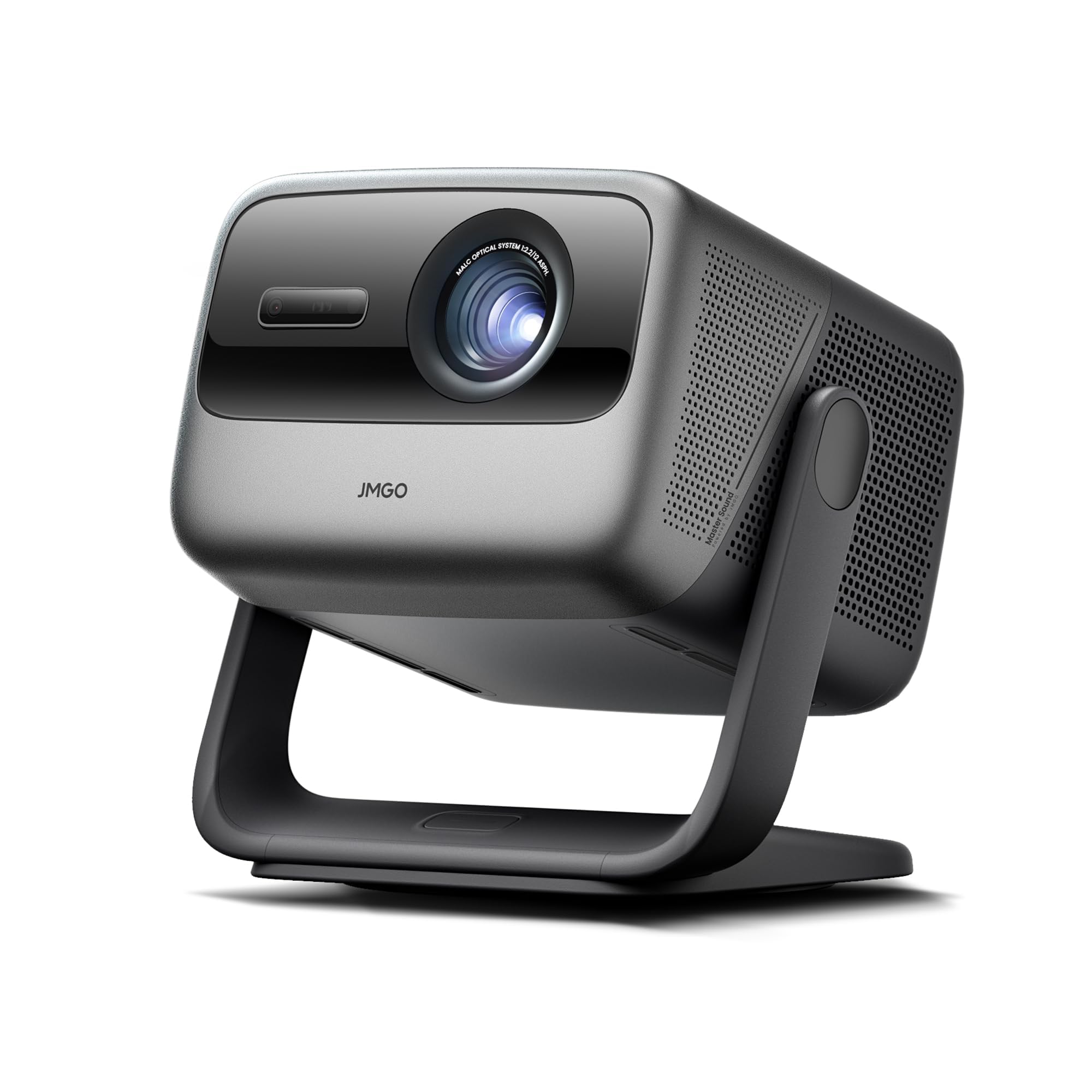
A gimbal, a triple-laser engine, and colour accuracy measured at ΔE<1.
Colour is the headline: triple-laser RGB optics with ΔE<1 accuracy and 1600:1 FOFO contrast, which is a level of colour fidelity most home projectors never approach. The integrated gimbal is the placement answer — move the unit or tilt the head and the auto system realigns the picture without manual keystone fiddling. Brightness at 2800 ISO lumens keeps it usable in a well-lit room, and native resolution is true 4K at 3840 x 2160.
The adaptive system is unusually thorough for this price: a 3D TOF sensor and CMOS camera handle real-time autofocus, keystone, brightness adaptation, wall-colour adaptation, lossless zoom, object avoidance and eye protection. Google TV brings 10,000+ apps and 800+ free live channels with Chromecast built in. Connectivity covers HDMI 2.1 with eARC and USB 2.0, and Blu-ray 3D capability adds a second dimension for the 3D crowd.
You get room-filling sound from 20W dual speakers with Dolby Digital Plus (a surround-sound format), reaching down to 45Hz for real bass weight. There are no review patterns behind this one to lean on, so judge it on the spec sheet and the maker’s reputation rather than owner consensus — the numbers are strong, and the engine is the reason this sits in the premium tier.
The defining figure: ΔE<1 colour accuracy from a triple-laser light engine is the precise reason this earns a premium slot.
Worth weighing: with no owner feedback to draw on, you are trusting the spec sheet and brand track record.
Worth it for: film lovers who notice colour grading errors and want the picture to look the way it was mastered.
Hold off if: you would rather buy on years of owner experience than on published specs.
8. NEBULA X1 4K Triple-Laser Projector

Two wireless speakers ride shotgun with a liquid-cooled triple-laser engine.
Most projectors make you build the sound system separately. This one ships with two wireless Wi-Fi speakers for 200W of 4.1.2 surround sound at 25ms latency — meaning you unbox a cinema instead of assembling one. A wireless microphone input turns it into a karaoke setup. Picture-side you get 3,500 ANSI lumens from a patented triple-laser optical engine with 110% Rec. 2020 colour, and native 4K at 3840 x 2160.
The contrast story is layered: a 6-blade iris delivers 5,000:1 native, and NebulaMaster technology pushes viewing contrast to 56,000:1. That is why dark scenes keep their shadow detail instead of flattening into grey. The 14-element all-glass lens is a serious optical choice at this tier, and the motorized 25° micro gimbal adjusts to walls as high as 10 ft — the placement flexibility that earns this category its name.
Cooling runs liquid-based and keeps noise under 26 dB, which is the difference between hearing dialogue and hearing a fan. Performance is what wins owners over here, with picture quality close behind, and setup stays straightforward. Colour quality is the mixed note — some viewers want a different tuning from the start — so budget a few minutes in the picture menu.
Why the premium tier fits
- 200W of 4.1.2 surround from two bundled wireless speakers
- Motorized 25° gimbal reaches walls up to 10 ft high
- Liquid cooling holds noise under 26 dB
- 14-element all-glass lens with native 4K resolution
Honest reservations
- Colour tuning divides opinion, so expect to adjust the preset
- It is a large desktop unit at just over 11 inches long, not a carry-around
- Premium pricing puts it out of reach for casual setups
Built for: the room where the sound is as important as the picture, and nobody wants to run speaker wire.
A different pick if: the projector has to travel — this one lives where you place it.
9. AWOL VISION Aetherion Max 4K Ultra Short Throw Projector
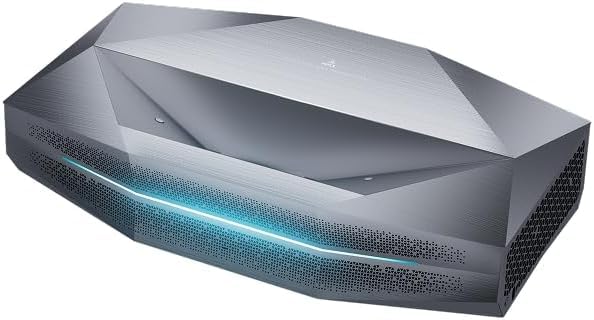
Sits inches from the wall and throws a 200-inch picture at a fraction of the wall space.
The ratio does the heavy lifting here. At 0.2:1, this unit sits essentially against the wall and still fills a huge screen — no ceiling mount, no professional install, done in minutes. Brightness is 3,300 ISO lumens from RGB triple-laser optics, and the maker states it holds its image in open-plan rooms and soft daytime light without blackout curtains. Owners confirm it holds up in a daytime living room, and overall performance is the most-praised part of the package.
Contrast is handled by the Noirscene System II with a 7-level IRIS and EBL algorithm — up to 6,000:1 native and 60,000:1 viewing contrast. Dolby Vision, HDR10+, HDR10, HLG and Dynamic Tone Mapping all land, and the gaming side runs 1ms-class input latency at 240Hz with VRR, ALLM and Dolby Vision Gaming across 3× HDMI 2.1a plus DisplayPort 1.4a. Anti-RBE technology cuts rainbow-effect distraction in 2D and 3D content, which matters for anyone who notices colour fringing in bright motion.
One thing to get straight: although a 0.2:1 UST panel has almost no placement freedom in the rotating sense, it compensates with optics. Pair it with an ALR screen and the contrast holds even under overhead lighting. Picture quality and colour both land warmly with owners, and functionality across HDR, SDR and Dolby Vision is appreciated. The honest limit is the one every UST shares — you aim it once, and it stays aimed.
The living-room case: a 200-inch screen from inches away, no install crew, and daytime brightness that skips the blackout curtains.
What you give up: UST placement is fixed by design, and an ALR screen is the partner that gets the most out of it.
Designed for: replacing a big TV in a bright, everyday living room without a ceiling install.
Not for you if: half the appeal is swinging the picture around the room — that is the rotatable-stand picks above.
Know the Specs
Throw ratio
Throw ratio is how far the lens sits from the wall set against how big the image gets. A low number like 0.2:1 means the projector can sit right against the wall and still fill a giant screen, which is what makes an ultra-short-throw unit a TV replacement. A number like 1.17:1 needs a short distance but not touching, and a standard throw of around 1.3 to 1.5 needs real floor space between the unit and the wall. Before you buy, measure the distance from where you plan to put the projector to where the image will land, then match it to the ratio on the spec sheet.
Keystone correction and rotation
Keystone correction is the software that squeezes a trapezoid back into a rectangle when the projector is tilted off-axis. Auto keystone does this for you; manual keystone asks you to nudge corners by hand. Rotation is a physical feature — a gimbal or a 360° stand lets you aim the lens at a ceiling or side wall. Rotation gets the picture pointed where you want it, and keystone squares the result. One caveat worth noting: some makers cap auto-focus at a specific tilt, so check the spec sheet before you mount at a steep angle.
Brightness in ANSI and ISO lumens
ANSI lumens and ISO lumens are two ways of measuring how much light the projector throws. Higher numbers mean the image stays visible in brighter rooms. A unit in the low hundreds needs a genuinely dark room, while one in the thousands can hold up in a lit living room. You will see claims in the tens of thousands on some listings — that discrepancy between marketing copy and spec sheet is worth reading carefully.
Native resolution versus 4K support
Native resolution is the actual pixel grid on the panel. “4K support” means the projector accepts a 4K signal and downscales it to whatever the panel can display. A native 1080P panel with 4K support still looks sharp, but it is not true 4K. True 4K projectors list 3840 x 2160 as their display resolution maximum. Match the claim to the panel, not to the marketing banner on the listing.
Common Questions
Does a 360 degree projector actually project onto the ceiling?
What throw ratio do I need for a small bedroom?
Is native 1080P good enough if the listing says 4K support?
How many lumens do I need for a daylight living room?
Will auto keystone work if the projector is mounted at a steep angle?
Can I use a rotating projector with a soundbar or external speakers?
Do these projectors need a separate streaming stick?
How long does the laser light source last compared with a lamp?
Can these projectors handle gaming consoles at high refresh rates?
Is a refurbished projector a risk worth taking?
The Bottom Line
For most rooms, the 360 degree projector winner is the ONOAYO ONO5Pro 2.0 because it pairs 60W of Dolby-tuned audio with a 3-second auto calibration that works in a ceiling mount, so you get the picture and the sound in one box. The AuKing 4K Projector has more ratings — 478 to 25 — but the ONOAYO’s 4.5+ star score beats it, and that gap is why it sits at the top.
If your whole reason for this category is pointing a picture at the ceiling from a nightstand, the PUTRIMSP66 has the 360° stand and 1.17:1 short throw that make it the most literal fit. For a bright living room where a TV used to sit, the AWOL VISION Aetherion Max sits inches from the wall and holds its image in daylight. And if sound carries as much weight as the picture, the NEBULA X1 bundles two wireless speakers for real surround, cooling quietly under 26 dB and reaching walls up to 10 ft with its motorized gimbal.
The one nudge worth acting on: these nine units serve nine different jobs, so pick the placement you need first, then let the specs confirm it. The ONOAYO has the depth of owner experience behind it, the ViewSonic has the response time gamers want, and the SAMSUNG is the one that packs into a bag.
How we choose
We do not accept paid placement. Every pick is matched to a real buyer and a real use-case; we do not hands-on test units.
Sources
Specifications: manufacturer listings and product documentation. Review insights: verified customer reviews, as of November 2026. Pricing: not shown on this page (it changes often); check the current price via the retailer link.
As an Amazon Associate, My Heart Lives Here earns from qualifying purchases. This does not affect which products we feature.