Heads up: This post contains affiliate links. As an Amazon Associate I earn from qualifying purchases, at no extra cost to you. Learn more
Specs are compiled from manufacturer listings and verified buyer reviews and can change over time — please confirm the key details on the product page before buying.
If your fat bike feels vague and skatey on gravel, wet pavement, or packed snow, the fix is usually the rubber, not the bike. A 26 x 3 tire puts a wide contact patch on the ground, and the tread pattern decides whether that patch grips or slides. This guide narrows the field to seven real 26 x 3 and 26 x 3.5 options, sorts them by what they actually do well, and tells you which one matches your riding.
This guide is built by comparing the manufacturers’ published specifications and the patterns across verified customer reviews, so you get each pick’s real strengths and trade-offs instead of marketing spin.
You will see which tires ship as pairs with tubes, which run slick for pavement, and which carry a knobby tread for mud and snow. Here is the straight answer on the best 26 x 3 bicycle tire.
Top Picks

How To Choose The Best 26 X 3 Bicycle Tire
The single biggest mistake buyers make here is assuming every fat tire is the same width. A 26 x 3.0 and a 26 x 3.5 are different animals, and your frame, fork, and rim decide which one you can actually run.
Check the width against your frame first
A tire listed as 26 x 3.0 measures 3 inches wide; a 26 x 3.5 measures 3.5 inches. That half inch of extra rubber can rub the chainstays or the fork legs on a frame built for a 3.0. Measure your current tire with a ruler before you order anything wider.
Match the tread to where you actually ride
A knobby tread (raised blocks of rubber across the tire) bites into loose gravel, mud, and snow. A semi-slick keeps a smooth center strip for low drag on pavement with shoulder knobs for corners. A slick is fully smooth and rolls fastest on dry hard surfaces but gives up grip the moment the ground turns loose.
Understand the pressure range on the sidewall
Fat tires list a working pressure band on the sidewall, and on these tires it commonly sits somewhere between roughly 15 and 36 PSI. Running near the low end gives you a bigger, softer contact patch for traction. Running near the top reduces drag on pavement but makes the ride firmer.
Decide if you want a bare tire or a full kit
Some tires arrive as a single tire only, with no tube and no rim. Others ship as a pair with matching inner tubes and tire levers in the box. If your tubes are old or the wrong size, a kit saves you a second order and a second wait.
Side-by-Side Comparison
| Model | Best For | Listed Size | Tread Type | What’s In The Box | Amazon |
|---|---|---|---|---|---|
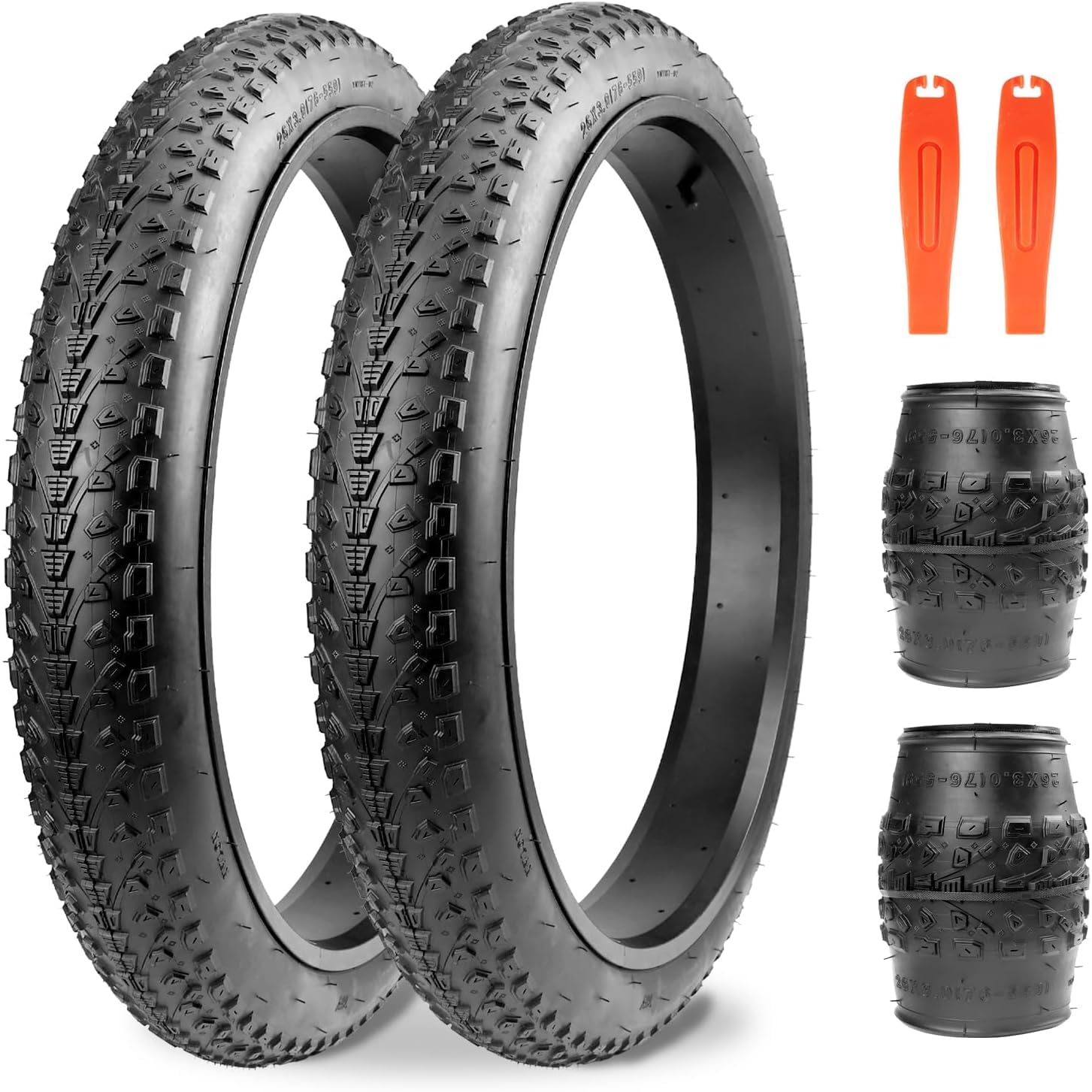
| YUNSCM 26″ Fat E-Bike Tire★ Best Overall | All-terrain riding on an e-bike | 26 x 3.0 (76-559) | Braided | 2 tires | Amazon |
| ZUKKA Fat Bike TireBest Grip | Mud, snow, and loose dirt | 24 x 3.0 | Knobby | 2 tires + 2 levers | Amazon |
| BALINGE 1/2 Pack Fat Bike Tires | Pavement and hard-pack rolling | 26 x 3.0 | Semi-Slick | 2 tires | Amazon |
| Sunlite Crusher Cruiser Tire | Cruiser look with a whitewall stripe | 26 x 3.5 | Inverted micro tread | 1 tire | Amazon |
| Alta Bicycle Fat Tire by Duro | Beach cruisers on dry hard surfaces | 26 x 3.0 | Slick | 1 tire | Amazon |
| WEEROCK 16/20/26 Inch E Bike Tires | One-stop replacement kit | 26 x 3.0 (75-559) | Directional | 2 tires + 2 tubes + 2 levers | Amazon |
| WEEROCK 1/2 Pack Fat Tires | E-bike and snow bike trail riding | 26 x 3.0 (70-559) | Knobby | 2 tires + 2 tubes + 2 levers | Amazon |
Detailed Reviews
1. YUNSCM 26″ Fat E-Bike Tire 26 x 3.0/76-559
Our pick — 4.5+★ from 60+ verified ratings; the strongest balance of quality and price.
The all-terrain default that folds flat for storage and grips from trail to tarmac.
This is the tire that suits the rider who genuinely does not know what surface the ride will end on. The listed size is 26 x 3.0 with a 76-559 designation (the standardized rim-matching code printed on the sidewall), and it is built to match 26 x 3.0 as well as 26X3 fitments. That flexibility matters because fat bike sizing labels are not always written the same way across listings.
You get one tire that handles pavement and soft trail, thanks to its multi-functional tread design. The maker says this tread pairs off-road bite with low rolling resistance. It also folds: new soft wire technology lets the tire fold for storage and carry. That helps when you keep a spare in a car or a boat locker.
The honest catch is the folding itself. The steel wire in the bead cannot be fully creased, and the maker explicitly warns that over-folding or over-pulling can leave the bead bent and the tire mounting unevenly. Open it, let it sit, and install gently. It also ships as two tires with no tubes in the box.
What earns it first place
- Tread is designed to switch between on-road and off-road riding without a second wheelset.
- Ships as 2 pcs of 26×3.0 tire, so you do a matching pair in one order.
- Folding soft wire construction stores flat and travels easily.
- Made from a high-content butyl rubber formula the maker describes as less odorous than most tire rubber.
Where it asks more of you
- No inner tubes included — you supply those separately.
- The bead tolerates only gentle folding and needs a careful first install.
- Warranty excludes extreme off-road riding, racing, overload, and improper installation.
Go for this if: you ride a fat e-bike across mixed surfaces and want one tire that handles both without drama.
Heads up: buy tubes at the same time — this box holds two tires and nothing else.
2. ZUKKA Fat Bike Tire 24 x 3.0
Built for the rider who wants the front wheel to stay planted when the trail turns to soup.
Look closely at the listed size before anything else: this one is written as 24 x 3.0 inches, not 26. That makes it the odd one out in a 26-inch lineup, and it belongs here for the buyer running a 24-inch fat frame or a smaller e-bike. Confirm the number stamped on your current sidewall matches before you order.
The tread is the whole story. It uses a knobby pattern — raised rubber blocks rather than a smooth strip — which the maker says maintains contact between the tread and the road and raises friction on loose ground. In practice, that means less rear-wheel spin on a loose dirt climb. There is also a deliberate drainage design, with an arrow anti-skid pattern and a groove combination that clears water so grip holds up on wet pavement. Rain does not have to be a day off.
The steel wire structure inside the tire is aimed at durability and wear resistance across mountain road, city street, and beach coast. The package includes two tires and two tire levers, and the tire folds for storage. Compared with the YUNSCM above, this is the more aggressive off-road choice — the YUNSCM is the one that switches between surfaces, this is the one that digs in.
Who this is built for: riders on wet trails, muddy fire roads, or snow who value bite over fast rolling.
The thing to double-check: the 24 x 3.0 sizing is its own decision point — it will not swap onto a 26-inch frame.
Reach for it when: traction on loose, wet, or snowy ground is the whole point of your ride.
Look elsewhere if: your bike is a 26-inch fat frame — you need the diameter to match first.
3. BALINGE 1/2 Pack 26 x 3.0 Fat Bike Tires
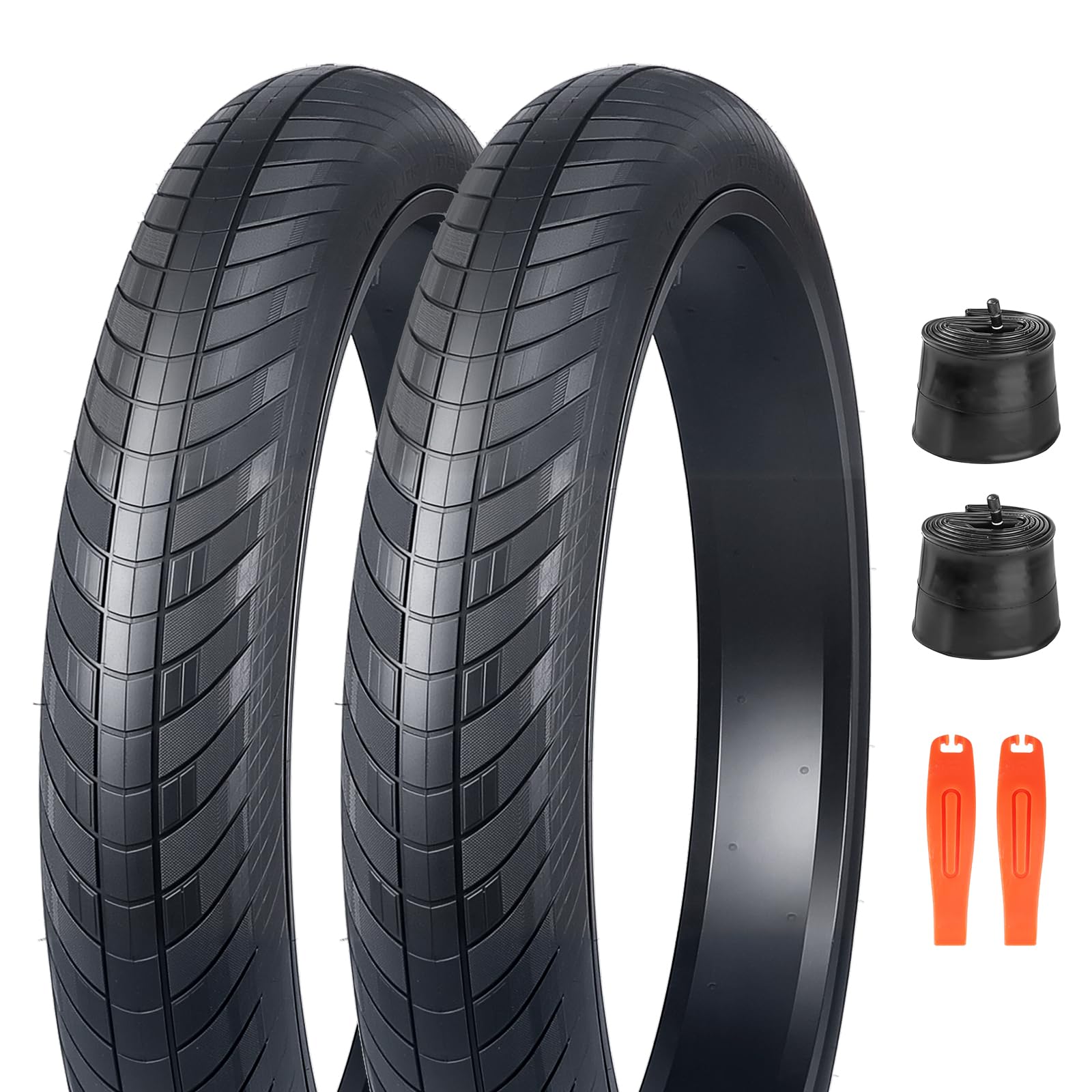
A semi-slick fat tire for the rider who mostly commutes but still wants the fat bike look.
This tire is built for speed on pavement, not just dirt. Its semi-slick tread (a smooth strip down the center with shoulder bite at the edges) targets low drag on hard-pack and paved terrain. The maker says the semi-slick center strip is built for rolling speed and minimal drag. If your 26-inch fat bike is really a town bike, that low drag matters on every ride.
Owners land on exactly one word for it. Reviewers consistently call the ride smooth, describing a planted, predictable feel underfoot rather than a buzzy one. BALINGE also builds shock dampening into the tire, softening the cracks and curbs that a stiff fat tire would telegraph up through the bars.
It folds, so storage and shipping are easy, and it mounts on the rim without special tools. You get two tires in the pack, and the maker recommends swapping both at once so the front and rear wear evenly. Unlike the knobby ZUKKA above, this tire trades off-road bite for a quieter, faster roll on pavement.
Why it earns a place: low-drag, smooth-rolling rubber that makes a fat bike feel far less sluggish on tarmac.
The trade-off worth knowing: a semi-slick is not a mud tire — deep loose ground is where it gives ground.
This is your tire if: pavement, bike paths, and hard-pack are where the bike actually lives.
Pass on it if: your weekends are mud, deep snow, or loose gravel climbs.
4. Sunlite Crusher Cruiser Tire 26 x 3.5

The widest tire in the group, with a thin white stripe that changes the whole bike.
At a listed 26 x 3.5, this is the widest rubber here — half an inch wider than the 26 x 3.0 tires that dominate the list. On a Baja Cruz or a similar cruiser frame built for the extra width, that translates to a bigger contact patch and a distinctly plusher ride. Check your frame and fork clearance carefully, because that half inch is unforgiving.
The tread is what Sunlite calls an inverted micro tread, a shallow pattern that stays quiet on pavement while still putting texture on the ground. It is not a mud tire and does not pretend to be. The real draw is the classy thin whitewall stripe — the detail that makes a plain black cruiser look finished rather than stock.
Buyers respond to the whitewall look and the value at this width. Cruiser replacements at this width are not always easy to find in a matched look, and the wire bead construction gives the sides a firm, stable seat on the rim. It ships as one tire only, so a full bike swap means ordering two.
Reasons to fit these
- The widest listed size in this lineup at 26 x 3.5, for a fuller contact patch.
- Thin whitewall stripe gives a cruiser a period-correct finish.
- Wire bead construction seats firmly on the rim.
- Shallow tread stays quiet on hard surfaces.
Know before you order
- Sold as a single tire — two are needed for a full bike.
- The 3.5 width will not clear every fat frame.
- Shallow tread gives up grip on soft or loose ground.
Fit these if: you want maximum width and a whitewall stripe on a cruiser-style build.
Be sure first: measure clearance for a 3.5-inch tire before committing to a pair.
5. Alta Bicycle Fat Tire Duro 26″ x 3.00″ Slick

A fully smooth fat tire that rolls quiet and straight on sand and hard pavement.
The slick tread is the defining feature here, and it is not a shortcut — a fully smooth tire rolls with the least resistance of any tread type on hard, dry ground. Made by Duro, this one is aimed at cruiser bikes and beach riding, where the surface is packed sand or boardwalk rather than mud. The listed pressure band runs 15-36 PSI, which gives you room to drop it low for float over soft sand or firm it up for the trip home.
Owners say it looks the part and holds its line on pavement. Quality is the trait reviewers mention most, followed closely by ride quality, with riders describing a true-rolling wheel rather than one that wanders. The look gets a mention too, with the wide black profile reading like a motorcycle tire on a cruiser build.
Buyer beware on the contents: this is the tire alone. No tube, no rim, sold each. If your wheels are due for a refresh anyway, plan for tubes in the same order. And keep it on dry hard surfaces — a slick on loose gravel is a slide waiting to happen.
Where it shines: quiet, low-resistance rolling on beach sand, boardwalk, and dry pavement.
The one to plan around: it is a single bare tire — tubes and rims are on you.
Pick this one for: a beach cruiser or boardwalk bike that never sees mud.
Skip the slick if: your riding includes loose gravel, wet grass, or trail dirt.
6. WEEROCK 26 x 3.0 E Bike Tires with Tubes
Everything you need to swap both wheels in one box, tubes and levers included.
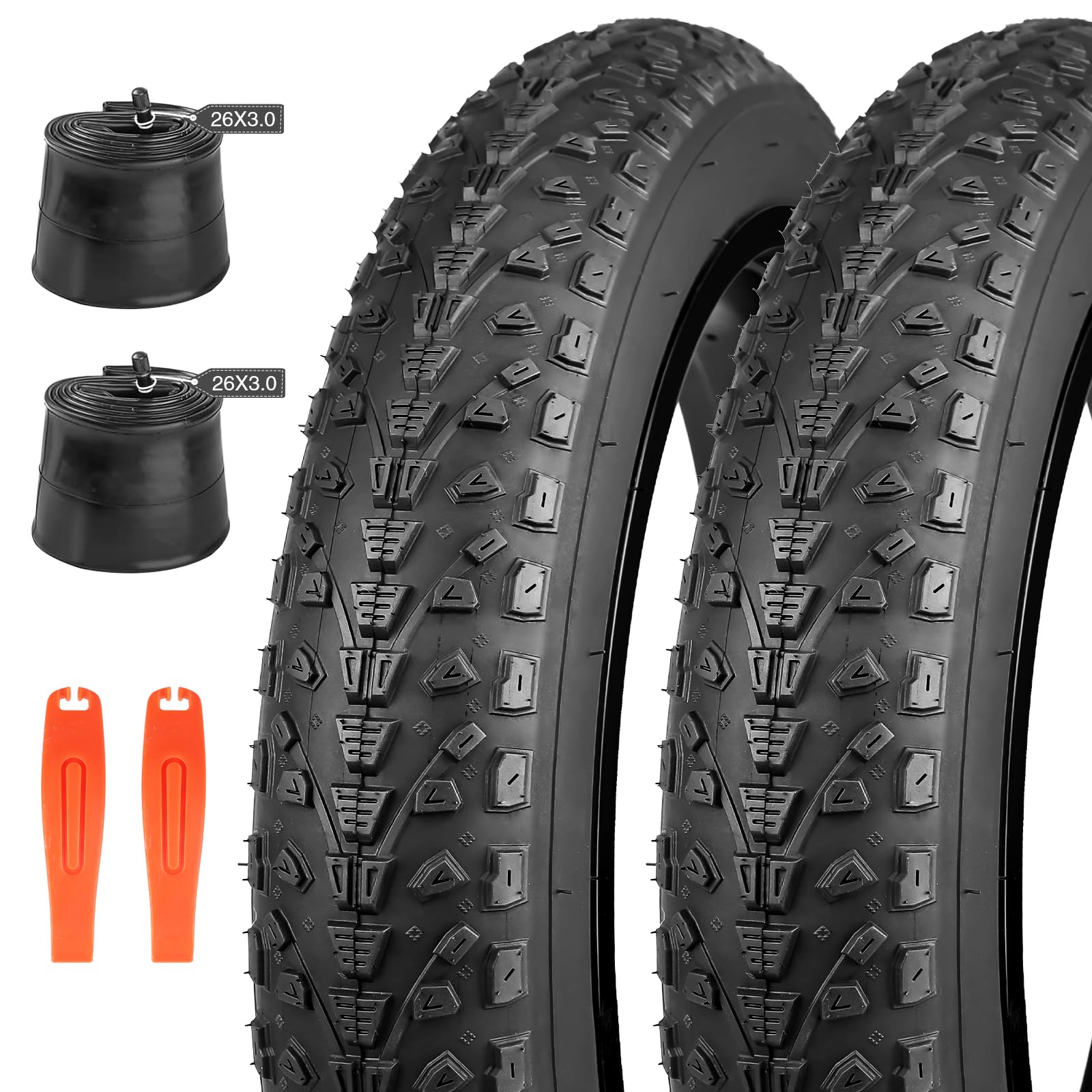
Most tire listings make you buy the rubber and then go hunting for tubes in the right size. This one closes that gap. The box holds 2 pcs of 26 X 3.0 tires, 2 pcs inner tubes, and 2 pcs tire prying rods, so a full front-and-rear change is a single order. That is the practical advantage, and it is a real one on a fat bike where the tubes are not something you find at every shop.
You get a 26×3.0 inch tire with a 75-559 designation (the standard size code for this wheel). The matching inner tube is also 26×3.0 and has a Schrader valve (the common wide-bore valve you inflate at any gas station air pump) that is 35mm long. The nylon and rubber blend compound is claimed by the maker to increase wear resistance and extend service life. That matters most on an e-bike, where the motor adds load to the rear tire.
The directional tread uses a concave-convex pattern aimed at grip during climbing and turning, with comfort and stability as the stated goal. It suits 26-inch electric bikes, snow bikes, fat bikes, and tricycles. The 4-count unit means tires plus tubes together, not four tires.
The case for the kit
- 2 tires, 2 tubes, and 2 levers in one package — a full wheel refresh.
- Schrader valves at 35mm suit standard pumps and gas station air lines.
- Directional tread designed for grip while climbing and cornering.
- Nylon and rubber compound built for wear resistance under e-bike load.
Worth weighing up
- Directional tread must be mounted the right way round — check the arrow.
- Only a 3-month warranty is listed.
- Fixed at 26 x 3.0, so no width flexibility.
Best call for: anyone who wants to finish the job in one order without a second trip for tubes.
Worth noting: mount the directional tread facing the marked direction or wet grip suffers.
7. WEEROCK 1/2 Pack Fat Tires 26 x 3.0 with Tubes
Knobby rubber plus tubes and levers, aimed straight at snow and mountain trails.
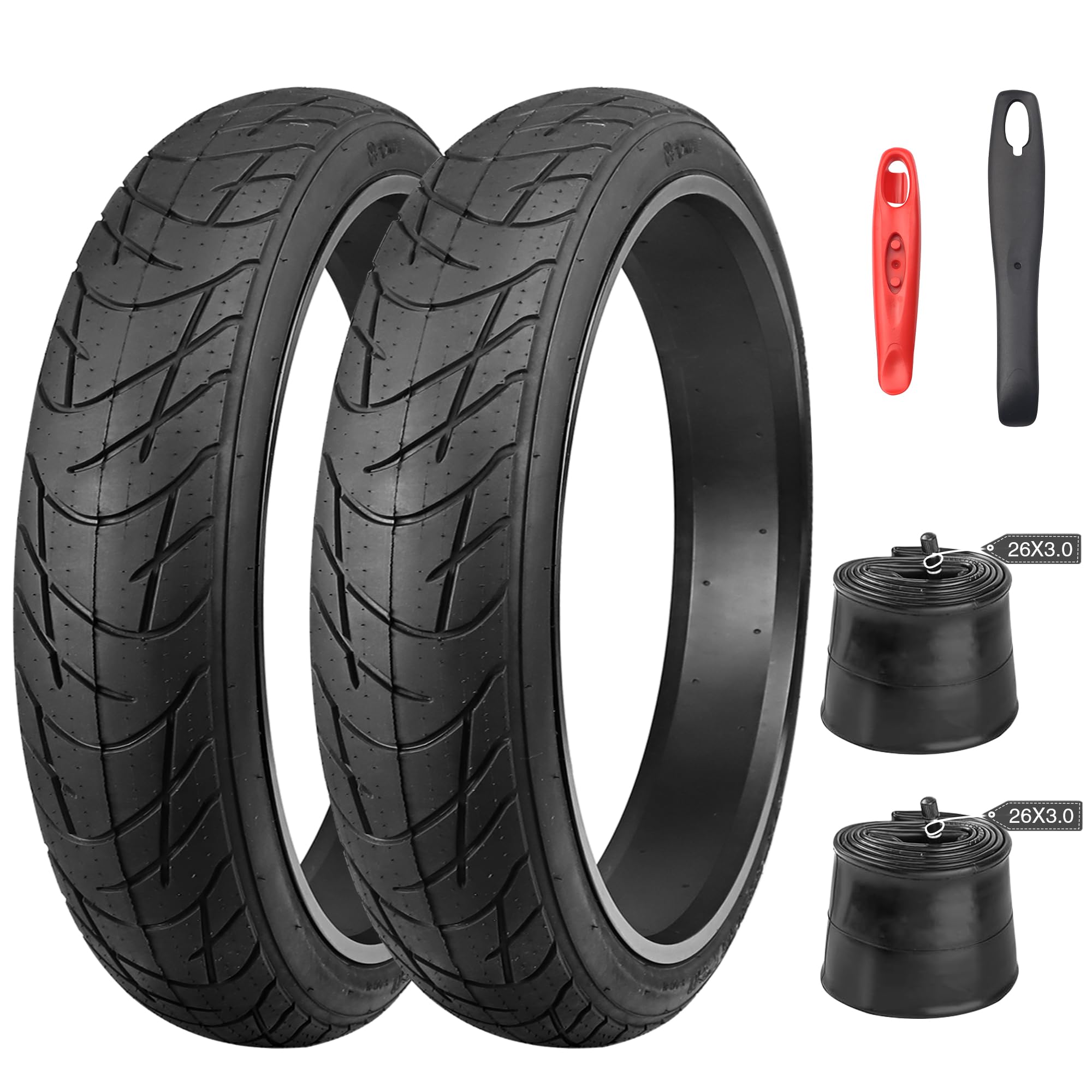
Where the other WEEROCK kit above runs a directional tread, this one goes knobby. The listed tread type is knobby — raised blocks of rubber that bite into soft ground — and the tire is sized 26 x 3.0 with a 70-559 designation. For a rider taking a fat e-bike out on packed snow or a mountain trail, that block pattern is the difference between driving forward and spinning in place.
The pressure range is spelled three ways on the listing and all three agree: 100-250 kPa, 1.0-2.5 BAR, or 15-36 PSI. Dropping to the low end widens the contact patch for float over snow, which is exactly what a snow bike wants. The concave-convex pattern is also credited with grip during climbing and turning, plus added comfort and stability.
What is in the box: 2 pcs of 26 X 3.0 tire, 2 pcs 26 X 3.0 inner tubes, and 2 pcs tire prying rods. The compound is nylon and rubber, aimed at wear resistance and a longer service life. If you are comparing it to the kit in the last section, this one is the trail-and-snow version and that one is the general e-bike version — same brand, different tread intent.
The standout: a true knobby tread paired with tubes and levers, so a snow or trail swap is one order.
Keep in mind: knobby blocks are noisier and slower on pavement than a semi-slick would be.
Go here for: winter riding on packed snow, or mountain trails where bite beats speed.
Think again if: the bike mostly commutes on smooth tarmac and you want a quiet roll.
Know the Specs
The 26 x 3.0 sizing code
The first number is the tire’s outer diameter in inches — 26 here — and the second is the width. So a 26 x 3.0 is a 26-inch diameter tire that measures 3 inches across. Get one of those numbers wrong and the tire will not seat on the rim or will rub the frame.
What 76-559 and similar codes mean
The second number in a code like 76-559 is the bead seat diameter in millimeters — the rim measurement the tire must match. It is the more precise figure, and it is why listings show both. A 26 x 3.0 and a 26 x 3.5 can share a diameter while sitting completely differently on the bike.
Clincher, wire bead, and folding bead
Every tire here is a clincher, meaning it hooks onto the rim edge with an inner tube inside. Wire bead tires have a steel wire ring in the edge, which holds shape and seats firmly. Folding bead tires use a softer wire so the tire packs down for storage — handy for a spare, but requiring gentler handling.
Pressure range and contact patch
The PSI band on the sidewall is your traction dial. Lower pressure flattens the tire against the ground for a wider contact patch and more grip on loose surfaces. Higher pressure rounds the profile and cuts rolling drag on pavement. Stay inside the listed band — over-inflating risks a blowout, and under-inflating risks pinch flats and rim damage.
Common Questions
Will a 26 x 3.0 tire fit on my 26-inch fat bike rim?
Can I run a 26 x 3.5 tire where a 26 x 3.0 was fitted?
What PSI should I run in a fat bike tire on sand or snow?
Do these tires come with inner tubes?
Is a knobby or slick tread better for a fat bike?
Can I use these tires on an electric bike?
What does a folding bead tire mean for installation?
Do I need to replace both tires at once?
What inner tube size do I need for a 26 x 3.0 tire?
How long should a fat bike tire last?
The Bottom Line
For most riders, the winner among the best 26 x 3 bicycle tire options is the YUNSCM 26″ Fat E-Bike Tire because its multi-functional tread genuinely switches between pavement and trail, and it folds flat for storage. If you want everything in one box, the WEEROCK 26 x 3.0 kit brings tires, tubes, and levers together. And for winter trails where bite is everything, the WEEROCK knobby pair is the one to reach for.
How we choose
We do not accept paid placement. Every pick is matched to a real buyer and a real use-case; we do not hands-on test units.
Sources
Specifications: manufacturer listings and product documentation. Review insights: verified customer reviews, as of November 2026. Pricing: not shown on this page (it changes often); check the current price via the retailer link.
As an Amazon Associate, My Heart Lives Here earns from qualifying purchases. This does not affect which products we feature.