Heads up: This post contains affiliate links. As an Amazon Associate I earn from qualifying purchases, at no extra cost to you. Learn more
Specs are compiled from manufacturer listings and verified buyer reviews and can change over time — please confirm the key details on the product page before buying.
If you keep a reptile, a chick brooder, or a hedgehog, the same question hits you fast: which 100 Watt Heat Bulb actually holds its heat without blowing out in a month? The short answer is to buy a ceramic emitter or a proper basking spot from a brand that has been around long enough to get the ceramic mix right. This guide walks through seven real options, what each one does best, and the honest catch on every one of them.
This guide is built by comparing the manufacturers’ published specifications and the patterns across verified customer reviews, so you get each pick’s real strengths and trade-offs instead of marketing spin.
You will see which bulbs run silent and dark for night heat, which throw a tight basking beam, and where the lifespan gamble really sits. The crowd favorite here is an old standby that keeps proving itself: a 4.5+ star ceramic emitter with 900+ ratings behind it. Below is my honest read on the 100 watt heat bulb market so you can pick the one that fits your setup the first time.
Top Picks

How To Choose The Best 100 Watt Heat Bulb
The single mistake most first-time buyers make is treating every 100 watt bulb as the same thing. They are not. A ceramic emitter and a basking spot bulb both draw 100 watts, but they deliver that heat in completely different ways — one floods the whole enclosure with invisible warmth, the other punches a tight hot beam into one corner. Pick the wrong one and your pet either bakes or never gets a proper basking zone.
Ceramic emitter or basking spot — start here
A ceramic heat emitter (a solid ceramic disc that glows warm but gives off no visible light) is the tool for keeping a background temperature steady, day or night. It works well for a leopard gecko, a ball python, or any animal that needs warmth after the lights go out. A basking spot bulb, by contrast, throws a concentrated beam so your bearded dragon or turtle can sit under it and soak. Many keepers run one of each on separate fixtures, which is why a mixed 24-hour setup is so common.
Check the screw base before you buy anything
Screw base is the first thing that can ruin your day. E26 is the standard household screw size most clamp lamps and dome fixtures use, while E12 is the smaller candelabra size. A bulb with the wrong base simply will not screw in. Read the base spec on both your fixture and the bulb before you order, and you save yourself a return.
Does the heat reach the whole tank or one corner
Heat output matters more than the wattage label in practice. A wide emitter spreads warmth across a bigger basking area, which suits larger enclosures. A narrow, intense spot bulb concentrates the heat into a tighter patch, which is what a basking animal wants to sit under. Match the spread to your tank size and you get the temperature gradient your reptile needs: a hot end and a cool end it can retreat to.
Side-by-Side Comparison
| Model | Best For | Bulb Type | Base | Rated Lifespan | Amazon |
|---|---|---|---|---|---|
| Fluker’s Ceramic Heat Emitter★ Best Overall | 24-hour background heat | Ceramic emitter | E12 | — | Amazon |
| ReptiKing Basking Light 2-PackTop Performer | Intense basking spot | Basking spot | E26 | 2000 hours | Amazon |
| Briignite Ceramic Emitter 2-Pack | Dark night warmth | Ceramic emitter | E26 | 10,000 hours | Amazon |
| REPTI HOME Infrared 2-Pack | Chicken coops and red-light basking | Infrared spot | E26 | 2000 to 3000 hours | Amazon |
| REPTI HOME Ceramic Emitter 2-Pack | Constant 24-hour heat | Ceramic emitter | E26 | 10,000 hours | Amazon |
| REPTI ZOO Ceramic Heat Lamp 2-Pack | Humid terrariums | Ceramic emitter | E26 | 10,000 hours | Amazon |
| Zoo Med Repticare | Large enclosures | Ceramic emitter | E26 | — | Amazon |
Detailed Reviews
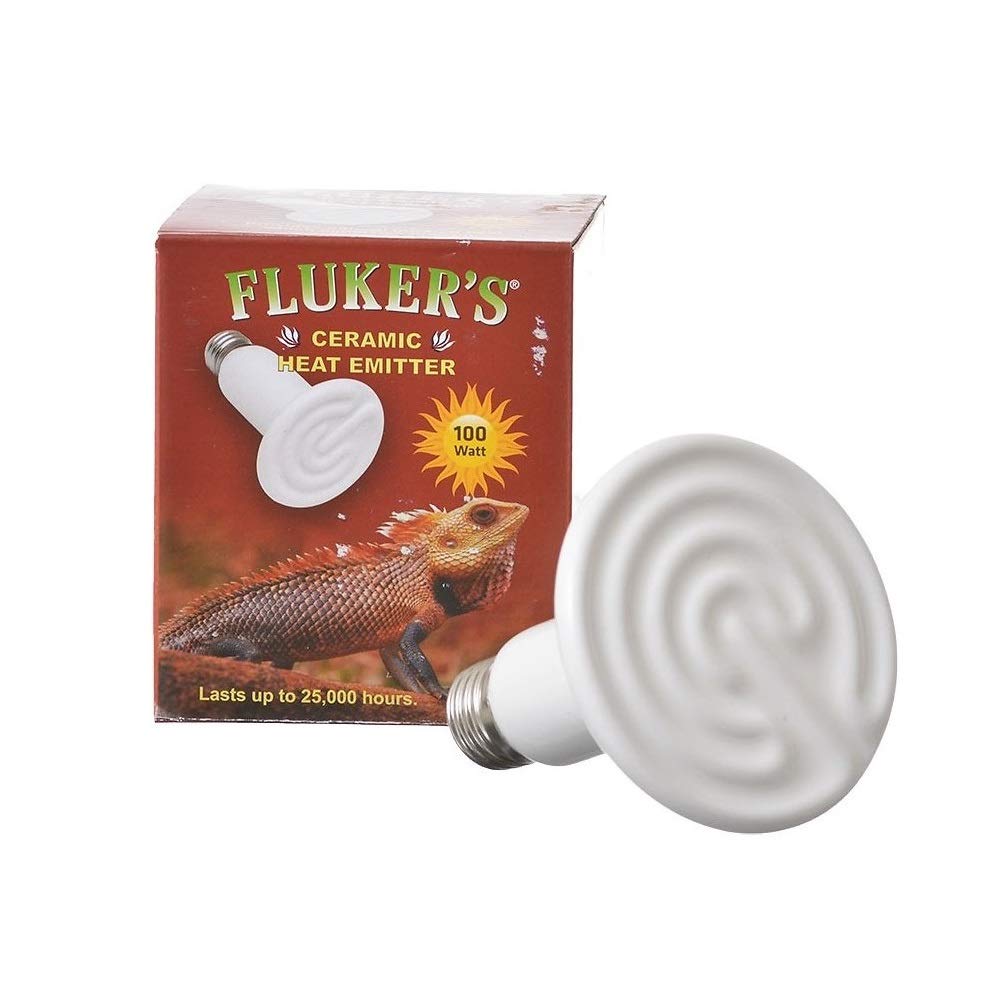
1. Fluker’s Ceramic Heat Emitter 100 Watt
Our pick — 4.5+★ from 900+ verified ratings; the strongest balance of quality and price.
The old reliable that spreads warmth across a whole basking area without a flicker of light.
The reason this Fluker’s emitter sits at the top is the width of its heat, not its wattage. A large circular emitter directs heat outward to increase the basking area, so a leopard gecko or ball python gets a proper warm zone instead of one narrow hot dot. That matters most at night, when you want the tank warm and completely dark. The 100-watt ceramic element produces zero visible light, which means your pet’s sleep and natural rhythm are left alone.
It is built as a constant 24-hour heat source that holds the temperature range reptiles and amphibians need across a whole enclosure. The accepted voltage is 100 to 120 volts at 60 hertz, so it runs on an ordinary US socket. Fluker’s designed it to pair with its own Repta-Clamp Lamp with Switch, which is worth knowing before you buy. Here is the catch worth flagging up front: the base is E12, the smaller candelabra size. Grab a standard E26 dome and this bulb will not screw in. Check your fixture first and this becomes a non-issue.
What wins people over is how consistently it delivers its function — holding a cage at the right temperature, especially through cool nights. The one split in the feedback is lifespan: plenty of these run for years, while others have given out inside a month. That is the nature of a ceramic heating element running hot for hours, and it is the same story you will read on nearly every bulb on this page. For a keeper who wants steady, lightless warmth and does not want to fiddle with anything clever, this is the pick. The crowd favorite reputation is earned: 4.5+ stars across 900+ ratings.
What sets it above the rest
- Wide circular emitter heats a larger basking area, not just a single spot
- No visible light at all, so you can run it through the night
- Runs on standard 100 to 120 volts at 60 hertz
- Simple 100-watt ceramic element with no moving parts to fail
What to weigh before buying
- E12 candelabra base — needs the smaller socket, not the common E26
- Lifespan is the recurring wildcard; some units give out early
- Pairs best with Fluker’s own clamp lamp
Money pick: Ideal if you want quiet, dark, around-the-clock heat and you already own or plan to buy an E12 fixture.
Do check first: The E12 base is the one detail that trips people up — confirm your lamp takes the small screw size.
2. Basking Light for Reptiles 2-Pack 100W
A tight, bright basking beam that mimics direct sun for a dragon that wants a hot corner to sit in.
Unlike the Fluker’s above, this ReptiKing bulb is all about a concentrated beam rather than spread. It throws a narrow, high-density spot that the maker rates 35% stronger to mimic the temperature and UVA of direct sunlight. For a bearded dragon or a turtle that wants to haul out and bask, that tight patch is exactly what you are after. It lets the animal choose between a hot end and a cool end, which is how thermoregulation works in a real terrarium.
Physically it is a compact bulb, at 3.2 inches wide by 4.8 inches tall, and it weighs 5.92 ounces. Compared with the REPTI HOME infrared spot further down at 1.22 by 1.69 inches, this is the bigger of the two by a clear margin, which matters if your dome fixture is a tight fit. The base is standard E26, the common household screw size, so it drops into most clamp lamps. It is rated at 2000 hours of service life, on 120 volts at 60 hertz. The two-pack means you have a spare on the shelf when the first one finally goes.
One useful touch: this is built to combine with a night heat lamp or ceramic emitter for a full 24-hour cycle, so it does not need to be your only heat source. The maker lists it for bearded dragons, crested geckos, umbrella lizards, desert lizards, turtles, tortoises, hermit crabs, iguanas, and even chickens. The honest limit is the 2000-hour rating — that is the shortest rated life on this list, and it tells you this is a bulb you will replace. If you want the true sun-like spot for daytime basking, that is the trade you make.
Where it shines: The narrow, intense spot is the point here — it delivers a real basking zone, and the 2000-hour rating is refreshingly honest about what you are getting.
The one number to note: At 2000 hours it is the shortest-lived rating on the page, so budget for a spare, which the two-pack already covers.
Reach for it if: You keep a daytime basker like a bearded dragon or turtle and want a strong sun-style spot plus a backup bulb in the box.
Look past it if: You want a bulb that runs for years without swapping — that is the ceramic crowd’s job, not this one’s.
3. Ceramic Heat Emitter for Reptiles 2 Pack 100W

Built dark and hot for nocturnal pets that need warmth without a single photon.
This Briignite pair goes hard at the no-light angle. The black ceramic emitter gives off zero visible light, which suits nocturnal reptiles and light-sensitive animals — it keeps the enclosure dim or dark while still providing the warmth the animal needs. If your gecko or frog goes still and stressed under a glow, this is the kind of bulb that keeps its natural behavior and biological rhythm intact. The thicker ceramic is meant to hold heat and ramp up temperature fast, and a NiCrAl alloy element (a high-resistance heating metal) does the actual warming.
The maker rates it at up to 10,000 hours, and it fits a standard E26 base on 100 to 120 volts at 60 hertz. Weight runs 0.33 kg, the same as the REPTI HOME ceramic pair below, so both feel like proper solid ceramics in the hand. The larger body compared with the REPTI HOME infrared spot — 0.33 kg against 0.16 kg — tells you there is more ceramic mass here, which is part of why it holds heat the way it does. It is a heat source, plus it is fine for birds, chicks, and small mammals, not just reptiles.
The honest split on this one is life expectancy. Some units run for a long time, while others have burned out quickly. That lifespan wobble is the one reason a keeper hesitates, and it is the same gamble you will find across the category. What the buyers respond to is raw heat output, with a bearded dragon owner noting their pet is happier with the temperature it creates. Two bulbs in the pack soften the risk, and E26 makes it easy to grab a replacement. Snap this in when your day bulb clicks off and your pet still needs warmth.
Why it earns a spot
- No visible light at all — safe for nocturnal and light-sensitive animals
- Thick ceramic and NiCrAl element for fast, strong heat
- Up to 10,000 rated hours
- Works for reptiles, birds, chicks, and small mammals
Worth knowing
- Lifespan is inconsistent — some units burn out early
- Ceramic carries no light, so it is warmth only by design
Made for the dark shift: This is your night-shift heat — pick it when your pet must stay warm but must also stay in the dark.
One caveat to absorb: The lifespan can be a lottery, which is exactly why buying the two-pack is the smarter move here.
4. Reptile Heat Lamp Bulbs Infrared 100W 2 Packs

The red-tinted workhorse that warms a chicken coop as happily as a basking corner.
This REPTI HOME pair runs the red-light route. It puts out infrared heat for pets that need warmth day and night, and the frosted coating cuts glare so the light is easier on animal eyes than a bare spot. That makes it a solid fit if you are brooding chicks or keeping a coop warm through a cold snap. The maker lists bearded dragons, tortoises, turtles, lizards, snakes, iguanas, geckos, chameleons, frogs, toads, chickens, tegus, and hedgehogs as fair game — a genuinely wide net.
It screws into a standard E26 socket, on 120 volts, and the maker’s guidance is 2000 to 3000 hours depending on use. Smaller than the ReptiKing basking bulb above, it measures 1.22 inches wide by 1.69 inches tall, and it weighs 0.16 kg. Compared with the REPTI HOME ceramic pair below at 0.33 kg, this is the slightly lighter of the two sibling models. For setup, the maker suggests running it 4 to 6 hours a day and replacing it roughly every three months for the best UVA effect. That replacement rhythm is a helpful thing to plan around.
Where the reviews get blunt is lifespan. Longevity is the single most-discussed thing about this bulb, and the mood there leans negative. Value and safety come up with a more mixed feel too. That said, what people do like is straightforward: solid heat output, chicks kept warm and cozy, and a bearded dragon tank holding proper temperatures. An occasional unit gives out early — expect to use that two-pack. Treat this as the coop and daytime basking bulb, and it does its job.
The honest headline: The frosted red glow and wide animal list make it a natural for chicken coops; it is the most-discussed point of concern on lifespan that you should weigh, not the heat.
Plan for it: With the maker’s 4-to-6-hours-a-day, replace-every-three-months guidance, budget for the swap and this becomes a dependable, glare-reduced basker.
Right for the coop: Choose this if you are brooding chicks or keeping a chicken coop warm and want a softer red glow rather than a harsh white spot.
Only if you accept swaps: This is not a set-and-forget bulb — its lifespan reputation means you should go in expecting to replace it.
5. 100W Ceramic Heat Emitter (2 Pack)

The all-rounder ceramic that warms a gecko tank or a kitten brooder with the same steady hand.
This REPTI HOME emitter leans into versatility and it means it. The solid ceramic element is meant to be stronger and more durable than an ordinary glass heat lamp, and it puts out infrared heat with no visible light at all. The maker rates it 100% heat efficiency: all warmth, no light. It is aimed at animals that need a constant 24-hour source, like leopard geckos, ball pythons, and monitors, and at reptiles that just need extra night warmth, like bearded dragons, chameleons, and tree frogs. It is honest to call it the most flexible bulb here, since it also suits chicks, dogs, and cats in a brooder or coop.
It fits a standard E26 base on 100 to 120 volts at 60 hertz, and it is rated up to 10,000 hours. The maker says you feel heat within 10 seconds and it hits rated temperature in about 4 minutes. The ceramic body measures 3 inches wide by 3 inches tall, and it weighs 0.33 kg — the same solid mass as the Briignite pair. Compare that to the lighter red REPTI HOME spot at 0.16 kg and you feel the difference in ceramic mass.
Where it separates from the red spot above is patience and safety. The maker warns against touching the bulb to test heat, keeping it more than 30cm from reptiles, and cycling it on and off repeatedly. Follow that and you get a steady heater. The recurring gripe is lifespan: some units run long, while a few burn out within weeks. Heat and build quality are what carry it. Set it behind a thermostat and let it do the background-warming job it was built for.
Best things going for it
- Constant 24-hour heat with no light emitted
- Fast ramp — rated temperature in about 4 minutes
- Up to 10,000 hours of rated life
- Suits reptiles, amphibians, chicks, dogs, and cats
Where it asks more of you
- Lifespan is uneven — some fail in a matter of weeks
- Maker warns against frequent on/off cycling and hand-testing the heat
- Needs a good-quality ceramic lamp holder to run safely
Pick it for flexibility: Go for this if you run more than one setup — the same bulb warms a terrarium tonight and a chick brooder next month.
Set it up right: Pair it with a solid ceramic holder and a thermostat, and the uneven lifespan is the one unknown left to chance.
6. REPTI ZOO 100W Reptile Heat Lamp 2Pack

A high-purity ceramic emitter built to shrug off the damp of a glass terrarium.
This REPTI ZOO pair makes its case on material. The ceramic is described as high-purity, crack-resistant, and safe to operate in high-humidity environments like a glass terrarium. If your setup runs wet — a humid hide, a misted tank, a tropical species — that humidity guard is the reason to reach for this over a cheaper emitter. It is also CE-certified and RoHS-compliant per the maker, and it fits most E26 sockets. Like the others here it gives off no visible light, so it keeps a constant, uninterrupted warmth while the animal sleeps.
The maker rates it at 10,000 hours, three times the life of a traditional heat lamp. It is a G40 shape, measuring 2.9 inches wide by 3.9 inches tall, and weighs 0.35 kg — the heaviest ceramic pair on this list, just above the 0.33 kg REPTI HOME models. That extra mass is consistent with the high-purity ceramic build, and it shrugs off the temperature swings of a humid tank. It suits turtles, bearded dragons, geckos, lizards, snakes, and chickens, and it is a two-pack, so a backup is included.
What buyers respond to most is the heat itself — it warms up quickly without overshooting into too-hot territory, giving nice, even heating. A dragon owner called it close to perfect for their setup. The split, again, is lifespan: some report it lasting a long while, while some units break within a few months. That is the lone soft spot on a bulb that otherwise feels built for the damp. If humidity is the enemy in your enclosure, the crack-resistant ceramic is worth the trade.
The build story: High-purity, crack-resistant ceramic that is rated for high-humidity terrariums is the standout, and the 10,000-hour rating backs the durability pitch.
Even heat, honestly: It warms fast without overheating, and the only unreliable part is lifespan, where some units give out sooner than you would hope.
For humid tanks: Reach for this if your terrarium runs damp and you want a crack-resistant ceramic that handles the moisture without complaint.
Skip the gamble: If you simply cannot stomach any early failure, know that a few units break in a few months — the two-pack is your insurance.
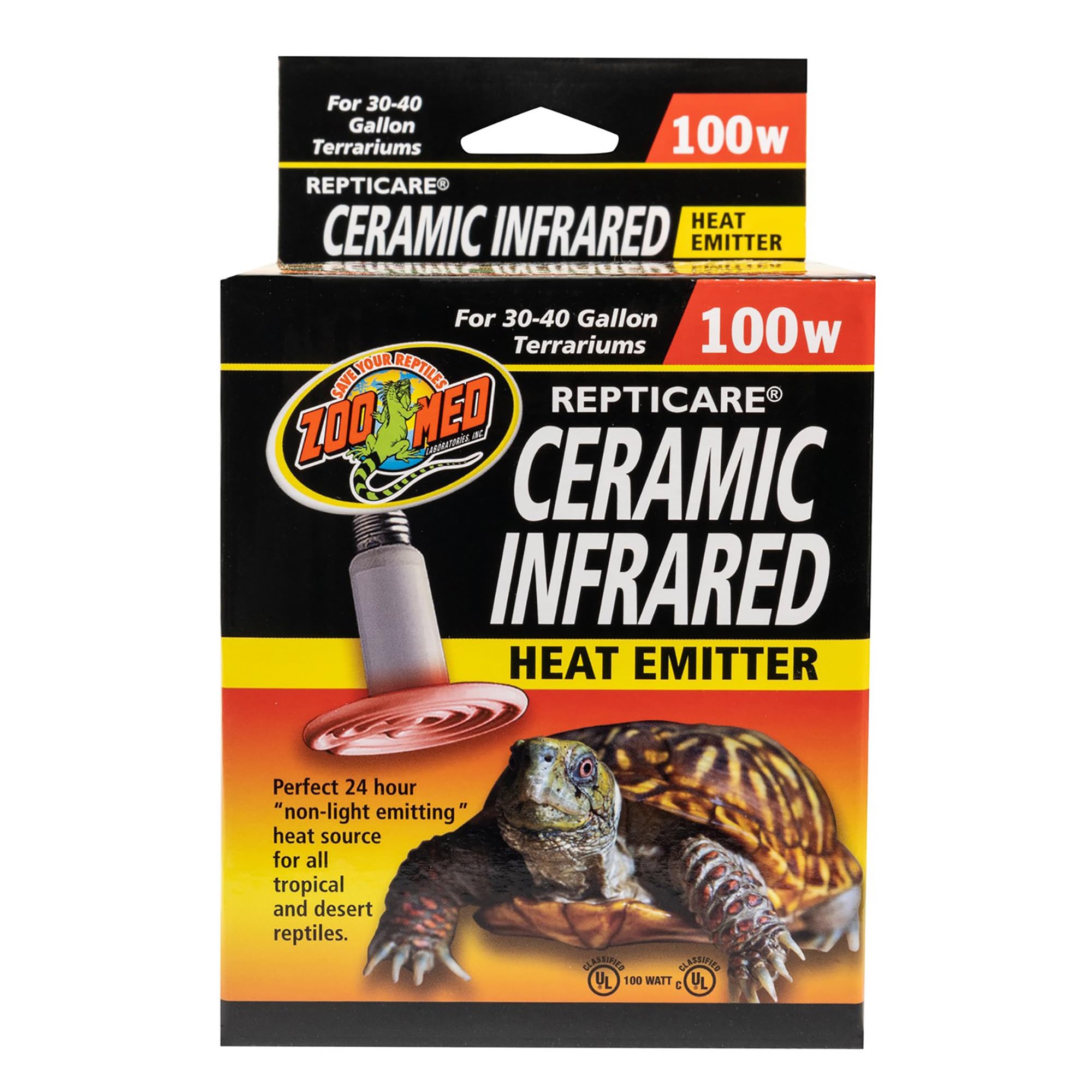
7. Zoo Med Repticare 100 Watt Ceramic Infrared Heat Emitter
The flat-faced veteran that lifts a whole room-temperature tank into the warm zone.
Zoo Med’s flat face is the interesting spec here, and it does real work. The maker says the flat face beats conical designs and can lift terrarium air 10 to 20 degrees above room temperature. That is a whole-tank heater, which suits a large enclosure where you need overall warmth rather than one hot corner. It is built for high-humidity terrariums too, so a damp setup does not scare it. It fits a standard E26 base and runs on 100 to 120 volts at 60 hertz.
The flat face spreads heat broadly, which is why the heat output gets so much attention — it holds a tank in the 70 to 80 degree range, and keeps working in cold rooms below freezing outside. It runs lightless, so nocturnal animals and hedgehogs sleep through the night undisturbed. Made in America, with a color rendering index of 95, this is the most-established name on the list. It slots onto most clamp-lamp and dome fixtures without a fight.
The durability and lifespan notes are the mixed part, as they are across the category — most run and run, a few give out before their time. What is not mixed is function: it raises ambient heat steadily, exactly what a bigger or cooler-room enclosure needs. This is the pick for the keeper with a tall glass tank and a chilly room who needs to lift the whole volume, not just a basking rock. It is the veteran that keeps doing the boring job well.
The defining spec: A flat face that raises terrarium air 10 to 20 degrees above room temperature makes this the ambient-warmer for big tanks.
The trade-off named: Lifespan and durability carry some mixed reports, so it is the same ceramic gamble — but function and heat output are rock solid every time it lights.
Big-tank energy: Choose it if you need to lift the whole air temperature of a large or cold-room enclosure, not just spot-heat one corner.
The caveat is life: Expect years from most units, but know the occasional one quits early, like any hot-running ceramic.
Know the Specs
Ceramic Emitter vs Basking Spot
A ceramic heat emitter is a solid ceramic disc that warms up but gives off no visible light. It is the tool for background temperature and night heat, keeping a gecko or snake warm while it sleeps. A basking spot bulb throws a narrow, bright beam so a dragon or turtle can sit under a hot patch. Most keepers run one of each, on separate fixtures, so the animal gets both a warm zone and a cool retreat.
Screw Base: E26 vs E12
The screw base is the size of the threaded end that twists into your lamp. E26 is the ordinary household size and fits most clamp lamps and dome fixtures. E12 is the smaller candelabra size, used by a handful of bulbs like the Fluker’s emitter above. A mismatch simply will not thread in. Check the base of both your fixture and your bulb before you buy, and you skip a return.
Rated Lifespan in Hours
Rated lifespan tells you how long the maker expects the bulb to burn before it fails. The numbers here range from 2000 hours on the basking spot to 10,000 hours on the ceramic emitters. Real-world reports on every bulb in this category swing widely, with some units outlasting the rating and a few giving out early. That is why buying a two-pack is the practical hedge for any heat bulb.
Wattage and Heat Spread
Wattage is how much power the bulb pulls, and every bulb here is rated 100 watts. What changes is how that heat is delivered. A wide or flat emitter spreads warmth across a larger area and lifts the whole tank. A narrow spot concentrates the heat into a smaller basking patch. Match the spread to your enclosure size: big tanks want spread, basking animals want a concentrated spot.
Common Questions
Will a 100 watt heat bulb fit my existing clamp lamp?
Can I use a ceramic heat emitter at night without disturbing my reptile?
What is the difference between a ceramic emitter and a basking spot bulb?
How long does a 100 watt heat bulb actually last?
Do I need a thermostat with a ceramic heat emitter?
Can a 100 watt heat bulb be used in a chicken coop?
Is a higher wattage bulb always hotter in the tank?
Can I use one bulb for both day and night heat?
How close should a 100 watt heat bulb be to my reptile?
Which ceramic emitter is best for a humid terrarium?
The Bottom Line
For most keepers, the 100 watt heat bulb winner is the Fluker’s Ceramic Heat Emitter, because it spreads steady, lightless warmth across the basking area and holds a cage at the right temperature through the night. If a bright daytime basking spot is what you are after, grab the ReptiKing Basking Light for its narrow, intense beam and spare bulb in the box. And for a humid glass terrarium, the crack-resistant REPTI ZOO Ceramic Heat Lamp is the one to reach for. Start with the bulb type your animal actually needs — dark background heat or a concentrated spot — and the rest of the choice falls into place.
How we choose
We do not accept paid placement. Every pick is matched to a real buyer and a real use-case; we do not hands-on test units.
Sources
Specifications: manufacturer listings and product documentation. Review insights: verified customer reviews, as of November 2026. Pricing: not shown on this page (it changes often); check the current price via the retailer link.
As an Amazon Associate, My Heart Lives Here earns from qualifying purchases. This does not affect which products we feature.