Heads up: This post contains affiliate links. As an Amazon Associate I earn from qualifying purchases, at no extra cost to you. Learn more
Specs are compiled from manufacturer listings and verified buyer reviews and can change over time — please confirm the key details on the product page before buying.
You want one 200Ah pack that can crank a trolling motor, run an RV fridge overnight and hold a solar shed through the night. — and the single spec that decides whether you get that is a 200A BMS (a protection board that caps how much current the battery will hand out at once). A 200A BMS lets a 200Ah LiFePO4 pack carry a 200A continuous load without tripping. An undersized BMS trips mid-pull and leaves you resetting a fuse in the dark. Below you’ll find six real packs, what each one is actually good at, and the honest limits that come with each.
This guide is built by comparing the manufacturers’ published specifications and the patterns across verified customer reviews, so you get each pick’s real strengths and trade-offs instead of marketing spin.
Trolling motors, camper vans and off-grid inverters all pull hard in short bursts, so the BMS amp ceiling matters more than the amp-hour number. The picks below spell out what each pack can carry — the short version of the best 12v 200ah lifepo4 battery options for boats, RVs and solar.
Top Picks
How To Choose The Best 12V 200Ah LiFePO4 Battery
Buying a 200Ah pack is really three separate decisions: how much current it can push, how cold it will let you charge, and what size hole it has to fit through. Most buyers fixate on the amp-hour number and get caught out by the BMS rating or the cold-charge cutoff.
Start with the BMS amperage, not the capacity
The BMS amperage is the ceiling on how much current the pack will hand out continuously. A 200A BMS supports a 200A continuous pull, which is what a trolling motor or a big inverter asks for in a burst. Keep your peak load under 200A and the pack runs it without cutting out mid-trip.
Check where you camp in winter
Lithium cells should not be charged below freezing, so a low-temperature cutoff (a sensor that blocks charging when the cells are cold) is what saves a pack from damage in a cold van or a boat stored outdoors. Discharge in the cold is usually allowed at lower temperatures than charge, so read both numbers.
Measure the compartment before you fall for the spec sheet
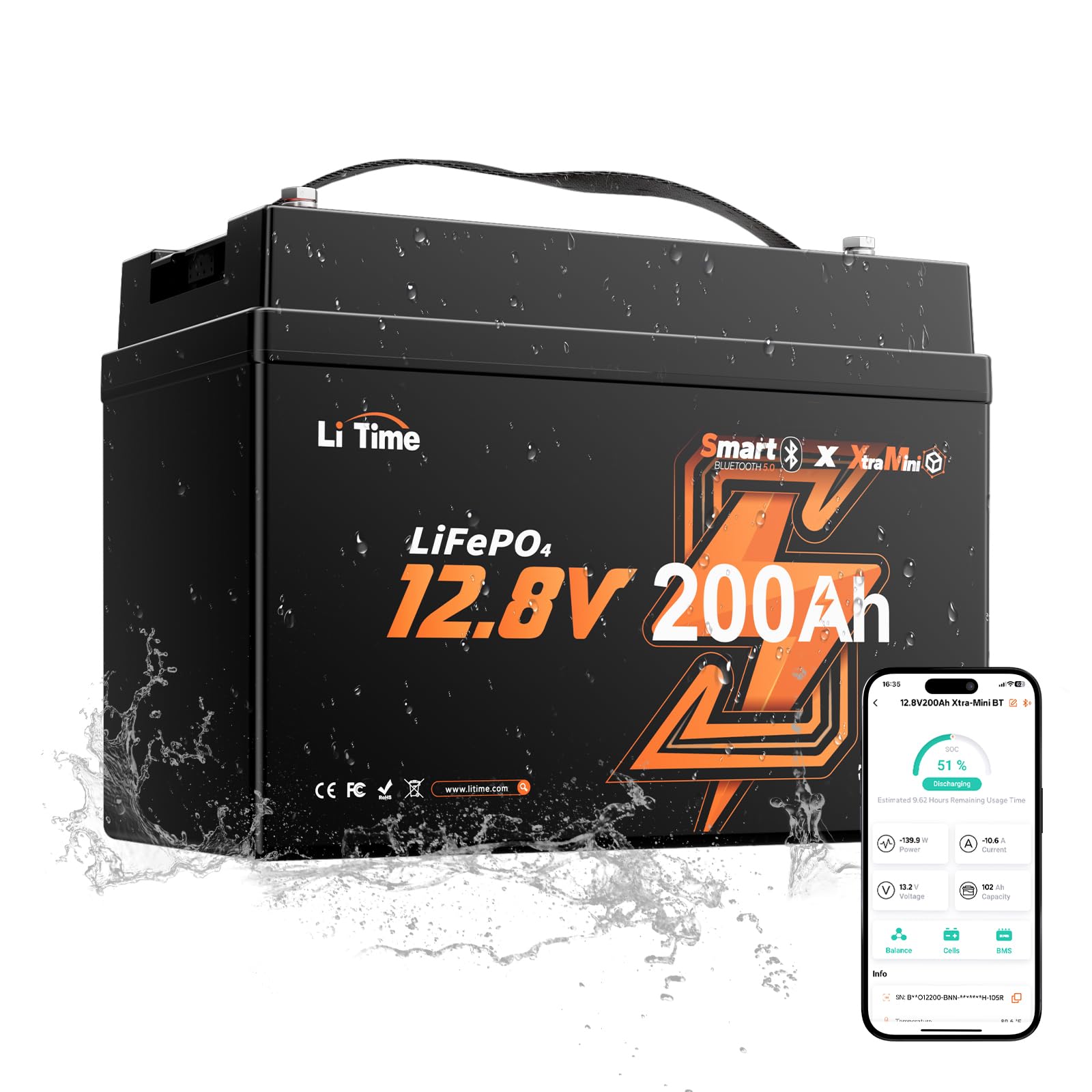
A 200Ah pack is a heavy block, and case shapes vary widely — from 13.11 x 6.93 x 9.45 inches on the LiTime to 19 x 9.4 x 6.7 inches on the HumsiENK. Note the length, width and height your battery tray or locker will take, then check the pack’s own listed dimensions against it. Metal-cased models tend to be boxier and heavier; plastic-shell packs are easier to slide into tight spaces.
Side-by-Side Comparison
| Model | Best For | Capacity | Cycle Rating | Weight | Amazon |
|---|---|---|---|---|---|
| LiTime 12V 200Ah Bluetooth★ Best Overall | Marine and trolling motor | 200Ah | 6000 cycles at 100% DOD | 44.5 lb | Amazon |
| DUMFUME 12V 200Ah 200A BMSCold-Weather Pick | Cold-climate off-grid | 200Ah | 15,000 cycles at 60% DOD | 58.9 lb | Amazon |
| HumsiENK 12V 200Ah | Budget solar build | 200Ah | 6000–15,000 cycles | 45.2 lb | Amazon |
| ECO-WORTHY EnergyRock 280Ah | Rugged RV mounting | 280Ah | — | 68.6 lb | Amazon |
| Vatrer 51.2V 105Ah Golf Cart | 48V golf carts | 105Ah at 51.2V | 4000+ cycles | 132.3 lb | Amazon |
| AOUSK 51.2V 600Ah 6-Pack | Whole-home solar bank | 100Ah per unit | — | 568 lb (set) | Amazon |
Detailed Reviews
1. Litime 12V 200Ah Lithium LiFePO4 Battery
Our pick — 4.5+★ from 600+ verified ratings; the strongest balance of quality and price.
The boat pack you can watch from the helm — 44.5 lb and paired to your phone.
Fitting a 200Ah battery into a trolling motor setup usually means one person wrestling a block into a hatch. This one weighs 44.5 pounds, and it drops 32% below the DUMFUME at 58.9 pounds, so one person can carry and set it on the bracket alone. Smaller numbers follow from that: less weight on the boat, easier handling on the trailer, and no second pair of hands needed at the launch ramp.
You get more full discharges before replacement: 6000 deep cycles at 100% DOD (full discharge each time), which the maker lists as 2000 more than other batteries. That is a 2.5x gap against the HumsiENK’s quoted 6000–15,000 range ceiling and floor. What wins people over is battery quality — the thing the review pages dwell on most — and owners largely agree the pack does its job quietly. As buyers put it: “they took 50lbs off their trailer tongue.”
Bluetooth is the part most people skip over in the spec list, and it is the reason this pick leads. Scan the QR code, pair with the LiTime app, and you can read state of charge, voltage and current from your phone instead of crawling into the hatch with a multimeter. You can also shut off the discharge circuit from the app. A low-temperature guard stops charging below 32°F and stops discharging below -4°F, which is the protection a boat stored outdoors actually needs.
What it does well
- 44.5 lb shell against 58.9 lb on the DUMFUME — a real difference on a trailer tongue
- 6000 deep cycles at 100% DOD, listed as 2000 more than comparable packs
- App reads charge state and voltage without touching the terminals
- Charging blocked under 32°F and discharge blocked under -4°F
- Expandable in a 4P4S layout up to 51.2V 800Ah
Where it bites
- Bluetooth needs a lithium-activation or MPPT charger on first use
- Deep-cycle only — not built for engine starting, golf carts or jacks
- Longer and taller at 13.11 x 6.93 x 9.45 inches than the compact-shell budget packs
Reach for this if: you run a trolling motor or a marine bank and want to see charge state from the console rather than a voltmeter.
Look elsewhere if: the spot you have lined up is a shallow tray, because this shell stands taller than the shorter budget packs.
2. DUMFUME 12V 200Ah LiFePO4 Lithium Battery
Built for the cabin that sits empty through a cold snap.
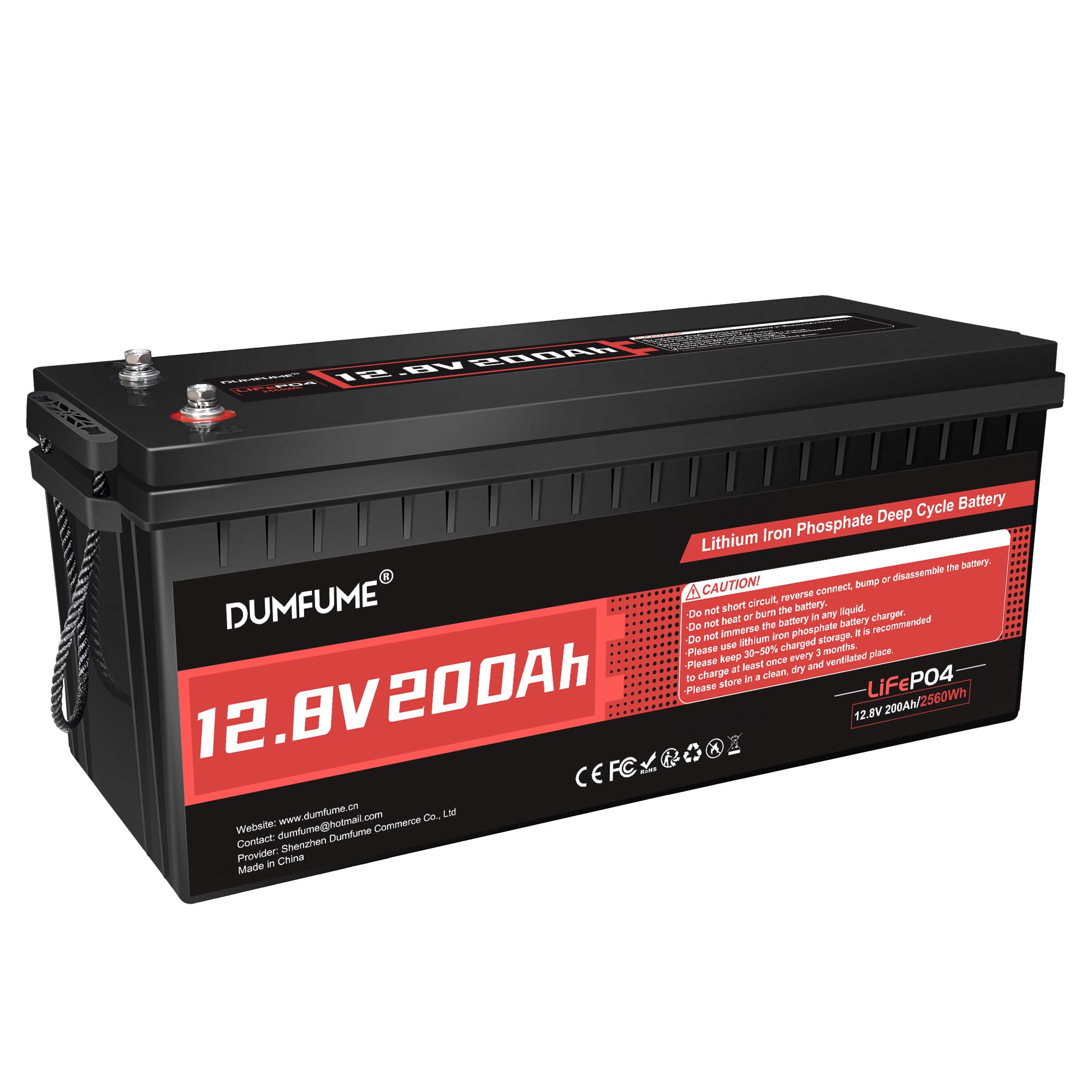
This is the pack for a system that lives outside year-round. Its low-temperature cutoff blocks charging when the cells drop below 32°F, then waits until they warm back to 41°F before allowing charge again. Discharge stays open down to -4°F. On a solar shed in February that means the pack simply stops accepting charge rather than plating lithium onto the cells — the failure mode that quietly kills cold-charged batteries.
Protection is specified rather than vague here. Overcharge protection trips at 14.6V ± 0.2V, over-discharge cuts off at 9.2V ± 0.2V, overcurrent responds within 50ms above 200A, and short-circuit protection activates in under 100µs. The enclosure carries an IP65 rating — level 6 dust tight, level 5 water mist resistance — which covers a damp marine locker or a dusty off-grid base camp. UL and UN38.3 certification for transport safety are both listed.
Weighing 58.9 pounds and measuring 21.06 × 8.07 × 8.46 inches with the handle, it needs a decent-sized compartment. It is the heaviest of the 200Ah picks here, so plan on two hands or a helper. The one honest wrinkle: hold-charge reports split down the middle — some owners get up to four days per charge, others find it drops faster than expected. Charging performance and capacity earn steady praise, though, and 16 units can chain in a 4S4P bank up to 51.2V 800Ah if you want to grow.
The cold-weather case: charge blocked under 32°F, resumed at 41°F, discharge open to -4°F — the sequence that keeps a seasonal cabin setup intact.
The catch to plan around: at 58.9 pounds it is not a one-hand lift, so factor in where it lands before it arrives.
Pick this one when: your pack sits in unheated space and you would rather it refuse a charge than suffer damage.
Think twice if: you need a light shell to swing into a hatch — the 58.9 lb case wants a fixed mount.
3. HumsiENK 12V 200Ah LiFePO4 Lithium Battery
The starter bank for a first solar build — light shell, quick top-up.
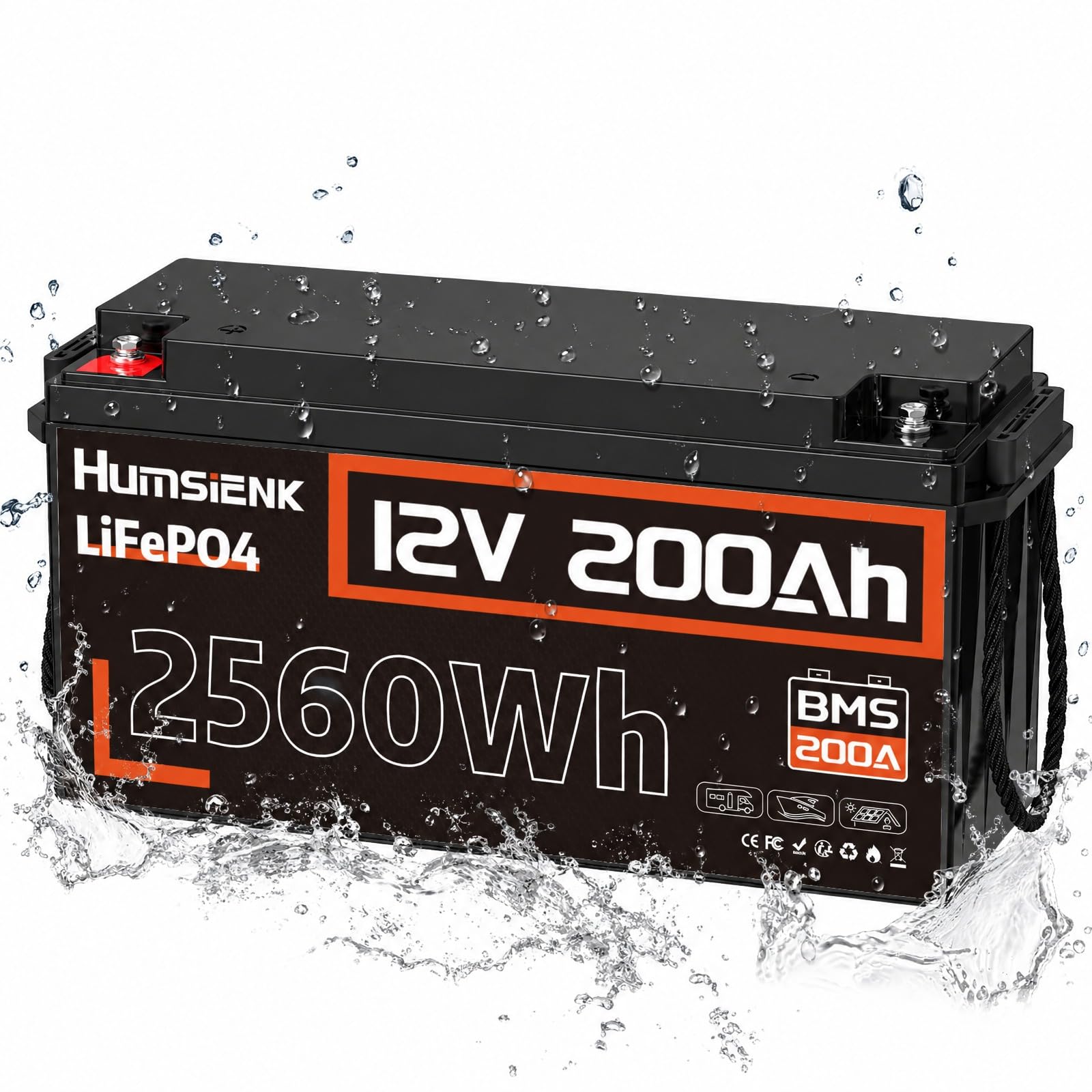
Recharge time is the headline here: a full charge in 3.33 hours on the right charger. For a weekend camper who rolls in Sunday and wants the pack ready by midweek from a solar array, that is the number that shapes the whole routine. Continuous output runs to 200A and 3200W, which covers an AC unit or a fridge kicking on at the same moment as the lights.
At 45.2 pounds it is the lightest 200Ah shell in this group, and the maker’s 52% lighter-than-lead-acid figure is the reason a van conversion can mount it on a wall panel rather than a floor tray. The dimensions span 19 x 9.4 x 6.7 inches, which is longer and flatter than the DUMFUME — worth checking against a locker before you commit. Value is where it shines in the feedback, alongside the cell quality in the A+ grade cells rated for 6000–15,000 cycles.
Here is the caution worth knowing up front: where the DUMFUME spells out a 15,000-cycle figure at 60% depth of discharge, HumsiENK quotes the cycle range as 6000–15,000 without pinning the depth. The lower end of that window is the realistic planning figure if you cycle hard. It is also not a golf cart battery — the maker lists it for solar, RV, off-grid and trolling motors. Buyers report running a full weekend before needing a recharge, which lines up with a 2560Wh pack doing moderate duty.
Good match for: a first solar or van build where you want a light shell, a fast recharge and 4S4P room to grow to 40.96kWh.
Know before you buy: the cycle figure is a range rather than a fixed depth-of-discharge number, so plan on the conservative end.
4. ECO-WORTHY EnergyRock 12V 280Ah Metal Case LiFePO4 Battery
More amp-hours in a steel box that bolts straight into the camper.
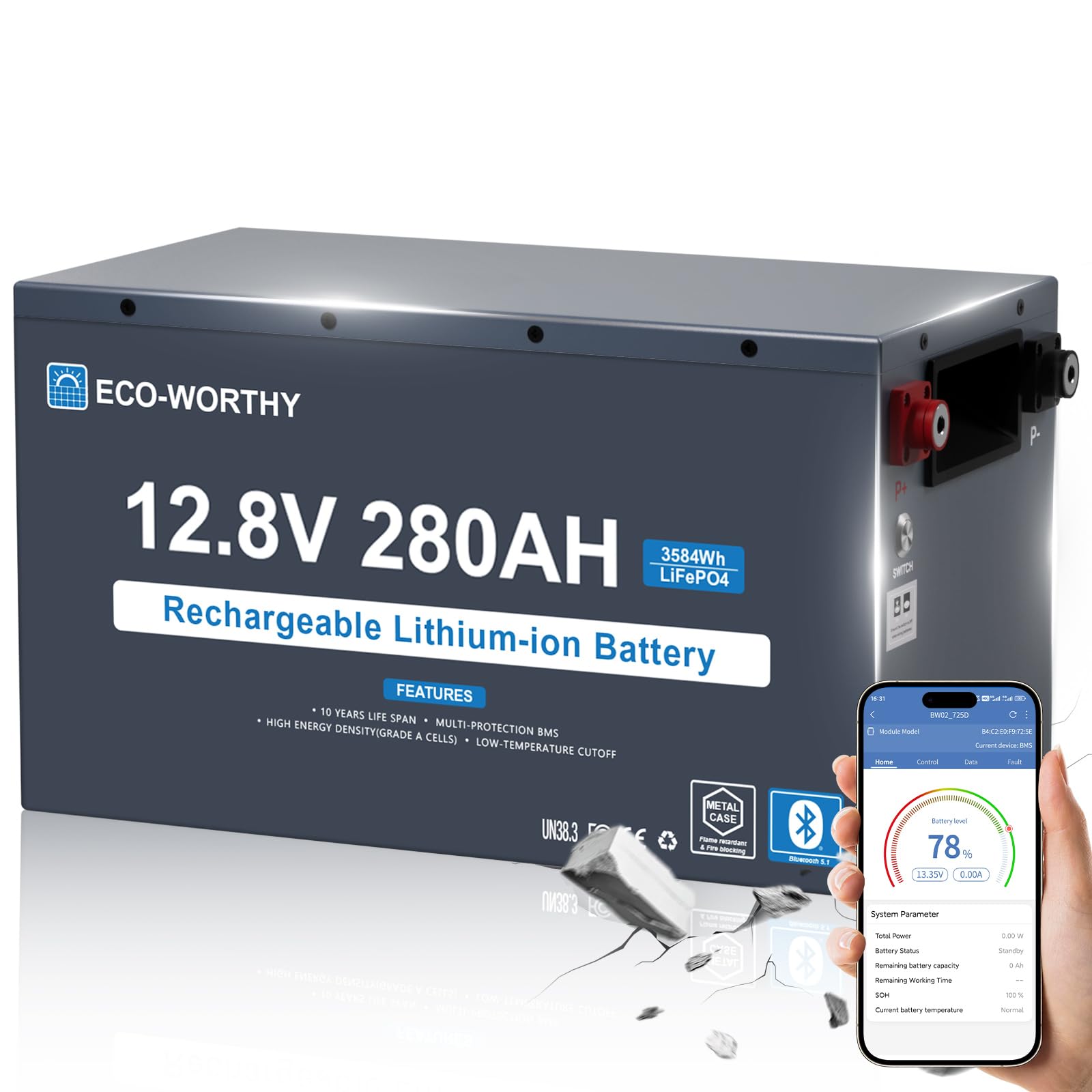
This one steps outside the 200Ah bracket: 280Ah, which the maker lists at 3584Wh of usable energy. For a fridge that runs overnight plus lights and a water pump, that extra headroom is what keeps the compressor cycling into day three instead of day one. The 200A BMS carries the same continuous ceiling as the 200Ah picks, so heavy loads behave the same way while the runtime stretches further.
The build is the reason to look at it. A heavy-duty metal enclosure handles heat and fire resistance far better than a plastic shell, and the reinforced case with internal cell holders keeps things steady over washboard roads. Four mounting feet are included, so no separate battery box is needed — it bolts directly to an RV floor or a camper frame. A one-touch safety switch cuts the discharge circuit for maintenance without wrestling a cable off a live terminal.
Bluetooth monitoring and a low-temperature charge cutoff come standard, same as the LiTime. What you pay for the steel and the extra capacity is weight: 68.6 pounds, the heaviest 12V pack in this group, and 8.7 x 16.6 x 9.7 inches of footprint. The warranty runs 3 years rather than the 5 on most of the others. Rare earth it is not — this is a battery for someone who wants a box that survives a dirt-road season, not a quick swap.
Built for rough roads: reinforced metal case, internal cell holders and four mounting feet mean no extra battery box and no rattling over gravel.
Go here if: your RV or camper racks up gravel miles and you want 280Ah of capacity bolted down rather than sliding around.
Not the fit if: you are chasing the 5-year coverage most of these packs carry — this one is backed for 3.
5. Vatrer 51.2V 105Ah Lithium Golf Cart Battery with 200A BMS
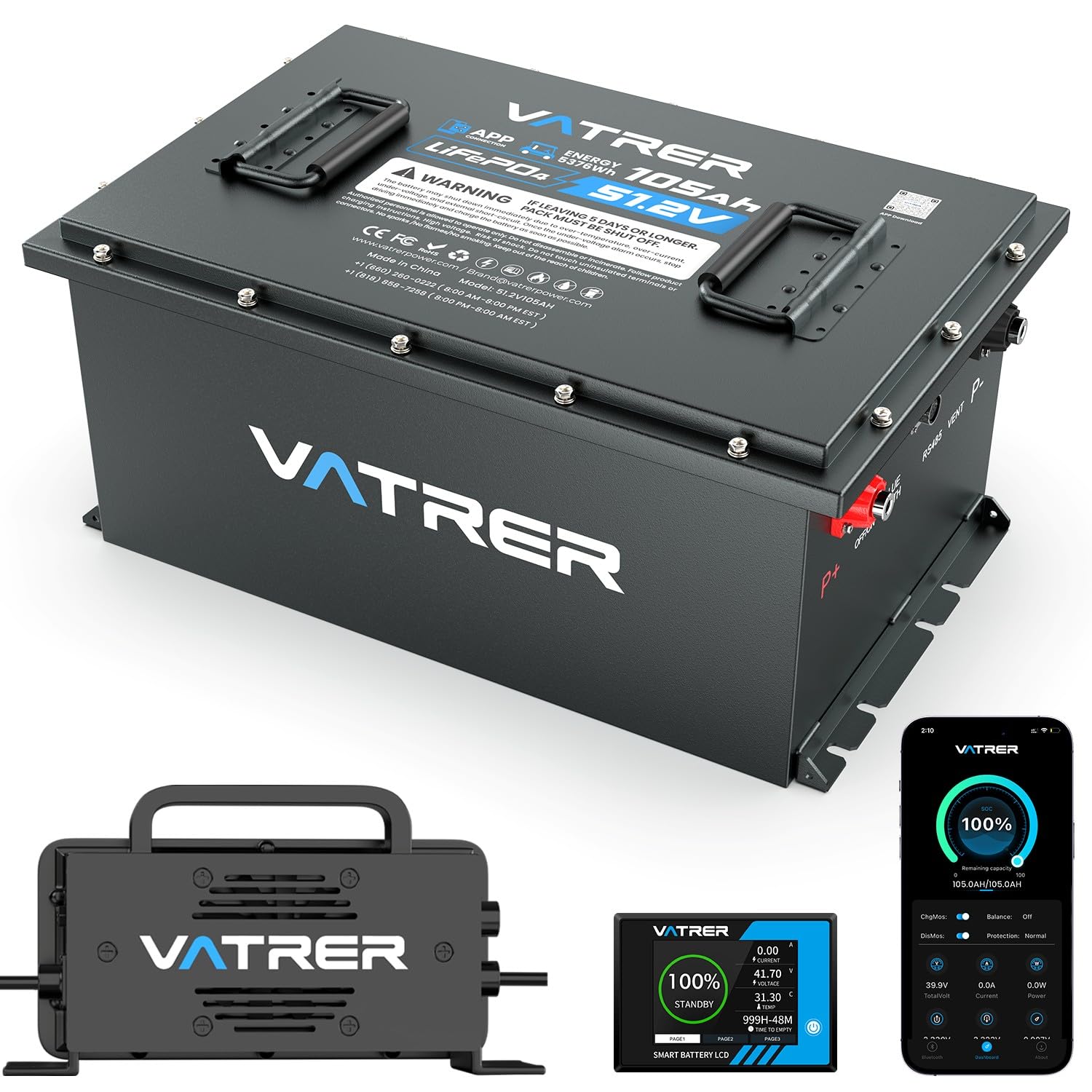
One brick replacing a whole rack of lead-acid cells under the seat.
This is a different animal from the 12V packs: 51.2V and 105Ah, a single 5.37kWh unit that the maker equates to four 12V 100Ah LiFePO4 batteries wired in series. That is the point — you are pulling eight lead-acid blocks out and dropping one box in. It is built specifically for 48V golf carts and lists compatibility with the main brand cart controllers on the market.
The performance numbers are why cart owners gravitate to it. Continuous discharge runs to 200A with peaks of 400A for 35 seconds and 600A for 3 seconds, plus a rated 10.24kW of power. Range is quoted up to 50 miles on a single charge, which reframes a golf course loop from a careful count to a non-issue. Battery life leads the feedback by a clear margin, followed by battery quality, and the construction holds up as solid in owner reports — as one put it, the swap is straightforward and the cart picks up speed.
A 2.8-inch touchscreen shows live battery data, and a phone app mirrors it over Bluetooth. A 58.4V 20A charger ships in the box, and the whole thing carries UL2271 compliance with Intertek ETL certification. The honest catch: at 132.3 pounds it is not a solo install for most people, and 21.97 x 12.09 x 10.59 inches needs a cart bay that has the room the old rack took. Still, it is listed at 50% lighter than the lead-acid pack of the same capacity, which is the whole reason the swap is worth doing.
What earns it a spot
- 51.2V 105Ah in one unit replaces a multi-battery lead-acid rack
- 200A continuous, 400A peak for 35 seconds, 600A for 3 seconds
- Quoted 50 miles of range per charge
- 2.8-inch touchscreen plus app monitoring
- Charger included, UL2271 compliant with Intertek ETL certification
What to weigh up
- 132.3 pounds — plan on two people and a hoist or a steady friend
- Built for 48V carts, not for a 12V RV or solar bank
- 4000+ cycles against the 6000 the LiTime lists at full discharge
Made for: a 48V cart owner ready to ditch eight lead-acid blocks for one box and a charging routine that lives on a screen.
Wrong tool if: your rig runs on 12V — this voltage is wired for golf carts only.
6. AOUSK 51.2V 600Ah LiFePO4 Solar Battery, 6-Pack Server Rack
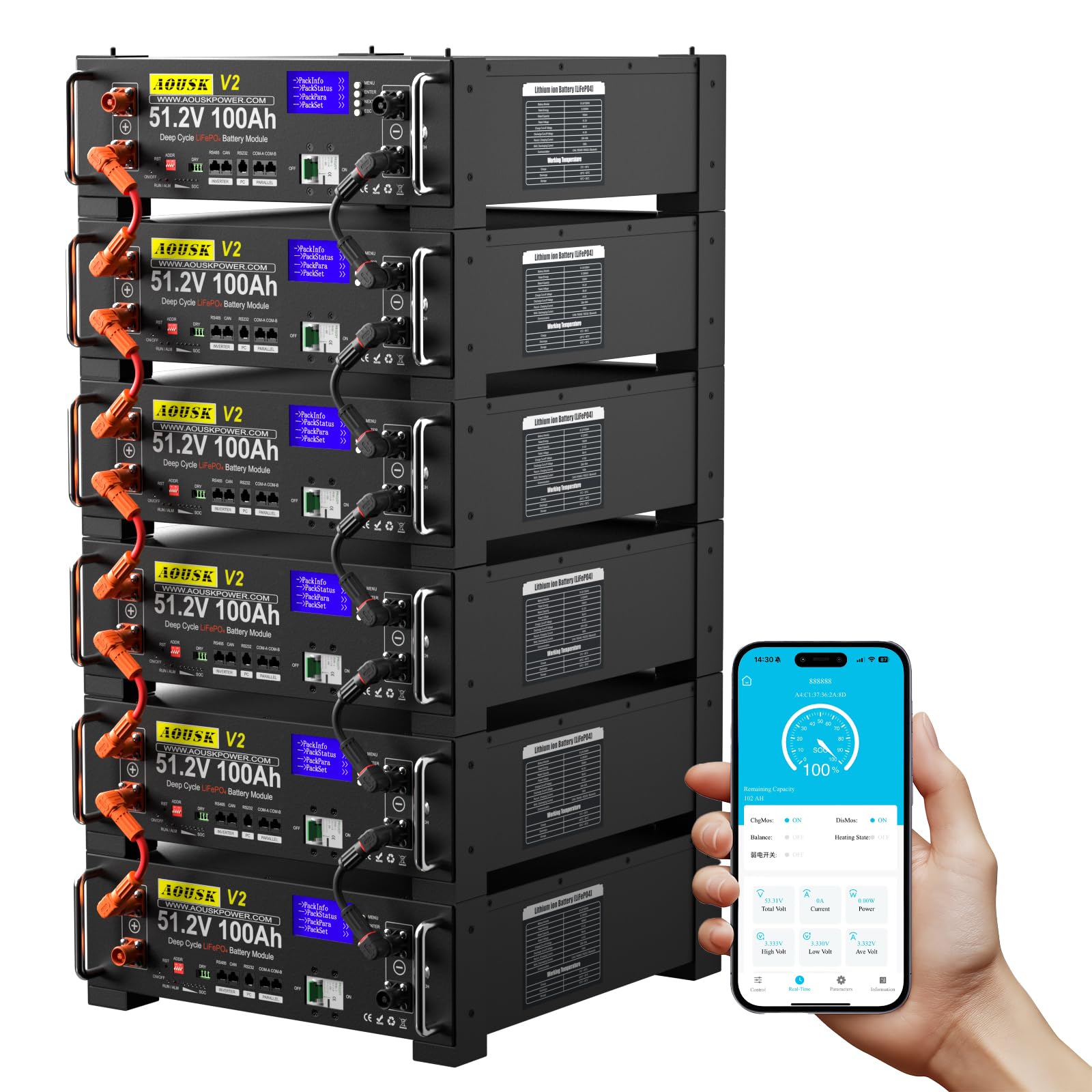
A rack-mount storage bank for the house that runs on sun.
This is not a single battery in the usual sense — it is six 51.2V 100Ah units, 10.24kWh of total capacity, sold as one system. Each unit packs 16 automotive grade A prismatic cells into a full-metal shell, and the maker lists each 100Ah block as equivalent to four 12V 100Ah LiFePO4 batteries in series. The set weighs 568 pounds in total, so this is a permanent install, not something you move between trips.
The comms are the real draw. CAN/RS485 support lets the bank talk directly to popular all-in-one solar inverters, which means the inverter knows the state of charge and can manage when it draws power. A 100A BMS guards each unit against overcharge, over-discharge, over-current and short circuit, and a high-temperature cutoff cuts charging above 167°F. Low-temperature cutoff protects against cold charging damage. A 125A air switch and a power switch sit on the front for isolation during maintenance.
You can mount each block vertically in a standard 3U cabinet (a 5.25-inch-tall rack slot), so it lives in a rack rather than on a shelf. At 94.8 pounds per unit one person can handle each one, though not the whole set at once. Up to 15 batteries can chain in parallel for larger builds. The practical caution: the listing’s own customer feedback is thin, so you are buying on the spec sheet and the 5-year warranty backing it rather than a proven track record — for a rack-mounted system at this scale, that is the number to check before you commit.
Fits the plan if: you are building a fixed off-grid bank around a rack and an inverter that speaks CAN or RS485.
Look elsewhere if: you need a portable pack — at 568 pounds for the set, this one stays where you install it.
Know the Specs
BMS Amperage (200A Continuous)
The BMS is the board that decides how much current the battery will hand out at once. A 200A continuous rating means it will hold a 200A load steadily; the pack shuts the flow off only if something goes wrong. Check the continuous number against your biggest load — a trolling motor, an AC unit, an inverter — before you pick a pack. Some models also list a peak figure for short bursts, which is the headroom above that ceiling.
Cycle Rating and Depth of Discharge
A “cycle” is one full charge and discharge. Cycle life depends heavily on how deep you discharge each time — a pack cycled to 60% of its capacity will generally last many more cycles than one drained to 100%. If a listing quotes a range like 6000–15,000 cycles, the depth of discharge is usually where the two ends differ. Compare only packs that quote cycles at the same depth of discharge.
Low-Temperature Cutoff
Lithium cells should not be charged below freezing, so good packs have a sensor that blocks charging when the cells are cold. Discharge usually stays open at lower temperatures than charge. Look for a stated charge cutoff figure and a separate discharge low point — those two numbers tell you what a pack will do in an unheated van or a winter boat shed.
Series and Parallel Expandability
Wiring batteries in series adds voltage; wiring them in parallel adds capacity. A 4S4P layout means four groups in series, each of four in parallel, so the bank grows with your rig. Each BMS must share the same communication protocol for the bank to coordinate. Start with one pack, add more as your power demands grow instead of buying a bigger bank up front.
Common Questions
How many amp-hours do I actually need for a trolling motor?
Can I charge a 12V 200Ah LiFePO4 battery below freezing?
Can I run my RV or camper on a 12V 200Ah LiFePO4 battery?
What does a 200A BMS actually protect against?
Can I combine a 12V 200Ah battery in series for 48V?
Is LiFePO4 actually lighter than lead-acid of the same capacity?
Do I need a special charger for a LiFePO4 battery?
Can I use a 200Ah LiFePO4 battery to start an engine?
Does the cycle count really change with how deeply I discharge?
Can a Bluetooth battery be monitored from a phone?
The Bottom Line
If you run a trolling motor or a marine bank, the LiTime 12V 200Ah leads the group on 44.5 pounds with app monitoring and a 6000-cycle rating at full discharge — the all-round pick for most buyers. If your pack sits in unheated space through winter, the DUMFUME and its 32°F charge cutoff earns its extra weight. Campers who want a metal box on gravel roads get 280Ah of capacity in the ECO-WORTHY. And a 48V cart owner should be looking at the Vatrer — one box in, eight lead-acid blocks out, and 50 miles of quoted range per charge.
How we choose
We do not accept paid placement. Every pick is matched to a real buyer and a real use-case; we do not hands-on test units.
Sources
Specifications: manufacturer listings and product documentation. Review insights: verified customer reviews, as of November 2026. Pricing: not shown on this page (it changes often); check the current price via the retailer link.
As an Amazon Associate, My Heart Lives Here earns from qualifying purchases. This does not affect which products we feature.