Heads up: This post contains affiliate links. As an Amazon Associate I earn from qualifying purchases, at no extra cost to you. Learn more
Specs are compiled from manufacturer listings and verified buyer reviews and can change over time — please confirm the key details on the product page before buying.
You want clean vocals, real bass, and a fit that survives a commute — without paying flagship money. the balance for wired in-ear monitors sits right around the hundred-dollar line, and the picks below are the ones that earn it. Each one is a wired IEM (in-ear monitor: a sealed earphone that sits deep in your ear canal for better isolation and detail). That means you need a phone with a headphone jack, or a small USB dongle, to run them.
This guide is built by comparing the manufacturers’ published specifications and the patterns across verified customer reviews, so you get each pick’s real strengths and trade-offs instead of marketing spin.
What follows breaks down driver types, cable connectors, and fit, so you can match an earphone to the way you actually listen rather than to a spec sheet. These are the $100 iems worth your attention if you want real detail without flagship money.
Top Picks

How To Choose The Best $100 IEMs
The first decision you make is not about brand at all — it is about how many drivers you want stuffed into each shell. A driver is the tiny speaker that makes sound, and more of them, of different types, is what separates a flat pair of earbuds from a proper monitor. Read the driver count before anything else.
Driver types: balanced armature vs. dynamic
A balanced armature is a small, precise driver that handles mids and highs with detail but does not move much air on its own. A dynamic driver is a bigger moving speaker that pushes bass harder. Hybrid sets combine the two, and that is where the interesting sound comes from around this price tier.
The connector decides your upgrade path
Check whether the cable is detachable and which connector it uses — 2-pin (0.78mm or 0.75mm) or MMCX. A detachable cable means a broken wire is a cheap swap instead of a dead earphone, and it lets you try a different cable later for a different tuning flavour.
Fit and ear tips change the sound more than you think
A loose seal leaks bass and hides detail, so the stock silicone tips matter as much as the driver inside. Buy from a kit with several tip sizes, then experiment — you will often find your favourite sound with a tip you did not expect.
Side-by-Side Comparison
| Model | Best For | Driver Setup | Connector | Detachable Cable | Amazon |
|---|---|---|---|---|---|
| KZ AS10★ Best Overall | Pure detail on a modest budget | 5 balanced armature | 2-pin | Yes | Amazon |
| KZ ZS10 PROGaming-Ready Hybrid | Gaming and all-purpose listening | 4BA + 1DD hybrid | 0.75mm 2-pin | Yes | Amazon |
| SIMGOT EW300 | Tuning flexibility and gaming cues | 1DD + 1 planar + 1PZT hybrid | 0.78mm 2-pin | Yes | Amazon |
| BASN Gold Obsidian | Stage and studio performers | 2DD + 1BA triple | MMCX | Yes | Amazon |
| Sennheiser IE 100 PRO | Stage monitoring with brand pedigree | Single dynamic (10mm) | Detachable (stage cable) | Yes | Amazon |
| Sennheiser IE 200 | Audiophile neutrality | Single dynamic (7mm) | MMCX | Yes | Amazon |
| JOYO JW-07 | Wireless practice and live monitoring | Wireless receiver system | Wireless (2.4G) | No | Amazon |
Detailed Reviews
1. KZ AS10 in Ear Monitor
Our pick — 4.5+★ from 850+ verified ratings; the strongest balance of quality and price.
Five balanced armatures in each shell, and a bass response that surprises anyone expecting a thin monitor.
The number that defines this one is five: KZ puts five balanced armature drivers in each ear — one large low-frequency driver, one mid, one mid-and-high hybrid, and two high-frequency units. That is a lot of hardware for a wired IEM at this tier, and it is the reason the AS10 holds the highest score in this group — 4.5+ stars from a large and steady flow of ratings.
What wins people over is the sound itself. The bass here is fuller than most pure-armature designs, so kick drums land with real weight instead of a polite tick. The mid driver keeps vocals flexible and natural, and the top end stays soft rather than sharp, which makes long listening sessions easy on the ears. Buyers report hearing new detail in familiar tracks, and the clarity holds across pop, rock, and spoken word.
The fit is the quiet hero. The sealed in-ear design stays put during movement and keeps outside noise down without a battery or an app in sight. The detachable 2-pin cable means a worn wire is a swap, not a funeral, and the green plastic carry case (about 6 grams by itself) slides into a pocket. What you should know: comfort splits opinion — a few wearers find the shells push a little after a couple of hours, and the stock cable is the weakest physical part. Swap in foam tips and give it a day to settle. It is also built for wired listening only, so a phone without a jack needs a dongle.
Where the AS10 pulls ahead
- Five balanced armature drivers per side — genuine detail for the tier
- Fuller bass than most pure-armature monitors, with soft extended highs
- Secure sealed fit and solid passive noise isolation
- Detachable 2-pin cable keeps it repairable and upgradeable
What to weigh before buying
- Comfort is mixed — shells can press after long sessions
- Stock cable is the first thing likely to need replacing
- Wired only; no mic or controls on this version
Top of the shortlist: the pick for a wired listener who wants layered detail and real bass without climbing into premium territory — and the strongest score in this entire group.
The honest catch: if your ears are sensitive to pressure over hours, budget for a tip swap or a break-in period.
2. KZ ZS10 PRO in Ear Monitor
A five-driver hybrid built to put kick drums between your ears and footsteps in the right spot.
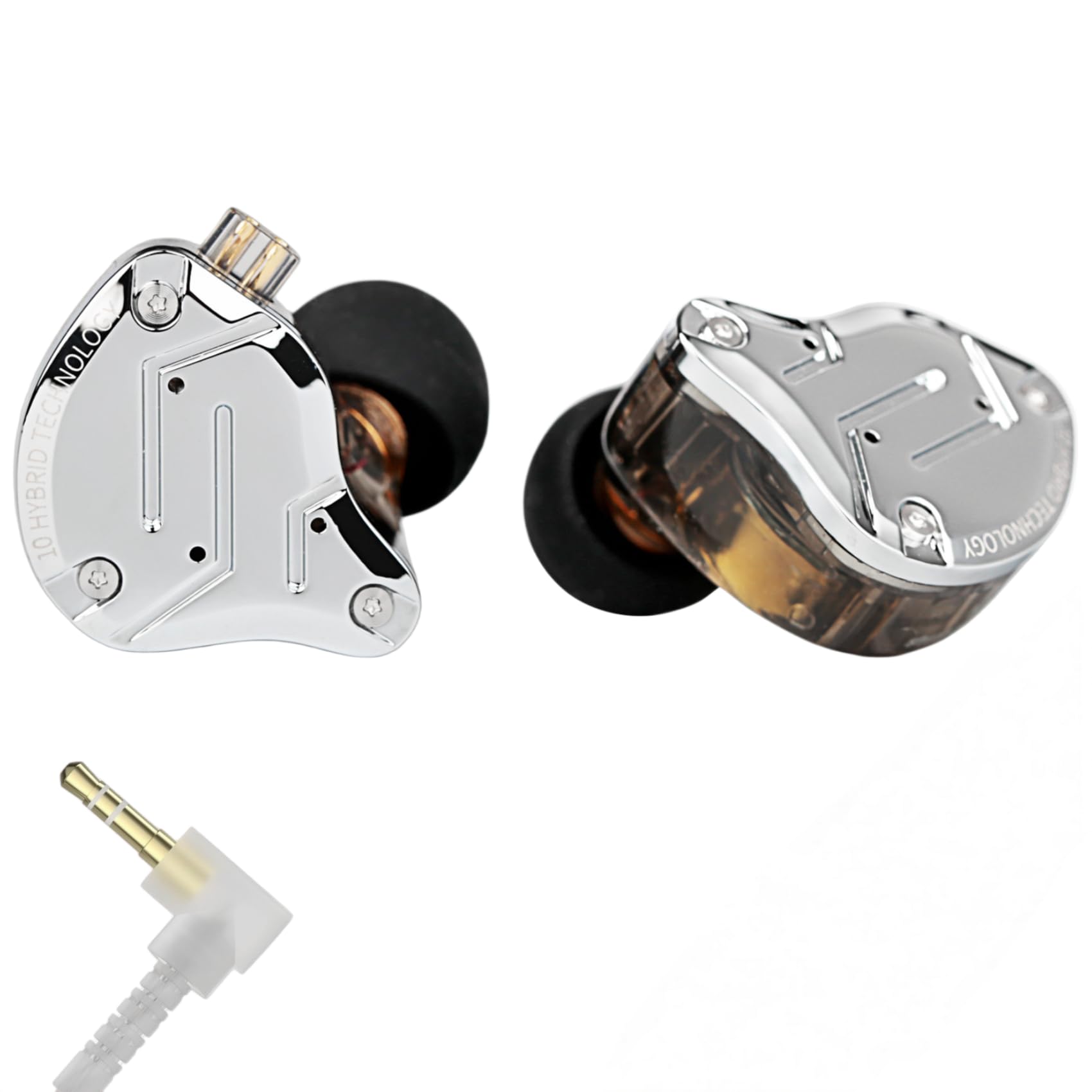
Where the AS10 leans on balanced armatures alone, the ZS10 PRO adds one dynamic driver to four balanced armatures — a hybrid setup of 4BA + 1DD per side. The dynamic unit brings the low end, and the balanced armatures handle the detail, so drums hit with weight while the high frequencies stay clean. The PCB board inside gives each driver its own room to work, and the result is a balanced, coherent sound from bottom to top.
The housing is a blend: a high-quality aluminum alloy faceplate over an imported resin cavity, and the metal section comes in a wide range of colors. It also isolates well — the spec puts it at 26dB of passive noise reduction with a proper seal, which is enough to bury a noisy commute. The upgraded cable uses a slot-protection design that guards the pins from bending, and the package throws in three pairs of ear tips and a manual.
Gaming is the standout use: each driver gets an independent sound channel, so positional cues stay separated and footsteps and gunfire do not smear together. The honest note is that fit is the recurring complaint — the snug seal some wearers love is the same seal others find refuses to stay put, and a handful report durability concerns over the long run. Ear-hook tips and a foam set usually finish the job. It is the pick if you want one hybrid pair for both competitive gaming and music.
What the hybrid delivers: deep, solid bass from the dynamic driver plus clear mids and clean highs from the four balanced armatures — an easy all-rounder for games, music, and calls.
Where it stumbles: the secure-style seal is a fit lottery for some ear shapes, and a few long-term owners mention the connection loosening.
Reach for this if: you split your time between gaming and listening and want strong bass plus positional detail in one wired set.
Look elsewhere if: you have struggled to keep in-ears seated in the past — start with a tip kit.
3. Linsoul SIMGOT EW300

Three different driver technologies per ear, and a nozzle swap that changes the whole tonal balance.
This is the most unusual driver count on the list: a dynamic driver, a planar driver, and a piezoelectric ceramic driver per side, three types working in a tri-matrix acoustic architecture. That is real engineering for the tier, and the payoff is a sound that changes character when you switch the tuning. The replaceable nozzles come in two distinct styles — one tuned to the SIMGOT-Golden2023 curve, one to the H-2019 target — and the threaded connection makes swapping quick.
The gold copper nozzle and purple silicone ring are aimed squarely at gamers. On the H-2019 tuning the set reproduces accurate cues, so gunfire and footsteps stay clearly separated during playback. Bass-heads have plenty to like too — owners single out the low end as the reason to buy. The housing is a CNC alloy case with a mirror-plated finish, and the 0.78mm 2-pin silver-plated oxygen-free copper cable arrives with a protective case, ear tips, and a manual.
Comfort is decent for the weight, though the all-metal shells are the largest feeling of the group, and fit lands mixed — some ears lock in and stay, others need to size up. A number of owners also report the occasional driver failing, which is the risk you take with three technologies working together. Buy it for the swappable-nozzle tunability and the gaming positional cues, and keep the receipt handy.
Why tinkerers pick the EW300
- Three-driver hybrid — dynamic, planar, and piezoelectric ceramic
- Two swappable nozzles for two different tunings on demand
- Gamer-focused H-2019 tuning with clear positional cues
- CNC alloy build, silver-plated OFC cable, and full accessory kit
Where it asks patience
- Fit is mixed — the metal shells need the right tip to seal
- Durability is mixed across long-term use
- More of a learning curve than a plug-and-play set
The tuner’s choice: ideal if you like swapping tips and nozzles to chase a signature, or want a precise, gamer-oriented set that still thumps.
Only if… you are willing to experiment — this is not the pick for someone who wants one fixed sound from the start.
4. BASN MMCX in Ear Monitor

Two dynamic drivers and a balanced armature, tuned for the bass punch a live stage demands.
BASN goes a different direction from the KZ hybrids: two dynamic drivers plus one balanced armature per side. Two dynamic units means the low end gets serious attention, and the bass burst here is the strongest on this list. Highs are extended, delicate, and supple, while the mids stay balanced — the spec describes the tuning as well-balanced and pure across high, mid, and low. The MMCX connection is the pro-friendly touch, and two detachable cables ship in the box — one with a mic and volume control, one upgraded silver cable, both 1.5m long enough for stage work.
The fit story is genuinely generous. BASN includes 12 pairs of ear tips — nine silicone sizes plus three memory foam sets — and the sealed in-ear design with adjustable memory earhooks suits most ear canals. The Golden Obsidian finish is a durable, artistic body that resists wear, and the portable carry case keeps the whole kit together. For a working musician monitoring a mix on stage, the long cable and secure hooks are the difference between a solid set and a distraction.
Sound quality is where you have to make your own call. Some owners find the crisp highs exactly right, while others report the overall reproduction sounding less clear than expected, so a quick tip-roll toward the memory foam may help the balance. It is also the least forgiving if you prefer a lean, flat monitor — this set is tuned for punch.
The performer’s angle: dual dynamic bass plus two included cables and a dozen tip options make it a turnkey stage companion.
Before you commit: the tuning is punch-forward, and the reported clarity varies by ear tip, so plan a short setup session.
Built for the stage: the pick for gigging and rehearsing musicians who want bass weight and a long, secure MMCX cable.
Not for everyone: if you want a flat, uncolored reference sound, the double-dynamic tuning will feel too forward.
5. Sennheiser Professional IE 100 PRO
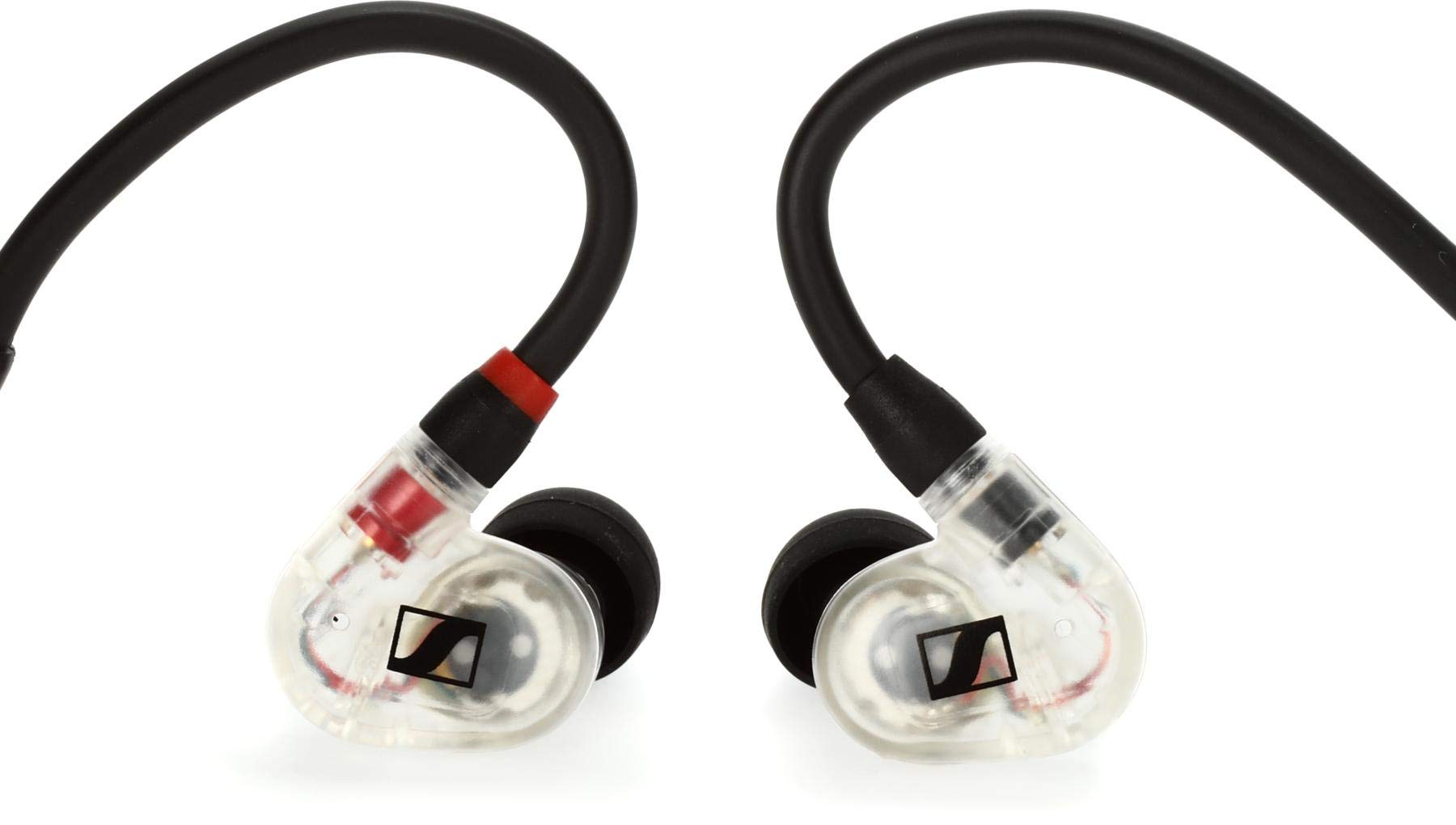
A single 10mm transducer from a monitoring name, built to survive a working stage.
Sennheiser bets on singular simplicity: one 10mm broadband dynamic transducer per side, designed to reduce acoustic stress and deliver a clean, distortion-free reproduction. That single-driver approach keeps the shells slim and ergonomic, so the fit sits comfortably without the bulk of a multi-driver stack. The tune earpiece and flexible silicone and foam tips create a strong shield against stage bleed, and the interior cable duct keeps the cable safe from the rigours of live use.
The result is a monitor that suits DJs, live performers, and studio tracking alike — the spec lists audio monitoring, recording, live performances, and DJ use. Owners call it excellent value, and the box includes a soft case, a cleaning tool, and both foam and silicone tips. The detachable cable is standard, and for critical monitoring work a single well-tuned driver often beats a cheaper multi-driver set that leaks detail.
Here is the trade-off. Fit and long-term reliability land mixed — the single-driver construction that keeps it slim can work loose in some ear canals, and a share of long-term customers note units giving out within a month. If your ears run small or you move a lot, budget for the right foam tip and treat the cable connection gently. The honest scenario: it is a solid monitoring tool, not a bass monster, so bass-forward listeners may want to look at the dual-dynamic sets above.
What the brand name buys you
- Single 10mm dynamic driver tuned for clean, distortion-free monitoring
- Slim, ergonomic shells with excellent passive isolation
- Stage-proof cable with an internal duct for real-world durability
- Comes with foam and silicone tip sets plus a soft case
Where the risk lives
- Fit is a mixed bag — some ears need a firmer tip
- A minority of reviewers point out early unit failures
- Neutral tuning with less bass slam than the hybrids
The safe institutional pick: right for a performer who trusts a known name and wants a slim, secure monitor for stage or studio.
Look past it if: you want heavy bass or a multi-driver feature list — this one is all about the single-driver clean.
6. Sennheiser IE 200

A 7mm transducer tuned for neutrality, with two ear-tip positions to shape the bass.
Smallest driver, biggest philosophy difference. The IE 200 uses a 7mm TrueResponse dynamic transducer to deliver a balanced, natural sound with expressive mids, smooth treble, and controlled bass. These are precision-matched units, manufactured so unit-to-unit variation stays low, which means the pair in your box should sound like the pair in the next box. That consistency is rare at the tier and is the whole point of a reference-oriented monitor.
The dual bass-tuning design is the clever bit: two ear-tip mounting positions let you choose a tighter, controlled low end or a fuller, warmer one. The low-noise braided cable runs gold-plated MMCX connectors and a 3.5mm plug, reducing handling noise as the cable moves. The fit is deliberately compact for ears of all sizes, with adjustable earhooks and both silicone and memory foam tips on board. Owners praise the smooth, controlled tuning and the tidy accessory kit.
Where it commands a strong caveat: comfort is not unanimous, and a number of owners describe the insertion as fiddly or the seal difficult to perfect. The tuning is also unapologetically neutral — if you came for hip-hop slam, this is not your pair. This is the set for someone who wants an honest window into the mix at a desk, not a bass party in their head.
The audiophile’s read: balanced, revealing tuning from a precision-matched 7mm driver, with the ear-tip position giving you a genuine low-end choice.
The friction point: insertion is fiddly for some ear shapes, and the neutral signature will underwhelm anyone chasing heavy bass.
Reach for this if: you listen analytically, value consistency between channels, and want to shape the bass with a tip swap.
Walk past if: you live for big low end or you know your ears fight deep-insertion designs.
7. JOYO JW-07 Wireless IEM System

A wireless monitoring kit for guitarists and DJs who want to move without a cable tether.
Different tool, different job. The JOYO JW-07 is a complete wireless transmitter and clip-on receiver system in the 2.4GHz band, not a pair of earphones on its own. It streams at 48kHz/16-bit for clear audio and keeps latency below 5ms — the gap between what you play and what you hear. For a guitar beginner recording practice or a DJ moving around a set, that near-instant return matters more than driver count.
Where the other picks fight for drivers, this one fights for reliability. Frequency hopping avoids interference from other wireless gear, and the spec puts the usable range at 40-60ft in open space. The built-in battery keeps it running for over 8 hours on a full charge, and it offers 12 channel banks in 4 groups to fit different setups. The transmitter is a single-receiver unit, so you cannot feed multiple receivers from one box.
Its sound quality lands mixed, and the honest framing is that you are buying the wireless system rather than a reference monitor. Setup is the strong suit — it pairs automatically and plays clean from the start. If you need a reference monitor for close listening, the wired options above will show more detail. If you need to play untethered, this is the only wireless pick in the lineup.
What sets the JW-07 apart: automatic pairing, under-5ms latency, 40-60ft of open-space range, and 12 channel banks across 4 groups.
The compromise: sound is a cut below the wired monitors here, and one transmitter cannot drive multiple receivers.
Made for moving: the pick for guitar players and DJs who need hands-free, low-latency monitoring without a cable.
Stay wired if: fidelity is your priority — this system is about freedom, not audiophile resolution.
Know the Specs
Balanced Armature Drivers
A balanced armature is a small driver that moves a tiny internal arm to create sound. It handles mids and highs with precision but does not push a lot of air, so a set with several of them can render vocals and detail cleanly. The KZ AS10 uses five of them per side to cover the whole frequency range in layers.
Dynamic and Hybrid Drivers
A dynamic driver is the classic moving speaker — bigger, with more air movement and typically more bass. A hybrid set pairs dynamic drivers with balanced armatures so you get low-end weight plus detail. The SIMGOT EW300 goes furthest, mixing a dynamic, a planar, and a piezoelectric ceramic driver per side.
Detachable Cables and Connectors
A detachable cable connects to the earpiece with a 2-pin or MMCX plug. When the wire eventually wears out, you replace the cable instead of the whole earphone. Check which connector your set uses — 0.75mm and 0.78mm 2-pin cables are not interchangeable with MMCX.
Fit, Ear Tips, and Isolation
An in-ear monitor relies on a sealed ear canal to sound its best. If the seal breaks, you lose bass and detail. A set with many tip sizes, like the BASN, or adjustable earhooks, like the Sennheiser IE 200, gives you the best chance of a stable fit without buying extra parts.
Common Questions
Do I need a headphone jack to use these IEMs?
What is the difference between 2-pin and MMCX cables?
Which pick has the most bass?
Will these IEMs work with a PC or tablet?
How many hours of battery does a wireless IEM system need for a gig?
Is a single-driver monitor worse than a multi-driver set?
How do I get a stable seal with in-ear monitors?
What does the SIMGOT EW300 nozzle switch actually change?
How low is the latency on the JOYO JW-07?
The Bottom Line
For most buyers, the $100 iems winner is the KZ AS10 because five balanced armature drivers deliver detail and bass that rarely come together this close to budget territory, and it holds the highest score in the group. If you want a hybrid for gaming and music in one set, grab the KZ ZS10 PRO. And for a neutral, precision-matched sound you can shape with a tip swap, the Sennheiser IE 200 is the one to reach for. Whichever pick you choose, spend an evening on tip rolling — a good seal does more for the sound than any spec on this page.
How we choose
We do not accept paid placement. Every pick is matched to a real buyer and a real use-case; we do not hands-on test units.
Sources
Specifications: manufacturer listings and product documentation. Review insights: verified customer reviews, as of November 2026. Pricing: not shown on this page (it changes often); check the current price via the retailer link.
As an Amazon Associate, My Heart Lives Here earns from qualifying purchases. This does not affect which products we feature.