Heads up: This post contains affiliate links. As an Amazon Associate I earn from qualifying purchases, at no extra cost to you. Learn more
Specs are compiled from manufacturer listings and verified buyer reviews and can change over time — please confirm the key details on the product page before buying.
If you are chasing a fault on a two-wire loop, the tool that saves you the most time is the one that both feeds the loop and reads it back. A 4-20mA signal generator (a handheld box that fakes the output of a sensor) lets you take the sensor out of the equation and prove whether the transmitter, the wiring, or the display is the real problem. The picks below are sorted by what they actually do for you on a panel or a rooftop, not by badge.
This guide is built by comparing the manufacturers’ published specifications and the patterns across verified customer reviews, so you get each pick’s real strengths and trade-offs instead of marketing spin.
You will see the difference fastest in the mA range. A generator that only sources current leaves you carrying a separate meter to confirm it. What you want is one box that sources, measures, and — on the better units — powers the loop from its own 24V supply. Below I have grouped the strongest 4-20mA signal generator options by the job each one handles best.
Top Picks
How To Choose The Best 4-20mA Signal Generator
The wrong assumption most first-time buyers carry into this category is that any box marked “4-20mA” will do the same job. It will not. Some only generate a current. Some generate voltage too. A few can power the loop from an internal 24V supply, and that single feature changes how fast you can fault-find a two-wire transmitter. Decide which of those three jobs you actually need before you look at a spec sheet.
Source, measure, or both
A signal generator that only outputs current is a one-way tool: you feed a value into a PLC input or a display, then walk back to the panel to see what it did. A calibrator that both sources and measures lets you compare what you are sending against what the instrument reads, in one hand. If you spend your day proving whether a transmitter is drifting, dual source-and-measure units cut the trips back and forth.
Resolution and accuracy are not the same thing
Resolution is the smallest step the display can show — 0.01mA or 0.001mA. Accuracy is how close that step lands to the true value — often quoted as a percentage like 0.2%. A box can show tiny steps and still be off by a tenth of a percent. Read the accuracy figure first, then the resolution.
Loop supply and thermocouple support
A built-in 24V loop supply means you can power and read a transmitter without dragging a second meter and a bench supply along. Thermocouple simulation is the other big split: if your work touches temperature transmitters, a calibrator that generates K, J, E, T, N, S, R, and B signals is worth the higher tier. If you only touch milliamp loops, you can skip that cost.
Side-by-Side Comparison
| Model | Best For | Current Range | Voltage Range | Power | Amazon |
|---|---|---|---|---|---|
| TH-71B★ Best Overall | Loop supply plus thermocouple work | mA step output | DC V and mV | Battery powered | Amazon |
| DROK 4-20mA Generator (2pcs)Best Value | Budget bench and panel debugging | 0/4-20mA | 0-10V | External power required | Amazon |
| LB78 | Fast key-based field testing | 4-20mA | 0-10V and mV | Built-in battery | Amazon |
| SG003A | Long field sessions and curve logging | 0-24mA (0.01mA) | 0-24V (0.01V) | 3000mAh USB rechargeable | Amazon |
| LB06 Source Process Calibrator | Plant maintenance across PLC and DCS | mA input/output | V, mV, resistance, Hz | Corded electric | Amazon |
| HDS2202S | Seeing the waveform, not just the number | Multimeter current | True RMS AC/DC | USB Type-C | Amazon |
| eC370T | Lab-accurate loop and thermocouple calibration | 0-24mA (0.001mA) | 0-20V and 0-100mV | Six AAA batteries | Amazon |
Detailed Reviews
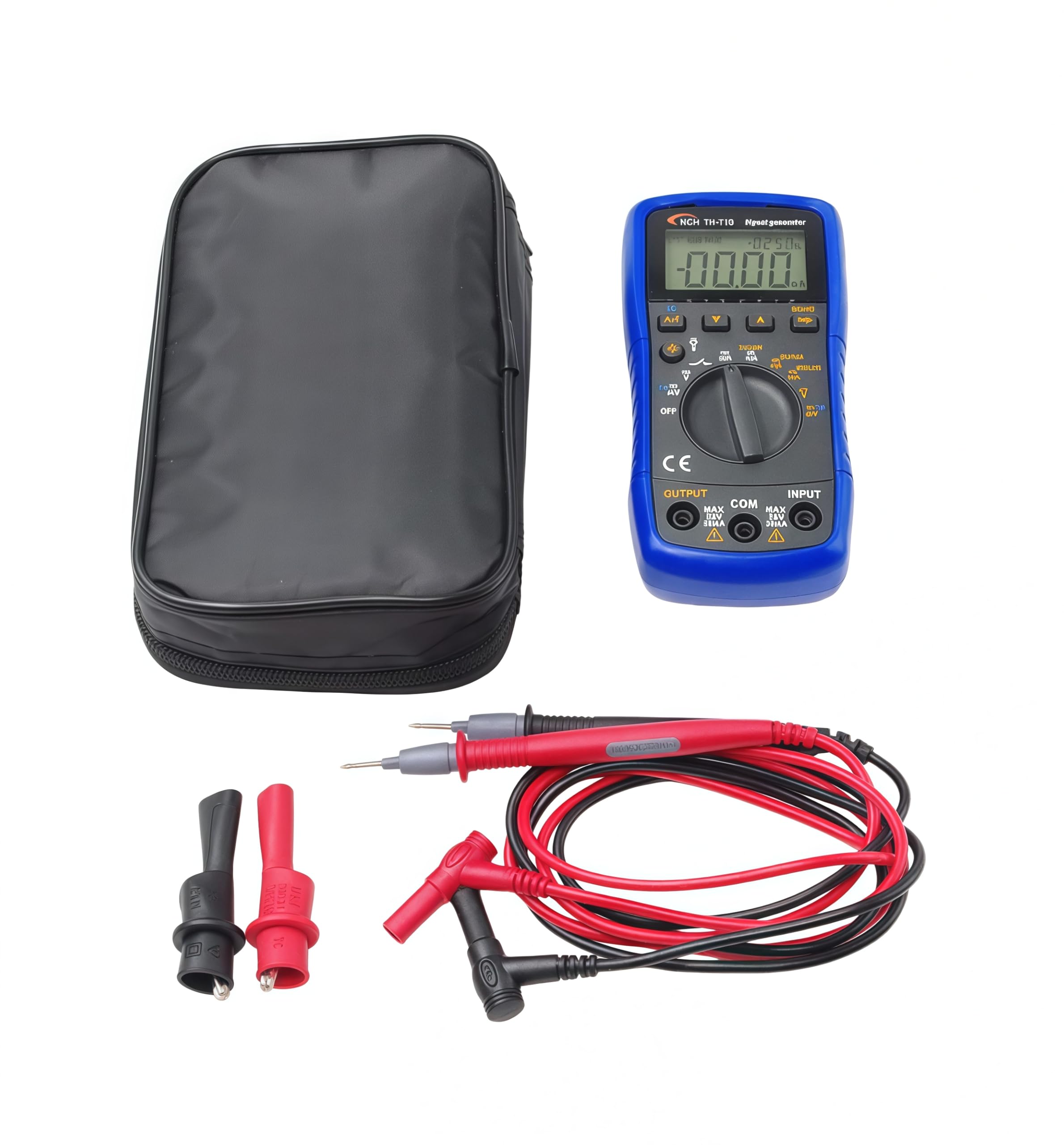
1. TH-71B Handheld Signal Generator Source Simulator Meter
Our pick — 4.5+★ from 200+ verified ratings; the strongest balance of quality and price.
The one box that powers the loop, drives it, and reads it back.
What makes the TH-71B the pick to start with is the combination of a built-in 24V loop supply and full thermocouple support in one handheld. You can power a two-wire transmitter from the meter itself, then step the milliamp output to prove the loop end to end. It also sources and measures voltage, current, and temperature, with a basic accuracy of 0.2% for both measure and source output. That figure is the one to hold onto — it is a single number that covers how close both your readings and your injected signals land.
For temperature work the range is genuinely wide. The upper temperature rating reaches 1800 °C, against 50 °C on the LB78 further down the list. That is not a small difference: it means a thermocouple type B or R job in a kiln or furnace is inside the TH-71B’s envelope where the LB78 simply is not. The manual step output for V and mA, plus the auto waveform output, makes it easy to walk a PLC input through a sweep without tapping keys for every value. The backlit display and the flashlight on the back matter more than they sound — panel rooms are dim and a lot of loops live in ceiling voids.
Where it earns its keep in the field is versatility: it simulates and reads at the same time, so you can watch what the instrument does with the signal you are feeding it. It is a popular choice for dryer calibration work, where its 0.2% accuracy and the price you pay for a 24V loop supply and thermocouple range are what win people over. The honest catch is build quality — it is not built as tough as a Fluke meter, and durability is the recurring mixed note. Treat it as a bench-and-bag instrument rather than something to drop off a ladder, and it holds up fine.
Why it takes the top slot
- Built-in 24V loop supply means you power and read a transmitter without a second meter.
- 0.2% basic accuracy applies to both measuring and sourcing, so a reading and a signal can be trusted as one.
- 1800 °C upper rating covers high-temperature thermocouple types the LB78 tops out well below.
- Backlit screen and a rear flashlight make dim panel rooms and ceiling voids workable.
What you give up
- Not built as tough as a Fluke — durability is the trade-off, so a case and careful handling matter.
- Step and auto-waveform functions still ask you to set the range by hand, so it is not a set-and-walk-away tool.
Pick it for: anyone fault-finding two-wire loops and temperature transmitters who wants source, measure, and 24V supply in one hand.
Think twice if: your work is pure milliamp testing only — you are paying for thermocouple range you will not use.
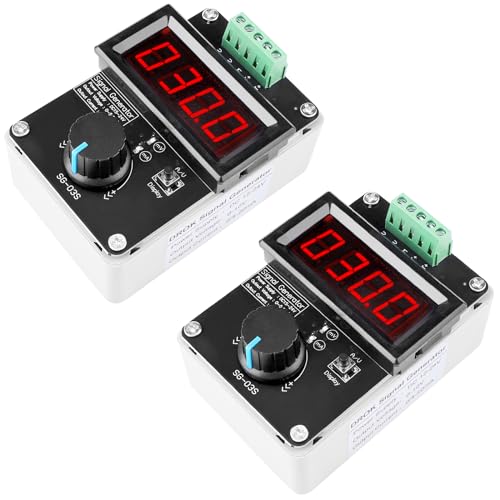
2. DROK 4-20mA Generator 2pcs, Adjustable Signal Generator
Two modules, a turn of a dial, and a loop signal appears.
This kit is the cheapest way to put a real 0/4-20mA signal into a panel. You get two modules in the box, and each one generates both a current signal and a 0-10V voltage signal from a single multi-turn potentiometer (a rotary dial with several full turns of travel, so you can land on a fine value). There is no menu, no keypad, and nothing to learn — you spin the dial and watch the output. That is the whole appeal for quick bench and panel debugging.
The display is a bright 3-digit LED showing the output current or voltage, and a switch below it flips between the two readings. On the back there are separate current and voltage calibration potentiometers, so if the display drifts you can correct it yourself rather than send the unit away. The wider feature list goes further than most budget boxes: an LCD showing frequency and duty cycle, a case, and PWM output with frequency and duty cycle set separately by buttons. Frequency is split into 4 ranges and switches automatically. That combination of current, voltage, and PWM output is a lot of capability for the entry tier.
Now the honest part, and it is the reason to read the listing carefully. It needs an external power source — it does not run on its own battery — and it arrives without instructions. Both are known friction points, so budget a few minutes with a multimeter to confirm the output before you trust it in a live panel. Owners praise the functionality — dual current and voltage output plus PWM from one dial — while reviews on calibration and stability are more mixed. Anyone with a bench supply and a little patience will get on with it fine.
Whose bench it suits: technicians who need a signal source on a test rig, already own a 24V supply, and would rather turn a dial than navigate a menu. The two-module pack means one can live on the bench and one in the tool bag.
The setup tax: no instructions and no internal power mean a short learning curve — it is a build-your-own-tool kit rather than a ready-to-go calibrator. That is the honest difference between it and the TH-71B at the top.
Reach for this if: you want the least expensive route to a dual current-and-voltage signal and you have power and patience on the bench.
Look elsewhere if: you need to walk out to a remote transmitter with nothing but the tool in your pocket — this one needs a supply to work.
3. LB78 Signal Generator

Built for the technician who wants one key per function and no menus.
Every function has its own dedicated key, so there is no combination to remember, and the key response is fast with zero delay. It generates 4-20mA plus 0-10V and mV, and it runs on a built-in battery with low power dissipation and a long stand-by time — so it sits in the bag for weeks and still answers when you pull it out.
The protection circuit is the detail that earns a premium-tier mention on a mid-tier budget. A built-in one-time quick-break fuse (a small fuse that blows on a surge to protect the internals) guards against the classic mistake of clipping onto a live 110V or 220V supply by accident. The reference voltage and operational amplifier chips are chosen for high-temperature stability, which is what keeps the reading honest as the box warms up through a shift and holds its long-term ageing figure. For a compact field calibrator, that is the right kind of engineering.
Know the limit before you buy. Its upper temperature rating is 50 °C, so it is a milliamp and voltage loop tool, not a kiln or furnace thermocouple calibrator — that job belongs to the TH-71B up the list. Set it up for loops and 0-10V analogue signals, keep it out of direct sun on a hot roof, and it does exactly what the key labels promise.
What the key layout buys you
- One independent key per function with fast, zero-delay response — no menu diving mid-test.
- Quick-break fuse guards the internals against a miswired 110V or 220V clip.
- Stable reference and amplifier chips keep readings consistent as the unit warms.
- Built-in battery with low draw and long stand-by, so it is ready from the bag.
Where it stops short
- 50 °C upper rating rules it out of high-temperature thermocouple simulation.
- Dedicated keys mean a fixed set of functions rather than a programmable output sequence.
Suits you if: you test milliamp and 0-10V loops all day and want the function you need under your thumb on the first press.
Not for you if: temperature transmitters are on your list — this one is not the tool for the hot end.
4. SG003A 4-20mA 0-24V Current Signal Generator

The one you charge on Friday and carry all week without a socket.
Runtime is the headliner here: a built-in 3000 mAh 3.7V USB rechargeable battery, charged through a micro 5V USB port, and a working length of up to 26 hours per charge. For a field technician walking a plant with no outlet in reach, that number is the whole argument. The unit itself is 1.06 pounds, which is 2.5 times lighter than the 2.64-pound HDS2202S further down, and its 4.41 x 3.23 x 1.06 inch body slips into a tool pouch. Compare that with the HDS2202S at 7.8 x 1.5 x 3.78 inches and the difference in pocket-friendliness is obvious.
You get mA output across 0 to 24mA at 0.01mA precision, V output across 0 to 24V at 0.01V, an XMT passive current mode at the same 0.01mA precision, and a Hz pulse signal from 0 to 9999 Hz at 5-digit precision. That pulse range takes it beyond simple loop work into driving counters and frequency inputs. The 2.4-inch 240×320 TFT color screen (a small color display) with adjustable backlight makes those values readable at night and in daylight, and the real-time curve view shows the output trending rather than just a frozen number.
Programmable output is the function that saves the most taps. Auto mode drives the output continuously through your set parameters in one of three patterns: monotone rise, monotone fall, or cycle. Set a sweep and let it run while you watch the receiving instrument respond. The catch is the charge routine — a full charge takes 4-6 hours, so a midday top-up is not quick. Keep it on the charger overnight after a heavy day and the 26-hour working window covers the rest.
Field-session champion: rechargeable, 1.06 pounds, and up to 26 hours per charge — this is the pick for long days away from a socket, with curve display and programmable sweeps to match.
The charge trade-off: 4-6 hours to full means you plan charging around your day, not the other way round.
Best fit: mobile technicians and commissioning engineers who need hours of output on a charge and want to see the curve, not just the value.
Second-guess it if: you only ever work at a bench with mains nearby and would rather not manage a charging cycle.
5. LB06 Source Process Calibrator
One pair of jacks, every function, and no need to move a lead.
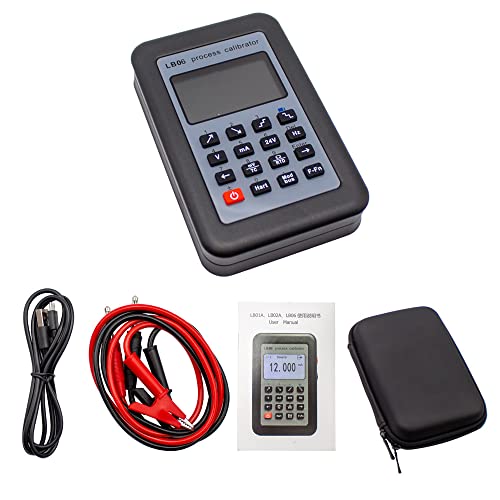
This is a plant-maintenance instrument, and its whole design logic is built around the person walking a round of instruments. The function list covers most of what you need for PLC, DCS, ESD, field instrument, regulating valve, and frequency converter work, and it sources and measures V, mV, mA, resistance, and Hz signals. Each of those has its own dedicated button to call it up directly, with no button combination to memorise.
The two-jack layout is the clever bit. The instrument uses only two jacks for every function, and switching between input and output does not require unplugging the test leads. That also means you cannot burn the meter by leaving it on the wrong gear position — the design removes the classic mistake rather than relying on a fuse to catch it after the fact. The casing is a branded matte shell treated to resist dirt and scratches, which is right for a tool that rides in a bag between panels.
Two honest notes for a buyer comparing this against the battery units. First, it is corded electric, so it needs a mains supply — convenient at a panel with a socket, awkward on a remote roof. Second, the manufacturer lists Voltmeter as its measurement type, which undersells what the button set actually covers. Run it as a stationary plant companion and the two-jack design saves you a lead swap on every single instrument you touch.
The two-jack advantage: input and output switch without unplugging a lead, and a wrong gear cannot cook the meter — a real time saver across a round of instruments.
The corded constraint: mains power is required, so it lives where sockets exist rather than on a remote rooftop.
Made for: in-plant maintenance where a socket is close and you cycle between mA, mV, resistance, and Hz all shift.
Wrong tool if: you need a self-contained calibrator for remote or rooftop work — its cord ties you to a supply.
6. HDS2202S Oscilloscope
When a single milliamp number is not enough and you need to see the waveform.
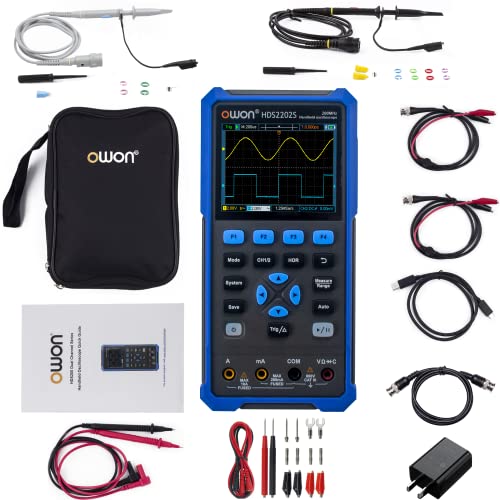
This is a different class of tool and worth the higher tier only if you regularly need to see a signal, not just measure it. It packs three instruments into one handheld: a 200MHz 2-channel digital oscilloscope, a 20,000-count True RMS multimeter, and a built-in 25MHz signal generator. The scope samples up to 1GSa/s in single-channel mode and 500MSa/s in dual-channel mode, with a 10,000 wfms/s refresh rate and 8K record length. In plain terms, you can catch fast glitches and watch two signals side by side that a plain signal generator would never reveal.
The built-in generator outputs sine waves up to 25MHz, plus square, ramp, pulse, and arbitrary waveforms for circuit testing and bench diagnostics. The multimeter half measures AC/DC voltage, AC/DC current, resistance, capacitance, diode, and continuity. All of it runs on a 3.5-inch color display with a USB Type-C port, and it saves settings, reference waveforms, screen images, and waveform files to a PC. That file saving is what turns it from a bench curiosity into a diagnostic record you can take back to the office. At 2.64 pounds it is not a pocket tool — a fair bit heavier than the 1.06-pound SG003A — so it earns a bench or cart spot rather than a pouch.
Owners praise its build quality most, with value close behind, and it delivers the most when you are chasing noise, ripple, or an intermittent fault on a signal line. When your whole question is simply “what milliamp value is going down this wire,” the HDS2202S is more instrument than the job needs.
Where it earns the bench space
- 1GSa/s single-channel sampling and 8K record length catch fast glitches a meter misses.
- Built-in 25MHz generator covers sine, square, ramp, pulse, and arbitrary waveforms.
- 20,000-count True RMS multimeter adds AC/DC voltage and current, resistance, and capacitance.
- USB Type-C with file saving turns readings into records you can review on a PC.
What to keep in mind
- 2.64 pounds and a 3.5-inch display mean it lives on a bench, not in a pocket.
- It is a scope-first tool — for a plain 4-20mA loop check it is more than you need to carry.
For the diagnostician: anyone troubleshooting ripple, noise, or intermittent faults who wants scope, meter, and generator in one unit.
Overkill if: your day is simple milliamp sourcing and you never need to see the shape of the signal.
7. eC370T Volt mA Thermocouple Loop Process Calibrator

The resolution figure is the tell: 0.001mA steps on a current generator is bench-grade precision.
Start with the numbers a calibration engineer actually reads first. Generate current from 0 to 24mA at 0.001mA resolution. Measure current transmitters across the same 0 to 24mA range with 0.08% accuracy. Measure voltages in two ranges: 0-100mV at 0.01mV resolution and 0.06% accuracy, and 0-20V at 1mV resolution and 0.08% accuracy. Those are the figures that decide whether you can prove a transmitter is drifting a fraction of a milliamp or not, and this box is built for exactly that question.
Temperature simulation goes wide and deep. It generates thermocouple signals from -250°C to +1800°C across types K, J, E, T, N, S, R, and B, with a resolution of ±0.7°C to ±2°C depending on your thermocouple type. That is the same 1800 °C upper ceiling as the TH-71B, so both cover the hot end for furnace and kiln work. Where the eC370T pulls ahead is the detail: a numeric keypad for setting output, hotkey programming so a long-press immediately outputs a user-configured signal, and custom-configurable ramp and ladder output functions. The built-in 24V loop supply powers and reads a two-wire transmitter without a second meter.
The honest catch is that this is a precision instrument and prices accordingly — it sits at the premium end of this list. Buy it because you need 0.001mA and thermocouple simulation, not because it looks the part. The package backs that up: six AAA batteries included, a carrying case, test leads, alligator clip adaptors, a Type K thermocouple probe (a temperature sensor for the meter), and a detailed user manual, plus a Windows software tool downloadable to control it over USB. For lab, calibration-stand, and transmitter-fault work, the resolution and the loop supply are the two specs that earn it a place at the top of the precision tier.
Where the precision is
- 0.001mA generation and 0.08% current accuracy prove sub-milliamp drift a coarse box cannot.
- 0-100mV range at 0.01mV resolution gives you fine voltage measurement, not just a coarse reading.
- Thermocouple simulation across K, J, E, T, N, S, R, and B from -250°C to +1800°C.
- Built-in 24V loop supply plus numeric keypad, hotkeys, and ramp/ladder output.
Where it asks more
- Premium-tier cost means you are buying resolution you should actually need.
- Runs on six AAA batteries, so keep spares in the case for long sessions.
The precision pick: calibration-stand, lab, and transmitter-fault work where 0.001mA resolution and full thermocouple simulation settle the question.
Not for you if: a basic milliamp source answers your daily loop checks — this is more resolution than that job demands.
Know the Specs
Resolution versus accuracy
Resolution is the smallest step the generator can show — 0.01mA or 0.001mA. Accuracy is how close that step lands to the true value, quoted as a percentage like 0.2% or 0.08%. A box with fine resolution but loose accuracy shows you precise-looking numbers that are off. Read the accuracy figure first, then the resolution, because the two answer different questions.
The 24V loop supply
A two-wire transmitter needs power to output a signal. A calibrator with a built-in 24V loop supply can power that transmitter itself, so you can read its output without hooking up a bench supply or a second meter. Without one, you either borrow power from the loop under test or carry more gear. It is the single feature that speeds up two-wire current loop testing the most.
Current, voltage, and thermocouple modes
A 4-20mA signal generator sources current. Some also source voltage (0-10V or 0-24V) and simulate a thermocouple (a temperature sensor made of two joined wires) so a temperature transmitter sees a real temperature signal. The wider the modes, the more instruments one box can test — but you pay for the ranges you will not touch.
Protection and power source
A quick-break fuse guards against clipping onto a live mains supply by mistake. Battery power (internal cells, or AAA, or a rechargeable pack) means you can carry the tool to a remote transmitter. Corded power means mains is always needed. Match the power source to where you actually work — the protection to how careful you can be under pressure.
Common Questions
What is the difference between a 4-20mA signal generator and a loop calibrator?
Do I need thermocouple simulation or just a milliamp output?
What does 0.001mA resolution actually get me?
Will a signal generator power my two-wire transmitter?
How long does the rechargeable battery last on a signal generator?
Can a 4-20mA generator damage the instrument I am testing?
Is a bench power supply enough instead of a dedicated generator?
What does accuracy of 0.2% mean in practice?
Do I need a separate oscilloscope for loop diagnostics?
Which generator should I carry up a ladder to a remote transmitter?
The Bottom Line
For most people who need to prove a loop is telling the truth, the strongest starting point in these 4-20ma signal generator picks is the TH-71B. Its built-in 24V loop supply (it powers the loop itself), 0.2% basic accuracy on both measure and source, and full thermocouple support up to 1800 °C cover the widest range of jobs in one handheld — If you want the lowest-cost route to a current and voltage signal on a bench, the DROK 4-20mA Generator pack gets you there with two modules and a dial. And for lab-grade precision, the eC370T gives you 0.001mA resolution, full thermocouple simulation, and a 24V loop supply when a fraction of a milliamp is the whole question.
How we choose
We do not accept paid placement. Every pick is matched to a real buyer and a real use-case; we do not hands-on test units.
Sources
Specifications: manufacturer listings and product documentation. Review insights: verified customer reviews, as of November 2026. Pricing: not shown on this page (it changes often); check the current price via the retailer link.
As an Amazon Associate, My Heart Lives Here earns from qualifying purchases. This does not affect which products we feature.