Heads up: This post contains affiliate links. As an Amazon Associate I earn from qualifying purchases, at no extra cost to you. Learn more
Specs are compiled from manufacturer listings and verified buyer reviews and can change over time — please confirm the key details on the product page before buying.
Your filament is not ruined because it is old. It is ruined because it sat in open air for three weeks, and moist filament prints with stringing, bubbling and weak layers no slicer setting can fix. A storage system solves that one problem — keeping spools dry and findable — and this guide separates open racks that hold up to 80 spools from sealed boxes that keep a single spool dry.
This guide is built by comparing the manufacturers’ published specifications and the patterns across verified customer reviews, so you get each pick’s real strengths and trade-offs instead of marketing spin.
Some picks are open racks for volume, others are sealed boxes with desiccant for moisture control, and the right one depends on whether your problem is space or damp air. Here is the breakdown of the 3d printed storage system options worth your bench space.
Top Picks


How To Choose The Best 3D Printed Storage System
Start with the honest question: is your problem too many spools, or too much humidity? A rack and a dry box are different products, and buying the wrong one wastes money and bench space.
Open Rack or Sealed Box
An open rack is a vertical metal or plastic frame that holds spools in the air, sorted by tier, so you can see your whole collection at a glance. It does nothing about moisture. A sealed box is an enclosure with a lid and desiccant packs inside, which keeps one or a few spools dry but hides them from view. Most serious setups end up with both: a rack for the working inventory, a box for the sensitive materials like nylon and PETG.
Spool Capacity and Tier Count
Manufacturers quote capacity in spools, not in tiers, because how many fit per tier depends on spool width and packaging. A 9-tier rack may hold 48 spools or 54 spools depending on whether the spools are vacuum-sealed with valves or boxed. Read the capacity number as an upper limit for standard 1kg spools, then expect fewer if your spools are wide.
Stability and Anti-Tip Hardware
A rack eight feet tall carrying dozens of 1kg spools is a tipping risk, especially in a home with kids or pets. Look for an included anti-tip kit and keyhole or wall-mount slots. Some racks are explicitly designed for stationary use only, and moving one while loaded is a genuine hazard.
Moisture Control: Passive or Heated
Passive control means desiccant packs inside a sealed box, which absorbs ambient moisture without power. Active control means a heated dryer that drives moisture out of the filament itself, usually with a PTC heater element. If your filament already prints badly and you live somewhere humid, passive alone often is not enough.
Side-by-Side Comparison
| Model | Best For | Spool Capacity | Type | Footprint or Size | Amazon |
|---|---|---|---|---|---|
| Akro-Mils 16-Drawer Cabinet★ Best Overall | Small parts and tool sorting | — | Drawer cabinet | 10.5″W x 6.5″D x 8.5″H | Amazon |
| HoHpHq 9-Tier Filament RackHigh Capacity | Large-scale open storage | 48 spools | Open rack with anti-tip kit | 11.8″D x 18.1″W x 81″H | Amazon |
| Anrigeail 7-Tier Rack with Wheels | Mobile print farm | 80 spools | Open rack on casters | 17.7 lb unit weight | Amazon |
| Polymaker Polydryer Box | Single-spool dry storage | 1 kg spool | Sealed box with hygrometer | 0.7 kg unit weight | Amazon |
| Razzi Fidel 9-Tier Rack | Organized maker workspace | 54 spools | Carbon steel modular rack | 11.81 x 16.69 x 80.69 in | Amazon |
| Qozary 4-Pack Storage Boxes | Sorting by material and color | 24 spools | Foldable fabric boxes | 16.5″ × 8.3″ × 8″ each | Amazon |
| JAYO J1 Filament Dryer | Drying wet filament | 0.25kg / 0.5kg / 1kg spools | Heated dryer box | 1.5 kg unit weight | Amazon |
Detailed Reviews
1. Akro-Mils 16-Drawer Plastic Storage Cabinet
Our pick — 4.5+★ from 55,000+ verified ratings; the strongest balance of quality and price.
Sixteen pull-out drawers that turn a pile of nozzle spares into a labelled, grab-and-go cabinet.
The single most useful thing about this cabinet is that it is not a filament rack at all. It is the parts organizer that sits beside your printer and holds the small stuff — nozzles, PTFE couplers, spare thermistors, hex keys, screws. Sixteen drawers measuring 6″ x 2-7/32″ x 1-9/16″ externally give you a compartment for every tiny part, and the whole cabinet runs just 10-1/2″ wide, so it tucks onto a shelf above the machine.
What wins people over is the build quality, and it is not subtle praise — the moulding is high-impact plastic made in the U.S.A., and it feels like the same material as a workshop tote rather than a discount bin. The drawers carry finger-grip pulls and rear stop tabs, so a drawer yanked open in a hurry stops before it dumps your M3 screws across the floor. Dividers come moulded into the back of the cabinet, which means you can split a single drawer into two lanes for different lengths.
Here is the honest catch, and it comes straight from how people actually use it: the dividers are the most-discussed sticking point. Some find them fussy to seat, and durability gets mixed marks over years of heavy use. This is a small-parts cabinet, not a spool rack — it will not hold a 1kg roll of PLA, and anyone expecting it to organize filament will be disappointed. It also has no sealing whatsoever, so it offers zero moisture protection.
What earns its shelf spot
- 16 pull-out drawers with rear stop tabs so contents stay put
- High-impact plastic, made in the U.S.A.
- Keyhole slots let you wall-mount it above the printer
- Dividers included and moulded into the back panel
- Just 10-1/2″ wide, so it fits tight shelving
Where it stops short
- No moisture sealing — it will not protect filament
- Drawer dividers are the recurring gripe to plan around
- Too short in depth for anything but small parts
Reach for this if: your bench is drowning in nozzles, screws and small spares and you want them sorted in one 10-1/2″-wide footprint.
Look elsewhere if: you need spools kept dry — this cabinet has no sealing at all, so a desiccant box is the right tool.
2. 9-Tier 3D Printer Filament Spool Storage Rack
Nine tiers of vertical filament storage that turn a wall into a spool library.
If your collection has outgrown a shelf, this rack is the volume answer: 48 spools across nine tiers, standing 81″ tall. Put that beside the Akro-Mils cabinet and the scale difference is stark — 81 inches of height against the cabinet’s 8.5″, and 18.1″ of width against 11″. It is built for home studios and small print businesses that need every spool visible and reachable.
The thoughtful part is the anti-tip kit. A rack this tall, loaded with 48 spools, deserves to be fixed to the wall, and the included hardware lets you do exactly that. Each tier is rated to support 30 lbs (15kg), and the snap-fit main frame assembles tool-free in minutes — the screws are only needed for the optional wall mount. It fits 1kg, 500g, 300g and 200g spools, so a mixed collection works without compromise.
Now the part you need to hear plainly: sturdiness is a genuine split. Some owners find the frame solid, others describe it flexing under a full load, and that is the one point to weigh before buying. Load the heavy spools low, use the anti-tip kit without skipping it, and this rack does its job well. Frame it as a fit question — brilliant for a stationary wall in a dedicated room, less ideal if you plan to move it around.
Load it low and anchor it: with 30 lbs per tier and a 6.3ft height, the anti-tip kit is the difference between a spool library and a hazard.
Mixed spool sizes welcome: 1kg, 500g, 300g and 200g all seat on these tiers, so an odd collection still organizes cleanly.
Worth it for: anyone whose filament has taken over the floor and who can dedicate a fixed wall to it.
Think twice if: you want to wheel your rack between rooms — this one is meant to stay put once anchored.
3. 7-Tier 3D Printer Filament Storage Rack with Wheels

The highest spool count on this list, and the only one you can roll across the shop floor.
Eighty spools. That is the number that sells this rack, and it beats the 9-tier HoHpHq rack’s 48 spools outright. It also does it in seven tiers rather than nine, because each tier is built to hold more per level. The frame uses upgraded 1.2 × 0.8 inch steel tubes, and the whole unit weighs 17.7 lbs.
The feature that changes daily life is the wheels. Upgraded heavy-duty industrial casters let you roll a fully organized filament setup out of the way for cleaning or repositioning, with no lifting. Four bonus hooks hang cutters, scrapers and filament guides within arm’s reach. The tiers adjust too, so 500g, 1kg and 2kg spools each get the spacing they need instead of wasting vertical air.
The honest trade-off is fit. Standard spools do not always seat properly on these tiers, and the stability split runs both ways — some find it sturdy, others find it wobbly once fully loaded. This is not a dealbreaker for a light-to-medium collection, but if you are maxing out all 80 slots, expect to distribute weight carefully and check your spool widths before committing.
Why a print farm would want it
- 80-spool capacity, the largest on this list
- Industrial wheels roll a loaded rack without lifting
- Adjustable tier height for 500g, 1kg and 2kg spools
- Four hooks keep cutters and scrapers at hand
Check before you commit
- Fits are hit-and-miss with standard spool widths
- Can wobble when every tier is loaded to the limit
Best matched to: a print farm or workshop that reorganizes often and wants the whole collection on casters.
Measure first if: your spools are on the wide side — fit is the recurring complaint here, and a wider spool may not seat.
4. Polymaker Polydryer Filament Storage Box
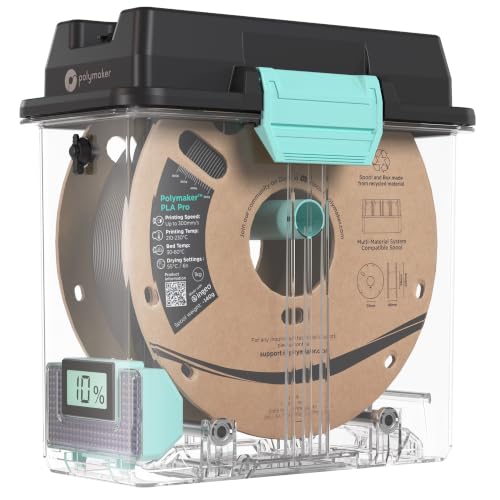
A sealed box with a humidity gauge on it, so you finally know what your spool is sitting in.
Every open rack on this list has the same blind spot: it holds your filament beautifully and protects it from nothing. This box is the fix. It is a sealed enclosure with desiccant support and a built-in hygrometer, which reads the humidity inside so you are not guessing whether your nylon has gone soft.
The daily workflow is where it earns its place. The box lets you feed filament from the spool while it stays sealed inside, so a print can run overnight or pause for a day and the spool never breathes the room’s damp air. Buyers report internal humidity down to 39%, and the dedicated desiccant compartment makes swapping packs a two-second job. It handles PLA, PETG, ABS, ASA, TPU, PVB and PA/Nylon, and it accepts 1.75mm, 2.85mm and 3.00mm filament up to a 1kg spool. It weighs 0.7 kg.
Two things to be straight about. First, this listing is the storage box only — no dryer, no heater, so it manages moisture passively rather than baking it out. If you print mostly PLA in a dry room, you may not feel the benefit. If you print nylon or live somewhere humid, you will.
The hygrometer changes everything: a visible humidity number beats blind faith, and it tells you exactly when to swap the desiccant.
Print without opening it: filament feeds straight through the seal, so protection does not stop the moment a job starts.
Made for: nylon and PETG printers who need one sensitive spool kept genuinely dry between jobs.
Not the tool for: bulk storage — this holds one 1kg spool, so a rack plus a couple of these is the practical combo.
5. Razzi Fidel 9-Tier 3D Printer Filament Storage Rack
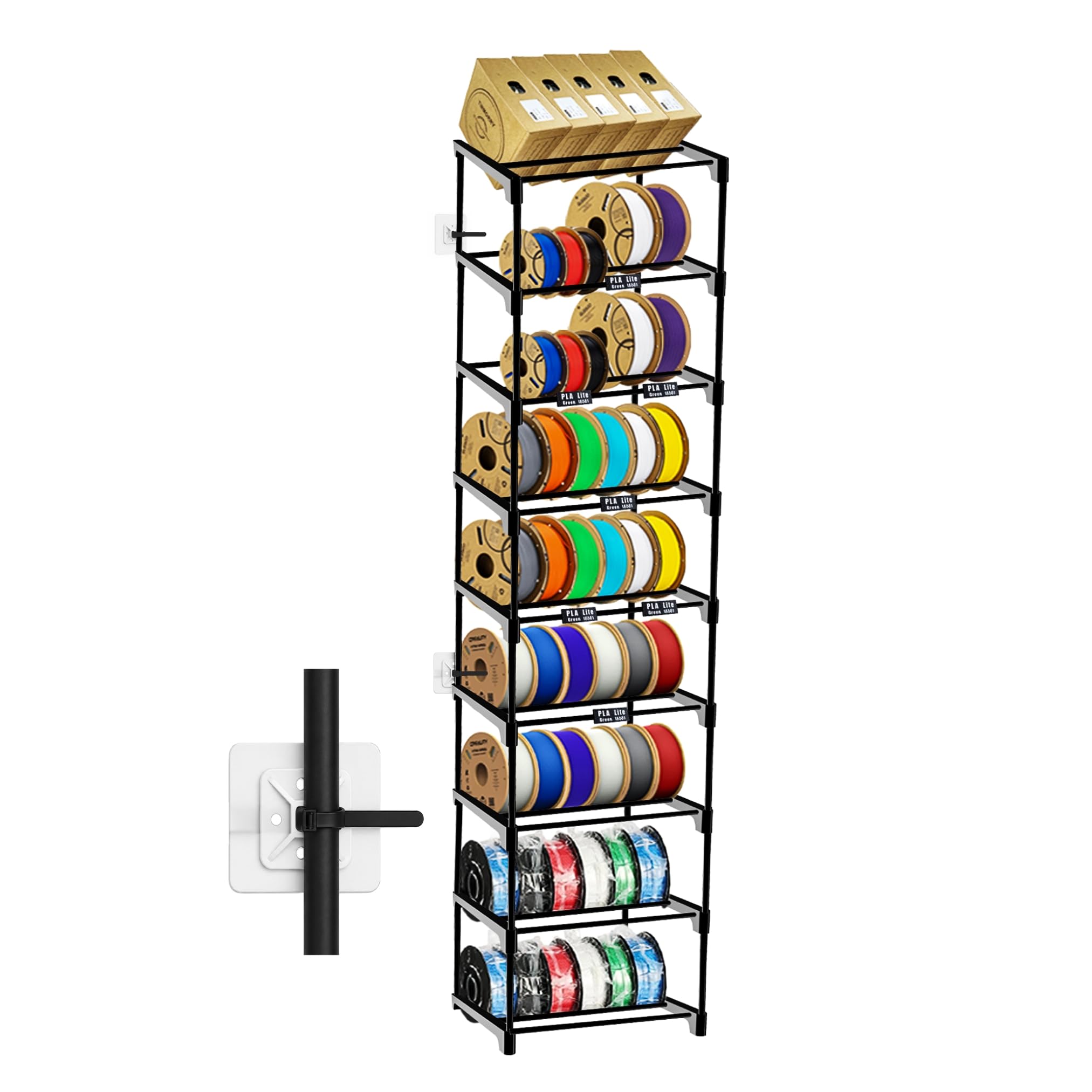
A rack that treats filament storage as inventory management, complete with printable labels.
Fifty-four spools across nine tiers, and a carbon steel frame made from tubes and reinforced PP connectors. That is six more spools than the HoHpHq rack’s 48, and the two share the same tier count — so this one squeezes more onto each level. Each tier is tested to support 30 lb (13.6 kg), and the whole thing stands about 80.7″ H × 16.7″ W × 11.8″ D.
What makes this one different is the system thinking behind it. The instruction manual includes printable label files designed by the product’s designer, supporting custom text and colors, so you can print labels on a multi-color setup and tag every tier by material, brand or project. The modular structure lets you build fewer tiers if a full-height rack will not fit your room. Assembly is tool-free — just push each tube fully into its connector. Anti-tip accessories are included and should go on during the build, not after.
Here is the limit worth knowing before you buy: this is a stationary rack. Moving one while loaded is explicitly not recommended, so pick its wall and leave it there. Assembly also rewards patience — a tube not fully seated will affect how the whole frame sits. Neither is a flaw in the design; both are things you should simply know going in.
The label-and-tier logic
- 54-spool capacity with roughly 5–6 spools per tier
- Printable label files included for material and color tagging
- Carbon steel tubes with reinforced PP connectors
- Modular build lets you drop tiers for a shorter rack
- Anti-tip accessories included
The honest limits
- Stationary only — do not move it while loaded
- Capacity drops if spools are wide or boxed
- Assembly needs every tube fully seated to sit right
Pick this one if: you think in materials and colors and want labels turning a rack into a real inventory system.
Pass if: you rent or rearrange often — it is built to stay against one wall.
6. Filament Storage Box 4 Pack
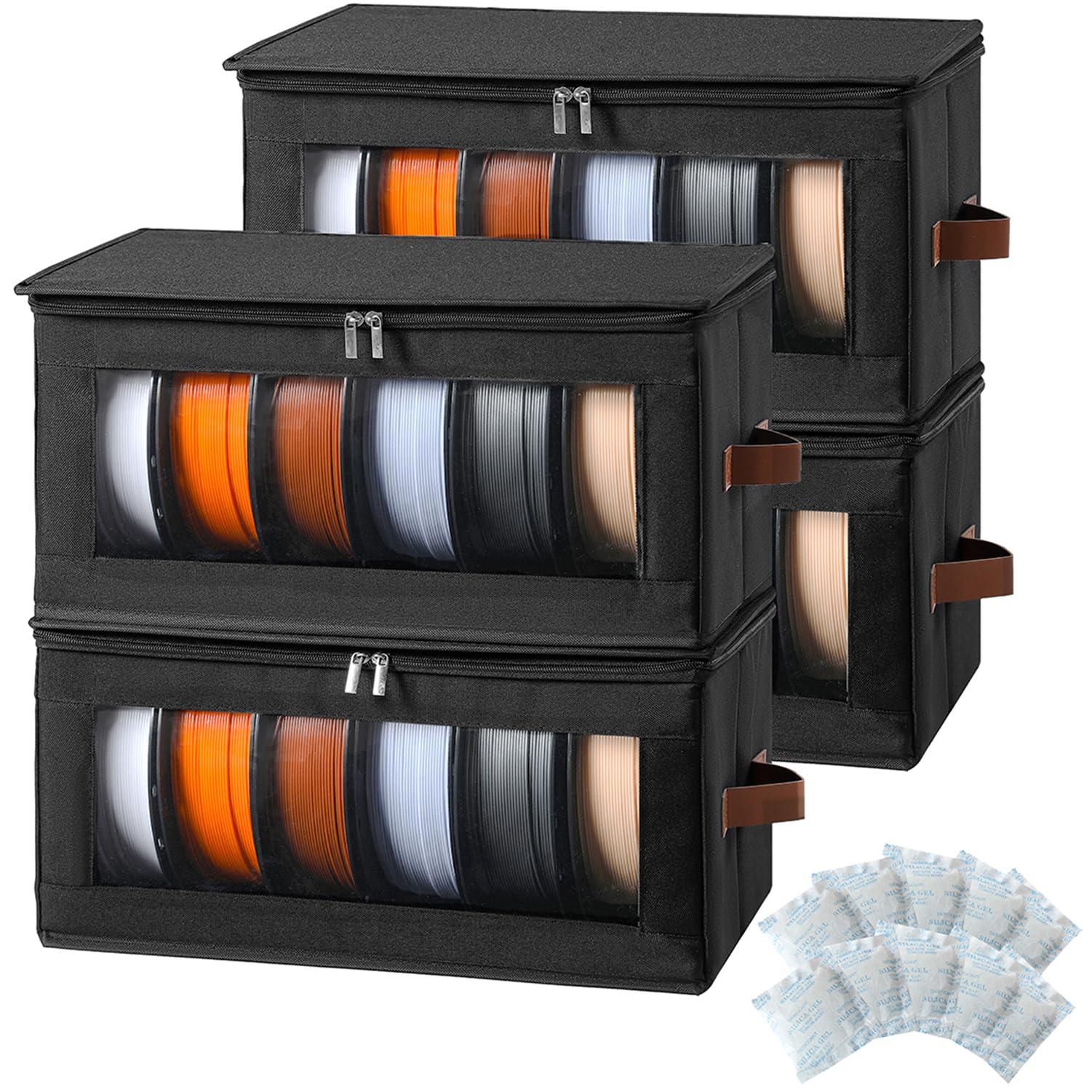
Four fold-flat boxes that hold 24 rolls and let you sort by material without a rack.
Twenty-four spools across four boxes, built from 600D Oxford fabric with a water-repellent outer shell. Each box measures 16.5″ × 8.3″ × 8″, small enough for a desk or a shelf but roomy enough to swallow a few 1kg spools. This is the option for someone with a moderate collection and no wall space for an 80-inch rack.
Organization is what people talk about here — each box holds its own material or color, so PLA, ABS, PETG and TPU never get mixed up. A clear front panel lets you see what is inside without unzipping. Each set includes desiccant packs with a dedicated compartment, and the fully zippered lid seals out dust and splashes. Assembly takes about a minute with no tools, and the boxes fold flat when not in use.
The soft spots are real but bounded. The bottom of each box is on the flimsy side, and the zipper is the quality point that draws the most criticism — treat these as gentle-use storage rather than rugged travel cases. Moisture resistance earns mixed marks too, which is fair for fabric: desiccant helps, but a fabric box is not an airtight plastic one. Keep them in a dry room and they do their job.
Visibility without unzipping: the clear front panel is a small feature that saves real time when you are hunting a specific spool mid-print.
Know the material limit: 600D Oxford fabric with a water-repellent finish keeps off dust and splashes, but it is not a sealed dry box — plan accordingly for nylon.
Good fit for: a home studio sorting a couple of dozen spools by material with no room for a tall rack.
Skip if: you need true airtight protection — go with a sealed plastic box for your moisture-sensitive filament.
7. JAYO J1 Filament Dryer Box
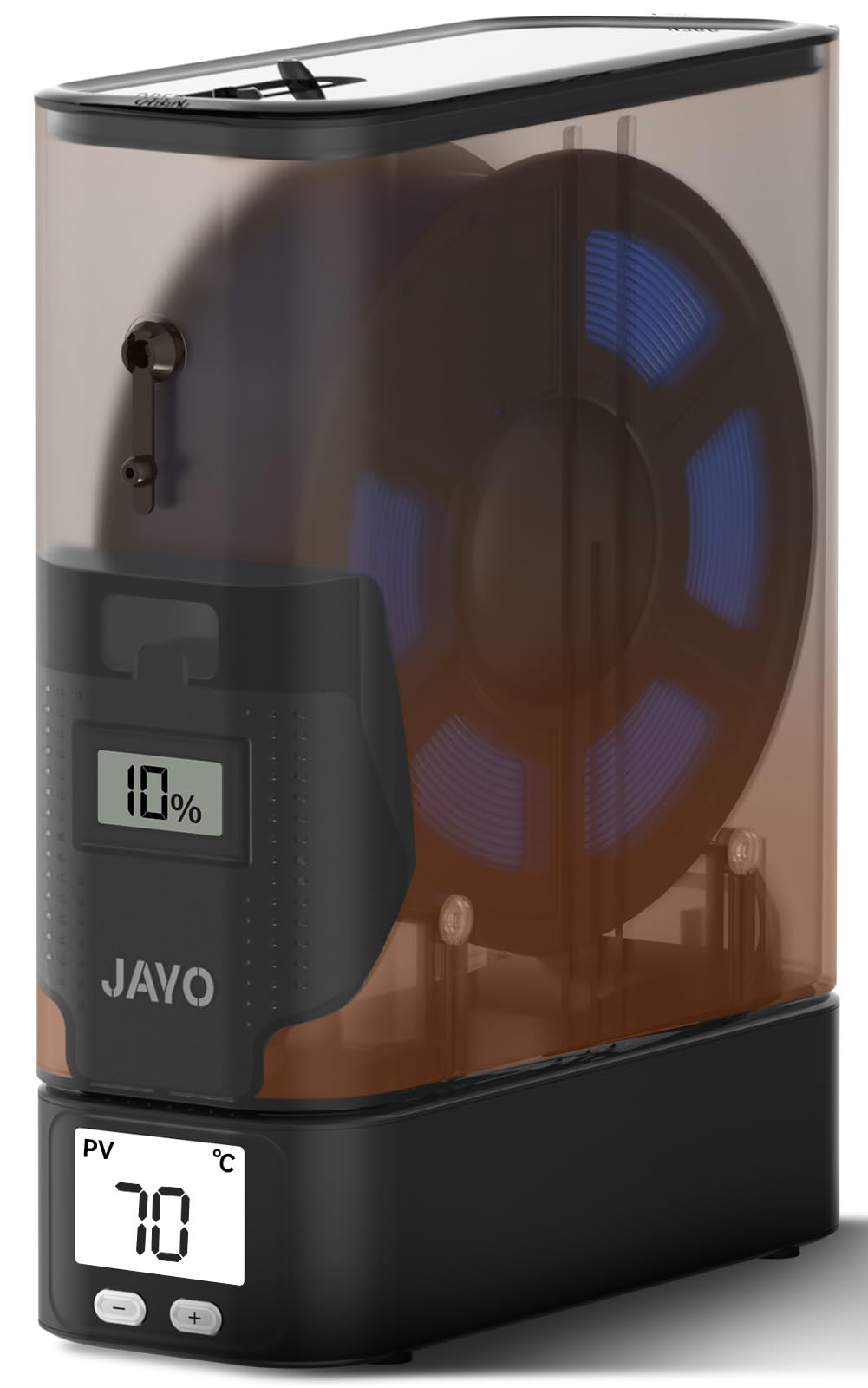
The only pick that actually bakes moisture out of a soggy spool instead of just storing it.
Here is where storage and drying diverge. Every box and rack above manages moisture passively; this one attacks it with a 150W PTC heating element that reaches up to 70°C in minutes. That is enough to drive moisture out of PLA, PETG and ABS spools that have already gone soft, not just keep fresh filament from spoiling.
The split design is the clever bit. Each unit works independently or stacks with another for multi-printer setups, so two machines can each have a dry box without doubling the bench footprint. It supports drying and printing at the same time, feeding filament straight from the box mid-job. Built-in desiccant holds internal humidity within ±5% over 21 days, and the humidity window lets you check conditions without breaking the seal. It runs 1.75mm filament, fits 0.25kg, 0.5kg and 1kg spools, and weighs 1.5 kg.
The caveat is straightforward: at 150W it needs to be plugged in, so it is not a passive storage cabinet you can tuck in a corner and forget. That is the trade for active drying. If your problem is already-wet filament or a humid basement, this is the only pick here that solves it at the source.
Choose this when: your filament already prints with stringing and bubbling and you want to dry it rather than just store it.
Not for you if: you only need somewhere to put dry spools — the Polymaker box handles that passively without a power cord.
Know the Specs
Spool Capacity
Manufacturers quote capacity in spools, and it is always an upper limit for standard 1kg rolls. A rack listed at 54 spools assumes roughly 5–6 per tier, and that number shrinks if your spools are wide or still in vacuum-sealed bags with valves. Treat quoted capacity as a best case for bare 1kg spools and size down if yours are wide or boxed.
PTC Heating
PTC stands for positive temperature coefficient — a heater element that self-regulates, holding a steady temperature instead of spiking. In a dryer like the JAYO it means even heat across the spool, which is what pulls moisture out consistently rather than scorching one side.
Hygrometer and Desiccant
A hygrometer is a humidity gauge; desiccant is a moisture-absorbing pack. Together they are passive drying: the pack pulls moisture from the air inside a sealed box, and the gauge tells you what the humidity has dropped to. When the reading climbs, you swap the pack.
Anti-Tip Kits
An anti-tip kit is the hardware that anchors a tall rack to the wall. On a rack standing 80 inches or more and carrying dozens of 1kg spools, it is not optional — it is what keeps the whole structure from going over. Install it during the build, not after.
Common Questions
Do I need a rack or a dry box for my filament?
How many 1kg spools will a 9-tier rack actually hold?
Is a heated filament dryer better than desiccant?
Can I print directly from a filament storage box?
Why is sturdiness a concern on tall filament racks?
Will a fabric filament box keep nylon dry?
What filament diameters do these systems support?
Can I use the Akro-Mils cabinet to store filament?
Do these racks adjust for different spool sizes?
How long does desiccant last before it needs replacing?
The Bottom Line
For most makers, the honest starting point is the Akro-Mils 16-Drawer Cabinet — not as filament storage, but as the small-parts organizer that keeps nozzles and screws out of the way, and its high-impact build quality is why it earns the top spot. If your actual problem is too many spools, the HoHpHq 9-Tier Rack holds 48 and anchors to the wall. For a setup that moves, the Anrigeail 7-Tier Rack rolls 80 spools on industrial wheels. And if your filament already prints wet, the JAYO J1 Dryer is the only pick here that dries rather than stores — pair it with a sealed Polymaker box and you cover both problems.
How we choose
We do not accept paid placement. Every pick is matched to a real buyer and a real use-case; we do not hands-on test units.
Sources
Specifications: manufacturer listings and product documentation. Review insights: verified customer reviews, as of November 2026. Pricing: not shown on this page (it changes often); check the current price via the retailer link.
As an Amazon Associate, My Heart Lives Here earns from qualifying purchases. This does not affect which products we feature.