Heads up: This post contains affiliate links. As an Amazon Associate I earn from qualifying purchases, at no extra cost to you. Learn more
Specs are compiled from manufacturer listings and verified buyer reviews and can change over time — please confirm the key details on the product page before buying.
If your walls only offer two slots and no round grounding hole, you do not have to choose between safe power and enough outlets. A two-prong surge protector takes that polarized pair of slots and turns it into a proper powering station — grounded three-prong sockets plus USB ports — so a bedroom lamp, a laptop and two phones can all run at once without a nest of loose adapters. The picks below are the ones worth your money, sorted by how well they handle that exact job.
This guide is built by comparing the manufacturers’ published specifications and the patterns across verified customer reviews, so you get each pick’s real strengths and trade-offs instead of marketing spin.
What separates a good unit from a wobbly one is simple: how many joules of surge absorption it carries, how many grounded slots it frees up, and whether it sits tight against the wall or sags out of the socket. The list below covers the 2 prong surge protector options that get those three things right for older homes.
Top Picks

How To Choose The Best 2 Prong Surge Protector
A two-prong surge protector is not a grounded outlet in disguise — it is a splitter and a spike blocker in one body. You get surge absorption and more places to plug in. What you do not get is a true earth ground, so treat grounded electronics with that in mind. Here is what to weigh before you buy.
Joules decide how much abuse it can take
Joules measure how much surge energy the unit can absorb before it gives out. A 900-joule wall adapter handles everyday flickers and small spikes fine. A 1400- or 1680-joule strip, by contrast, is built for lightning-adjacent surges and heavier loads like a desktop setup or a small appliance. Read the joule number next to the outlet count — a big outlet count with a tiny joule rating is mostly just a splitter.
Polarized plug orientation and wall fit
Two-prong outlets are polarized: one slot is slightly wider than the other, and the plug must go in one way only. Check that the unit’s prong matches that wider slot, or you will find yourself flipping it. Wall fit matters too, since a bulky block pushes furniture away from the wall. A flat plug sits nearly flush, so a dresser or sofa can rest close and hide the unit behind it.
How many grounded slots you actually need
Count the things you plug in at once — lamp, phone charger, laptop, fan, router. Then add two spares, because you will want them. A 5- or 6-outlet extender covers a single nightstand or desk. If you are consolidating one whole room onto two holes, the 8-outlet pick is the smarter reach. Wide-spaced slots are a small detail that saves big frustration when a chunky power brick would otherwise cover the neighbor.
Side-by-Side Comparison
| Model | Best For | Surge Rating | Outlets & Ports | Weight | Amazon |
|---|---|---|---|---|---|
| WRXDMC 2 Prong Power Strip (12-in-1)★ Best Overall | Most devices, least space | 1400 J | 8 AC + 4 USB | 9.28 ounces | Amazon |
| WRXDMC 2 Prong to 3 Prong Outlet Adapter (5ft) | Whole-room powering | 1680 J | 6 AC + 3 USB | 300 g | Amazon |
| TROND 3 to 2 Prong Power Strip | Bedside with USB gear | 1440 J | 5 AC + 3 USB | 6.28 ounces | Amazon |
| VINTAR 2 Prong to 3 Prong Outlet Adapter | Compact travel plug | 900 J | 6 AC | 4.16 ounces | Amazon |
Detailed Reviews
1. WRXDMC 2 Prong Power Strip
Our pick — 4.5+★ from 1,000+ verified ratings; the strongest balance of quality and price.
Eight AC outlets plus four USB ports — twelve connections from a single two-prong outlet.
Twelve is the headline: 8 grounded AC outlets plus 4 USB ports (two USB-A at 2.4A, two USB-C at 3.0A), feeding up to 12 devices from a pair of two-prong slots. The surge side rates 1400 joules, capacity is 1625 watts at 125 volts and 13 amps, and the wall plug measures just 0.27 inch thick. That thinness is the real story for a bedroom — it sits close enough to the wall that a headboard or dresser slides back over it.
The 45-degree angle on the plug is worth a mention because it leaves the second wall slot usable instead of buried under the block. On outlet count this beats the TROND above — 8 AC and 4 USB versus 5 and 3 — so if you are powering a desk full of gear from two slots, it is the roomier setup. A white surge-protection indicator lights when the unit is live, and a lighted switch with an integrated circuit breaker lets you cut the whole bank at once.
Where others in this lineup are trimmer, this one is a brick. At 9.28 ounces it is the heaviest pick here, and hanging that much weight off a two-prong wall outlet means it depends on the plug grip unless you add your own mounting. It is also the least portable of the bunch — a station you install, not something you toss in a bag.
Best room for your plugs: 12 connections with 1400 joules behind them is the widest spread of any pick here — a lamp, router, monitor, laptop, two phones and a tablet can all sit on it without a single adapter block.
The little snag: that 9.28-ounce body wants a firm socket; check it has not worked loose after the first month.
Choose it when: a whole desk or entertainment corner needs power and you will not be moving the strip.
Skip it for: travel or a single-lamp setup, where the 12-in-1 size is simply more unit than you need.
2. WRXDMC 2 Prong Power Strip 5ft Cord
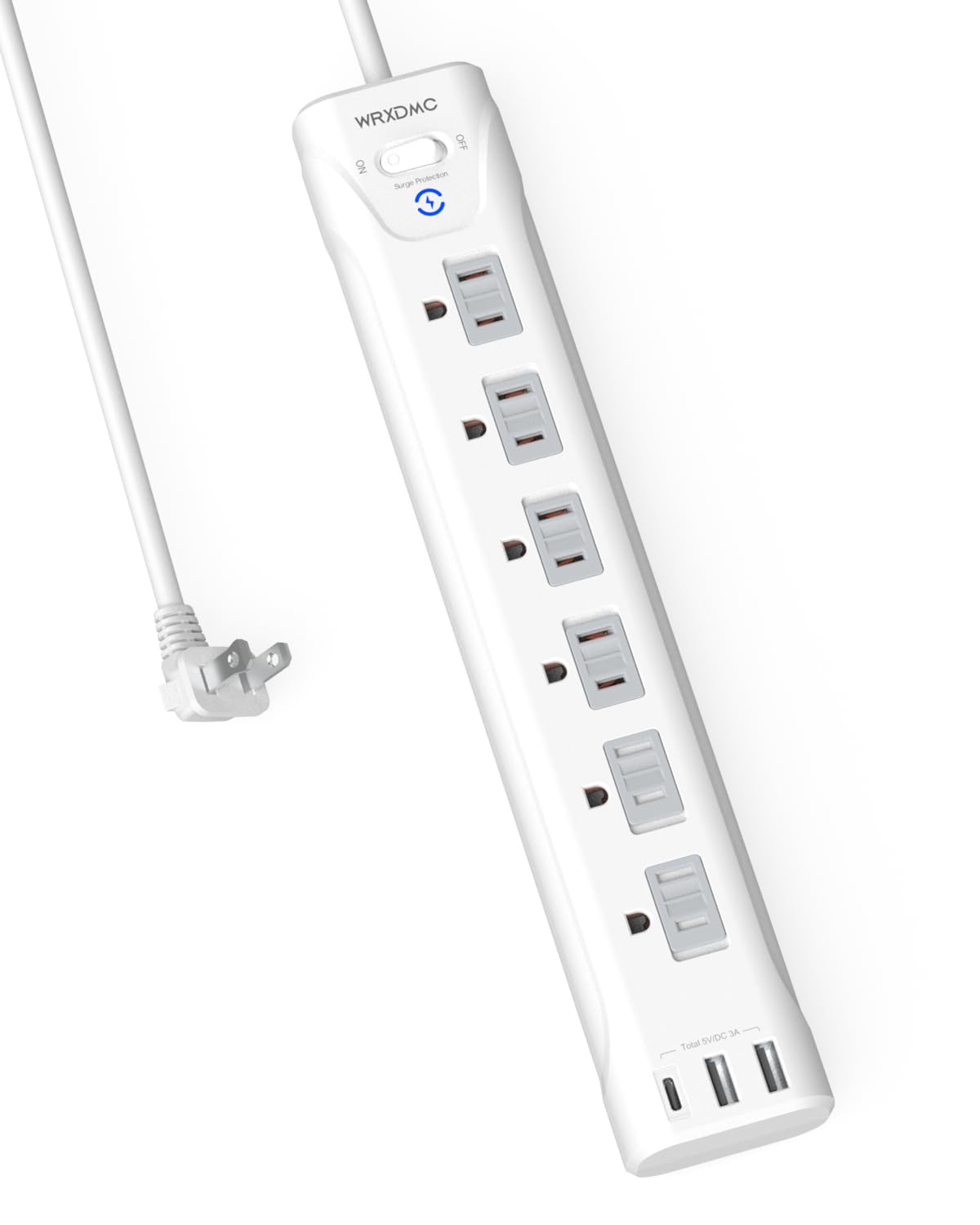
The highest joule rating in this lineup, on a strip thin enough to disappear behind a dresser.
The number to buy for is 1680 joules, the highest surge rating in this lineup. That is how much surge energy this strip can absorb before it stops shielding your gear — enough headroom for a laptop, monitor and phone on the same two slots through storm season. It carries 6 grounded AC outlets plus 3 USB ports (two USB-A, one USB-C), and the whole thing is rated to 1625 watts at 125 volts and 13 amps. On a five-foot cord and a 0.75-inch flat plug, it tucks against the wall instead of jutting into the room.
Owners use it the way you probably will — as a bedside hub in an older house with no ground holes. The flat profile is the part that keeps getting mentioned, because furniture can slide back flush against the wall and the strip disappears behind it. USB outputs top out at 2.4A for each USB-A and 3.0A for the single USB-C, with 5V/3.0A total, so phones and e-readers charge in the background while the AC slots do the heavy lifting. Against the VINTAR below, the surge side is the gap: 1680 J versus 900 J, so this one absorbs substantially more of a spike before giving out.
The trade-off is honest and small: the USB ports share that 5V/3.0A total, so they will not fast-charge a tablet and a phone at the same time as quickly as a dedicated wall brick. Its 300 g body is also heavier than the compact picks, which is the price of the long cord and the higher joule rating. Neither stops it working — it just means you position it once and leave it.
What holds up
- 1680 joules of surge absorption — the most protection in this lineup.
- 9 total connections from one two-prong slot (6 AC + 3 USB).
- 0.75-inch flat plug keeps furniture able to sit close to the wall.
- 5ft cord lets the strip reach up off the floor or across the back of a desk.
What to plan around
- USB ports share a 5V/3.0A total, so multi-device charging is steady rather than quick.
- At 300 g, it needs supporting when you reposition it.
Reach for this if: you are consolidating one room onto a single pair of two-prong slots and want the most surge headroom in the lineup.
Think twice if: you only need two extra outlets, because the 9-in-1 capacity is more body than a small nightstand spot needs.
3. TROND 3 to 2 Prong Outlet Adapter

A wall block that replaces three chargers while using just one two-prong outlet.
You get 1440 joules here, plus 5 grounded outlets and 3 USB ports (two USB-A at 5V/2.4A and one USB-C at 5V/3A), all in a body that measures 4.1 by 3.5 inches and weighs 6.28 ounces. The outlets are split across three sides with 0.98 inch between them, so a fat laptop brick on one slot does not muscle out the lamp plug next door. That 15-amp rating also gives it more current headroom than the strip above.
For a nightstand or hotel desk, the three-sided layout fans your plugs outward instead of stacking them on one face. The ON/OFF switch with a built-in circuit breaker is a genuinely handy addition when you leave things stationed in the wall and want to kill power without unplugging. The housing uses UL 94 V-0 flame-retardant PC+ABS, a material grade that resists catching fire. Talking port mix versus the WRXDMC 12-in-1, this TROND gives you 5 AC slots to that strip’s 8, but matches it on USB count at 3 ports.
The honest caveat is mounting. The screw-in tab is there, but the screw hole does not line up cleanly on every outlet — a recurring note in the reviews that leaves some units relying on the plug grip alone. In a sideways or worn socket, that can mean the block wants to sag. If your outlet sits high and vertical, plan to seat it firmly and check it after a week.
Sizing the outlet count: 5 grounded slots plus 3 USB ports covers a lamp, a laptop, two phones and a watch charger at once — enough for one person’s whole nightstand with a spare slot left over.
Where it gives ground: the screw alignment, not the electrical side. The 1440-joule rating and 15-amp rating are both solid for the tier.
Suits you: if your load is a mix of AC plugs and USB devices clustered in one spot, and you want them all off with one switch.
Pass on this: if your outlet is horizontal or loose, since the screw mount is not a guaranteed snug fit everywhere.
4. VINTAR 2 Prong to 3 Prong Outlet Adapter
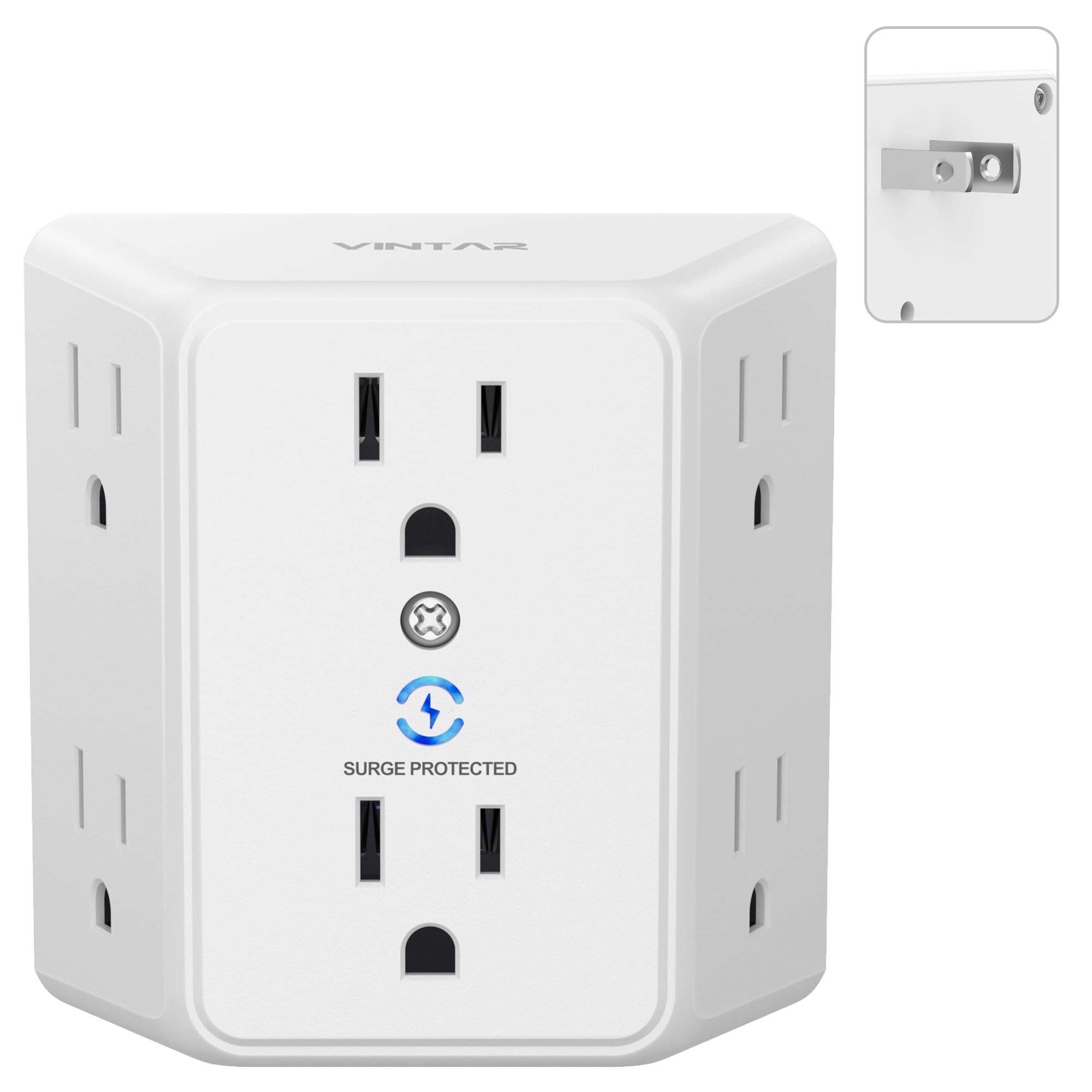
At 4.16 ounces, the lightest block here — small enough to pack for a rental.
Six wide-spaced AC outlets, no USB, in a body that weighs 4.16 ounces and measures 3.62 by 1.81 inches. Those 1.77-inch gaps between sockets let six bulky plugs sit side by side without a phone brick stealing the slot next to it. The surge rating is 900 joules, handled by what VINTAR describes as three protection circuits — a transient voltage suppressor, a metal oxide varistor and a gas discharge tube. Against the WRXDMC 9-in-1, that surge gap shows: 900 J versus 1680 J, so this is the everyday-flicker pick rather than the storm-surge one.
Its case is portability and price: a compact plug-in extender you can carry from room to room. It lists UL498A certification, meaning a recognized safety standard for this kind of adapter, plus overload, short-circuit, over-current, over-voltage and overheating protection, and a fire-resistant casing. A screw is included if you want to pin it down. For a rental bedroom or a bathroom outlet where you need four or five things connected and nothing fancy, the wide spacing does the work.
Here is the catch worth knowing up front. The mounting screw hole does not always line up with the outlet’s screw hole, and without a solid screw grip the block can feel loose in a worn socket — that is the recurring complaint, and it is a fit mismatch rather than a broken unit. It is also the lowest joule rating of the four, so it is the lighter-duty choice for delicate electronics.
Why it earns a spot
- 1.77 inches between outlets — chunky plugs stop blocking each other.
- 4.16 ounces is the lightest here, so it slips into a bag for a trip or rental.
- Six outlets from two prong slots with 900 joules of suppression.
- Ul 498A certification and a fire-resistant casing.
Where it asks patience
- The included screw does not align on every outlet, and grip alone can leave it wobbly.
- 900 joules is the smallest protective budget in this lineup.
- No USB ports, so phone charging needs its own brick.
The one to grab: if you want a compact, carry-friendly extender for a rented room or a lightly loaded outlet.
Look elsewhere when: you need a hard screw-mount anchor or heavier surge protection for expensive electronics.
Know the Specs
Joules and surge absorption
The joule rating tells you how much surge energy a unit can soak up before it stops protecting. A 900-joule plug-in extender is fine for everyday spikes and the occasional flicker. A strip in the 1400- to 1680-joule range is built for heavier power events and for gear you would rather not replace. When you compare two units, compare joules first, then count outlets.
Polarized two-prong plugs
A polarized two-prong outlet has one slot wider than the other to force correct wiring. A 2-to-3 prong adapter matches that shape, so the plug only goes in one way. It gives you three-prong sockets to plug into, but it does not create a true earth ground — the adapter sits on a two-wire circuit. Treat it as a splitter and spike blocker, not as grounding your home’s wiring.
Flat plug and wall clearance
A flat plug is the low-profile end that lets the unit sit close to the wall. In real terms, that means a bed frame, dresser or sofa can push back within an inch or so of the wall instead of leaving a gap. If your outlet is hidden behind furniture, the plug thickness is the spec that decides whether the unit fits.
Screw-mount versus plug grip
Many of these units ship with a screw tab so the adapter can secure to the wall plate. When the screw hole aligns, the unit stays put. When it does not, the plug’s grip in the two slots holds the weight alone — and a heavy 9-plus-ounce body can sag in a loose socket. If your outlet is worn, prefer a lighter unit or plan a secondary mount.
Common Questions
Will a 2 prong surge protector work on an old two-slot outlet with no ground hole?
What joule rating should I look for in a two-prong surge protector?
How many devices can one two-prong surge protector run at once?
Can I plug a 3 prong plug into a 2 prong adapter safely?
Do two-prong surge protectors have a flat plug that fits behind furniture?
Why does the mounting screw not line up on some outlet adapters?
How long does surge protection actually last?
Is a two-prong surge protector better than a plain two-prong extension cord?
Can I use a two-prong surge protector in a bedroom or hotel room?
Do these protect against lightning surges?
The Bottom Line
For most two-slot rooms, the WRXDMC 2 Prong to 3 Prong Outlet Adapter with 5ft Cord wins on the number that counts — 1680 joules and 9 connections in a body that still hides behind the furniture. If your load leans on USB and you want everything off with one switch, the TROND 3 to 2 Prong Power Strip earns its place with 1440 joules and three-sided sockets. And for the simplest job — a rental outlet, a couple of lamps, a phone — the VINTAR extender is the light one to carry. Whatever you pick, buy by joule rating and outlet fit, not just outlet count.
How we choose
We do not accept paid placement. Every pick is matched to a real buyer and a real use-case; we do not hands-on test units.
Sources
Specifications: manufacturer listings and product documentation. Review insights: verified customer reviews, as of November 2026. Pricing: not shown on this page (it changes often); check the current price via the retailer link.
As an Amazon Associate, My Heart Lives Here earns from qualifying purchases. This does not affect which products we feature.