Heads up: This post contains affiliate links. As an Amazon Associate I earn from qualifying purchases, at no extra cost to you. Learn more
Specs are compiled from manufacturer listings and verified buyer reviews and can change over time — please confirm the key details on the product page before buying.
You do not need a bench full of gear to get a working axe edge back. A round sharpening puck — a thick disc of abrasive you hold in one hand and sweep along the blade — does the whole job in the field. The trick is picking a puck whose grit numbers match the damage on your axe head and whose shape keeps your knuckles behind the cutting edge. This guide lines up seven of them so you can match a stone to your tool and your hands.
This guide is built by comparing the manufacturers’ published specifications and the patterns across verified customer reviews, so you get each pick’s real strengths and trade-offs instead of marketing spin.
Every puck below runs a two-sided grit setup: a coarse face for nicks and a fine face for finish. Grab the axe sharpening stone whose grit pair suits your blade and pack it before the weekend trip.
Top Picks
How To Choose The Best Axe Sharpening Stone
An axe edge is a wedge of steel, and a puck is a flat abrasive disc you rub across it. Matching the grit pair to your axe matters more than the brand stamp on the box. Get the grit wrong and you either polish a nick forever on too fine a face or hog off more steel than the head can spare on too coarse a one.
Match the grit to the damage, not to the brochure
A coarse face — 120 to 240 grit — is for removing material fast, so it belongs on chipped or rounded edges. A fine face, roughly 320 to 1000, refines what the coarse side started. If your axe only needs a touch-up between swings, you will live on the fine side and barely touch the coarse one.
Diamond pucks cut on both push and pull with almost no pressure, while silicon carbide and ceramic pucks cut like traditional whetstones. The diamond route skips the lubricant entirely: sharpen dry, wipe the dust, done.
The three-inch puck and the finger problem
Most of these stones are around 3 inches in diameter and around an inch thick — enough palm real estate to grip firmly while your fingers sit behind the abrasive face. Look for a groove, a contoured edge, or a leather sleeve if you want extra distance between your knuckles and the blade tip.
Carry weight and the sheath question
A puck rides loose in a pack or belt pouch, so what matters is whether it ships with a sheath or case to protect the abrasive face. A leather sheath or a hard aluminium case protects the stone face from chipping against other gear, and protects your other gear from the stone.
Side-by-Side Comparison
| Model | Best For | Grit Pair | Diameter | Weight | Amazon |
|---|---|---|---|---|---|
| Angerstone 3.8″ Axe & Hatchet Sharpener★ Best Overall | Oversized surface for fast field work | 180 / 320 | 3.8″ | 0.39 kg | Amazon |
| Norton Axe & Hatchet StoneWorkshop Standard | Workshop stock removal and repair | Coarse / Fine | 3″ | 4.96 oz | Amazon |
| SHARPAL 216N Diamond Stone | Dry sharpening with no oil or water | 220 / 600 | 3.15″ | — | Amazon |
| Whitby Abrasives 4″ Puck | Grooved grip for yard and mower blades | 120 / 240 | 4″ | 0.5 kg | Amazon |
| Wisemen Trading Dual Grit Puck | Finer finishing on a ceramic face | 240 / 400 | 3″ | 0.24 kg | Amazon |
| WATL Official Dual Grit Stone | Throwing-axe touch-ups between matches | 400 / 1000 | 3″ | 16 ounces | Amazon |
| 1844 Helko Werk Germany Stone | Field kit with oil and hard case | 120 / 320 | 3″ | 6.88 ounces | Amazon |
Detailed Reviews
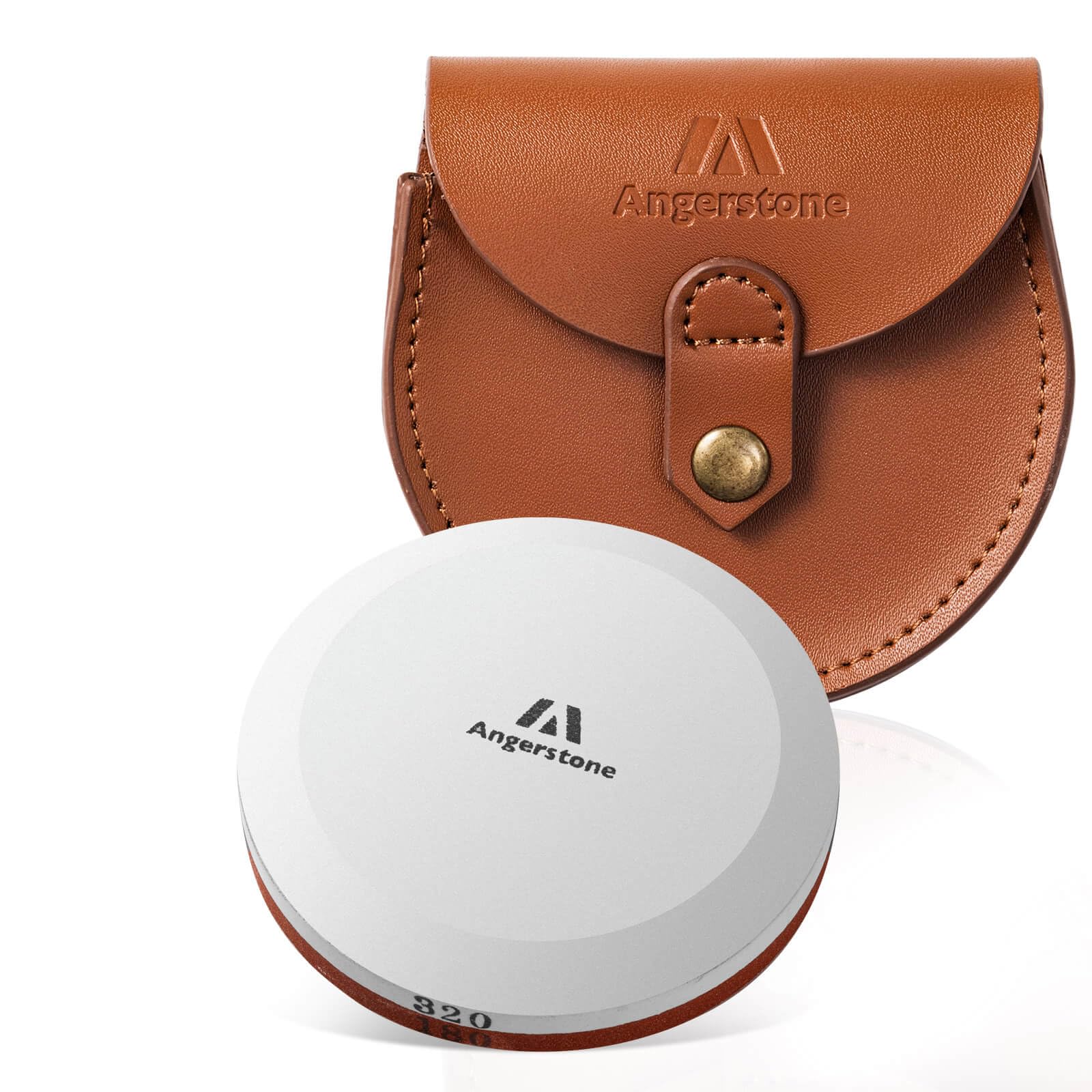
1. Angerstone 3.8″ Axe & Hatchet Sharpener, 180/320 Grit
Our pick — 4.5+★ from 900+ verified ratings; the strongest balance of quality and price.
A puck wide enough that your sharpening strokes stop being a balancing act.
That 3.8-inch face is the whole reason this one takes the top spot. Most field pucks top out near three inches, so the extra surface gives you a longer, flatter stroke per pass and less chance of rocking the stone and rounding the edge you just set. Sizing it against the Norton is telling: the Angerstone measures 3.8″L x 3.8″W x 1″H while the Norton lists 10.44″L x 3″W x 10.44″H, and it runs 0.39 kg against the Norton’s 4.96 ounces.
The two faces run 180 grit for taking out nicks and 320 for the finishing pass — a sensible middle pairing that will not hog steel off a good head. The abrasive is first-grade white corundum, a hard ceramic-style grit that cuts steadily and holds its shape. It ships with a genuine cowhide leather sheath with reinforced stitching and a copper rivet snap, so you can hang it off a belt loop or drop it in a pack without the stone face grinding against your other tools.
Buyers keep coming back to the build. What wins people over is the overall quality of the thing in the hand, and portability runs a close second — the sheath does most of that work. Word travels about the edge it leaves too: as owners put it, it took a marbles carving axe to a razor edge. The honest caveat sits in the durability chatter, so do not treat the stone face as indestructible; store it in the sheath and it will hold up.
Where it earns its keep
- The 3.8″ face gives a bigger, steadier contact patch than a standard 3″ puck.
- 180/320 splits repair work and finishing cleanly without over-cutting a healthy edge.
- Cowhide sheath with a copper snap makes belt carry genuinely practical.
- Corundum abrasive holds its cutting action across repeated sessions.
What to keep in mind
- At 0.39 kg it is a chunk in a pocket — this is a pack or belt item, not a keyring one.
- The coarse 180 side is slower on deep chips than a diamond stone will be.
Reach for this if: you want one stone that handles nicks and finishing on a single camping trip, with a sheath already sorted.
Look elsewhere if: you are chasing the absolute lightest puck for a long backcountry trek.
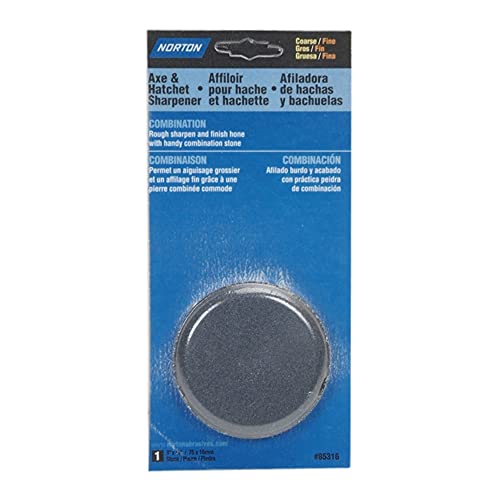
2. Norton Axe & Hatchet Stone — Dual Grit Combo Whetstone
The garage-shelf puck that removes metal fast and asks for nothing fancy.
Norton’s Crystolon abrasive is silicon carbide — a sharp, aggressive grit designed for fast stock removal and quick edge sharpening with minimal loading, meaning the stone does not clog up with steel dust and go slick. One side is coarse for repairing a damaged edge; the other is fine for a keener finish. A 3-inch diameter sits nicely in the palm, and the stone weighs 4.96 ounces.
The weight and size numbers cut both ways against the Angerstone. At 4.96 ounces it is far lighter, and at 3 inches it is more compact — the trade is a smaller contact patch per stroke. For bench work in a shed or toolbox that is a non-issue. For long field strokes on a big felling axe, the extra surface on the Angerstone is genuinely easier to use.
This is a stone with a serious following among people who own a lot of edged tools. Quality leads the way, with effectiveness right behind it, and it draws praise for producing a very keen edge — it can take hunting and fillet blades to a polished finish. Versatility gets a nod too, covering axes, machetes and other tools. The recurring gripe is around value for money and hand feel, so treat it as a solid working stone rather than a premium-feeling one.
The working case: silicon carbide that cuts quickly and keeps cutting without loading up is exactly what a shed stone should do. Fewer passes, less fuss, and a fine side that will polish a hunting blade if you want it to.
The realistic catch: the compact 3-inch face and plain gray bar shape make it a tool rather than a keepsake — no sheath, no contour, nothing to stop it sliding around a toolbox.
Suits the tool-crib owner: a shed, garage or glovebox stone you reach for whenever an edge goes dull, across axes, machetes and knives.
Not the one for you if: you want a contoured puck with a sheath for belt carry in the woods.
3. SHARPAL 216N Dual-Grit Diamond Sharpening Stone

Diamond grit that bites into a dead edge and never asks for a drop of oil.
Diamonds electroplated onto a stainless steel base change the whole ritual. There is no soaking, no oil bottle, no slurry to wipe off your hands — you sharpen dry and move on. SHARPAL claims it cuts up to 5 times faster than an oil or water stone and lasts far longer than a water stone. Take that as the maker’s claim, but the dry-cutting convenience is real and it is the reason a lot of people keep one in a pack.
The grit pair is the widest spread here after the WATL. An extra coarse 220 (a 60 micron particle) resets a damaged edge or forms a new one; a fine 600 (25 micron) hones it to a working sharpness. That range means one stone covers a badly dinged hatchet and the same hatchet after it is back in service. The 3.15″L x 3.15″W x 1.18″H body is compact enough to slip into a sheath pocket.
The diamond surface works on hard stuff that eats ordinary stones — carbide, high speed steel, titanium, ceramics — plus knives, axes, hatchets, machetes, mower blades and shears. Owners find it gets a good edge every time while keeping fingers clear of the sharp side. One small point to size honestly: durability opinions are split, so treat the plated diamond face as a long-lived tool but not a forever one.
The reasons it travels well
- 220 and 600 grit in one stone covers repair and finishing on a single pack item.
- Dry sharpening — no oil, no water, no cleanup. Open it, use it, close it.
- Cuts carbide, high speed steel, titanium and ceramic, not just axe steel.
- Ergonomic handle design keeps a secure, comfortable grasp while sharpening.
Where it asks for care
- Durability feedback is mixed, so avoid dropping it face-first onto concrete.
- Diamond stones cut aggressively — a light hand on the 220 side protects your edge geometry.
Go dry: this is the pick for anyone who hates the oil-bottle-and-rag routine and wants an edge back in under a minute.
The trade you accept: a plated diamond face demands a bit more care than a solid abrasive puck to keep its cutting life long.
4. Whitby Abrasives 4″ Dual Grit Axe & Hatchet Sharpening Puck
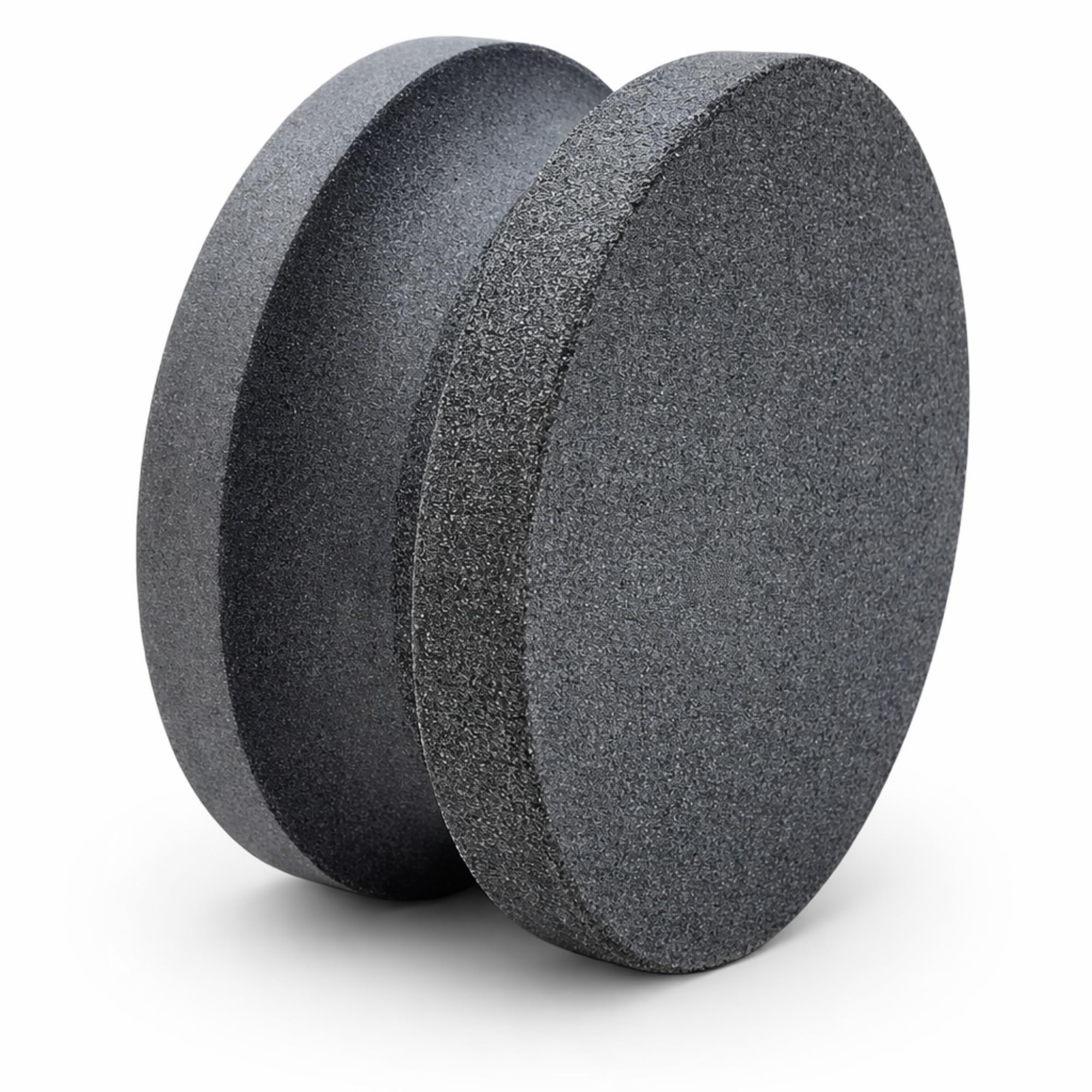
A recessed groove around the middle so your fingers stay behind the abrasive.
A puck gets dangerous the moment it slips. Whitby’s answer is a recessed middle groove that gives you a secure grip and better control while your hand works a tough blade — the grooved shape keeps fingers clear of the sharpening surface and the cutting edge when you use it properly. On a 4-inch disc with a 1.5-inch thickness, that groove is doing real work.
The grit pair runs 120 coarse for fast edge repair and burr removal, then 240 fine for smoothing, honing and touch-ups. That is a rougher starting point than the Angerstone’s 180, which makes it well suited to backyard blades that have taken real abuse — a mower blade that hit a rock, a machete that found a fence post. The abrasive is silicon carbide, chosen for aggressive cutting action on metal edges and heavy-duty outdoor blades.
This is the heaviest puck on the list at 0.5 kg, which makes sense for a 4-inch disc that thick. It is a tool for the shed, the truck bed or the landscaping kit rather than a pocket carry. On the owner feedback front, quality is the thing people vouch for most, while value for money splits — some find it strong for what it is, others less convinced. Nothing dramatic, just a mixed read on the price-to-utility question.
The grip story: that recessed groove is the differentiator. If you have ever had a slick puck skate across a wet mower blade, you know why a channel to hook your fingers into matters.
The weight caveat: 0.5 kg rules out pocket carry entirely, and the 4-inch disc is the largest here beside the Angerstone.
Built for the yard kit: homeowners and landscapers restoring mower blades, shovels and machetes in the shed rather than the backcountry.
skip it if: the stone needs to live in a jacket pocket all day.
5. Wisemen Trading Dual Grit Sharpening Puck
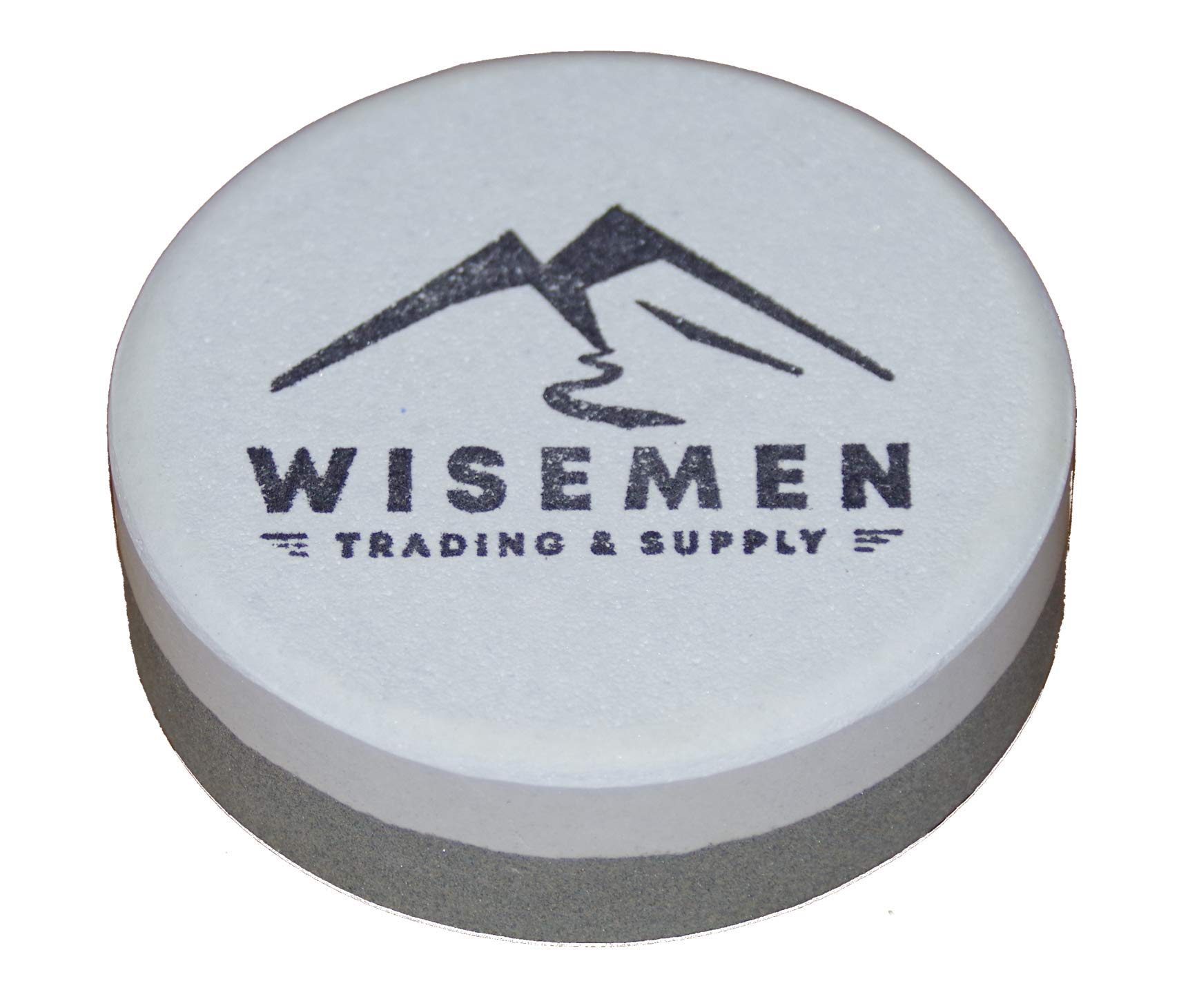
Both faces are fine-grit, so this one is for refining an edge that is already close.
Spot the grit numbers and the job becomes clear: 240 medium and 400 fine. There is no aggressive coarse side here, which tells you this puck is a finisher. If your axe head has a chip out of it, reach for the Whitby or the Helko Werk first. If your edge is simply dull and needs its bite back, this ceramic puck is the right tool and it will not carve away steel you would rather keep.
The size is the other half of the story. At 3 inches in diameter and 7/8 inch thick, it is thin, light at 0.24 kg, and made in the USA. That thinner profile sits differently in the hand than a fat 1.5-inch puck — you get a flatter, lower stance over the blade, which some people find easier to control on a curved axe cheek.
Control is exactly what owners talk about. The sharpening performance holds up well, and people find it easier to steer than a plain stone — it performs better than regular stones in that respect, and it draws praise for how it handles axes and machetes. Quality is the standout, with sharpening performance close behind.
What this puck does well
- 240/400 grit makes it a dedicated finisher that respects your edge geometry.
- Ceramic abrasive, made in the USA.
- At 0.24 kg it is the lightest puck in this lineup.
- Thin 7/8-inch profile gives a low, controlled stance over a curved blade.
Its limits
- No coarse face means it cannot reset a chipped or badly rounded edge.
- 3-inch diameter gives you a smaller contact patch per stroke.
The maintenance pick: for anyone whose axe is already sound and just needs its working bite refreshed before a trip.
Wrong tool if: you are buying one stone to fix a heavily damaged head from scratch.
6. WATL Official Dual Grit Axe & Hatchet Sharpening Stone
The finest grit pair on this list, built around the throwing-axe ritual.
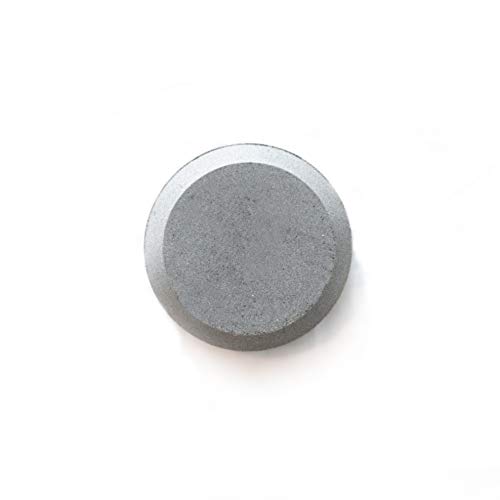
Here is the outlier: 400 and 1000 grit, no coarse side at all. That is a polishing setup. At the 1000 level you are refining an edge that already cuts, not building one from a chipped mess. For the use case it was designed around — World Axe Throwing League throwing axes — that makes complete sense, because a throwing axe head gets checked and touched up between matches rather than rebuilt after a felling job.
The body is small and simple. Just over 3 inches in diameter, an inch thick, 16 ounces in the hand. The brand pitches it as portable and durable with a simple design: run the axe across the surface and go. No angle jig, no technique to learn, which is why it works well for a quick tune-up paced around a throwing bay.
On performance, the sharpening itself is what stands out, with the axe-ready fit singled out specifically. Functionality gets its own nod — it handles the between-match tune-ups it was built for. The realistic note: if your blade has real damage, this is the wrong grit range, and 16 ounces makes it the heavier of the compact pucks here.
The league logic: a 1000 grit face is what you want on a throwing axe you keep consistent, because it fine-tunes without altering the profile you have dialled in over dozens of throws.
What it will not do: reset a blunt or chipped head. Pair it with a coarser stone if you also split wood.
For the thrower: keep it in the bag for between-match touch-ups and keep that profile consistent.
Not for the woodpile: chopping and splitting damage needs a coarser grit than 400/1000 can offer.
7. Helko Werk Axe Sharpening Stone
The only stone here that arrives as a complete kit, oil and hard case included.
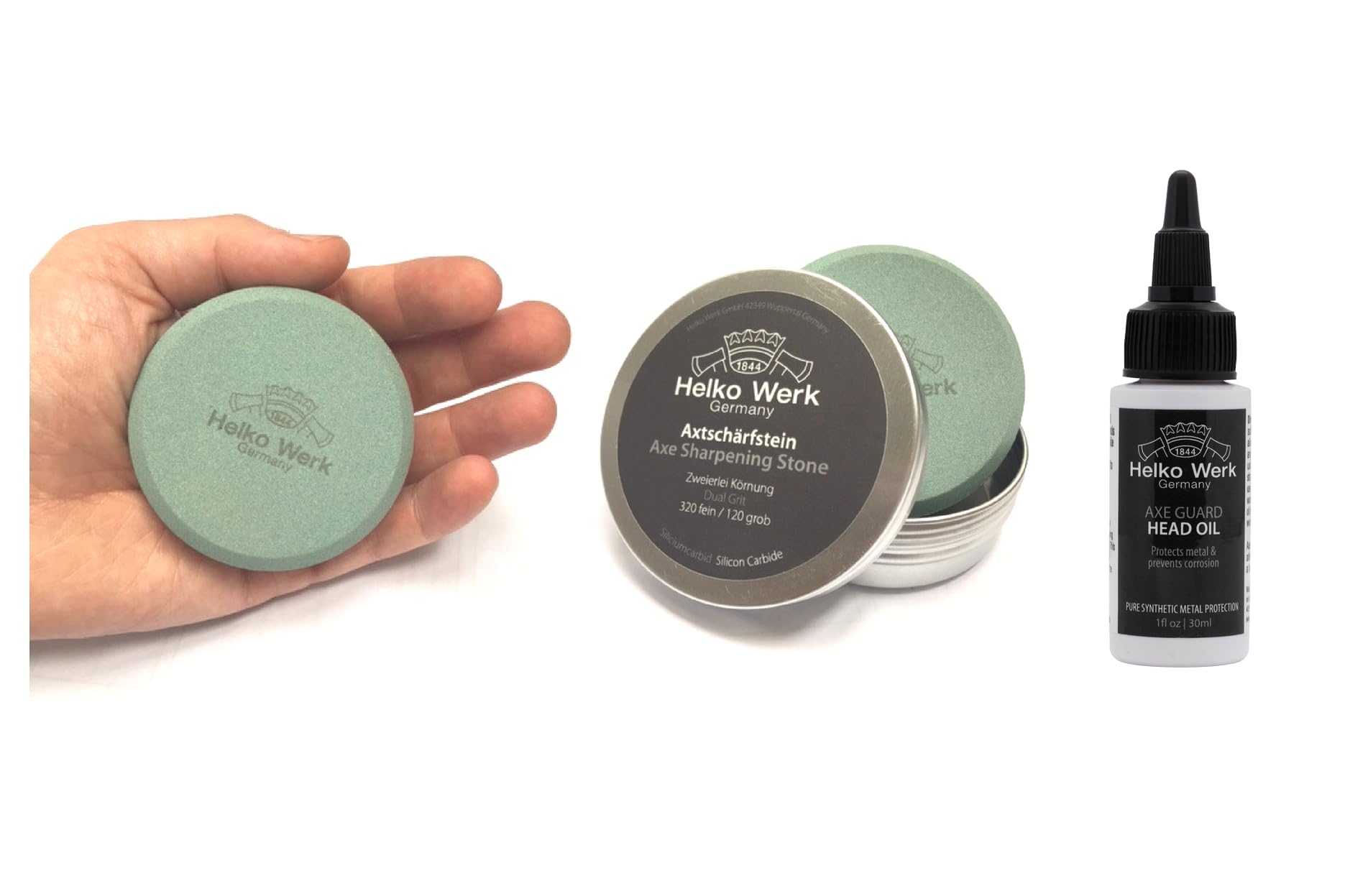
Made in Germany from ceramic silicon carbide, this stone is designed to be used dry, with water, or with oil — and the maker states oil gives the best results. So they ship a 1 oz bottle of Axe Guard Head Oil, usable as a honing oil, plus an aluminium protective case. That case is not a small thing: a stone that lives loose in a pack picks up grit and chips at its own edges.
The contoured shape is built for a firm, safe grip, and the grit pair spans 120 coarse for restoring dull edges and 320 fine for the finishing pass. The coarse side is gray, the fine side green, with the coarse face listed at 1 cm thickness and the fine at 1.5 cm. At 6.88 ounces and 3 inches across, it is a light puck you can carry all day. The maker lists it for machetes, hatchets, tomahawks, shovels and other garden tools.
Owners describe it as well-made and easy to use, and it handles older steel without complaint — it worked perfectly on an old Collins axe. Value for money gets a warm reception, and functionality and ease of use both come up. Yes, it is the priciest stone in this lineup, and yes, the grit pair is identical to the Angerstone’s 180/320 in spirit — but the oil and the aluminium case are what you are paying for.
Why the kit argument holds
- 1 oz Axe Guard Head Oil included, usable as a honing oil for the best finish.
- Aluminium protective case guards the stone face in transit.
- Contoured shape is shaped for a safe, firm grip in the field.
- 120/320 covers edge restoration plus finishing on practically any edged tool.
Worth knowing
- The most expensive stone on this list — the kit premium is real.
- Best results call for oil, so you carry a bottle alongside the stone.
The all-in option: buyers who want the stone, the lubricant and the case in one box rather than assembling a kit piece by piece.
Money-conscious alternative: if you already have honing oil and a pouch, the Angerstone delivers the same grit logic for less.
Know the Specs
Grit Numbers Explained
Grit is how many abrasive particles fit in a fixed space — the higher the number, the finer the particles and the smoother the finish. A 120 grit face is coarse enough to reshape a chipped edge quickly. A 600 or 1000 grit face polishes and hones, and removes almost no material. Most pucks pair one coarse side with one fine side so a single stone does both jobs.
Diamond vs Silicon Carbide vs Ceramic
Diamond stones have monocrystalline diamond particles plated onto a steel base. They cut fast, work dry, and handle hard steels and carbide. Silicon carbide — often called carborundum — is a traditional abrasive that cuts aggressively and works with oil or water. Ceramic stones are denser and slower-cutting, which makes them suited to finishing work rather than repair.
Common Questions
What grit should I use to fix a chipped axe edge?
Can I sharpen an axe with a knife sharpening stone?
Do I need oil or water with an axe sharpening puck?
How often should I sharpen my axe?
Is a round puck better than a flat bench stone for axes?
Will a diamond stone wear out faster than a traditional one?
How do I keep my fingers safe while sharpening an axe?
Can these stones sharpen mower blades and other garden tools?
What is the difference between a 320 grit and a 1000 grit finish?
Does the stone come with a case or sheath?
The Bottom Line
For most people, the axe sharpening stone to buy is the Angerstone 3.8″ Axe & Hatchet Sharpener, because the oversized 3.8-inch face makes every stroke flatter and steadier than a 3-inch puck, and the cowhide sheath means it is ready to travel the moment it arrives. If you want to skip the oil bottle entirely, grab the SHARPAL 216N Diamond Stone — 220/600 grit that cuts dry and handles carbide and high speed steel. And for sharpening that needs the finest finish, the WATL Official Dual Grit Stone at 400/1000 is the one to reach for.
A quick word on the Helko Werk: it carries the strongest owner reputation in this group, with build quality the clear standout, and it is the only pick that hands you the stone, the oil and a hard case together — the straightest path to a complete field kit if you would rather not assemble one yourself.
How we choose
We do not accept paid placement. Every pick is matched to a real buyer and a real use-case; we do not hands-on test units.
Sources
Specifications: manufacturer listings and product documentation. Review insights: verified customer reviews, as of November 2026. Pricing: not shown on this page (it changes often); check the current price via the retailer link.
As an Amazon Associate, My Heart Lives Here earns from qualifying purchases. This does not affect which products we feature.