Heads up: This post contains affiliate links. As an Amazon Associate I earn from qualifying purchases, at no extra cost to you. Learn more
Specs are compiled from manufacturer listings and verified buyer reviews and can change over time — please confirm the key details on the product page before buying.
You can make an asbestos surface safe to live with without ripping up old vinyl or sanding a tired concrete floor. You need a sealer that soaks in, binds the fibers, and leaves a tough film over them. The best overall pick here is the Lead Barrier Compound III, a 5-gallon high-gloss liquid that brushes, rolls, or sprays on and builds a permanent barrier indoors or outdoors.
This guide is built by comparing the manufacturers’ published specifications and the patterns across verified customer reviews, so you get each pick’s real strengths and trade-offs instead of marketing spin.
A good sealer locks fibers in place, dries to a film you can walk on, and takes a new finish on top. Below you’ll find seven picks compared on coverage, cure time, and the surfaces each one actually grips. That way you can match a formula to the floor in front of you and pick the right asbestos floor sealer for your project.
Top Picks

How To Choose The Best Asbestos Floor Sealer
The first decision is not brand — it is what your floor actually is. A bare concrete slab with old cutback glue needs a different product than a pipe jacket in a basement ceiling or a cracked painted wall. Once you know whether you are sealing concrete, wood, metal, or old adhesive, the rest of the checklist narrows to coverage and cure time.
Match the formula to the surface you are sealing
Asbestos fibers are trapped two ways. A lockdown product soaks into a porous surface and glues loose fibers down. An encapsulation coating builds a thicker film on top instead. Read the label’s surface recommendation — wood, metal, masonry, concrete, vinyl, or old adhesive — because adhesion is the whole job. A sealer that peels off a slick or dusty surface leaves the fibers exposed again, so adhesion matters more than film thickness.
Coverage per gallon decides how much you buy
Coverage is quoted as square feet per gallon, and it usually assumes two thin coats rather than one heavy one. A one-gallon can that covers up to 200 sq. ft. across both coats will not stretch over a whole basement floor. Measure the floor in square feet, divide by the per-gallon coverage figure, and round up before you order.
Dry time versus cure time
These are not the same number. Dry time is when the film stops being wet to the touch. Full cure is when it has hardened enough to take a topcoat, a tile, or foot traffic. A product that dries in a few hours may still need days before you install anything over it, so plan your flooring delivery around the cure time, not the dry time.
Side-by-Side Comparison
| Model | Best For | Container Size | Coverage / Application | Dry & Cure Time | Amazon |
|---|---|---|---|---|---|
| Fiberlock Lead Barrier Compound III★ Best Overall | Whole-room barrier work, indoor or out | 5 gallons | Brush, roller or airless spray; 7 dry mils required | 12 hours dry / 12 hours full cure | Amazon |
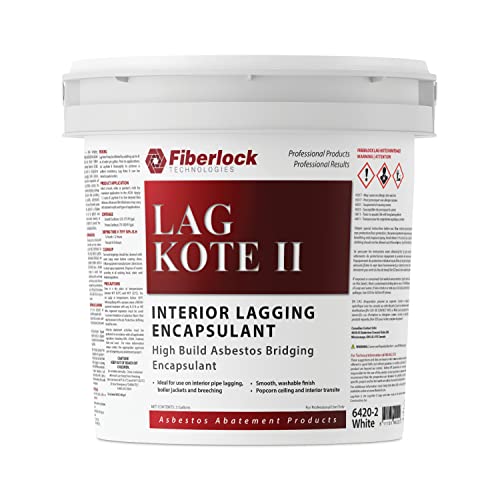
| Fiberlock Lag-Kote IIBest for Pipe Lagging | Pipe lagging, boiler jackets, HVAC surfaces | 2 gallons | Brush, roller or painter’s mitt | — | Amazon |
| Dumond Lead Seal ‘n Stop | Painted walls, brick, plaster and metal | 1 gallon | Brush or airless sprayer; two coats may be needed | — | Amazon |
| Sentinel 812LS Lockdown (White) | Post-removal lock-down on big jobs | 5 gallons (640 fl oz) | Brush, roller or spray | — | Amazon |
| Sentinel 811LS Lockdown (Clear) | Keeping the floor’s original look | 5 gallons (640 fl oz) | Brush, roller or spray | — | Amazon |
| Perfect Primer Asbestos Sealer | Sealing old mastic before new flooring | 1 gallon | Two coats, up to 200 sq. ft. total | 36 hours dry / 72 hours full cure | Amazon |
| Fiberlock ABC Asbestos Binding Compound | Dilutable abatement and soil control | 5 gallons | Professional-grade airless spray | — | Amazon |
Detailed Reviews
1. Fiberlock Lead Barrier Compound III, 5 Gallons, White
Our pick — 4.0+★ from 100+ verified ratings; the strongest balance of quality and price.
Five gallons of high-gloss barrier that brushes on like paint and dries to a walkable film overnight.
Here is the pick for anyone sealing a whole room’s worth of painted surface in one go. The can holds 5 gallons, so you are not running back to the store halfway through a basement. Apply it with a brush, a roller, or airless spray equipment, and it goes onto a dry surface like ordinary paint.
The number that decides whether this product works is film thickness. You need a minimum of 7 dry mils — the thickness of the coating once the water has left it — and that means laying down 14 wet mils at application. In plain terms, you apply it twice as thick as it will finish. Laid down at that thickness, the film forms a barrier over lead-based paint indoors or outdoors, in white or antique finishes.
What wins people over is the quality of the finished film, and the ease of application runs a close second — it rolls out smooth and covers well. Expect a thick, high-solids liquid that some find heavy going and others find thinner than they wanted. The glossy white finish is a plus if you plan to paint over it, less so if you wanted the original colour back.
What earns its place at the top
- A 5-gallon pail covers a genuine room-sized job in one container.
- Meets the ASTM E-1795 standard for lead-based paint encapsulants, and is UL Classified and Grade A fire proof.
- 12-hour dry and 12-hour full cure means you can topcoat the next day.
- Works indoors and outdoors, so a porch or garage gets the same protection as a hallway.
Where it asks more of you
- The 14 wet mils / 7 dry mils minimum rewards a wet-film gauge — eyeballing it risks a thin, ineffective coat.
- High-gloss white changes the look of whatever it covers, which rules it out where you want the original finish to show.
Take this one if: you are sealing a full room of painted walls, trim, or floor edges and want a single can that finishes the job with a fire-rated, standard-meeting film.
Think twice if: the surface you are sealing needs to keep its original colour and texture — the gloss white will not hide.
2. Fiberlock Lag-Kote II 2 Gallons
The thick-bodied formula that stays put on a ceiling pipe instead of dripping onto your head.
Not every asbestos surface is a floor. If you are dealing with friable material — the crumbling, easily disturbed kind — wrapped around heating pipes, a boiler jacket, or breeching, this is the shape of product you want. The 2-gallon container holds a polymer-based liquid that clings to galvanized metal, wood, and masonry, and it cures to a flexible film rather than a brittle shell. That flexibility matters on hot pipes and boiler jackets, which expand and contract as they heat and cool.
Where it earns its keep is control at the point of application. The thick body keeps the material from running and dripping, which cuts cleanup and stops you wasting product on the drop cloth. Apply it with a brush, a roller, or a painter’s mitt — the mitt is the trick for wrapping a pipe neatly without a sprayer.
Sealing performance is the headline: the two things buyers talk about here are quality and how well it seals, and they come up in equal measure. On old asbestos flooring as well as pipe work, the film holds.
The honest catch: this is an interior lagging product, and the surface needs to be clean and any damage repaired before you start. It is also the smallest container in the Fiberlock lineup here at 2 gallons, so a large floor area is not its job.
Right pick for: pipes, boiler jackets, and ductwork where a flexible coating has to bridge heat movement without cracking.
Wrong tool for: a wide open floor that needs gallons of coverage — you will run out fast at 2 gallons.
3. Dumond Lead Seal ‘n Stop Lead Encapsulant Coating, 1 Gallon

One gallon of water-based coating that grips wood, brick, steel, stucco and plaster, then primes for paint.
The reason to reach for this one is surface count. The water-based formula is listed for wood, brick, metal, steel, fiberglass, stucco, and plaster — a longer list than any other pick here. In a room with a brick chimney breast, a plaster wall, and a steel radiator pipe, one can covers all three surfaces.
It builds a durable elastomeric barrier, meaning the cured film stretches rather than cracks as the surface moves underneath it. Apply with a brush, and plan on two coats where the surface is thirsty. An airless sprayer speeds up larger areas. It dries white and behaves like a primer, so paint goes straight over the top.
What it does well: functionality is the thing that lands with people — it works, and it works on a wide spread of materials without a separate primer step.
The trade-off to weigh: the finish texture splits opinion, and some find the results great while others are not convinced. If your surface takes high friction or high heat, this is not the product for it — the maker says so directly.
Worth grabbing when: your surfaces are mixed and painted, and you want one water-based can that seals and primes before a repaint.
Keep looking if: the area sees foot traffic or hot pipes — this formula is not rated for friction or heat.
4. Sentinel 812LS Lockdown Sealant 5 Gallons
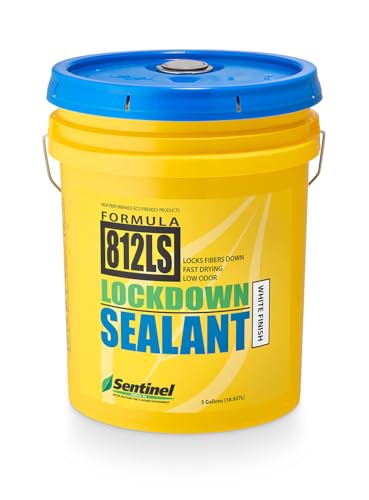
A 49-pound pail of acrylic lockdown designed for the messy stage after the material comes out.
Post-removal is its own job. Once the floor tile or sheet vinyl is up, a residue of fibers and dust sits on the concrete, and this acrylic sealant is built to lock that down. The water-based, low-odor formula means you can use it inside an occupied building without fumigating the place, which is not true of every product on this list.
Weight tells you what you are buying: 49 pounds in a 5-gallon pail, against 11.2 pounds for the Lead Barrier Compound III above. That is a 4.4x gap — this is the pro-sized bucket that two people carry, not one. The trade is a real barrier over a large slab for that lifting effort.
Adhesion is listed for concrete, wood, and metal, and you can brush, roll, or spray it, so the same pail handles a floor and the steel supports around it. The white colour makes coverage easy to check — missed patches stand out on a second pass.
Where it fits: a garage slab or basement floor that has just been stripped and needs dust locked down before anything new goes on top.
Worth knowing: a 5-gallon, 49-pound pail is a two-person lift, and a floor is the only place it makes sense — for pipes and jackets, the 2-gallon Lag-Kote II above is the better fit.
Pick it for: the dust-control stage of a removal job, where you need a low-odor lockdown you can brush, roll, or spray across a full slab.
Pass it over for: small patch work — you will be storing a heavy half-full pail for years.
5. Sentinel 811LS Lockdown Sealant 5 Gallon Pail
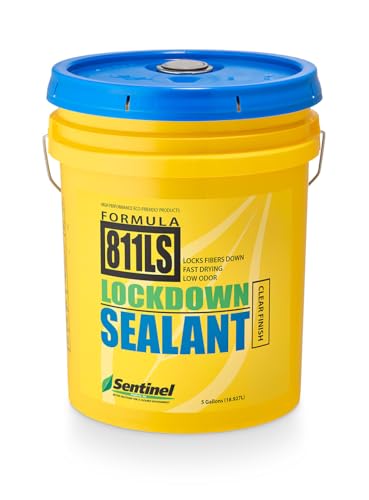
The same 5-gallon lockdown as the white pail, but the floor underneath still shows through.
Sometimes the whole point is to keep what is there. This is the clear version of the Sentinel 811LS lockdown, and it does the same job — sealing and locking down asbestos and lead dust after removal — without turning a concrete slab or an old floor into a white-painted surface. The unit count is 640 fluid ounces, the same 5-gallon size as its white sibling.
The acrylic film is listed as water resistant and bonds to concrete, wood, and metal. It is water-based and low odor, so an occupied building can stay occupied. Brush, roller, or spray all work.
Compare it with the white 812LS above and the choice depends on one question: do you need to see coverage, or do you need to keep the look? On a bare grey slab you will want the white. On a floor you plan to leave exposed, or on a surface where a coloured film would be obvious, the clear film earns its slightly higher price.
Choose clear when: the floor is visible and you want the lockdown to disappear once it dries.
One limitation: a clear film is hard to inspect for missed spots, so work in good light and overlap your passes.
Best match for: a visible or decorative floor where a white coating would ruin the finish you are trying to preserve.
Reconsider if: you are sealing a large bare slab in poor light — the white version shows gaps, this one does not.
6. Perfect Primer Asbestos Sealer, Medium Grey, 1 Gallon
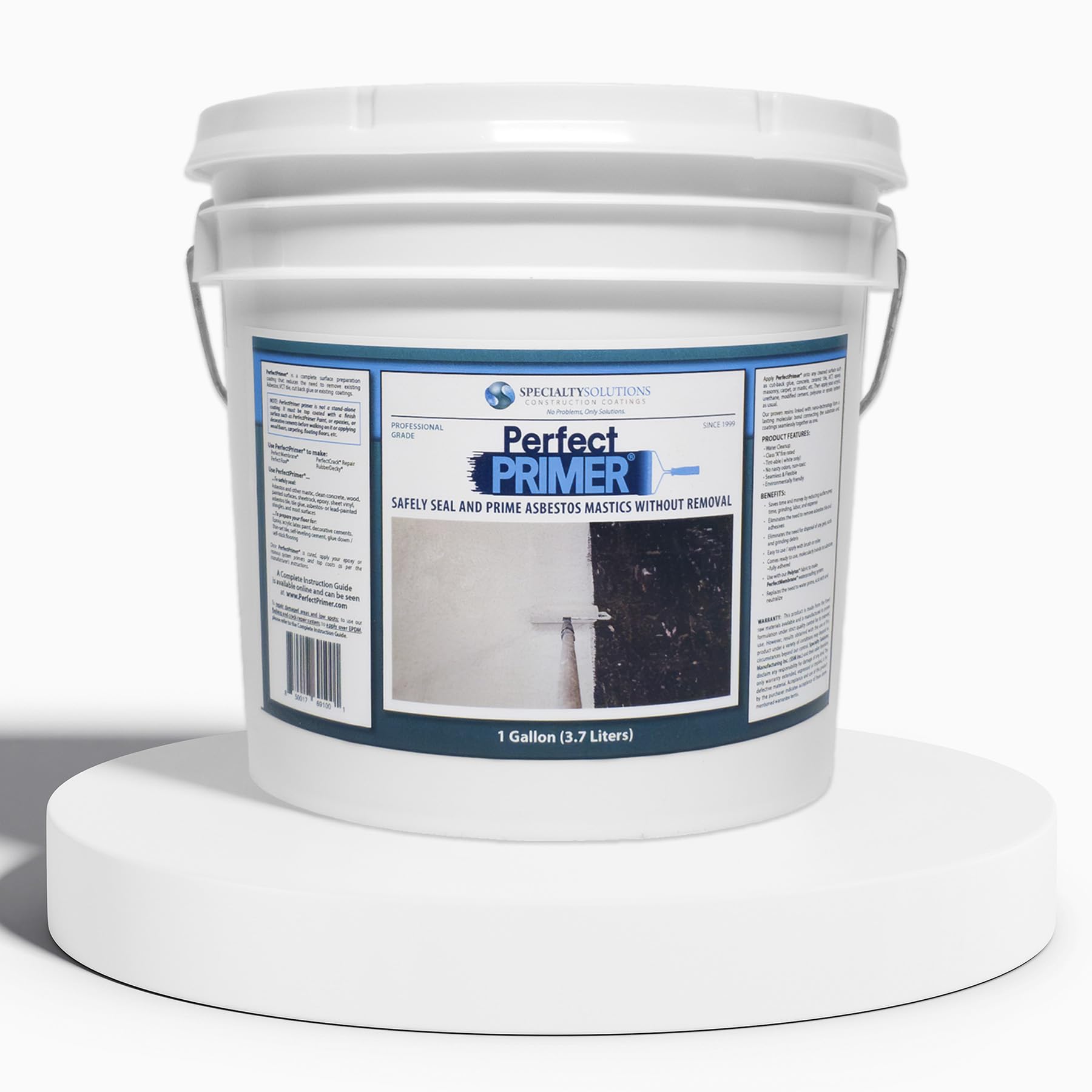
Seals the old black mastic in place and primes it for whatever flooring you lay on top.
This is the pick for the most common floor problem in old homes: black cutback adhesive stuck to a slab, with asbestos tile residue under it. The usual answer is a messy removal process. This product skips that. It is an encapsulant and a primer in one — it seals the mastic, then leaves a surface that bonds with epoxy, tile, self-leveling cement, latex paint, glue-down wood, or sheet vinyl.
The numbers to plan around are coverage and cure. One gallon covers up to 200 sq. ft. with both coats included, so measure your floor before you order. Dry time between coats is 12 hours, and full cure before you install the new finish is 72 hours. Miss the cure window and your new flooring will not bond.
It also handles more than floors. Walls and ceilings take it too, and it seals stains and odors from old materials as well as bonding surfaces. The medium grey matte finish is unobtrusive as a base coat. It is water-based and listed as EPA compliant.
Why it leads on prep
- Skips mastic removal entirely — encapsulate and prime in one step, then floor over it.
- Up to 200 sq. ft. per gallon, both coats included, so the can goes further than you might expect.
- Bonds to concrete, wood, tile, vinyl, and epoxy floors, plus walls and ceilings.
- Effectiveness and coverage are the two things buyers mention most, and both land positively.
The practical limits
- Three full days of cure before any new flooring — this is not a weekend project.
- The 1-gallon can only does one room’s worth of floor; larger jobs need more than one container.
The one to buy if: you have old cutback glue or tile residue and want to seal it and prep for new flooring without scraping.
Look elsewhere if: you need to walk on the floor within a day or two — the 72-hour cure will not allow it.
7. Fiberlock ABC Asbestos Binding Compound 5 Gallons
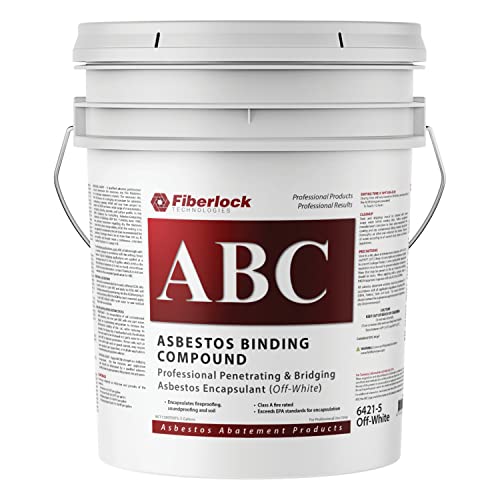
A high-solids 5-gallon compound you thin with water to suit the job in front of you.
This is the most flexible of the Fiberlock line in how it is used. The high-solids, non-flammable formula can be diluted with water to cover three different jobs — lockdown and removal, penetrating encapsulation, and bridging encapsulation. That range is why it turns up on abatement jobs where one product has to do several tasks.
It meets EPA standards for encapsulating and removing asbestos-containing materials, and it can also help control exposure to asbestos fibers found in soil. Apply it with professional-grade airless spray equipment onto a cleaned, defect-free surface. The 5-gallon container suits a large job; the compound itself weighs 9.6 pounds, so the weight is in the liquid, not the packaging.
Quality is the thing people come back to, and drying time is close behind — it firms up in a few hours rather than overnight. The catch is equipment. This is a spray-applied product, so if you do not own or rent a professional airless sprayer, the brush-and-roller picks above are the practical route.
Where it wins: one 5-gallon pail, diluted to the job, handles lockdown, penetrating encapsulation, and bridging encapsulation — unusual versatility for a single can.
The setup cost: professional-grade airless spray equipment is required, which puts this out of reach for a one-room DIY patch job.
Built for: larger abatement work where a sprayer is already on site and the formula needs to be thinned for different surfaces.
Not the one for: a single-room brush-and-roller job — the spray requirement is the whole obstacle.
Know the Specs
Dry mils and wet mils
These describe how thick the coating is when wet versus after it dries. Dry mils are the finished film; wet mils are what you lay down. Products are specified at a minimum dry film — the Lead Barrier Compound III asks for 7 dry mils, which means applying 14 wet mils. The water leaves, the film shrinks, and the fibers stay sealed under a coat thick enough to hold. A wet-film gauge takes the guesswork out of it.
Dry time versus full cure
Dry time is when the surface stops feeling wet. Full cure is when the film has hardened enough to take a topcoat or new flooring. A product can dry in 12 hours and still need far longer to fully cure — the Perfect Primer, for example, wants 72 hours before you lay anything over it. Read both numbers before you schedule the flooring delivery.
Coverage per gallon
Coverage is quoted in square feet per gallon, and it almost always assumes two coats. The Perfect Primer covers up to 200 sq. ft. per gallon with both coats included. Measure the floor, divide by the coverage figure, and round up — running short mid-job means a visible seam of uncovered surface.
Lockdown versus encapsulation
A lockdown product soaks in and binds loose fibers to the surface, which is what you want after a removal. An encapsulation coating builds a thicker film over the top, sealing the material underneath. Some products do both: the ABC Binding Compound is diluted differently for lockdown, penetrating encapsulation, and bridging encapsulation. Match the method to the state of your surface.
Common Questions
Can I seal over old asbestos floor tile instead of removing it?
How do I know if my black floor adhesive contains asbestos?
What does 7 dry mils actually mean for my application?
How long before I can put new flooring over a sealer?
Do I need a professional sprayer to apply an asbestos sealer?
Is a clear sealer or a white sealer better on a concrete floor?
How much sealer does a typical basement floor need?
Can an asbestos sealer be used on pipes and walls or only floors?
Does an asbestos floor sealer have to be fire rated?
Can I dilute an asbestos binding compound to stretch it further?
The Bottom Line
For most people sealing a painted room or a floor edge, the Fiberlock Lead Barrier Compound III is the answer — 5 gallons, a 12-hour cure, and the ASTM E-1795 standard behind it. If the surface is old mastic or tile residue you plan to floor over, the Perfect Primer does the seal-and-prime in one pass with up to 200 sq. ft. of coverage per gallon. And when a ceiling pipe or boiler jacket needs a flexible wrap instead of a flat film, the Lag-Kote II is the one to reach for. An old asbestos floor is a sealing job, not a demolition one — measure the area, buy the right can, and work through the coats over a weekend.
How we choose
We do not accept paid placement. Every pick is matched to a real buyer and a real use-case; we do not hands-on test units.
Sources
Specifications: manufacturer listings and product documentation. Review insights: verified customer reviews, as of November 2026. Pricing: not shown on this page (it changes often); check the current price via the retailer link.
As an Amazon Associate, My Heart Lives Here earns from qualifying purchases. This does not affect which products we feature.