Heads up: This post contains affiliate links. As an Amazon Associate I earn from qualifying purchases, at no extra cost to you. Learn more
Specs are compiled from manufacturer listings and verified buyer reviews and can change over time — please confirm the key details on the product page before buying.
You want to know how much charge a battery actually holds — not how much the label promises. That is the whole job of an amp hour battery tester: it measures the real current flowing in and out, then turns that into a number you can trust before a battery strands you. The three meters below all count amps and hours, but each answers a different question: cranking diagnosis, continuous bank monitoring, or inline bench analysis.
This guide is built by comparing the manufacturers’ published specifications and the patterns across verified customer reviews, so you get each pick’s real strengths and trade-offs instead of marketing spin.
Below you will find how each meter counts amps and hours, where the readings can drift, and which one matches the way you actually check batteries. Here are the three strongest amp hour battery testers for three different jobs.
Top Picks
How To Choose The Best Amp Hour Battery Tester
The first thing to settle is what you are actually measuring. An amp hour battery tester counts the current that flows out of a battery over time and reports it as Ah — the real capacity it delivered. A cranking tester instead watches how far voltage sags during a hard start. Some meters do both, and some do only one.
Match the current range to your battery, not your ambitions
A 200A meter covers a car starter and most power-tool packs. A meter that reaches 30-3800 CCA (cold cranking amps — the burst of current a battery can deliver at cold temperatures) is built for diagnosing why an engine will not turn over. Extra range costs little; too little range means the meter maxes out mid-test, exactly when a fault shows up.
Resolution tells you what the last digit is worth
Resolution is the smallest step a meter can display. A 0.001Ah resolution lets you watch capacity tick down in fine increments on a small pack. A 0.1W resolution is fine for a solar panel but coarse for a receiver drawing a fraction of an amp. Check the resolution on the reading you will watch most — 0.001Ah for small packs, 0.01A for idle draw.
Inline meters versus panel meters
An inline meter with power connectors sits between the battery and the load for a single test, then comes back off. A panel meter mounts permanently and monitors a battery bank continuously. If you want to log a battery’s decline over months, the permanent mount wins. If you want a quick capacity check on a bench, the inline unit is faster to hook up.
Chemistry awareness is not a marketing line
Flooded, AGM, EFB, gel and lithium batteries all behave differently under load. A meter with chemistry-specific logic reads an AGM start-stop battery more fairly than one that applies a single curve to everything. On a mixed-chemistry fleet, that setting separates a useful answer from a false “replace it” verdict.
Side-by-Side Comparison
| Model | Best For | Voltage Range | Current / Capacity Range | Weight | Amazon |
|---|---|---|---|---|---|
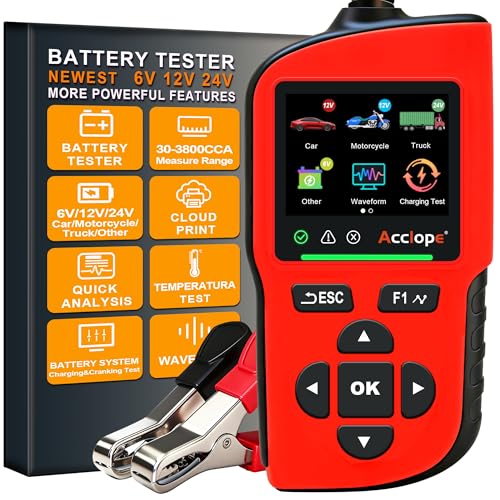
| BT90 PRO QR Report Battery Tester★ Best Overall | Shops and fleets needing printable proof | 6V / 12V / 24V | 2-360Ah; 30-3800 CCA | 0.33 kg | Amazon |
| ANKG 200A Power Analyzer | Bench testing RC packs and chargers | 0-60V | 0-200A; 0-65Ah | — | Amazon |
| DROK Battery Monitor WLS-PVA200 | Permanent monitoring of a battery bank | 0-300V | 0-200A; remaining Ah and percentage | 0.13 kg | Amazon |
Detailed Reviews
1. BT90 PRO QR Report Battery Tester
Our pick — 4.0+★ from 400+ verified ratings; the strongest balance of quality and price.
The tester that hands your customer a printed report instead of a shrug.
This is the pick for anyone whose battery diagnosis ends with someone else asking “can you prove it?” It reads across 2-360Ah of capacity, 30-3800 CCA of cranking power, and 6V/12V/24V systems, so one unit covers a motorcycle battery and a heavy-truck dual pack without a second purchase. The headline trick is the QR code: scan it and the test becomes a cloud report with state of health (SOH — how much capacity the battery has lost), state of charge (SOC — how full it is right now), voltage, resistance, plus cranking and charging results, stamped with time, temperature and a plate or order ID.
What wins people over is how little friction there is between hooking up and getting an answer. The four-metric view is the real reason it earns its place — voltage alone tells you almost nothing, but SOH alongside internal resistance (IR — a rough read on sulfation and aging) tells you whether to charge, load-test, or replace. A dedicated start/charge loop adds cranking voltage drop and alternator output at idle and under load, which is how you separate a tired battery from a failing alternator or a bad ground. Chemistry settings for flooded, AGM, EFB, gel and lithium keep an AGM start-stop battery from being called bad by a lead-acid curve. The kicker is the ambient temperature feed folded into the algorithms — cold mornings under-read and hot afternoons over-read, and this corrects for both.
Here is the honest trade-off. Accuracy is the split verdict in the feedback, and that is worth taking seriously: this is a diagnostic aid, not a calibrated laboratory instrument, so confirm a borderline “replace” call with a load test before you quote a customer. The QR cloud workflow also assumes you want cloud reports — if you just want a number on a screen, you are paying for paperwork you will not use. And at 0.33 kg it is a chunky handheld, noticeably heavier than the DROK panel meter at 0.13 kg, though that is the price of a rugged housing and large keys that survive an oily bay.
What earns the top slot
- One scan turns a test into a shareable, time-stamped cloud report — proof a customer or fleet manager can keep
- Reads 2-360Ah and 30-3800 CCA across 6V, 12V and 24V, covering cars, motorcycles, trucks, RVs and marine
- Four-metric diagnosis (SOH, SOC, voltage, resistance) plus cranking and charging results in a single pass
- Chemistry-aware settings for flooded, AGM, EFB, gel and lithium stop false “bad battery” calls
Where it asks something of you
- Accuracy draws a split reaction — treat borderline results as a prompt for a second test, not a final verdict
- The cloud report workflow is the point of the tool; skip it and you are carrying weight for nothing
Reach for this if: you run a service lane, a roadside callout, or a mixed fleet and need objective evidence attached to every battery you touch.
Look elsewhere if: you want a bare number on a bench and have no use for printable reports.
2. ANKG 200A Power Analyzer
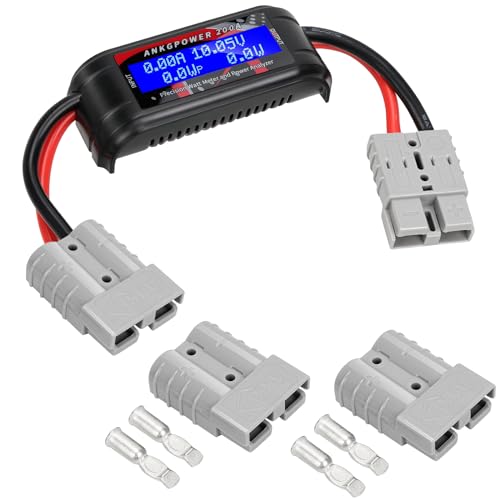
Eight readings in a pocket-sized inline meter, wired and ready before you open the box.
For RC hobbyists and anyone verifying a charger, this is the least fussy way to see what is actually happening on the wire. It measures 0-200A of current and 0-60V, and splits that into eight separate readings: current, voltage, watts, amp-hours, watt-hours, peak amps, minimum volts and peak watts. Resolution is the part that matters — 0.01A on current, 0.01V on voltage, 0.1W on power, and 0.001Ah on charge, fine enough to watch a small pack fill up incrementally instead of jumping in chunks.
Two sets of 50A power connectors come already attached on both ends, with the internal metal contacts in place. Nothing to solder, nothing to assemble — it goes inline between battery and charger or battery and load, and starts reading in real time. That inline position is genuinely useful for catching the things a spec sheet hides: an ESC or motor pulling more than you expected, a receiver drawing enough to need a UBEC, a charger that tapers off early. It also logs minimum volts under load, which is the number that tells you whether a pack is sagging before cutoff.
The catch is durability and noise, and both show up in the feedback. Functionality draws mixed reports — plenty of units work great, but some stop working after a short period, so treat this as a bench instrument rather than something you leave wired into a vehicle permanently. There is also a high-pitched whine while it operates that owners find annoying, which matters if you test in a quiet room. Buy it on value and keep your expectations sized to an inline analyzer, and it earns its place in a flight box.
What it is genuinely good at: packing peak amps, minimum volts, Ah and Wh into one small inline body with 0.001Ah resolution, all pre-wired with 50A connectors and no assembly required.
Buy it for: the RC bench, the charger check, the “is this pack sagging?” question you answer in thirty seconds.
Pass if: you need a meter that lives permanently in a vehicle — the whine and the short-lifespan reports make it a poor fit for that job.
3. DROK Battery Monitor
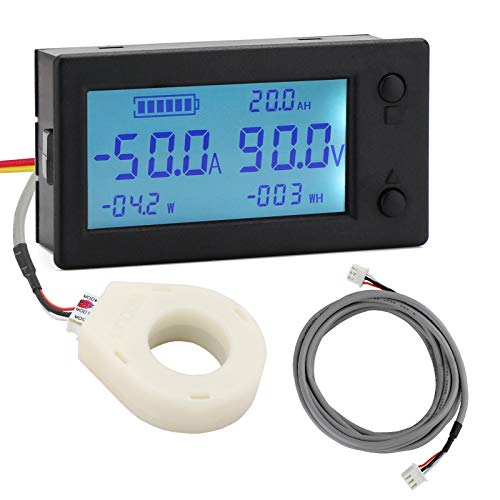
A panel meter that watches a battery bank around the clock and tells you what is left.
If your question is “how much capacity remains in this bank right now,” this is the tool built for it. It reports the percentage and the Ah of remaining battery capacity, plus bidirectional DC current, DC voltage, DC power and accumulated energy — and it does it while mounted, not while held. The voltage window runs 0-300V and current 0-200A, which covers lead-acid, lithium polymer and lithium iron phosphate banks alike.
The Hall sensor is the safety story. It measures current through magnetic isolation rather than sitting in the conductor’s path, so the reading stays reliable without you tapping into a live line. Wiring is flexible: two wires for testing 5-90V, three wires for monitoring 0-300V, and the included 2.5m shielded cable gives you room to route it cleanly from the shunt to the display. It also stores your data through a power-down, so a bank going flat overnight does not erase the history you were counting on.
Two details decide whether it suits you. The alarm flashes when voltage or current strays outside preset limits, or when remaining capacity runs low — genuinely useful on an unattended bank, mildly irritating if you are testing on a bench and trigger it constantly. At 0.13 kg it is the lightest meter here, less than half the BT90 PRO’s 0.33 kg, and that is exactly right for a display you mount and forget rather than carry. The thing it does not do is crank-test: there is no CCA figure and no printable report, so a workshop chasing a no-start fault still wants the BT90 PRO.
The everyday win: a permanent, backlit readout of remaining Ah and percentage on a battery bank, with a Hall sensor keeping the measurement isolated and an alarm that speaks up before the bank goes flat.
The right call for: solar banks, boat house batteries, RV auxiliaries and any setup where you want to glance at capacity without clipping on a handheld tester.
Think twice if: you need cranking amps or documented test results — this meter monitors, it does not diagnose a starter fault.
Know the Specs
Amp hours and CCA are not the same measurement
Amp hours (Ah) count how much current a battery delivers over time — the capacity figure that tells you how long a bank will run a load. Cold cranking amps (CCA) measure the short, hard burst needed to turn an engine in the cold. A tester with a 2-360Ah capacity window and a 30-3800 CCA cranking window answers both questions. One that only reports Ah is monitoring, not diagnosing a no-start.
Why a Hall sensor matters on a 200A line
A Hall sensor reads current by detecting the magnetic field around a conductor instead of sitting inline with the current path. On a meter rated to 0-200A, that isolation is what makes a permanent install sensible: the measurement stays reliable and you are not running heavy current through the display itself. It also allows two-wire or three-wire hookup depending on the voltage you are monitoring.
Resolution versus range
Range is the biggest number a meter can show; resolution is the smallest step it can distinguish. A 0-200A meter with 0.01A resolution can display a fraction of an amp, which is what lets you see a receiver’s idle draw. A 0-65Ah window with 0.001Ah resolution is fine enough to track a small pack charging cell by cell. Pick the resolution on the reading you will actually watch.
SOH, SOC, voltage and resistance together
State of health (SOH) estimates how much capacity a battery has lost to age. State of charge (SOC) says how full it is right now. Voltage shows terminal condition, and internal resistance hints at sulfation. Any one of these alone can mislead you — a fully charged battery with poor SOH still fails a load test. Reading all four together is what turns a number into a decision.
Common Questions
What is the difference between an amp hour battery tester and a load tester?
Can a 200A meter handle a 24V truck battery?
How accurate are these meters for checking remaining battery capacity?
Will a Hall sensor meter work on a lithium iron phosphate bank?
Does the DROK meter lose its stored data when the battery goes flat?
What does the QR code on the BT90 PRO actually give me?
How much current can the ANKG analyzer measure at once?
Which meter should I mount permanently in an RV or boat?
Do I need to set alarm limits on a battery capacity monitor?
What resolution do I need to watch a small battery charge?
The Bottom Line
For most people who need real proof of a battery’s condition, the BT90 PRO is the one to buy — it is the only pick here that combines a 2-360Ah capacity window, 30-3800 CCA cranking range, chemistry-aware logic and a shareable QR report in a single tool. If you want a permanent readout of remaining capacity on a bank you monitor daily, the DROK WLS-PVA200 mounts and stays there, with a Hall sensor and a backlit STN display. And for bench work on RC packs and chargers, the ANKG 200A Power Analyzer hands you eight readings and pre-wired connectors with nothing to assemble.
Choose by the question you ask most: cranking and diagnosis (BT90 PRO), continuous monitoring (DROK), or inline bench analysis (ANKG).
How we choose
We do not accept paid placement. Every pick is matched to a real buyer and a real use-case; we do not hands-on test units.
Sources
Specifications: manufacturer listings and product documentation. Review insights: verified customer reviews, as of November 2026. Pricing: not shown on this page (it changes often); check the current price via the retailer link.
As an Amazon Associate, My Heart Lives Here earns from qualifying purchases. This does not affect which products we feature.