Heads up: This post contains affiliate links. As an Amazon Associate I earn from qualifying purchases, at no extra cost to you. Learn more
Specs are compiled from manufacturer listings and verified buyer reviews and can change over time — please confirm the key details on the product page before buying.
If you are cutting threaded rod, the thing that actually matters is whether the threads survive the cut — a clean, burr-free cut lets a nut spin on by hand, while a ragged one means you are chasing the threads with a die before anything will fit. This guide sorts the seven tools buyers actually reach for, from compact hand cutters to a cordless rod cutter built specifically for the job, so you can pick the one that matches the work in front of you.
This guide is built by comparing the manufacturers’ published specifications and the patterns across verified customer reviews, so you get each pick’s real strengths and trade-offs instead of marketing spin.
Some of these tools cut threaded rod directly, while others are bolt cutters and thread restorers that handle the same jobs around it. The picks below are ordered so the highest-rated tool comes first, and each entry tells you exactly which jobs it belongs on — the practical way to land on the right all-thread cutter for your bench or truck.
Top Picks

How To Choose An All-Thread Cutter
Threaded rod punishes the wrong tool. Cut it with a toothed blade or a dull jaw and the end mushrooms, the threads flatten, and the nut you planned to run on there will not start. So the first decision is not “which brand” — it is which type of tool the job actually calls for.
Match the tool type to the job
A dedicated rod cutter is built to shear threaded rod cleanly, which is why the DEWALT cordless unit lists specific rod sizes it handles. A bolt cutter is the general-purpose choice that will get through rod, chain, and padlocks, and its capacity is usually listed by metal hardness rather than by one number. A thread restorer does not cut at all — it cleans up and re-forms damaged threads, which is the fix when a rod end has already been mangled.
Read cutting capacity by metal hardness
Look for capacity stated in two or three tiers, because harder metal needs a smaller bite. The RIDGID S24, for example, is rated at 7/16″ for soft metals, 3/8″ for medium metals, and 5/16″ for hard metals. The WORKPRO lists its capacity as 3/8-inch (11mm maximum) at HRC≤19 and 5/16-inch (8mm maximum) at HRC<48 — HRC being a hardness scale for steel, with higher numbers meaning tougher metal.
Weigh leverage against weight
Longer handles and compound leverage multiply your squeeze, which is how a 24-inch cutter gets through material a short one cannot. The trade-off is heft and reach: the Crescent PowerPivot measures 27.25 x 6.75 x 1.75 inches and weighs 7.44 pounds, which buys serious cutting power but is a two-hand tool you will feel at the end of a long fence line.
Side-by-Side Comparison
| Model | Best For | Overall Length | Item Weight | Power Source | Amazon |
|---|---|---|---|---|---|
| KNIPEX CoBolt Compact Bolt Cutter (7102200)★ Best Overall | One-hand bench and wire work | 8.25 in | 13.12 ounces | Manual | Amazon |
| DEWALT DCS350B 20V MAX Cordless Threaded Rod CutterCleanest Cuts | Clean cuts on rod, all day | 13 in (item dimensions) | 9 pounds | 20V Lithium-Ion (tool only) | Amazon |
| Crescent H.K. Porter 24″ PowerPivot 0190MCP | Heavy fence and chain tear-down | 27.25 in | 7.44 pounds | Manual | Amazon |
| WORKPRO 24 Inch Bolt Cutter | Budget padlock and chain cutting | 24 in | — | Manual | Amazon |
| Lang Tools 2584 15-Piece Metric Thread Restorer Set | Repairing threads, not cutting | 7.2 x 0.7 x 10 in | 1.06 pounds | Manual | Amazon |
| RYOBI 18V ONE+ Bolt Cutter (P592) | Cordless cutting without hand fatigue | 18.5 in (height) | 6 pounds | 18V Lithium-Ion (bare tool) | Amazon |
| RIDGID 14223 Model S24 Bolt Cutter | Mixed soft, medium, and hard metal | 24 in blade | 2.7 kg | Manual | Amazon |
Detailed Reviews
1. KNIPEX Tools CoBolt Compact Bolt Cutter
Our pick — 4.5+★ from 550+ verified ratings; the strongest balance of quality and price.
At 13.12 ounces, this compact cutter slices fencing wire and tig wire with a light one-handed squeeze.
Pocket-sized at 8.25 inches long and 13.12 ounces, this is the cutter you can actually keep in a tool pouch and use one-handed — the job where you are up a ladder trimming tig wire or cutting tie wire and a two-hand 24-inch cutter would be a nuisance. The cutting width is 0.4 centimeters, so it is a compact bite rather than a demolition tool.
Buyers praise its cutting performance above all — fencing wire and tig wire slice through with almost no effort, and value, ease of use, and sharpness draw steady praise alongside it. It is also the pick where the leverage question gets answered by design: the multi-component grip is built to be comfortable in repeated squeeze work, which is why it earns its place as the first tool out of the bag for trim jobs.
The honest catch is durability of the cutting edge, which gets the most divided feedback of anything about this tool — some buyers report a long service life, others report the edge chipping. It also will not touch rod sizes the larger cutters handle, and the 0.4 cm cutting width is a hard ceiling. Worth knowing before you buy: this is a precision hand tool, not a heavy-duty demo cutter, and expecting it to chew 1/2-inch rod all week is asking the wrong thing of it.
Why it earns the top slot
- Cuts fencing wire and tig wire with minimal effort, which is the most-praised quality of the tool
- 8.25-inch length and 13.12-ounce weight keep it pouch-sized and usable one-handed
- Ergonomic multi-component grip is built for repeat squeeze work
- Compact design suits trim jobs a 24-inch cutter cannot reach
Where it runs out of room
- Cutting edge durability draws divided feedback, with some reporting chipping
- 0.4 cm cutting width is a hard limit on material size
- Not the tool for heavy demo work on thick rod
Make this your everyday carry: electricians, fencers, and anyone trimming wire who wants a compact cutter that does the work with a light squeeze.
Think twice: if your week is thick rod and padlocks, the bigger leverage tools below are the fit — and edge durability is the one thing to keep an eye on.
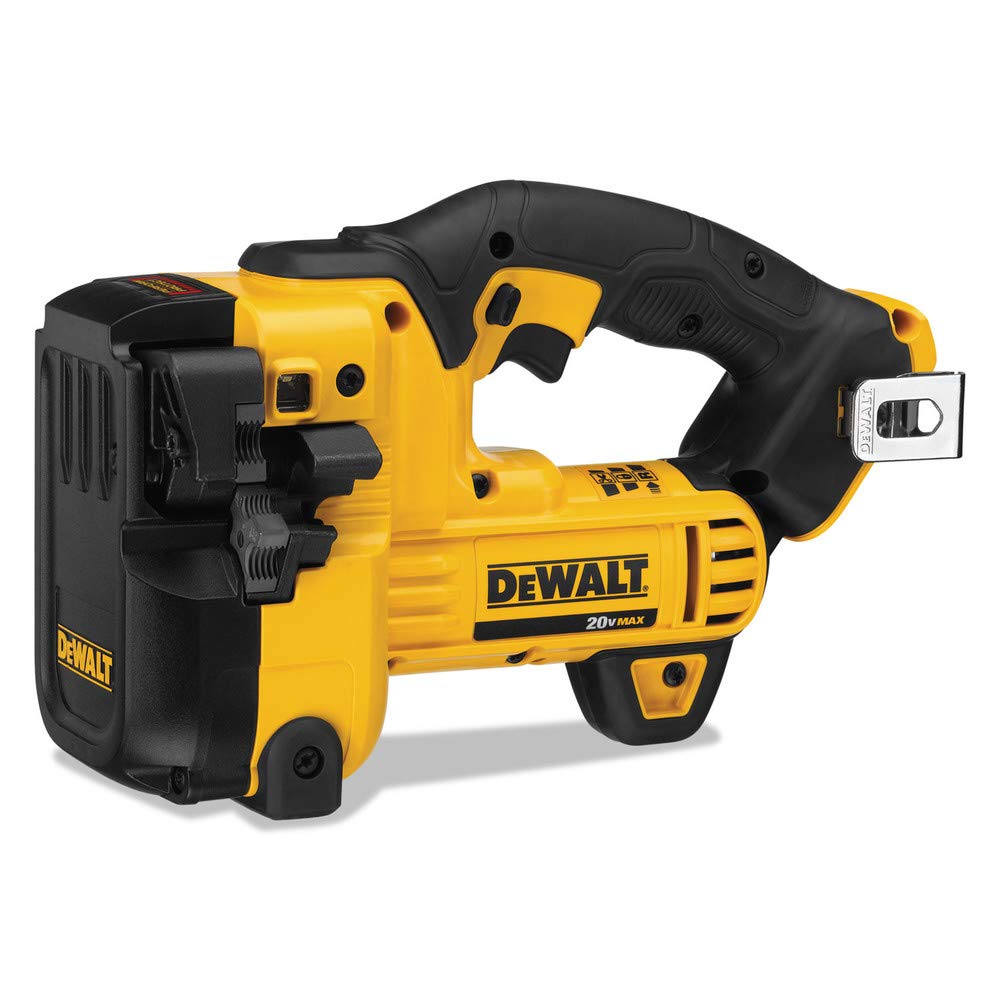
2. DEWALT DCS350B 20V MAX Cordless Threaded Rod Cutter
The only pick here rated to cut 1/4″, 3/8″, and 1/2″ mild steel threaded rod with burr-free ends.
This is the only pick whose job description is the job itself. It is rated to cut 1/4″, 3/8″, and 1/2″ mild steel course threaded rod, plus 1/4″ and 3/8″ stainless steel course threaded rod. The cuts are described as clean and burr-free, which is the whole point — a burr-free end means the nut threads on without a chase.
The rotating cutter lets you move through those rod sizes with a single cutter, and the four-sided cutter head is included along with a cutter wrench and hang hook. There is a bright LED work light for the cutting area, which matters when you are working inside a wall cavity or under a deck. Reliable performance is the most-praised trait, followed by cutting performance and time saved — buyers consistently describe the cuts as clean and the threads as undamaged.
Two things to price into your decision. It is a bare tool, so you need a 20V MAX battery and charger already in your kit. And at 9 pounds it is the heaviest pick on this list by a wide margin — the Lang Tools thread set weighs 1.06 pounds, so plan on a holster or a bench rather than a pocket. Capacity also stops at 1/2″ mild steel, so it is a rod cutter, not a fence-cable cutter.
Who this is genuinely for: anyone running threaded rod regularly — pipe hangers, strut work, mechanical rooms — where a clean end saves a rethreading step on every single cut.
The bar to clear: you need the battery platform already, and you need to accept 9 pounds of tool in exchange for the only purpose-built rod cutter here.
Reach for this if: threaded rod is the material you cut most and you are already on the 20V MAX battery system.
Look elsewhere if: you want one tool that also handles padlocks and chain — the manual cutters below do both.
3. Crescent H.K. Porter 24″ PowerPivot Bolt Cutter

A 7.44-pound, two-handed cutter whose double compound action shears through rusty padlocks and chain.
Start with the size, because it drives everything else. This cutter runs 27.25 x 6.75 x 1.75 inches overall and weighs 7.44 pounds — for scale, the KNIPEX above is 8.25 inches long, so you are talking about a tool in a completely different class. That mass is the point: the PowerPivot technology and double compound cutting action turn a modest squeeze into serious force at the jaws.
What people actually praise is functionality and build quality in equal measure, backed by the cutting performance itself — it walks through 1/4″ steel wire without drama and gets called out as a strong pick for tearing out a derelict fence. The blades are induction hardened and heat treated for wear resistance over a long cutting life, and the alloy steel handle material is built to take the load.
Here is what you are trading away. It is heavy, and weight draws mixed feedback — for a full afternoon of overhead work you will feel it. Value also splits people, largely along the line of how much cutting they actually do. This is the tool for the day the fence comes down or the chain gets cut, not for trimming a dozen wire ties on a ladder.
The case for it: when nothing else will budge, 24 inches of handle plus double compound action gets the job done — and the hardened center-cut blades hold up to repeat wear.
The trade-off you accept: 7.44 pounds is a real commitment, so plan the job around the tool rather than carrying it up a ladder all day.
It beats most cutters on raw force: 27.25 inches overall and double compound action make stubborn chain and padlocks a short conversation.
The one caution: the weight is the recurring gripe — if the work is overhead or all-day, this is not the tool you want in hand.
4. WORKPRO Bolt Cutter 24 Inch

A 24-inch lever-fulcrum cutter with drop forged chrome vanadium jaws at a budget price.
The spec that does the work here is the capacity ladder: 3/8-inch (11mm maximum) at HRC≤19 and 5/16-inch (8mm maximum) at HRC<48. Translated, that means soft metal up to 3/8-inch and harder metal up to 5/16-inch, which covers padlocks, soft bolts, rods, rivets, and chain. Drop forged chrome vanadium steel jaws with a powder coat finish are built for efficient cutting and a long life.
The classic lever-fulcrum design with precisely aligned blades is where the leverage comes from, and the bi-material anti-slip grips keep it controllable when you are really leaning on it. Cutting performance and overall quality are the two things buyers call out most, with strength right behind — padlocks going in a single attempt is the story that keeps coming up, and the value read is consistently warm.
What it is not is a precision rod cutter. There is no burr-free cutting claim here, and 24 inches of handle is a lot of tool to swing in a tight space. If you are cutting threaded rod that needs to accept a nut afterward, the DEWALT or a thread restorer is the better pairing — this is the brute-force answer for locks and chain.
What it gets right
- 3/8-inch soft-metal capacity and 5/16-inch hard-metal capacity cover locks, chain, rivets, and rods
- Drop forged chrome vanadium steel jaws with a powder coat finish
- Lever-fulcrum design and aligned blades add leverage with less effort
- Anti-slip bi-material grips keep control under a hard squeeze
The limits worth knowing
- No burr-free claim, so it is not the pick for rod ends that must thread cleanly
- 24-inch length is awkward in tight spaces
- Harder metal is capped at 5/16-inch
Pick this for the padlock job: if you need one cutter for locks, chain, and soft bolts and you want to spend sensibly, this is the one.
Step up instead if: clean threaded ends matter — that is a different tool, not a different brand.
5. Lang Tools 2584 15-Piece Metric Thread Restorer Set

Seven metric dies and seven metric taps that re-form damaged threads instead of cutting new ones.
Here is the pick that belongs in the same drawer as your cutter, because the two do different halves of the same job. The set contains 7 metric rethread dies and 7 metric rethread taps, covering M6-1.00, M8-1.25, M10-1.25, M10-1.50, M12-1.25, M12-1.50, and M12-1.75. There is also a metric restorer file with 8 pitches:.75, 1.00, 1.25, 1.50, 1.75, 2.00, 2.50, and 3.00.
The whole point of a restorer versus a tap is that it cleans and re-forms existing threads rather than cutting new ones. That is why the common story here is engine blocks, cylinder heads, and other assembled parts where you cannot afford to lose material. It is also built to be easy to use on reassembly, which is where most of the practical value lands. It weighs 1.06 pounds and is made in the USA.
Set your expectations on size. This is the metric set, and it is aimed squarely at common automotive fastener sizes — if your work is imperial threaded rod, this is the wrong ladder entirely. It also does not replace a cutter; it repairs what the cutter left behind.
Where it pays off: a 15-piece kit with 7 dies, 7 taps, and a file covering 8 pitches gives you real coverage of common metric sizes on one bench.
The honest boundary: metric only, and it re-forms threads rather than cutting rod — do not buy it expecting to shorten anything.
The right buy if: you work on metric fasteners in engine blocks, heads, or assembled parts and need threads cleaned without removing metal.
Not your set if: your rod is imperial or your problem is that the rod is still too long.
6. RYOBI 18V ONE+ Bolt Cutter (P592)

A 6-pound cordless cutter that powers through 3/8-inch chain and bolts without hand fatigue, sold as a bare tool.
The reason to look at a cordless cutter is fatigue, and this one states the case plainly: the design is built to minimize hand and arm fatigue compared with a manual bolt cutter. The jaws open to accept material up to 3/8 in. in diameter, and the hot forged steel jaws and hardened steel mechanism are built for durability. At 6 pounds it is also lighter than the DEWALT rod cutter’s 9 pounds.
When it works, it works fast. Cutting performance and speed are the two things that get praised most, with chain links and a wide spread of materials — chain, locks, bolts, fencing, wire shelving — all on the list. The hot knife comparison comes up because a powered jaw does not need your shoulder behind it.
Be clear-eyed about the durability record, though, because that is where the feedback divides most sharply — some owners find it well worth the money, while others report it breaking. Clamping performance also splits, with jaws that do not close completely coming up as the specific gripe. Buy it with the battery platform already in hand — it is a bare tool, and it arrives in a generic box rather than retail packaging.
The genuine win: powered cutting at 6 pounds takes the hand and arm fatigue out of a long run of chain or bolt work.
The genuine risk: durability and jaw closure are the two areas where the record is uneven, so treat it as a tool for moderate repeat work rather than the hardest jobs on site.
Worth it if: you are already on the 18V ONE+ battery system and your hands are the limiting factor on a cutting job.
Pass if: you need proven durability on the toughest material — the hardened alloy steel jaws of the RIDGID below are the safer bet.
7. RIDGID 14223 Model S24 Bolt Cutter, 24″ Heavy-Duty

Rated 7/16″ for soft metals, 3/8″ for medium, and 5/16″ for hard metals, so you know the bite before you squeeze.
Most cutters give you one capacity number and let you find out the hard way. This one splits it three ways: 7/16″ capacity for soft metals, 3/8″ for medium metals, and 5/16″ for hard metals. That spread is the most useful spec on the page, because it tells you the tool will handle nonferrous metals, bolts, screws, rivets, wire, stainless steel, iron, spring wire, heat-treated rod, and reinforcing rod — while being honest that the hardest material takes the smallest bite.
The build is where the premium case is made. The hardened alloy steel jaws are designed to last the longest blade life possible under jobsite use, and the one-step internal cam mechanism keeps the cutting blades precisely aligned with the simplest action. The ergonomic handles with grips are shaped to give greater mechanical advantage for controlled cuts. Blade length is 24 inches, and it carries a full lifetime warranty — if the tool malfunctions from defects in workmanship or materials, it gets repaired or replaced free of charge.
Here is the honest read on the weight: 2.7 kg is a substantial tool, and unlike the KNIPEX above there is no pretending it is a one-hander. That heft is what the hardened jaws and the cam alignment are attached to, so the trade is straightforward — mass in hand, control in the cut.
Where the extra buys you something: three hardness-rated capacities, an internal cam that keeps the blades lined up, and a full lifetime warranty on the tool itself.
What you carry for it: 2.7 kg of cutter — this is a bench or truck tool, not a pouch tool.
The tool for a mixed scrap pile: soft, medium, and hard metals all have a rated capacity here, so you are not guessing which cutter to grab.
The catch is the carry: at 2.7 kg you set it down between cuts, so it suits the yard and the truck bed better than the ladder.
Know the Specs
Cutting Capacity and HRC Ratings
Capacity is usually written as a size plus a hardness figure, because a jaw that bites 3/8-inch soft steel will only manage 5/16-inch on something harder. HRC is a steel hardness scale, so a listing like HRC≤19 means softer metal and HRC<48 means harder metal. When you compare cutters, look for the capacity at each hardness tier rather than the single biggest number on the box.
Compound Leverage and Handle Length
Longer handles multiply your squeeze, and compound or double compound action multiplies it again by gearing the jaw movement. That is how a 24-inch cutter generates far more force than an 8-inch one. The cost shows up as weight and reach — a tool built for leverage is a tool you carry with two hands and set down between cuts.
Burr-Free Cutting Versus Shearing
A burr-free cut leaves the thread form intact so a nut starts by hand. Shearing through rod with a general-purpose jaw can leave a flattened, mushroomed end that needs chasing before anything threads on. If the rod has to accept a fastener right after the cut, that distinction matters more than any other spec on the page.
Manual, Cordless, and Restorer Tools
Manual cutters rely entirely on your leverage. Cordless cutters use a powered jaw to take hand and arm fatigue out of repeat work, at the cost of needing a battery platform. Thread restorers cut nothing at all — they re-form existing threads with taps, dies, and a pitch file, which is the repair step after a bad cut.
Common Questions
Will a bolt cutter cut threaded rod without ruining the threads?
What does HRC mean on a bolt cutter capacity rating?
Is a thread restorer the same thing as a tap?
Do I need a battery for the RYOBI 18V ONE+ bolt cutter?
How big a rod can the DEWALT cordless rod cutter handle?
Will a 24-inch bolt cutter cut a padlock shackle?
What is the difference between center cut and shear cut bolt cutters?
Can a cordless bolt cutter replace a manual one entirely?
Should I buy a compact cutter or a 24-inch one?
Does the Lang Tools thread restorer set cover imperial sizes?
The Bottom Line
For most people cutting wire, fencing, and light rod, the all-thread cutter that earns its place first is the KNIPEX CoBolt Compact Bolt Cutter — 8.25 inches and 13.12 ounces of tool that cuts fencing wire and tig wire with a light squeeze, and the one cutters reach for before anything else in the bag. If your material is threaded rod and the end has to accept a nut cleanly, the DEWALT DCS350B is the only pick here built for that job, with burr-free cuts across 1/4″, 3/8″, and 1/2″ mild steel rod. And when the threads are already damaged, the Lang Tools 2584 set re-forms them rather than cutting — the repair step that saves the part.
How we choose
We do not accept paid placement. Every pick is matched to a real buyer and a real use-case; we do not hands-on test units.
Sources
Specifications: manufacturer listings and product documentation. Review insights: verified customer reviews, as of November 2026. Pricing: not shown on this page (it changes often); check the current price via the retailer link.
As an Amazon Associate, My Heart Lives Here earns from qualifying purchases. This does not affect which products we feature.