Heads up: This post contains affiliate links. As an Amazon Associate I earn from qualifying purchases, at no extra cost to you. Learn more
Specs are compiled from manufacturer listings and verified buyer reviews and can change over time — please confirm the key details on the product page before buying.
Here is the short answer: if you want the biggest, most forgiving screen for a normal living room, buy the 100-inch LG QNED85A. If you want true 8K pixel density and the deepest blacks, the Samsung QN900F is the pick. Everything else below is a different compromise — some trade resolution for raw size, some trade brightness for projection, and one trades a familiar brand name for a panel that punches above it. The trick with this category is understanding that “8K” and “100 inch” rarely live in the same box, so you are always choosing which half of that headline matters more to your room.
This guide is built by comparing the manufacturers’ published specifications and the patterns across verified customer reviews, so you get each pick’s real strengths and trade-offs instead of marketing spin.
Big panels bring their own physics problems: wall width, seating distance, and how much light your room throws back at the glass. Below you’ll find the specs that actually decide whether a giant screen looks spectacular or washed out in your space, plus the honest limits of each set. The goal is simple — matching the right 8k 100 inch tv to your wall, your seating, and your patience for setup.
Top Picks

How To Choose The Best 8K 100 Inch TV
Start with the wall, not the spec sheet. A screen in this class is furniture-sized, and the numbers that decide whether it fits are base width (how much stand footprint it needs) and overall width with the stand attached. If you are wall-mounting, the number that matters is the panel width alone, because a 100-inch class set will span most of a standard living-room wall.
Decide if you want resolution or raw size
You get the wall-of-picture effect you picture in your head from a 100-inch screen at 4K (4K means about 8 million pixels). True 8K panels in this category generally top out around 85 inches, because 8K pixel density only pays off when your eyes sit close enough to resolve it. Neither is wrong — but know which one you are buying before you rearrange the room.
Understand what Mini LED is doing for you
Mini LED is a backlight made of thousands of tiny light-emitting diodes grouped into zones that dim independently. More zones and higher brightness mean darker blacks next to bright highlights, which is what stops a huge screen from looking grey and flat in a bright room. Look for the zone count and peak brightness where the maker publishes it, and look for full array local dimming as the baseline feature name.
Check refresh rate before you check anything else for sports
Refresh rate is how many times per second the screen redraws the image, measured in Hz. A native 120Hz panel handles fast camera pans and live sports cleanly; 144Hz goes a step further for gaming. On a screen this wide, a slow panel makes motion smear across a huge field of view, which is far more noticeable than on a 55-inch set.
Match seating distance and room light to the panel
A screen this large needs distance to feel comfortable, usually further back than you sit now. And because a giant panel reflects more of your room, glare handling and an ambient light sensor matter more here than on a smaller TV. If your room has big windows opposite the wall, prioritize sets that name reflection control or automatic brightness adjustment.
Projector or panel — a real fork in the road
You can get 100 inches without hanging a giant slab on the wall by pairing an ultra short throw projector (a projector that sits inches from the wall) with an ambient light rejecting screen (a screen that pushes away room light). But brightness is measured in lumens (light output) rather than nits (screen brightness), and the setup has its own rules. A panel is simpler to live with and brighter in daylight. Choose the projector path only if wall-mounting a huge panel is physically impossible.
Side-by-Side Comparison
| Model | Best For | Screen Size | Resolution | Refresh Rate | Amazon |
|---|---|---|---|---|---|
| LG QNED85A (100″)★ Best Overall | Biggest all-round living-room screen | 100 inches | 4K | 120 Hz | Amazon |
| Samsung QN900F (85″)Sharpest 8K | True 8K detail and glare control | 85 inches | 8K | — | Amazon |
| Samsung QN900D (75″) | Bright 8K in a smaller footprint | 75 inches | 8K | 240 Hz (Motion Xcelerator) | Amazon |
| Hisense L5G-CINE100A | 100 inches without a wall-mounted slab | 100 inches (projected) | 4K | — | Amazon |
| Toshiba Z670 (100″) | Fast motion and next-gen gaming at 100 inches | 100 inches | 4K | 144 Hz | Amazon |
| TCL QM8L (98″) | Peak brightness and contrast punch | 98 inches | 4K | 144 Hz | Amazon |
| Sony Z9K (75″) | PlayStation 5 pairing and 8K Mini LED | 75 inches | 8K | 120 Hz (4K/120) | Amazon |
Detailed Reviews
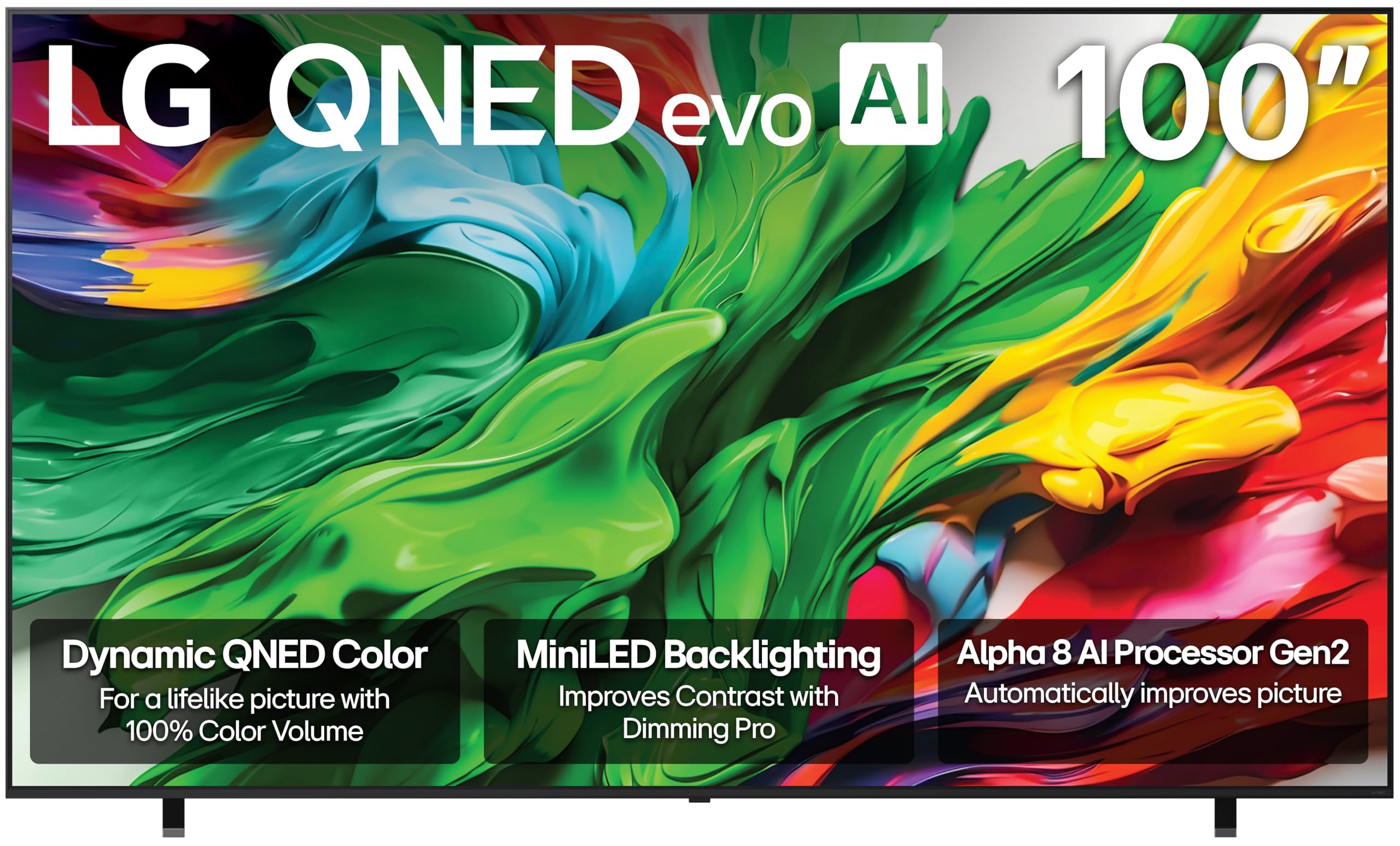
1. LG QNED85A Series Mini LED 4K Smart TV
Our pick — 4.0+★ from 300+ verified ratings; the strongest balance of quality and price.
A 100-inch Mini LED panel with native 120Hz and Precision Dimming — the biggest screen in this roundup.
The number that decides this one is 100 inches of QNED panel — the largest screen in this group, and the reason it takes the top spot. You get a native 120Hz refresh rate, so a fast football pass or a car chase stays smooth instead of smearing across that huge field of view. Precision Dimming controls the Mini LED backlight in individually managed zones, which is what keeps dark scenes dark rather than grey-washed on a panel this big.
Pictures get help from the Alpha 8 AI Processor Gen2, which detects what you are watching and adjusts picture and sound on the fly. HDR10 Pro lifts color and contrast scene by scene, and Filmmaker Mode strips out the smoothing so a movie looks the way the director set it. For gaming there is VRR up to 144Hz and the LG Game Optimizer in one menu, plus GeForce NOW and Xbox Cloud Gaming built in if you stream instead of owning a console.
The physical reality is worth planning around. The stand base measures 67.9 inches wide versus 1 inch on the Samsung QN900F — a 67.9x gap that means this set demands a genuinely wide media console. Buyers consistently praise the picture and call it good value for a screen this size, and the setup is described as straightforward. Sound is the honest weak point: it earns mixed feedback, with a real split between people who find it fine and people who find it thin. Budget for a soundbar and this becomes a very complete package.
What earns it the crown
- A true 100-inch Mini LED panel — the biggest screen here
- Native 120Hz with VRR up to 144Hz for smooth sport and gaming
- Precision Dimming keeps blacks deep next to bright highlights
- Filmmaker Mode and HDR10 Pro for movie-night accuracy
Plan around this
- 67.9-inch base width needs a very wide console or a wall mount
- Built-in audio splits opinion — a soundbar is the smart add
Buy this if: you want the largest screen in the room and watch a mix of sport, movies, and streaming games.
Measure first: your console needs to clear that 67.9-inch base, or plan on a wall mount.
2. Samsung QN900F Series Mini LED Smart TV
A true 8K panel at 85 inches, with 256 AI neural networks upscaling everything below 8K.
This Samsung answers the LG’s full 100 inches with resolution: a genuine 8K panel driven by 256 AI neural networks (processing that sharpens everything up to 8K). At 85 inches you sit close enough to see that extra detail pay off, which is not always true of smaller 8K sets. The Glare Free finish is what changes daily life — sun through a window or a lamp left on no longer washes out the screen. That matters more on a panel this reflective than most buyers expect.
Its numbers show a different design philosophy. Base depth runs 14.5 inches against 11.2 inches on the Samsung QN900D — that extra stand footprint buys the flat metal back with audio grooves, which lets the set sit flush against a wall when mounted. Object Tracking Sound with Dolby Atmos fills the room, and VRR gaming runs up to 4K 165Hz. There is also the Art Store angle: you can pull artwork from The Met, MoMA, and artists like Basquiat onto the screen when it is not showing a movie.
The picture here is the thing people keep talking about — a sharpness that reviewers describe as almost three-dimensional on good source material. The catch is the 85-inch ceiling: you are paying for 8K pixels rather than sheer wall coverage. If your heart is set on the biggest possible image, this is the worthy compromise rather than the exact match.
The resolution argument: 8K with 256 AI neural networks is the real difference here, and at 85 inches your eyes can actually resolve it.
One trade to accept: it stops at 85 inches, so the wall-of-picture effect is smaller than the 100-inch sets in this group.
Reach for this if: sharpness and glare control matter more to you than raw diagonal inches.
Look elsewhere if: you have already measured your wall and decided 85 inches is not the drama you wanted.
3. Samsung QN900D Series Mini LED Smart TV

A 75-inch 8K panel with 512 AI neural networks and Motion Xcelerator 240Hz for smaller rooms.
If the 100-inch sets would simply overwhelm your space, this 75-inch QN900D is the elegant answer. It carries Real 8K Resolution with AI Upscaling Pro and 512 AI neural networks, so a 4K or HD source gets rebuilt scene by scene rather than left soft. The panel’s Infinity Air Design pushes the image right to the edges, which makes a 75-inch frame feel more expansive than the measurement suggests.
Motion is where it gets serious. Motion Xcelerator 240Hz handles fast action, and AI Motion Enhancer Pro sharpens moving objects and subtitle text so a live sports ticker stays legible. Quantum Matrix Pro with Mini LEDs carries 1.5x more lighting zones than standard Quantum Matrix technology, which is the spec behind the deeper darks and brighter brights you actually see. Dolby Atmos with Object Tracking Sound Pro tracks audio to whatever is happening on screen.
It fits a shallower console than the bigger Samsung above — base depth of 11.2 inches against that model’s 14.5 inches, so it needs noticeably less console depth. The honest note: buyers report genuinely divided video quality, with some calling the picture outstanding and others unmoved. That split usually depends on source quality and setup, so plan on calibrating rather than trusting the out-of-box preset.
Where it wins: a 240Hz motion engine and 512 neural networks make fast sport and upscaled content look crisp in a compact room.
Set your expectations: picture opinion splits among its buyers, so budget an evening with the picture settings before you judge it.
This one suits: a smaller living room that still wants true 8K and premium motion handling.
Consider the 85-inch instead: if you have the wall space and want the extra 8K canvas for the same family of features.
4. Hisense 100L5G-CINE100A 4K UHD Laser TV with 100″ ALR Screen

An ultra short throw projector that sits 11 inches from the wall and throws a 100-inch image up it.
An ultra short throw projector sits 11 inches from the wall and throws a 100-inch picture up it — no ceiling mount, no cable run across the room. It ships with a matched Ambient Light Rejecting screen, which is the part that makes this work in a normal lit room instead of a darkened cave. The spec that matters is 2700 ANSI lumens of peak brightness, paired with HDR10 and a fixed focal length that keeps focus even across the whole frame.
Audio is unusually well covered for a projector: 30W of stereo Dolby Atmos built in, plus eARC pass-through if you want to route everything to a real surround system. Android TV brings the Google Play Store and the usual streaming apps, and both Alexa and Google Assistant are built in for voice control. It is also genuinely portable in a way a 100-inch panel never can be.
Be clear-eyed about the fundamentals. It is a 4K display, not 8K, and 480 nits of brightness is a different world from the Mini LED panels in this group — daylight viewing leans on the ALR screen doing its job. This is also the lowest-rated pick in the roundup, which tells you it asks more of its owner than a panel does. Get the screen placement right and it rewards you; get it wrong and the picture suffers.
Why it earns a slot
- 100-inch image from just 11 inches of throw distance
- Matched ALR screen included, so no guesswork on setup
- 30W Dolby Atmos stereo with eARC pass-through
- Portable in a way no 100-inch panel can be
The honest limits
- 4K, not 8K, and 480 nits needs the ALR screen to hold up in daylight
- Asks more of its owner than a plug-and-watch panel
Worth it for: anyone who physically cannot wall-mount a giant panel, or who wants a screen they can take to another room.
Know before you buy: this is a projector, so screen placement and room light are your job, not the TV’s.
5. Toshiba Z670 Series Mini-LED 4K UHD Smart Fire TV
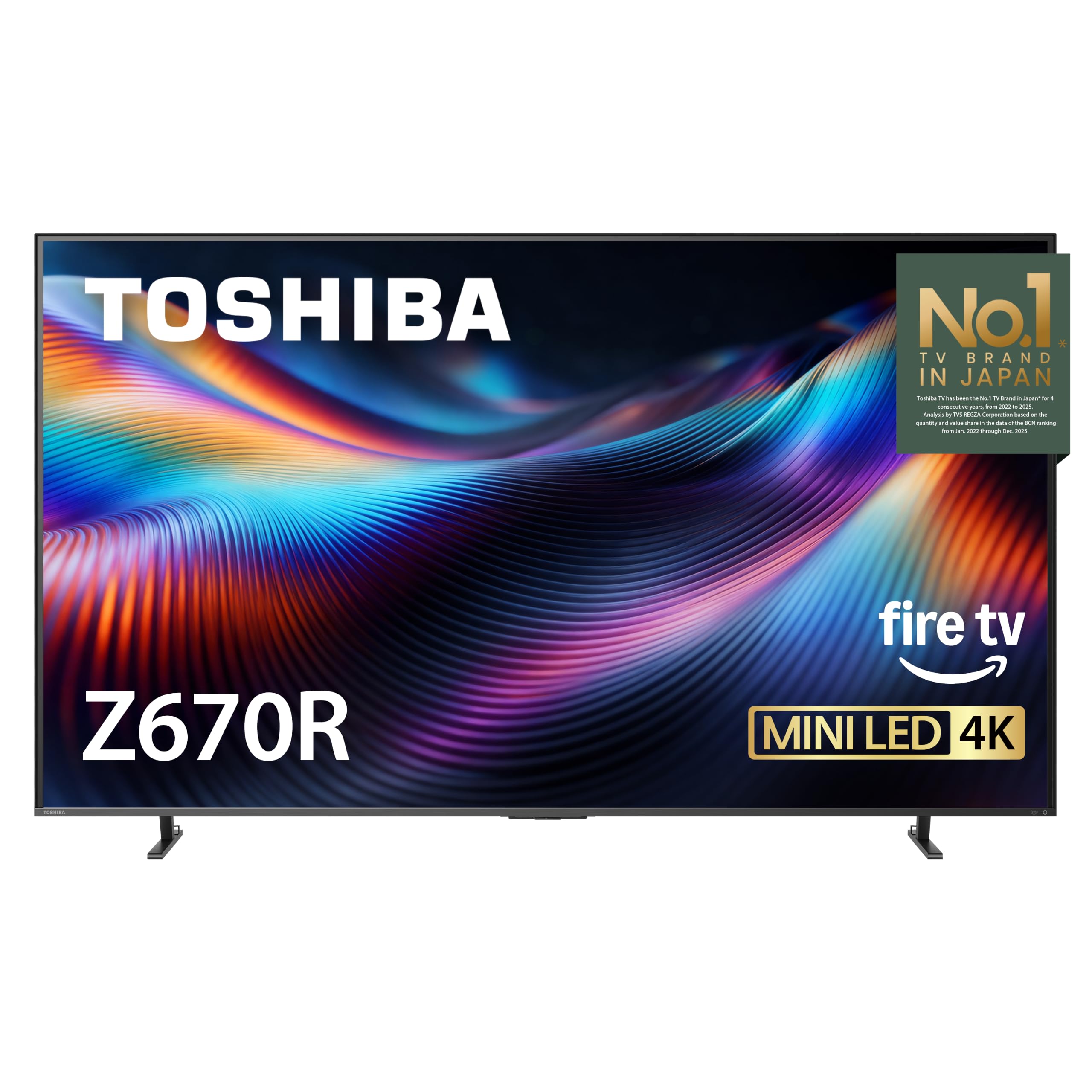
A 100-inch Mini LED with a native 144Hz panel, AMD FreeSync Premium, and ALLM for console gaming.
The headline here is 144Hz native, which beats the LG’s 120Hz — a 20% higher refresh rate that turns into visibly smoother aim tracking and motion on next-gen consoles. Mini LED with Full Array Local Dimming sits behind it, dimming zones independently so shadow detail and bright highlights coexist properly. The REGZA Engine ZRi Gen3 handles scene-by-scene picture and sound processing, tuned by Toshiba engineers in Japan.
For gaming, AMD FreeSync Premium, VRR at 144Hz, and ALLM all come standard, so screen tearing and input lag are handled without you diving into menus. Audio is a genuine strength: REGZA Power Audio Pro with a dedicated Bass Woofer gives this set real low-end that most flat panels cannot produce. The Total HDR Solution Pro stack covers Dolby Vision IQ, HDR10+, and HDR10+ Adaptive, and the AI Light Sensor Pro adjusts brightness to the room automatically.
It is a Fire TV, which means Alexa is one press away and your live channels and apps live on one home screen. Quality and picture quality dominate what owners talk about, with value for money close behind and setup described as easy. One recurring note worth knowing: some units reportedly fail after about a month of use, so buying with a clear warranty path makes sense. Also remember this panel is 4K — the size is the draw here, not resolution.
Standout strengths
- Native 144Hz beats the LG’s 120Hz for smoother motion
- AMD FreeSync Premium, VRR 144Hz, and ALLM from the start
- REGZA Bass Woofer delivers real low-end without a soundbar
- Dolby Vision IQ and HDR10+ Adaptive across the board
Worth a moment’s thought
- 4K rather than 8K — you are buying size and speed, not pixel density
- Some units reportedly fail early, so keep the warranty close
Go for it if: a 100-inch screen plus competitive gaming performance is the combination you have been chasing.
Weigh it against: the LG if you value brand familiarity and a slightly brighter all-rounder over the 144Hz edge.
6. TCL 98 Inch QM8L Series SQD-Mini LED QLED 4K Smart Google TV
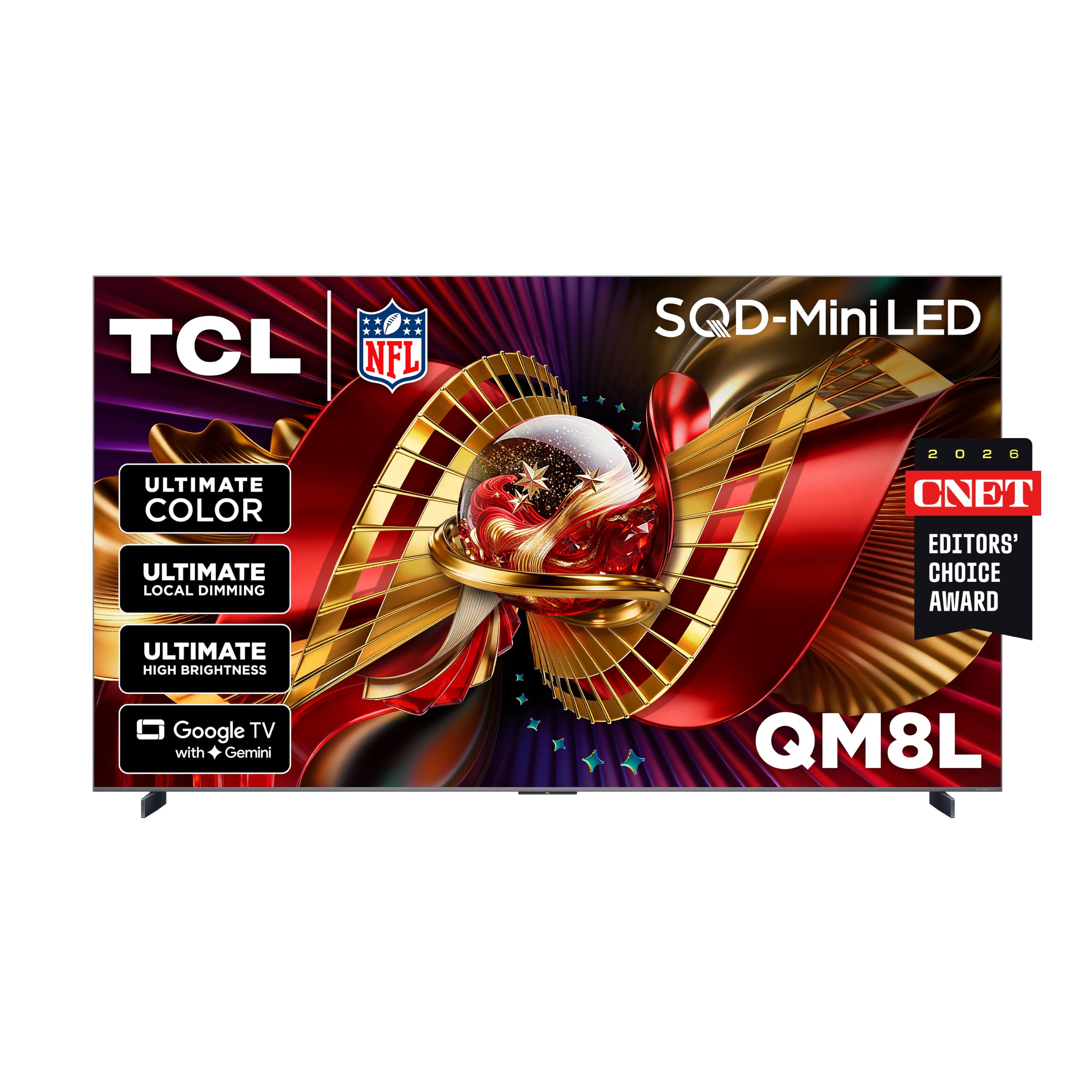
A 98-inch Mini LED rated up to 6,000 peak nits with a 7000:1 static contrast ratio.
Two specs do the heavy lifting: up to 6,000 peak nits of brightness and a 7000:1 static contrast ratio. Those numbers sit at the top of this group, and in practice they mean highlights that genuinely pop and blacks that stay black even with a lamp on. Up to 4000+ discrete dimming zones give the Halo Control System fine control over where light lands, which is how a screen this large avoids the grey wash that plagues lesser panels. TCL’s Ultra Color Filter uses 5 nanometer particles against a standard 60 nanometer, which sharpens color accuracy at the pixel level.
The panel runs at 144Hz, matching the Toshiba, and the Game Pack adds Game Accelerator 288 VRR, a Game Bar, and AMD FreeSync Premium Pro for smoother, lower-latency play. Audio comes from Bang & Olufsen with optional wireless subwoofer and satellite speakers if you want to build out. Google TV with Gemini lets you ask for something to watch rather than scrolling, which on a screen this size is a small mercy.
Owners describe it as the best TV they have owned, with sharp contrast and a premium look that reads far above its tier. Picture quality follows close behind in what people talk about, and the brightness impresses. The trade-off is the 98-inch size — four inches shy of the 100-inch LG, and the difference is noticeable next to a full 100-inch panel. For the picture punch you get, though, that is a fair bargain.
The brightness story: 6,000 peak nits and 7000:1 contrast make this the punchiest picture in the group, daylight or dark.
The catch to weigh: 98 inches against the LG’s full 100 — small on paper, visible next to a true 100-inch screen.
Pick this when: contrast and brightness are what you notice most in a picture, and you want the best of both at near-enough-to-100 inches.
Think again if: those last two inches of screen are non-negotiable for your wall.
7. Sony Z9K Series BRAVIA XR Mini LED Smart Google TV

A 75-inch 8K Mini LED with input lag as low as 8.5ms and PS5 auto HDR tone mapping.
Sony’s angle is processing and gaming, and the numbers back it. The Cognitive Processor XR works with XR Backlight Master Drive to control thousands of Mini LEDs with precision, so contrast stays deep and colors stay natural even at high brightness. Input lag runs as low as 8.5ms, and BRAVIA XR exclusive features like Auto HDR Tone Mapping and Auto Genre Picture Switch kick in automatically when a PS5 is connected. HDMI 2.1 brings 4K/120, VRR, and ALLM for high-frame gaming.
The rest is a full premium package: XR Triluminos Pro for billions of colors, Google TV with Google Assistant, AirPlay 2 for Apple devices, and BRAVIA CORE with 10 movie credits loaded. Dolby Vision, IMAX Enhanced, and Netflix Adaptive Calibrated Mode cover cinematic content, and a BRAVIA CAM ships in the box for video chat, gesture control, and Ambient Optimization Pro. The included backlit remote is a small but welcome touch in a dark room.
Here is the realistic caveat: this is a 75-inch set, the smallest screen in the lineup, and it shares that ceiling with the Samsung QN900D. It is 8K, so detail is exceptional, but you are not getting the rich wall coverage the 100-inch sets deliver. If your room is sized for 75 inches and gaming is your priority, this is an outstanding fit. If you want the biggest possible picture, look up the list.
For the gaming room
- Input lag as low as 8.5ms with PS5-exclusive auto modes
- HDMI 2.1 with 4K/120, VRR, and ALLM
- BRAVIA CAM included for video chat and auto picture adjustment
- BRAVIA CORE with 10 movie credits included
Where it stops short
- 75 inches — the smallest screen here, so less wall drama
- 8K appeal is limited unless you sit close enough to resolve it
Perfect for: a PS5 owner in a mid-sized room who wants 8K detail and Sony’s processing first.
Not the one for: a buyer whose main goal is maximum screen size above all else.
Know the Specs
Mini LED and dimming zones
Mini LED is a backlight made of thousands of tiny LEDs instead of a few large ones — think of it as thousands of small lamps behind the glass instead of one big one. Grouped into zones that dim independently, they create deeper blacks next to bright highlights. More zones and higher brightness generally mean a more dimensional picture, especially on a screen this large.
8K resolution and AI upscaling
8K means a fixed pixel count many times higher than 4K, so a panel can resolve fine detail up close. AI upscaling takes lower-resolution sources and reconstructs detail scene by scene to fill that canvas. Because 8K only pays off at close seating distances, most buyers feel the benefit more from good upscaling than from native 8K alone.
Refresh rate and VRR
Refresh rate measures how many times per second the panel redraws, in Hz — 120Hz means 120 redraws every second. VRR lets the screen match the frame rate of a game console on the fly to reduce tearing. On a giant panel, higher Hz makes fast pans and sports feel cleaner because motion has less distance to smear across.
Nits, lumens, and contrast ratio
Nits measure panel brightness, while lumens measure projector brightness — the two are not directly comparable because a projector’s light travels to a screen, while a panel lights from behind. Contrast ratio describes the difference between the brightest white and the deepest black. Look for brightness paired with local dimming, since either alone tells you only part of the story.
Base width and stand depth
Base width is the footprint of the TV’s own stand, and it is the first number to match against your furniture. A wider base needs a wider media console; a deeper base needs more room from the wall. If neither fits, a wall mount removes the stand from the equation entirely.
HDR10+ and Dolby Vision
These are HDR formats that carry extra brightness and color instructions per scene, so highlights and shadows stay realistic rather than clipped. A set that supports multiple formats covers more of the sources you already stream. Dolby Vision IQ and HDR10+ Adaptive go further by adjusting for room lighting.
Common Questions
Is there a true 8K TV that is also 100 inches?
Will a 100-inch TV fit on a normal media console?
How far back should I sit from a 100-inch screen?
Does 8K matter if most of my content is 4K or HD?
Is a laser projector better than a 100-inch Mini LED panel?
What refresh rate do I need for sports and gaming on a giant screen?
Do these big TVs need a soundbar?
How much wall space does an 85-inch versus a 100-inch TV take up?
Is Mini LED better than a projector for a bright living room?
The Bottom Line
For most people chasing the biggest possible picture, the 8k 100 inch tv answer is the LG QNED85A — a full 100 inches, native 120Hz, and Precision Dimming that keeps a screen that large from looking flat. If genuine 8K detail and a glare-free finish are what you are after, the Samsung QN900F delivers it at 85 inches with 256 AI neural networks doing the upscaling. And if you want to game on the biggest screen without giving up speed, the Toshiba Z670 pairs a 100-inch panel with a native 144Hz refresh rate. Measure your wall, decide whether resolution or size wins, and pick the one that fits the room you actually have.
How we choose
We do not accept paid placement. Every pick is matched to a real buyer and a real use-case; we do not hands-on test units.
Sources
Specifications: manufacturer listings and product documentation. Review insights: verified customer reviews, as of November 2026. Pricing: not shown on this page (it changes often); check the current price via the retailer link.
As an Amazon Associate, My Heart Lives Here earns from qualifying purchases. This does not affect which products we feature.