Heads up: This post contains affiliate links. As an Amazon Associate I earn from qualifying purchases, at no extra cost to you. Learn more
Specs are compiled from manufacturer listings and verified buyer reviews and can change over time — please confirm the key details on the product page before buying.
Rust never announces itself. It starts as a faint bloom on a seam, a brake line, or a battery terminal, and by the time you notice it, the metal is already thinning. A corrosion inhibitor either halts that bloom at the surface or lets it eat through the panel, and a thin oil can wash off in the first rainstorm. Below are nine formulas, each matched to a different job and budget.
This guide is built by comparing the manufacturers’ published specifications and the patterns across verified customer reviews, so you get each pick’s real strengths and trade-offs instead of marketing spin.
You will see waxy films, self-healing marine barriers, and penetrating oils that free seized bolts. Some are built for underbody panels you never look at, others for terminal posts you touch every month. The shortlist below sorts them by what they actually protect and how long they hold — a practical read on the best automotive corrosion inhibitor for the metal you care about.
Top Picks


How To Choose The Best Automotive Corrosion Inhibitor
Two inhibitors in identical aerosol cans can behave nothing alike. One dries into a firm wax that shrugs off road salt; another stays oily and creeps into seams. Before you pick a can, decide which of those two behaviors your metal actually needs.
Waxy Film vs. Oily Film
A waxy film dries to a firm coating that resists humidity and salt spray and never becomes brittle, which makes it the right choice for surfaces left outdoors or under a vehicle. An oil-based film stays slick and creeps into tight places, so it suits hinges, cables, and bolts that need to keep moving. Neither film is better; each suits a different surface.
How Long Protection Lasts
Some formulas are built for long-term indoor and outdoor storage; others are rated for a set number of years indoors and a shorter stretch outside. Match that indoor/outdoor rating to how often you can realistically reapply. A trailer that sits through winter needs a longer-lived film than a shop tool you handle weekly.
Electrical and Terminal Protection
Coating a battery post or a grounding lug asks something different of a spray: it has to block moisture without conducting current. Look for a formula described as dielectric — meaning it forms an insulating film — and check that it is meant for electrical connections before you spray your terminals.
Getting Into Cavities and Seams
Frame rails and internal body panels rust from the inside, where you cannot see or reach with a normal can. Products made for that job are designed to be used with an applicator wand, and the wand is often sold separately, so factor that into the plan.
Side-by-Side Comparison
| Model | Best For | Form | Volume | Film Type | Amazon |
|---|---|---|---|---|---|
| Koch-Chemie Motorplast★ Best Overall | Engine bays and rubber parts | Liquid conserver | 1 liter | Permanently elastic film | Amazon |
| CRC SP-400Long-Term Shield | Long-term outdoor metal storage | Aerosol spray | 10 wt oz | Firm waxy film | Amazon |
| ACF-50 Anti-Corrosion SprayBike and Metal Pick | Motorcycles and metal film | Aerosol spray | 13 fl oz | Thin protective film | Amazon |
| Boeshield T-9 | Hinges, terminals, hitches | Aerosol spray | 12 fl oz | Thin waxy film | Amazon |
| H&H CB12 Corrosion Block | Corrosive environments | Aerosol spray | 12 fl oz | Protective coating | Amazon |
| CorrosionX Heavy Duty | Saltwater and marine gear | Aerosol spray | 12 oz | Self-healing barrier | Amazon |
| CorrosionX Dielectric 16oz | Electronics and battery terminals | Aerosol spray | 16 fl oz | Dielectric film | Amazon |
| CRC 06026 4-Pack | Underbody and jack points | Aerosol spray | 10 fl oz each | Hard wax coating | Amazon |
| 3M Cavity Wax Plus | Frame rails and body panels | Aerosol spray | 18 fl oz | Non-hardening wax | Amazon |
Detailed Reviews
1. Koch-Chemie – Motorplast -1 Liter
Our pick — 4.5+★ from 450+ verified ratings; the strongest balance of quality and price.
A one-liter conserver that keeps an engine bay looking new instead of dusty and dull.
Motorplast is not a spray-and-forget aerosol. It comes as a one-liter liquid conserver, and its job is a permanently elastic protective film that shields engines, housing parts, rubber hoses, and power units from corrosion and environmental exposure. Because that film stays elastic rather than drying hard, it flexes with rubber and housings instead of cracking off them.
What wins people over is the finish. It leaves a naturally shiny satin look that does not attract dirt, so the engine bay holds its clean appearance far longer between washes. Buyers also get the most out of its dust-repelling side — surfaces stay cleaner, which is exactly what you want in a compartment you rarely open. It carries a pleasant fruity fragrance rather than the harsh chemical smell you might brace for.
Here is the catch to plan around. This is a conserver for dressing and protecting an already-clean engine bay, not a heavy rust-barrier for exposed underbody steel. It measures 3 x 3 x 8.5 inches at 1.23 pounds, so it stores on a shelf without drama. At 4.5+ stars across 400+ ratings, it earns its top spot on the strength of that satin finish and its staying power.
Why it earns the crown
- Permanently elastic film flexes with rubber hoses and housings instead of cracking
- Satin finish resists dust so the engine bay stays clean much longer
- Pleasant fruity fragrance, unusual for an engine protectant
- One-liter liquid covers engine compartments, housings, and power units
Where it steps back
- Built for dressing engine bays, not as a hard underbody rust barrier
- Liquid form needs an applicator, unlike a throw-in-the-truck aerosol
Go for it if: you want your engine bay to look showroom-clean and stay that way with occasional reapplication.
Pass if: your real problem is rust creeping along a frame rail under the car.
2. CRC Sp-400 Corrosion Inhibitor, 10 Wt Oz
Dries to a firm waxy shell that road salt and humidity cannot easily get through.
If your metal sits outdoors through winter, this is the film to reach for. SP-400 lays down a firm, waxy coating that resists humidity and salt spray and, by design, never becomes brittle. That last part matters: a coating that stays slightly flexible does not crack and let moisture creep back underneath the way a hard shell can.
It handles the ugly jobs — motors, shafts, equipment exposed to the elements, and raw or finished stock kept in outdoor storage. The 10 wt oz aerosol can is NSF H2 registered, which means it is rated for use in meat, poultry, and beverage plants where incidental food contact is a concern. A 5 x 4 x 4 inch can is small enough to keep on a garage shelf.
The trade-off is texture. The film is waxy and a touch sticky as it sets, and some find it overpriced for the can size. It is also a committed coating, not something you wipe off and forget. At 4.5+ stars across 400+ ratings, it earns its keep for buyers who want a serious barrier and do not mind the waxy feel.
The real appeal: a firm wax that seals out moisture and holds up to salt spray, built for motors, shafts, and equipment stored outdoors.
Adjust expectations: it dries waxy and slightly sticky — a protective layer, not a clean finish. Apply it where the coating can sit undisturbed.
This is your can: for farm equipment, stored raw stock, or anything left exposed to the weather.
Look elsewhere: if you need a grip-friendly or low-residue finish on parts you handle daily.
3. Anti-Corrosion Spray – 13 oz Aerosol (ACF-50)
The motorcycle crowd’s quiet favorite — a thin film that clings rather than drips.
You get more coats per can from ACF-50: its 13 fl oz aerosol (a 13 fluid ounce spray can) holds 13 fluid ounces against the Boeshield T-9’s 12, a modest edge in volume. It is built for metallic objects across automotive and electrical use. You spray it on and it leaves a protective film, which is what you want when you coat exposed metal against wet roads and sea air.
The formula puts its effort into corrosion resistance and durability, and that combination is what keeps a motorcycle’s exposed fasteners and frame from blooming over a season. It works on the tight spots too, misting into crevices where a heavier coating would never reach.
The honest caveat is the nozzle. Spray performance splits opinion — some find it mists cleanly, others fight with the spray head as the can empties. At 4.5+ stars across a few hundred ratings, the protection itself is clearly doing its job; just be ready to manage the spray pattern rather than expect a perfect fan every press.
Standout strengths
- 13 fl oz offers more volume than the 12 oz Boeshield T-9
- Thin film clings to metal and reaches tight spots
- Built for both automotive and electrical surfaces
- Corrosion resistance and durability are its core strengths
What to plan for
- Nozzle behavior is hit-or-miss as the can empties
- Thin film suits exposed metal better than heavy underbody work
Reach for this when: you are coating a bike, a frame, or electrical hardware and want a light, clinging film.
Better off skipping: if you need a thick wax barrier for a car underbody.
4. Boeshield T-9 Lubricant 12 oz
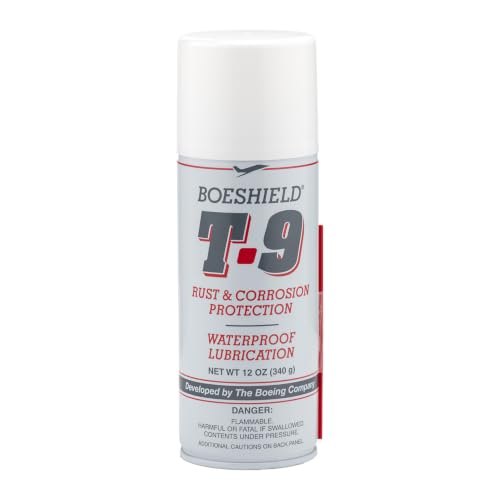
One can that lubricates, displaces moisture, and leaves a thin waxy film all at once.
Boeshield T-9 does two jobs at once: its 12 fl oz formula (12 fluid ounces) penetrates metal, pushes moisture out, and dries to a thin waxy film instead of a thick sticky residue. So it protects the metal and keeps moving parts moving. That is why it suits hinges, latches, battery terminals, tow hitches, trailer plugs, seat tracks, and window mechanisms — small metal parts that rust quietly.
Rust resistance is the headline, with water resistance close behind, and the wax film holds up against humidity, road spray, salt, and seasonal storage. It was originally developed by Boeing, which speaks to its aerospace lineage rather than its everyday behavior, but the practical result is a coating that keeps parts gliding smoothly for months.
The trade-off is residue. The thin wax is cleaner than heavy oily coatings, but it is still a film, and some find the value for the can size a point to weigh. At 4.5+ stars across 300+ ratings, it stands as the best all-purpose choice for a home garage, though the ACF-50 edges it on volume (13 fl oz versus 12).
What it solves: a single can for metal parts that both rust and need to keep moving — terminals, hinges, hitches, and seat tracks.
The honest note: that waxy film is the protection; if you want a totally invisible, dry finish, expect a light coating to remain.
Suits you if: you want one can on the shelf that handles small metal parts across the garage.
Think twice if: you need a heavy underbody barrier or the largest can for the money.
5. H&H CB12 Corrosion Block, 12-Ounce Aerosol Can
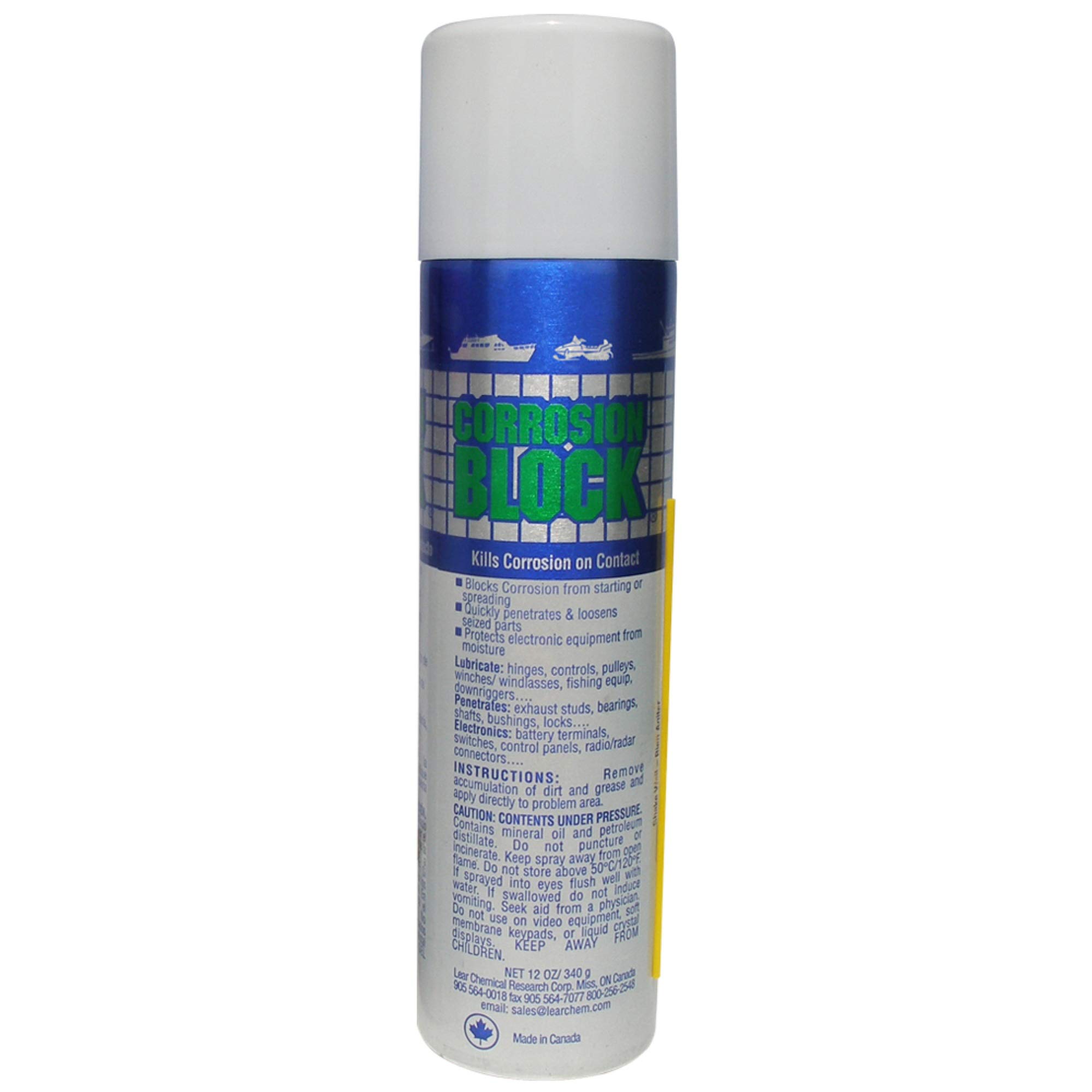
A 12-ounce spray that keeps outdoor units looking untouchable for years.
Corrosion Block stakes its reputation on the toughest environments. It comes as a 12 fl oz aerosol spray, and its job is straightforward: stop rust and corrosion on metal that lives outside. The proof people bring up is long service — outdoor units kept looking like new for years when treated with it, which is exactly the kind of longevity a harsh-environment product has to deliver.
Corrosion resistance is what it does best, and protection is the close second. That pairing makes it a natural fit for equipment sitting in corrosive air, coastal garages, or any metal that faces constant moisture and salt. The can has a flash point of 79 °C, so store it away from heat and direct sun.
The catch is the price conversation. Opinions split sharply — some feel it is worth triple what you pay, others find it overpriced for a 12-ounce can. At 4.5+ stars across 450+ ratings, the formula itself clearly performs; the question is whether you are buying enough of it to justify the spend.
Where it shines
- Built specifically for corrosive environments
- Long service — outdoor equipment stays protected for years
- 12 fl oz aerosol is easy to spray across exposed metal
The fair warning
- Cost divides opinion — some see value, others see it as pricey for a 12 oz can
- Store it away from heat given the low flash point
Pick it for: equipment and metal that sit in genuinely corrosive air and need years of coverage.
Hold off if: you want the most can for the money and your conditions are mild.
6. CorrosionX Heavy Duty Anti Rust Spray, 12oz Aerosol

A dripless barrier that clings through rain, seawater, and pressure washing.
For marine and agricultural gear, this is the can that does not quit. CorrosionX Heavy Duty lays down a self-healing barrier that stays put through rain, seawater, and even a direct pressure wash. The self-healing part matters: when the film gets nicked or flexes, it reflows rather than flaking away, so the protection stays continuous.
The maker rates it for up to 5 years indoors and 2 years outside, which is the kind of window you want on a boat trailer, barn door, or dock equipment. It is also built for heavy-duty electrical connections — larger terminals, battery posts, and grounding lugs — where the thick, non-conductive formula seals without harming sensitive components. Polar bonding locks onto the surface to interrupt corrosion before it starts, even in hidden spots like engine bays and salty dock sides.
The honest trade-off is that thick film. It is adhesive and can be heavy on a part, and some buyers find value and thickness points to weigh. At 4.5+ stars across 1,000+ ratings, it has the deepest track record on this list — but treat it as a serious protective barrier for harsh weather, not a low-residue touch-up spray.
The case for it: a self-healing, dripless barrier rated for up to 5 years indoors and 2 years outside, built for battery posts, trailers, and marine hardware.
Weigh this: it is a thick, clingy film — great on a dock, less subtle on small parts you handle often.
The one to grab: for boat trailers, docks, and heavy electrical connections in salt-heavy air.
Not the right tool: if you want a light, invisible coating on a part you touch every day.
7. CorrosionX Rust Inhibitor 16oz

The 16-ounce can that coats a circuit board and still lets it work.
This is the electrical specialist of the group. The film is dielectric — meaning it insulates rather than conducts — and it molecularly bonds to metal surfaces and subsurfaces, forming a moisture-blocking barrier. That is the film you want on battery terminals, sensors, and circuits, where a conductive coating would spell trouble.
The dielectrics are rated over 39,000 volts, so the film shields electronics while displacing moisture and stopping galvanic corrosion between dissimilar metals. It also works as a marine-grade lubricant that clings like a magnet, resisting pressure, friction, and washout on locks, hinges, cable pulleys, and marine components. Deep penetration frees frozen bolts and seized engine parts that other products leave stuck.
The one thing to size up is the greasy film — some find it heavier than they want, and value is a point of debate at 16 fl oz. At 4.5+ stars across 800+ ratings, it carries real depth of experience behind it. Compared with the Boeshield T-9’s thin waxy film, this is the more committed, electronics-capable coating.
Why it stands out
- Dielectric film rated over 39,000 volts protects circuits and terminals
- 16 fl oz — the largest can among the aerosol picks here
- Deep penetration frees rusted bolts and frozen fittings
- Doubles as marine-grade lubricant for locks, hinges, and pulleys
Where it asks patience
- Leaves a greasy film some find heavier than expected
- Value is debated at the 16-ounce size
Made for: anyone coating electrical connections, terminals, or sensors while also freeing up seized hardware.
Skip it for: a dry, invisible finish on cosmetic surfaces.
8. CRC 06026 Heavy Duty Corrosion Inhibitor, 10 Wt Oz – 4 PACK

Four cans of hard-wax protection for the underbody you would rather not think about.
This is the bulk answer for a whole vehicle’s underside. You get a 4-pack of CRC’s heavy duty inhibitor, each can 10 fl oz, and the formula dries to a hard wax rather than a wet oil. That film protects metal surfaces, electrical connections, engine components, and fasteners subjected to salt spray and high humidity — the parts of a car that rust first and get looked at least.
Application covers the awkward places: steering and throttle linkages, spindles, shafts, jack points, and equipment storage. The hard wax holds where a thin oil would wash away, and the four-can format means you can coat the underbody without rationing. If you live where roads get salted, coating the jack points and linkage before winter is the move this pack is built for.
The honest gripe is the smell. The formula is potent as it goes on, so apply it in a ventilated space and give it time to dry. At 4.5+ stars across 800+ ratings, the coating and rust resistance clearly do their job, and a 4-pack spreads the cost across a full underbody job.
What you get: a four-can supply of a hard-wax inhibitor that holds on underbody metal, linkages, and jack points through salt spray.
Prep for this: a strong odor while spraying — ventilate the garage and let the wax set before you handle anything.
Best matched to: a full underbody treatment in a salt-belt climate, done at home.
Not for you if: you only need a small touch-up and dislike a strong solvent smell.
9. 3M Cavity Wax Plus Aerosol Spray, 08852, 18 fl oz
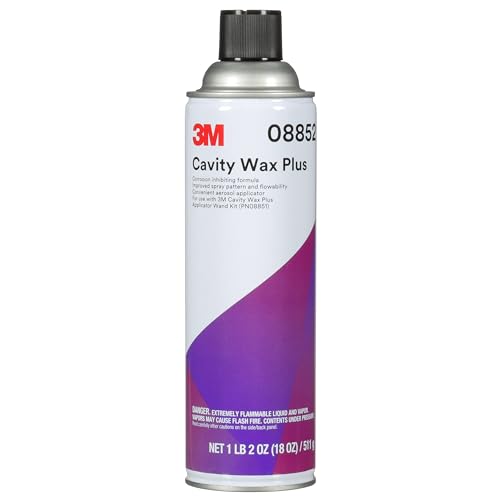
The inside-the-panel specialist that stays soft and creeps into cracks no spray reaches.
Cavity Wax Plus is the one product here aimed at metal you cannot see. Its job is to protect internal body panels, frame rails, and structural enclosures — the enclosed spaces where rust starts from the inside and works its way out through the paint. The 18 fl oz aerosol handles that coverage without bulky spray equipment.
The defining trait is that the wax never hardens. It stays soft and pliable so it will not crack, chip, or peel, and the self-healing formula reflows into cracks and crevices for long-term coverage. That non-hardening behavior is exactly what an enclosed panel needs, since flex and vibration quickly break down a brittle coating. It is designed to be used with the 3M Cavity Wax Plus Applicator Wand Kit, which is sold separately, so budget for the wand to reach deep into rails.
The catch is the cost and the setting. It carries a note that it is for industrial or occupational use, not consumer sale, and the price is more than some want for a single can. At 4.5+ stars across 400+ ratings, it is the right tool for anyone serious about stopping rust inside the panels rather than just on the surface.
What makes it different
- Non-hardening wax stays soft and will not crack, chip, or peel
- Self-healing formula reflows into cracks for long-term coverage
- 18 fl oz covers frame rails and internal body panels
- Reaches enclosed cavities without bulk spray equipment
Read before buying
- The applicator wand kit is sold separately
- Marked for industrial or occupational use, not general consumer sale
- Price is high for a single can
Choose it for: protecting frame rails and internal body panels from the inside out.
Look at another pick if: you only need surface rust protection and do not plan to buy the applicator wand.
Know the Specs
Film Type: Wax vs. Oil
Film type tells you how the protection behaves. A firm waxy film resists humidity and salt spray and stays put on surfaces left outdoors, while an oil-based film stays slick and creeps into joints that need to keep moving. Match the film type to the surface, not to the brand.
Volume and Coverage
Volume tells you how far a can goes. Aerosols here range from 10 wt oz to 18 fl oz, and a four-pack stretches coverage across a full underbody. Larger volume means more coats, which matters most on big surfaces like frame rails and trailer decks.
Dielectric vs. Conductive
A dielectric film insulates rather than conducts, which is the property you want when coating battery posts, sensors, and circuit boards. The CorrosionX formula is rated over 39,000 volts for this reason. Never assume a random spray is safe on electrical parts — check for a dielectric rating first.
Self-Healing and Non-Hardening
A self-healing or non-hardening coating reflows into nicks and cracks instead of flaking off. That behavior matters on metal that flexes or vibrates — frame rails, trailer frames, engine mounts — where a brittle coating would soon break down and let moisture in.
Common Questions
Can I spray a corrosion inhibitor directly on a car battery terminal?
What is the difference between cavity wax and a regular corrosion spray?
How long does a corrosion inhibitor actually last?
Will a waxy corrosion inhibitor wash off in the rain?
Can I use a corrosion inhibitor on rubber hoses and plastic parts?
Is a thicker coating always better for rust protection?
Do I need a separate applicator wand for internal body panels?
Can a corrosion inhibitor free a rusted bolt, or only prevent rust?
Is one 4-pack better than buying single cans for an underbody job?
The Bottom Line
The automotive corrosion inhibitor that fits most people is the Koch-Chemie Motorplast, because its permanently elastic film keeps an engine bay looking new and stays clean far longer between washes. If your metal actually faces salt, weather, and washout, reach for the CorrosionX Heavy Duty, whose self-healing barrier is rated for 5 years indoors and 2 years outside. And if you are coating electrical connections and terminals, the dielectric CorrosionX Dielectric 16oz is the one to grab — its film is rated over 39,000 volts, so it protects without conducting. Pick the film that matches your surface and exposure, and the metal will outlast the weather.
How we choose
We do not accept paid placement. Every pick is matched to a real buyer and a real use-case; we do not hands-on test units.
Sources
Specifications: manufacturer listings and product documentation. Review insights: verified customer reviews, as of November 2026. Pricing: not shown on this page (it changes often); check the current price via the retailer link.
As an Amazon Associate, My Heart Lives Here earns from qualifying purchases. This does not affect which products we feature.