Heads up: This post contains affiliate links. As an Amazon Associate I earn from qualifying purchases, at no extra cost to you. Learn more
Specs are compiled from manufacturer listings and verified buyer reviews and can change over time — please confirm the key details on the product page before buying.
In most countries, 100Wh is the largest battery you can legally carry onto a plane, so that figure is the ceiling every pick here has to clear. Pick right and your laptop, phone, and tablet last a full travel day away from any wall socket. Pick wrong and you are hauling a heavy brick that quits when you need it most. Below are the eight units worth your attention, sorted by what they actually do well, from the do-it-all favourite to the premium brick with an AC outlet.
This guide is built by comparing the manufacturers’ published specifications and the patterns across verified customer reviews, so you get each pick’s real strengths and trade-offs instead of marketing spin.
Every model here sits under the airline watt-hour cap, but they differ sharply on output, port count, and weight. Here is how to tell them apart before you spend a cent on a 100wh power bank.
Top Picks

How To Choose The Right 100Wh Power Bank
100 watt-hours (Wh) is the line most airlines draw for a battery you can slip into a carry-on without special permission. Go over it and an agent can refuse the pack at the gate. Every unit on this list respects that ceiling, so the real decision is what you want the battery to do once you are past security.
Read watt-hours before anything else
Watt-hours combine capacity and voltage into one number, and it is the figure the airline actually checks. A pack rated at 99.54Wh clears the cap; one at 101Wh does not. If a listing only shows milliamp-hours, look for the Wh rating in the fine print before you buy — that is the number that decides whether your pack flies.
Milliamp-hours still matter for day-to-day use, but only as a rough guide to how many refills you get. A 27,650mAh pack and a 31,000mAh pack can sit under the same watt-hour ceiling because they run at different internal voltages. Trust the Wh figure for travel and the mAh figure for how many phone top-ups you get.
Match output watts to your biggest device
A laptop with a 140W charger will only pull its full speed from a bank rated at 140W or higher on a single port. Plug it into a 65W bank and it charges slowly, or barely holds its charge while you work. If your daily carry is a MacBook Pro or a gaming laptop, look for 100W to 240W output. A phone-only user can stop at 30W and save weight.
Count your ports, then count your devices
A single USB-C port means charging your laptop and phone one after the other. Three ports let you run all of them at once, but the total is shared — a 250W bank split across a laptop, tablet, and phone gives each a healthy slice. Think about how many devices leave the house with you, then pick a bank that covers that count without re-plugging.
Side-by-Side Comparison
| Model | Best For | Capacity | Max Output | Wh Rating | Amazon |
|---|---|---|---|---|---|
| UGREEN Nexode Pro★ Best Overall | Everyday travel with cables built in | 25,000mAh | 200W | 90Wh | Amazon |
| AFERIY Nano100Biggest Capacity | Long trips off the grid | 31,000mAh | 145W | 99.2Wh | Amazon |
| AsperX 140WSlimmest Frame | Fast laptop top-ups in a slim frame | 25,000mAh | 140W | 92.5Wh | Amazon |
| Paopaoyu AC Outlet | Wall-plug devices on the move | 27,000mAh | 100W AC | Under 100Wh | Amazon |
| AOHI Future Starship | Two laptops at once | 27,600mAh | 240W | 99.36Wh | Amazon |
| EF ECOFLOW Rapid Pro X | Quickest possible recharge | 27,650mAh | 300W | 99.54Wh | Amazon |
| Anker Prime | App control and multi-device days | 27,650mAh | 250W | 99.54Wh | Amazon |
| Goal Zero Sherpa 100AC | Rugged build plus a real AC socket | 25,600mAh | 100W | 95Wh | Amazon |
Detailed Reviews
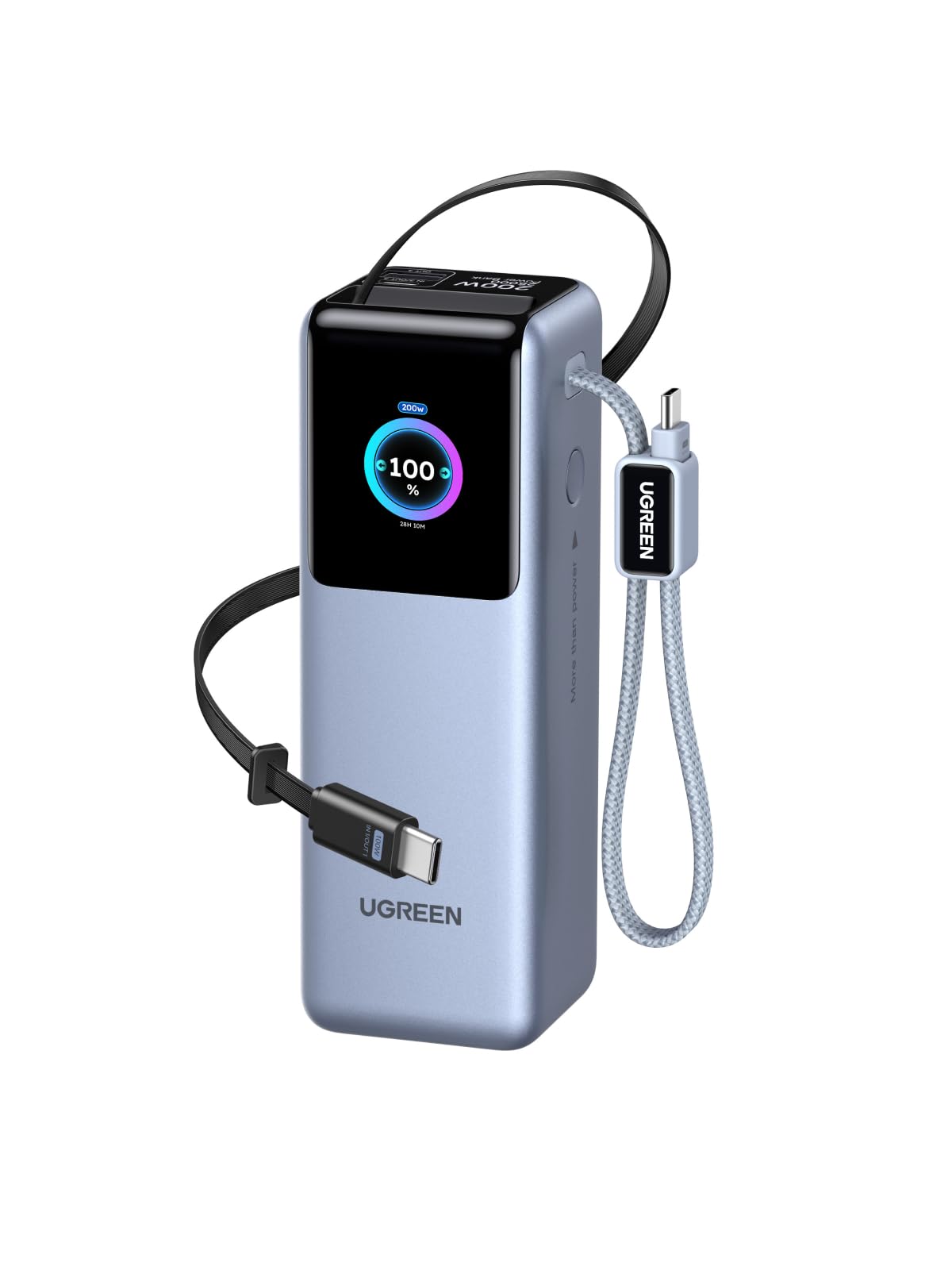
1. UGREEN Nexode Pro 25000mAh Power Bank
Our pick — 4.5+★ from 200+ verified ratings; the strongest balance of quality and price.
The travel pack that keeps its own cable tucked inside, so nothing tangles in your bag.
The UGREEN Nexode Pro is the one most buyers should get. It packs a 25,000mAh battery (a measure of stored charge) and 200W total output, and one USB-C port can deliver 100W — enough to charge two 16-inch MacBook Pros to 43% in 30 minutes, so a short layover becomes a productive work block. Its 90Wh rating (watt-hours, the energy measure airlines use) sits well under the 100Wh carry-on cap, so it clears security with room to spare.
The daily-life upgrade is the 26.7-inch retractable USB-C cable built into the body. It handles 100W in and out and has been tested over 25,000 pulls, so you can leave your charger cable at home. A second 13.8-inch strap cable is also integrated. Travelers consistently single out those built-in cables as the reason the pack earns a spot in the bag. The TFT screen — a small colour display — shows live output wattage, battery health, cycle count, and time remaining, and a Low Current Mode safely tops up earbuds and smartwatches.
The catch is bulk and a split verdict on run time. The pack is a bit chunky for a pocket, and a share of owners find it drains faster than they expect on heavy laptop use. Most of the feedback, though, converges on charging speed and raw power as the standout strengths, with one reviewer recharging a 12-inch iPad while it was in active use. Sizing matters: at 6.22 x 2.13 x 1.97 inches it slips into a laptop sleeve, not a jeans pocket. For a device this capable, that is a fair trade.
Why it earns the top slot
- 200W total output with 100W on a single USB-C port charges two laptops fast
- 26.7″ retractable cable rated for 100W and tested over 25,000 pulls
- 90Wh rating clears the airline carry-on ceiling
- TFT display shows live watts, cycles, and time left
Where it asks for patience
- Bulkier than a pocket-sized phone bank
- Battery life draws split feedback on heavy laptop drains
The short verdict: the one to grab if you want a laptop-capable bank that never needs a separate cable.
Think twice if: you want something that disappears into a jacket pocket — this pack wants a bag.
2. AFERIY Nano100 Power Bank Station
The capacity monster that still walks onto a plane, packing 31,000mAh into a 99.2Wh shell.
If your trips run long and your devices run thirsty, the AFERIY Nano100 is the one. It holds 31,000mAh against the UGREEN’s 25,000mAh — the AFERIY carries 24% more capacity — while staying at 99.2Wh, still under the airline limit. Output tops out at 145W total, split across a 100W USB-C PD3.0 port, a 45W USB-C port, and an 18W USB port. The 45W port behaves exactly as advertised, which makes it a clean fit for phones, tablets, and a Steam Deck alongside a laptop.
What sets this one apart in the long run is the battery chemistry. Its LiFePO4 cells — a lithium iron phosphate chemistry known for stability — are rated to hold over 80% of capacity after 3,000+ cycles, which the maker calls 6x the life of standard power banks. A smart BMS (battery management system) with NTC temperature control adds 6-in-1 protection against over-current, over-voltage, low-voltage, short circuits, and temperature extremes. It is certified to FCC, CE, PSE, UL, and UN38.3 standards, and it takes up to 100W solar charging for camping or outages.
Build quality is what buyers talk about first — the solidity and finish draw the most praise, with charging speed close behind. One practical limit: at 5.8 x 3.46 x 3.43 inches it is a squat, chunky block, and the AFERIY’s footprint is 13% deeper than the slimmer AsperX’s 6.56 x 3.21 x 1.08-inch frame. It is a bag resident, not a pocket one.
The trade that matters: you accept a fatter shape in exchange for 31,000mAh and a chemistry built to survive thousands of cycles.
One more note: 145W is plenty for a laptop plus a phone, but it will not run two high-draw laptops at full tilt the way the 240W AOHI can.
Reach for this if: you want maximum stored energy and a battery that ages slowly.
Look elsewhere if: a slim profile matters more to you than raw capacity.
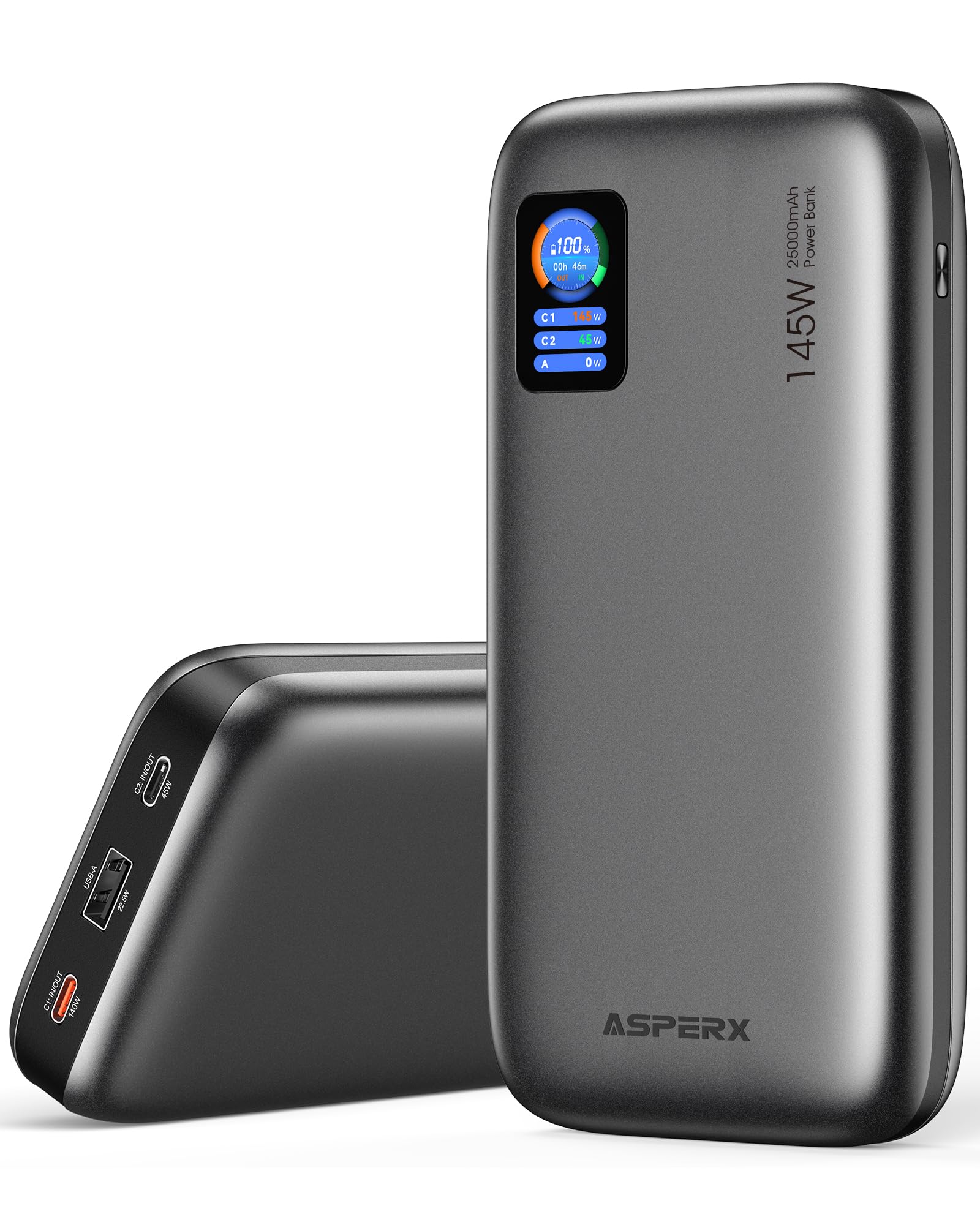
3. AsperX Laptop Power Bank 25,000mAh
A 1.08-inch-thin slab that pushes 140W to a single laptop and tells you the time left.
The AsperX wins on geometry. At 6.56 x 3.21 x 1.08 inches it is a flat, laptop-sleeve-friendly slab — noticeably slimmer front-to-back than the AFERIY’s deeper 3.43-inch body. Inside sits a 25,000mAh battery rated at 92.5Wh, and a single USB-C1 port delivers up to 140W. Two devices can share 145W total. The pack recharges itself at 65W input and fills in about 1.8 hours, which the maker pitches as three times faster than standard banks.
For anyone who types away between flights, the TFT smart display is the quiet hero. It shows real-time battery percentage, remaining usage time, and live input/output wattage, so you stop guessing. It charges a MacBook Pro 1.3 times or an iPhone 16 4.5 times. Support runs across PD3.0, QC3.0, PPS, AFC, and UFCS, and a low-power mode handles fans, headphones, and smartwatches. Durability and portability both sit in the positive column, with a Starlink Mini powered for 3 hours among the real-world uses buyers cite.
Honesty time: the biggest debate around this pack is charging speed, and a chunk of feedback is mixed rather than glowing — some setups do not hit the headline wattage. A certified 5A USB-C cable (the included one qualifies) helps, but expect the fastest numbers only with a willing device. Weigh that against a slim design that travels well.
The real draw: that thin body plus a live wattage readout is a rare combination in a laptop-class bank.
Fair warning: peak 140W depends on your cable and device agreeing to it, so results vary.
Best fit: travelers who want laptop-grade output and the least possible bulk.
Not for you if: you need verified lightning speed on every device every time.
4. Portable Power Bank with AC Outlet 27000mAh

The only pack here with a wall socket built in, so non-USB gadgets still get power.
Some devices simply have no USB-C port — a small fan, a lamp, a camera battery dock. The Paopaoyu solves that with a 100W AC outlet, letting you run anything drawing under 100W from a battery. Alongside it sits a 65W PD USB-C port for two-way fast charging, a 12W USB port, and an 18W USB port. The 27,000mAh battery is rated at 98Wh, comfortably under the airline ceiling, and it recharges from the Type-C port in about 1.5 hours.
Power capacity is the strength buyers lean on — running everything from low-voltage gear up to the AC output draws the most positive comment. A carry case makes it easy to toss in a backpack for camping, fishing, or a storm-season outage. Safety cover includes FCC, CE, and RoHS certification plus over-charge, over-voltage, over-current, and short-circuit protection; if a device exceeds the AC limit, the pack drops into protection mode rather than failing hard.
The honest trade-off is that this is the pick most likely to frustrate on the details. Reliability and battery life draw the most mixed feedback — some units do not hold up the way owners hope — and the 100W AC ceiling means bigger appliances will not run at all. Treat it as a specialist for small AC gadgets and a backup phone/laptop charger, not as a whole-home power station.
Where it shines: a genuine 100W AC socket on a pack you can legally fly with is a uncommon and useful combo.
The honest caveat: owner satisfaction on long-term reliability is uneven, so buy it for the outlet, not for decades of service.
Pick it when: you have a wall-plug device that must run away from a socket.
Pass if: you only ever charge USB gear — a pure USB bank serves you better.
5. AOHI 240W Laptop Power Bank 27600mAh

Dual-laptop power at 240W, with a top-up so fast you barely notice the wait.
The AOHI Future Starship is the one for people who run two machines at once. It delivers 240W total across dual USB-C plus a USB-A port; USB-C 1 can hold 140W while USB-C 2 keeps up to 100W flowing. That is 38% more peak output than the UGREEN’s 200W ceiling, and it will pull a 16-inch MacBook Pro from empty to 50% in 28 minutes. The 27,600mAh cell is rated at 99.36Wh — under the TSA line — and it recharges itself at 140W, hitting 50% in roughly 30 minutes through either USB-C port.
Inside, the maker uses automotive-grade cells rated for over 1,000 charge cycles — more than three times the lifespan of ordinary banks, it claims. AOHICE 3.0 temperature control and 15 layers of built-in safety protection ride alongside. The digital display shows remaining capacity and live input/output wattage, and a three-stage LED light — amber for fast, blue for standard, green for trickle — lets you read status from across the room. A 140W USB-C cable is tucked under the foam in the box.
The recurring gripe is charging behavior: a portion of owners find the speed or reliability does not quite match the headline numbers on everything they plug in, so a few setups disappoint. Note too the physically large 8.9 x 3.1 x 3.9-inch body — this is a desk-side or bag-side brick, not a pocket unit. Build quality and portability are what buyers praise most, so the machine core is solid.
Standout strengths
- 240W total output charges two laptops at the same time
- Recharges at 140W — 50% in about 30 minutes
- Automotive-grade cells rated over 1,000 cycles
- Live wattage display plus readable LED status light
Things to know first
- Large frame at 8.9 x 3.1 x 3.9 inches
- Some owners see charging results below the peak figures
The closing read: if two laptops travel with you, this is the pack that keeps both fed.
Skip the rush if: one device and a pocket-friendly size are all you need.
6. EF ECOFLOW Rapid Pro X Power Bank

Empty to full in 20 minutes — the recharge speed is the headline and nothing else comes close.
The ECOFLOW Rapid Pro X sells itself on one number: a full recharge in only 20 minutes using 320W input. For a traveler who plugs in during a coffee stop, that turnaround changes how you pack. It can also charge four devices at once with 300W total output, spread across a 140W USB-C port and two 65W USB-C ports, plus a 2-foot retractable USB-C cable built in. The 27,650mAh cell is rated at 99.54Wh, so it flies as a carry-on.
Capacity translates to real refills: an iPhone 16 up to 4.5 times, a MacBook Air up to 1.3 times, or a Steam Deck up to 1.4 times. A 3.9-inch LCD screen shows live charging data, and an app lets you change themes, standby modes, and charging settings. The maker also cites UAV-grade cells with smart temperature control that cuts peak temperature by 46.4°F, plus an eco-mode for gentler charging.
Where it stumbles is run time and value. Battery life draws the most mixed feedback — some units hold a charge for hours, others drain faster than expected — and price-for-what-you-get is the weakest aspect of its reputation. Power itself is praised, so the performance chops are real. Go in expecting a fast-recharging sprinter and you will be pleased; expect marathon endurance and you may not be.
The winning scenario: short layovers and back-to-back meetings where 20 minutes at a socket resets the whole day.
The risk to accept: endurance and long-term value are the parts owners question most.
The right buyer: someone who values a lightning recharge over a long, even drain.
Look at the AOHI instead if: you want proven cycle life and steadier run time.
7. Anker Prime Power Bank 27,650mAh

The seasoned workhorse that keeps a laptop, tablet, and phone all topped up at once.
Anker’s Prime is the most established pick on the list, and its 250W multi-device charging is why. It holds a laptop at a full 140W while still feeding a tablet and phone from the other ports, and pulls a 16-inch MacBook Pro to 50% in 28 minutes. The 27,650mAh battery does a 13-inch MacBook Air (M2) 1.28 times or an iPhone 14 up to 4.67 times. At 99.54Wh it is cleared for carry-on, and it recharges fully in just 37 minutes using 170W total input from dual chargers.
The extra layer is software. The Anker app lets you watch charging status and even locate the pack when it goes missing in a bag or hotel room — the kind of small feature that saves real annoyance. You get two USB-C ports and one USB-A port, a 2-foot USB-C cable, and a travel pouch. The story buyers keep telling is straightforward: it performs, it travels well, and it handles several devices without complaint.
There is one quirk worth knowing. When the pack is fully drained and the screen is off, the wireless base charging shuts off automatically — recharge through the USB-C port first to bring it back. It is a small operational note, not a flaw. Otherwise the numbers and the reputation line up more tightly here than almost anywhere else on the list.
Why it holds up: 250W across three ports plus app control is a combination very few rivals match.
The small catch: that base-charging quirk means you occasionally need to re-plug by cable first.
Go for it if: you juggle several devices and want an app that finds the pack for you.
Consider the lighter AsperX if: you would rather save volume than gain a third port.
8. Goal Zero Sherpa 100AC Power Bank

An aluminum-bodied power station with a real AC socket and a spot to drop your phone.
The Goal Zero Sherpa 100AC is the premium, rugged pick, and it looks the part. A heavy-duty aluminum unibody (a single-piece metal shell) surrounds a 25,600mAh battery rated at 95Wh, so it flies as carry-on with margin. It packs an integrated 100W AC inverter (a chip that turns battery power into a wall-style outlet) — the same “wall outlet in your bag” idea as the Paopaoyu — plus a 100W USB-C output and 15W wireless charging, so you can set a phone down and let it fill without a cable. A 2-year warranty backs it.
For off-grid trips, an 8mm cable connection lets it charge from a compatible Goal Zero solar panel. Quality and performance are the strengths buyers highlight — the clean, steady power delivery earns genuine loyalty, and this is a brand with a long track record in portable power. The finish and feel justify its premium tier better than most.
The honest downside is size and a mixed battery-life record. At 1.45 kg it is the heaviest pack here, and the 7.69 x 5.49 x 1.02-inch body is a flat slab that claims serious bag space. Battery life is the area that draws split feedback, and there are rare reports of harm to connected laptops — enough to treat it as a unit to buy with care and a warranty in hand rather than blind faith. If durability and an AC socket top your list, it earns its keep.
What you pay for: an aluminum unibody, a true 100W AC inverter, wireless charging, and solar input in one rugged shell.
What to accept: the highest weight on the list and a battery record that is not uniformly clean.
Made for: off-grid adventurers who want a tough shell, an AC socket, and solar-ready charging.
Bear in mind: at 1.45 kg it is the pack you plan around, not toss in casually.
Know the Specs
Watt-hours (Wh) vs milliamp-hours (mAh)
Watt-hours measure total energy and are the figure airlines check; milliamp-hours measure charge at a given voltage and are a rough guide to refills. That is why a 31,000mAh pack and a 27,650mAh pack can both sit under the same 100Wh ceiling. Look for the Wh number on the label before you fly, and use mAh to estimate how many phone top-ups you get.
Output watts and PD 3.1
Output wattage decides how fast a device charges. A laptop with a high-wattage charger only hits full speed on a bank rated at or above that wattage on one port. PD 3.1 is a fast-charging standard that allows very high wattages over USB-C, so a 140W or 240W PD 3.1 bank can feed modern laptops at their rated speed. Total output is shared, so more ports means each device gets a slice.
Battery chemistry and cycle life
Lithium polymer and lithium ion are the common cells; LiFePO4 (lithium iron phosphate) is a more stable type that some makers rate for thousands of cycles. Cycle life is how many full charge-and-drain rounds a battery survives before capacity drops. A higher cycle rating means the pack keeps usable capacity for more years of regular use.
AC inverters and built-in cables
An AC inverter turns the battery’s DC power into a household-style AC socket, letting you run wall-plug devices under its watt limit — useful for gear with no USB port. Built-in cables remove the need to carry a separate cord and reduce tangles in a bag. Both add bulk and, in the case of an inverter, cap what you can run.
Common Questions
Can I take a 100Wh power bank on a plane?
Is watt-hours or milliamp-hours more important for travel?
Will a 100Wh power bank charge my laptop?
What is the difference between PD 3.0 and PD 3.1?
Do built-in cables wear out on a power bank?
Why do some power banks charge earbuds slowly or shut off?
Can a power bank with an AC outlet run a fan or a lamp?
How long does a 100Wh power bank last between charges?
Are LiFePO4 cells better than lithium ion in a power bank?
Can I recharge a power bank with a solar panel?
The Bottom Line
For most people, the best 100wh power bank is the UGREEN Nexode Pro — 200W output, a retractable cable built in, and a 90Wh rating that clears airline rules with room to spare. If raw capacity is what you crave, the AFERIY Nano100 packs 31,000mAh into a 99.2Wh shell. And for two laptops at once, the AOHI Future Starship leads the field on total output. Any of these three covers a phone-only traveler and a laptop-carrying road warrior alike, so pick the one whose strongest spec matches your heaviest device.
How we choose
We do not accept paid placement. Every pick is matched to a real buyer and a real use-case; we do not hands-on test units.
Sources
Specifications: manufacturer listings and product documentation. Review insights: verified customer reviews, as of November 2026. Pricing: not shown on this page (it changes often); check the current price via the retailer link.
As an Amazon Associate, My Heart Lives Here earns from qualifying purchases. This does not affect which products we feature.