Heads up: This post contains affiliate links. As an Amazon Associate I earn from qualifying purchases, at no extra cost to you. Learn more
Specs are compiled from manufacturer listings and verified buyer reviews and can change over time — please confirm the key details on the product page before buying.
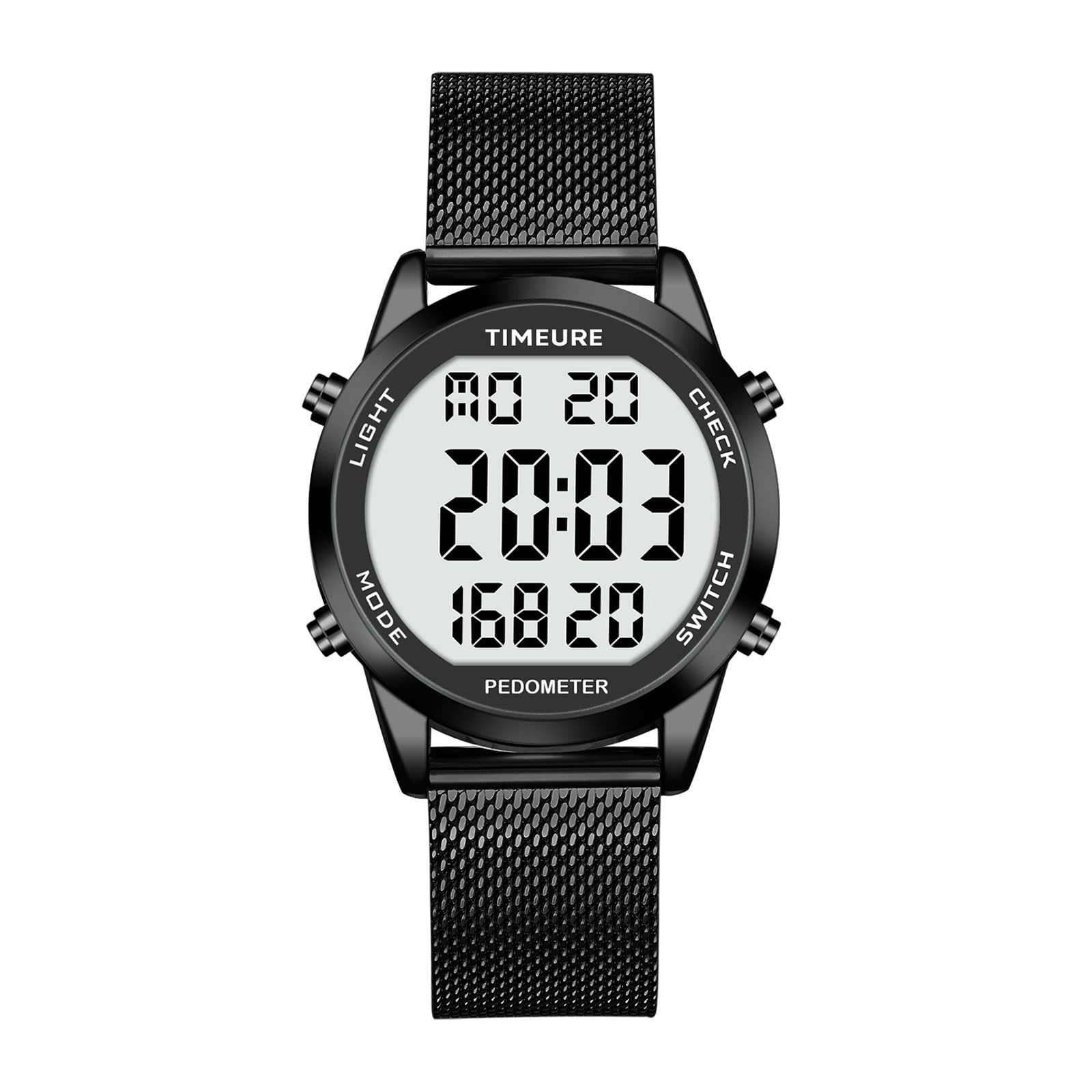
You want a watch that counts your steps but still looks like a watch. No glowing rectangle on your wrist, no nightly charging cable, no phone app nagging you to sync. The pick that satisfies that wish list best is the TIMEURE stainless steel pedometer watch. It pairs a 42-millimeter metal case with a stainless steel mesh bracelet that adjusts from 6.29 to 9.44 inches, runs on a CR2032 rated for up to 12 months, and never asks for a phone.
This guide is built by comparing the manufacturers’ published specifications and the patterns across verified customer reviews, so you get each pick’s real strengths and trade-offs instead of marketing spin.
The three watches below split cleanly into three jobs: everyday step tracking, hands-free voice readouts, and a teen-friendly starter. Keep reading to see which one belongs on your wrist, because the right analog watch with step counter is the one whose quirks you can live with.
Top Picks
How To Choose The Best Analog Watch With Step Counter
The hardest part of buying this category is not picking a brand. It is accepting that a watch on your wrist does not move like a pedometer clipped to your belt, so the software has to be smart about what counts as a step. Read the four points below before you click anything.
The movement filter is the whole ballgame
Your wrist swings when you stir a pot, fold laundry, or wave at a neighbor. A watch that logs every jiggle will flatter you with steps you never walked. So look for a published rule about how long movement must last before it registers. The TIMEURE, for example, ignores activity that stops before 10 seconds, then adds the earlier steps back once you keep moving past that mark. That 10-second threshold is the most useful accuracy spec in this category, and it is published in plain text rather than buried in a rating.
Battery type decides your routine
A rechargeable watch means a cable on your nightstand and one more thing to forget before a trip. A coin cell watch means you wear it and forget it until the battery finally gives out. The trade-off is honesty about lifespan: the TIMEURE states up to 12 months on a CR2032, while some buyers in that listing report shorter runs than advertised. Treat any battery claim as a best case, not a promise.
Fit range before face size
A 42-millimeter case sounds reasonable until the bracelet will not close on your wrist. The TIMEURE publishes its range openly: 6.29 to 9.44 inches, or 160 to 240 millimeters. Outside that 160-to-240-millimeter window, no strap adjustment will save the fit, so you need a different model. Check your wrist with a tape measure before you order anything in this category.
Decide if you want a voice or a glance
Some people want to press a button and hear their step total read aloud. Others want to tilt their wrist and read a number. The hands-free route suits walkers who carry bags or push a stroller; the glance route suits anyone who dislikes sound coming from their wrist. Pick voice if your hands are full on walks; pick a glanceable dial if you dislike sound from your wrist.
Side-by-Side Comparison
| Model | Best For | Power Source | Band / Material | Stated Weight | Amazon |
|---|---|---|---|---|---|
| TIMEURE TU-2306B★ Best Overall | Everyday walking without a phone | CR2032, up to 12 months | Stainless steel mesh, metal case | — | Amazon |
| NYSW Atomic Voice Pedometer Watch | Hands-free spoken step readouts | 1 CR2 battery | Stainless steel mesh band | 7.05 ounces | Amazon |
| PASNEW PSE-489 | Teens and smaller wrists | 2 lithium metal batteries (included) | Black, unisex-child sizing | 1.06 ounces | Amazon |
Detailed Reviews
1. TIMEURE TU-2306B Stainless Steel Pedometer Watch
Our pick — 4.0+★ from 200+ verified ratings; the strongest balance of quality and price.
A metal-cased watch that counts your steps and then leaves you alone for a year.
The TIMEURE wins this list because it solves the category’s central problem in the plainest possible way: it keeps counting when you stop fussing with it. Power comes from a CR2032 coin cell rated for up to 12 months, so there is no cable, no pairing screen, and no Bluetooth menu to fight. Put it on and walk. The 42-millimeter metal case and adjustable stainless steel mesh bracelet land it in grown-up territory rather than fitness-band territory.
The step filter is where this watch earns its keep. Brief, irregular hand movements under 10 seconds get ignored, and once movement continues past that mark the earlier steps are added back automatically. That is the difference between a watch that rewards you for chopping onions and one that counts a real walk. What wins people over is how basic and usable the whole thing feels. The function set covers steps, calories, and distance in miles or kilometers. It also gives you time, date, weekday, alarm, hourly chime, stopwatch, countdown timer, and a 5-second EL backlight (a glow light that stays on for 5 seconds) for reading in the dark.
It is a genuine head-to-head against the NYSW below on weight, though not in the direction you might guess: the TIMEURE has no published weight in its specs, while the NYSW lists 7.05 ounces. If portability is your deciding factor, that is the number to weigh. Water resistance is rated 30M, which covers handwashing, rain, and brief splashes — just do not press the buttons while the watch is wet. The honest catch is accuracy. It is the one attribute that splits opinion in the listing, with a meaningful share of owners finding steps drift from what they actually walked. Pair it with the movement filter and it behaves well; expect lab-grade precision and you will be disappointed.
What earns it the top spot
- Twelve months on a CR2032 means no charging routine at all
- 10-second movement filter cuts out fidget and false steps
- Steps, calories, and distance in miles or kilometers on one dial
- Fits wrists from 6.29 to 9.44 inches, published up front
- 5-second EL backlight for evening walks and dark stairwells
Where it asks patience
- Step accuracy is the attribute owners disagree on most
- 30M rating means splashes, not swimming or button presses underwater
- Battery life runs shorter than advertised for some
- No published weight, so you cannot compare grams before you buy
Wear this if: you want a metal-banded watch that tracks walking without a phone, an app, or a charger in your life.
Pass if: you need swimming-grade depth or you will be checking step counts against a calibrated treadmill.
2. NYSW Atomic Time Sync Analog Pedometer Watch
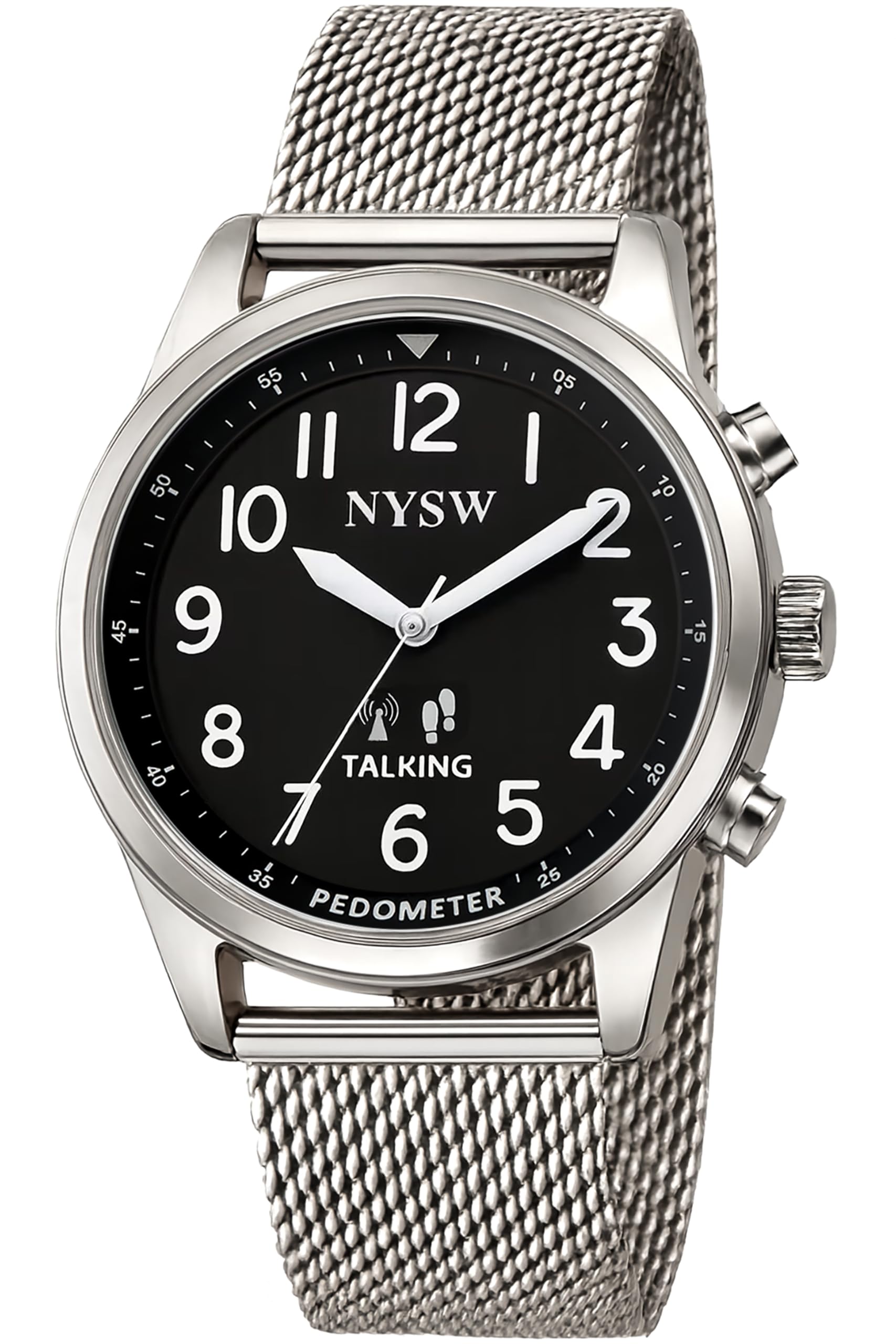
Press a button and a voice tells you your steps, so you never break stride to read a dial.
Start with the feature that makes this watch different from every other pick here: it talks. A button press gives you a clear female voice announcing steps, distance, and calories, and a second button reads out the time and date. If you walk with grocery bags in both hands or you push a stroller for an hour, that is a real convenience rather than a gimmick. Setup follows the same logic — you enter your weight and height with voice prompts guiding each button press, and the watch calculates your stride length from there.
The timekeeping is the other half of the story. The watch receives the WWVB atomic signal and syncs automatically at 3 AM, then stops receiving to conserve battery, which is why it runs on a single CR2 cell. Travel abroad or land somewhere without atomic coverage and you set it manually; it then keeps time on standard quartz movement. Choose Imperial in pounds and inches or Metric in kilograms and centimeters, and your settings stay saved in the watch.
Now the part you need to hear before ordering. The NYSW is the heaviest watch on this list at 7.05 ounces, and the PASNEW comes in at 1.06 ounces — that is roughly a 6.7-times gap between the two on the spec sheet. On a wrist, the difference reads as a substantial, solid piece versus something you forget you are wearing. Its stainless steel mesh band and classic analog face keep it looking professional, and there is no Bluetooth, no WiFi, no app, and no phone pairing of any kind, with EMF-free passive signal reception. Just know that the voice readouts and atomic sync are the reasons to choose it, not a slim profile.
The case for it: spoken step, distance, and calorie readouts solve the glance-down problem completely, and the 3 AM atomic sync means you rarely touch the time setting again.
What to know first: at 7.05 ounces it sits firmly on the heavy side, so you will feel it on your wrist. Atomic reception (the radio signal that sets the time for you) depends on where you live. And it is a standalone tracker by design — no export, no history, no app to look back through.
Made for: walkers who want their numbers spoken aloud while their hands are full, and anyone who likes a watch that sets its own time overnight.
Think twice if: you want a featherweight wrist or you split your year between countries outside atomic signal coverage.
3. PASNEW PSE-489 Digital Analog Watch for Teens

The lightest way onto a step-counting wrist — 1.06 ounces and a black case built for a teenager.
Not every buyer of an analog step counter is an adult logging daily miles. Some are parents shopping for a first real watch, and the PASNEW is aimed straight at that case. The maker lists it for ages 12 and up, in unisex-child sizing, with a black multi-function layout covering a pedometer and a stopwatch. Two lithium metal batteries come included, so it works the moment it comes from the start.
Weight is where this one runs away from the field. At 1.06 ounces it is dramatically lighter than the NYSW at 7.05 ounces, and its package dimensions of 3.11 x 2.99 x 2.99 inches make it a small parcel rather than a jewelry box. For a wrist that is still growing, that matters more than any spec sheet bravado — a heavy steel band on a slim wrist gets taken off and left in a drawer, and a light watch gets worn.
Here is the honest read. This listing is thin on detail compared with the other two: no published water resistance rating, no stated battery lifespan, and no written step-filter explanation. What you get is the brand’s own description as a multi-function PASNEW watch with a pedometer and stopwatch. If you need a published wrist-size range and a stated 30M depth rating before ordering, the TIMEURE above lists both. For a teenager’s first step-counting watch, 1.06 ounces with batteries in the box is the whole case for it.
The featherweight angle: 1.06 ounces on a growing wrist is the entire pitch, and it is a good one — this is the watch a kid forgets they are wearing.
Read the listing closely: water resistance, battery lifespan, and step-filtering rules are not published here, so buy it for what it plainly is rather than for specs you are assuming.
Reach for it if: you are equipping a teenager with a first step-counting watch and weight matters more than a published spec sheet.
Look elsewhere if: you need a stated water resistance rating or a documented wrist-size range before buying.
Know the Specs
Step Filter and Movement Threshold
A wrist-worn counter has to decide what counts. The published version of that rule on the TIMEURE is a 10-second threshold: motion shorter than that is discarded, and once you keep moving past it the earlier steps are added back. In practice this means chores and hand gestures stop inflating your number, while a continuous walk registers fully. When a listing states no such rule, as with the PASNEW, you are trusting the sensor without knowing its logic.
Coin Cell Versus Rechargeable Power
The TIMEURE runs a CR2032 rated for up to 12 months and the NYSW runs a single CR2, and the PASNEW ships with two lithium metal batteries included. None of them need a charging cable. The trade-off is that a coin cell dies quietly rather than warning you at 20 percent, and published lifespans are best-case figures — some TIMEURE buyers report shorter runs than advertised. Budget for a replacement cell and the whole category stays maintenance-free.
Water Resistance Ratings Decoded
A 30M rating on the TIMEURE covers handwashing, rain, and brief exposure, and the maker specifically warns against pressing buttons underwater. That is a splash rating, not a swimming rating. The NYSW and PASNEW publish no depth figure at all in their specs, so treat them as Dry-day watches until the maker says otherwise. Nobody in this group should go in a pool.
Atomic Time Sync and Travel
The NYSW receives the WWVB atomic signal and syncs nightly at 3 AM, then stops receiving to save battery. That keeps it accurate without you touching a setting — until you leave the signal’s coverage area. Abroad, you set the time manually and it runs on quartz movement from there. It is a convenience for home use, not a travel feature, and it is worth knowing before you pack it.
Common Questions
Do analog step counter watches count steps as accurately as a clip-on pedometer?
Will the TIMEURE mesh bracelet fit a large wrist?
How long does the battery actually last on these watches?
Can I swim with the TIMEURE at 30M water resistance?
What is atomic time sync and do I need it?
Does the NYSW voice watch need a phone or an app?
Which watch here is lightest for a teenager?
Do these step counter watches track distance in miles or kilometers?
Can I read the TIMEURE in the dark?
The Bottom Line
For most people shopping for an analog watch with step counter, the answer is the TIMEURE TU-2306B. It gives you metal on the wrist, a published 10-second movement filter, 30M splash protection (safe for rain and handwashing, not swimming), and a CR2032 battery that runs up to 12 months without a cable. If you would rather hear your step total than look at it, the NYSW Atomic Voice Pedometer Watch speaks steps, distance, calories, time, and date on demand. And for a teenager’s first step-counting watch, the PASNEW PSE-489 at 1.06 ounces is the one that will actually stay on the wrist. Match the watch to how you actually walk: metal and a movement filter for daily miles, voice readouts for full hands, 1.06 ounces for a teenager.
How we choose
We do not accept paid placement. Every pick is matched to a real buyer and a real use-case; we do not hands-on test units.
Sources
Specifications: manufacturer listings and product documentation. Review insights: verified customer reviews, as of November 2026. Pricing: not shown on this page (it changes often); check the current price via the retailer link.
As an Amazon Associate, My Heart Lives Here earns from qualifying purchases. This does not affect which products we feature.