Heads up: This post contains affiliate links. As an Amazon Associate I earn from qualifying purchases, at no extra cost to you. Learn more
Specs are compiled from manufacturer listings and verified buyer reviews and can change over time — please confirm the key details on the product page before buying.
Water finding a way through your roof is a problem you want closed today, not next weekend. The tricky part is that roofing tar is a loose label covering very different products — a pourable self-leveling sealant, a sticky flashing tape, a brush-on liquid rubber, a reinforcing fabric, and a thick trowel-grade cement. Pick the wrong one and you will be back up the ladder within a season. The five picks below are sorted by what they actually repair, so you can match the product to the leak instead of guessing.
This guide is built by comparing the manufacturers’ published specifications and the patterns across verified customer reviews, so you get each pick’s real strengths and trade-offs instead of marketing spin.
Two things decide whether a roof repair survives the weather: what surface you are sticking to, and how much movement that surface makes. Everything else is detail. Here is how to match the right Roofing Tar to the leak you are actually staring at.
Top Picks


How To Choose The Best Roofing Tar
Start by naming the shape of the failure. A pinhole over a screw head, a seam that has opened between two panels, a hairline crack in a parapet wall, and a rotted patch around a vent boot all want different products. Buying a thick cement for a hairline crack, or a thin liquid for a gap you can see daylight through, is the most common way a repair fails twice.
Match the product form to the repair
A self-leveling sealant pours out and flattens itself into a puddle, which makes it the right answer for horizontal surfaces like RV roofs and flat roof membranes. A flashing tape is a roll you press down over seams, gutters and window edges where you need instant grab without waiting for anything to cure. A brush-on liquid rubber coating is for broad coverage — a whole panel, a foundation wall, a masonry face. A roofing cement is the thick, trowel-grade material for filling a hole and holding a patch in place. Reinforcing fabric is not a sealer at all; it embeds into a wet coating to bridge a crack so the repair can flex instead of splitting.
Read the temperature range and the surface compatibility
Cold weather is where roof repairs go wrong. A product with a stated lower limit tells you the floor you can safely work in, and products without one should be treated as fair-weather friends. Surface compatibility matters just as much — some membranes and polypropylene RV roof accessories need a primer before any sealant will bond, and a coating that will not stick to a painted or plastic surface is the wrong purchase no matter how good it looks in the can.
Side-by-Side Comparison
| Model | Best For | Form | Size | Stated Temperature Range | Amazon |
|---|---|---|---|---|---|
| Dicor 610SASLW-1 Self-Leveling Sealant★ Best Overall | Flat RV and membrane roofs | Pourable liquid | 10.1 oz | — | Amazon |
| BXI Flashing Roll Tape MembraneBest for Seams | Seams, gutters and deck joists | Self-adhesive roll | 4 in x 32 ft | 5°F to 158°F | Amazon |
| Flex Seal Liquid Rubber Coating | Broad brush-on waterproofing | Brush, roll, dip or pour liquid | 32 oz | — | Amazon |
| Liquid Rubber Geo-Textile Fabric Roll | Bridging cracks and seams | Stitch-bonded polyester fabric | 4 in x 160 ft | — | Amazon |
| HENRY HE208042 Gal Roof Cement | Filling holes and setting patches | Trowel-grade cement | 0.90 gal (3.41L) | — | Amazon |
Detailed Reviews
1. Dicor 610SASLW-1 Self-Leveling Ultra Sealant System
Our pick — 4.5+★ from 550+ verified ratings; the strongest balance of quality and price.
Pours on wet, flattens itself out, and saves you the smoothing job
The whole point of this sealant is that you do not have to work it. A 10.1 oz tube of polyurethane pours out liquid and spreads into a level puddle on its own, which is exactly what you want over a screw head or a small tear on a flat RV roof. Covering the repair and walking away is the entire method. That self-leveling behavior is the trait owners bring up again and again, and it is why this takes the top slot for anyone patching a horizontal membrane.
The formula carries no solvents or isocyanates, so there is no harsh solvent smell hanging over the job while it cures. You can paint over it with most paints if you want the repair to disappear completely. The brand also lists aluminum, brass and steel among the metals it bonds to.
Here is the catch, and it is a real one. Some RV membranes and polypropylene roof accessories need the Dicor Ultra Sealant Primer applied first, or the sealant will not bond properly. Skipping that step is the fastest way to waste a tube. Owners also split on longevity — some get several years out of a repair while others see issues sooner — and the can itself has been known to break during use, so treat it as glass rather than a football. Value is the other divider: some call it well worth it, others find it a touch pricey for the tube size.
Where this sealant earns its keep
- Self-leveling liquid flattens into a clean puddle with no tooling needed
- Solvent-free and isocyanate-free formula with no harsh smell during curing
- Non-yellowing white finish holds its color through long sun exposure
- Paintable with most paints so the repair can blend into the roof
What to know before you buy
- Certain RV membranes and polypropylene accessories need the Ultra Sealant Primer first
- Longevity reports vary — some repairs hold for years, others not as long
- The can has been known to break mid-job, so handle it carefully
Reach for this if: you are sealing a flat RV roof or membrane and want a repair that smooths itself out.
Check first: whether your membrane calls for the primer — this is the one step that decides whether the sealant bonds at all.
2. BXI Flashing Roll Tape Membrane, 4 inches X 32 Feet
Thirty-two feet of peel-and-press repair for the seams a liquid sealant cannot reach
The first thing that separates this from the tube sealant above is coverage: 4 inches wide by 32 feet long, versus 10.1 oz of pourable liquid. That is a different job entirely. A flashing tape is what you press over a seam, a gutter edge, a deck joist or a window frame — anywhere the surface is vertical or awkward and you cannot wait for something to flow. You cut it with a utility knife or scissors, peel the backing, and press it down. No primer, no torch.
The construction is a high-quality SBS polymer modified rubber asphalt core with a silver aluminum foil backing and a polyethylene film. The bitumen core works into existing cracks and gaps and fills them, so the seal tightens over time rather than sitting on top. The foil face is paintable and UV-resistant, and the material is listed as thick, flame retardant, puncture resistant and abrasion resistant. The stated working range of 5°F to 158°F is the detail worth highlighting — this is one of the few picks here that publishes a cold-weather floor, so you can work it well into winter.
Adhesion is the honest sticking point, and it is genuinely split. Applied to a smooth, flat, dry surface it grabs extremely hard; on a dusty, damp or textured one it can refuse to stick at all. Prep is the whole game, and the manufacturer says so plainly. Durability also divides opinion, with some repairs holding past half a year and others falling short of expectations. Weigh that against the roll length and the fair-weather-free application window, and it is still a strong buy for anyone chasing a seam.
Weight and bulk reality: at 4 pounds this roll is twice the heft of the 32 oz Flex Seal liquid, so plan to carry it up the ladder rather than tuck it in a pocket. That mass comes from the thick asphalt core, which is also why it bridges a gap instead of tearing across one.
Pick this when: the leak traces back to a seam, gutter, deck joint or window edge and you want it closed in minutes.
Prepare properly: the surface must be clean, dry and flat — that single step is what separates a permanent bond from a peel-off.
3. Flex Seal Liquid Rubber Sealant Coating, Black, 32 oz
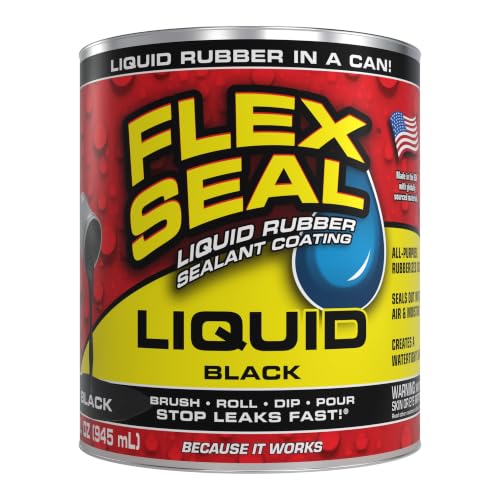
The one can you can brush, roll, dip or pour — a whole-panel waterproof skin in one go
Nobody buys a 32 oz can to fix a single screw hole. This is a coating, and its job is broad coverage: a panel, a masonry face, a foundation wall, a gutter line. You can brush it, roll it, dip a part in it, or pour it on, which means one product covers the widest spread of repairs in this whole group. It goes on smooth, seals out water, air and moisture, and it is UV resistant.
Because it is a rubber coating rather than a thin sealer, it also prevents rust and corrosion and resists chemicals — useful on metal. Compare the footprint with the Dicor tube: 4.75 x 4.25 x 4.25 inches for this can versus 11.5 x 2 x 2 inches for the sealant, a tube-shaped package against a squat tub. It is a 2 pound can, so it is easy to carry, easy to store on a shelf, and easy to dip a brush into without a funnel.
The trade-off with a coating this thick is curing. The review pages split almost evenly on drying time — some find it sets quickly and leaves a heavy rubbery layer, others find it takes forever to dry. Durability is the bigger question: it holds well for plenty of people, but peeling within a year is a recurring theme, and it does not adhere to latex house paint or PVC irrigation pipe. Durability and value show up as the most debated points in owner feedback, which tells you this is a great product for the right surface and a frustrating one for the wrong one.
Best suited to: rust protection, broad panel sealing, and anyone who wants one can that handles brush, roll, dip and pour work.
Know the limits: latex house paint and PVC irrigation pipe will not take this coating, so confirm your surface before you open the can.
4. Liquid Rubber Geo-Textile Fabric Roll, 4 Inch x 160 Foot
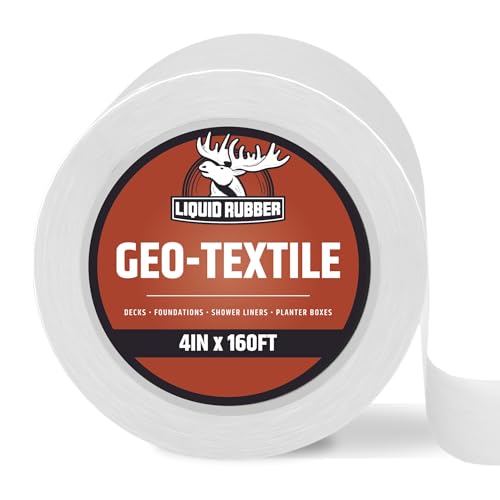
Not a sealant at all — the fabric that stops a crack from reopening
Stop and read this one carefully, because it is the pick most people misunderstand. This 4 inch by 160 foot roll is stitch-bonded polyester, described by the maker as one of the strongest materials available in the roofing industry. It is not waterproof on its own. It is a reinforcement that embeds into a wet coating to build plies and bridge gaps, cracks, joints, seams, vents and skylights. The coating does the sealing; the fabric stops the repair from splitting when the surface moves.
The application is genuinely approachable. Wearing disposable gloves, you lay down a heavy coat of Liquid Rubber coating, cut the geo-textile to size, press it into the wet coating and let it bleed through, then add more coats as needed. The maker’s own comparison is drywall — you are taping a joint, just on a roof. It pairs with waterproof sealant, color sealant, RV roof coating, foundation sealant, polyurethane deck coating and more, so it slots into a system rather than standing alone.
The 160 foot length is what makes this the long-haul option here; it covers far more lineal footage than the 32 foot BXI tape, and it is priced in the same neighborhood as a single can of liquid coating. What holds it back is tack. Adhesiveness is the one aspect that runs negative, with owners reporting it does not stick well and is hard to work into place — almost certainly a sign of too little wet coating underneath. Embed it into a properly heavy coat and it does what it promises.
Why fabric changes the outcome: a liquid coating alone will crack again wherever the substrate flexes. Embedding polyester into the wet layer turns a surface patch into a bridging layer that flexes with the substrate instead of splitting.
Takes the job when: the crack or seam moves, and you want a repair that flexes instead of splitting next season.
Pair it, do not substitute it: this needs a wet Liquid Rubber coating underneath — used alone it will not waterproof anything.
5. HENRY HE208042 Gal Roof Cement

Thick, black, and stubborn enough to fill a hole no liquid will stay in
This is the old-school answer, and it solves the problem none of the liquids can. A 0.90 gal (3.41L) pail of trowel-grade roof cement fills a major hole, holds an asphalt shingle back down, and stays where you put it. The acrylic-based black cement is rated to adhere to wet surfaces, which is the detail that matters when you are up on a roof after rain and cannot wait for perfect drying conditions.
What it does best is brute-force repair. Owners describe it working on metal roofs and major holes, and it spreads easily out of the pail rather than fighting the trowel. It also stops leaks and keeps water out with no curing step. If the failure is a crater rather than a hairline, this is the pick. The liquid sealants above would simply run out of it.
The honest limit is sunlight. Durability is the weakest aspect here, and cracking under sun exposure after a single summer is the recurring report. That cracking does not mean the repair failed on day one, but it does mean this cement suits a shaded or protected area, or a first-stage repair you plan to coat over later. Value divides owners too — plenty call it a good deal for the coverage, others find it expensive for a single pail. Adhesion holds on shingles and slips elsewhere, so surface prep still counts.
Choose this for: a big hole, a lifted shingle, or a metal roof repair where you need material that stays put.
The sun caveat: this cement is prone to cracking under direct summer exposure — plan to top-coat it or keep it out of the worst of the light.
Know the Specs
Form: liquid, tape, cement or fabric
A product’s form tells you what it can physically do before any other spec matters. A pourable self-leveling sealant flows flat on horizontal surfaces. A self-adhesive roll presses onto seams and vertical edges. A brush-on coating spreads over broad areas. A thick trowel-grade cement fills a cavity. Fabric embeds into a wet coating to bridge movement. Buying the wrong form for the shape of the failure is the single biggest reason a repair needs doing twice.
Coverage: ounces against square footage against lineal feet
Coverage numbers are not interchangeable, so read the unit carefully. A 10.1 oz tube of sealant covers small point repairs. A 32 oz can of liquid coating spreads over a panel. A 4 inch by 32 foot tape covers a seam run, while a 4 inch by 160 foot fabric roll covers far more lineal footage. A 0.90 gal (3.41L) pail of cement covers a hole area. Match the unit to the size of the job, or you will run out halfway across the roof.
Temperature range and cold-weather work
Roof repairs do not wait for mild weather. A stated temperature range is your working window: the BXI tape publishes 5°F to 158°F, so it stays workable in cold. Products without a published range should be treated as warm-weather products. Applying a sealant below its rated floor is a common cause of a bond that never forms.
Surface compatibility and primer requirements
Adhesion is decided by the surface, not the product’s reputation. Some RV membranes and polypropylene roof accessories require a primer before a sealant will bond. A liquid rubber coating will not adhere to latex house paint or PVC irrigation pipe. Flashing tape needs smooth, flat and dry surfaces to grab at all. Check the compatible materials list before you buy, and prep accordingly.
Common Questions
Can I use self-leveling sealant on a sloped or vertical roof surface?
Does the Dicor sealant work on every type of RV roof?
How cold can I apply a flashing tape outside?
Why will flashing tape not stick to my roof?
Can I use Flex Seal Liquid over painted exterior walls or PVC pipe?
Do I need separate products to repair a crack, or will one can do it all?
How much lineal coverage does one geo-textile roll give me?
Is roof cement better than liquid rubber for a large hole?
How long do these roof repairs usually hold up?
Can I paint over these sealants once they cure?
The Bottom Line
The best overall Roofing Tar here is the Dicor 610SASLW-1, because a self-leveling liquid that flattens itself does the whole job on a flat RV or membrane roof with no tooling — just confirm whether your membrane needs the primer first. If your leak traces to a seam, a gutter or a deck joint rather than a flat panel, grab the BXI Flashing Roll Tape, which gives you 32 feet of peel-and-press repair with a stated 5°F to 158°F working range. And for a hole big enough that liquids would run straight out of it, the HENRY Roof Cement is the one to reach for — just expect to keep it out of the worst of the summer sun. Plan on one product for the sealing and, where the surface moves, the Liquid Rubber Geo-Textile to hold the repair together.
How we choose
We do not accept paid placement. Every pick is matched to a real buyer and a real use-case; we do not hands-on test units.
Sources
Specifications: manufacturer listings and product documentation. Review insights: verified customer reviews, as of November 2026. Pricing: not shown on this page (it changes often); check the current price via the retailer link.
As an Amazon Associate, My Heart Lives Here earns from qualifying purchases. This does not affect which products we feature.