Heads up: This post contains affiliate links. As an Amazon Associate I earn from qualifying purchases, at no extra cost to you. Learn more
Specs are compiled from manufacturer listings and verified buyer reviews and can change over time — please confirm the key details on the product page before buying.
Red light glasses are a confusing shelf because two very different jobs share one name. One set keeps bright therapy panels and IPL hair-removal flashes out of your eyes while you treat your face. The other sits ON your face as the device itself. Buying the wrong kind wastes your money and does nothing for your skin, so start by deciding which job you actually need done.
This guide is built by comparing the manufacturers’ published specifications and the patterns across verified customer reviews, so you get each pick’s real strengths and trade-offs instead of marketing spin.
The quick read: a protective pair around the eyes is a filter decision, while a wearable panel is a skincare routine decision. Below you get both, spelled out in plain words, as I break down the red light glasses worth putting on your face or over your eyes.
Top Picks

How To Choose The Best Red Light Glasses
The first thing to settle is which product you are actually shopping for. Protective goggles go over your eyes while a separate lamp or IPL handset does the work. A wearable beauty panel is the light source, and the “glasses” in that kit are simply a spare pair to shield your eyes during the session. Mixing those two up is the most common mistake on this shelf.
Match the filter to the light you own
A pair only helps if its stated wavelength range covers the light coming at you. IPL and laser hair removal throws off a broad mix of light, so look for a wide range printed right on the listing, such as 200-2000nm. If you are treating your face with a near-infrared panel, check that the range is named too. A pair with no stated range tells you nothing about what it stops.
Optical density and certified testing
Optical density, or OD, is the number that describes how strongly a lens cuts light down. A higher number means less light gets through to your eye. You will also see certification language, such as testing by an external service for eye protection and personal protective equipment. Treat that paperwork as one more reason to trust the filter claim rather than a guarantee of any health outcome.
Fit over your everyday frames
Most people wear these over their prescription glasses, so the frame needs to clear your own lenses without pressing on your temples. An over-the-glasses design with side shields covers the gaps at the edges where stray light slips in. Head size matters here too: a frame that is slightly large will slide, while a snug one stays put through a whole session.
Side-by-Side Comparison
| Model | Best For | Stated Wavelength Range | Over-Prescription Fit | Frame / Build | Amazon |
|---|---|---|---|---|---|
| JILERWEAR IPL Safety Glasses★ Best Overall | Laser and IPL sessions on a budget | 190-450, 560-1200nm | — | 3.17 oz | Amazon |
| Under-Eye Red Light Therapy Beauty Glasses | Wearable under-eye treatment at home | — | — | 2 modes with eye massage | Amazon |
| LaserPair IPL Safety Glasses | Techs and home users needing wide coverage | 200-2000nm | Yes, over-the-glasses | TR90 frame, anti-fog polycarbonate | Amazon |
Detailed Reviews
1. JILERWEAR IPL Safety Glasses
Our pick — 4.5+★ from 650+ verified ratings; the strongest balance of quality and price.
The dependable workhorse for anyone running an IPL handset at home.
It takes the top spot because it covers a wide slice of the light spectrum at just 3.17 ounces. Its stated range of 190-450, 560-1200nm catches the blue, green and near-infrared bands that IPL and laser devices throw out. It tips the scales at 3.17 ounces, so it sits on your face without dragging. The crowd favorite here — 4.5+ stars across 670+ ratings — shows that most buyers walk away satisfied.
What wins people over is the shielding itself. Blocking harmful light is the thing buyers praise most, with fit and comfort close behind, and the frame is reported to settle on the face correctly. The lens has one small quirk worth knowing: it is a strong filter, so the room will look noticeably darker than you expect, and a few people find the tint heavier than they wanted. That is the nature of blocking light, not a flaw in the build.
The catch is durability: a minority of owners describe the frame as fragile. Most owners say the pair holds up, but a handful describe the frame as fragile, so treat it like the piece of protective gear it is and store it in the included case. Consider a second pair pointless unless you want one for a partner — one set covers a single person fine. For a home IPL routine that needs reliable eye cover without stretching a budget, this is the one to grab.
What earns its spot
- Wide 190-450, 560-1200nm range covers blue, green and near-infrared light
- Only 3.17 ounces, so it stays light on the face
- Comes with a case and cleaning cloth to keep the lens clear
- Fit and comfort both land as top positives among buyers
Where it asks for care
- Frame is described as fragile by a minority, so store it in the case
- The strong filter leaves the room darker than some people expect
Go for this: home IPL users who want proven light coverage at an entry-level price.
Hold off: if you need a pair that slips over thick prescription frames — this one does not list an over-the-glasses design.
2. LaserPair IPL Safety Glasses

The specialist pair that covers the widest light range here and slips over your own frames.
For beauty technicians and heavy home users, this is the more serious set. Its filter is rated from 200 to 2000nm, which is a far broader span than the JILERWEAR pair’s stated 190-450, 560-1200nm. Broad coverage matters because it catches UV and infrared light on both ends, not just the visible middle. The lens uses anti-fog treatment, so it will not cloud up midway through a longer treatment session.
The build is where the money has gone. A TR90 frame — a flexible, lightweight plastic — keeps the weight down despite the full-rim design. Scratch-resistant polycarbonate lenses and 360-degree side shields close the gaps at the edges where stray light leaks in. It is designed to be worn over prescription glasses, so spectacle wearers are not left out. The kit adds a hard case and a cleaning cloth.
The honest trade-off is fit: the full-rim frame runs large on smaller heads. Some heads are smaller than the frame expects, so a minority find it sits a little large and shifts during use, and a couple of owners question the value. Those are real points to weigh, not reasons to dismiss it. If you want broad 200-2000nm coverage and side shielding for a working set, this is the one.
Built for long sessions
- Broad 200-2000nm filter spans UV through infrared light
- Anti-fog polycarbonate lenses keep vision clear in longer treatments
- Designed to be worn over prescription glasses
- 360-degree side shields close off edge light
- Ships with a hard case and cleaning cloth
Worth measuring before you buy
- Some find the frame slightly large, so it can shift on a smaller head
- Value is a mixed point — a few owners think the price is high for the build
Reach for this: if you want the widest wavelength coverage in the group and need to wear it over your own frames.
Look elsewhere: if you have a small head and want a frame that will not shift during a session.
3. Under-Eye Red Light Therapy Device
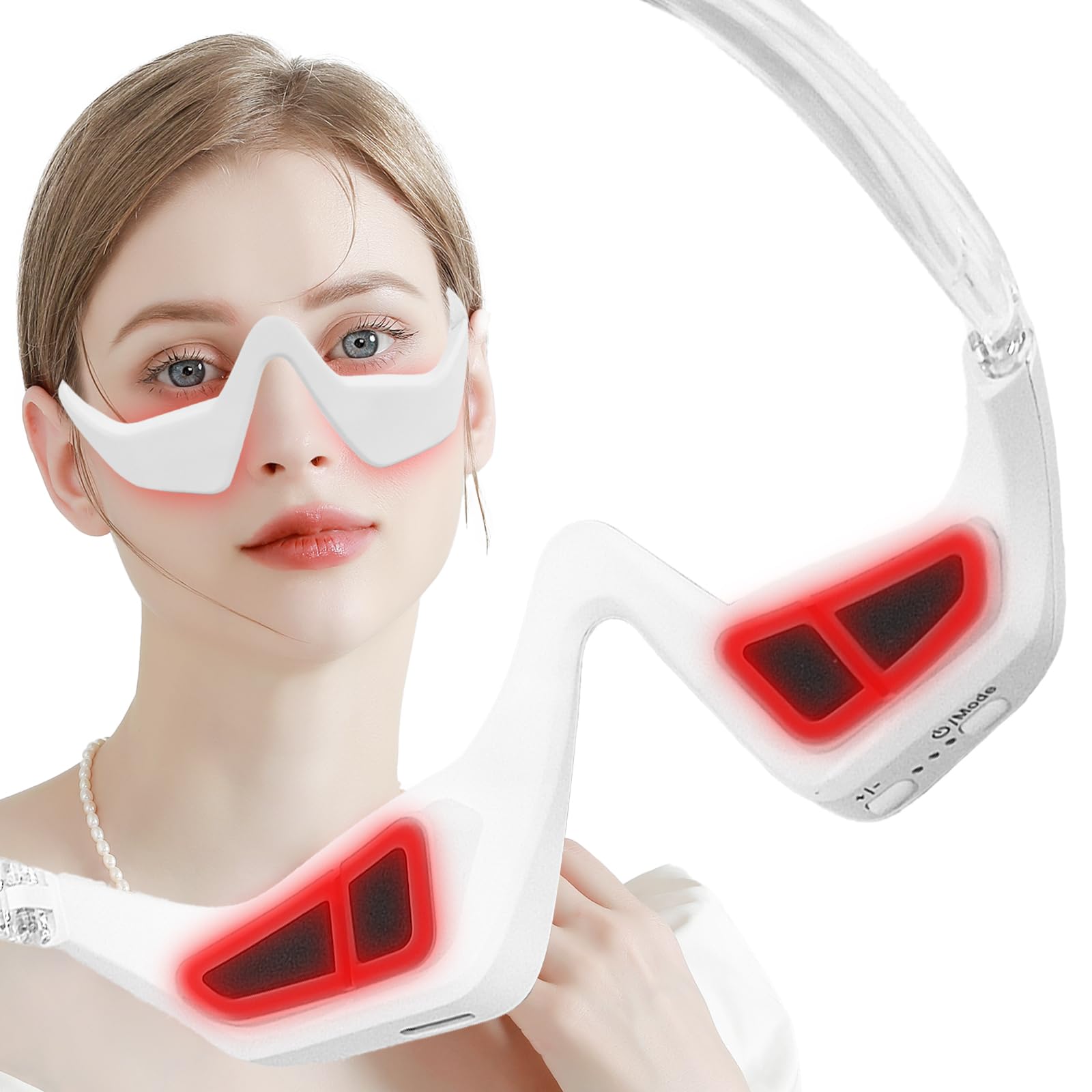
The one that wears its light rather than shielding your eyes from someone else’s.
This is a different animal from the filter goggles above. It is a wearable beauty device that sits under your eyes and lights that area itself, with two modes and a built-in eye massage. If your goal is a small at-home treatment rather than protection from an IPL flash, this is the shape you want. Its box measures 6.34 x 4.17 x 2.83 inches, compact enough to tuck in a drawer.
Against the INTEO panel, which comes in a 12.24 x 8.7 x 2.48 inch package, this piece is the smaller, simpler option for targeting just the under-eye zone. It does not carry the multiple wavelengths or the magnetic battery the larger panel packs. Do not put this on expecting full-face coverage — its job is narrower.
The catch is simple: it is a light-duty under-eye device, not a professional filter and not a full-face lamp. If you already own an IPL handset and just need eye protection, this is the wrong pick. If you want a low-commitment under-eye gadget to try, it fits that lane.
Who it serves: someone curious about under-eye light treatment who wants a small, simple wearable with a massage function and no full-therapy kit behind it.
The narrow case: buy it to experiment with under-eye light at home.
The mismatch: it is not a protective filter, so skip it if you are shielding your eyes from an IPL or laser device.
4. INTEO Red Light Therapy

The full face-and-body rig for anyone who wants the light source and the goggles in one box.
Here the goggles are a bonus, not the product. This is a portable red light panel that packs in four wavelengths — combining red, near-infrared, blue and yellow — spread across six modes. Its 850nm near-infrared band penetrates deeper than visible red, which is why it is the wavelength used for skin work. It weighs 1.82 lb and is only 0.59 inch thick, so it slips into a backpack. The package arrives at 12.24 x 8.7 x 2.48 inches — noticeably more compact a footprint than the 6.34 x 4.17 x 2.83 inch box the Under-Eye device comes in.
The good bits are practical: a magnetic battery, auto shut-off, voice prompts and an adjustable bracket. A magnetic battery means you are not tethered to a wall socket, so you can set it up anywhere you are comfortable. Each mode has a set time, and when it ends the light and the device both power off on their own, so it will not stay on if you drift off. A voice prompt walks you through switching it on, and the integrated bracket adjusts to your own angle. The maker describes its sleep and repair modes as covering pre-bed and post-sun routines.
The catch is the commitment: this is a full routine device, not a quick add-on. For a full at-home light routine that includes the goggles, it delivers the most here.
Pick this if: you want an all-in-one face and body light panel with protective goggles and cordless freedom in the box.
Pass if: you only need eye protection for a separate IPL device, in which case a filter pair does the job.
Know the Specs
Wavelength Range
Wavelengths are measured in nanometers (nm) — each nm a sliver of light on the spectrum. A wider stated range, like 200-2000nm, means the lens catches more kinds of light, from UV through infrared. Match that range to the light your device emits, or your eyes can be exposed to the part it misses.
Optical Density (OD)
Optical density is a rating of how strongly a filter cuts light down. A higher OD means less light reaches your eye. When a lens claims an OD figure, treat that as the short version of its blocking power, and always combine it with the stated wavelength range.
Over-the-Glasses Fit
Many people wear safety goggles on top of their everyday prescription frames. A design listed as over-the-glasses, with side shields, covers the corners where light leaks in. Frame material such as TR90 keeps that bigger frame light on your face.
IR vs. Visible Red Light
Near-infrared light, often the 850nm band, is invisible yet used in skin devices; the visible red you see is a different band. A filter pair will block this on purpose, while a treatment panel emits it. Know which side of the line your product sits on.
Common Questions
Do red light therapy goggles block the light from my own LED mask?
Will these safety glasses fit over my prescription frames?
What does the optical density rating on safety goggles mean?
Can I wear red light goggles instead of a full red light panel?
Are anti-fog lenses worth it for longer IPL sessions?
How long can I safely leave a red light panel on my skin?
Is a near-infrared 850nm panel safe to look at directly?
Can I use these goggles with a laser hair removal pen?
The Bottom Line
For most people hunting the red light glasses shelf, the JILERWEAR IPL Safety Glasses is the winner — it covers a wide 190-450, 560-1200nm range at 3.17 ounces and keeps a giant share of buyers happy, so it earns its top slot. If you want the widest coverage and need to wear it over your own frames, the LaserPair pair is the one to reach for. And for a full at-home light routine with the goggles included, the INTEO panel gives you the light source and the shielding in a single box — the complete setup if you are building out a routine rather than just protecting your eyes.
How we choose
We do not accept paid placement. Every pick is matched to a real buyer and a real use-case; we do not hands-on test units.
Sources
Specifications: manufacturer listings and product documentation. Review insights: verified customer reviews, as of November 2026. Pricing: not shown on this page (it changes often); check the current price via the retailer link.
As an Amazon Associate, My Heart Lives Here earns from qualifying purchases. This does not affect which products we feature.