Heads up: This post contains affiliate links. As an Amazon Associate I earn from qualifying purchases, at no extra cost to you. Learn more
Specs are compiled from manufacturer listings and verified buyer reviews and can change over time — please confirm the key details on the product page before buying.
You want power for the camper, the tailgate, or a blackout night — but you do not want the whole campground staring at you. That is the real job of a quiet portable generator: staying under the noise line while still running your fridge, your AC, or your laptop. The picks below cover the spectrum, from a battery box that makes almost no sound at all to gas inverters rated as low as 52 dBA (a decibel is a unit of loudness — a normal chat sits around 60).
This guide is built by comparing the manufacturers’ published specifications and the patterns across verified customer reviews, so you get each pick’s real strengths and trade-offs instead of marketing spin.
Quiet is not one number. It depends on how loud the unit is, how far you stand from it, and whether it has a battery or a gas engine — so here is what actually decides that, laid out for the quietest portable generators worth your money.
Top Picks
How To Choose The Quietest Portable Generator
The loudness number on the box is your starting point, not the whole story. A generator rated at 52 dBA measured from 23 feet will be noticeably easier on your ears than one rated at 60 dBA, because decibels climb on a curve — every extra few points is a real jump in perceived volume. Always check the distance the maker measured from, since a rating taken up close looks worse than the same unit rated from farther away.
Battery power stations versus gas inverters
A battery unit like the Anker SOLIX runs silent because there is no engine — nothing to hear but the fan. A gas inverter still has a motor, so its quiet comes from a fully enclosed shell and eco mode. If you need overnight silence indoors or in a tent, the battery route wins. If you need days of fuel-fed runtime, a gas inverter is the practical pick.
Running watts, peak watts, and what your appliances draw
Peak watts cover the brief surge when a motor starts; rated watts are what the generator can hold. A camper AC or a fridge compressor spikes on startup, so you size to the surge, then live on the rated number. Clean power matters too — a low THD (total harmonic distortion, the wobble in the electrical wave) protects laptops and phones from damage.
Weight, outlets, and safety features
Portability is a real spec, not a nicety. A 39.7-pound unit you can lift into a truck bed beats a 105.8-pound one you dread moving. Check the outlet types against your gear: a TT-30R is the standard 30-amp RV plug, and USB ports save you bringing a brick. A CO (carbon monoxide) shutdown sensor is worth insisting on for any gas unit used near a camper or home.
Side-by-Side Comparison
| Model | Best For | Quiet Rating | Power | Weight | Amazon |
|---|---|---|---|---|---|
| Anker SOLIX C2000 Gen 2★ Best Overall | Silent indoor backup | Silent (battery) | 2,400W rated / 4,000W peak | 41.7 lb | Amazon |
| Cummins Onan P4500IRV Workhorse | RV and job-site power | — | 7.3 hp / 224cc | — | Amazon |
| PowerSmart 3800Best Value | Quiet camping on a budget | 59 dBA at 23 ft | 3,200W rated / 3,800W start | 47 lb | Amazon |
| Aceup Energy 4000 | Lightweight RV-ready | ~60 dB in Eco mode | 3,200W rated / 4,000W peak | 50 lb | Amazon |
| Pulsar PGD40ISCO | Compact emergency power | 59 dB | 3,200W rated / 4,000W peak | 47.3 lb | Amazon |
| Champion 2500-Watt | Lightest quiet option | 53 dBA at 23 ft | 1,850W rated / 2,500W start | 39.7 lb | Amazon |
| WEN 56360i | Reliable daily camper power | — | 2,900W rated / 3,600W surge | 46 lb | Amazon |
| WEN 56477i | Big power with wheels | — | 4,000W rated / 4,800W surge | 72.7 lb | Amazon |
| Westinghouse 4000 Dual Fuel | Propane quiet and remote start | 52 dBA | 3,300W rated / 4,000W peak | 62.8 lb | Amazon |
| Westinghouse 5000 | Long-run home backup | 52 dBA | 3,900W rated / 5,000W peak | 105.8 lb | Amazon |
| Honda EU3000iS | Quietest gas premium pick | 50–57 dB(A) | 3,000W | 144 lb | Amazon |
Detailed Reviews
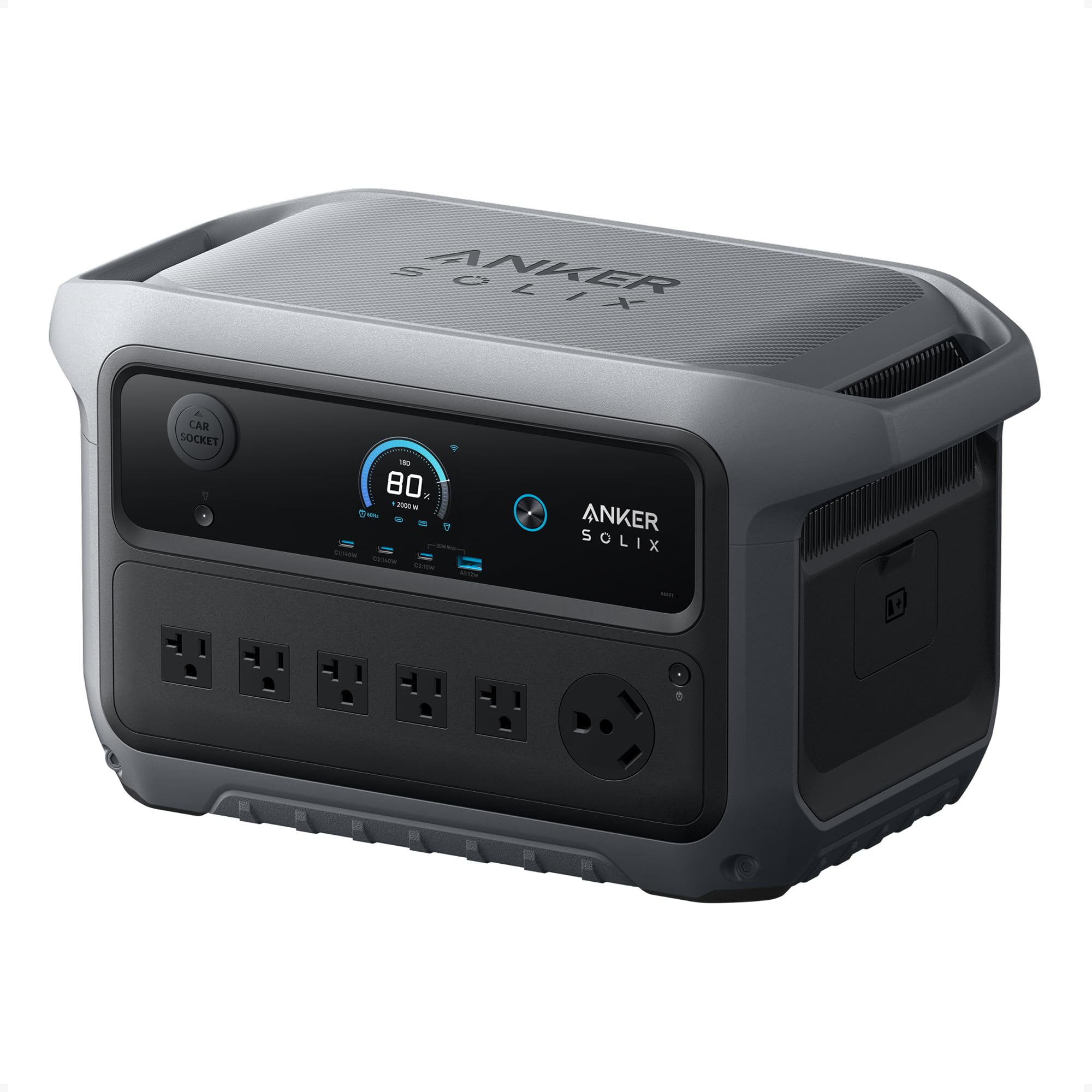
1. Anker SOLIX C2000 Gen 2 Solar Powered Generator
Our pick — 4.5+★ from 750+ verified ratings; the strongest balance of quality and price.
The one that makes zero engine noise — because there is no engine
If you want true silence, this is the answer: the C2000 Gen 2 is a battery power station, so there is no motor to hear, only a fan. Its 2,048Wh LiFePO4 battery feeds 2,400W rated and 4,000W peak output. That peak is enough for most window and RV air conditioners, per the maker, which is the hard part for battery units.
The efficiency story is the standout. Buyers report just 9W of standby draw and up to 32 hours on a dual-door fridge. An expansion battery doubles that to a 4kWh pool and up to 64 hours on the same fridge. AC plus solar tops it off in 58 minutes, and an 800W alternator charger fills it in 3 hours from your car.
The portability is real, and it beats the gas field on size. At 41.7 lb it is lighter than the Westinghouse 5000 at 105.8 lb, and the 18.1″L x 9.8″W x 10.1″H body is far tidier than the Cummins Onan’s 24.5″L x 18.25″W x 20.5″H. It slides under a counter or TV stand for storage, so it disappears between outages. The trade-off is fuel-independent runtime: it does not refuel in minutes like a gas tank, so long multi-day backup needs either the expansion battery or a gas unit beside it.
What earns the top spot
- Runs completely silent — no engine, barely a fan
- 58-minute full recharge from AC and solar
- 4,000W peak runs most window and RV ACs
- Doubles its capacity with an expansion battery
Where it asks you to plan ahead
- Runtime is capped by the battery, not a refill
- Multi-day outages need the add-on battery or a gas partner
Go for this if: you want dead-quiet backup for a fridge, TV, and WiFi through an outage and you are fine recharging from a wall or the sun.
Think twice if: you need to run for a week straight without a power source to top it up.
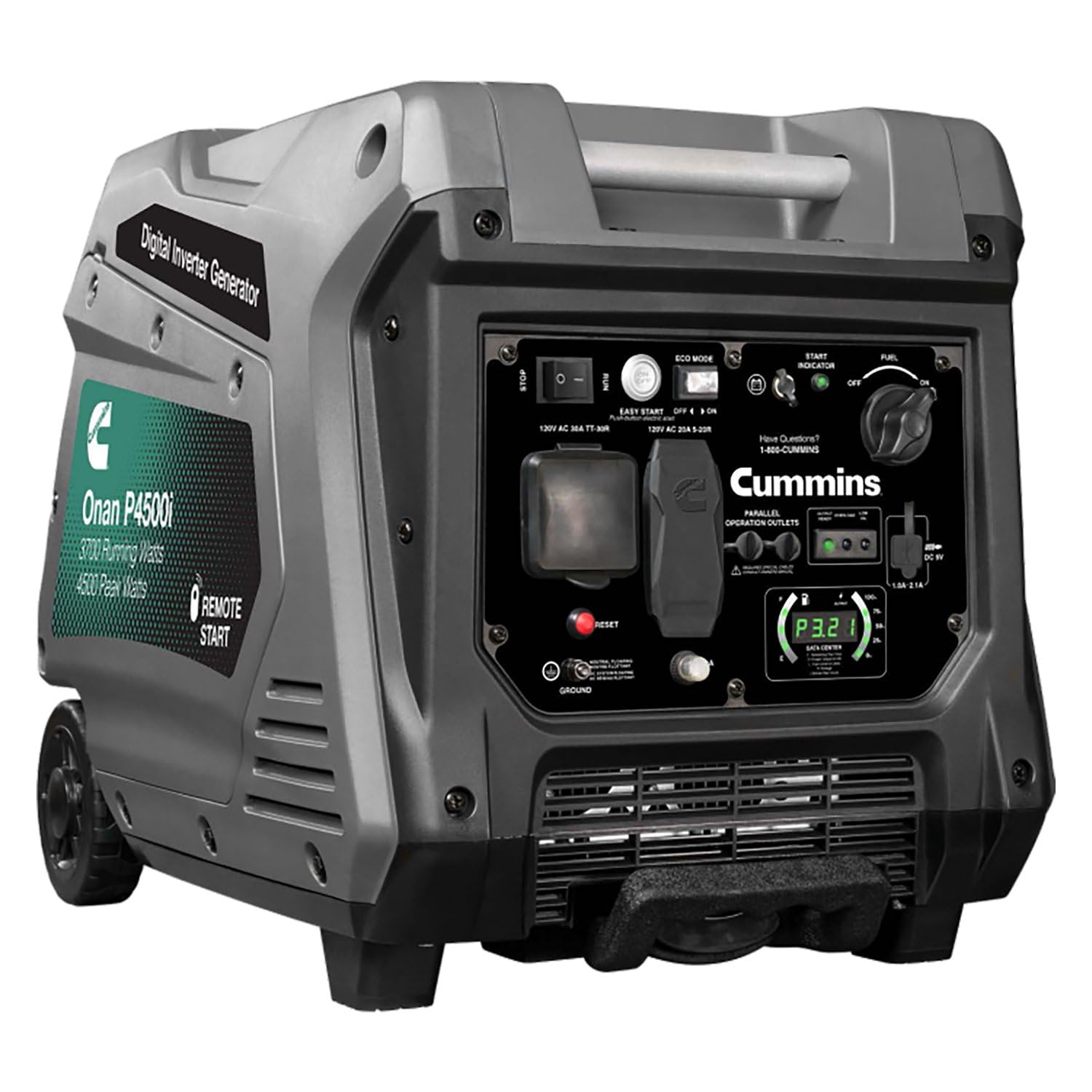
2. Cummins Onan P4500I Portable Inverter Generator
The camper-ready inverter with a push button and a 30-amp RV outlet
This is the one for the fifth-wheel owner who wants power without walking out into the rain to pull a cord. A 7.3 hp 224cc OHV four-stroke engine (overhead valve — the layout behind the power) drives it, and it starts from a push button with a pull-cord backup. It carries a 30A TT-30R outlet for camper use plus dual 5V USB ports for phones.
That 224cc engine is the biggest displacement here in the gas group, well above the PowerSmart’s 143 cubic centimeters, and the 7.3 hp tops the Pulsar’s 5.5 hp. On performance and reliability, that size is what owners lean on — it works flawlessly right from the start and holds up on the road. The quiet engineering is enough that it earned steady praise for staying relatively hushed, which is the reason it lands on this list at all.
Know the one wrinkle: the data shows power capacity drawing some mixed feedback, so it may not run every heavy AC on the market without care. Its 50 hertz frequency is note if your appliances expect 60. Parallel two units and the maker says you can reach 50A combined — a real path to whole-camper power. For RV duty with remote start as your priority, this earns its place.
Remote-start payoff: A keyed push button and a pull cord in reserve means no reaching into a cold morning to yank a starter — the camper-class convenience here.
The frequency footnote: Rated at 50 hertz, lower than the 60 hertz most US outlets run, so confirm your sensitive gear is happy before you commit to it as your only source.
Reach for it when: you tow an RV and want push-button start plus a proper 30-amp camper outlet.
Leave it be if: you need a strict 60 hertz feed for delicate appliances or the loudest-quiet possible night.
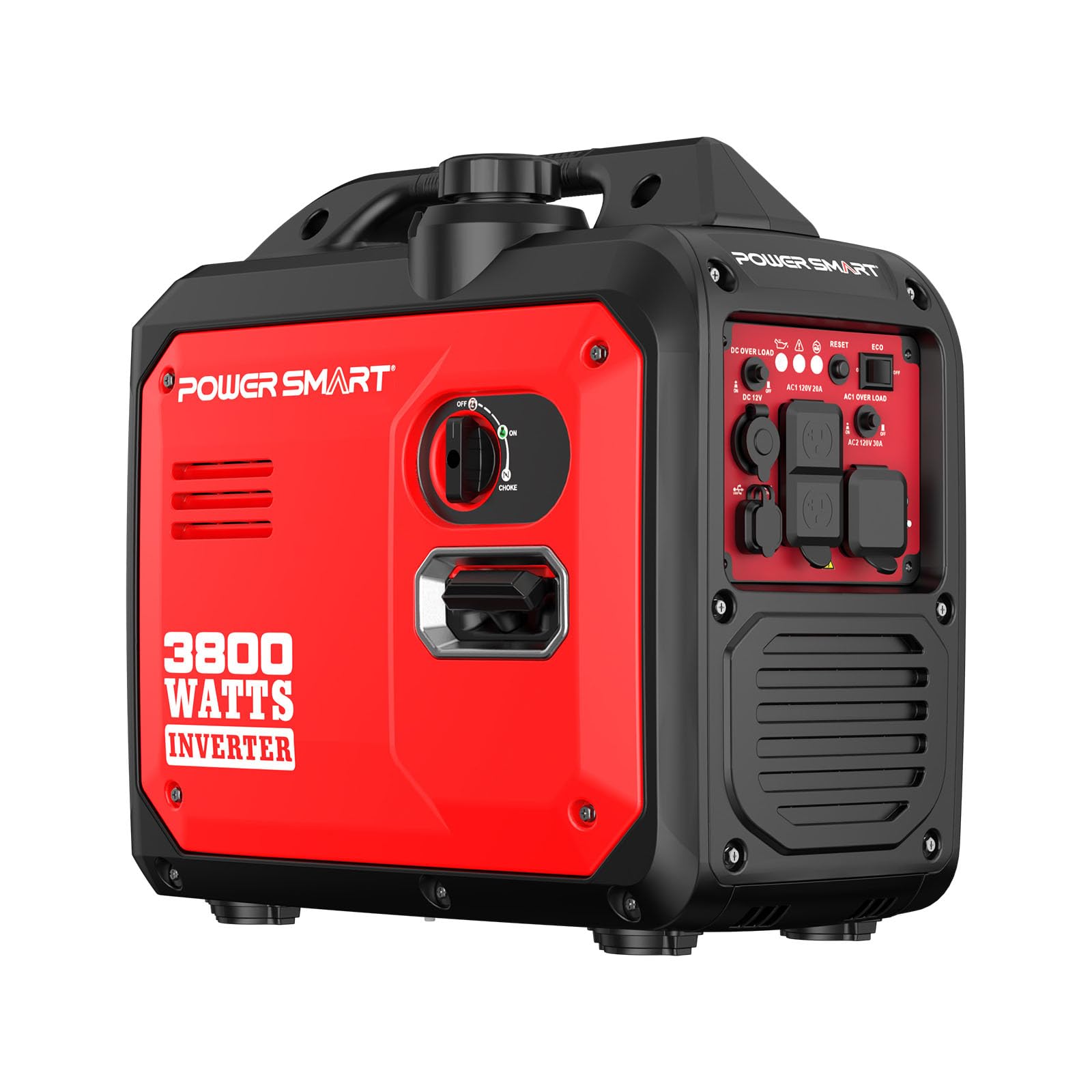
3. PowerSmart 3800 Watt Portable Inverter Generator
Campground-quiet for a budget, at 59 dBA from 23 feet
Fifty-nine decibels at 23 feet is the number to hold onto here — quiet enough for quiet camping, and the reason this budget pick earns a spot. It makes 3,800 starting and 3,200 rated watts of clean power under 3% THD, so laptops, phones, and tablets are safe. Its 143cc engine is far smaller than the Cummins Onan’s 224 cubic centimeters, but for camper duty the rated watts are what carry you.
A 47-pound body you can handle yourself, and the control panel covers real ground: one 120V 20A duplex household outlet, one 120V 30A L5-30R twist-lock, one 12V 8A DC port, two 5V 2.1A USB ports, and Eco Mode. Owners mention about 6.5 hours of runtime with two fans on one tank. It also gets praised for a simple pull start that starts without fuss.
The honest caveat: it uses a recoil start, so there is no button — a cold morning takes a yank. And a 20-foot camper is right in its lane, but a big rig drawing heavy startup surge may want the extra watts of a larger unit. For the money, the mix of quiet and clean power is hard to argue with.
Quiet-to-price read: A 59 dBA rating and sub-3% THD clean power is a lot of generator for a budget-tier buy, and it comes with a 2-year limited warranty plus free lifetime support.
The one thing to accept: Pull start only — no push button, so plan for a manual yank each time you fire it up.
Best fit: the camper who wants quiet, clean, budget power for a modest trailer and small electronics.
Not for you if: you run a large AC or want push-button starting.
4. Aceup Energy 4000 Watt Portable Inverter Generator

A 50-pound inverter that quiets down to about 60 decibels in Eco mode
A fully enclosed shell brings this one to roughly 60 decibels in Eco mode at 23 feet with a 25% load — the shell is doing the quiet work here. Under it, a 149cc four-stroke OHV engine makes 4,000 peak and 3,200 rated watts, and built-in inverter tech holds THD below 1.5% for phones and TVs. Its 1.32-gallon tank runs up to 5 hours at half load.
The 5-in-1 knob is the design touch: fuel on/shut-off, engine on/off, and choke all in one turn, so shutting down also cuts the fuel to avoid a risk. An intelligent gauge watches voltage, run-time, the gasoline meter, hertz, and power output, plus a low-oil LED.
The track record gives pause. The recurring reliability note is a tank problem — a reported implosion and breakage after limited use on some units. That is the exception rather than the rule, and the quiet, the gauge, and the RV receptacle remain strong. If you pack light for camping and want a running gauge you can read at a glance, this is a fair fit — just treat the fuel system with care.
Quiet and clean together: About 60 dB in Eco mode with sub-1.5% THD clean power means a peaceful camp and safe electronics from one unit.
Watch the tank: A minority report tank breakage, so inspect the fuel system and treat the plastic carefully.
Suits: campers who want a 50-pound, gauge-equipped, Eco-quiet inverter with an RV outlet.
Pick something sturdier if: you need a unit to shrug off rough handling season after season.
5. Pulsar PGD40ISCO Ultra Light Quiet 4000W Inverter Generator

A tidy 47.3-pound box rated at 59 dB for AC units up to 13,500 BTU
For a compact emergency unit, the headline is the 13,500 BTU ceiling — that covers a standard RV air conditioner, and it does so at a rated 59 dB. It makes 4,000 peak and 3,200 rated watts, and its 1-gallon tank gives 4 hours at half load. Its 145cc engine sits between the PowerSmart’s 143 cubic centimeters and the Cummins Onan’s 224, and it keeps a 60 hertz frequency.
What owners gravitate to is the performance and the value — it starts easily and runs several appliances at once in a travel trailer. Light weight gets its share of love too, since 47.3 pounds is easy to shove into a truck bed. Automatic voltage regulation and a magneto ignition round out the practical bits, and it parallels with a second unit when you need more.
The honesty note: reliability and noise both draw split feelings in the reviews, and a smaller 1-gallon tank means more frequent refills than the Westinghouse 5000’s 3.4 gallons. Those are fit notes, not defects — this is a good unit for short RV trips and emergency backup where the compact size matters most. For a starter kit that fits under a shelf, it does the job.
Size-to-AC ratio: A 47.3-pound unit that handles a 13,500 BTU AC is a smart pairing for a mid-size camper without the bulk.
Refill rhythm: The 1-gallon tank at 4 hours half-load means topping off more often than a bigger-tank rival — fine for a night, busy for a weekend.
Right for: the small-RV owner who wants compact, quiet emergency power that stows easily.
Look elsewhere if: you need multi-day runtime between refills or prefer a rock-solid track record over compact size.
6. Champion 2500-Watt Ultralight Portable Inverter Generator

Thirty-nine pounds and 53 dBA — the easiest lift here that stays quiet
At 39.7 pounds, this is the lightest generator on the list, and it still rates 53 dBA from 23 feet. That combination — easy carry plus soft hum — is what makes it the tailgate and tent-camping favorite. It makes 2,500 starting and 1,850 running watts and runs up to 11.5 hours. A CO Shield carbon monoxide auto shutoff adds a safety layer for anyone running it near a camper.
Clean power is on tap too: a 120V 15.4A household duplex outlet with less than 3% THD, a 12V automotive-style outlet, and parallel outlets. Customers note it is powerful for its size, with the listed feedback pointing to a large cart, a slushie machine, and electronics run for eight hours. Its 79cc engine is the smallest here, so it is meant for essentials, not a full house. It also comes with a 3-year limited warranty and free lifetime technical support.
Set your expectation on watts. For a light, quiet, easy-to-lift unit for camping essentials, though, nothing here beats the carry weight.
Carry comfort first: It is the lightest unit on the list at 39.7 pounds, so one person can load it solo into a car or truck.
Matched to essentials: Its 1,850 running watts suits fridges, lights, and small gear, so size it to lighter loads rather than a big AC.
Pick it for: camping, tailgating, or backing up a few home essentials where light weight and 53 dBA matter most.
Pass if: you need to run a large RV air conditioner or a whole-home load.
7. WEN 3600-Watt Portable Inverter Generator (56360i)

The camper workhorse that quietly outsizes its own watts
Reliability and performance are the twin anchors for this one, and both are earned by a simple design: a 149cc engine making 3,600 surge and 2,900 rated watts of clean power, with a fully enclosed body that keeps the drone down. A 46-pound frame makes it easy to haul, and the fuel shutoff burns off leftover carburetor gas before you store it — that is the lifespan-extender right there.
A full outlet set covers a camper: two three-prong 120V receptacles, one TT-30R RV receptacle, one 12V DC receptacle, two 5V USB ports, and a three-year warranty. Buyers find it handles an older camp trailer without complaint and delivers ample power for AC units and microwaves. It is described as remarkably quiet under both light and heavy load, which is rare for a unit in its class.
Where it stands out is feel versus spec: it stays composed under load in a way many larger units do not, per the buyer picture. It lacks a push-button start and a CO sensor, so plan for a manual pull and place it carefully. Still, for a first camper generator that must start every time, this is the safest bet in the mid tier.
Built to keep running: Two outlets plus an RV plug, a 149cc engine, and clean power under 3% THD cover camper and electronics duty in one 46-pound body.
The quiet payoff: It is called remarkably quiet even under heavy load, a trait that separates it from louder units its size.
Good for: a camper who wants a dependable, genuinely quiet 2,900-watt unit that starts on the first pull.
skip it if: you insist on push-button start or an automatic CO shutdown.
8. WEN 56477i Inverter

A 4,000-watt camper unit on wheels with a CO shutdown that watches the air
When you need real watts and a quieter run, this is the step up. A 224cc engine pushes 4,800 surge and 4,000 rated watts of clean power, and a WEN Watchdog CO shutdown sensor automatically cuts the generator if dangerous carbon monoxide builds up — a genuine safety feature for camper use. Onboard wheels and a telescoping pull handle make the 72.7-pound body manageable to roll around.
The outlet set is full-sized: four three-prong 120V receptacles, one TT-30R RV receptacle, one 12V DC receptacle, two 5V USB ports, plus the same fuel shutoff that clears the carburetor. Reviewers point out it starts reliably on the first or second pull and can run a 35.5-foot camper. Quiet operation is consistently noted, which is impressive given the wattage. It carries a three-year warranty.
Runtime feedback splits — some run 12 hours on a full tank while others report far less — so treat fuel economy as something to test against your own load. Its 72.7 pounds also means you want the wheels, not your arms, to move it. For a bigger camper or a home backup with a safety sensor built in, the extra watts and CO guard earn the size.
Why it earns the watts
- 4,000 rated watts run a full-size trailer
- Watchdog CO sensor shuts it down automatically
- Wheels and a telescoping handle for moving 72.7 pounds
- Four house outlets plus an RV plug and USB
What to plan around
- Reported runtime on a full tank varies widely
- Heavier than the 46-pound WEN 56360i, so the wheels matter
Made for: a large camper or home backup that wants big watts, wheels, and an automatic CO shutoff.
Hold off if: you move the unit by hand or need predictable multi-day tank range.
9. Westinghouse 4000 Peak Watt Dual Fuel Inverter Generator
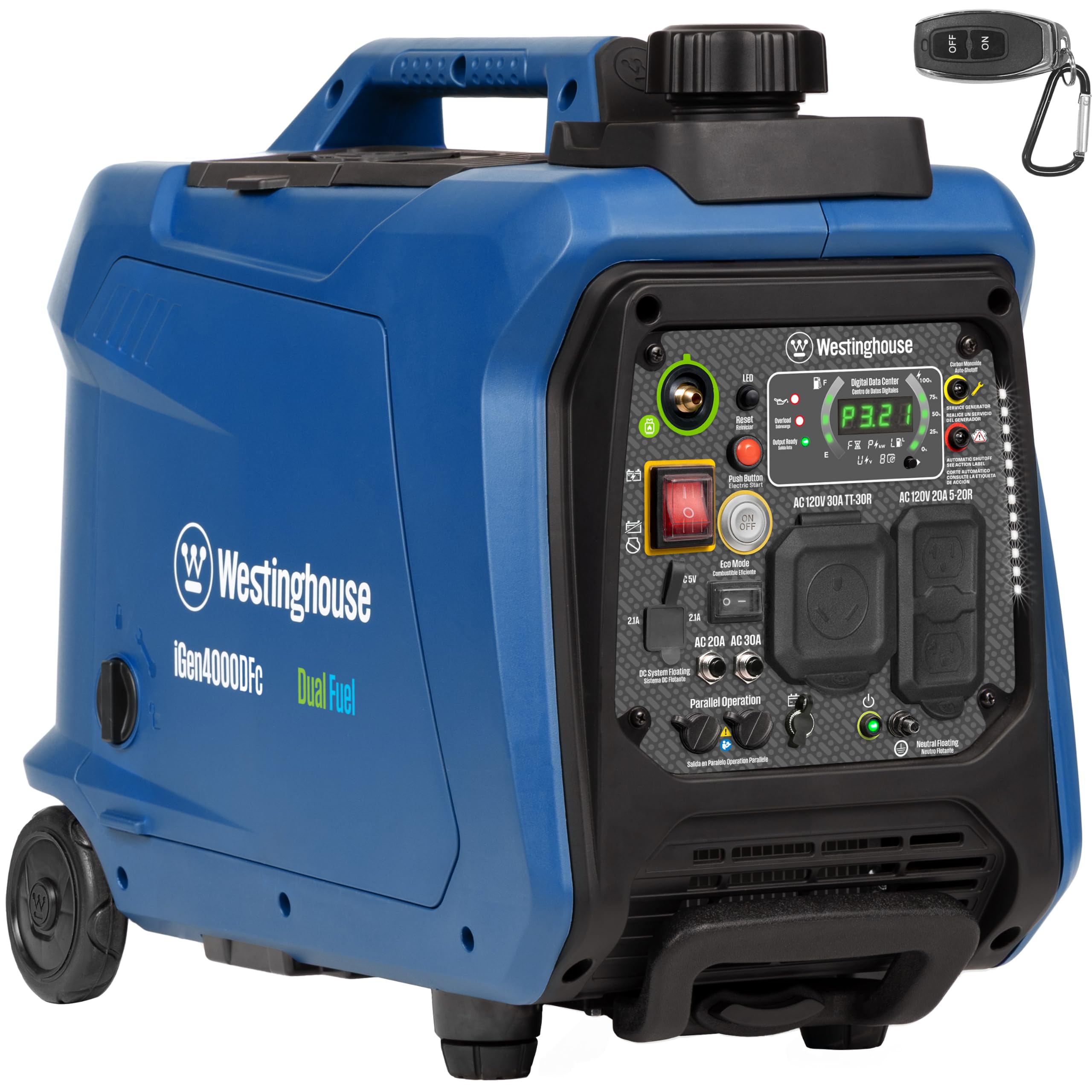
Gas or propane, and it drops as low as 52 dBA — quieter still on propane
Run it on propane and the noise drops to its lowest, which is the reason this one ranks among the quietest gas units here. Rated as low as 52 dBA, it makes 4,000 peak and 3,300 rated watts under 3% THD. It carries a 5-20R household duplex, an RV-ready TT-30R 30-amp outlet, and two USB outlets, and it starts from a key fob, electric, or recoil.
The dual-fuel flexibility is the real draw — gasoline, liquefied petroleum gas, your pick. A rotating LED display shows fuel level, power output, remaining run time, voltage, and lifetime hours. A 1.69-gallon gas tank gives up to 7 hours of run time, and Economy Mode stretches the fuel. It weighs 62.8 pounds with a telescoping handle, so it rolls with some care.
The quiet and the power both land with owners — it runs an AC plus coffee makers and toasters, and the remote start is repeatedly called a standout. Factories test each unit, so a faint residual oil or fuel smell is expected on delivery. For silent-ish camping with a remote-start fob in your hand, the dual-fuel Westinghouse is the flexible choice.
Propane-quiet: As low as 52 dBA, especially on propane, with a 3% THD clean feed for sensitive gear.
Flexible fuel, modest tank: The 1.69-gallon tank reaches up to 7 hours; propane gives you a backup supply path when gasoline is short.
Reach for it if: you want the quietest gas option with a remote fob and the option to switch to propane.
Skip if: you want a huge gas tank for long unattended runs.
10. Westinghouse 5000 Peak Watt Portable Inverter Generator
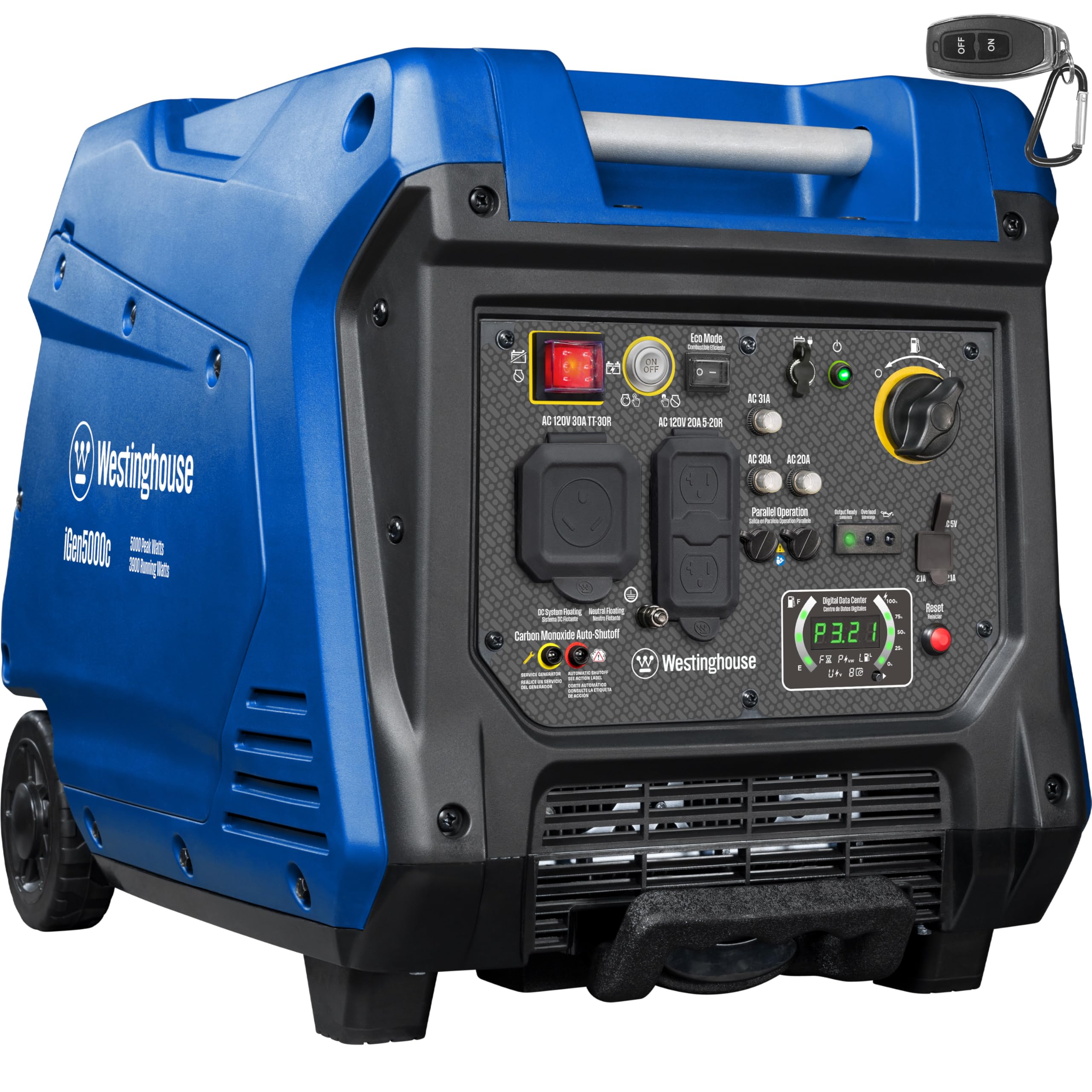
Eighteen hours on one tank and still rated as low as 52 dBA
Here the run time is the story: up to 18 hours on a 3.4-gallon tank, and it still rates as low as 52 dBA. It makes 5,000 peak and 3,900 rated watts under 3% THD — the most rated watts in the gas group — enough for a travel trailer or home essentials. A rotating LED display tracks fuel, output, remaining time, voltage, and lifetime hours, and a telescoping handle helps roll the 105.8-pound body.
The outlet set is built for a rig: a 5-20R household duplex, an RV-ready TT-30R 30-amp outlet, and two USB outlets. It is described as quiet enough to be unheard inside a trailer, and the remote-start fob earning the standout tag makes sense when you are not climbing out in the cold to pull a cord. It also has automatic low-oil and CO shutdown, plus a three-year warranty.
That 105.8 pounds is the catch — this is a roll-it-into-place unit, not a lift-it-by-hand one, and the Honda at 144 pounds is heavier still. For long home backup where you want the generator to run all evening without a refill, the big tank and 3,900 rated watts do the job. It is a heavyweight in every sense, and that is the point.
Tank-to-noise value: A 3.4-gallon tank for up to 18 hours paired with 52 dBA output is a rare balance of long run and low hum.
Weight you plan for: At 105.8 pounds it needs the handle and some muscle; treat it as a wheeled, stay-put unit.
Built for: home backup and long camper runs where 18 hours of near-silent power matters.
Not for: anyone who must carry the generator up stairs or lift it solo.
11. Honda EU3000iS 3000 Watt Inverter Generator
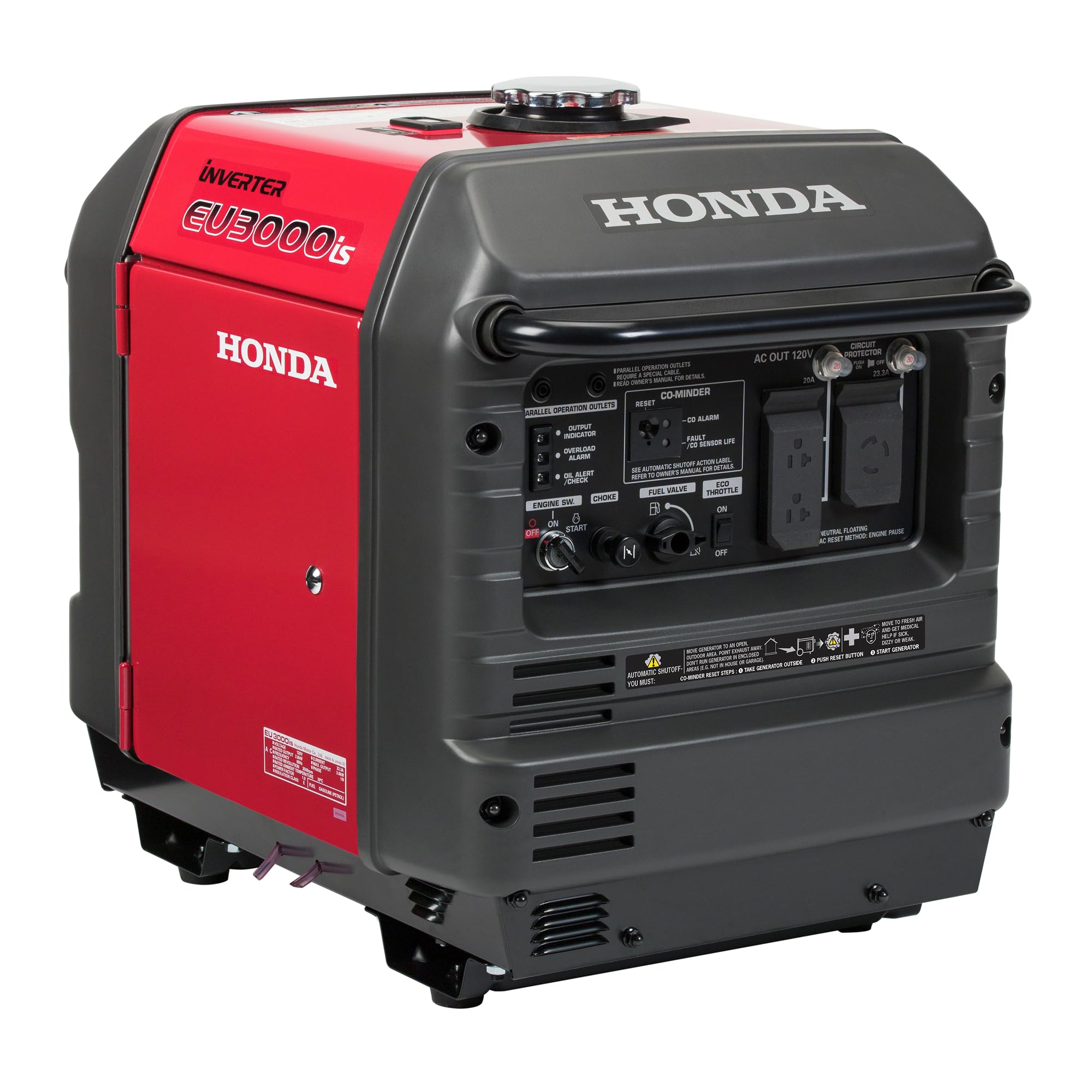
Fifty to fifty-seven decibels — quieter than a normal conversation
This is the quiet benchmark for a gas unit. The EU3000iS runs at 50 to 57 dB(A), which the maker frames as less noise than a normal conversation — real silence at the campsite compared to a 59 dB box. It is a 3000-watt inverter that handles furnaces, fridges, and most 13,500 BTU RV AC units, and the inverter tech supplies power clean enough for computers.
Run time is strong and lasts overnight: 6.9 to 19.6 hours on a 3.4-gallon tank, helped by the Eco Throttle system. A CO-MINDER continually monitors carbon monoxide and shuts the unit down before levels near the home or camper get dangerous, and electric start saves your arm. A three-year residential warranty covers it top to bottom. Its 418cc engine is the largest here, far beyond the Cummins Onan’s 224 cubic centimeters, and that displacement is part of what keeps the output firm.
The real talk: 144 pounds makes this a heavy unit, and it is the priciest ticket on the list, so value is the honest trade-off to weigh. It is also not available in California — the maker points to the EU3200IAC2 instead. If whisper-quiet, dependable overnight power matters more than lifting weight or the outlay, this is the long-term choice.
Where it wins the quiet game
- 50 to 57 dB(A) — the lowest noise figure here
- Up to 19.6-hour run time with Eco Throttle
- CO-MINDER shuts it down automatically
- Electric start and a three-year residential warranty
The honest cost of the quiet
- 144 pounds — the heaviest unit on the list
- Heavy price tag, so value gets debated
- Not available in California
Choose it when: whisper-quiet overnight power with a proven CO shutdown tops your list and weight is not your problem.
Look elsewhere if: you lift the generator yourself, live in California, or want the biggest tank-to-price ratio.
Know the Specs
Decibels (dBA and dB) at distance
A decibel is a unit of loudness, and the rating only means something if you know how far away it was measured. Generators are usually rated at 23 feet, so a 52 dBA unit and a 60 dBA unit will feel meaningfully different across a campsite. A lower number is quieter; the distance matters, so compare like for like. A battery power station has no decibel rating because it has no engine to make noise.
Rated watts versus peak watts
Rated watts are what the generator can hold all day; peak watts cover the brief surge when an AC or fridge motor kicks on. Size to the surge so it starts, but live on the rated number so it does not overload. Cleaner THD — the smoothness of the electrical wave — protects laptops and phones from damage; look for a low percentage. Battery units rate output the same way, with a peak that runs the starting surge.
CO sensors and shutdowns
Carbon monoxide is an invisible gas a gas engine makes, and it can build up near a camper, tent, or house. A CO shutdown sensor automatically cuts the engine before levels get dangerous. If you run a generator near sleeping quarters at all, treat the sensor as a must, not a nice-to-have.
Fuel tank, run time, and eco mode
Tank size sets how long you go between refills: a 3.4-gallon tank stretches up to 18 hours on one unit, while a 1-gallon tank gives about 4 hours at half load. Eco mode throttles the engine down when load is light to save fuel. A battery unit instead measures runtime in battery hours, refilled from a wall or solar rather than a can.
Common Questions
Will a quiet generator run my RV air conditioner?
Is a battery power station quieter than a gas inverter generator?
How loud is 52 dBA compared to 60 dBA at a campsite?
Can I run two quiet generators together for more power?
How long can a quiet generator run on a full tank?
Is a dual fuel generator quieter on propane than on gas?
Do quiet generators need a carbon monoxide sensor to be safe?
What does THD mean on a quiet inverter generator?
How heavy is too heavy to lift a portable generator by hand?
Can I store a quiet generator for months between outages?
The Bottom Line
For most people, the quietest portable generators winner is the Anker SOLIX C2000 Gen 2 because it makes no engine noise at all, and its 2,048Wh battery with a 58-minute recharge covers a fridge, TV, and WiFi through a real outage. If you want to run a camper AC on gasoline with the lowest noise figure here, the Honda EU3000iS delivers 50 to 57 dB(A) and up to 19.6 hours on a tank. And for flexible fuel with a remote-start fob, the Westinghouse 4000 dual fuel drops to 52 dBA on propane and still runs on gas.
The quiet middle ground is crowded, and that is good news for you. The PowerSmart 3800 rates 59 dBA at 23 feet with clean power under 3% THD on a budget, proving you do not have to reach the top tier to get a soft run. Whatever you choose, match the rated watts to what you actually run, and keep a CO sensor on any gas unit that sits near where you sleep.
How we choose
We do not accept paid placement. Every pick is matched to a real buyer and a real use-case; we do not hands-on test units.
Sources
Specifications: manufacturer listings and product documentation. Review insights: verified customer reviews, as of November 2026. Pricing: not shown on this page (it changes often); check the current price via the retailer link.
As an Amazon Associate, My Heart Lives Here earns from qualifying purchases. This does not affect which products we feature.