Heads up: This post contains affiliate links. As an Amazon Associate I earn from qualifying purchases, at no extra cost to you. Learn more
Specs are compiled from manufacturer listings and verified buyer reviews and can change over time — please confirm the key details on the product page before buying.
Paint sliding off a shiny galvanized gate is not a paint problem — it is a primer problem. Galvanized steel wears a slick zinc skin that ordinary primer simply cannot grip, so the short answer is this: you need a primer built to bite into zinc, and the Rust-Oleum Stops Rust Brush On Rusty Metal Primer is the one most people should reach for first. Below you get five real options, each suited to a different job, so you can pick the right can the first time instead of scraping a peeling coat off next spring.
This guide is built by comparing the manufacturers’ published specifications and the patterns across verified customer reviews, so you get each pick’s real strengths and trade-offs instead of marketing spin.
Galvanized metal is the tricky one: it is coated in zinc, it is often oily from the factory, and it goes chalky as it weathers. Some primers are made to etch into that surface, others are made to sit on bare rusted steel, and a few expect a clean bare panel. What follows is the practical difference between them and which one fits your job.
Here is the plain-English breakdown of the primer for galvanized metal that actually holds its grip.
Top Picks

How To Choose The Best Primer for Galvanized Metal
Galvanized metal is steel dipped in zinc, and that zinc layer is the whole problem. It is smooth, it is often coated in a factory oil, and paint that lands on it without a proper base coat will lift and flake once the weather turns. The primer you choose has to do one job above all: stick to that zinc skin so your topcoat has something solid to hold.
Etch versus rust-converting versus straight primer
An etch primer carries an acid that lightly bites the metal surface, which is exactly what a slick galvanized panel needs. A rust-converting primer is built for steel that already has rust on it, sealing that surface so the decay stops spreading. A plain primer with no etch chemistry is the wrong tool for fresh galvanized sheet unless the maker spells out that it works there. Match the chemistry to the surface, not the other way around.
Read the three different “dry” numbers
Products list dry-to-touch, recoat or sanding time, and full cure time, and they are not the same thing. Dry-to-touch means you can look at it without it smearing. Full cure is when the coating has hardened all the way through. A can that says 30 minutes to touch may still need much longer before a topcoat goes on. Plan your job around the full cure figure, not the headline number.
Brush-on versus aerosol
A brush-on can suits railings, posts, sink bases and any pipe you can reach with a brush. An aerosol suits bare panels, automotive touch-ups and awkward shapes where a brush cannot follow the contour. The form you pick changes coverage and control as much as the formula does, so choose the format your job actually allows.
Side-by-Side Comparison
| Model | Best For | Form | Dry Time | Full Cure | Amazon |
|---|---|---|---|---|---|
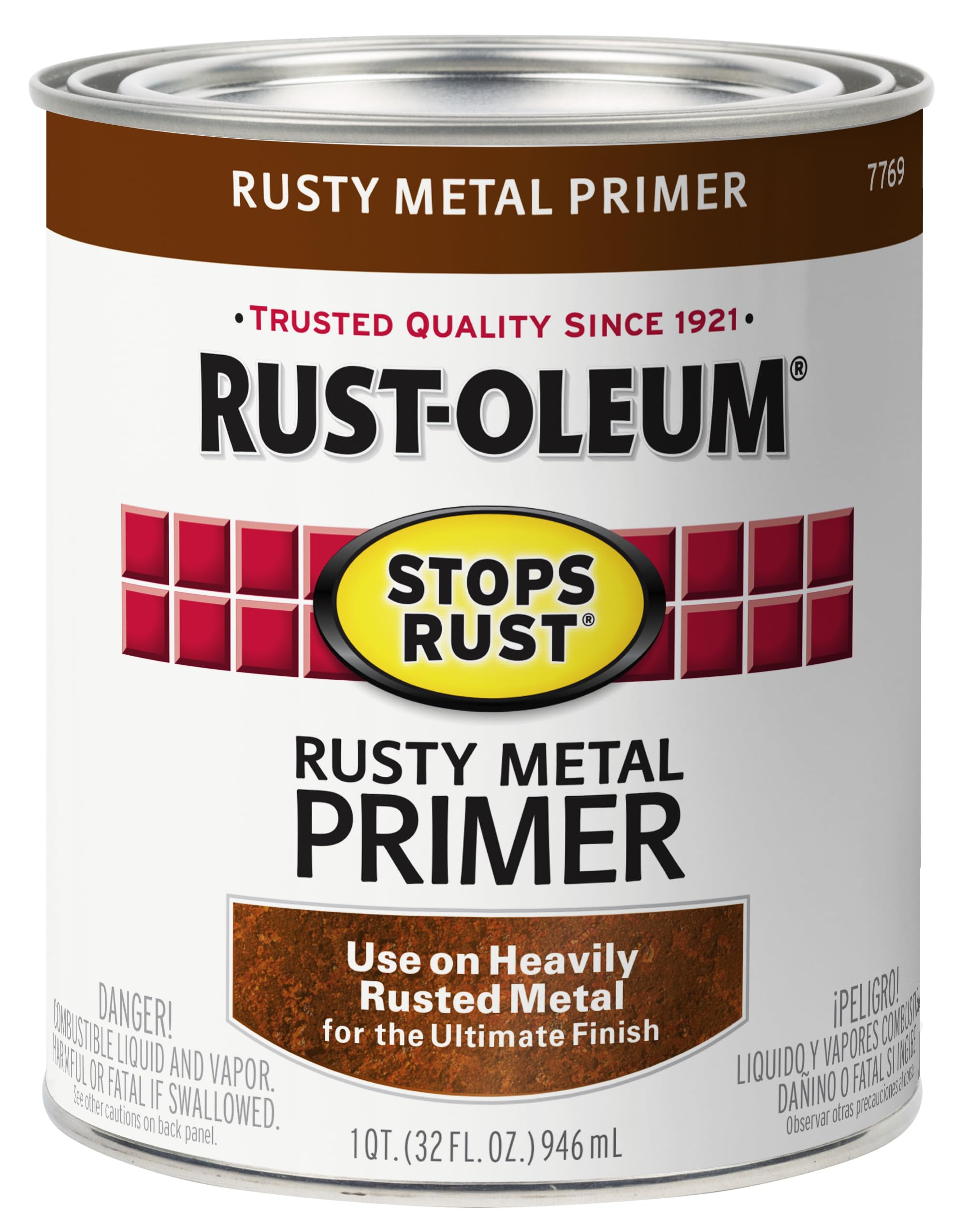
| Rust-Oleum Stops Rust Brush On Rusty Metal Primer★ Best Overall | Rusted steel, rails and sink bases | Brush-on liquid, 32 oz can | 2–4 hours to touch | 4 hours | Amazon |
| Krylon Rust Tough Galvanizing PrimerFastest Drying | Fast spray jobs on mixed surfaces | Aerosol, 12 oz | 0.5 hours | 20 minutes | Amazon |
| Raptor Acid Etch Primer 1K Aerosol | Bare galvanized steel and aluminum panels | Aerosol, 450 ml | 1 hour | — | Amazon |
| SprayMax 2K Epoxy Primer Black | Automotive and restoration work | Aerosol, 341 ml | 12 hours | 12 hours | Amazon |
| SEM 39683 Grey Self Etching Primer | Bare metal, fiberglass and plastic prep | Aerosol, 15.5 oz | 3 hours | 1 hour | Amazon |
Detailed Reviews
1. Rust-Oleum Stops Rust Brush On Rusty Metal Primer, Flat
Our pick — 4.5+★ from 2,500+ verified ratings; the strongest balance of quality and price.
The brush-on can that turns a rusted railing back into something a topcoat can grab.
Start with the format, because it decides the job. This is a 32-ounce brush-on liquid, not a spray, so it suits the metal you can stand next to and work a brush into — gate rails, post bases, galvanized pipe, the base of a metal kitchen sink. The maker states it is for heavily rusted metal surfaces, interior or outdoor, and the oil-based formula lays down a durable protective coating with rust prevention built in.
Timing is generous enough for a real job: dry to the touch in 2 to 4 hours and fully cured in 4 hours. Coverage is listed as between 65 and 110 square feet per can, which is a wide band because a pitted rusted surface drinks more primer than a smooth one. It dries flat, so it grips rather than glosses, and it is described as waterproof — handy for a sink base or a fence post that sees weather.
What wins people over is the sheer confidence of the finish. Reviewers praise its quality most often, and that holds across sinks, pipes and heavy-use metal. It also earns consistently good marks for adhesion and for how easily the second coat goes on. The one honest catch is that the 12 square foot figure listed under coverage is dramatically tighter than the 65–110 sq. ft. band in the description — treat the bigger number as best-case on smooth steel and the small one as the reality on deeply pitted rust. It is also a brush job, so it is slow on large flat panels.
What it earns its keep on
- Brush-on control you cannot get from a spray can
- Fully cured in 4 hours and dry to touch in 2–4
- Oil-based coating with built-in rust prevention
- Waterproof finish for interior or exterior metal
Where it asks more of you
- Slow going on large flat panels versus a spray
- The stated coverage range is wide — budget extra on pitted rust
- Designed for rusted steel, so fresh galvanized sheet may want an etch product instead
Go with this one: rusted railings, pipes and sink bases you can reach with a brush, where you want rust stopped and a topcoat to bite.
Think again if: you are coating a big flat galvanized panel, where an aerosol etch primer gets the job done faster.
2. Krylon Rust Tough Galvanizing Primer
Half an hour to touch, and no separate primer required underneath.
If your problem is impatience, this is the can that answers it. The maker states this galvanizing primer goes on direct to metal with no primer needed underneath, and it dries to the touch in 30 minutes. Compare that with the 12-hour cure on the SprayMax 2K Epoxy Primer Black — the Krylon is the one you can handle the same afternoon. It is an aerosol at 12 fluid ounces, covers up to 25 square feet, and lists a 20-minute full cure.
It is also the most flexible of the five on surfaces. The maker lists metal, fiberglass, masonry, wood and most plastic, and calls it ideal for automotive, marine, aviation, home, farm and industrial use. Fade resistance is part of the pitch, and the gray zinc-toned finish reads as a flat, even base rather than a gloss. For a galvanized job where you want a fast, tidy, uniform coat over a small welded repair or a garden gate, it does the work with very little fuss.
Where it shines: the ultra-fast 30-minute touch time plus that 25 sq. ft. coverage ceiling makes it the practical choice for small spray jobs on mixed materials. Buyers call the finish polished-silver and the coating genuinely tough. Adhesion to metal is the point buyers return to most.
What to expect: drying time is the most-discussed point and it is not universally loved — a few find it slower than the can promises under cool or humid conditions. Coverage on a porous or heavily textured surface will fall short of the 25 sq. ft. high mark, so buy a second can if your patch is broad.
Reach for it when: you need a fast, flat, silver-gray base on a small metal repair and you want one aerosol that also handles wood or fiberglass.
Look elsewhere if: your metal is heavily rusted and needs the sealing power of a dedicated rust converter.
3. Raptor Acid Etch Primer 1K Aerosol, 13.2 OZ

The one built specifically to bite slick zinc and aluminum — a genuine etch primer in a can.
Here is the pick for the actual wording of this job. Raptor uses a phosphoric acid ester formula to enhance paint adhesion on tough surfaces like galvanized steel and aluminum, which is precisely the problem a fresh galvanized gate or sheet panel gives you. It etches and primes bare metal in a single step, so you are not laying down a separate pre-treatment first. The maker also states no sanding is required and the surface can be directly topcoated with most paint systems.
The numbers to note: a 450 ml aerosol, dry to the touch in 1 hour, matte gray finish, and a flat fan high-atomization nozzle that spreads a wide even pattern. It is rated for indoor or outdoor use and is formulated to build an anti-corrosive barrier against rust.
Where the honest note lands is quality. Quality draws the most discussion of any point on this product and it is genuinely split — plenty find it excellent, some come away disappointed, and that is the pattern rather than a one-off. The fix is user expectation: this is a thin, fast etch coat meant to be topcoated promptly, not a buildable high-fill primer. Performance on aluminum and bare steel is the consistently strong point. Use it as it is designed and it does its job.
Pick this for: bare, clean galvanized or aluminum panels that need an etch bite before color, with no sanding step.
Not the one for: heavy rusted steel or a job where you want a thick fill coat — go brush-on or 2K instead.
4. SprayMax 2K Epoxy Primer
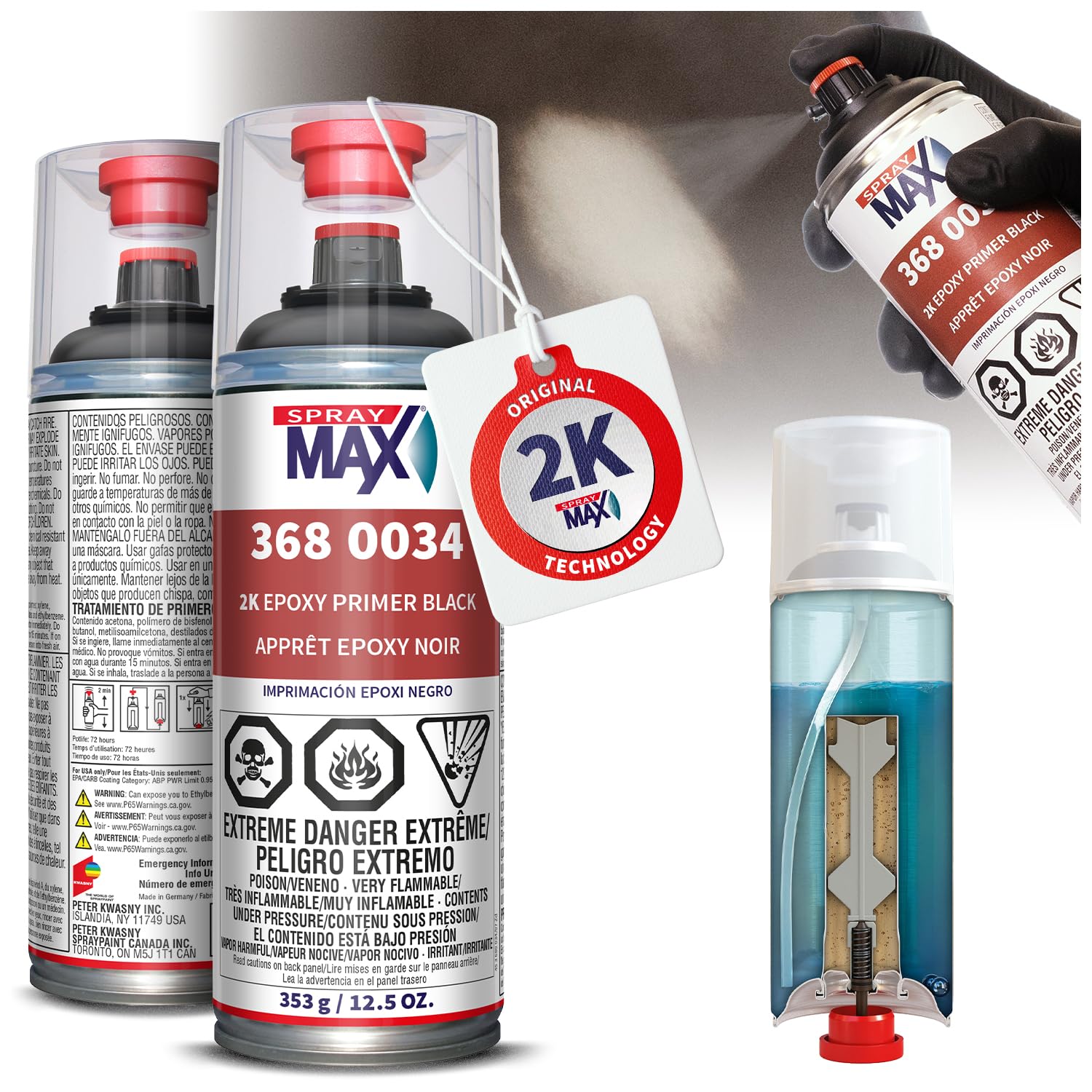
Professional two-part epoxy in a spray can — with a cure time you have to plan around.
This is the most technically ambitious can here. It is a true 2K system, meaning two components that must mix and then harden chemically, and it delivers that professional bonding strength from an aerosol with a variable nozzle for control. It states superior corrosion protection and excellent adhesion on steel, aluminum and galvanized metal, aimed at cars, motorcycles and restorations. Dust-dry in 15 minutes and sandable within hours, per the maker.
Then the number that changes your day: 12 hours dry-to-touch and 12 hours full cure. Set that beside the SEM 39683 Grey Self Etching Primer at 1 hour full cure and you can see the trade — the SprayMax holds a far longer working window, so you cannot rush a topcoat on. It is worth it if you want a smooth, sealed, sandable base on a panel you are taking seriously. It is the wrong tool if you want to finish the job in an afternoon.
Be clear-eyed on the rest. Performance is the strong point: on properly prepped surfaces it sprays and bonds without drama. But spray performance and coverage each split opinion, and a number of automotive buyers feel the can runs out before the panel is done — so buy a spare rather than stop mid-panel. Quality and value also divide people, and the value question is the softer one, driven mostly by how much area the can actually covers.
Suits you if: you are prepping a car or bike panel and want a professional-grade, sandable 2K base with time to work methodically.
Give it a miss if: you need a fast turnaround, or you have a large panel and only one can on hand.
5. SEM 39683 Grey Self Etching Primer – 15.5 oz.

The one that etches itself into bare metal and lays a bond subsequent coats trust.
Self-etching means the primer does the biting for you, and that is what earns this can its following. It is a 15.5-ounce grey aerosol built for bare metal, fiberglass and plastic, creating a strong bond for the coats that follow. Dry to the touch in 3 hours and fully cured in 1 hour — the short cure window is what separates it from the 12-hour SprayMax 2K Epoxy Primer Black above. Same class of product, a fraction of the wait.
The finish work is where it earns its place. Buyers repeatedly praise its grip on bare metal, fiberglass and plastic, and the self-etching formula gets consistent praise for prepping metal before auto projects. Buyers describe it as spraying on smooth, drying fast and covering well. It is rated for outdoor use and arrives as a 65.66 cubic inch aerosol. For a bare-metal prep where you want a reliable bond without a sanding marathon, this is the can.
The case for it: self-etch chemistry plus a 1-hour full cure plus wide material compatibility — bare metal, fiberglass, plastic — all from one grey aerosol. That mix of self-etch chemistry, a 1-hour cure and wide material compatibility is hard to match for general prep work, and buyers rate quality and performance top-notch.
The catch: value is the split point — a number of buyers feel it is priced high for the volume. And it is not listed as waterproof, so keep it for surfaces that will be topcoated, not for finishing bare. Buy the right amount for your panel and the cost picture settles.
Worth grabbing for: bare metal, fiberglass or plastic prep where a fast-curing self-etch base is the goal.
Best skip if: you need the cheapest per-area primer for a large flat surface, or a waterproof finish coat.
Know the Specs
Dry time versus full cure time
Dry-to-touch is when the film stops smearing; full cure is when it has hardened all the way through. They are different numbers, and the gap can be large — 0.5 hours to touch versus 20 minutes full cure on the Krylon, but 12 hours on both figures for the SprayMax. Always schedule your topcoat against the full cure figure, not the touch figure, or you risk trapping a soft base coat.
Coverage in square feet
Coverage tells you how far a can or quart will go, and it varies wildly with the surface. A smooth panel takes less primer; pitted rust or a fully rusted rail drinks far more. The Rust-Oleum lists 65 to 110 square feet per can, while the Krylon lists up to 25 square feet — different formats, so read the number against the can size and your surface, not against the other product.
Etch chemistry
An acid etch formula lightly bites bare metal to improve adhesion — the Raptor uses a phosphoric acid ester, and the SEM self-etching primer does the same job in its own way. This is the chemistry that matters for slick galvanized and aluminum surfaces, where a plain primer struggles to grip. If your metal is bare and shiny, an etch primer is the tool; if it is already rusted, a rust-converting primer is the tool.
Form: brush-on versus aerosol
Brush-on liquid gives control, penetration and coverage on railing posts, pipes and sink bases. Aerosol gives a fast, even film on bare panels and awkward shapes a brush cannot follow. The formula on the can is only half the decision — the format decides how the job actually gets done. Match the format to what you can physically reach and how large the surface is.
Common Questions
Will a regular primer stick to galvanized metal?
Do I need to sand galvanized metal before priming?
What is the difference between a self-etching primer and a regular primer?
Can I paint over galvanized metal without a primer?
How long before I can apply the topcoat?
Is a 2K epoxy primer worth it over a single-component primer?
How much coverage will I get from one can?
Can these primers be used outdoors?
Will a primer for galvanized metal cover rust as well?
The Bottom Line
For the widest range of jobs, the primer for galvanized metal winner is the Rust-Oleum Stops Rust Brush On Rusty Metal Primer — it brushes into rails, pipes and sink bases, it is fully cured in 4 hours, and it stops rust while giving a topcoat a real surface to grab. If your metal is bare galvanized or aluminum sheet and you want an etch bite with no sanding, the Raptor Acid Etch Primer is the one built for that surface. And for automotive or restoration work where you want a professional sandable base, the SprayMax 2K Epoxy Primer Black is the choice — just plan around its 12-hour cure.
How we choose
We do not accept paid placement. Every pick is matched to a real buyer and a real use-case; we do not hands-on test units.
Sources
Specifications: manufacturer listings and product documentation. Review insights: verified customer reviews, as of November 2026. Pricing: not shown on this page (it changes often); check the current price via the retailer link.
As an Amazon Associate, My Heart Lives Here earns from qualifying purchases. This does not affect which products we feature.