Heads up: This post contains affiliate links. As an Amazon Associate I earn from qualifying purchases, at no extra cost to you. Learn more
Specs are compiled from manufacturer listings and verified buyer reviews and can change over time — please confirm the key details on the product page before buying.
Bare metal is unforgiving. Sand a panel down to shiny steel and the clock starts ticking — moisture in the air begins to flash-rust the surface within hours. The right primer for bare metal buys you time, grips the steel mechanically or chemically, and gives your topcoat something honest to hold onto. Pick wrong and you get peeling, blistering, or rust creeping back under the paint within a season.
This guide is built by comparing the manufacturers’ published specifications and the patterns across verified customer reviews, so you get each pick’s real strengths and trade-offs instead of marketing spin.
This page sorts the field by how each formula actually bonds to bare steel — brush-on rust converters, fast-drying sandable sprays, self-etching aerosols, and professional-grade epoxy sealers. By the end you will know exactly which primer for bare metal fits your project, your workspace, and your topcoat.
Top Picks
How To Choose The Best Primer for Bare Metal
Your pick depends on two things: what your metal looks like right now, and how fast you need a topcoat on it. A heavily rusted gate and a freshly sanded aluminum panel need different chemistry.
Etching vs. Epoxy vs. Rust-Converting
Self-etching primers (aerosols with an acid that bites into the metal surface for grip) are the classic pick for bare aluminum, fiberglass, and clean steel panels. Epoxy primers mix with a hardener and cure into a dense, corrosion-resistant seal — the standard for body-shop work where topcoat gloss matters. Rust-converting brush-on primers go on over existing rust and stop it from spreading.
Dry Time and Cure Time Are Different Things
Dry-to-touch means the surface is no longer wet. Full cure means the primer has hardened enough to sand or topcoat safely. A formula that dries in minutes can still want hours of cure — check both numbers before you plan your topcoat window.
Coverage Per Can
Rattle cans typically cover in square feet, brush-on cans by the ounce. Match that figure to the panel area — a large truck bed or gate can eat through a small can faster than you expect.
Side-by-Side Comparison
| Model | Best For | Dry Time | Full Cure | Format | Amazon |
|---|---|---|---|---|---|
| Rust-Oleum Stops Rust Brush On Rusty Metal Primer★ Best Overall | Heavily rusted gates, sinks, pipes | 2–4 hours | 4 hours | Brush-on can | Amazon |
| Seymour PBE Professional PrimerFastest Dry | Fast body-shop panel work | 0.08 hours | 5 minutes | Aerosol | Amazon |
| SEM 39683 Grey Self Etching Primer | Bare aluminum and fiberglass | 3 hours | 1 hour | Aerosol | Amazon |
| Custom Shop Black DTM Epoxy Primer/Sealer | Professional DTM sealing | 1 hour | — | 1-quart 1:1 kit | Amazon |
| U.S. Chemical & Plastics All-Metal | Aluminum-filled body repair | — | — | 1-quart kit with hardener | Amazon |
Detailed Reviews
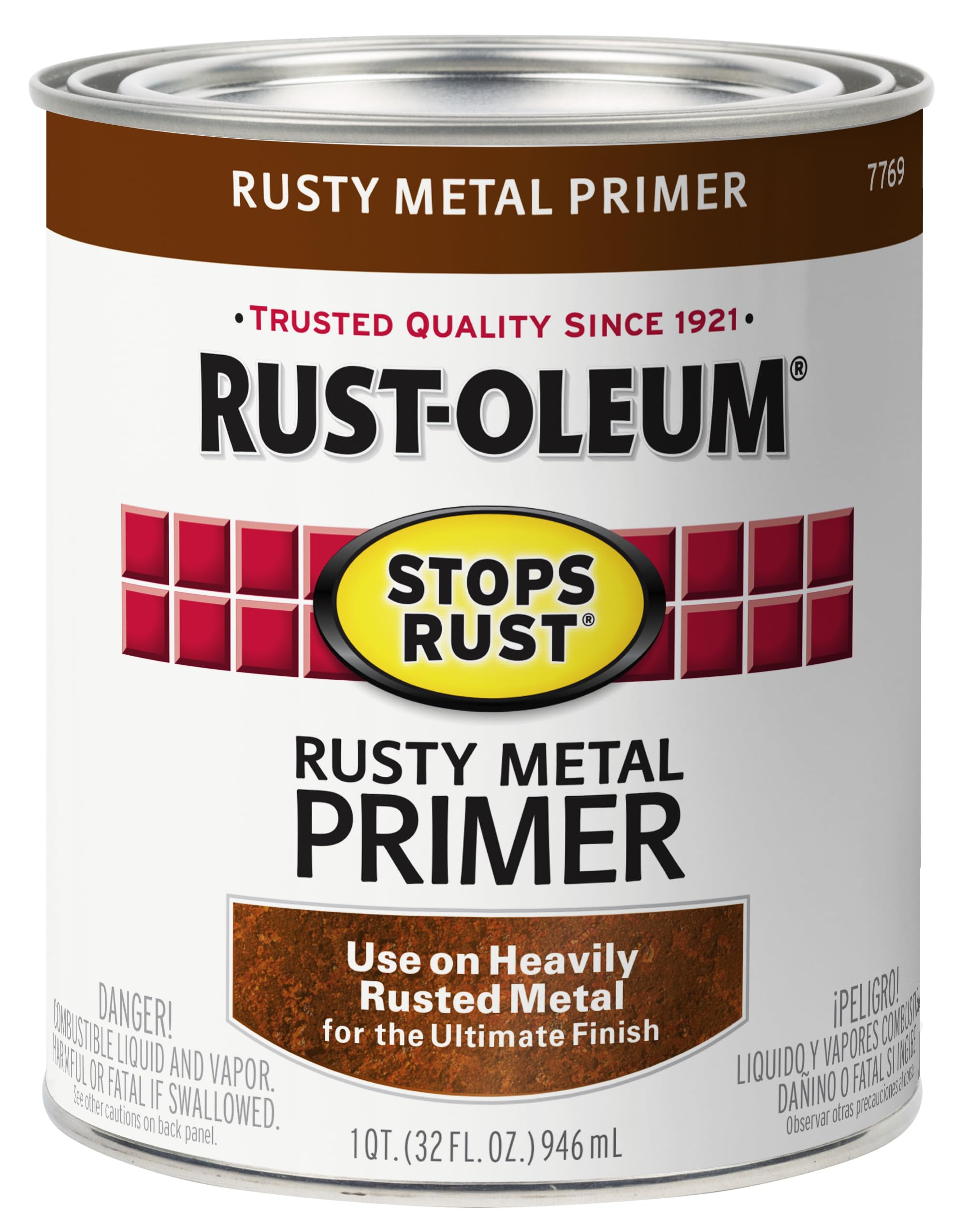
1. Rust-Oleum Stops Rust Brush On Rusty Metal Primer, Flat
Our pick — 4.5+★ from 2,500+ verified ratings; the strongest balance of quality and price.
Forget the sandblaster — this brush-on oil primer grips rusted steel where it already sits and locks the surface down.
If your metal has already bloomed into orange rust, your job is different from the guy priming a clean fender. This Rust-Oleum formula is built for exterior or interior heavily rusted metal only — it lays down an oil-based barrier directly over the corrosion. Dry-to-touch lands in 2 to 4 hours, with a full cure in 4 hours. That cure figure is twice as fast as the SEM etching primer’s 1-hour cure, but slower in real drying — both numbers matter when you plan your next coat.
What wins people over is the quality of the coating across large, ugly surfaces — rusted kitchen-sink bases, galvanized pipe, aging metal gates. It brushes on thick, covers 65–110 square feet per can according to the maker, and adheres well enough that a topcoat of enamel clings without peeling. The user-consensus across nearly 2,800 owners lands on 4.5+ stars — one of the strongest showings of the five picks here. It lets you paint a rust-riddled gate without stripping it to clean steel first.
The catch is honest: this is a brush-on can, not an aerosol. If you want an even automotive-style finish on a curved panel or a spray-gun look for a body shop, you need a different format. And because it is oil-based, cleanup needs the right solvent — not water. But if your priority is stopping rust and creating a base for a durable topcoat on something ugly, this is where you spend your money.
Turns Rust Back Into a Paintable Surface
- Oil-based barrier blocks moisture on heavily rusted steel
- Full cure in just 4 hours, ready for a topcoat the same day
- Wide 65–110 sq. ft. coverage per can handles a full gate in one pass
- Bonds to galvanized pipe and rusted sink bases without stripping
Where It Falls Short of a Shop Unit
- Brush-on application only, no aerosol spray for a smooth panel finish
- Oil-based clean-up requires solvent, not water
- Exterior or interior heavily rusted metal only — not for a clean aluminum panel
Made for rust: pick this if you’re staring at an already-rusted gate, pipe, or sink base and want to topcoat the same day without stripping it back.
Rethink it if: you need a spray-gun finish on a smooth automotive panel — a rattle-can etcher earns its keep there instead.
2. Seymour 20-1671 PBE Professional Primer, Sandable Gray
Five minutes from spray to sandpaper — the fastest turnaround on this list by a wide margin.
The number that matters here is 0.08 hours. That is Seymour’s listed dry time — roughly five minutes — and it gets you to a sandable surface before your coffee goes cold. Compare that to the SEM 39683 at 3 hours and the gap is enormous: same product category, wildly different pace. For a body-shop tech shooting multiple panels in a day, that time adds up across every coat.
The large sprayhead throws an even mist that mimics a spray gun rather than a rattle can, and the formula was built specifically for body-shop work. It adheres extremely well to bare metal, handles heat up to 250°F, and is VOC compliant — relevant if you’re working in a regulated shop environment. Coverage lands around 10–15 square feet per 15-ounce can, so plan your cans against panel size before you start a hood or full door.
The trade-off is the small owner base — under a hundred ratings so far, at 4.0+ stars. That is respectable but far fewer voices than the Rust-Oleum or SEM picks here. It is also indoor-use-only and not waterproof. If you’re priming something that lives outside, this is not the can for the job. For indoor body-shop panels where speed matters more than weather exposure, though, it cuts hours off the schedule.
The speed argument: if you measure your day in panels per hour, Seymour earns its shelf spot. Its 0.08-hour dry time (about 5 minutes) and 5-minute sandability beat the SEM’s 3-hour dry by a factor of 37.5 on this spec alone.
The honest limit: it works indoors only and is not waterproof, with roughly 10–15 square feet per can. If your project lives outdoors or runs longer than a door panel, match cans to coverage before you start to save a second trip.
Ideal for the spray booth: a body-shop tech or serious DIYer shooting multiple indoor metal panels who cannot wait hours between coats.
Not the one for: an exterior job — this formula is indoor-rated and not waterproof, so an outdoor gate or bumper wants a different chemistry.
3. SEM 39683 Grey Self Etching Primer – 15.5 oz.

The aerosol that chemically bites into clean aluminum and fiberglass — no sanding grit required to make it stick.
Self-etching means the primer carries a mild acid that microscopically opens the metal surface as it dries. So bare aluminum, fiberglass, and properly prepped plastic get a real mechanical and chemical bond, not just a coat resting on top. That is exactly what this SEM formula delivers. It is the go-to for auto projects and prepped metal, and it cures in 1 hour after a 3-hour dry. Compare that 1-hour full cure to the Rust-Oleum’s 4-hour cure: it is a quarter of the wait before you can sand or topcoat.
The thing owners rave about is how cleanly the etching works on bare metal, fiberglass, and plastic in one pass — the primer creates a solid base that the next coat locks onto. Quality and adhesion both dominate the review discussion, and the spraying is described as smooth and even. The aerosol format gives you a controllable fan pattern, so you can get into recesses and around curves that a brush cannot reach. It gives a bare-metal restoration a smooth, spray-gun-quality base.
The honest weakness lands on price. It is the priciest per-ounce aerosol here, and a meaningful slice of buyers find that hard to swallow relative to coverage. If you’re priming a whole car frame on a tight budget, the math gets ugly. But for a small high-value panel or a one-off fiberglass repair, the 1-hour cure and reliability of the etch make the extra spend make sense.
Why the etch earns its premium: bare aluminum and fiberglass get a chemical bite that brush-on primers cannot deliver — and a 1-hour full cure means sanding sooner than most brush-on formulas allow.
Where the price bites: per-ounce cost is the highest aerosol on this list, so high-surface-area jobs push you toward a quart kit instead.
Worth picking for: bare aluminum, fiberglass, and prepped plastic where the etch matters and you want to sand or topcoat inside an hour.
Look past it for: large panel runs — the per-ounce outlay adds up fast enough that a quart epoxy kit becomes the smarter call.
4. Custom Shop Black DTM Epoxy Primer/Sealer 1 Quart Kit

Two-part epoxy that seals bare steel, aluminum, and gelcoat in one coat — when you can get it mixed.
DTM stands for Direct to Metal — one coat of this two-part epoxy primer goes straight onto bare steel, bare aluminum, fiberglass, and gelcoat without a separate etcher underneath. That is a big shortcut on a full automotive job. The 1:1 mix ratio (one part primer, one part hardener) is designed for precise mixing, there is no induction time needed before application, and pot life runs 4 hours once the two parts are combined. It cures in 1 hour and lays down with a semi-gloss or gloss finish that holds topcoat gloss well.
Where it shines is the spraying itself. The epoxy atomizes cleanly and gives an even, smooth coat — the spray behavior draws more praise than any other aspect of this kit, and it can be topcoated with most major automotive paint brands once cured. At 2.1 VOC per gallon it is compliant coast to coast, and the anti-corrosive additives target rust and salt spray. Mixed correctly, it lays down a dense film that primes and seals in one coat.
The hard part is real: mixing. The pigment and resin tend to settle hard at the bottom of the can, and if you don’t break that up thoroughly before mixing in the hardener, the batch underperforms. Some batches require serious thinning to spray at all. Quality sentiment across hundreds of owners is genuinely mixed, and value is split too — the kit works beautifully for some and disappoints for others. Know going in that mixing discipline is the whole game. With a drill mixer and patience it performs like a pro-grade kit; without them, the batch underperforms.
What the DTM Epoxy Does Best
- One coat seals bare steel, aluminum, fiberglass, and gelcoat — no separate etcher needed
- 1-hour full cure means topcoat and gloss holdout come fast
- Spray performance draws the strongest praise — smooth, even atomization
- Compatible with most major automotive paint brands for topcoating
The Mixing Reality
- Pigment solidifies at the bottom of the can — you must break it up before mixing
- Some batches need serious thinning to spray at all
- Quality and value sentiment are split; results hinge on your mixing discipline
For the patient pro: an experienced painter with a drill mixer who wants one-coat DTM sealing across mixed metals.
Think twice if: you want a shake-and-spray can — the mixing discipline here is not optional and uneven batches disappoint.
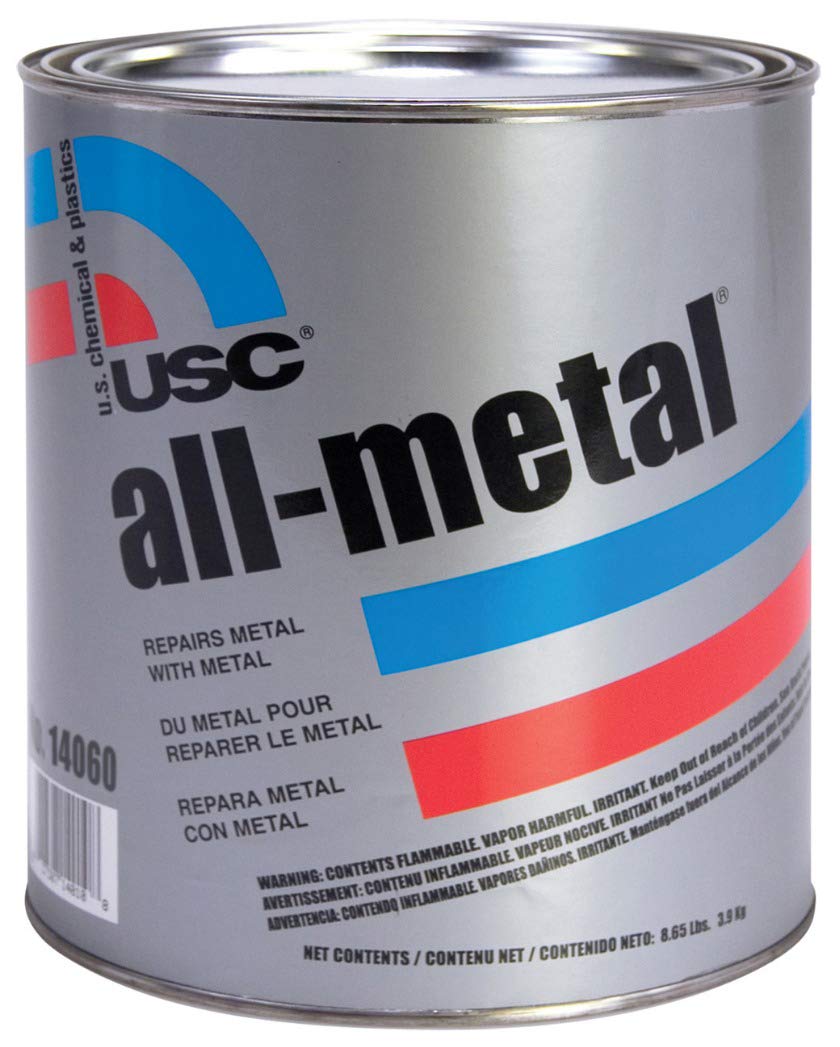
5. U. S. Chemical & Plastics All-Metal, 1-Quart (USC-14060)
An aluminum-filled body filler that patches bare metal damage — then accepts primer and topcoat once sanded.
Here is an important distinction up front: this U.S. Chemical & Plastics quart is a metal filler, not a liquid primer. It goes on over bare metal damage, dents, and seams to rebuild the surface before you prime. Sold as a 1-quart kit with hardener included, it is aluminum-filled — which means it sands and takes a drill bit or tap afterward without crumbling. That material property matters when you’re filling a hole that needs a fastener through it, not just paint.
What earns it a spot on this shelf is the mixing and spreading behavior. Customers describe it as spreading like butter — it goes on smooth, sets up fast, and sands cleanly enough to feather into existing metal. Quality dominates the review discussion, with effectiveness close behind. It rebuilds dents and seams on bare metal so the panel is flat and ready for primer. Once sanded, it accepts an etching or epoxy primer like any bare-metal substrate.
Hardness is the honest trade-off. It sets very hard, and some buyers find that a chore — sanding takes more effort than softer fillers, and a few batches dry hard enough to test your patience. That hardness makes it a durable choice for small dents and fastener holes. If you’re blending a wide feather edge on a curved panel, plan on extra sandpaper and elbow grease. It comes with no warranty per the manufacturer, which tells you this is a consumable pro product, not a lifetime tool.
Where it slots in: not a topcoat primer but the metal-filler stage before priming — aluminum-filled and drillable, so repairs hold fasteners and accept primer cleanly.
The hardness question: this sets very hard, which protects a repair but demands patience at the sanding stage.
Pair this with a primer: body-work DIYers filling dents and seams on bare steel who want a drillable, tap-able filler that takes primer afterward.
Skip the pairing: if you only need a liquid coat straight onto metal, this is a filler — add an etching or epoxy primer on top of it.
Know the Specs
Dry Time vs. Full Cure
Dry time is how long until the surface stops being wet and tacky — safe to touch, but not safe to sand or topcoat. Full cure is when the primer has hardened through. Seymour’s 0.08-hour dry is unusually fast, and so is its 5-minute full cure. Most brush-on and epoxy formulas want 2–4 hours of dry time. Plan topcoat after full cure, not after dry time, or the next coat traps solvent and blisters.
Self-Etching Chemistry
A self-etching primer carries a mild acid that opens the pores of bare metal as it dries, creating a mechanical and chemical grip without sanding. It is the go-to for bare aluminum, fiberglass, and properly prepped plastic. Standard primers laid over bare aluminum can fail to grip without a separate etch. If your panel is bare aluminum or fiberglass, etching is not optional.
DTM Epoxy and 1:1 Mixing
Direct-to-Metal epoxy primer goes straight onto bare steel, aluminum, fiberglass, and gelcoat in one coat, acting as both primer and sealer. The 1:1 ratio means one part primer and one part hardener. Once mixed, the pot life is finite — Custom Shop’s kit runs 4 hours — so mix only what you can spray inside that window. Ambient temperature affects pot life, so mix in small batches.
Coverage Per Can
Brush-on cans cover in square feet — the Rust-Oleum lists 65–110 sq. ft. per can. Aerosols list 10–15 square feet per can. Match the coverage to your panel area before starting. Running short mid-panel means a second trip and a visible seam. On a full gate or truck bed, coverage is the number that decides how many cans you buy.
Common Questions
Does primer for bare metal work on already-rusted surfaces?
Can I topcoat over bare metal primer without sanding?
How long does bare metal primer last before it needs a topcoat?
Is self-etching primer necessary for bare aluminum?
What does 1:1 mix ratio mean on an epoxy primer?
Does bare metal primer need a topcoat?
Can I use body filler and primer on the same bare metal panel?
How many square feet does one can of bare metal primer cover?
Is an epoxy primer better than an etching primer on bare steel?
The Bottom Line
For most projects involving already-rusted bare metal, the winner is the Rust-Oleum Stops Rust Brush On Primer. It cures in 4 hours, covers 65–110 sq. ft. per can, and its oil-based barrier turns corrosion into a paintable surface. If clean aluminum or fiberglass is on your bench and you want to sand fast, grab the SEM 39683 Self Etching Primer. Its 1-hour cure beats the Rust-Oleum’s 4-hour figure, and its etch bites where a plain primer slips. And when a body-shop job calls for a DTM epoxy sealer over bare steel, aluminum, and gelcoat, the Custom Shop Black DTM Epoxy Primer delivers. Just budget for the mixing time.
One honest nudge: the Rust-Oleum pick carries the highest rate of owner consensus at 4.5+ stars — if you are unsure where to start and your metal is rusted, it is the safest first can to open.
How we choose
We do not accept paid placement. Every pick is matched to a real buyer and a real use-case; we do not hands-on test units.
Sources
Specifications: manufacturer listings and product documentation. Review insights: verified customer reviews, as of November 2026. Pricing: not shown on this page (it changes often); check the current price via the retailer link.
As an Amazon Associate, My Heart Lives Here earns from qualifying purchases. This does not affect which products we feature.