Heads up: This post contains affiliate links. As an Amazon Associate I earn from qualifying purchases, at no extra cost to you. Learn more
Specs are compiled from manufacturer listings and verified buyer reviews and can change over time — please confirm the key details on the product page before buying.
Getting a peel and stick underlayment wrong is expensive: a membrane that loses its grip lets rain onto the decking, and a roll that is too short leaves you mid-roof with a seam open. The picks below are the ones worth your weekend, sorted by what actually matters on a sloped deck.
This guide is built by comparing the manufacturers’ published specifications and the patterns across verified customer reviews, so you get each pick’s real strengths and trade-offs instead of marketing spin.
Some rolls here self-seal, some nail down, and the widths run from 36 inches to 48 — the difference between one pass and three. Everything you need to pick a sound peel and stick roof underlayment is below.
Top Picks


How To Choose
Three things decide whether you finish the roof on Saturday or fight it all week.
Roll width and coverage
A 36-inch peel and stick roll means more laps up the slope, while a 48-inch roll covers more deck per pass.
Adhesion versus nailing
Self-adhered butyl membranes stick straight to the deck with no fasteners, while synthetic rolls are nailed down with capped nails — pick based on what your sheathing is.
UV exposure window
The printed UV rating tells you how many days the membrane can sit uncovered before the shingles go on.
Side-by-Side Comparison
| Model | Best For | Roll Width | Coverage | Type | Amazon |
|---|---|---|---|---|---|
| DuPont Roof Protector★ Best Overall | All-round value | 42 in. | 42″ x 286′ | Synthetic, 4-layer | Amazon |
| Hydroshield 50 YearBest Value | Long warranty confidence | 48 in. | 10 squares / 250 ft. | Synthetic, nailed | Amazon |
| SIPA 100 GSM | Budget deck protection | 48 in. | 1,000 sq. ft. | Synthetic, nailed | Amazon |
| Grace Select | Peel and stick on tight decks | 36 in. | 195 sq. ft. | Butyl, self-adhesive | Amazon |
| Tyvek Protec 200 | Big-roll tear resistance | 48 in. | 1,000 sq. ft. / 250 ft. | Synthetic, nailed | Amazon |
| Titanium PSU30 | Self-stick for steep pitches | 36 in. | 2 sq. / 72 ft. | Asphalt, peel and stick | Amazon |
Detailed Reviews
1. DuPont Roof Protector Roofing Underlayment Roll – 42″ x 286′
Our pick — 4.5+★ from 150+ verified ratings; the strongest balance of quality and price.
Four layers doing four jobs at once, on a roll light enough to carry up a ladder alone.
The 42-inch width and 286-foot length mean fewer laps up the slope, and the whole roll weighs 19 pounds. Four layers do the work: a grippy top layer, a water-blocking lamination layer, a woven polypropylene scrim (the strength mesh), and a slip-resistant coating that grips the deck under your boots.
What wins people over is build quality — the tear resistance beats plain roofing felt, so the deck stays protected during install. Installers also call it easy to work with. If you only buy one roll for a mid-size roof, this is the one.
Where It Delivers
- Four-layer build resists tearing better than felt.
- 42″ x 286′ covers more deck per lap.
Worth Knowing
- This is a nailed synthetic, not a self-adhered peel and stick membrane.
Reach for this if: you want proven tear resistance and a wide roll at a fair price.
Look elsewhere if: you need a true peel and stick self-adhesive layer for ice dams.
2. 50 Year Synthetic Underlayment Single Roll
Pre-printed nailing lines turn a fiddly layout job into a paint-by-numbers pass.
The Hydroshield roll covers 10 squares across 250 lineal feet at 48 inches wide, and weighs 2.0 pounds per square, so it lays out fast. The printed overlap lines and nail pattern mean you can skip the chalk line entirely — you just follow the marks. A 50-year warranty backs it up, and it meets ASTM D-4869, D-5034, D-226, D-4533 and D-7349 codes.
Its 48 x 10 x 10 inch package is a touch bulkier than the Tyvek Protec’s 47.8 x 7.9 x 7.7 inch box, but both fit a truck bed fine. Buy this if layout speed is your bottleneck.
The layout edge: those pre-printed lines save real time on a big roof, and 2.0 pounds per square is a light load to haul up.
The smart buy for: anyone nailing by hand who wants fewer measuring mistakes.
Skip if: you wanted a self-stick membrane — this one is nailed.
3. SIPA 100 GSM Roof Underlayment

A 60-day UV window lets you stall before the shingles go on — genuinely useful on a slow job.
This 48-inch by 250-foot roll covers 1,000 square feet of non-woven polypropylene at 100 GSM (grams per square meter — a weight measure, so higher means heavier fabric). It meets ASTM D4869 and D226 and is TDI/FBC approved for both shingle and metal systems. The 60-day UV ceiling is generous: stall a month and the membrane still holds.
Ease of installation and raw function are what it gets praised for. Quality is where feedback splits — some find it exactly as expected, others less durable than hoped, so treat it as a good mid-tier membrane for a fast job, not a forever roof.
What It Brings
- 60-day UV exposure window.
- Covers 1,000 sq. ft. at 100 GSM.
Mind the Gap
- Durability feedback is mixed, so don’t expect premium longevity.
Good fit for: a fast job where you want a long UV window on a tight budget.
Better to pass if: you need a membrane you trust for decades — size that expectation honestly.
4. Tyvek Protec 200 Roof Underlayment – 4′ x 250′ – 1 Roll
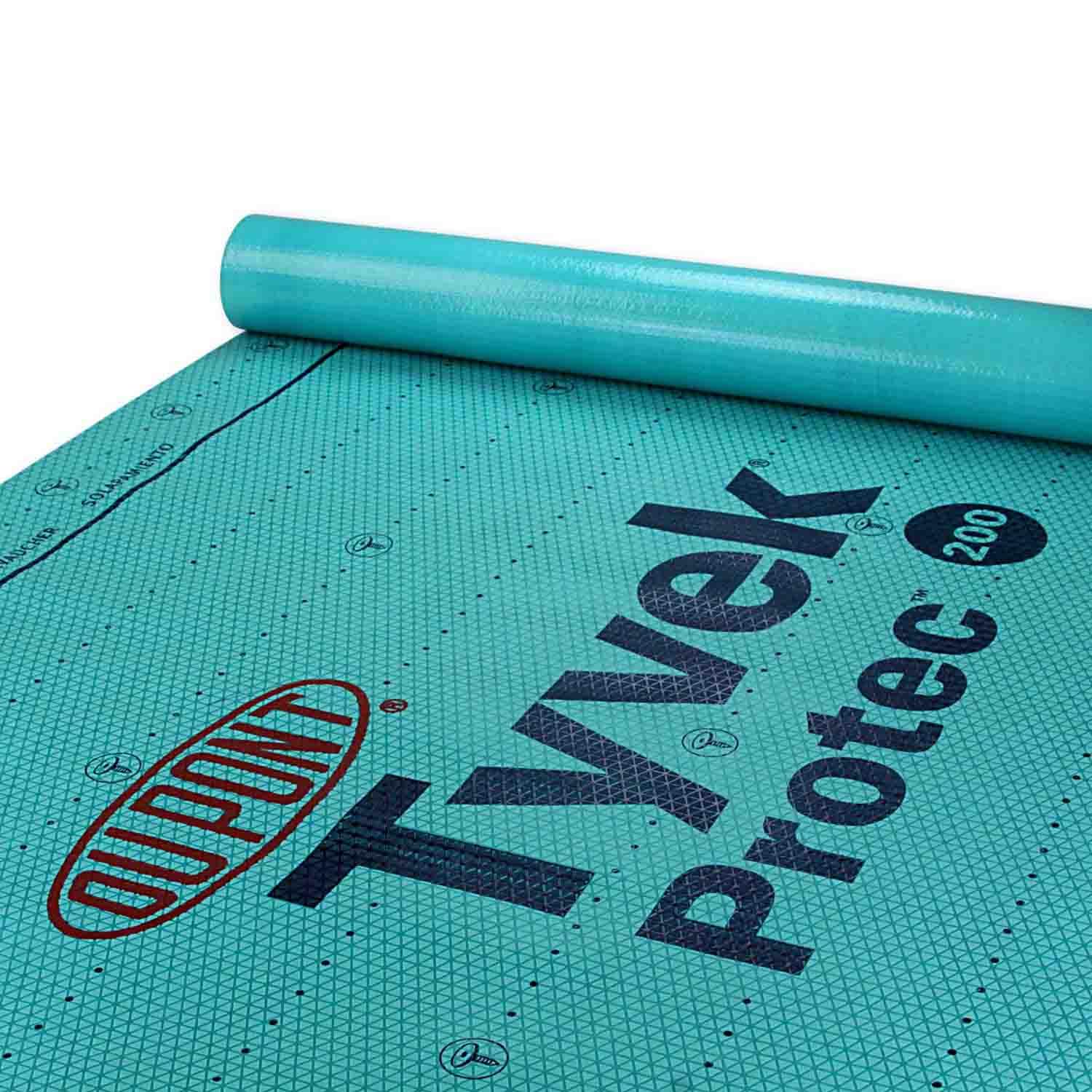
The roll you buy when the inspector is watching — Miami-Dade approval and a Class A fire rating.
This 4-foot by 250-foot roll covers 1,000 square feet at 16.5 mils thick, up to 6 months of UV exposure, with a 50-year limited replacement warranty and ICC-ES AC188 code approval. It’s rated Class A for fire per ASTM E110 and carries Miami-Dade County Approval 19-0109.07 — meaningful on coastal jobs. At 16.16 pounds it is also 48 pounds lighter than the Titanium PSU30, so it climbs a ladder easier.
The membrane gets top marks for durability — it simply won’t rip. Water resistance earns full marks too. The gripe is value: it costs more than most rolls here, so you’re paying for code paperwork and a long warranty rather than a bargain.
Code-ready confidence: ICC-ES approval and Miami-Dade certification travel with this roll, which matters at inspection.
The honest catch: it’s the pricier route, and some feel the sticker doesn’t reward you enough — buy it if compliance is worth it to you.
The right call for: coastal or high-wind zones and any job where the inspector needs paper.
Skip if: you’re roofing a shed and code approval isn’t part of the conversation.
5. Grace Select Roll Roofing Underlayment

True peel and stick: a butyl membrane that seals to the deck and a 30-day UV window.
This is the only roll here that self-adheres — 25 mils of butyl with a slip-resistant surface, 36 inches wide and 195 square feet per roll. Coverage matters: it measures 65 feet long, while the Tyvek runs 250 feet, so it’s a targeted roll for valleys, ice-dam edges and low-slope spots rather than a full roof. The 30-day UV exposure allowance and CertainTeed’s SureStart Warranty back it up.
What owners consistently rate is the quality of the membrane. Adhesion is the split point — some find it very sticky, others find it loses grip over time, so the deck has to be clean, dry and primed before you lay it.
What Earns It a Spot
- True self-adhesive butyl build at 25 mils.
- Slip-resistant surface and 30-day UV window.
Trade-off to Note
- Adhesion feedback is mixed — surface prep is not optional.
Built for: valleys, eaves and ice-dam zones where self-sealing matters most.
Not the one if: you’re covering a whole roof — 195 square feet won’t stretch far.
6. Titanium PSU30 Peel & Stick Roof Underlayment
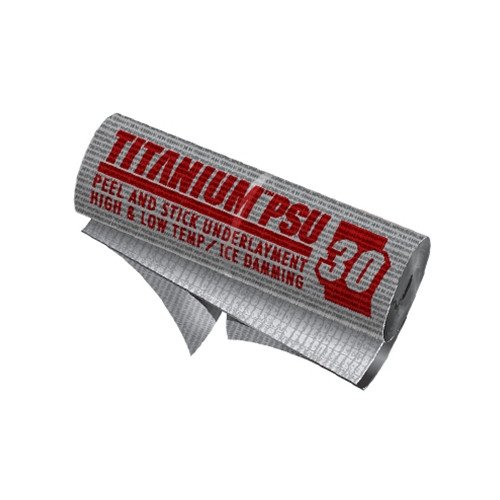
A peel and stick roll built for extremes — rated from -40°F to 240°F.
This asphalt peel and stick membrane carries a 45-mil minimum thickness, comes 36 inches wide by 72 feet long, and sticks with an asphalt-to-asphalt lap system. That all-temperature range (-40 degrees F to 240 degrees F) is broad, and the patented SURE-FOOT surface is designed to stop boot slips on a steep pitch. Up to 6 months of UV exposure gives you real scheduling room.
The catch is weight: at 48 pounds per roll this is roughly triple the 16.16 pounds of the Tyvek Protec 200, so it’s a two-person job up a ladder. Buy it for steep, cold-weather installs where grip and all-temperature performance matter — not for a big flat roof.
Where it earns the money: the 45-mil body and SURE-FOOT surface are aimed squarely at steep pitches and cold snaps.
Plan for the hoist: 48 pounds per roll is real weight, and only 72 feet long means more rolls than a wide synthetic.
For: steep, cold-climate decks and anyone who values Sure-Foot grip underfoot.
Go another way if: you’re working solo or covering a wide area on a budget.
Know the Specs
Mils and GSM
A mil is one-thousandth of an inch of thickness, and GSM is grams per square meter of fabric weight — both hint at how much abuse a membrane takes before it tears.
UV exposure window
The printed day count is how long the membrane can sit uncovered; a longer window lets you buy materials before the shingle crew arrives.
Common Questions
Can I lay peel and stick underlayment over old shingles?
How long can a synthetic roof underlayment sit exposed?
Do I need a peel and stick layer on a full roof?
The Bottom Line
The DuPont Roof Protector takes the top spot because its four-layer build resists tearing and its 42-inch width covers more deck per pass. Need a true self-adhered membrane for valleys and ice dams? Reach for the Grace Select. And for code approval plus a 50-year warranty, the Tyvek Protec 200 is the roll to order.
How we choose
We do not accept paid placement. Every pick is matched to a real buyer and a real use-case; we do not hands-on test units.
Sources
Specifications: manufacturer listings and product documentation. Review insights: verified customer reviews, as of November 2026. Pricing: not shown on this page (it changes often); check the current price via the retailer link.
As an Amazon Associate, My Heart Lives Here earns from qualifying purchases. This does not affect which products we feature.