Heads up: This post contains affiliate links. As an Amazon Associate I earn from qualifying purchases, at no extra cost to you. Learn more
Specs are compiled from manufacturer listings and verified buyer reviews and can change over time — please confirm the key details on the product page before buying.
If you want the short answer: pick a granular organic fertilizer matched to what you actually grow, feed it on a schedule, and let the soil microbes do the slow work. The table below sorts five bags by what they are genuinely good at — roses, mixed beds, heavy feeders, fruit trees, or a big yard on a budget — so you can stop reading labels and start feeding.
This guide is built by comparing the manufacturers’ published specifications and the patterns across verified customer reviews, so you get each pick’s real strengths and trade-offs instead of marketing spin.
Slow release matters because the nutrients arrive as the granule breaks down, not in one hit the day you spread it. That is why nobody in this lineup is chasing instant greening. Each pick below is chosen for a different garden job, and every one is approved for organic growing. The five bags in this organic slow release fertilizer shortlist cover roses, mixed beds, fruit trees, and big yards without a single synthetic shortcut.
Top Picks

How To Choose The Best Organic Slow Release Fertilizer
The first thing to settle is what you are feeding. A bag built for roses is not the bag you want for a tomato bed, even if both are organic and both are slow release.
Read the NPK ratio before anything else
Those three numbers on the bag are the ratio of nitrogen, phosphorus, and potassium — the nutrients that drive leaf growth, root and bloom development, and overall plant strength. A higher first number pushes leafy green growth, while a higher middle number supports flowering and fruiting. Roses, fruit trees, and vegetables each want a different balance, so match the ratio to the crop instead of buying one bag for the whole yard.
Know what “slow release” actually means
Organic granular feed releases its nutrients as soil microbes break it down, so the plant draws steadily rather than getting one strong dose. That is the practical appeal: you spread it, water it in, and come back to a plant that has been fed for weeks. It also makes overfeeding less likely, which matters for anyone who has scorched a plant with a fast synthetic product.
Check for organic approval and honest ingredients
Look for a listed organic input, and read the ingredient list to see what the nutrients are actually made from — feather meal, bone meal, alfalfa, kelp, and similar natural sources show up in the better bags. A bag that names no sludges or fillers is telling you something worth knowing. Also expect a smell: natural organics are made of real material, and that material does not smell like a flower shop.
Side-by-Side Comparison
| Model | Best For | NPK Ratio | Bag Size | Form | Amazon |
|---|---|---|---|---|---|
| Espoma Organic Rose-Tone (2-pack)★ Best Overall | Roses and flowering shrubs | 4-3-2 | 4 lb per bag, 2 bags | Granules | Amazon |
| Espoma Organic Plant-Tone (2-pack)Most Versatile | All-purpose beds and veg | 5-3-3 | 4 lb per bag, 2 bags | Granules | Amazon |
| FoxFarm Happy Frog All Purpose | Microbe-friendly feeding | 6-4-5 | 4 lb | Granules | Amazon |
| Down To Earth Fruit Tree 6-2-4 | Backyard orchards | 6-2-4 | 5 lb | Powder | Amazon |
| Jobe’s Organics Granular All Purpose | Big yards on a budget | 4-4-4 | 16 lb | Granules | Amazon |
Detailed Reviews
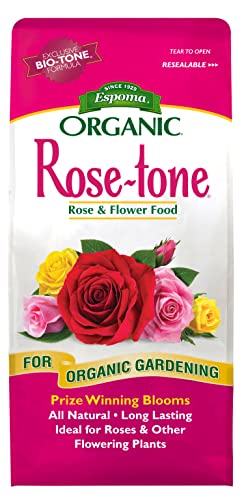
1. Espoma Organic Rose-Tone 4-3-2 (Pack of 2, 4 lb Each)
Our pick — 4.5+★ from 750+ verified ratings; the strongest balance of quality and price.
A 4-3-2 rose feed with 5% calcium, built to push flowering over leaf growth.
Your rose bushes do not need more water or more sun — they need the right ratio. Rose-Tone carries a 4-3-2 analysis with 5% calcium, a blend tilted toward flowering rather than leafy growth. Spread it around the drip line (the outer edge of the plant where rain drips off the leaves) and water it through, and the granules break down gradually instead of dumping everything at once.
There is real weight in this pick. At 4 pounds per bag with two bags per order, it is the lighter of the two multi-bag Espoma options here — a full 12 pounds lighter than the Jobe’s 16-pound bag. That matters if you are carrying feed across a garden or storing it on a shelf. Rose-tone arrives ready to use with no mixing, so there is no bucket work before or after spreading.
Effectiveness is what wins people over here — well over three-quarters of the conversation is about how well it works, and the follow-up theme is bloom count and size. Viburnum, bougainvillea, and clematis are all named on the bag alongside knockout and climbing roses. Feed monthly through the growing season, roughly May through September, and you stay ahead of the bloom cycle. The one thing to plan for is the smell. Natural organics are made of real material, and the recurring gripe on this bag is a strong odor right after application — it fades, but the first day is noticeable. Approved for organic gardening as a registered Organic Input Material.
Where this bag earns its keep
- 4-3-2 ratio with 5% calcium is built for blooms, not just leaf
- Two 4 lb bags per order, ready to use with no mixing
- Registered Organic Input Material for organic production
- Works on roses plus viburnum, bougainvillea, and clematis
Worth knowing before you buy
- Strong odor on application day, per the bag’s most-discussed mixed topic
- Monthly feeding through the season means repeated passes
- Smaller bags suited to beds, not large-scale spreading
Go for this if: roses and flowering shrubs are the headliners of your garden and you want blooms, not just bush.
Think again if: you are feeding a whole vegetable plot or want a feed that covers everything in one bag.
2. Espoma Organic Plant-Tone 5-3-3 (Pack of 2, 4 lb Each)
A 5-3-3 all-purpose feed labeled for annuals, perennials, tomatoes, peppers, squash, lettuce, trees, and shrubs.
Plant-Tone runs a 5-3-3 analysis with 5% calcium, which is a step more nitrogen-leaning than the Rose-Tone above. That makes it a leaf-and-fruit feeder rather than a bloom-first one, and it is the bag to reach for when your garden is a mix. Annuals, perennials, tomatoes, peppers, squash, lettuce, trees, and shrubs are all named on the label — one bag, most of the yard.
The ordering math is worth noting. This is a two-pack, and it is the only two-pack in the lineup — the FoxFarm Happy Frog and the Down To Earth Fruit Tree each come as a single bag. If you are feeding a wide bed all season, two bags per order saves a reorder mid-season. Spring and fall are the recommended windows for trees and shrubs, with monthly feeding for roses, flowers, and vegetables through the growing season.
Quality is the steer here — the biggest share of owner feedback is about how consistently good the product itself is, with effectiveness running a close second. The Bio-tone enhancement is part of that story, as is the no-sludges, no-fillers claim. The honest caveat is the same one that follows every natural organic: the smell. Some find it fine, others find it unpleasant, so it is a plan-for-it item rather than a surprise. Approved for organic gardening as a registered Organic Input Material.
The two-pack advantage: with two 4 lb bags per order, this is the bag you stock rather than re-buy.
The adjuster’s note: if your beds are mostly roses, the Rose-Tone’s 4-3-2 tilt will serve better than this more nitrogen-forward 5-3-3.
The one to stock up on: mixed gardens with vegetables, flowers, and shrubs that need one feed for everything.
Second thoughts for: pure rose beds or orchards where a crop-specific ratio would suit better.
3. FoxFarm Happy Frog All Purpose Fertilizer, 4 lb

The highest NPK here at 6-4-5, and the only bag that adds soil microbes and mycorrhizal fungi.
At 6-4-5, Happy Frog carries the strongest numbers in this lineup — higher in all three nutrients than the Rose-Tone’s 4-3-2 and the Plant-Tone’s 5-3-3. That makes it a feeder for plants that eat hard: heavy vegetable crops, ornamentals pushing new growth, and anyone starting from tired soil. It is OMRI Listed, the Organic Materials Review Institute listing organic growers look for.
What sits inside besides the NPK is the reason people pick this one. FoxFarm loads it with beneficial soil microbes and mycorrhizal fungi — the soil organisms that help roots take up nutrients and water. Think of them as a support crew for your plant’s root system. The granules are ready to use with clear instructions for both new plantings and established beds. One 4 lb bag per order is the format, which is fewer bags than either Espoma two-pack — plan your spread accordingly.
Quality is the theme that carries this bag. It comes up more than anything else, and it is followed by plant health and effectiveness — including people growing Monstera, which tells you something about its range indoors and out. The counterweight is value. That topic splits right down the middle, and this is the discussion where you genuinely notice the cost. The answer is straightforward: the higher analysis and the microbe content are what you are paying for, and if you have one hungry bed to feed, it earns the difference.
Why gardeners reach for this bag
- 6-4-5 analysis is the strongest ratio here
- Contains soil microbes and mycorrhizal fungi
- OMRI Listed for organic production
- Ready to use for both new and established plants
The honest trade-offs
- One 4 lb bag per order, not a multi-pack
- Value is the split topic — the price is more noticeable here
- Higher analysis is more than some low-feed plants need
Built for: heavy feeders and soil you want to rebuild, not just top up.
Look elsewhere if: you are feeding light-need plants or want the lowest cost per spread.
4. Down To Earth Organic Fruit Tree Fertilizer 6-2-4, 5 lb

A 6-2-4 fruit-tree formula with added calcium for fruit development, not just foliage.
Most all-purpose bags stop at NPK. This one goes a step further with a 6-2-4 formula plus added calcium for proper fruit development — an extra that matters if the crop, not the foliage, is the point. Apples, pears, plums, cherries, peaches, mangoes, pomegranates, and figs are all on the list. That is a wider orchard reach than a rose or all-purpose blend gives you, because it is formulated for fruiting canes, shrubs, and trees.
Ingredient quality is where this earns its spot. Feather meal, fish bone meal, calcium carbonate, langbeinite, potassium sulfate, alfalfa meal, and kelp meal make up the recipe. It is a 5 lb single bag and it is OMRI Listed for organic production. One detail worth repeating: the maker states the product does not expire if stored in a cool, dry place. If you keep feed over winter in a shed, that is the note you want.
Effectiveness is the headline, and fruit growth follows close behind — including mango trees producing more than they had before. Improved leaf color over a season comes up too, which is the slow-release effect visible on the plant itself. Where this differs from the other picks is form: it comes as a powder rather than pure granules, so plan on some dust when you spread it. Keep the box dry and it will keep for seasons, which is what makes a single bag practical even if you only have a couple of trees.
Orchard-grade extras: added calcium for fruit development and a formula that spans backyard trees from apple to fig.
The shelf-life detail: the maker states it does not expire if stored cool and dry — a reason a single bag is enough.
Reach for this if: your goal is fruit, not just greenery, and you want a formula that understands the difference.
Not the one for: rose gardens or mixed flower beds, where the rose and all-purpose bags fit better.
5. Jobe’s Organics Granular All Purpose Fertilizer, 16 lb

A 16 lb bag — four times the 4 lb Espoma bags — with a level 4-4-4 ratio for whole-yard feeding.
Here is the number that sets this bag apart. At 16 pounds, it contains a full four times the weight of the 4 lb Espoma Rose-Tone bags — the difference between a bedroom garden and a real yard. A 4-4-4 NPK keeps the ratio level across all three nutrients, so vegetables, flowers, trees, and shrubs all get a balanced feed rather than one that favors blooms. Granules are easy to measure, which lets you dose beds precisely instead of guessing, and the bag is resealable.
The application routine is the most frequent in the lineup: every 2-3 weeks during the growing season, which is a tighter cadence than the monthly Rose-Tone schedule. That is why the larger bag earns its place — you are feeding more often, across more ground. It is OMRI listed for organic gardening by the USDA and contains no synthetic chemicals. Root development, seed development, and soil conditioning are all part of what it is designed for.
Quality and effectiveness dominate what people say, and plant growth comes next — tomatoes greening up, garden beds and landscaping filling out. Ease of use and affordability both land well too. The most-discussed topic, though, is odor: a fair number of owners find it smelly out of the bag, more so than on the other picks here. That is the nature of a large natural organic. If you are spreading it next to a patio, spread before guests arrive, not after.
What the big bag gives you
- 16 lb is four times the weight of the 4 lb Espoma bags
- 4-4-4 NPK feeds vegetables, flowers, shrubs, and trees alike
- Resealable and easy to measure for precise dosing
- OMRI listed for organic gardening, no synthetic chemicals
Plan around this
- Odor is the most-discussed mixed topic on this bag
- 2-3 week feeding cadence means frequent passes
- Heavy 16 lb bag takes a bit more handling
Pick this one for: a full yard, a big vegetable patch, or landscaping that needs regular feeding without constant reordering.
Keep looking if: you only have a few pots and want a small bag that stores easily.
Know the Specs
NPK Ratio
Those three numbers represent nitrogen, phosphorus, and potassium, in that order. Nitrogen drives leafy green growth, phosphorus supports flowering and fruiting, and potassium helps overall plant strength. A 4-3-2 is slanted toward blooms, while a 6-4-5 gives a hungry plant more of everything. Match the ratio to what you grow instead of buying one bag for everything.
Granular vs. Powder Form
You get an even spread with less mess when you choose granules, which is why most all-purpose bags use them. Powder coats the ground more densely, but it tends to dust when you handle it. Neither form feeds the soil better — it depends on how tidy you want the application to be.
Bag Size and Feeding Cadence
Bag size only makes sense next to how often you feed. Monthly schedules across a few beds suit a 4 lb bag, while a 16 lb bag works best on a 2-3 week routine across a larger yard. Buy to your schedule and your acreage, not just to the biggest number.
Organic Listing
An OMRI listing means the product has been reviewed by the Organic Materials Review Institute for organic production. It is the flag organic gardeners look for before a bag goes into the beds. Ready-to-use bags need no mixing, so what you buy is what you spread.
Common Questions
How often should I apply organic slow release fertilizer during the growing season?
Will organic fertilizer burn my plant roots?
What does OMRI Listed mean on a fertilizer bag?
Which NPK ratio is right for roses?
Can I use an all-purpose fertilizer on fruit trees instead of a fruit-tree blend?
How do I apply granular fertilizer around a plant?
Do these organic fertilizers expire if I store them?
Why does my organic fertilizer smell so strongly?
Is granular or powder fertilizer easier to spread evenly?
Can I feed vegetables and flowers with the same organic bag?
The Bottom Line
For most gardens, the organic slow release fertilizer winner is the Espoma Organic Rose-Tone. Its 4-3-2 ratio (4% nitrogen, 3% phosphate, 2% potash) with 5% calcium is built to turn a flowering shrub into a blooming one, and it ships as two ready-to-use bags. If you want one bag for the whole yard, grab the Espoma Organic Plant-Tone — its 5-3-3 covers vegetables, flowers, trees, and shrubs together. And for a big yard that needs feeding every 2-3 weeks, the Jobe’s Organics 16 lb bag is the one to reach for.
A rose bag on a tomato bed, or a fruit-tree formula on a flower border, wastes the advantage you paid for. Match the NPK ratio to your crop and the bag size to your feeding cadence, and any of these five will do right by your soil.
How we choose
We do not accept paid placement. Every pick is matched to a real buyer and a real use-case; we do not hands-on test units.
Sources
Specifications: manufacturer listings and product documentation. Review insights: verified customer reviews, as of November 2026. Pricing: not shown on this page (it changes often); check the current price via the retailer link.
As an Amazon Associate, My Heart Lives Here earns from qualifying purchases. This does not affect which products we feature.