Heads up: This post contains affiliate links. As an Amazon Associate I earn from qualifying purchases, at no extra cost to you. Learn more
Specs are compiled from manufacturer listings and verified buyer reviews and can change over time — please confirm the key details on the product page before buying.
You want the joints between your pavers to stop washing out every time it rains. The short answer: for a paver patio or walkway, a polymeric jointing product is the practical pick, and for brick, block or stone repairs a sanded acrylic mortar in a caulk tube does the job with no mixing. This guide covers five products that actually do those jobs, and it tells you which one fits your project before you buy.
This guide is built by comparing the manufacturers’ published specifications and the patterns across verified customer reviews, so you get each pick’s real strengths and trade-offs instead of marketing spin.
The trick is matching the product to the joint rather than the label on the bucket, so polymeric paver sand never ends up in a fireplace and refractory mortar never ends up between pavers. Below you will find the mortar for pavers that best suits the surface you are actually repairing.
Top Picks


How To Choose The Best Mortar for Pavers
Most people buy the wrong product here because they shop by the word “mortar” instead of by the joint they are filling. A paver patio needs a joint material that flexes slightly and resists water. A brick wall or a stone step needs a rigid repair that grabs the masonry. Those are two different products, and mixing them up wastes a weekend.
Match the product to the joint, not the label
If you are filling the narrow gaps between concrete pavers on a driveway, walkway or patio, you want a polymeric jointing material — a sand blended with a binder that firms up once it is watered and cured. If you are patching a cracked mortar line in a brick or block wall, you want a sanded acrylic paste in a tube that you gun into the crack and smooth with a trowel or fingertip.
Neither one is a substitute for the other. A tube of sanded acrylic will not hold a wide paver joint, and a bucket of polymeric sand will not fix a broken mortar bed under a wall.
Check the joint width before anything else
Joint width is the number that quietly decides whether a product works at all. The Rhino polymeric sand in this list is rated for joints up to a maximum of 2 inches, which covers most standard paver gaps. The Quikrete acrylic tubes are built around filling 3/8 inch mortar joints. Measure your widest gap with a tape before you order — a product rated too narrow simply falls through.
Think about winter, not just the day you install
Freeze-thaw cycling is what kills paver joints in cold climates. Water gets in, freezes, expands and pushes the material apart. A product that resists repeated freezing and thawing holds longer. This is why the acrylic bonding additive in this list exists at all — it is meant to be mixed into a cement or mortar base to make the finished bond more stable through those cycles.
Decide if you want to mix or squeeze
Mixing means a bucket, water, a trowel and cleanup. Squeezing means a caulk gun and a rag. Homeowners with one small repair often do better with a tube. Anyone doing a full patio or a large repoint should expect to mix and to buy more material than they first guessed.
Side-by-Side Comparison
| Model | Best For | Form | Coverage / Size | Stated Cure or Set | Amazon |
|---|---|---|---|---|---|
| Sika SikaLatex R Acrylic Concrete Bonding Admix★ Best Overall | Strengthening a cement or mortar mix | Liquid admix | 1 gal bottle | 30 days full cure | Amazon |
| Quikrete 8620-05 Mortar Repair Squeeze Tube, 3 PackBest for Small Repairs | Small brick and stone touch-ups | Paste in squeeze tube | 5.5 oz tube, 3 pack | — | Amazon |
| Tenon Refractory Mortar | Fireplaces, fire pits and flues | Powder, add water | 10 pounds | 1 hour working time | Amazon |
| Rhino Power Bond Plus Polymeric Sand | Paver joints on patios and driveways | Polymeric sand | 10 pounds | — | Amazon |
| Quikrete 8620-09 Mortar Repair Caulking Tube, 5 Pack | Long masonry crack runs | Paste in caulk tube | 10 oz tube, 5 pack | 24 hr initial hardening | Amazon |
Detailed Reviews
1. Sika SikaLatex R Acrylic Concrete Bonding Admix
Our pick — 4.5+★ from 850+ verified ratings; the strongest balance of quality and price.
A one-gallon jug that turns an ordinary mortar mix into one that grips and survives winter.
If your paver project involves setting a base, bedding a step or repairing a cracked mortar bed, this is the pick. It is not a joint sand and it is not a squeeze-and-go repair — it is a liquid you pour into your cement, concrete or mortar mix to raise its adhesion and tensile strength. The spec that earns it first place is 500 psi bond strength, stated by the maker for the cured acrylic-polymer latex. In plain terms, that is the pull-apart force the cured bond is rated to hold, which is what keeps a repair from separating at the edge.
The other number that matters is on the weather side. This fortifier is formulated to resist damage from repeated freezing and thawing — the cycle that cracks paver bedding in cold climates. You get 8.5 pounds of liquid in a 1 gallon container, and the label says no dilution is needed, so there is no measuring jug step before you start. Full cure time runs 30 days, so plan around a month before you judge the finished job harshly.
Owners praise its effectiveness above all, with the quality of the finished bond a close second. The honest trade-off is dry time. Some users report it takes around three days to dry completely, which is longer than a fast-set patch would take, so do not schedule the final seal coat for the next morning. One more note for paver work specifically: this is an admix, not a standalone filler, so you still need your sand and cement on hand. The crowd favorite here is a 4.5+ star product with 800+ ratings.
What earns it the top slot
- 500 psi bond strength gives a repair a rated grip rather than a hope
- Made to resist repeated freeze-thaw damage, so a cold-climate patio bed holds longer
- No dilution needed — you pour and mix, one less step and one less measuring cup
- Doubles as a primer for grout and will not create a vapor barrier
Where it asks for patience
- 30-day full cure and reports of roughly three days to dry mean it is not a same-day finish
- It is an additive, not a filler — you still buy and mix the mortar itself
- Sold as a single 1 gallon bottle, so large jobs need more than one
Reach for this if: you are mixing your own bedding or repair mortar and want it to hold through winter in a climate that freezes.
Look elsewhere if: you want to fill paver joints without mixing anything — the Rhino sand below is that job.
2. Quikrete 8620-05 Mortar Repair
Three small squeeze tubes for the hairline cracks you keep meaning to get to.
This is the tube you keep in the garage for a cracked mortar line on a brick porch step or a chip in a stone sill. Each tube holds 5.5 oz of sanded acrylic paste, and you get three of them, so you have a spare when the first one runs dry. The sanded texture matters for appearance — it is what lets the repair blend into the surrounding mortar rather than sitting on top like a smooth bead of caulk. It is rated to adhere to brick, block, stone and concrete.
You get quick spot repairs without mixing anything, and that is also the limit. A 5.5 oz squeeze tube is a touch-up tool, not a project tool. Compare it to the bigger Quikrete five-pack in this list at 10 oz per tube: grab that one if you are running a long crack line, while this three-pack suits scattered small fixes across a patio edge or a garden wall. The pack count helps too — three tubes here against three in the larger-tube pack, but at a much smaller volume per tube.
Owners praise its effectiveness most and its ease of use second — you gun it straight into a crack with no bucket or mixing. The mixed signals are worth knowing before you order. Color match is genuinely split — some find it blends, others find it off — so test a small hidden area first on a light mortar. Durability also draws criticism on a minority of jobs. Treat it as a cosmetic and small-structural repair, not a permanent rebuild of a failing wall.
Honest read on value: the paste is water resistant and easy to tool into a joint, which is why it lands on so many short repair lists. The catch is that a 5.5 oz tube empties quickly on anything wider than a hairline crack.
The color question: because the color match is the split point in owner feedback, buy it for a repair where a slight shade difference will not bother you, or test a patch first.
Suits you when: you have a handful of small brick or stone cracks and want zero mixing, zero cleanup.
Not your pick when: the joint you are filling is a wide paver gap — this paste is not built to span it.
3. Tenon Refractory Mortar, 10 Pounds

Built for fire, not for foot traffic — this is the mortar for the fire pit ring and the flue.
Here is the point most buyers miss: “refractory” means heat resistant, not stronger. This mortar is rated up to 2550°F and is meant for fireplaces, the inside of fire pit rings, barbeques, pizza ovens and chimney work such as setting clay flue liners. It passes ASTM C199, the standard most building codes reference for installing firebrick and flues in chimneys and masonry fireplaces. If your paver project involves a fire feature set into the patio, this is the material for the hot part only.
You mix it yourself, so you control the batch size. It comes as a 10 pound bag of preblended powder — you add water, and you get 1 hour of working time before it hardens. That hour is the clock you are racing, so mix in batches you can actually place rather than one big tub. Once cured it becomes water insoluble and acid resistant. On size, the bag is packed at 9.4 x 9.4 x 7.1 inches against the Rhino sand’s 11.34 x 9.72 x 3.07 inches — the Tenon bag is the taller, more compact footprint on a shelf, and the Rhino tub spreads wider and flatter.
Quality is the strongest theme in owner feedback, with performance a close second. Where opinions split sharply is ease of use — some find it very easy to work, others find it extremely hard to trowel. Durability also draws fire, with a minority reporting the cured material breaking down. Both of those point the same direction: this is a specialist material that rewards careful mixing and proper curing, and it is not the product to learn on with a whole chimney.
Where it belongs: firebrick, flue liners and the fire-facing interior of a pit or oven, at 2550°F with an ASTM C199 pass behind it.
Where it does not: between patio pavers. It is the wrong tool for a walkway joint, however good it is at heat.
Pick it for: any joint that will see flame or flue gas, where heat resistance is the deciding spec.
Skip it for: driveway and patio joints — the one-hour working time and rigid cure are wrong for a flexing paver field.
4. Rhino Power Bond Plus Polymeric Sand
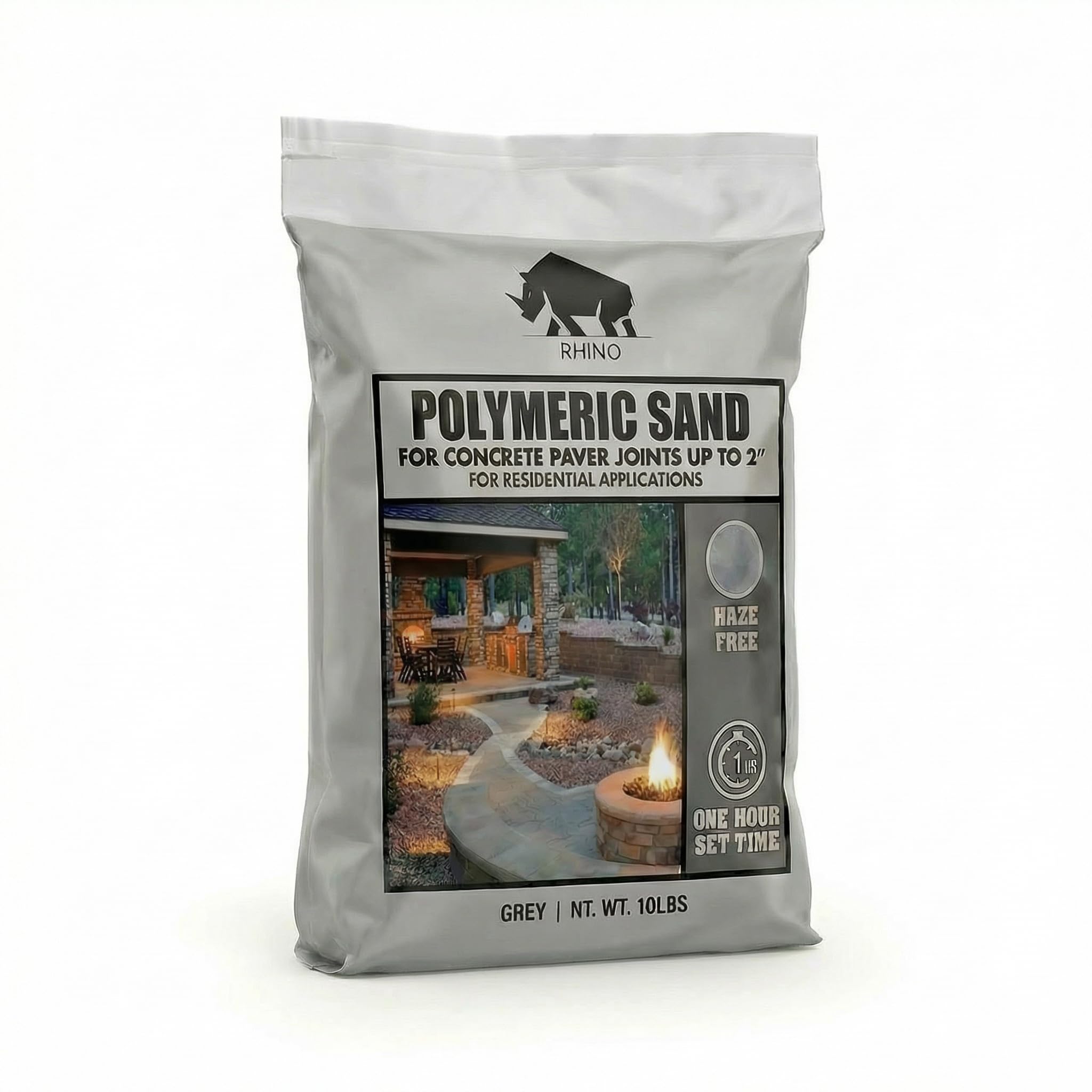
The joint filler made for the patio itself — up to 2 inches of gap, rain or shine.
This is the product in this list that is actually built for paver joints. You sweep it into the gaps between the pavers, the binder in it firms up, and the joints stop being a channel for water and weeds. It handles joints up to a maximum of 2 inches, which covers most concrete paver and wet-cast paver layouts on a driveway, walkway or pool surround. That is the headline number, and it is the one to check against your widest gap before ordering.
You carry a real bag here, not a pocket tube. This 10 pound bag sits far from the small acrylic tubes in this list — the Quikrete five-pack of 10 oz caulking tubes weighs 1.3 pounds total. The maker claims it is designed to handle rain, snow and strong sunshine, which is the freeze-thaw-and-heat test a patio actually faces. The bag is also rated for use with concrete pavers and wet-cast based pavers specifically.
Owners like how it performs once it is down: functionality leads the feedback, ease of use and installation follow, and the slate-gray finish draws praise for looking good in the joints. The catches are real and worth sizing honestly. Quality and value are genuinely split, and a portion of buyers report erosion over time or sand washing out between pavers, so joint prep and correct watering matter enormously. A 10 pound bag also does not go far on a large patio.
Why patio owners keep buying it
- Rated for joints up to 2 inches, so it fills the wide gaps a tube cannot
- Blends in visually — slate gray with a finish owners describe as good-looking
- Made for driveways, walkways and pool surrounds with concrete or wet-cast pavers
- Application is straightforward: sweep, water, let it set
What to plan around
- Quality and value draw genuinely mixed reactions, so prep and curing discipline decide the result
- A share of owners see sand washing out or eroding over time
- 10 pounds is a modest bag — measure your patio area before you commit
Start here if: the job is the joint between concrete or wet-cast pavers and you want it locked against weather.
Keep looking if: you are patching a brick wall — a sanded acrylic tube is the right shape for that.
5. Quikrete 8620-09 Mortar Repair

The bulk tube pack for a whole wall of mortar lines instead of one crack.
When the repair is not one crack but a run of them along a brick garden wall, this five-pack of 10 oz caulking tubes is the efficient shape. That is five tubes against the three in the 5.5 oz squeeze pack above — more tubes and nearly double the volume per tube, so you get through a long repoint without stopping to reorder. You load a tube into a standard caulk gun, and the sanded acrylic paste is made to blend with the surrounding mortar texture and color.
You know when you can walk on the repair, because the timing specs are here — more than most tubes offer. Initial hardening is stated at 24 hours, with a full cure time of 8 hours listed separately on the spec sheet — read those as a two-stage process and give the repair the full day before you stress it. The paste is listed for brick, block, stone and concrete surfaces. On the weight contrast, this whole pack is 1.3 pounds while the Rhino polymeric sand is a full 10 pound bag — this is a light box you can carry in one hand.
Functionality is where this tube pack is most consistent. Filling gaps around outside faucets, patching stucco holes and general concrete filling are the jobs owners keep describing it as working well for, and ease of use holds up under a caulk gun. The split points matter though. Color is the recurring gripe, with some finding it much lighter than expected against their grout, so test in an out-of-sight spot first. Quality opinions are genuinely divided, and a durability complaint about a broken or burst tip shows up in a minority of cases.
The practical case: five 10 oz tubes, a sanded finish and a 24 hour initial hardening window make this the batch-buy for a long masonry face.
The one to watch: color is the most consistent complaint, so buy it knowing the gray may read lighter than your existing mortar.
Best matched to: a full-wall repoint on brick, block or stone where one small tube would never finish the job.
Think twice if: exact color matching against existing mortar is the whole reason for the repair.
Know the Specs
Bond strength (psi)
Psi means pounds per square inch — the pull-apart force a cured bond is rated to hold. The SikaLatex R states 500 psi bond strength, which is the number that tells you how hard the repair fights separation at an edge. A higher figure means a tougher bond, but it only applies once the mix has fully cured.
Joint width (inches)
This is simply how wide a gap the product can fill. The Rhino polymeric sand is rated for joints up to a maximum of 2 inches, while the Quikrete acrylic tubes are built around 3/8 inch mortar joints. Measure your widest gap first — a filler rated narrower than your joint will fall straight through.
Refractory rating (°F)
Refractory means heat resistant. The Tenon mortar is rated up to 2550°F, which is why it belongs in fireplaces, fire pit rings and flues rather than on a walkway. Treat this spec as a heat limit, not a strength score.
Working and cure time
Working time is how long you have to place and tool the material before it stiffens — the Tenon refractory mortar gives 1 hour. Cure time is when it reaches full strength — 30 days on the SikaLatex R, 8 hours full cure with 24 hours initial hardening on the Quikrete five-pack. Plan your schedule around the longer figure.
Common Questions
Can I use polymeric sand instead of mortar for paver joints?
How wide can a paver joint be before sand will not hold?
Do I need to add a bonding agent to mortar for pavers?
Can Quikrete mortar repair be used on a paver patio?
Why does my polymeric sand wash out after rain?
Is refractory mortar the same as paver mortar?
How long before I can walk on a repaired paver joint?
Will gray mortar repair match my existing mortar color?
Can I use mortar repair in a caulk gun on vertical walls?
The Bottom Line
For most people fixing a paver patio, the answer is the Rhino Power Bond Plus polymeric sand, because it is the one product here actually built to fill paver joints up to 2 inches and lock them against weather. If you are mixing your own bedding or repair mortar instead, the SIKA SikaLatex R admix is the pick worth taking, thanks to its 500 psi bond strength and freeze-thaw resistance. And when the job is a long brick wall rather than a patio, the Quikrete five-tube pack gives you the volume to finish it in one go.
How we choose
We do not accept paid placement. Every pick is matched to a real buyer and a real use-case; we do not hands-on test units.
Sources
Specifications: manufacturer listings and product documentation. Review insights: verified customer reviews, as of November 2026. Pricing: not shown on this page (it changes often); check the current price via the retailer link.
As an Amazon Associate, My Heart Lives Here earns from qualifying purchases. This does not affect which products we feature.