Heads up: This post contains affiliate links. As an Amazon Associate I earn from qualifying purchases, at no extra cost to you. Learn more
Specs are compiled from manufacturer listings and verified buyer reviews and can change over time — please confirm the key details on the product page before buying.
If you suspect a wall is damp, you need a tool that tells you where the water is hiding before mold takes hold. This shortlist covers both types: meters that read moisture through the surface, and test kits that grow a sample so you can see what is actually in the air.
This guide is built by comparing the manufacturers’ published specifications and the patterns across verified customer reviews, so you get each pick’s real strengths and trade-offs instead of marketing spin.
The picks below are split between instant moisture readers and lab-style test kits, so your first decision is simply which kind of answer you want. Here is a practical shortlist of the mold detector options worth your time.
Top Picks

How To Choose The Best Mold Detector
Three things decide whether a detector is useful to you or just sits in a drawer.
Pinless or pin-type sensing
A pinless sensor slides over drywall and tile without marking it, while a pin-type unit presses two steel points into the material for a direct read.
if you want a number or a sample
An electronic meter gives you a moisture reading in seconds, whereas an agar test kit grows a culture over 2-4 days so you can see what is floating in the air.
Alerts you will actually notice
A backlit screen, a color bar graph, or an audible beep helps in a dim crawl space where you cannot easily read a plain display.
Side-by-Side Comparison
| Model | Best For | Type | Surfaces | Standout | Amazon |
|---|---|---|---|---|---|
| RDINSCOS MT68★ Best Overall | Whole-home checks | Pinless | Wood, drywall, masonry, concrete | Built-in LED flashlight | Amazon |
| Povlen MT510-YBest for Finished Walls | Finished surfaces | Pinless | Softwood, hardwood, wall, masonry | Beeps and turns red over limit | Amazon |
| General Tools MM8 | Leak stains | Pinless | Drywall, masonry, softwood, hardwood | 3-color LED bar graph | Amazon |
| PREXISO PMX-57A | Lumber buyers | Pin-type | Wood, building materials | 7 calibration scales | Amazon |
| GoveeLife H5106 | Air tracking | Air sensor | Room air | PM2.5 plus temperature and humidity | Amazon |
| SRUI 14-Test Kit | Multi-room testing | Agar kit | Air, HVAC, surfaces | 14 separate tests | Amazon |
| Evviva Sciences Kit | Optional lab ID | Agar kit | Air, HVAC, surfaces | 10 petri dishes with swabs | Amazon |
Detailed Reviews
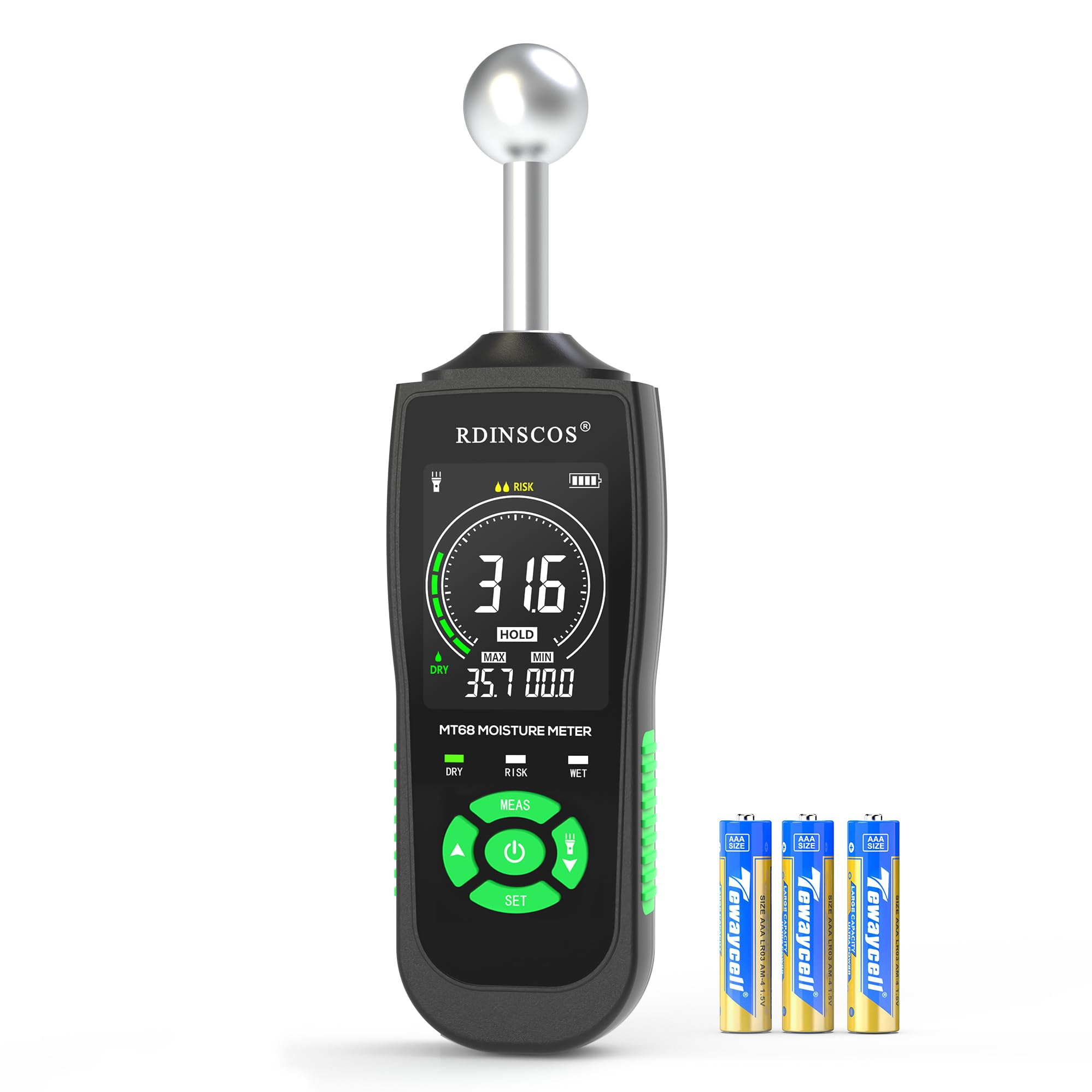
1. RDINSCOS Drywall Moisture Meter
Our pick — 4.5+★ from 4,000+ verified ratings; the strongest balance of quality and price.
A basement and bathroom scanner that lights up the dark corners you would otherwise guess at.
The RDINSCOS MT68 is a pinless meter, meaning its sensor reads moisture through the surface without drilling or leaving pinholes. That matters on finished drywall and painted walls, where you want an answer and not a patch job. It also works across wood, masonry, and concrete, so one tool covers most of a house.
What wins people over is how well it just works — thousands of owners treat it as a grab-and-go tool, and the built-in LED flashlight is the sleeper feature for crawl spaces and behind cabinets. Each unit ships with 3 AAA batteries and a carry bag, so it is ready on arrival.
The catch is accuracy near metal. Pipes, studs, and conduit can throw off a reading, so keep the sensor clear of them. A fair share of owners also see varying numbers on repeat passes, which is normal for capacitive sensing.
Where It Earns Its Keep
- Reads through drywall, tile, wood, and concrete with no holes
- Lightweight at 0.17 kg and comes with batteries and a bag
Worth Knowing Before You Buy
- Metal nearby skews the reading, so you must keep it clear
Grab this one if: you want a fast, no-damage moisture check across a whole house.
Skip the guesswork instead: if your walls are packed with metal conduit, a pin-type meter may read truer.
2. Povlen Pinless Moisture Meter
The one that shouts at you when a wall crosses its wetness limit.
Povlen builds this around four modes — SOFTWOOD, HARDWOOD, WALL, and MASONRY — so you switch to match the material rather than interpreting one raw number. It reads at ±4% accuracy, and the large LCD has an analog bar that beeps and turns red once moisture passes the limit you set.
That audible alarm is the real selling point for anyone scanning a long wall: your ears catch the spot your eyes miss. It runs on 3 AAA batteries, which are included, and weighs 5.6 ounces.
One honest note: a few buyers report damage to the display over time, so treat it like the precision tool it is. Compare it to the pin-type PREXISO below, which leaves two small points in the wood but reads direct.
The alarm is the win: a color bar plus a beep turns a slow visual scan into a fast sweep of an entire room.
Where it stumbles: durability of the screen is the recurring weak spot, so don’t toss it loose in a toolbag.
Reach for this if: you want a meter that alerts you out loud as you sweep a finished wall.
Look elsewhere if: you need a brush-proof display that survives hard daily jobsite use.
3. General Tools MM8 Pinless Moisture Meter

Big 2-inch digits that make a dark attic inspection readable at a glance.
General Tools fits the MM8 with separate settings for drywall, masonry, softwood, and hardwood, plus non-marring sensing that protects the surface. The 2″ (50mm) backlit white LCD digits are large enough to read from arm’s length, and the 3-color LED bar graph plus audible alert flags a wet patch fast.
It is built for early prevention: hold it over a suspicious leak stain and it tells you whether the area is still wet or has dried. An out-of-range alarm and a low 9V battery alert round it out.
Accuracy is the honest caveat. Some owners call it among the most accurate they have used, others find it far off on thin material, so use it as a wet-or-dry indicator rather than a lab instrument.
Readable at a glance: the oversized backlit display and the color bar are what make this one easy to trust in dim spaces.
Sized-down truth: readings on very thin material can wander, so confirm a hit with a second pass.
Best for: checking a ceiling stain to decide if it is wet or already dry.
Not for: buyers who need a precise percentage on a thin veneer panel.
4. PREXISO 7-in-1 Digital Moisture Meter

Two steel pins that press straight into the wood and give you a direct number.
The PREXISO PMX-57A is a pin-type meter, so instead of sensing through the surface, you push its two stainless steel pins into the material for a direct read. Its 7 calibration scales cover softwood, hardwood, and building materials from 0% to 57% moisture content — the number a lumber buyer checks before paying for hardwood.
It also reads ambient temperature and humidity, and offers single-point, multi-point average, and max/min modes. A color backlit LCD with a hold function keeps the last reading on screen while you reposition.
Ease of use is where opinions split. Lumber suppliers and flooring installers take to the calibration menus quickly, but casual users find the modes hard to figure out at first. The probe cover keeps the pins safe between jobs.
What It Does Well
- 7 calibration scales cover a wide 0% to 57% range on wood
- Also reads room temperature and humidity
The Learning Curve
- The mode menus confuse first-time users, so read the manual
Perfect for: woodworkers and flooring installers who need a true moisture-content reading.
Think twice if: you only want a quick drywall check — a pinless meter is simpler.
5. GoveeLife Smart Air Quality Monitor H5106

Not a wall meter at all — this one watches the air itself and logs the trend.
Where the meters above probe surfaces, the GoveeLife H5106 tracks indoor air quality on three indexes: PM2.5 (fine airborne particles), temperature, and humidity. The PM2.5 sensor holds ±15 µg/m³ accuracy, and the display refreshes every 2 seconds so you see a change almost as it happens.
It connects over 2.4G Wi-Fi (not 5G) and stores 13 days of graphs, with the option to export up to 2 years of data. That history is what separates it from a hand-held meter — you get a pattern, not a single sn
The catch is it needs wall power, since there is no built-in battery, and it uses a Type-C cable only. Wi-Fi pairing also draws mixed results, with some owners fighting the connection while others link up without trouble.
Where it shines: the 13-day graph and exportable history make long-term air trends easy to spot.
Mind the cord: no battery means you need an outlet where you want it placed.
Best for: tracking your room’s air quality over weeks rather than locating a wet wall.
Not the tool for: reading moisture inside a wall — it measures the air, not the studs.
6. SRUI 14-Test Mold Test Kit

Fourteen separate tests so you can sample a whole house, not just one suspect corner.
This is a grow-it-yourself kit, not an electronic meter. It ships with 14 individual tests and covers three methods: room air, HVAC systems, and household surfaces like walls, showers, and sinks. That spread lets you sample several rooms in one go instead of guessing where the problem is.
Results show up in 2-4 days, and the kit includes a mold identification guide. Owners also like that you can send photos to the maker for free analysis. What stands out is the overall build and accuracy.
One honest limitation: it tells you whether mold is present and roughly what it looks like, not an exact species. For a named lab ID, look at the Evviva kit below.
Why It Works
- 14 tests cover air, HVAC, and surfaces across a whole home
- Free photo analysis plus an identification guide included
Set Expectations
- You wait 2-4 days for a culture and get no precise species ID
Pick this if: you want to test several rooms and surfaces without buying multiple kits.
Not ideal if: you need an exact species name from a certified lab.
7. Evviva Sciences Mold Test Kit
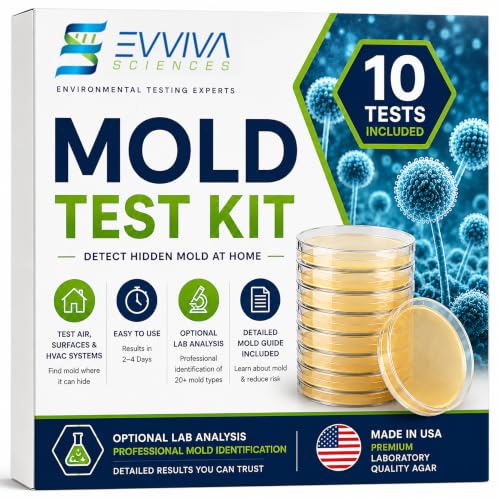
Ten agar dishes with an optional certified lab read for anyone who wants a named species.
Evviva’s kit gives you 10 agar petri dishes and 10 cotton-tipped swabs, so you can sample room air, HVAC, and surfaces in 10 different spots. A downloadable mold information guide comes with it, and results appear in as little as 2-4 days.
The real differentiator is the optional lab analysis through an AIHA certified laboratory. It costs an extra fee of about per dish, but it returns a detailed report on the mold types found — the closest thing here to a professional ID.
Set expectations fairly: owners find the kit easy to use and helpful, but results are mixed on how effective and how clear the instruction guide is. The payoff comes when you spring for the lab report.
The lab option is the point: an AIHA certified report names the molds, which no grow-at-home kit can do alone.
The trade-off: that report carries a per-dish extra fee, so budget for it up front.
Reach for this if: you want an official lab report naming the mold you found.
Only if you will pay for it: skip the lab option and the plain kit just shows you that mold grew.
Know the Specs
Pinless vs. Pin-Type
A pinless meter reads moisture through a surface using high-frequency waves, so it leaves no holes and suits finished drywall or tile. A pin-type meter presses two steel points into the material and reads the moisture content directly, which is the tool of choice for lumber.
Moisture Content Percent
Wood and building materials are judged by their moisture content, shown as a percentage (%MC). High readings mean trapped water, the wet condition where mold tends to grow, so the number tells you where to dry out first.
Common Questions
Can a pinless meter read through tile or paint without damage?
How long does a mold test kit take to show results?
Will an air quality monitor tell me if my wall has mold?
The Bottom Line
For most households, the RDINSCOS MT68 is the pick because its pinless sensor reads through drywall and masonry without leaving a mark, and the built-in flashlight helps in crawl spaces. If you are buying lumber, the PREXISO gives you a direct moisture-content number. And for a named species from a certified lab, reach for the Evviva Sciences kit with its optional lab report.
How we choose
We do not accept paid placement. Every pick is matched to a real buyer and a real use-case; we do not hands-on test units.
Sources
Specifications: manufacturer listings and product documentation. Review insights: verified customer reviews, as of November 2026. Pricing: not shown on this page (it changes often); check the current price via the retailer link.
As an Amazon Associate, My Heart Lives Here earns from qualifying purchases. This does not affect which products we feature.