Heads up: This post contains affiliate links. As an Amazon Associate I earn from qualifying purchases, at no extra cost to you. Learn more
Specs are compiled from manufacturer listings and verified buyer reviews and can change over time — please confirm the key details on the product page before buying.
If someone you love is spending most of the day in bed, the mattress underneath them is the single biggest lever on their skin comfort — and the wrong surface makes every turn a risk. This shortlist narrows eight real hospital-style mattresses and toppers down to the ones that redistribute weight where it matters, with foam density and cover details spelled out in plain words.
This guide is built by comparing the manufacturers’ published specifications and the patterns across verified customer reviews, so you get each pick’s real strengths and trade-offs instead of marketing spin.
You’ll see which surfaces stay firm under a heavier body, which ones breathe, and which cover wipes clean in seconds. Here is the honest shortlist of the best mattress for bedridden patients, ranked by what actually protects skin.
Top Picks


How To Choose The Best Mattress for Bedridden Patients
Three things decide whether a surface actually helps: how much weight it can carry, how its foam is built, and how easy the cover is to keep clean.
Weight capacity
Match the stated capacity to the person’s weight with room to spare, so the foam never bottoms out against the frame.
Foam construction
A denser base plus a softer top layer holds shape longer than one thin slab of foam.
Cover and cleaning
A fluid-resistant, wipeable cover turns a spill from a crisis into a two-minute job.
Side-by-Side Comparison
| Model | Best For | Capacity | Thickness | Cover | Amazon |
|---|---|---|---|---|---|
| Invacare Premier★ Best Overall | Overall balance | 500 lb | 6 in | Fluid-resistant stretch | Amazon |
| ProHeal Memory FoamHeaviest Support | Heavier patients | 1000 lb | 6 in | Waterproof nylon | Amazon |
| Invacare SolaceZoned Firmness | Zoned firmness | — | 6 in | Welded waterproof | Amazon |
| Armonyo Dual-Layer | Cooler sleep | 450 lb | 5 in | 70D nylon | Amazon |
| MedVance Air | Alternating pressure | 450 lb | 8 in | Quilted PU | Amazon |
| Drive Med-Aire | Caregiver alerts | — | 8 in cells | Vapor-permeable | Amazon |
| LCH Gel Memory Foam | Adjustable frames | 242 lb | 6 in | Waterproof removable | Amazon |
| Lumex Gel Topper | Adding relief to an existing bed | — | 4 in | Fluid-resistant | Amazon |
Detailed Reviews
1. Invacare Premier Hospital Bed Mattress
Our pick — 4.5+★ from 700+ verified ratings; the strongest balance of quality and price.
Three foam zones and a 500 lb ceiling make this the safest all-round bet.
What you get here is a split personality on purpose — a firm mid-section under the torso and softer foam at the head and feet. That zoning spreads weight away from the spots that take the most punishment, and it supports up to 500 lb, so the foam stays off the frame under a larger body.
The build is two independent layers: a single-piece U-core with a contoured foam insert, plus high-density foam on both layers so the sides hold up during transfers. A four-way stretch polyurethane cover shrugs off fluids, and a coated polyurethane base extends the life underneath. Sizing is 36 by 80 by 6 inches, and Invacare recommends pairing it with its own 5410IVC or 5310IVC frames.
The honest catch: at 28.7 pounds it is the heavier of the Invacare foam options here, so moving it alone takes effort. That weight is what buys the density, though.
Where it earns its keep
- Three-zone foam supports the torso firmly while easing the head and feet
- 500 lb capacity keeps dense foam from bottoming out
Weigh before you lift
- Heavier than the Solace-style foam beds, so positioning it solo is a two-hand job
Reach for this if: you want zone-by-zone support with a fluid-resistant cover and proven hospital-bed compatibility.
Think twice if: you plan to reposition the mattress often by yourself.
2. ProHeal Hospital Bed Mattress Memory Foam
Twice the weight ceiling of the Invacare Premier, with a heel slope built in.
If the person you’re caring for is on the heavier side, this is the mattress that stops the conversation. It carries up to 1000 lb versus the Invacare Premier’s 500 lb, a 2.0x gap on paper. The sloped heel section shifts load from the heel to the less vulnerable lower leg, which matters for anyone who can’t lift their own feet.
Under the cover it stacks die-cut high-density foam through the torso and head, with open-cell memory foam at the heel. The removable nylon topper is waterproof and vapor permeable, and the base uses triple-laminate vinyl that is fluid resistant. Expect a 28 ILD foam feel, a 7-year non-prorated core warranty, and a 2-year cover warranty.
What wins people over is sleep quality — the surface is firm enough to feel supportive yet forgiving enough to rest on. Value is the split opinion: some consider it a clear bargain for this build, others less so.
The weight math: a 1000 lb ceiling is the standout number across this entire list, and it’s the reason this bed suits bariatric care.
One fair warning: the nylon topper saves you cleanup time, but you’ll still want a flat under-sheet to keep it cool.
Go here for: bariatric support and a heel zone that takes pressure off the most fragile spot.
Not your bed if: you only need a light-duty surface and want the simplest possible setup.
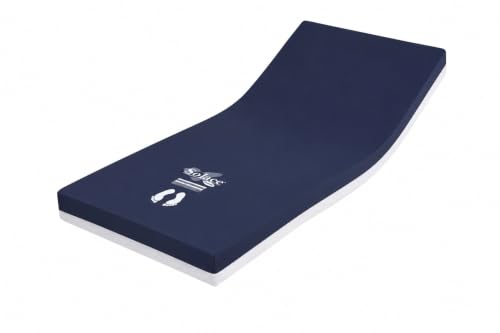
3. Invacare Solace Hospital Bed Mattress
Deep egg-crate cuts and three firmness zones, each tuned to a different body part.
This one is for the caregiver who wants to stop guessing. The head and neck sit on a medium-firm 36.2 IFD, the lower back and hips on a firm 40.5 IFD, and the heels on a lighter 35.4 IFD, so each zone does a specific job. IFD simply means how much force it takes to dent the foam — a higher number is firmer.
Deeper castellation cuts than a standard medical mattress give the foam room to move with the patient, and the cover is a 2-way vertical stretch fabric that reduces shearing as someone shifts position. Zippers are fully welded for fluid control, and integrated side handles help with transfers. It measures 84 by 36 by 6 inches and anchors to any 84-inch hospital or home frame.
There’s no meaningful review history yet, so treat the firmness zones as the evidence you’re buying on. It’s a firm mattress by design, and the 84-inch length is longer than a standard 80-inch hospital bed.
The foam blueprint: three separate IFD values is the most specific pressure plan on this list.
Measure first: the 84-inch length needs a frame that matches it.
Built for: anyone who wants the head, hips, and heels each handled differently.
Skip the fitting guess: confirm your frame is 84 inches before you buy.
4. Armonyo Dual-Layer Foam Hospital Bed Mattress

It prints its foam density, which is rarer than it should be in this category.
Most listings hide density; this one tells you: a 2.1 lb base foam for firm support and a 1.9 lb top layer for pressure relief. In plain words, that’s how much a cubic foot of foam weighs, and a denser base resists collapsing under long-term load. It supports up to 450 lb and measures 80 by 36 by 5 inches — a five-inch profile that fits twin XL adjustable beds.
The cover is 70D nylon with a non-butyl backing, chosen to cut heat buildup rather than trap it. It’s waterproof, wipes clean, and the anti-shear liner keeps friction low as someone moves. Four reinforced handles help with repositioning, and a low-slip bottom holds it steady.
The catch is the thinner five-inch profile — that puts you closer to the frame than the six-inch beds above. Buyers consistently like the medium-firm feel and how easily the cover cleans.
Rare transparency: naming both foam densities lets you compare build quality, not marketing words.
Trade-off worth knowing: 5 inches is shallower than most hospital mattresses here.
Best for: warm rooms and anyone who sweats through a night in bed.
Look elsewhere if: you want a deep cushion with plenty of foam between body and frame.
5. MedVance Medical Alternating Air Mattress

Air cells that shift under the body, plus a pump quieter than a whisper.
For a patient who can’t be turned often, air does what foam can’t — it changes where the pressure sits. This system runs a pump under 20 dB, which is quieter than a library, so it won’t keep the room awake. The cell-on-cell design with 8-inch cells prevents bottoming out and holds pressure up to 24 hours during a power outage.
The digital panel shows weight and pressure, and a red CPR tag deflates the whole thing within a second in an emergency. A pillow function keeps air in the three head cells. The quilted PU cover is water resistant, anti-slip, and straps to the frame. It fits 80 by 36 by 8 inches and supports 450 lb.
Reliability is the mixed note here — some units run perfectly, others stop. The guarantee is solid spec-wise; the pump is the part to watch.
The quiet selling point: under 20 dB is the lowest noise figure on this list by a wide margin.
The honest watch-out: an air system adds a pump to maintain that a plain foam bed never needs.
Consider this when: turning is hard and constant pressure change is the priority.
skip it if: you want zero maintenance and no power dependency.
6. Drive Medical Med-Aire Low Air Loss Mattress System
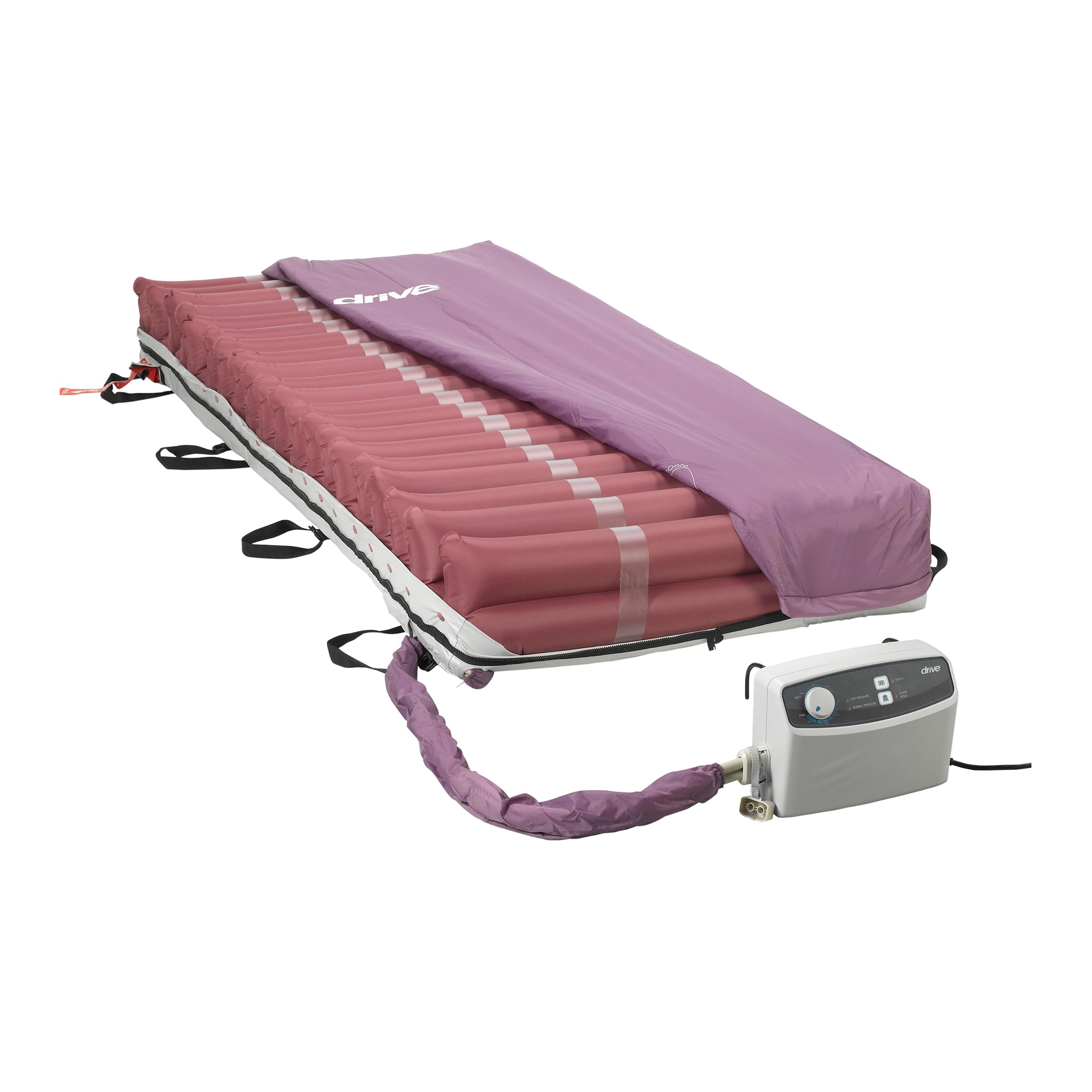
Twenty replaceable bladders and an alarm that tells you when pressure drops.
This system is built for a caregiver who can’t be in the room every hour. An audio-visual alarm and automatic pressure monitoring flag low pressure, so you know before the patient feels it. Twenty individual 8-inch bladders can each be swapped out, and a built-in pillow zone stabilizes the head.
The vapor-permeable cover is designed to reduce moisture, friction, and heat. The honest limit is durability: pump and bladder failures are the most-reported weak spot, so budget for replacement parts over time. The alarm is exactly the feature that helps most when a blower does give out — you get a warning, not a silent deflate.
Strong points
- 20 replaceable 8-inch bladders mean one failure doesn’t scrap the bed
- Automatic pressure monitoring with an audio-visual alarm
Plan for upkeep
- Parts wear out — expect to replace bladders or the pump eventually
Right for: homes where monitoring matters as much as the mattress itself.
Weigh the upkeep: this is the pick that most needs an owner willing to watch the alarm.
7. LCH Hospital Bed Mattress Gel Memory Foam
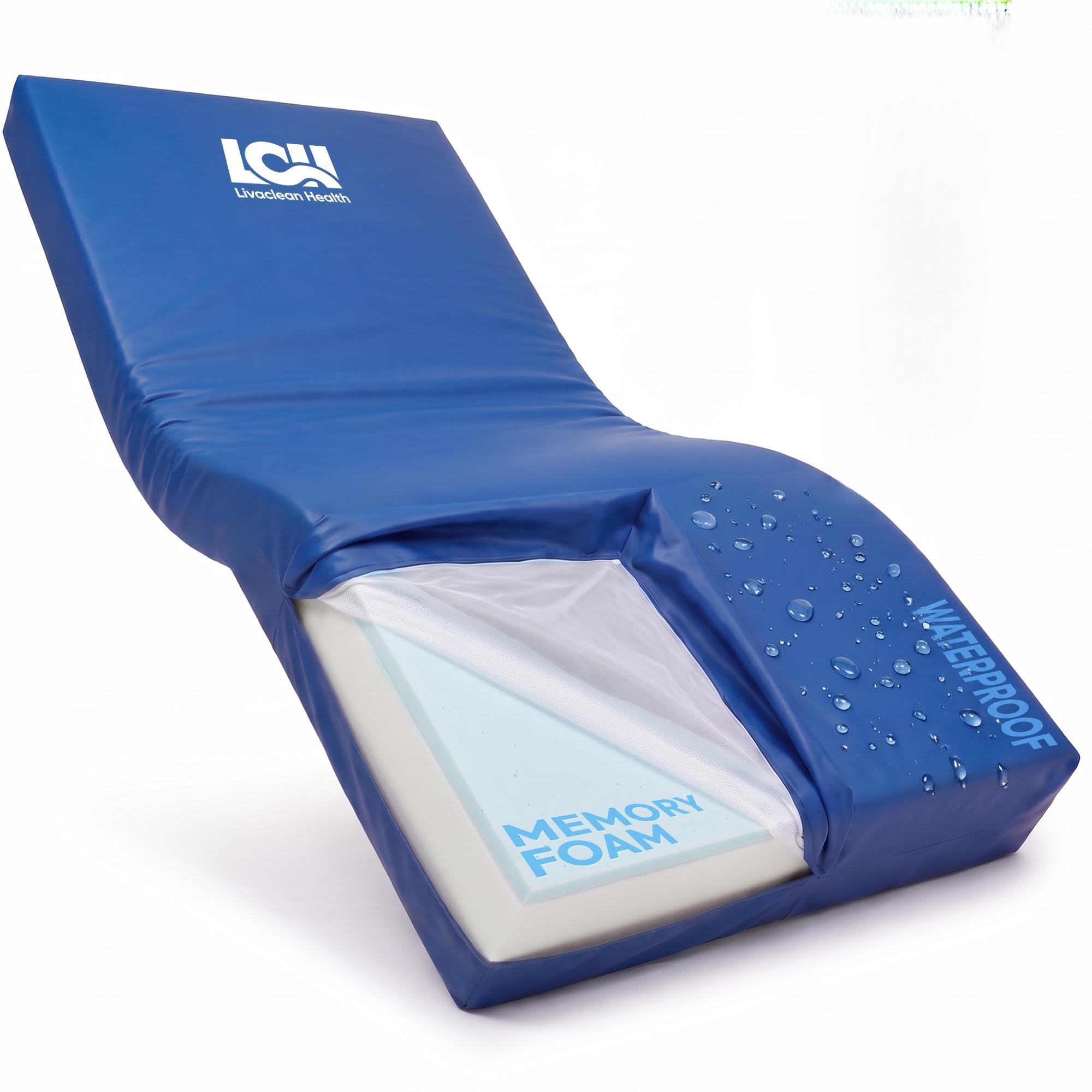
Gel over support foam, with straps that hold through constant position changes.
Adjustable frames are where this one shines — four corner straps keep the mattress fixed while the head and foot sections move. The comfort layer is gel memory foam over high-density support foam, and the whole thing measures 80 by 36 by 6 inches to fit standard hospital and adjustable beds.
A removable waterproof cover comes included: soft, breathable, and easy to wipe. It supports up to 242 lb, which is the lowest ceiling on this list, so it suits seniors and lighter patients better than bariatric care. It arrives compressed and needs 48 hours to fully expand. Expect an 8-year extended protection on the foam and 1 year on the cover.
Two things to know: a mild chemical smell fades with ventilation, and firmness divides opinion — some call it just right, others want softer.
Fit-first design: the corner straps are the detail that makes this a strong adjustable-bed partner.
Check the limit: 242 lb is the number to weigh against your situation.
Pick this for: an electric adjustable bed at home and a lighter patient.
Choose a higher-capacity bed instead if: you need bariatric support.
8. Lumex Foam & Gel Mattress Topper

An overlay that adds gel relief without buying a whole new mattress.
This topper is the cheap upgrade route: a soft convoluted foam top, a visco-elastic gel core, and a high-density foam base. The gel layer spreads weight across the hips, heels, and shoulders, and it’s engineered to stay in place rather than pooling. At 16.5 pounds it’s far lighter than the Invacare Premier’s 28.7 lb — about 74% less — so it’s easy to lift onto a bed.
Sizing swaps heads with the Invacare Premier: 42 inches wide and 84 inches long, both larger than that mattress’s 36 by 80 inches, while the overall height of 4 inches is 2 inches thinner than the Premier’s 6. It fits most standard and extended-length medical mattresses, and the fluid-resistant cover wipes clean.
Because it’s an overlay, it stacks on top of an existing mattress — so it won’t fix a sagging base underneath. It suits rehab and home-care setups where the current bed is fine but the surface needs softness.
The quick add-on: gel relief for a bed you already own, with a broader footprint than many full mattresses.
The limit: it’s a topper, not a replacement — the base bed still has to be sound.
Grab one of these if: you want to soften an existing hospital mattress on a modest budget.
Don’t buy it as a fix: it won’t rescue a frame or foam that’s already collapsed.
Know the Specs
Weight capacity
This is the total weight the foam is rated to hold, stated in pounds. Go below it and the foam compresses to the frame, which creates the hard spots you’re trying to avoid.
Foam density and IFD
Density (pounds per cubic foot) tells you how much foam is packed in; IFD tells you how firm it feels. Higher density resists sagging, while a lower IFD feels softer under the skin.
Common Questions
Will a 36 by 80 inch mattress fit an adjustable home bed?
Is a foam mattress or an alternating air mattress better for long-term bed rest?
Can I add a gel topper over my existing hospital mattress?
The Bottom Line
The strongest all-round pick for the mattress for bedridden patients is the Invacare Premier, because its three-zone foam and 500 lb capacity handle both comfort and side support. Go with the ProHeal if the person needs the 1000 lb ceiling, and reach for the MedVance Air when turning is difficult and alternating pressure is the priority.
How we choose
We do not accept paid placement. Every pick is matched to a real buyer and a real use-case; we do not hands-on test units.
Sources
Specifications: manufacturer listings and product documentation. Review insights: verified customer reviews, as of November 2026. Pricing: not shown on this page (it changes often); check the current price via the retailer link.
As an Amazon Associate, My Heart Lives Here earns from qualifying purchases. This does not affect which products we feature.