Heads up: This post contains affiliate links. As an Amazon Associate I earn from qualifying purchases, at no extra cost to you. Learn more
Specs are compiled from manufacturer listings and verified buyer reviews and can change over time — please confirm the key details on the product page before buying.
You want the tang and the fizz of a real kombucha, but you do not want a drink that quietly hides a dessert’s worth of sweetness. The label rarely makes that trade-off obvious. The short answer: sugar levels swing wildly between cans, bottles, and powder sticks, and the label does not always make it obvious. This guide compares five low sugar kombucha options on what actually matters — how much sugar you swallow per serving, whether the cultures are still alive, and whether the taste holds up without a sweetener crutch.
This guide is built by comparing the manufacturers’ published specifications and the patterns across verified customer reviews, so you get each pick’s real strengths and trade-offs instead of marketing spin.
Start with format, because a canned brew, a powder stick, and a 24-pack each fit a different routine. Below you will find the formats ranked, the sugar talk decoded, and the honest catch on each one so you can pick a low sugar kombucha that fits your fridge and your routine.
Top Picks
How To Choose The Best Low Sugar Kombucha
Most people buying low sugar kombucha are chasing one of two things: a soda replacement they can drink daily without a sugar crash, or a gut-friendly habit that survives a busy week. A soda replacement points to cans; a habit that survives a busy week often points to powder sticks. Pick your format first — can, bottle, or powder stick — and the sugar and culture comparisons fall into place.
Read the sugar line, then read the serving size
A can that says “low sugar” tells you nothing until you see the serving size beside it. An 8.5 fl oz can and a 12 oz can hold very different amounts, so the same sugar number per ounce lands differently in your hand. Check both lines together, every time.
Decide if you want a can or a powder stick
Cans give you real carbonation straight from the fridge but eat shelf and fridge space, and they arrive heavy. Powder sticks trade that instant fizz for a packet you can drop in a bag. If you travel or work away from a fridge, a powder stick needs no cold storage and weighs almost nothing in a bag.
Know what the culture count really promises
Probiotic numbers on a can — like 2 billion or 1 billion CFUs (colony-forming units, the standard way live cultures are counted) — describe what is in the drink when it is made. Heat and time on a truck can affect live cultures, which is why shipping and storage instructions matter as much as the number on the front.
Match the flavor profile to your sweet tooth
Low sugar brews split into two camps: tart and dry, or lightly sweetened. If you are coming off regular soda, start with a lightly sweetened can like wildwonder before moving to a dry brew. If you already drink sparkling water, the tart, dry end of the range — Liquid Remedy’s ginger lemon, for instance — will taste familiar.
Side-by-Side Comparison
| Model | Best For | Sugar Per Serving | Probiotics | Format & Volume | Amazon |
|---|---|---|---|---|---|
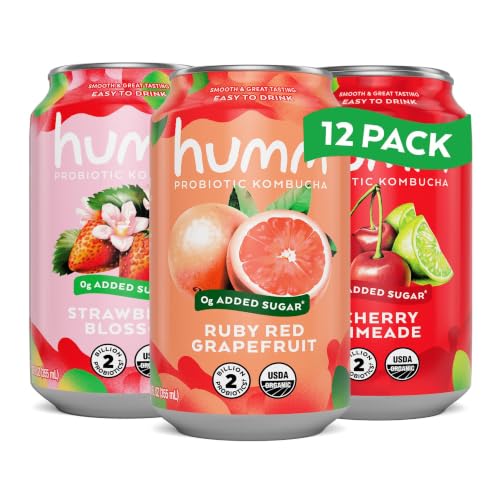
| Humm Kombucha Variety Pack (12 Pack)★ Best Overall | Sweet-tooth switchers | Up to 30% less sugar (no added sugars) | 2 billion per can | 12 cans, 144 fl oz total | Amazon |
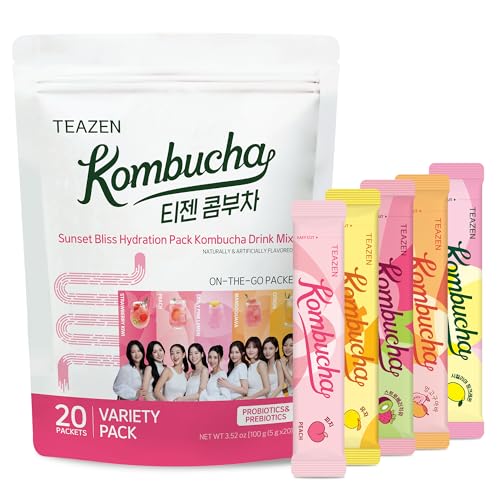
| TEAZEN Sunset Bliss Variety PackBest for Travel | Travel and desk drawers | Sugar free, 15 calories per stick | Prebiotics + probiotics | 20 powder sticks, 4.16 oz pack | Amazon |
| SUNMANC Peach Kombucha 30 Packets | Big-batch pantry stocking | 0g sugar, 15 calories | 19 strains + vitamin C | 30 powder packets, 5.29 oz pack | Amazon |
| wildwonder Classic Variety (6 Pack) | Soda-style sipping | 6g sugar per can | 1 billion CFUs + 5g prebiotic fiber | 6 cans, 72 fl oz total | Amazon |
| Liquid Remedy Ginger Lemon 24-Pack | Daily zero-sugar habit | No sugar | Live cultures from 30-day brew | 24 cans, 204 fl oz total | Amazon |
Detailed Reviews
1. Humm Kombucha Variety Pack
Our pick — 4.5+★ from 800+ verified ratings; the strongest balance of quality and price.
Twelve cans, three fruit flavors, and a sugar cut of up to 30% — the easiest swap for a soda habit.
This is the pick for someone who still wants a drink that tastes like fruit rather than vinegar. The pack splits into four Strawberry Blossom, four Cherry Limeade, and four Ruby Red Grapefruit cans, so you get a genuine rotation instead of twelve of the same thing. Each can carries 2 billion probiotics (live cultures counted in colony-forming units) plus vitamin B12, which makes it a fuller daily drink than a plain sparkling water.
The sugar story is where Humm earns its spot. The label promises up to 30% less sugar with no added sugars, no artificial sweeteners, and it is USDA certified organic, Non-GMO, vegan, and gluten free. Three flavors in one box also lets you find out which one you actually like before committing to a full case — something a single-flavor brew cannot offer. That variety is what wins people over most, and the recurring feedback lands on exactly that: the flavors are not overly sweet and the ingredient list reads clean.
Two things to know before you buy: it ships at room temperature from Bend, Oregon, so refrigerate it on arrival to keep it at its best. The other catch is value. Cost per can is the loudest gripe in the reviews — buyers report loving the taste but balking at what a 12-pack costs per can. Unlike the Liquid Remedy 24-pack below, you are not buying volume here; you are buying flavor choice.
What earns the top slot
- Three flavors in one 12-pack, four cans each, so you can taste-test before restocking
- Up to 30% less sugar with no added sugars or artificial sweeteners
- 2 billion probiotics and vitamin B12 in every can
- USDA certified organic, Non-GMO, vegan and gluten free
What to weigh before you buy
- Ships ambient and needs refrigeration on arrival
- Per-can cost is the most common complaint in the reviews
- Only 12 cans per order, so a daily drinker restocks often
Reach for this if: you are stepping down from sugary soda and want fruit-forward flavors that still taste like a treat.
Think twice if: you drink one a day and want a big case that lasts — the 24-can options below stretch further.
2. TEAZEN Kombucha Sunset Bliss Variety Pack
A whole kombucha habit that lives in a drawer and weighs barely more than a phone.
Twenty sticks across five flavors — Peach, Mango-Guava, Strawberry-Kiwi, Citron, and Sicilian Pink Lemon — with no bottle, no refrigeration, and no spill risk. You tear one open, add it to cold water (8.5 oz / 250ml), stir, and you have a fizzy drink in about the time it takes to fill a glass. The whole pack weighs 4.16 ounces, which is the number that matters most here.
Set that against the wildwonder six-pack, which comes in at 12 ounces for a far smaller drink count — the stick format is a fraction of the carry weight for a much bigger serving count. If your kombucha habit has to survive a gym bag, a hotel room, or a desk with no fridge, that gap is the whole argument. Each stick is sugar free at 15 calories with 0.1mg caffeine, and it pairs prebiotics with probiotics.
What people talk about most is the flavor, and it lands well — the fruity medley is the reason most keep reordering. The one thing to know is that fizz is the split opinion. Some find the carbonation just right, others want more bite. This is a stirred powder, not a can opened cold, so set your fizz expectation accordingly.
Where it shines: sugar free at 15 calories per stick, five flavors in one pack, and a dissolve that needs nothing but a glass and a stir spoon.
The realistic caveat: carbonation is the mixed note — treat it as a lightly sparkling drink rather than a soda-level hiss.
Built for: commuters, travelers, and anyone whose fridge is already full.
Not the one for: you if a sharp, can-fresh fizz is the reason you drink kombucha in the first place.
3. SUNMANC Peach Kombucha 30 Packets, 0g Sugar
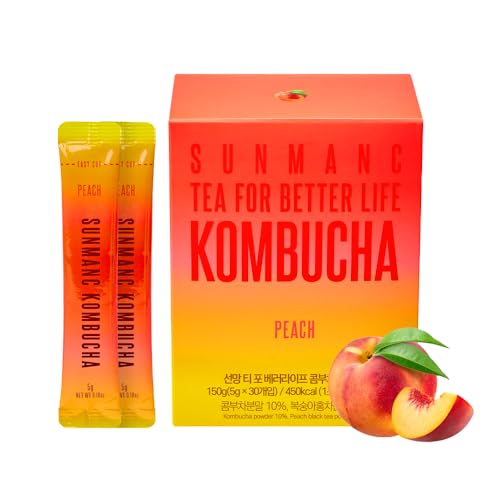
Thirty sugar-free packets with 19 probiotic strains — the pantry option that outlasts every can here.
Zero grams of sugar, 15 calories, 19 probiotic strains, and vitamin C, all in a packet that weighs almost nothing. Thirty of them in one order means a month of daily drinks from a single box, which no canned pick on this list can match. The flavor list runs wide too: Lemon, Peach, Shine Muscat, Grapefruit, Apple, and Pineapple, though this particular listing is the Peach version.
Where it differs from the TEAZEN sticks above is the strain count and the format emphasis. TEAZEN leans on a five-flavor medley and a fast dissolve; SUNMANC leans on 19 strains and a 30-count box. It is also the portable one of the group — the packets travel flat and easy, and that convenience is the thing reviewers keep coming back to alongside the flavor.
The trade-off is fizz, plainly. This is a drink mix, not a carbonated can, and the fizz question splits opinions — some find it pleasantly sparkling, others report little to no fizz at all. If you want bubbles as a feature, a canned brew is the safer call. If you want a zero-sugar daily habit at the lowest per-serving cost in this lineup, this is the box to reach for.
The bulk math: 30 packets at 0g sugar and 15 calories each, with 19 probiotic strains and vitamin C per serving.
The honest limit: fizz is the most divided point in the feedback — this is a still-to-lightly-sparkling mix, not a soda substitute.
Pick it when: you want the most servings per order and a sugar number that reads zero.
Look elsewhere when: real carbonation is non-negotiable for you.
4. wildwonder Classic Variety Sparkling Probiotic Drink, 6 Pack
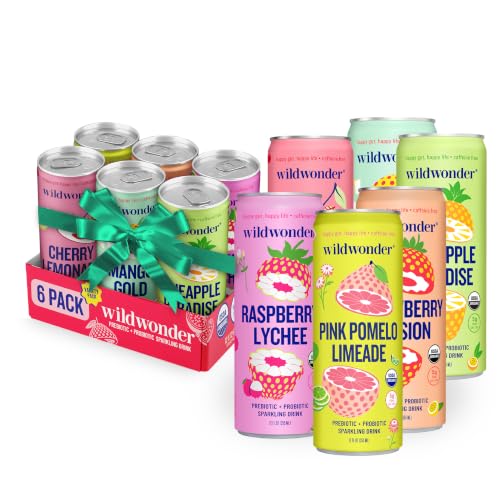
The one that tastes most like a treat — six cans of Guava Rose, Peach Ginger, and Mango Gold.
Two cans each of three flavors, all built on real fruit and freshly brewed herbs. What sets this apart from the other cans here is the prebiotic-plus-probiotic combination: 1 billion CFUs of live probiotics alongside 5g of prebiotic plant fiber (the food those cultures feed on) in every can. That puts 40 calories and 6g sugar per can on the label — not the lowest sugar number on this list, but far from a soda.
The drinking experience is where it wins. It pours super bubbly and reads like a light fruit spritz, which is exactly the point for someone using it as a soda alternative or a mocktail mixer. Drinkers consistently flag the taste as the standout and note it is not overly sweet, and the natural ingredient list earns its own praise.
Compare the volume: this six-pack totals 72 fluid ounces, while the Liquid Remedy case below runs to 204 fluid ounces — very different commitments, and a reminder that six cans go fast. The real consideration is cost per can, which is the loudest objection in the feedback for a six-pack this size. Six cans at this per-can price make it a treat to ration rather than a daily pour.
Why it stands out: 1 billion CFUs plus 5g prebiotic fiber per can, with real fruit and a genuinely bubbly pour at 6g sugar and 40 calories.
What to expect: six cans is a short run, and the per-can price is the part buyers push back on most.
Choose it for: mocktails, alcohol-free nights, and anyone who wants their gut drink to taste like a spritz.
Skip the small pack if: you already know you will drink one daily — the 24-can case suits that habit better.
5. Liquid Remedy Kombucha Ginger Lemon

Twenty-four cans of sugar-free ginger lemon, brewed slow for 30 days the old-school way.
If sugar is the number you watch closest, this is the cleanest answer here: no sugar at all, in an 8.5 fl oz can, twenty-four to a case. The brew is small-batch and long-aged for 30 days, and the resulting drink carries live cultures, organic acids, and tea polyphenols (the antioxidant compounds naturally present in brewed tea). Caffeine sits under 10mg per 100ml, and alcohol stays below 0.5% — a trace from fermentation, not a drink.
The ginger lemon tang is what carries it. Flavor and taste are the two things drinkers bring up again and again, and the zero-sugar label is the third — people use this specifically as a soda replacement they can drink without watching a sugar count climb. The serving size gets its own nod too; the smaller can suits a quick daily pour rather than a long sip.
Here is the reality check. Twenty-four cans is 204 fluid ounces, which is more fridge space than any other pick on this list, and the per-can value draws mixed feelings — some call it fair for the quality, others find it steep. It is also a single flavor, so if you get bored easily, the Humm variety pack up top solves that better.
The zero-sugar case: no sugar, 8.5 fl oz per can, 24 cans per order, from a 30-day small-batch brew with live cultures.
The honest catch: it is one flavor, and it takes up real shelf space — a fair trade for a daily drinker, less so for a casual one.
Best match for: a committed daily kombucha habit where zero sugar and a big case matter more than flavor variety.
Pass on it if: you want to rotate flavors or only have room for a few cans.
Know the Specs
Sugar Per Serving vs Sugar Free
These are not the same claim, and the difference changes what you buy. “No added sugars” means nothing sweet was poured in during production — Humm takes this route, cutting sugar by up to 30% and skipping artificial sweeteners. “Sugar free” means the finished drink carries essentially none, as with the TEAZEN sticks and the Liquid Remedy cans. A brew can also land in between: wildwonder lists 6g sugar per can because it uses real fruit. Always read the serving size next to the sugar line, because a small can and a large can hide very different totals.
Probiotics, CFUs, and Prebiotics
A CFU is a colony-forming unit — the standard way live cultures are counted, so 2 billion probiotics means roughly that many at the time of production. Prebiotics are different: they are plant fiber that feeds those cultures, which is why wildwonder pairs 5g prebiotic fiber with its 1 billion CFUs. Powder formats like TEAZEN and SUNMANC list both prebiotics and probiotics too. Heat and time in transit can affect live cultures, so refrigeration instructions on the can matter as much as the number printed on it.
Cans, Bottles, and Powder Sticks
Your format decides how you actually use the product. Cans deliver fizz straight from the fridge but arrive heavy and take up shelf space — a 24-can case runs to 204 fluid ounces. Powder sticks weigh next to nothing (the TEAZEN pack is 4.16 ounces for 20 servings), need no refrigeration, and dissolve in cold water in seconds. Sticks win on portability and servings per order; cans win on carbonation and the ritual of cracking one open.
Calories, Caffeine, and Alcohol Trace
Low sugar usually means low calorie, but check anyway. The powder picks sit at 15 calories per serving, while wildwonder lists 40 calories per can. Caffeine is small either way — TEAZEN lists 0.1mg per stick, and Liquid Remedy stays under 10mg per 100ml because it is brewed from tea. Fermentation can leave a trace of alcohol, which Liquid Remedy tests per batch to stay below 0.5%. None of these are alcohol drinks; they are brewed teas.
Common Questions
Is sugar-free kombucha actually fermented tea or just flavored powder?
How much sugar is actually in a low sugar kombucha can?
Do powder kombucha sticks fizz like a canned kombucha?
Does Humm kombucha need to be refrigerated when it arrives?
What is the difference between prebiotics and probiotics in kombucha?
How many probiotic strains should I look for in a kombucha?
Can I drink low sugar kombucha if I am cutting back on caffeine?
Is a 24-pack of kombucha worth the fridge space?
Does low sugar kombucha contain alcohol?
The Bottom Line
If you are cutting back on sugary soda, start with the Humm Kombucha Variety Pack. It is the low sugar kombucha that does the job best for most people, because three flavors in one 12-pack let you find your favorite before you commit. The brand claims its formula has up to 30% less sugar with no added sweeteners, which keeps a daily habit light. Want a zero-sugar drink that travels in a bag? The TEAZEN Sunset Bliss sticks are the pick. And for a committed daily routine with no sugar and a big case that lasts, reach for the Liquid Remedy Ginger Lemon 24-pack.
How we choose
We do not accept paid placement. Every pick is matched to a real buyer and a real use-case; we do not hands-on test units.
Sources
Specifications: manufacturer listings and product documentation. Review insights: verified customer reviews, as of November 2026. Pricing: not shown on this page (it changes often); check the current price via the retailer link.
As an Amazon Associate, My Heart Lives Here earns from qualifying purchases. This does not affect which products we feature.