Heads up: This post contains affiliate links. As an Amazon Associate I earn from qualifying purchases, at no extra cost to you. Learn more
Specs are compiled from manufacturer listings and verified buyer reviews and can change over time — please confirm the key details on the product page before buying.
If your parent misses calls because the ringer is too quiet or the buttons are too small, the fix is a phone built for exactly that. The short answer: the AT&T CD4930 is the safest all-round buy, because a corded phone keeps working in a power cut and its oversized tiltable backlit display (a big screen you can angle toward you) makes caller names easy to read.
This guide is built by comparing the manufacturers’ published specifications and the patterns across verified customer reviews, so you get each pick’s real strengths and trade-offs instead of marketing spin.
Below you get the specs that actually matter for aging ears and eyes, plus where each model falls short. The right pick for a parent with hearing loss is often the one with real amplification, and this landline phone for seniors list covers that case too.
Top Picks

How To Choose The Best Landline Phone for Seniors
Three things decide whether a senior phone helps or frustrates.
Volume you can raise
Look for a stated amplification figure in decibels (dB, the unit sound loudness is measured in) so quiet callers actually arrive louder.
Buttons you can see and press
Big high-contrast keys and a large display matter more than any other feature once eyesight fades.
Corded or cordless
A corded handset draws power straight from the phone line, so it keeps working during a power outage.
Side-by-Side Comparison
| Model | Best For | Amplification | Ringer | Answering System | Amazon |
|---|---|---|---|---|---|
| AT&T CD4930★ Best Overall | All-round home use | Audio Assist boost | Extra-loud with visual alert | 25 minutes | Amazon |
| Excelltel EX-LD-828Simplest Setup | Simple picture dialing | Amplified volume | — | Digital | Amazon |
| HePesTer P-46 | Wall or desk mounting | Up to 40 dB | Adjustable, can be turned off | — | Amazon |
| Clarity P-300 | Photo dialing on a budget | Up to 26 dB | 75+ dB | Digital | Amazon |
| VTech SN1127 | Built-in answering machine | Up to 40 dB | 90 dB with visual alert | Digital answering machine | Amazon |
| AT&T CL82218 | Stopping robocalls | — | — | 22 minutes | Amazon |
| Serene Innovations HD40P | Dementia and memory support | 26 dB | 85 dB | — | Amazon |
Detailed Reviews
1. AT&T CD4930 Black Corded Phone with Digital Answering System
Our pick — 4.0+★ from 3,500+ verified ratings; the strongest balance of quality and price.
The corded desk phone that stays readable and audible when eyesight and hearing fade.
What you get first is a screen you can angle: the oversized LCD tilts toward you and lights up, so caller names stay legible in a dim hallway. The keys are oversized and high-contrast, which cuts misdials for stiff or arthritic fingers.
Its 25-minute digital answering system records incoming messages, your outgoing greeting, and memos, so a missed call is never lost. Audio Assist temporarily boosts volume and clarity, and the extra-loud ringer flashes a light as well as ringing. Because it is corded, it runs off the phone line through an outage.
The honest catch is long-term reliability — some units quit within months, and loud voices can blare on some connections. The crowd still backs it heavily, with a large base of owners behind the high score. It also measures 14.57 x 11.26 x 5.98 inches, so clear real desk space.
What earns its place
- Tiltable backlit display keeps caller ID readable
- Records 25 minutes of messages
- Works during power outages
Where it can trip up
- Some units fail within months
- Volume can blare on loud callers
Reach for this if: you want one dependable corded phone with a big tilted screen and a real answering machine.
Think twice if: you need a wall-mounted unit — this is a desk design.
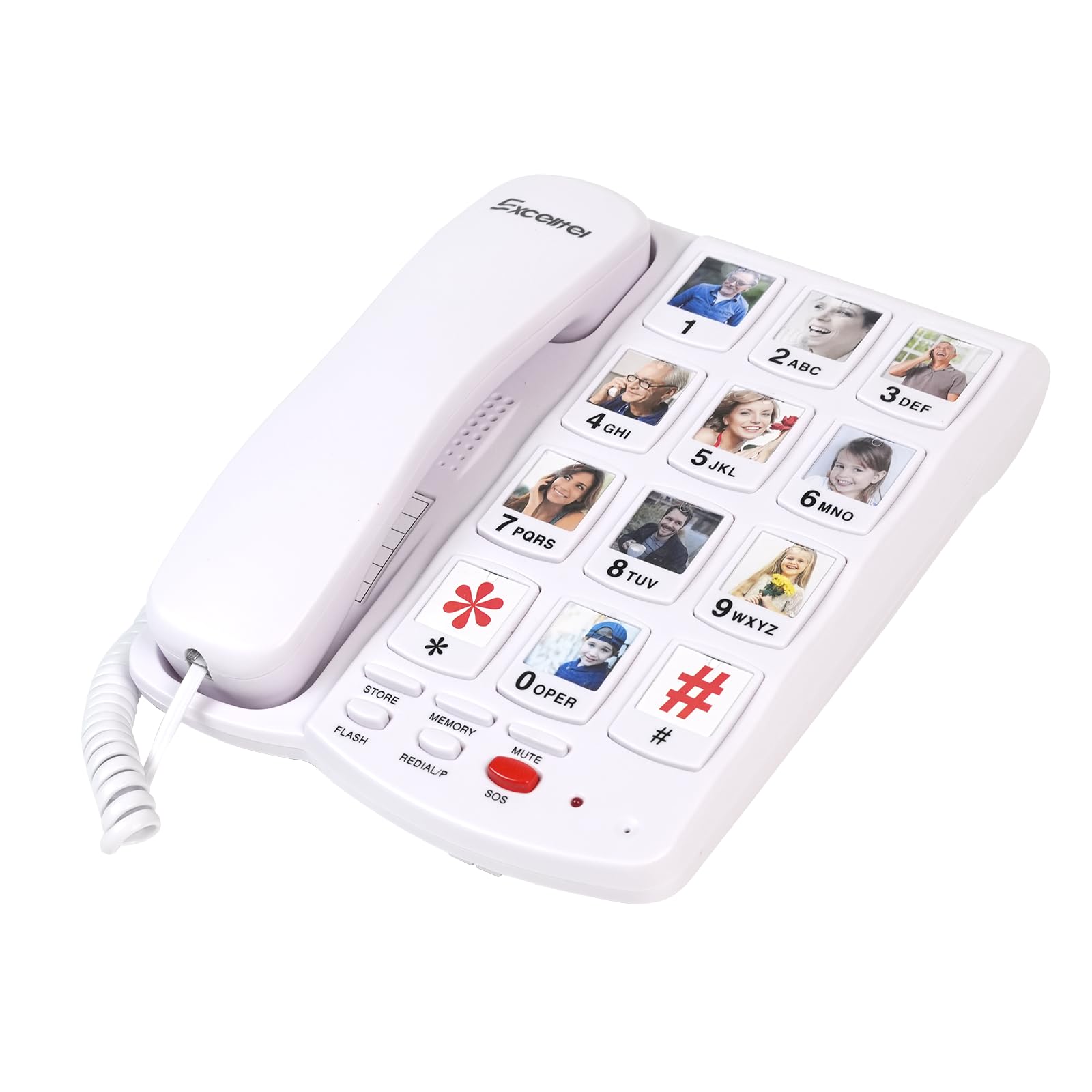
2. Excelltel Big Button Phone
Ten photo buttons make a single press enough to reach family.
The headline here is the dialing method: 10 picture keys let you slide a photo under each one, so a parent presses a face instead of remembering seven digits. Volume is amplified and the phone works with hearing aids, and the white ABS body is a light 0.69 kg — noticeably lighter than the VTech SN1127’s 1.08 kg.
Its 8.5 x 6.7 x 2.8 inch footprint suits a nightstand. The caveat is early feedback: quality and functionality both come back mixed, and some units arrived dead. It is a good fit only if you are comfortable with a simpler, less-proven build.
Photo-first dialing: perfect for a parent who forgets numbers but never forgets a face.
Honest limit: the track record is thin, so buy with the option to return.
Best match for: a tight budget and a family that wants photo speed dial.
Not for you if: you want a long, proven service record.
3. HePesTer P-46 Amplified Corded Phone for Hearing Impaired

Buttons an inch wide, plus a volume dial that reaches 40 dB.
Each key measures 1.0 inch by 1.0 inch — big enough for low-vision fingers to find without hunting. A built-in speaker IC amplifies up to 40 dB, and you can adjust receiver, speakerphone, and ringer separately, including turning the ringer off entirely.
There are 3 one-touch and 10 two-touch speed dial slots, and stored numbers survive even if the line is unplugged. It also mounts on a wall or sits on the desk on four nonskid feet. The caution: sound quality and reliability divide owners, static shows up on some calls, and the wall plate must measure between 3 and 3.8 inches between holes.
Built for hard-to-see hands: the 1-inch keys are the real story here.
Weigh first: at 650 g it is a solid desk unit, not a featherweight.
Worth it when: you need adjustable volume and a wall-mount option in one phone.
Look elsewhere if: pristine call clarity is your top priority.
4. CLARITY Amplified Corded Photo Telephone P-300

Nine photo buttons and a ringer loud enough to cross the house.
Clarity’s pitch is memory support: 9 programmable photo buttons let you press a face to dial. Incoming sound is amplified up to 26 dB, and the ringer hits 75+ dB with a bright visual ring indicator — the loudest attention-grabber in this group alongside the Serene.
You can also adjust ringer pitch and volume. It suits elderly users well, and voice clarity gets strong marks for hard-of-hearing callers. The trade-off is volume itself — some find it not exceptionally loud — so test it in the room it will live in. At 1 kg it is a substantial handset.
Strong points
- 9 photo memory buttons
- 75+ dB ringer with visual alert
Worth knowing
- Some find the voice volume modest
Solid choice for: a parent who dials by picture and needs a loud ring.
Only if: you can live with volume that split owners.
5. VTech SN1127 Amplified Corded Phone

A 90 dB ringer and 40 dB boost in one corded package.
This sits at the top of the loudness range: a 90 dB adjustable ringer with a flashing visual alert, so a missed call is hard to ignore. One-touch amplification lifts incoming voice up to 40 dB, and 8 photo speed dial keys put family one press away.
An integrated digital answering machine answers when nobody does, and the full-duplex speakerphone (both sides can talk at once) suits hands-free chats. It runs off the phone line, so it works through outages. At 1.08 kg it is heavier than the Excelltel, and its 7.47 x 8.23 x 4.11 inch body is compact beside the 14.57-inch-wide AT&T CD4930. Loudness and call quality split reviewers, though — some report it is hard to hear clearly.
Where it wins: the 90 dB ringer and 40 dB boost cover both ends of hearing trouble.
The catch: call clarity divides owners, so keep the receipt handy.
Consider this if: you need maximum ringer volume plus a built-in answering machine.
If clarity matters more: weigh the mixed call-quality reports first.
6. AT&T CL82218 2-Handset DECT 6.0 Cordless Phone
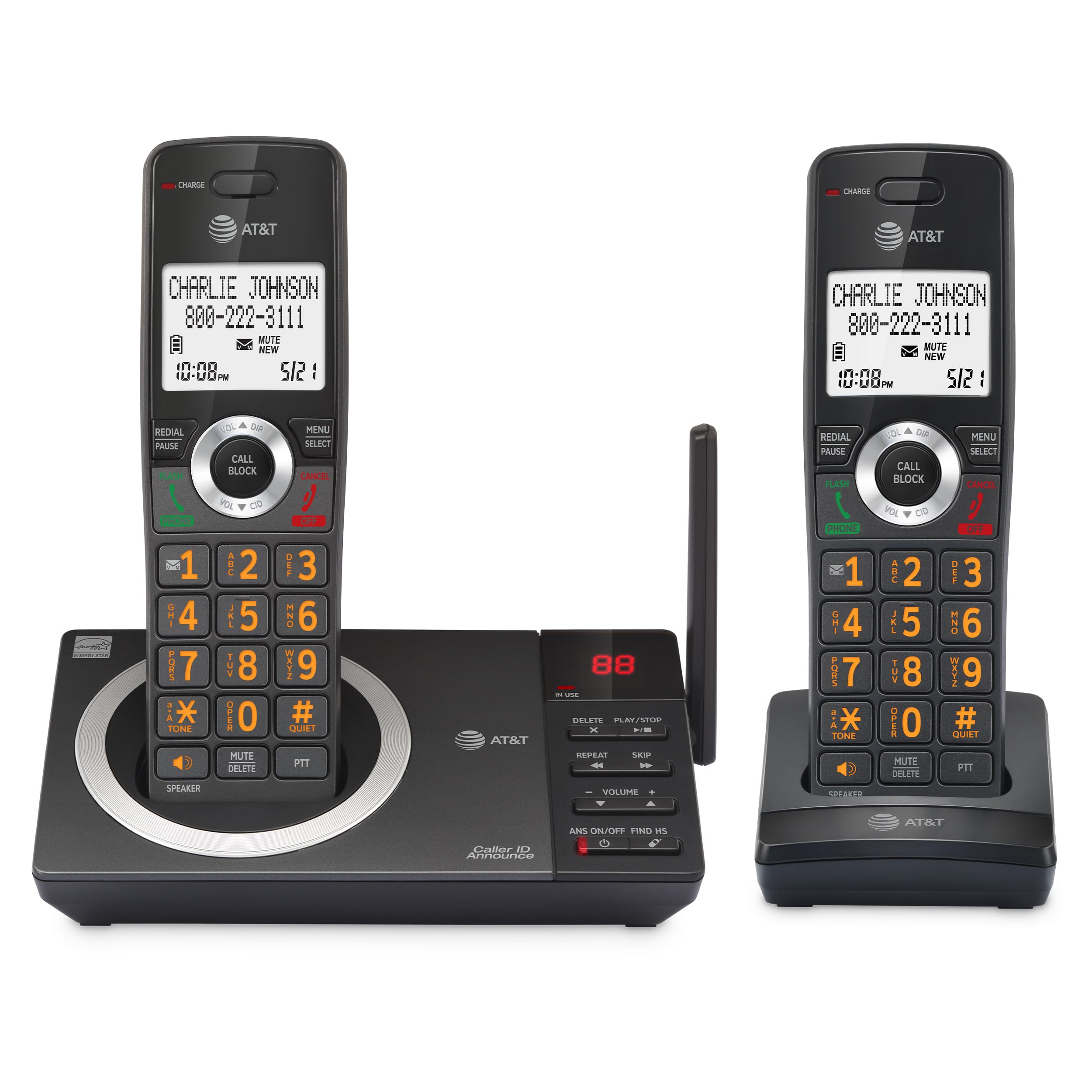
Cordless freedom with robocalls screened before the phone rings.
Here the win is call screening: Smart Call Blocker stops robocalls before they ring, and you can store up to 1,000 names and numbers to block. Caller ID Announce speaks the caller’s name aloud, so nobody has to grab the handset to check.
Two handsets use DECT 6.0 (a cordless standard built for range and clarity), and a push-to-talk intercom turns them into a house-wide walkie-talkie. The answering system records up to 22 minutes, and the 2-inch white-backlit display keeps caller ID readable. Sound quality splits owners, though, and some find setup has a learning curve.
Why it earns a slot
- Blocks robocalls before they ring
- Two handsets plus intercom
The honest gap
- Not corded, so it needs power for charging
- Sound quality divides reviewers
Pick it for: the senior who wants to move around the house and hates spam calls.
Skip if: you need a handset that works when the power is out.
7. Serene Innovations HD40P Amplified Phone

Built for Alzheimer’s and memory loss, with a portrait on every speed dial.
This is the most purpose-built phone in the group. Each speed dial button holds a portrait photo, so one press reaches a friend, family member, or doctor. The ringer hits 85 dB — the maker compares it to a lawn mower. Incoming sound is amplified 26 dB.
It runs off the phone line rather than mains power, so a power cut does not silence it, and it weighs 1.9 pounds on a 7 x 5 x 3 inch base. Ease of use and suitability for disabled users are what win people over. The recurring gripe is sound — tinny audio, static, and occasional dead buttons show up. Programming the photos is straightforward for most but confusing for some.
Made for memory support: the photo-per-button design is the clearest one-touch dialing here.
Fair warning: sound quality is the weak spot, so test it early.
Good fit for: a parent with dementia or memory loss who needs photo dialing.
Less ideal if: crisp audio is your deciding factor.
Know the Specs
Amplification (dB)
This is how much louder incoming voice can get, measured in decibels. A higher number like 40 dB gives more headroom for a quiet caller, so look for an adjustable dial rather than a fixed boost.
Corded vs cordless
A corded handset draws power from the phone line itself, so it keeps working in a power cut — the key reason many families choose it. Cordless models like the AT&T CL82218 give you range and two handsets instead.
Common Questions
Will a senior phone work during a power outage?
Does a picture button phone help with dementia?
Do these phones work with hearing aids?
The Bottom Line
For most families, the AT&T CD4930 is the pick that balances a readable tilted screen, big keys, a 25-minute answering machine, and corded reliability. If stopping spam calls and walking around the house matter more, grab the AT&T CL82218. And for a parent with memory loss, the Serene HD40P puts a face on every button.
How we choose
We do not accept paid placement. Every pick is matched to a real buyer and a real use-case; we do not hands-on test units.
Sources
Specifications: manufacturer listings and product documentation. Review insights: verified customer reviews, as of November 2026. Pricing: not shown on this page (it changes often); check the current price via the retailer link.
As an Amazon Associate, My Heart Lives Here earns from qualifying purchases. This does not affect which products we feature.