Heads up: This post contains affiliate links. As an Amazon Associate I earn from qualifying purchases, at no extra cost to you. Learn more
Specs are compiled from manufacturer listings and verified buyer reviews and can change over time — please confirm the key details on the product page before buying.
If you are buying a jewelers loupe to check hallmarks, sort coins, or spot inclusions in a stone, the honest answer up front is this: match the magnification to the job. A 30x tool is a detail-scanner, not an all-rounder, and a 10x triplet is the one to trust when you need to judge color and cut without distortion. Below are five loupes that cover those jobs properly, each with the lens type, light options, and magnification spelled out in plain terms.
This guide is built by comparing the manufacturers’ published specifications and the patterns across verified customer reviews, so you get each pick’s real strengths and trade-offs instead of marketing spin.
You will see what each lens diameter and light mode actually means at the jeweler’s bench, plus where the budget sets give you extra tools for the price of one. The shortlist below weighs lens glass against acrylic, focused light against fiddly batteries, so the right jewelers loupe lands in your pocket without a return label.
Top Picks


How To Choose The Best Jewelers Loupe
The single most common mistake is buying the highest magnification you can find. Higher power means a smaller lens and a tighter focal range, so a 90x loupe forces your eye millimetres from the object and shows you a pinhead. Decide what you are inspecting first, then pick the power and lens material to match.
Match the magnification to the task
A 10x loupe is the traditional jewelry-trade power — enough to read a hallmark stamp on a ring band and judge a stone’s cut with the whole face visible. A 30x tool suits coin dates, watch movement screws, and inclusions you already suspect are there. Anything at 60x or 90x is specialist work: you are hunting a single grain of detail, and the lens must sit almost against the surface. Sets that offer 30x, 60x and 90x in one package let you step up only when the job demands it.
Glass beats acrylic when clarity matters
Lens material decides whether the image stays sharp to the edges. Acrylic lenses are light and shatter-resistant but softer and easier to scratch. Glass lenses hold sharpness longer, and a triplet — three glass elements bonded together — corrects the colour fringing and edge distortion a single lens produces. That correction is what a jeweler wants when judging a gem’s true colour, because a distorted lens makes a stone look off-tone.
White light, UV, or no light at all
White LED light is the workhorse: it fills the shadow you create with your own head and makes fine engraving readable in a dim shop. UV black light is a different tool — it makes certain minerals fluoresce and helps verify security markings. If you inspect a lot of banknotes or stamps, the UV mode earns its place. For pure gem grading, a plain unlit triplet against good daylight is often the purer choice, since coloured light can tint what you see.
Battery style and pocket size
Illuminated loupes come in two battery camps. Some arrive with batteries already installed plus a spare pair, which is handy but means a future purchase when they die. Others are rechargeable over USB and never need a battery run. Check the folded footprint too — a loupe lives in a pocket or a case, and a hinged housing protects the lens from scratches when it is not in use.
Side-by-Side Comparison
| Model | Best For | Magnification | Lens Material | Light Type | Amazon |
|---|---|---|---|---|---|
| JARLINK 3 Pack 30X 60X 90X UV LED★ Best Overall | One set covering every power | 30x / 60x / 90x | Acrylic | LED + UV, batteries included | Amazon |
| HTS 203D0 Chrome TripletClassic Triplet | Pocket triplet with a leather case | 30x | Glass (triplet, 21 mm) | None | Amazon |
| Amoper 30X Loupe Magnifier | Desk-top stamp and coin checks | 30x | Glass (1 inch) | 3 white + 3 UV, rechargeable | Amazon |
| DANOPLUS 10x Triplet Pocket Loupe | Gem and hallmark grading | 10x | Glass (triplet, 21 mm) | LED + UV | Amazon |
| VIVOSUN 30X Rechargeable Loupe | Coin and stone inspection with a bright light | 30x | Glass (double optics) | White + UV, rechargeable | Amazon |
Detailed Reviews
1. JARLINK 3 Pack 30X 60X 90X UV LED Illuminated Jewelers Loupe
Our pick — 4.0+★ from 1,000+ verified ratings; the strongest balance of quality and price.
Three loupes, three powers, one small tin — the set that covers every inspection job.
You get two separate tools here, not one. The first is a foldable diamond loupe (a small magnifier for close inspection) with three magnification levels — 30x at 25 mm, 60x at 12 mm, and 90x at 8 mm — plus an iron plate. The second handles 30x at 22 mm and 60x at 12 mm. Between them, a 90x maximum is the highest power on this list, and that extra reach makes this the all-round pick: you get the wide 30x for hallmarks and the tight 90x for a single inclusion, without buying twice.
Lighting is built into both bodies as LED plus a UV black light lens — the UV mode is there specifically for spotting fluorescent minerals and certain security markings. Batteries arrive already installed with a spare pair in the box, so nothing stalls on day one. The bodies mix aluminum alloy, ABS plastic and acrylic glass lenses, and they fold flat enough to drop in a pocket or cloth bag.
Buyers consistently report the build and function match the listing across all three loupes. Reviewers single it out as a daily-carry set for coins, watch movements and diamonds. The honest limit is the acrylic lens and the tight field on the top setting: expect to hold the 90x lens almost against the surface to keep the image from blurring or flipping upside down. It measures 3 Count versus 1 Count for the HTS triplet, so the value sits in having every power ready.
What buyers praise most
- Highest power on the list at 90x, paired with usable 30x and 60x settings
- LED plus UV black light built into both loupes for dim-shop and security-marking checks
- Batteries pre-installed with a spare pair, so it works straight from the box
- Folds flat for pocket or cloth-bag carry, which is why travel users like it
Where it asks more of you
- Acrylic lenses soften edge clarity versus the glass triplets here
- The 90x lens needs near-contact distance, so the field of view is tiny
- A few find the small viewing area harder to line up than expected
Grab this one if: you want one purchase that covers hallmarks, coin dates and close inclusions at every power.
Think twice if: your main job is judging a gem’s exact colour — that needs a glass triplet, not acrylic.
2. HTS 203D0 Jeweler’s Loupe
A single-purpose chrome triplet built the old way, with a folding housing to protect the glass.
This is the purist’s loupe. It runs one power — 30x — through a 21 mm triplet, which means three separate 21 mm glass lenses bonded together. That bonding is the whole point: three elements working as one drastically reduce spherical aberration, the blurring that makes a cheap single lens go soft near the rim. If you are squinting at a hallmark or the edge of a bezel and need the whole 21 mm circle to stay sharp, that correction is the reason to choose the HTS over the acrylic sets.
The package is a working tool and nothing more. A folding housing snaps shut over the lens to keep it safe between jobs. There is an eyelet so you can thread the loupe onto a chain or string, and a leather storage pouch to carry it. At 1.92 ounces it is genuinely light in a pocket. It is 1 Count against 3 Count for the JARLINK set, so expect one excellent tool rather than three passable ones.
Where it gets tricky is depth of field. The focal range is genuinely narrow, which means a feature that sticks up off the surface — a raised stone setting, a thick embossed stamp — can slip out of focus and blur. The magnification itself is clear and strong; the skill is in holding the loupe at exactly the sweet distance. Anyone who expects the lens to simply show everything at once will need a little practice with this one.
The glass argument: a 21 mm triplet at 30x is the sharpest small-circle option on the list, and the folding chrome body with a leather pouch suits someone who inspects the same rings every day.
The practice cost: the tight focal range rewards a steady hand. Features that protrude past the focal plane drop out of focus, so it is not the forgiving choice for a first-time user.
Full marks for: crisp triplet glass in a pocketable chrome body with real lens protection.
Less ideal for: anyone who wants to look quickly without learning the correct holding distance.
3. Amoper 30X Loupe Magnifier

The loupe you set down and leave there, with a measuring base and a light that never needs batteries.
Most loupes want your eye pressed to them. This one flips that: it stands on a scaled base and you place the object in the middle of the scale instead. The focal length is fixed and needs no adjustment, so there is nothing to dial in. The scale doubles as a ruler for sizing what you are looking at, which makes it genuinely useful for stamps and coins where dimensions matter alongside detail.
The power is 30x through a 1 inch glass lens, and the body is solid zinc alloy with a black paint finish — a step up in heft from the plastic-and-acrylic sets. Lighting is the clever part. A soft silicone button cycles three white LEDs for normal viewing, then three UV LEDs for banknote and marking checks, then off. It recharges over micro USB with the cable in the box, so this is a loupe you never feed batteries to. At 2.3 x 2.1 x 2.0 inch it matches the VIVOSUN’s 2.3 x 2.1 x 2.0 inch footprint almost exactly.
Desk work is where it shines: printing, handcrafts, watch repair, coins, stamps. The caveat is battery life. The rechargeable cell holds a charge well for many users, but it is the most common gripe, with a share of units that stop holding charge. The square viewing window is also small, so be realistic about how much of a surface you can see at once. Reviewers consistently praise the zinc-alloy build and the clear detail it shows on stamps, coins and watch work.
Why it earns bench space
- Fixed focal length means no adjustment — set it down and look
- Scaled base works as a measuring tool, handy for stamps and coin diameters
- Rechargeable over micro USB, so no battery purchases
- Cycles three white LEDs and three UV LEDs from one soft button
Read this before you commit
- Battery life is the recurring weak point, with some units failing to hold charge
- The square viewing area is small for larger objects
- At 200 g it is heavier than a pocket folding loupe
Made for: the hobbyist who wants a stable, lit, measuring loupe sitting on the desk for stamps, coins or watch work.
Not the one for: pocket-and-go inspection on the road, where the compact folder wins on weight.
4. DANOPLUS 10x Jewelry Loupe

The traditional ten-power grader’s loupe, with light built in and a case to keep the glass clean.
Ten power is the jewelry trade’s standard for a reason. A 10x triplet through a 21 mm achromatic optical glass lens shows the whole face of a stone, so you can judge proportions and colour rather than a single facet. Your 90x and 30x tools hunt detail; this one grades. The triplet build bonds three single lenses together for colour sharpness and clarity, and the black frame is deliberately black to keep reflected light off the object — a small design choice that sharpens what you see. Against the 90x JARLINK it is a 9.0x lower power, which is the entire point of the trade.
The kit is what makes it a working tool rather than just a lens: the 10x loupe, a protective case, a lens cleaning cloth, and a quickly detachable lanyard cord. In the hand it is metal-bodied aluminium for durability, and the foldaway pocket design slips into a shirt or apron. LED and UV illumination are both there, so a dim shop bench or a back-room fluorescent check are both covered.
Know the one consistent catch: it is not always ready when you grab it. Lumination runs on its own batteries, and they drain with use over a few days, so it is worth keeping a spare set in the case. The 21 mm triplet glass is sharp and clear, and the aluminium body holds up to daily use. If you want a loupe that lights without fuss, budget for battery changes; if you want pure optics with no electronics in the way, this still gives you clean triplets.
The trade standard: 10x through glass triplets is where gem grading lives, and the case-plus-cloth-plus-lanyard bundle makes this a take-anywhere kit.
The battery drawer: UV and LED draw on batteries with no recharge, so keep spares handy or the light dims mid-check.
Pick this: if you are grading stones or reading hallmarks and want the orthodox 10x field of view.
Pass it by: if you need to see a single grain at 60x or 90x — this is the wrong power for that hunt.
5. VIVOSUN 30X Loupe Magnifier
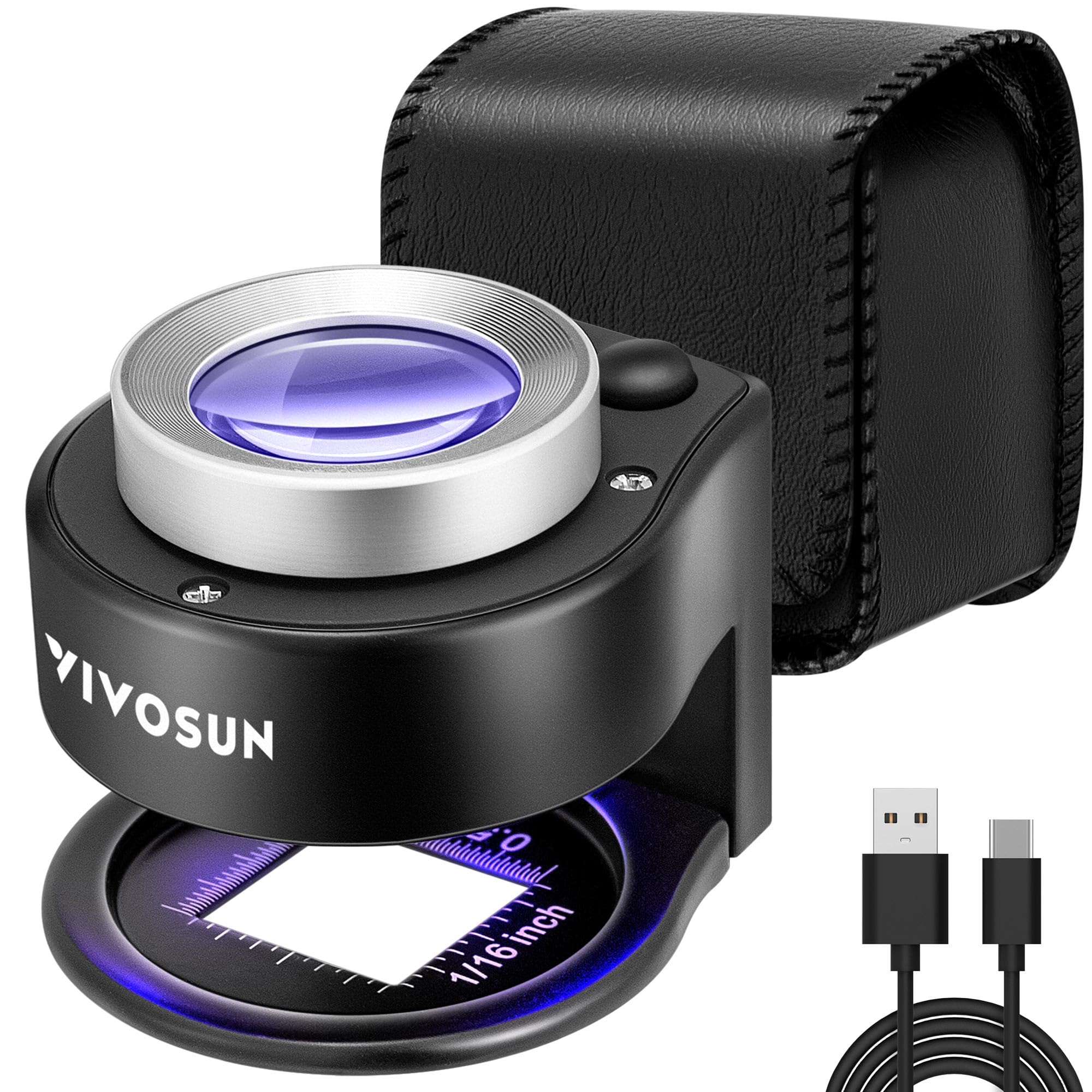
A zinc-wrapped 30x with a light bright enough to turn coins into readable maps.
Thirty power is the working compromise, and VIVOSUN lands it well. The glass lens sits inside a zinc alloy surround for durability, and the double optics carry their quality into daily use. You get a white LED and a UV light with a button to switch between them, plus a scale at the bottom to help gauge the object in view. The folded size is 2.36 x 2.05 x 2.01 inch against 2.3 x 2.1 x 2.0 inch for the Amoper, so the two sit almost the same in a pocket. It weighs 0.36 lbs.
Its 30x glass lens draws the most praise and the fewest complaints of any loupe here, and coin dates and lettering come up crisp. The built-in bright light is a genuine asset on worn silver and dim shop light. It recharges over USB with a cable in the box, so there are no batteries to buy. Reach for this when you want a single, well-lit 30x that handles jewelry, watches, gems, stamps or coins without a second tool.
The honest catch is battery life again: it recharges, but a share of units stop holding charge. The magnification figure is also disputed by a minority who say it does not measure up to a true 30x and the stated dimensions are off. Most units still read a coin’s surface clearly. Treat it as a bright, capable pocket tool with a battery that asks for care, not a sealed instrument.
Where it shines: the clearest, brightest 30x on the list for coin dates and jewelry detail, with white and UV modes a button-press apart.
The honest limit: rechargeable but not always reliable in the long run — a portion of batteries fail to hold a charge.
For the bright worker: a solid zinc body, rechargeable light and a 30x lens make this the everyday coin-and-jewelry pocket pick.
Look to the HTS instead: if you want glass triplets and no electronics to worry about at all.
Know the Specs
Magnification Strength (30x, 60x, 90x, 10x)
The number is a multiple, not a size. At 30x a 1 mm detail looks 30 mm across, but the higher you go the narrower the circle you can see. A 90x lens shows a pinhead of surface and demands near-contact distance; a 10x lens lets you see the whole face of a ring or stone while still enlarging the hallmark enough to read. Choose 10x to judge colour and cut, 30x for hallmarks and coin dates, and 60x to 90x to chase a single inclusion.
Triplet and Glass versus Acrylic
A triplet means three lens elements bonded together. Because each one corrects the faults of the last, the image stays sharp to the edges and colour stays true — the reason a jeweler reaches for glass. Acrylic lenses are lighter and tough, but they soften near the rim and scratch more easily over time. For judging a gem’s real colour, glass triplets are the standard; for all-round hobby inspection, acrylic can be fine.
LED White Light versus UV Black Light
A white LED fills the shadow your head casts and makes fine engraving readable in dim shops. A UV black light makes specific minerals fluoresce and helps verify security markings on banknotes and documents. Both are useful, but they do different jobs: white light to see, UV light to verify.
Field of View, Focal Length, and Lens Diameter
Lens diameter sets how much surface you see at once — 21 mm is a wide, comfortable circle for a triplet, while an 8 mm lens at 90x shows a sliver. Focal length is the distance at which the image is sharp; a fixed-focus desktop loupe removes the guesswork, while a pocket folder expects you to hold the right gap. Get too close or too far and the image blurs or flips.
Common Questions
Will a 30x loupe show me a ring’s hallmark clearly?
What is the difference between a triplet lens and a plain single lens?
Is 90x better than 30x for examining jewelry?
Do I need the UV light, or is white LED enough?
Are rechargeable loupes better than battery-powered ones?
Will the lens scratch if I carry it loose in a pocket?
Can I use a jeweler’s loupe on coins and stamps as well?
How do I focus a pocket loupe — why does the image blur or flip?
What lens diameter should I look for?
Is a desktop loupe better than a folding one for bench work?
The Bottom Line
If you want one purchase that covers every power and both light modes, the JARLINK 3 Pack 30X 60X 90X UV LED Illuminated Loupe is the all-rounder — three powers in one foldable set, with batteries already in the box. If accurate colour and edge-sharp glass matter most, the HTS 203D0 30x 21mm Chrome Triplet gives you the purest small-circle optics. And for coin and stamp work at a desk, the Amoper 30X Loupe Magnifier with its scaled base and rechargeable light is the one to leave right where you work.
How we choose
We do not accept paid placement. Every pick is matched to a real buyer and a real use-case; we do not hands-on test units.
Sources
Specifications: manufacturer listings and product documentation. Review insights: verified customer reviews, as of November 2026. Pricing: not shown on this page (it changes often); check the current price via the retailer link.
As an Amazon Associate, My Heart Lives Here earns from qualifying purchases. This does not affect which products we feature.