Heads up: This post contains affiliate links. As an Amazon Associate I earn from qualifying purchases, at no extra cost to you. Learn more
Specs are compiled from manufacturer listings and verified buyer reviews and can change over time — please confirm the key details on the product page before buying.
If standard iron pills leave you doubled over with cramps or blocked up for days, the fix is usually the form of iron, not the dose. The picks below all use gentler iron compounds — chelated bisglycinate, carbonyl iron, or liposomal iron — that are built to be easier on your gut than the ferrous sulfate in most drugstore bottles. Start with the Pink Stork capsules if you want a women-focused daily dose with vitamin C already built in.
This guide is built by comparing the manufacturers’ published specifications and the patterns across verified customer reviews, so you get each pick’s real strengths and trade-offs instead of marketing spin.
Below you’ll find honest notes on dose, absorption helpers, and which one suits a truly touchy stomach — a practical shortlist of the best iron for sensitive stomach buyers. This is the shortlist I would hand a friend who dreads iron pills.
Top Picks
How To Choose The Best Iron for Sensitive Stomach
The single biggest decision is the type of iron, not the strength. Ferrous sulfate is the cheap workhorse in most pharmacies, and it is also the form most likely to leave you queasy or constipated. The gentler options are chelated iron bisglycinate (iron bonded to the amino acid glycine), carbonyl iron (a very fine powder form), and liposomal iron (iron wrapped in a tiny fat bubble).
Match the dose to your need, not the biggest number
A 65 mg tablet delivers 361% of the Daily Value, which is a serious therapeutic dose. An 18 mg capsule covers 100% of the Daily Value, which suits everyday maintenance and pregnancy support. Neither is “better” — they serve different jobs, so pick based on what your bloodwork or doctor actually calls for.
Check what comes packaged with the iron
Vitamin C is the classic absorption helper, and you’ll see it dosed from 30 mg up to 250 mg across these bottles. Folate and B12 show up too, since they work alongside iron in red blood cell production. A capsule that already pairs iron with these saves you from buying a second bottle.
Read the “take with food” instruction carefully
Iron absorbs best on an empty stomach, but an empty stomach is exactly when gentle-form iron still has the best chance of bothering you. Many of these labels suggest taking the capsule with a small amount of food if you are prone to nausea.
Look at the supply length per bottle
A 60-capsule bottle taken once daily is a 2-month supply. A 90-capsule bottle is a 90-day supply. Longer supplies mean fewer reorders, which helps when you’re trying to build a consistent daily habit.
Side-by-Side Comparison
| Model | Best For | Iron Form | Iron Per Serving | Vitamin C | Amazon |
|---|---|---|---|---|---|
| Pink Stork Iron Supplement for Women★ Best Overall | Daily women’s support | Chelated iron bisglycinate | 18 mg | 50 mg | Amazon |
| Doctor’s Recipes Iron PlusFull-Spectrum Pick | Iron plus B-vitamin support | Ferrous bisglycinate | 36 mg | 30 mg | Amazon |
| GNC Gentlesorb Iron | Sensitive stomachs, 90-day supply | Gentle iron capsule | 18 mg | — | Amazon |
| ORZAX Liposomal Iron | Liposomal absorption | Liposomal iron | 25 mg | — | Amazon |
| Vitalibre Carbonyl Iron 65 mg | High-potency deficiency support | Carbonyl iron | 65 mg | 250 mg | Amazon |
Detailed Reviews
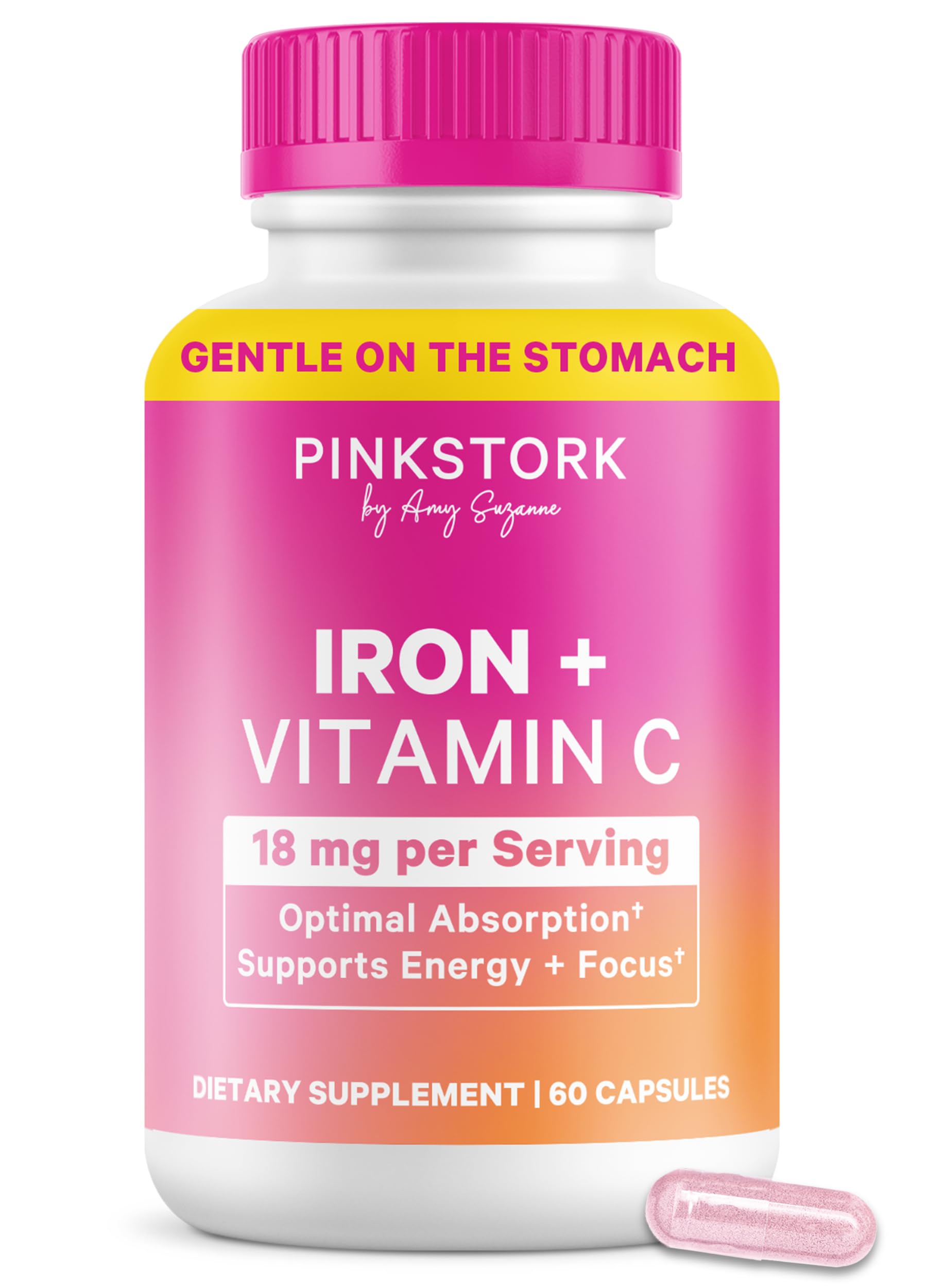
1. Pink Stork Iron Supplement for Women + Vitamin C
Our pick — 4.5+★ from 900+ verified ratings; the strongest balance of quality and price.
The everyday women’s capsule that pairs 18 mg of chelated iron with acerola vitamin C in one swallow.
Start with the form on the label. This is chelated iron bisglycinate — iron bonded to the amino acid glycine — at 18 mg per capsule, which is 100% of the Daily Value. That bonding is the whole point for a tender stomach: it is commonly chosen over ferrous sulfate salts precisely because it tends to be gentler. Add 50 mg of vitamin C from acerola fruit extract and you have a complete iron-plus-helper pair in a single capsule, no second bottle needed.
The strongest argument for this bottle is that it is genuinely easy to live with. Swallowing it is simple, it’s a vegan capsule made without gluten, dairy, peanuts, tree nuts, or animal products, and a 60-capsule bottle runs two months on one capsule a day. Pink Stork is a women-owned brand founded by Amy Suzanne Upchurch, an Integrative Health Coach — a real detail if brand ethos sways you. Note the honest flip side: 18 mg is a maintenance-level dose, not a therapeutic punch. If you have actual low iron on a lab report, the 65 mg carbonyl tablet further down is the heavier tool.
Two practical notes from the label. Iron is typically taken on an empty stomach, at least 1 hour before or 2 hours after a meal — but the maker itself suggests taking it with a small amount of food if your stomach is sensitive. Also check total iron if you already take a prenatal or multivitamin, since those often carry iron too. It holds 4.5+ stars across 900+ ratings.
What earns its keep
- 18 mg chelated iron bisglycinate — 100% of the Daily Value in one capsule
- 50 mg vitamin C from acerola built in, so no separate bottle
- 60-capsule bottle is a full 2-month supply
- Vegan, third-party tested, and made in cGMP-certified facilities
Where it runs light
- 18 mg is a maintenance dose, not a high-potency therapeutic one
- Label suggests food if you’re stomach-sensitive, which slows absorption
- Overlaps with iron already in many prenatals — needs a total-intake check
The natural fit: Anyone who wants one gentle daily capsule through cycles, pregnancy, postpartum, or perimenopause.
Look elsewhere for: A clinically low iron reading that calls for a much bigger elemental dose.
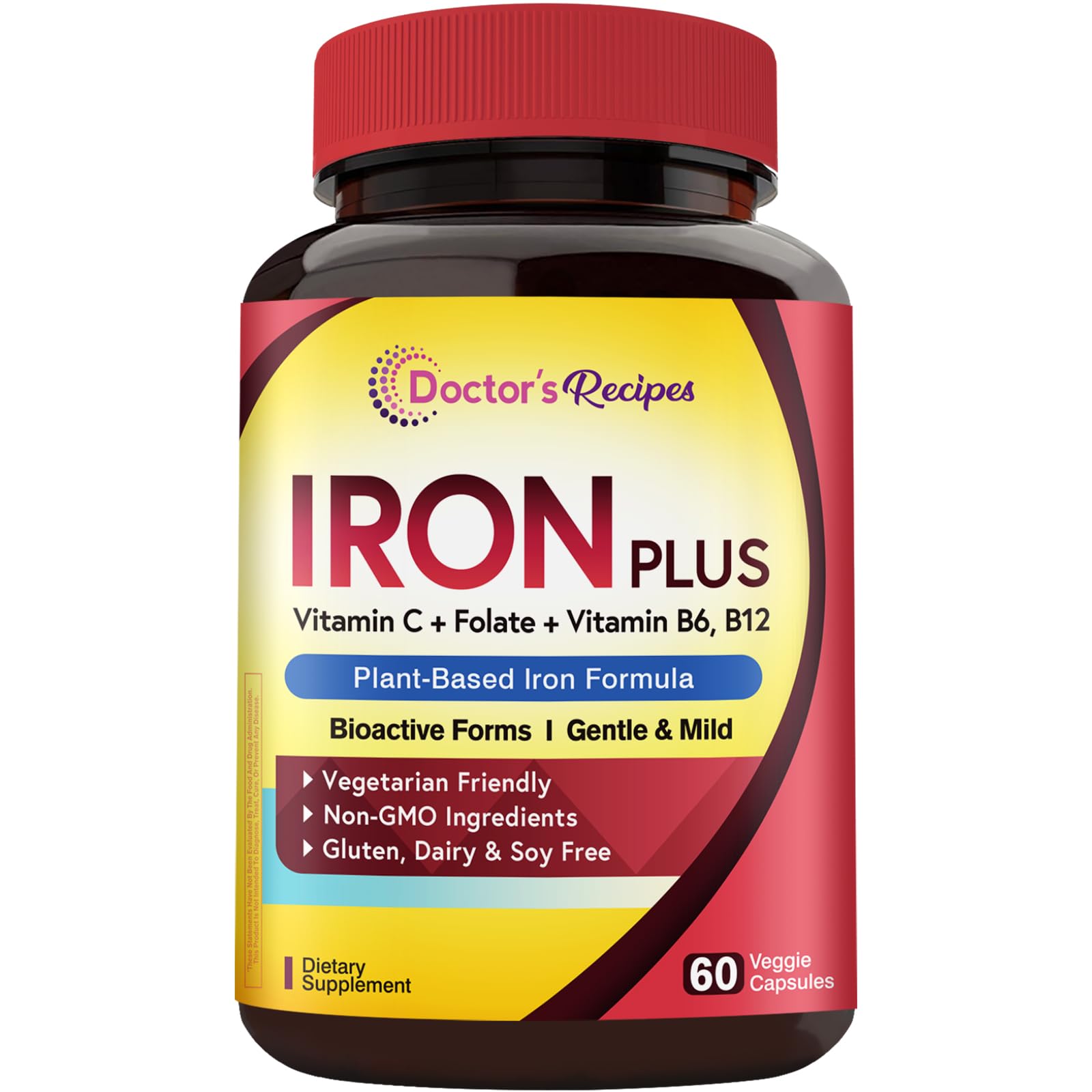
2. Doctor’s Recipes Iron Supplement for Women Men
A 36 mg bisglycinate capsule that brings B6, folate, and B12 along for the ride.
The headline here isn’t just the iron — it’s the 36 mg of elemental iron in a non-constipating ferrous bisglycinate form, paired with 5 mg of vitamin B6, 667 mcg DFE of folate, 30 mcg of B12, and 30 mg of vitamin C, all in one veggie capsule. That combination matters because B vitamins work alongside iron in red blood cell production. The 36 mg dose sits neatly between the light 18 mg capsules and the heavy 65 mg tablets — compare it to Pink Stork’s 18 mg and you’re looking at double the elemental iron per capsule.
What wins people over is that it delivers that stronger dose without the usual digestive price. The formula is described as non-constipating. This is the one for menstruating women, vegans, vegetarians, or anyone whose diet skips the richest iron sources. It is made in a GMP-certified facility in the USA and is vegan-friendly with no soy, gluten, or dairy.
Here’s the catch a big dose brings: 36 mg is a real shift if you’ve been on 18 mg, and doubling up with a prenatal that also carries iron is a genuine risk of overdoing it. Confirm the total with your doctor before stacking. If you want one capsule that covers iron plus the B-vitamin support, this is the fuller formula of the two bisglycinate options shown here.
The B-vitamin bundle: Iron plus B6, folate, B12, and vitamin C in one capsule means fewer bottles to manage — a complete red-blood-cell package rather than iron alone.
Dose reality: At 36 mg it is roughly double the 18 mg daily-maintenance capsules, so it fits someone with an actual gap to close rather than everyday topping-up.
Reach for this if: You want a stronger 36 mg dose but still need the gentle bisglycinate form, and the B-vitamin support saves you a second purchase.
Think twice if: Your prenatal already carries iron — the combined total needs a doctor’s sign-off.
3. GNC Gentlesorb Iron 18mg Supplement
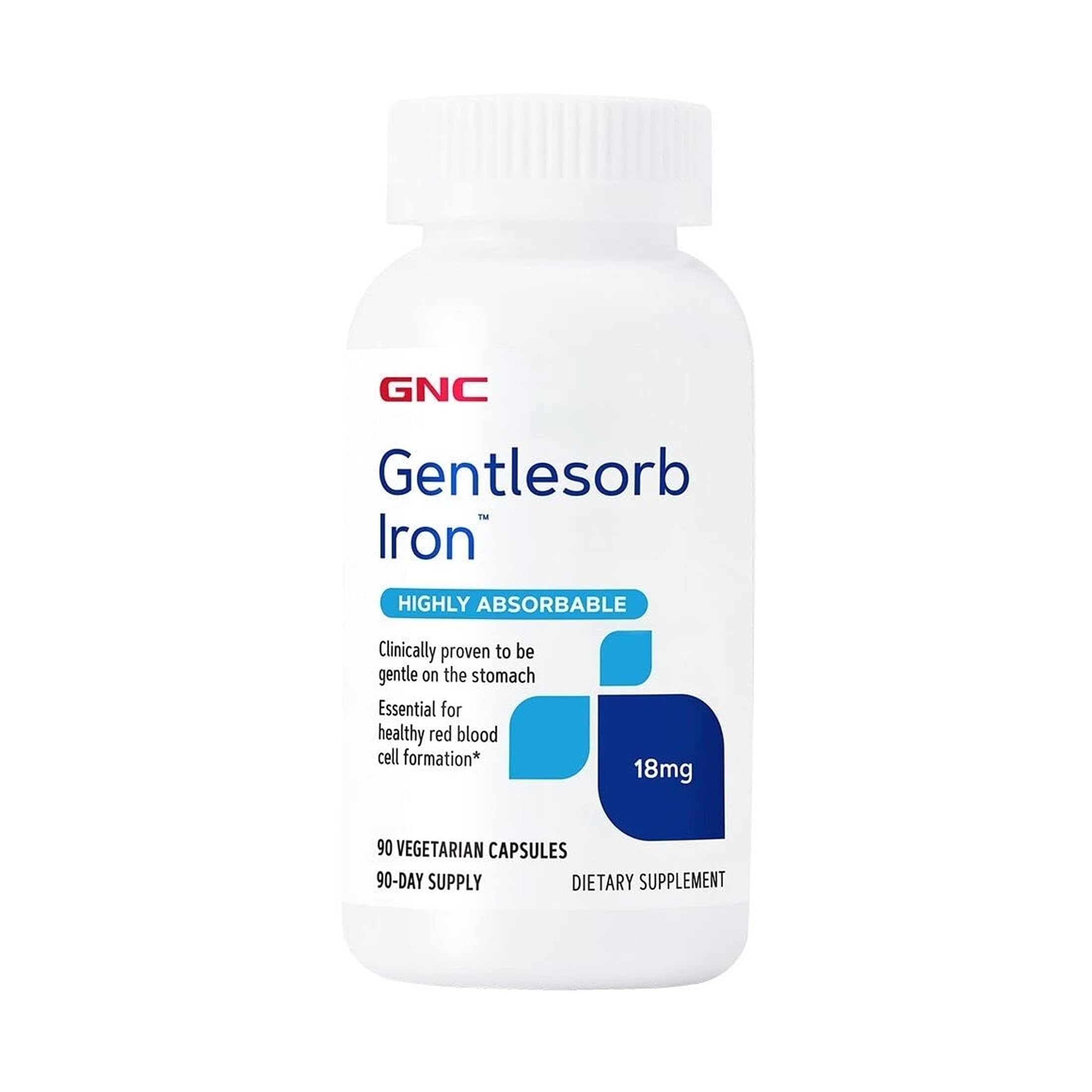
Ninety days of capsule-form gentle iron from a brand that has been at it since 1935.
The dose is 18 mg, supporting healthy red blood cell formation at a maintenance level. The label is clean on the things many people avoid: no sugar, no starch, no artificial colors or flavors, sodium free, no wheat, gluten free, no corn, no dairy. This is the choice if you want to build a long, uninterrupted daily routine and you’d rather not think about iron again for three months.
One honest note: at 18 mg this is a daily-support dose, not a high-potency fix — the 65 mg carbonyl tablet below is the heavier option if your levels are genuinely low. And because the capsules are vegetarian, check that suits your routine. For a steady, gentle, low-fuss daily habit, the three-month bottle is hard to argue with.
Long-game value: A single bottle covers 90 days at one capsule daily, so you’re reordering roughly four times a year instead of six.
Clean label: No sugar, starch, artificial colors or flavors, wheat, gluten, corn, or dairy — a short ingredient list for an 18 mg maintenance dose.
Best for: Someone who wants to set a gentle daily habit and forget about restocking for a full quarter.
Not the one if: You need a high 65 mg therapeutic dose to correct a real deficiency.
4. ORZAX Iron Supplement 25 mg

Liposomal delivery — iron wrapped in a lipid bubble to ease absorption — at 25 mg a capsule.
If you’ve tried iron and found it hard to tolerate, the form here is the reason to look. This is liposomal iron, meaning the mineral is wrapped in a tiny fat bubble, a delivery method chosen to help the body absorb it more easily. The dose is 25 mg, and you get 90 vegetable capsules — the same three-month run as the GNC bottle. At 2.89 ounces for the whole package, it is a light bottle to travel with.
The point of liposomal iron is straightforward: it’s about getting more of the dose used, not just swallowed. The formula is described as easy to swallow, quickly absorbed, non-constipating, non-GMO, and gluten free, and it’s positioned for women, men, and adults broadly. Energy is the goal — iron is needed for hemoglobin, the protein that carries oxygen to your muscles and brain, which is why topping up iron tends to show up as more daily stamina.
The trade-off is real: this is a slightly heavier bottle at 2.89 ounces than the 1.45-ounce Vitalibre tablets, so it’s the bigger item in a pill organizer drawer. And while liposomal delivery is designed to make iron easier to absorb, it is still a mineral and individual tolerance still varies. If you want a mid-weight dose with a delivery method built around absorption, this is the distinct pick of the bunch.
Why absorption gets the spotlight
- 25 mg liposomal iron in a form designed to be easy to absorb
- 90 vegetable capsules — a three-month supply
- Non-constipating, non-GMO, and gluten free
- Suitable for women, men, and adults generally
Things to weigh
- A heavier 2.89-ounce bottle than the slim carbonyl tablet bottles
- No vitamin C listed, so pair with food or a C source
- Liposomal helps absorption but does not guarantee a trouble-free stomach
Pick it for: The buyer curious about liposomal delivery who wants a mid-range 25 mg dose with a three-month supply.
Pass it over for: A formula that already includes vitamin C, or the smallest possible bottle to pack.
5. Vitalibre Iron Supplement

The big-dose tablet for a real deficiency — 65 mg of carbonyl iron backed by a hefty 250 mg of vitamin C.
This is the strength pick. Each small coated tablet carries 65 mg of elemental iron — 361% of the Daily Value — which is more than triple the 18 mg in Pink Stork. The vitamin C is just as serious: 250 mg per tablet to boost absorption, which also supplies antioxidant and immune support. If you’re working from an actual low-iron reading rather than everyday upkeep, this is the dose that matches that job.
What keeps the big number from being brutal is the form. The maker describes carbonyl iron as having superior bioavailability and gentle absorption, so substantially less of it is needed to hit the same daily intake versus ferrous salts like ferrous sulfate, ferrous fumarate, or ferrous gluconate. Fewer unwanted digestive issues — nausea, upset tummy, constipation — is the promise there. The tablet is coated and small to swallow, and it’s free of sugar, gluten, dairy, soy, wheat, eggs, tree nuts, and peanuts, made in the USA under GMP guidelines.
The obvious caveat: 361% of the Daily Value is a therapeutic-level dose, not something to take casually alongside other iron sources. This is the one to run past a doctor, especially if you already take a multivitamin. But for confirmed low iron in a supplement-averse digestive system, the carbonyl form with 250 mg of C is the most serious tool here.
The dose that means business: 65 mg elemental iron — 361% of the Daily Value — with 250 mg vitamin C to help your body actually use it, and carbonyl iron chosen for gentler absorption than ferrous salts.
Clean and compact: A small coated tablet, 1.45 ounces for the package, free of sugar, gluten, dairy, soy, wheat, eggs, tree nuts, and peanuts.
The right tool if: You have a real iron deficiency and want a high 65 mg dose in a gentler carbonyl form with vitamin C attached.
The wrong tool if: You just want light daily support — at 361% of the Daily Value it needs a doctor’s eye first.
Know the Specs
Iron form: the gentleness lever
The form (ferrous sulfate, bisglycinate, carbonyl, liposomal) decides how much stomach trouble you’re likely to feel. Bisglycinate bonds iron to glycine, carbonyl iron is a fine-powder form absorbed gently, and liposomal iron wraps the mineral in a lipid bubble. Ferrous sulfate — the pharmacy default — is the form most often linked to queasiness and constipation.
Elemental iron vs. the salt
The milligram number on these bottles is elemental iron, the amount your body can actually use. That’s why a 65 mg carbonyl tablet and a 65 mg dose of a ferrous salt are not the same thing. Read the elemental figure and the form together, never the headline number alone.
Vitamin C pairing
Vitamin C helps your body absorb iron, which is why every good formula here pairs them. It ranges from 30 mg on the Doctor’s Recipes capsule to 250 mg on the Vitalibre tablet. Down a capsule with a glass of orange juice if the label doesn’t include C.
Daily Value and dose
18 mg equals 100% of the Daily Value, which is a maintenance dose. 65 mg is 361%, a therapeutic-level dose for correcting a real deficiency. Choose the dose that matches what your bloodwork or doctor calls for, not the biggest number on the shelf.
Common Questions
Which form of iron is the gentlest on a sensitive stomach?
Can I take iron on an empty stomach if it makes me queasy?
Do I need vitamin C with my iron pill?
How long until I notice a difference in energy?
Can I take iron alongside my prenatal or multivitamin?
Is 65 mg of iron too much for daily use?
Why is carbonyl iron different from ferrous sulfate?
What does “elemental iron” mean on the label?
Should I take a gentle iron if I’m not actually deficient?
How should I store my iron capsules?
The Bottom Line
For most people dealing with a touchy stomach, the Pink Stork Iron Supplement for Women is the winner because it pairs 18 mg of gentle chelated bisglycinate with 50 mg of acerola vitamin C in one easy daily capsule — the maintenance dose that suits cycles, pregnancy, and everyday support. If you have a real gap to close and want a stronger 36 mg dose with B-vitamin backup, the Doctor’s Recipes Iron Plus brings B6, folate, and B12 along. And if your bloodwork shows an actual deficiency, the Vitalibre 65 mg Carbonyl Iron is the serious tool — 361% of the Daily Value in a gentler carbonyl form. It holds 4.5+ stars across 900+ ratings, but if you simply want three uninterrupted months of gentle 18 mg support, the GNC Gentlesorb 90-day bottle is the easy daily habit to lock in.
How we choose
We do not accept paid placement. Every pick is matched to a real buyer and a real use-case; we do not hands-on test units.
Sources
Specifications: manufacturer listings and product documentation. Review insights: verified customer reviews, as of November 2026. Pricing: not shown on this page (it changes often); check the current price via the retailer link.
As an Amazon Associate, My Heart Lives Here earns from qualifying purchases. This does not affect which products we feature.