Heads up: This post contains affiliate links. As an Amazon Associate I earn from qualifying purchases, at no extra cost to you. Learn more
Specs are compiled from manufacturer listings and verified buyer reviews and can change over time — please confirm the key details on the product page before buying.
You wake up to droppings behind the cereal box and a gnawed corner on the dog food bag. Mice slip through gaps as narrow as a pencil, so the fix is not a trap — it is plugging the hole with something they physically cannot chew through. Soft fiberglass and expanding foam are easy for a mouse to tunnel through. Copper mesh and packed steel wool are not, which is why both show up again and again on this list.
This guide is built by comparing the manufacturers’ published specifications and the patterns across verified customer reviews, so you get each pick’s real strengths and trade-offs instead of marketing spin.
Below you get a straight comparison of five real hole-plugging materials, from a 100 ft copper roll to a six-pack of steel wool. The short answer: buy copper mesh for long-term sealing and steel wool for quick, cheap gap filling.
Top Picks

How To Choose the Right Insulation to Keep Mice Out
Mice do not need a big door. They need a gap the width of a pencil, and they will chew soft material until it becomes a tunnel. The material you stuff in that gap has to do one thing well: resist their teeth. Everything else — length, thickness, included tools — is about how much work the job takes.
Copper mesh versus steel wool
Copper mesh is a knitted wire cloth that holds its shape when you wad it into a crack. It does not rust, which matters in weep holes, foundation vents, and anywhere rain or condensation reaches. Steel wool is the cheaper filler. It is dense and hard to chew, but it can rust when it gets wet, so it belongs in dry interior gaps like sill plates and pipe penetrations inside the house. Coarse steel wool holds up better than fine grades because the fibers are thicker.
How roll length changes the job
Length is the spec that decides how many holes you can seal before you run out. A short roll covers a handful of foundation vents. A long roll covers a whole crawl space perimeter plus the pipe gaps. Measure the openings you plan to fill, add a little for the wad you push in, and pick your roll from that number rather than guessing at the store.
Wire thickness and density
Mesh thickness is measured in millimeters, and the difference between a thin and thick wire is how much pressure it takes to deform. A denser knit also packs tighter, which leaves fewer gaps for a mouse to push a nose through. Look for wire listed in the 0.17 to 0.18 mm range for a sturdy, bendable mesh that still cuts with household scissors.
Kit extras worth having
Some rolls ship with scissors, a packing stick, or gloves. Those extras save you hunting for a tool at the moment the hole is open and the mouse is in the wall. A packing tool lets you push the mesh deep into a crack without shredding your fingers. Gloves matter more with steel wool, which has sharp edges.
Side-by-Side Comparison
| Model | Best For | Material | Roll Length | Wire Thickness | Amazon |
|---|---|---|---|---|---|
| STUF-FIT Copper Mesh 100 ft. roll★ Best Overall | Whole-house sealing | 99.99% pure copper | 100 ft | — | Amazon |
| Copper Mesh Rodent Control 5in x 33ftBest Value | Budget gap filling | 100% pure copper wire | 33 ft | 0.17 mm | Amazon |
| Copper Mesh Rodent Control Kit 5in x 35ft | First-time DIY kit | Copper | 35 ft | 0.18 mm | Amazon |
| Valchoose Copper Mesh Roll 5″ x 40FT | Longest single copper roll | 100% pure copper | 40 ft | — | Amazon |
| JINGTONG 78 Feet Steel Wool (6 Rolls) | Big multi-gap jobs | Steel wool | 78 ft total | — | Amazon |
Detailed Reviews
1. STUF-FIT Copper Mesh – 100 ft. roll
Our pick — 4.5+★ from 700+ verified ratings; the strongest balance of quality and price.
At 100 ft, this roll seals a full crawl space perimeter and still leaves spare mesh.
Length is the number that decides how many gaps you can seal before the roll runs dry. This STUF-FIT roll runs 100 ft, which is the longest here by a wide margin — the YAGJIA roll is 33 ft and the RAYTRENDS roll is 35 ft. A 100 ft roll covers a full foundation perimeter, pipe penetrations, vents, and still leaves spare mesh for next spring.
It is made of 99.99% pure copper, so it will not rust the way steel wool can in a damp vent. Copper is the key detail: mice cannot chew through it, it holds its shape when wadded, and it does not stain the wood around the gap. The weight comes in at 2 pounds for the whole roll, so it is easy to carry up a ladder while you work.
What wins people over is the quality of the mesh itself — it does not tear apart under finger pressure and the strands stay intact when you cut and pack them. The recurring gripe is material confusion, with a slice of buyers questioning whether it is genuine copper. Treat it as a fit note: if you want to check the metal, a quick scratch on an off-cut shows the reddish copper tone before you commit it to a crack. It holds a 4.5+ star rating across 700+ reviews, with repeat buyers coming back for a second roll.
Why it earns the top slot
- 100 ft roll covers a whole house perimeter without reordering
- 99.99% pure copper resists rust and cannot be chewed through by hand
- Cuts with household scissors and holds its shape when packed
- 2-pound roll is manageable to handle on a ladder
Where it asks for trust
- Material authenticity is the one point a slice of buyers question
- Premium tier among the copper rolls on this list
Reach for this if: you have a whole house or crawl space of gaps and want one roll that outlasts the problem.
Look elsewhere if: you only need to plug one or two weep holes — a shorter, budget-friendlier roll will do.
2. Copper Mesh Rodent Control 5in x 33ft
Double-layer knit that refuses to be gnawed through, at an entry-level price.
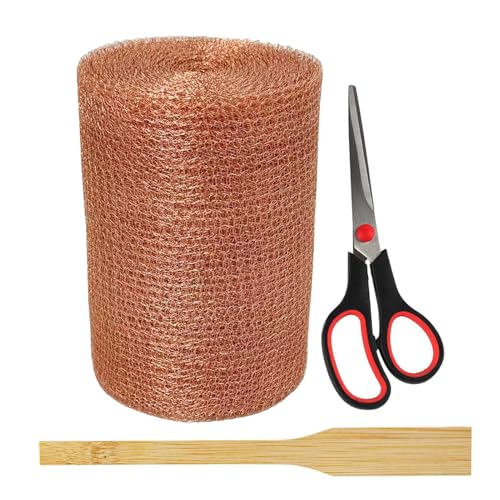
The YAGJIA roll is knit from 100% pure copper wire, with every loop linked to the next in a double-layer tubular design. That interlocking structure is what makes it hard for a mouse to pull strands loose or chew a path through. It also stays flexible, so you can fold and compress it into irregular cracks that a rigid patch cannot follow. The wire runs 0.17 mm, slightly thinner than the 0.18 mm RAYTRENDS roll, but the double-layer construction adds back the strength a single layer would lose.
The roll measures 5 inches wide and 33 ft long, which is enough for a row of foundation vents, weep holes, and the gap around a plumbing line. You cut it with ordinary scissors to whatever shape the hole needs, then push it in and compact it with the included wood stick. The kit also ships with a pair of scissors, so you can open the package and start plugging gaps without a trip to the toolbox. It will not rust, which keeps the mesh usable if you pull it out to reposition it.
One thing to keep in mind: some buyers want to verify the metal is really copper, so test an off-cut before you commit it to a crack. That aside, the double-layer knit holds its shape once packed and keeps blocking the gap.
Where the value sits: 33 ft of double-layer copper knit plus scissors and a packing stick, in a roll that folds into awkward gaps a flat patch cannot reach.
One honest caveat: at 0.17 mm the wire is slightly thinner than the RAYTRENDS 0.18 mm, so if you are sealing a spot a determined rodent hits hard, pack it denser.
Who it beats: the pricier rolls if you have a modest number of gaps and want tools in the box.
Who should pass: anyone sealing a whole foundation perimeter — 33 ft will run short.
3. Copper Mesh Rodent Control Kit, 5 Inch x 35ft
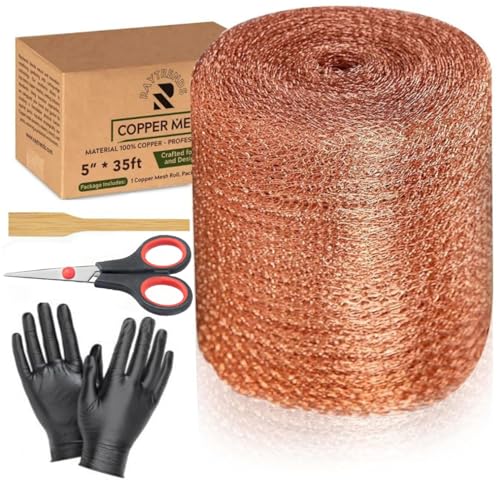
The kit that hands you scissors, gloves, and a packing tool in the same box as the mesh.
This is the roll to buy if you want to open the package and start sealing the same afternoon. Inside the box: a 5-inch by 35-ft copper mesh roll, a pair of scissors, gloves, and a packing tool. The gloves and packing tool are the pieces that matter, because they let you push mesh deep into a crack without shredding your fingers on the wire ends. That combination is why first-time DIYers tend to gravitate to this one.
The mesh runs at 0.18 mm thick, which is slightly beefier than the YAGJIA 0.17 mm wire. That extra bit of heft translates into more resistance when a mouse pushes against it. It is rust- and fire-resistant, so it holds up in a damp vent or near a heat source where a steel wool plug would start to break down. Cut it with the included scissors to the shape of the hole, wad it in, and pack it tight with the tool.
The roll length lands between the budget rolls and the long STUF-FIT 100 ft, so it covers a solid afternoon of gap sealing. Ease of work is what people single out most, and the included tools get consistent praise for how cleanly the scissors slice through the mesh. The trade-off: you pay a small premium for the extras, so if you already own gloves and a good pair of shears, a bare roll is the leaner buy.
The DIY-ready angle: 35 ft of 0.18 mm copper mesh plus scissors, gloves, and a packing tool — everything you need in one box for a first rodent-proofing job.
The premium you pay: the bundled tools add cost over a bare roll, so a confident DIYer with gloves on the shelf may not need them.
Best fit: a first-time gap sealer with no tool kit of their own, sealing a dozen or so openings.
Consider passing: if you already own gloves and heavy shears — the bare rolls deliver the same copper for less.
4. Copper Mesh Roll 5″ x 40FT
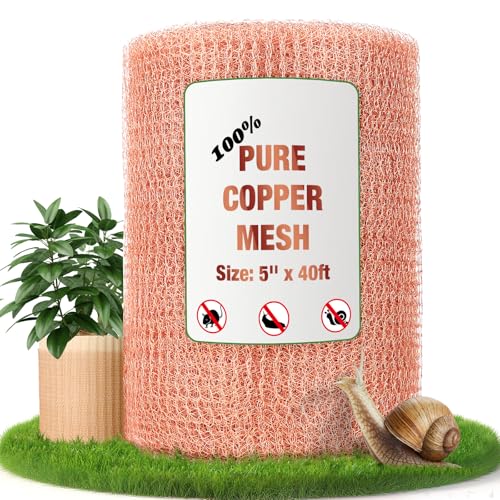
Forty feet of pure copper for a bigger job, without the whole-roll bulk of the 100 ft spool.
The Valchoose roll measures 5 inches wide by 40 ft long, which is the longest single copper roll on this list after the STUF-FIT 100 ft spool. The longer length covers a garage, shed, and basement perimeter in one order, and leaves spare for the next problem spot. It is a plain-weave copper mesh, which bends easily around pipe curves and window frames while holding the wadding you pack into the gap.
Wire is 100% pure copper, so it will not rust and it will not stain the wood it touches. It is listed as waterproof, fire-resistant, and reusable, so if you pull a plug out to check, you can push it back in. The roll weighs 12.6 ounces, which keeps the whole job light in hand. Cut it with scissors, shape it around the opening, and pack it until it holds firm. Gardeners also use it around plant stems to keep snails off, and it works as a grounding fabric in a pinch.
The point buyers raise most is durability of the packed plug, with a slice of the mesh coming apart when pieces are trimmed. That is worth knowing before you commit an off-cut to a deep crack. Pack it denser than you think you need, and the plug holds. Overall the roll trades a little rigidity for flexibility, which suits curved and irregular openings that a stiffer mesh struggles to fill.
What it brings to the job
- 40 ft of 5-inch wide copper mesh — the longer single copper roll here
- Plain-weave construction bends around pipes and window frames
- Rust-free, fire-resistant, reusable across seasons
- 12.6-ounce roll stays light on the ladder
Where to pack it denser
- Some buyers report trimmed pieces coming apart, so pack tighter
- Plain weave is on the softer side, so dense cracks need extra wadding
Its balance: outdoor and curved openings — garden beds, shed frames, and pipe collars where a flexible weave fits the gap better.
Skip for: a spot you need to be rock-rigid on the first shot — a stiffer, tighter-knit mesh holds that shape more firmly.
5. JINGTONG 78 Feet Steel Wool Mice Control, 6 Rolls
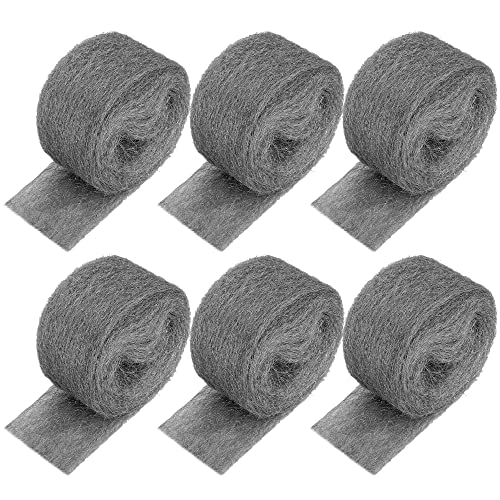
Six rolls of coarse steel wool for the multi-gap job you want to finish in one afternoon.
This is the bundle for a garage, barn, or workshop with more holes than patience. You get 6 rolls, 78 ft total, made from thousands of metal fibers packed soft, dense, and fluffy. The density is the point: mice cannot chew through the packed wool because the fibers are too tightly bound to separate. Cut it with ordinary scissors, push it into the crack, and the plug holds. The coarse grade is what keeps the fibers thick enough to resist a rodent’s teeth. Do not substitute fine steel wool — it is too soft and rusts fast in damp spots.
Scope of use is broad. Fill gaps around garden walls, workshop vents, brick walls, pipe systems, air-conditioning equipment, window frames, wallboards, and the seam between a foundation and sill. The 78 ft total goes a long way when you are plugging many small cracks rather than one big hole. For a multi-building rodent-proofing job, that volume is the reason to choose this pack over a copper roll.
Two honest notes before you buy. The steel wool is thin, and a slice of buyers find it prone to rusting once it gets wet. So keep it to dry interior gaps where rain and condensation are not an issue. And wear gloves — the fiber ends are sharp. The value lands in the volume: 78 ft across six rolls covers a multi-gap job with spare for next season.
The volume play: 6 rolls and 78 ft total of coarse steel wool, enough to plug a barn, workshop, and garage without reordering mid-job.
The rust caveat: steel wool can rust when it gets wet, so stick to dry interior gaps and skip weep holes and exterior vents.
For the multi-building job: a workshop, barn, or garage with a dozen-plus gaps and no exterior moisture in play.
Not for wet spots: a weep hole or exterior vent will rust the plug over a season — use copper there instead.
Know the Specs
Material: Copper Mesh vs Steel Wool
Copper mesh is knitted copper wire that does not rust, so it holds up in damp spots like foundation vents and weep holes. Steel wool is denser and cheaper, and it is excellent for dry interior gaps like sill plates and pipe penetrations inside the house. The trade-off is rust: steel wool that gets wet can rust over a season. Match the material to the moisture level of the gap, and you get the most life out of the plug.
Roll Length: The Coverage Number
Length is measured in feet, and it decides how many openings you can seal from one purchase. A 33 ft roll covers a handful of vents and pipe gaps. A 78 ft or 100 ft roll covers a whole perimeter. Measure the openings you plan to fill and add a little extra for the wadded bulk, then pick your roll from that total. Running short mid-job on a weekend stalls the whole rodent-proofing project until the next order arrives.
Wire Thickness: How Much It Resists Teeth
Thickness is measured in millimeters, and thinner wire bends more easily but holds less pressure. The 0.17 and 0.18 mm wire on the copper rolls here is thin enough to cut with household scissors and stiff enough to hold a packed shape. Pack the mesh denser in any spot where a rodent pushes hard, and the total barrier gets stiffer regardless of gauge.
Kit Extras: Scissors, Gloves, Packing Tool
A kit that ships with scissors lets you cut to size on the spot. Gloves protect your fingers from wire ends, which matters more with steel wool. A packing tool lets you push mesh deep into a crack without scraping your knuckles. If you already own these tools, a bare roll is the leaner buy. If you do not, a kit saves you a second trip to the hardware store.
Common Questions
Does copper mesh really stop mice better than steel wool?
How wide a gap can a mouse squeeze through?
Will steel wool rust inside a wall or vent?
Can I cut copper mesh with ordinary household scissors?
How much mesh do I need for a whole crawl space?
Do I need gloves when installing steel wool?
Will copper mesh stain the wood around the gap?
Can I combine copper mesh and steel wool in one opening?
What is the difference between fine and coarse steel wool?
Will the mesh survive a second season after I pull it out?
The Bottom Line
The STUF-FIT Copper Mesh 100 ft. roll takes the top spot because 100 ft of 99.99% pure copper covers a whole house perimeter in one purchase, and the mesh will not rust or tear by hand. If you want a bundled kit that gets you started without a trip to the toolbox, the RAYTRENDS Copper Mesh Kit hands you the scissors, gloves, and packing tool in the same box. For a multi-gap job in a dry interior, the JINGTONG steel wool six-pack gives you 78 ft total to plug every crack in the garage. Match the material to the moisture of your gap, pack it denser than the hole looks, and you will not be buying another roll next spring.
How we choose
We do not accept paid placement. Every pick is matched to a real buyer and a real use-case; we do not hands-on test units.
Sources
Specifications: manufacturer listings and product documentation. Review insights: verified customer reviews, as of November 2026. Pricing: not shown on this page (it changes often); check the current price via the retailer link.
As an Amazon Associate, My Heart Lives Here earns from qualifying purchases. This does not affect which products we feature.