Heads up: This post contains affiliate links. As an Amazon Associate I earn from qualifying purchases, at no extra cost to you. Learn more
Specs are compiled from manufacturer listings and verified buyer reviews and can change over time — please confirm the key details on the product page before buying.
Spotted lanternfly pressure is brutal because the pest attacks in two waves — the black-spotted nymphs that crawl up your trunk in spring, then the adult planthoppers that swarm in late summer. The short answer: a 16 oz broad-use concentrate gives you the most flexibility for trunk sprays and lawn treatment at once, while a systemic concentrate is your best bet when the insects are already buried deep in a shrub. Below you’ll find the five liquid concentrates worth putting in a sprayer, what each one actually kills, and where each falls short.
This guide is built by comparing the manufacturers’ published specifications and the patterns across verified customer reviews, so you get each pick’s real strengths and trade-offs instead of marketing spin.
Spotted lanternfly control starts with reading the label before you spray anything, and this breakdown covers the mixes, the dilution rates, and the honest limits of each bottle. Match the bottle to the surface: a lawn-edge contact spray, a trunk-band pass, or a systemic for shrubs.
Top Picks

How To Choose The Best Insecticide for Spotted Lanternfly
The spotted lanternfly feeds by piercing the bark and sucking sap, which is why a spray that only wets the surface often disappoints. You need to match the product form to where the insect actually sits — on the trunk, in the canopy, or down in the roots of an ornamental shrub.
Concentrate vs. ready-to-spray
A concentrate is a bottle of active ingredient you dilute yourself, usually in a tank sprayer or a hose-end sprayer. That gives you control over strength and lets one 16 oz bottle stretch across a large area. A ready-to-spray bottle hooks straight to your garden hose and is faster to deploy, but you are locked into the manufacturer’s mix ratio.
Contact killers vs. systemics
Contact insecticides kill the insect when the spray lands on it, so timing your pass while the nymphs are climbing is everything. A systemic insecticide is absorbed into the plant’s tissue, so the pest ingests it while feeding — useful when the lanternflies are high in the canopy and out of reach of your wand. Note that systemic products are typically labeled for ornamental plants and not for vegetables or fruit you plan to eat, so always check that line on the label first.
Reading the coverage number
Most broad-use concentrates print a treated-area figure on the label, such as square feet per measured amount of product. That number tells you how far one bottle really goes. If you are treating a lawn edge plus a row of shrubs, do the rough math before you buy so you are not caught halfway through a pass.
Side-by-Side Comparison
| Model | Best For | Form | Volume | Item Weight | Amazon |
|---|---|---|---|---|---|
| Hi-Yield (32009) Broad Use★ Best Overall | All-around lawn and garden | Liquid concentrate | 16 fl oz | 16 ounces | Amazon |
| BioAdvanced Tree & ShrubEasiest to Apply | Hose-end tree spraying | Ready-to-spray liquid | 32 fl oz | 2.1 pounds | Amazon |
| Bonide Pyrethrin Garden Spray | Gentle on beneficials | Concentrate spray | 16 fl oz | 16 ounces | Amazon |
| Bonide Systemic Insect Control | Hard-to-kill infestations | Concentrate spray | 16 fl oz | 16 ounces | Amazon |
| Hi-Yield (32029) Malathion | Fruit trees and vegetables | Oil-based spray | 32 fl oz | 2.5 pounds | Amazon |
Detailed Reviews
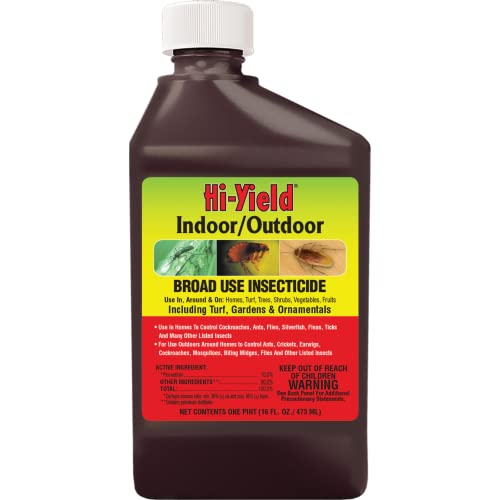
1. Hi-Yield (32009) Indoor/Outdoor Broad Use Insecticide, 16 oz
Our pick — 4.5+★ from 400+ verified ratings; the strongest balance of quality and price.
One 16 oz bottle that treats up to 1,000 square feet per half ounce, so a single purchase covers a full yard edge.
If lanternflies are spread across a fence line, a lawn border, and a few shrubs, this one bottle covers all three. The label lists ticks, mosquitoes, termites, fleas, and cockroaches alongside the garden pests, and it is cleared for trees, lawns, and garden vegetables. That label breadth is why it earns the top slot — one bottle covers trees, turf, and vegetables.
The coverage math is the part worth memorizing. Treats up to 1,000 square feet per 1/2 ounce of insecticide, which means a 16 fl oz bottle of concentrate stretches across an enormous area once diluted. It mixes readily with water and works in either a tank-type sprayer or a power sprayer, so you can scale the pass to the size of the job. Application rates vary by plant and method, so read the label chart before you fill the tank.
Here is the honest catch. This is a broad-use contact product, not a systemic, so it kills what the spray reaches and does not travel through the plant’s tissue. Lanternflies feeding high in a tree canopy may sit outside your spray pattern. For trunk banding and low foliage it is excellent; for a mature tree crown you will want a hose-end sprayer or a systemic. The 4.5+ star rating across 400+ ratings reflects that most people get the results they came for.
What earns it the top spot
- 1,000 square feet per 1/2 ounce gives you serious dilution mileage from one bottle
- Label covers trees, lawns, and garden vegetables, so one bottle handles mixed terrain
- Works in both a tank-type and a power sprayer without clogging issues
- Mixes readily with water, so no special carrier fluid to buy
Where it stops short
- Contact action only — no systemic movement into the canopy
- Application rates change by plant and method, so the label chart is mandatory reading
Reach for this if: you are treating a lawn edge, a fence line, and low shrubs and want one bottle to cover all three.
Look elsewhere if: your lanternflies are feeding high in a mature tree crown where a contact spray cannot land.
2. BioAdvanced Tree & Shrub Insect Killer 32 oz
Hooks straight to your garden hose and keeps killing listed insects on trees and shrubs for up to two weeks.
No mixing, no measuring cup, no tank to rinse — that is the entire pitch of this bottle and it is a good one when lanternfly nymphs have already started crawling and you need to act today. The ready-to-spray head connects to any garden hose and delivers an even pass across the foliage. At 32 fl oz and 2.1 pounds, it is the lighter of the two large bottles here; the Hi-Yield Malathion sits at 2.5 pounds for the same 32 fl oz.
Buyers consistently praise how well it kills, and the two-week residual is why. Effectiveness is the thing buyers rave about most, and the two-week residual is the reason — a single pass keeps protecting trees and shrubs rather than needing a fresh spray after every rain. The listed targets include aphids, Japanese beetles, caterpillars, and whiteflies, so if your ornamentals are hosting multiple invaders at once, you are covered for the whole lineup.
The trade-off is scope. This is formulated for trees and shrubs, and it does not carry the lawn or vegetable-garden labeling that the Hi-Yield broad-use bottle does. If your plan is a full-yard pass, this is one piece of the puzzle rather than the whole thing. For targeted trunk and canopy spraying on ornamentals, the hose-end convenience makes it the fastest route to a treated tree.
The hose is the feature: connect, spray, done — the fastest path from noticing the pest to having a treated tree, with no dilution math.
Two weeks, then repeat: the residual is real but finite, so plan a second pass if the adult flight drags on.
Best match for: a homeowner with a few ornamental trees and no interest in mixing concentrate.
Not the pick for: a full-lawn treatment plan — this bottle is labeled for trees and shrubs, not turf.
3. Pyrethrin Bonide Garden Insect Spray Concentrate 16 oz

A pyrethrin concentrate that controls a broad range of insects while staying safe for beneficial insects on the label.
If you garden for the bees and ladybugs as much as the plants, this label’s beneficial-insect claim is the reason to pick it. The label covers a broad range of insects and states it is safe for beneficial insects — a meaningful distinction when your lanternfly pass would otherwise take out the predators that help you long term. It ships as a concentrate in a 16 fl oz bottle, so you dilute to your own ratio.
Buyers single out its knockdown on aphids and leafy green bugs. Buyers single out its performance on aphids and leafy green bugs, and duration gets consistent praise — the knockdown lasts long enough to be worth the mixing. For a nymph pass on garden plants and low ornamentals, that is exactly the profile you want: quick contact kill, no lingering residue concern on the plants you handle.
What you give up is reach. This is a 16 fl oz concentrate at 16 ounces of shipping weight, so it is the small-bottle option in this lineup, and a heavy infestation across a big property will drink through it fast. There is also no systemic action here, so it is a spray-the-insect product, not a feed-the-plant product. Stock a second bottle if your lanternfly pressure is heavy or your property is large.
The beneficial-insect angle: controlling the pest without wiping out your garden’s natural defenders is the reason to choose this one over a harsher contact spray.
Buy two: 16 fl oz goes quickly on a large property, and concentrate is only economical if you have enough of it.
Choose this when: your garden is full of pollinators you want to keep and the lanternflies are on low foliage you can reach.
Think twice when: you are treating acres of turf — a 16 fl oz bottle will not stretch that far.
4. Bonide Systemic Insect Control, 16 oz Concentrate
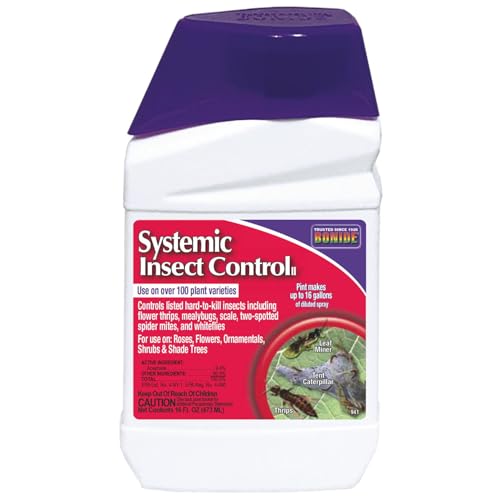
Moves through the plant’s tissue instead of sitting on the leaf, so insects feeding out of spray range still get hit.
When lanternflies are feeding inside a shrub where your sprayer cannot reach, a systemic absorbed into the tissue is the answer. This concentrate is absorbed into the plant, and the listed targets include thrips, mealybugs, scale, 2-spotted spider mites, and whiteflies — a lineup of insects that all hide in crevices and leaf joints. It is labeled for over 100 plant varieties, covering flower beds, roses, shrubs, and other listed ornamentals.
The application rhythm is spelled out plainly: apply to affected plants every 7 to 10 days as long as the infestation occurs. It is fast-acting, and it can be mixed with certain fungicides or fertilizers in a single combination spray, which saves you a second pass through the garden. For a large ornamental bed where the pest keeps returning, that repeat-and-combine approach is more efficient than chasing individual insects with a contact spray.
The catch here is real and worth hearing plainly. The odor draws heavy criticism — described consistently as a horrible smell, and that is the most-discussed drawback on this bottle. It is also intended for outdoor residential use only, and it is not labeled for vegetable or fruit plants, so do not carry it into the edible garden. Buyers still rate its effectiveness highly, but plan your application for a day you will not be sitting on the patio.
Works from the inside: a systemic gets to pests a spray cannot touch, which is why it is the tool for a stubborn, recurring infestation on ornamentals.
The smell is not a rumor: expect a strong odor during and after application, and keep the bottle out of the edible garden entirely.
Reach for this if: you are fighting a recurring infestation on roses, shrubs, or flower beds and need the product to travel through the plant.
Keep it away from: your vegetable patch and fruit trees — this label is not written for edible crops, and the odor lingers.
5. Hi-Yield (32029) 55% Malathion Spray, 32 oz
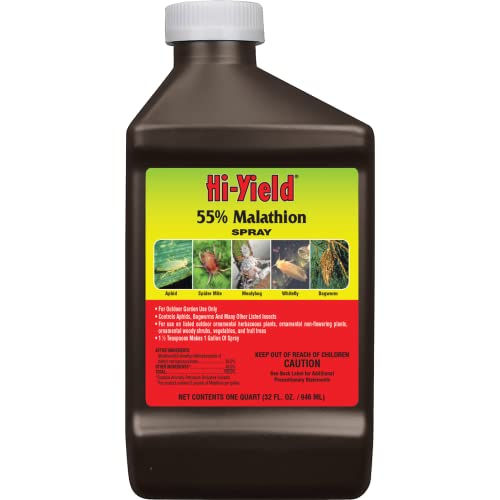
A 55% Malathion formula cleared for vegetables and fruit trees, which most tree-and-shrub sprays are not.
Most of the bottles on this list stop at ornamentals. This one goes where the others will not: herbaceous plants, ornamental non-flowering plants, shrubs, vegetables, and fruit trees all appear on the label. The active ingredient is 55% Malathion in a 32 oz bottle, and the listed targets run to aphids, thrips, spider mites, and lace bugs. At 2.5 pounds and 32 fl oz, it carries twice the liquid volume of the 16 fl oz Hi-Yield broad-use bottle.
Timing the pass matters more with this formula than with a systemic. The label instructs you to apply in calm weather when rain is not predicted for the next 24 hours — a wind-blown spray drifts, and rain inside that window washes the work away. Apply it with a hose-end or tank sprayer and follow the label rates. If you are spraying a fruit tree you plan to harvest, read the pre-harvest interval on the label before you pull the trigger.
This is an oil-based formula, so it behaves differently on foliage than a water-mix concentrate, and it is the heaviest bottle in the lineup. For a gardener whose lanternfly problem overlaps a vegetable plot or a small orchard, that extra weight buys you labeling the tree-and-shrub sprays simply do not have. For a pure lawn or ornamental job, the broad-use bottle covers the same ground more economically.
The edibles clause: vegetables and fruit trees on the label is the differentiator — this is the bottle to reach for when the pest is on something you plan to eat from.
Weather window required: calm air and 24 rain-free hours are conditions of use, not suggestions, so check the forecast before mixing.
The right bottle when: spotted lanternfly is hitting your fruit trees or vegetable rows and you need a formula labeled for edible crops.
Pass on it when: you are only treating turf and shrubs — the smaller broad-use concentrate covers that job with less weight in the sprayer.
Know the Specs
Concentrate vs. Ready-to-Spray
A concentrate is undiluted active ingredient you mix with water yourself. It costs less per treated area and lets you dial the strength, but you need a tank or hose-end sprayer and a measuring routine. A ready-to-spray bottle arrives pre-mixed with a hose connector, so setup is seconds — you trade that convenience for a fixed ratio and a shorter shelf life once opened.
Contact vs. Systemic Action
A contact insecticide kills only where the spray lands, so coverage and timing carry the whole result. A systemic is absorbed into plant tissue and reaches insects feeding inside the plant, including ones your wand never touches. Systemics are typically labeled for ornamentals rather than edible crops, so check that line before you buy if vegetables or fruit are in the plan.
Coverage Per Bottle
Broad-use labels often state a treated area, such as square feet per measured amount of concentrate. That figure, plus the bottle’s fluid volume, tells you how many passes you realistically get. A 32 fl oz bottle holds twice the liquid of a 16 fl oz one, so compare volume alongside the label rate rather than bottle size alone.
Target Species List
The label’s target list is the legal scope of what the product is cleared to control. If a pest is not on that list, the product is not labeled for it — regardless of what a forum post claims. Read the list before you buy, and treat the “see label for full list” note as an instruction rather than a formality.
Common Questions
Will any of these actually kill spotted lanternfly?
What is the difference between a contact spray and a systemic for lanternfly?
Can I use these on a fruit tree I plan to harvest from?
How long does the protection last after one spray pass?
Do I need a tank sprayer or will a hose-end sprayer work?
How much area does one bottle cover?
Is it safe to spray near bees and other pollinators?
Why do some reviews mention a strong smell?
Can I mix these insecticides with a fungicide or fertilizer?
The Bottom Line
For most yards, the insecticide for spotted lanternfly winner is the Hi-Yield (32009) Broad Use Insecticide because one 16 fl oz bottle treats up to 1,000 square feet per 1/2 ounce and works across trees, lawns, and garden vegetables. If you want the fastest application with no mixing, grab the BioAdvanced Tree & Shrub and hook it to your hose. And for a fruit tree or vegetable row where the pest has settled in, the Hi-Yield 55% Malathion is the labeled choice for edibles.
How we choose
We do not accept paid placement. Every pick is matched to a real buyer and a real use-case; we do not hands-on test units.
Sources
Specifications: manufacturer listings and product documentation. Review insights: verified customer reviews, as of November 2026. Pricing: not shown on this page (it changes often); check the current price via the retailer link.
As an Amazon Associate, My Heart Lives Here earns from qualifying purchases. This does not affect which products we feature.