Heads up: This post contains affiliate links. As an Amazon Associate I earn from qualifying purchases, at no extra cost to you. Learn more
Specs are compiled from manufacturer listings and verified buyer reviews and can change over time — please confirm the key details on the product page before buying.
Making i-cord by hand means hours of twisting four stitches on double-pointed needles, and your wrists feel every row. An i-cord knitting machine turns that same yarn into a neat, even tube with a crank or a motor instead — so you get bag handles, trims and ties without the hand fatigue. The trick is knowing which type actually feeds your yarn without tangling.
This guide is built by comparing the manufacturers’ published specifications and the patterns across verified customer reviews, so you get each pick’s real strengths and trade-offs instead of marketing spin.
The picks below split into two camps: motor-driven units that pull the yarn for you, and manual crank tools you feed by hand, and this guide to the i-cord knitting machine explains which camp suits your yarn and your hands.
Top Picks

How To Choose The Best I-Cord Knitting Machine
Three things decide whether a machine earns its shelf space in your craft room.
Power source: motor or crank
A motor-driven unit feeds and twists the yarn for you, while a manual crank tool relies on your hand turning a handle and guiding the yarn.
Needle count
More needles make a thicker, firmer cord — the 6-needle Caydo builds sturdier handles than a 4-needle version, at the cost of a bulkier cord.
Yarn tolerance
Check the maker’s stated yarn limits before you buy, because a machine that only likes certain yarns will tangle on a fuzzy or uneven skein.
Side-by-Side Comparison
| Model | Best For | Drive | Needles | Weight | Amazon |
|---|---|---|---|---|---|
| Caydo Electric F1★ Best Overall | Hands-free volume | Electric motor | — | 1.56 lb | Amazon |
| Etcokei iCord MachineBudget Auto-Knitter | Budget auto-knitting | Electric motor | — | — | Amazon |
| Caydo F1 Lite Handheld | Portable crafting | Manual | 4 | 1.1 lb | Amazon |
| Caydo F1 Lite 6-Needle | Thick, sturdy cords | Manual | 6 | 1.79 lb | Amazon |
| Tulip I-Cord Knitter | Precision finishing | Hand crank | — | 321 g | Amazon |
Detailed Reviews
1. Caydo Electric iCord Knitting Machine F1
Our pick — 4.0+★ from 250+ verified ratings; the strongest balance of quality and price.
The motorised one that knits the cord so your hands can rest.
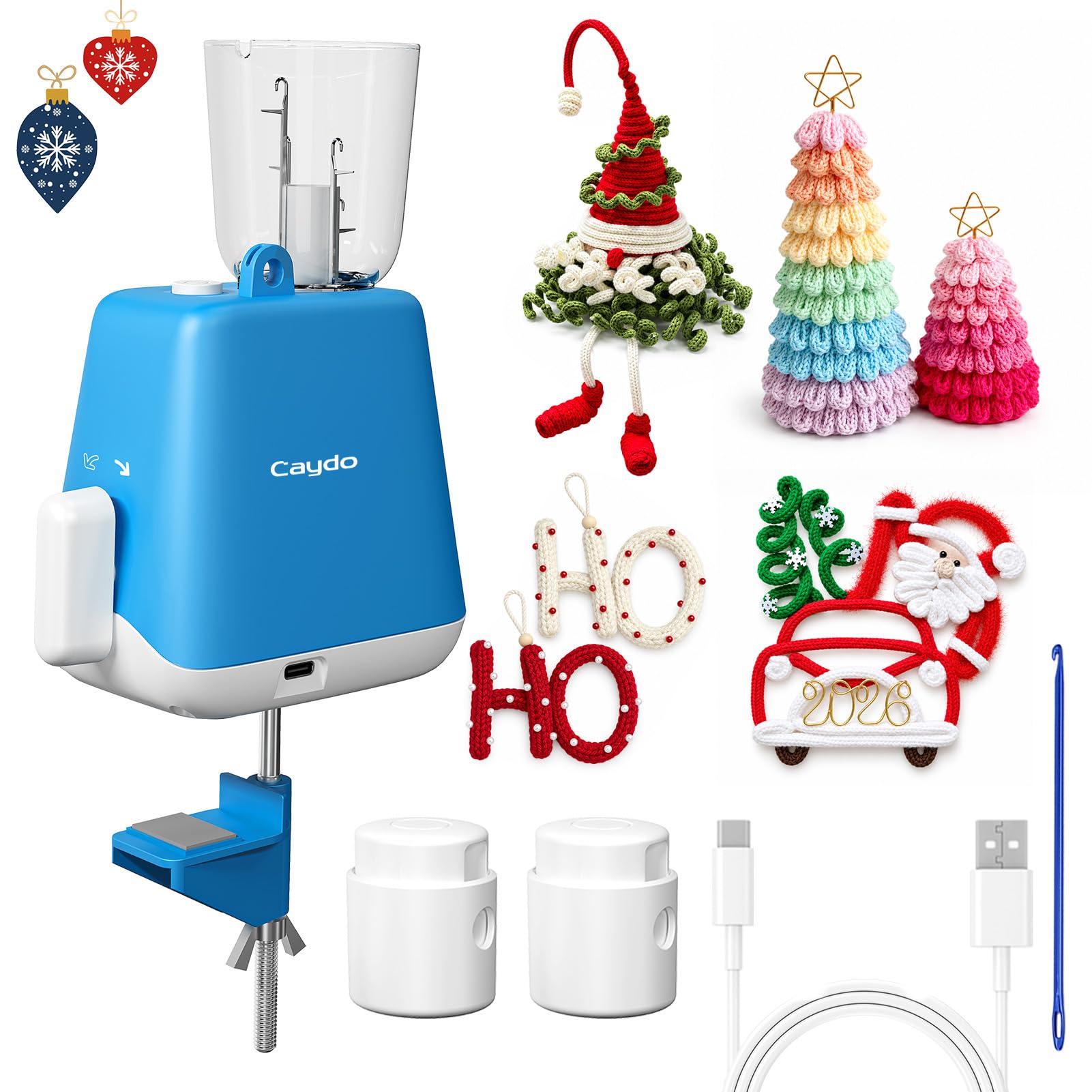
This is the pick that removes the twisting entirely. A custom motor pulls the yarn and forms the tube, and two supplied weights hold the yarn at steady tension so the cord comes out uniform instead of lumpy. At 8.85 x 7.59 x 3.22 inches it is a benchtop unit, and the 1.56-pound body is light enough to shift around the table.
What wins people over is simple function — the machine does the job it advertises, and newcomers are surprised how quickly the threading clicks. The honest catch: a fair share of owners hit tangling when the yarn is a brand the machine dislikes, so test a scrap length of your own skein before committing a full project.
The manual Caydo F1 Lite below is a fraction of this footprint, but this one trades portability for a motor that finishes longer cords in one sitting. For knitters turning out bag handles and trims in bulk, the two tension weights alone justify the step up.
Where It Wins
- Motor plus two tension weights produce even, compact cords
- Detailed manual and video walkthroughs get beginners threading fast
Where It Trips
- Picky about yarn — some standard brands tangle badly
Grab this if: you want cords made for you and your yarn is medium-weight and smooth.
Pass if: your stash is fuzzy novelty yarn, which fights the feed.
2. Etcokei iCord Knitting Machine
Press once and the cord starts growing — no handle to turn.
The Etcokei runs on a one-press automatic system, so the circular head rotates and feeds the yarn continuously without you cranking. Its ABS plastic shell keeps it light, and the included two weights steady the tension the same way the Caydo does. It comes with a one-year warranty.
What buyers trust most is reliability — the machine simply keeps working — and it earns plenty of fabulous little machine praise for winder duty. The trade-off is the learning curve: threading is either obvious or baffling depending on your yarn, and a few owners find the pace slower than they hoped.
Compared with the Caydo F1, this is the cheaper auto route with the same tension-weight idea, but it does not publish a needle count or a footprint figure, so check before you plan a tight table setup. Tangling shows up here too, tied to yarn choice.
The easy-access engine: one-button automatic rotation keeps cords coming without hand twisting, and the year of warranty softens the risk on a budget buy.
Reach for it when: you want hands-free cord-making without spending much.
Hold off if: you need a guaranteed-thin cord — this one’s yarn appetite is fussier.
3. Caydo F1 Lite iCord Handheld Knitter
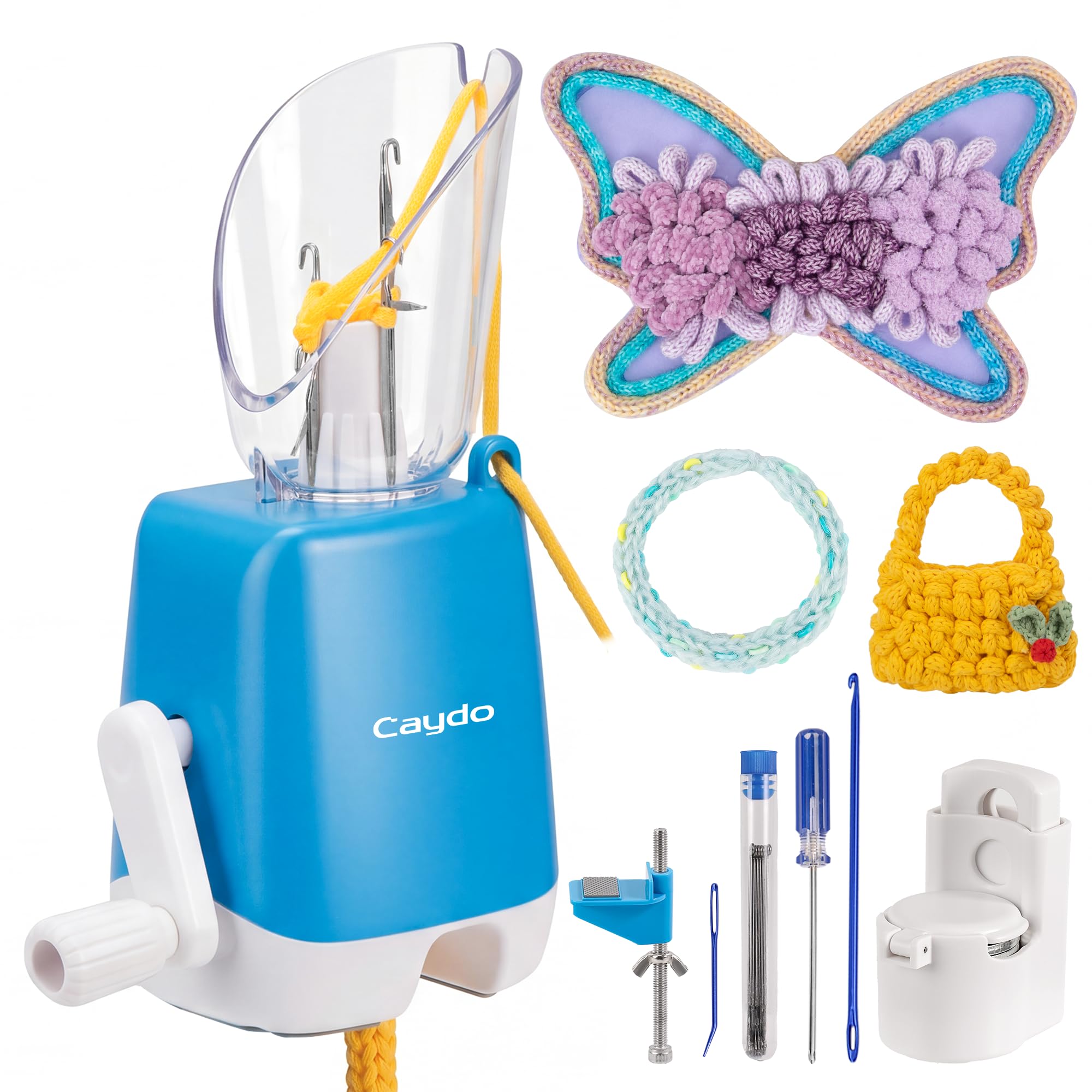
Toss it in a project bag and crank cords on the train.
The travel-friendly manual of the family: a 4-needle crank tool with a removable desk clip, so you can clamp it to a table for one-hand use or pop the clip off and work it anywhere. At 1.1 pounds the whole unit carries easily, and the beveled cover lets you watch the cord form as you turn.
The instructions include beaded i-cord guides, and the wider yarn range means thin thread up to thick yarns all feed through — something the more expensive Caydo F1 Lite iCord (the heavier 1.79-pound 6-needle version) does not claim in its listing.
Do check your yarn before you get going — some buyers report certain yarns simply refuse to knit well here, and the fit between tool and fiber is the deciding factor. Buy with yarn you can test, and it will crank happily.
Made for the knitter on the move: the portable 1.1-pound build plus clip-on clip-off design means you can craft in a coffee shop, a car seat, or a workshop.
Best for: crafters who want one lightweight tool that travels and handles several yarn thicknesses.
Not for: heavy cord production — a manual crank is slower than a motor.
4. Caydo F1 Lite 6-Needle iCord Knitting Machine
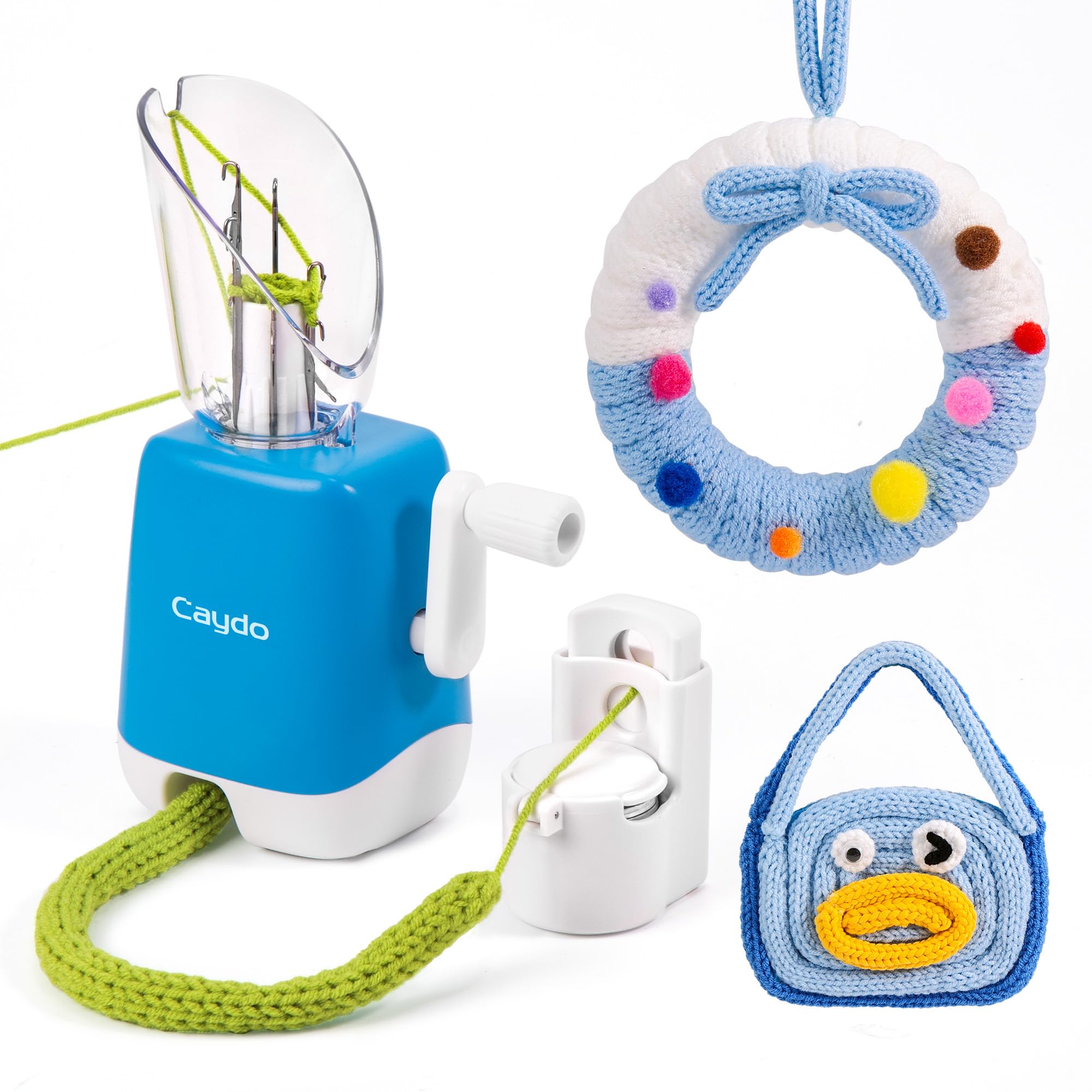
Two extra needles turn out cord with real body and weight.
That matters when your cord is structural: sturdy bag handles, name tags, coasters, doll limbs. The detachable clamp frees a hand, and the beveled cover lets you watch progress.
Its dimensions are the ones to know: 3.15 x 2.36 x 0.79 inches against the electric Caydo F1’s 8.85 x 7.59 x 3.22 inches — the 6-needle tool is a palm-sized device you can slip into a pocket. It weighs 1.79 pounds versus the 1.1 pounds of the 4-needle handheld, so it carries a bit more heft.
This pick has the thinnest review base of the group, so treat it as a niche tool rather than a crowd-tested one. Buy it specifically for the thicker cord, not as an all-rounder.
The big-cord advantage
- 6 needles build thicker, firmer cords for handles and tags
- Detachable clamp plus beveled cover for easy one-hand work
Before you commit
- Newer listing with less owner feedback to rely on
Choose it when: the cord needs to be thick enough to carry load or hold its shape.
Otherwise: the 4-needle handheld travels lighter for fine decorative cords.
5. Tulip I-Cord Knitter

A hand-cranked tool for fine work where precision beats speed.
Tulip’s version is the most hands-on of the group and the most careful. You rotate the handle clockwise until the first hook catches the yarn, slide the yarn behind the second looper with the crochet hook, and keep turning until the third looper catches it — a three-step rhythm that keeps the cord tight and even.
The build reads as a fabric-craft kit with mixed materials and comes in grey, with thread included. At 321 grams it is heavier than the 1.1-pound Caydo handheld and the dimensions run 11.02 x 5.91 x 3.54 inches, so it wants a bit more bench space than a pocket tool.
It is slower than any motorised option and expects your full attention on the handle, which is exactly why it suits lettering, accessories and interior decoration rather than bulk cord. Fine maker work, not volume.
Where the craft shows: the guided three-step feed keeps every loop consistent, and the mixed-material kit feel suits delicate decoration pieces rather than utility cords.
Picture it for: woolen letters and fine trims where the look matters more than the speed.
Think twice if: you want cords by the metre — hand-cranking one handle is slow going.
Know the Specs
Needle count
More needles mean more stitches per round, which builds a thicker, firmer cord — handy for bag handles, less so for delicate trims.
Tension weights
Two small weights hold the yarn steady as it feeds, so the cord stays even instead of bulging where the yarn sagged.
Common Questions
Will these machines handle any yarn I already have?
Do I still need a crochet hook with an i-cord machine?
Is a motorized machine faster than a manual crank?
Do these machines come with instructions for beginners?
Can I clamp the tool to my table for one-hand work?
How many needles do I need for a thick cord?
Is an i-cord machine a good gift for a knitter?
What happens if the yarn keeps tangling?
The Bottom Line
For most crafters the i-cord knitting machine worth choosing is the Caydo Electric F1, because its motor and two tension weights make even cords without your hands turning a handle. If you need cords with real thickness for handles, the Caydo 6-Needle is the one to reach for. And for travel and fine yarn work, the Caydo F1 Lite Handheld packs into a project bag and handles thin thread up to thick yarn.
How we choose
We do not accept paid placement. Every pick is matched to a real buyer and a real use-case; we do not hands-on test units.
Sources
Specifications: manufacturer listings and product documentation. Review insights: verified customer reviews, as of November 2026. Pricing: not shown on this page (it changes often); check the current price via the retailer link.
As an Amazon Associate, My Heart Lives Here earns from qualifying purchases. This does not affect which products we feature.