Heads up: This post contains affiliate links. As an Amazon Associate I earn from qualifying purchases, at no extra cost to you. Learn more
Specs are compiled from manufacturer listings and verified buyer reviews and can change over time — please confirm the key details on the product page before buying.
If your notes vanish the moment a meeting ends, the fix is a handheld recorder that captures clean audio and hands you a transcript. This shortlist covers the seven that actually earn their place — from featherweight AI note takers to 32-bit field recorders built for musicians.
This guide is built by comparing the manufacturers’ published specifications and the patterns across verified customer reviews, so you get each pick’s real strengths and trade-offs instead of marketing spin.
You will see where each one wins, where it makes you compromise, and which fits your pocket or your mic stand. Here is the honest shortlist of the best handheld recorder options for meetings, music, and everything between.
Top Picks


How To Choose The Best Handheld Recorder
Three things decide whether a recorder suits you, and none of them is the brand name on the box.
Recording Format
32-bit float (a format that keeps quiet and loud sounds usable in one take) saves you from ruined loud moments, while plain MP3 keeps files small and easy to share.
Inputs And Mics
Built-in stereo mics cover interviews and lectures, but XLR/TRS inputs let you plug in pro microphones and instruments.
Recording Time And Battery
Check the stated hours of recording and battery life together, because a long session on a short battery means carrying spares.
Side-by-Side Comparison
| Model | Best For | Format | Recording Time | Weight | Amazon |
|---|---|---|---|---|---|
| Plaud Note★ Best Overall | Meeting transcription | WAV | 30 hours | 30 g | Amazon |
| TASCAM DR-07XPBest Audio Quality | Music and video audio | WAV | 17 hours | 4.8 ounces | Amazon |
| Olympus WS-882 | Long lectures and dictation | MP3 | 1040 hours | 77 g | Amazon |
| Olympus WS-883 | All-day voice notes | MP3 | 124800 | 77 g | Amazon |
| Zoom H1 XLR | Filmmakers and podcasters | WAV | 18.5 hours | 6.4 ounces | Amazon |
| Plaud NotePin S | Wearable capture | MP3 | 1200 minutes | 17.28 g | Amazon |
| Zoom H4 Essential | Multi-track music | WAV | 10 hours | 243 g | Amazon |
Detailed Reviews
1. Plaud Note AI Voice Recorder
Our pick — 4.5+★ from 5,000+ verified ratings; the strongest balance of quality and price.
The note taker that turns a rambling meeting into a tidy summary.
At 0.12 inches thin and 1.06 oz, the Plaud Note disappears into a pocket or phone case, so you never leave it behind. It records up to 30 hours continuously and holds 64GB of audio locally, meaning a full week of meetings stays on the device with no internet needed.
The real draw is what happens after you stop talking: it captures 112 languages and converts them into transcripts and structured summaries through the Plaud app. What wins people over is the sheer usefulness in work settings, and the dual-mode switch handles both phone calls and in-person meetings.
credit card thin
- 30 hours of recording in a 1.06 oz body
- Transcribes and summarizes in 112 languages
subscription required
- Transcription beyond the free monthly allowance needs a paid plan
meeting notes: you sit in back-to-back meetings and want summaries without typing.
offline use: you want unlimited transcription without a subscription.
2. TASCAM DR-07XP
Adjustable stereo mics that shrug off a loud stage without clipping.
This is the musician’s recorder: its stereo condenser mics handle sources up to 125dB SPL (a measure of how loud a sound can get before it distorts), so a drum kit or amplifier stays clean. It records in 32-bit float, 24-bit or 16-bit at up to 96kHz, and doubles as a 2-in/2-out USB-C audio interface.
Storage is the standout — it takes microSD cards up to 512 GB, where the Olympus WS-882 settles for 4 GB of built-in memory. It runs about 17.5 hours on two AA batteries and weighs 4.8 ounces, which beats the 6.4-ounce Zoom H1 XLR on the scale. The controls split opinion, so budget a little time learning the menus.
field recording: podcasters and video shooters who want pro-grade files straight from the device.
studio work: no memory card in the box, so add one before your first session.
3. OM SYSTEM Olympus WS-882

A pocket dictaphone that keeps recording for weeks, not hours.
If you record lectures or long interviews, the numbers here are absurd in the best way. The WS-882 manages 1040 hours of maximum recording on its 4GB internal memory — where the TASCAM DR-07XP manages 17 hours. Its 68-hour battery life also dwarfs the Zoom H1 XLR’s 10 hours, so a week of classes fits in a single charge cycle.
USB Direct means you plug the recorder itself into a laptop with no cable hunting. Sound quality picks up even quiet voices, and owners describe it as simple to use. The honest catch is the screen: there is no backlight, so recording in a dim hall means squinting.
lecture capture: you want set-and-forget voice capture for study or work notes.
music takes: you need a lit display or studio-grade audio files.
4. Olympus WS-883

Doubles the storage of its sibling and adds true stereo mics.
The WS-883 takes the WS-882 formula and doubles the memory to 8GB and the maximum recording time to 2080 hours. Two true stereo microphones give your voice notes a sense of direction, and a low-cut filter trims room rumble so speech sits clearer.
Battery life is the headline: 68 hours, which towers over the Zoom H1 XLR’s 10 hours. Owners describe recordings as superb and the audio as crisp, and the rechargeable battery in this unit is a plus. A recurring gripe is that the menu interface ships in Japanese, so check that before you buy.
interview notes: you want a rechargeable, long-running dictaphone with stereo capture.
loud rooms: the menu language, which some buyers find hard to navigate.
5. Zoom H1 XLR

Two XLR inputs in a body that fits in a jacket pocket.
For interview and podcast work, the H1 XLR gives you two locking XLR/TRS combo inputs, so pro microphones and instruments plug straight in. It records in 32-bit float at up to 96kHz, and an OLED waveform display (a live visual graph of your audio levels) shows you at a glance whether the take is clean.
The 3.5mm input and headphone output cover monitoring and external devices. Storage reaches 1TB via SDXC, and the recorder weighs 6.4 ounces — heavier than the 4.8-ounce TASCAM DR-07XP, but still pocketable. Battery life is the weak spot: 10 hours, and it has a mixed reputation for draining quickly.
XLR input pair: filmmakers and podcasters who already own XLR mics and want a compact front end.
no built-in mics: carry spare batteries, because 10 hours goes quickly on a shoot day.
6. Plaud NotePin S
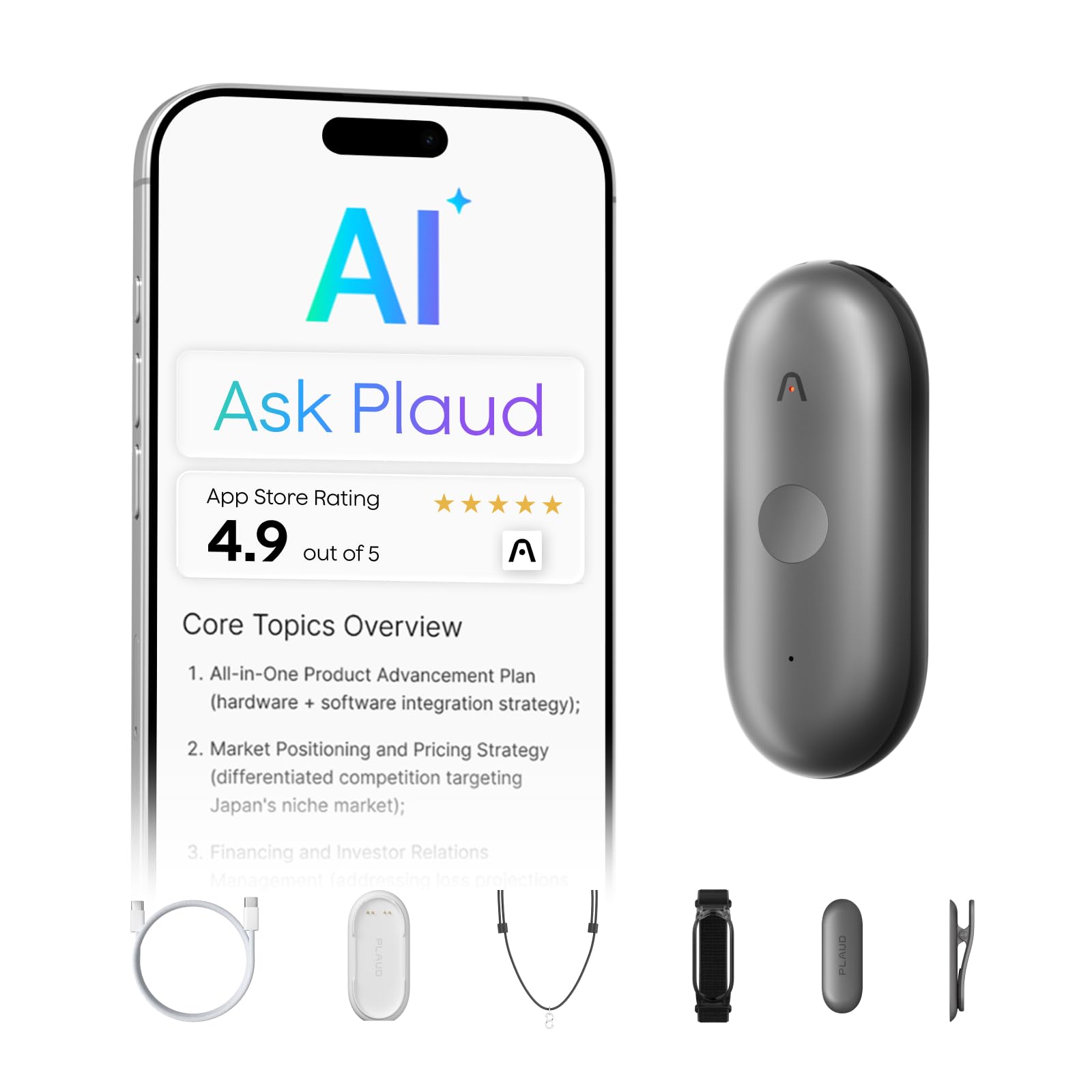
Clip it on and forget it, then read the summary later.
Wear the NotePin S as a clip, pin, necklace or wristband, and it picks up voices clearly from up to 3 meters away. Apple Find My helps you locate it when it goes missing.
Its AI turns conversations into summaries with key decisions and next steps, and even drafts emails and reports. What people rave about is the sheer usefulness in business settings. The honest caveat is that the app and functionality split opinion, so give yourself a trial period to confirm it fits your workflow.
all-day wear: professionals who move between rooms and want hands-free capture.
high fidelity: you prefer a screen you can read at a glance.
7. Zoom H4 Essential

Four tracks of 32-bit audio for anyone recording a full band.
The H4 Essential records four tracks, so you can capture layered performances without worrying about a distorted take. It combines built-in stereo mics with two XLR/TRS inputs, then saves audio both to SD card and to your phone or computer over USB-C.
Spoken menu guidance makes it easier to navigate, and owners say it beats the older H4N on simplicity. Sound quality handles tiny dialogue and loud performances alike. The trade-off is battery life, which draws mixed feedback and will not stretch a long festival day.
four-track recording: multi-track recording with pro-level 32-bit float audio.
bulky footprint: a shorter runtime than the Olympus dictaphones, so carry backups.
Know the Specs
32-Bit Float
This format keeps very quiet and very loud sounds usable in a single take, so you spend less time re-recording after a sudden noise.
XLR Inputs
XLR and TRS jacks let you connect pro microphones and instruments instead of relying on the built-in mics.
Common Questions
Is 32-bit float better than standard 24-bit recording?
Can I use a handheld recorder for phone calls?
Do these recorders include a memory card?
The Bottom Line
For most buyers the winner is the Plaud Note, because 30 hours of recording and AI summaries in a 1.06 oz body cover meetings without extra effort — the crowd favorite at 4.5+ stars across 5,000+ owners. If you record music or want pro audio, grab the TASCAM DR-07XP for its 32-bit float and 512 GB card support. And for plain long-form voice notes, the Olympus WS-882 and its 1040 hours of recording are hard to argue with.
How we choose
We do not accept paid placement. Every pick is matched to a real buyer and a real use-case; we do not hands-on test units.
Sources
Specifications: manufacturer listings and product documentation. Review insights: verified customer reviews, as of November 2026. Pricing: not shown on this page (it changes often); check the current price via the retailer link.
As an Amazon Associate, My Heart Lives Here earns from qualifying purchases. This does not affect which products we feature.