Heads up: This post contains affiliate links. As an Amazon Associate I earn from qualifying purchases, at no extra cost to you. Learn more
Specs are compiled from manufacturer listings and verified buyer reviews and can change over time — please confirm the key details on the product page before buying.
Skin glue has one job, and it is harder than it sounds: hold a dressing, tape, sensor, or appliance in place through sweat, showering, and a full day of movement. The five products below cover very different jobs, from a spray-on liquid bandage for small cuts to a silicone adhesive built for ostomy wafers. Your first decision is not which one is “best” — it is what you are sticking to your skin, and for how long.
This guide is built by comparing the manufacturers’ published specifications and the patterns across verified customer reviews, so you get each pick’s real strengths and trade-offs instead of marketing spin.
Some of these formulas are meant to seal a nick on a finger, others to anchor medical gear for days at a stretch, so matching the formula to the job matters more than brand loyalty. Here is how to pick the right glue for skin without guessing.
Top Picks


How To Choose The Best Glue for Skin
Two bottles that both read “liquid adhesive” can behave nothing alike. One seals a cut into a flexible film; the other is a tack agent that makes tape grip harder and hold longer. Getting that wrong is the most common way people end up frustrated — and the most common reason a dressing peels off by lunch.
Match the formula to the job before anything else
A cyanoacrylate adhesive (the same family as super glue, formulated for tissue) bonds skin edges together so a small cut closes and stays closed. A silicone adhesive, by contrast, is a skin-friendly tack layer that sits under a dressing or appliance so it grips without soaking in. Neither one replaces the other, so decide which problem you have first.
Watch the cure time, not just the claims
“Full cure time” is how long the adhesive needs to reach its final grip. A formula listing a full cure time of 24 hours behaves very differently from one listed at 0.08 days, so plan your first application around that number rather than assuming it is instant.
Think about moisture and sweat
Sweat and showering are what kill most tape jobs. A non-water soluble formula resists that moisture far better than a water-based one, which is why it shows up so often in hospital and long-wear settings. If your adhesive will sit under a dressing for days, prioritize this over everything else.
Side-by-Side Comparison
| Model | Best For | Item Form | Full Cure Time | Container | Amazon |
|---|---|---|---|---|---|
| New-Skin Liquid Bandage Spray (2-Pack)★ Best Overall | Small cuts on the go | Liquid (spray) | — | Bottle | Amazon |
| Mastisol Medical Liquid Adhesive (4 Vials)Best for Single Use | Single-use dressing securement | Liquid | — | Single-use vials | Amazon |
| Liquid Medical Adhesive (Long-Lasting, CHG-Compatible) | Extended-wear dressings and devices | Liquid | 24 hours | Bottle | Amazon |
| 3M Vetbond Tissue Adhesive | Fast wound closure | Liquid | 0.08 days | Bottle | Amazon |
| Skinister Medical Adhesive Spray | Ostomy supplies and prosthetics | Spray | 1 minute | Bottle | Amazon |
Detailed Reviews
1. New-Skin Liquid Bandage Spray, 1 Ounce (Pack of 2)
Our pick — 4.5+★ from 600+ verified ratings; the strongest balance of quality and price.
A spray that lays a sealing film over a nick in seconds, no touching required.
Reaching for a bandage when your hand is wet, dirty, or covered in garden soil is the exact moment this pick earns its place. It is a sterile liquid bandage in spray form, so you coat the small cut and let the film form rather than pressing a pad onto an open wound. That spray format is the whole appeal: no cotton ball, no contact, no fuss.
What wins people over is how well it holds a wound shut on knuckles and fingers, the places ordinary bandages slide off first. The two-bottle pack means you can leave one in a bag and one at home, and the liquid form keeps working where a soft pad would soak through. The crowd verdict sits at 4.5+ stars across 600+ ratings, which is a strong signal for a wound-care item people repurchase.
The honest limit: this is a liquid bandage for small, minor cuts, not a substitute for stitches or medical care, and it seals rather than cushions. It also stings on open skin — a normal trade-off for a formula that has to bond. If you need something to hold a dressing or sensor under motion, this is the wrong tool; the silicone and vial adhesives below are built for that job.
Where it pulls ahead
- Spray format seals a cut without touching it, handy when your hands are dirty.
- Sterile liquid bandage suited to small cuts on fingers and knuckles.
- Two-pack means one bottle lives in your bag and one at home.
What to keep in mind
- Stings briefly on open skin before the film sets.
- Built to seal minor cuts, not to anchor dressings or devices.
Reach for this if: you want a quick, sterile seal over a small nick on your hands or feet.
Keep looking if: your goal is keeping tape, a sensor, or a dressing fixed in place — that is a different formula entirely.
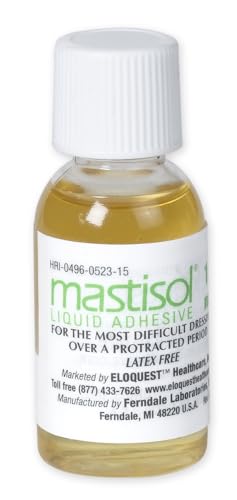
2. Mastisol Medical Liquid Adhesive, 2/3 mL Vials (Four Vials)
Four sealed vials of tack agent, so nothing in the bottle goes stale between dressing changes.
If you change a dressing or appliance regularly, the vial format is the quiet advantage here. Four single-use 2/3 mL vials let you open exactly what you need and keep the rest sealed, which means no half-used bottle drying out in a drawer. The whole kit weighs 0.32 ounces — compare that to the 1 ounce New-Skin two-pack and you are looking at a far smaller footprint to tuck into a medical bag.
This is a tack agent, not a wound sealer. You paint a thin layer on skin and let it turn slightly tacky so tape, dressings, and devices bite harder and hold longer. The clear liquid is a real plus for anyone self-conscious about visible residue under a dressing, because it does not stain. It also stays put on damp skin, where ordinary tape lifts.
Buyers report mixed results, and the gap depends on technique. Some say it grips hard; others say it doesn’t stick well. The difference is usually applying too much and not letting it dry to tack (slightly sticky) first. A minority also mention mild irritation, so patch-test a small area if your skin is reactive. Used correctly and sparingly, it is among the most efficient tack products in this lineup.
How it actually behaves: a thin, clear film you let dry until it feels slightly sticky, then press your tape or dressing down. Too heavy a coat is what makes it feel like it failed.
Worth choosing when: you want tamper-clean single doses and a clear film that won’t stain skin or fabric.
Think twice if: you prefer one bottle you can dip into repeatedly rather than opening a fresh vial each time.
3. Liquid Medical Adhesive
Built for the sweaty, moist spots where ordinary tape gives up first.
Consider where your dressing sits: under a breast, near a stoma, along a waistband, anywhere sweat collects. This formula is engineered for exactly those high-moisture areas, because it is non-water soluble — meaning water and sweat do not dissolve the bond. That single trait is why it holds dressings, tapes, and small medical devices in place for extended wear when a standard adhesive would lift at the edges.
The bottle format is the practical counterpoint to the vials above: one container you draw from, so it suits a routine where you are prepping skin several times a week. It is listed as CHG-compatible, which matters if you are prepping around a chlorhexidine-based skin antiseptic, and it is latex-free. The manufacturer lists a full cure time of 24 hours, so this is not a quick-touch-and-go product — plan your change schedule around that.
The catch: a long cure window means the first hours are not the final grip, so pressing a dressing on and immediately expecting it to survive a shower is a mistake. It also takes a light hand; a heavy layer stays tacky and grabs lint. When you respect both, it is the steadiest option here for a dressing that needs to stay put through several days of real life.
The moisture advantage: non-water soluble is the spec that matters most here, because sweat and bathing are what break down most skin bonds.
One honest caution: the 24-hour full cure time is the number to respect — build it into your dressing schedule rather than fighting it.
Best fit for: anyone whose dressing sits in a high-moisture spot and needs to survive sweat and showering.
Not for you if: you wanted something that reaches full grip almost instantly — the cure time rules that out.
4. 3M Vetbond Tissue Adhesive, 3ml Bottle, 1469SB

A tissue adhesive that sets fast, so a small cut closes before you have time to fuss.
The number that defines this bottle is its listed full cure time of 0.08 days — a close, quick set compared to the 24-hour cure of the extended-wear liquid above. It is a cyanoacrylate tissue adhesive, the class of glue that bonds skin edges together into a flexible film. For a minor cut on a hand, arm, or leg, that means the wound is sealed and closed rather than padded and taped.
Owners lean on it hard for wound closure: reviewers describe a hold that lasts up to a week longer than other tissue adhesives, and a little goes a long way from a single 3ml bottle. It is a staple in first aid kits for that reason — one bottle is listed at just 9.07 g, so it disappears into a kit or a travel pouch. The reusable applicator tips are the detail that keeps it tidy, letting you place a thin line instead of a blob. Effectiveness and overall quality are the two things people praise most about it.
Where it falls short of the extended-wear liquid is moisture: this is a wound-closure bond, not a dressing anchor, so it is the wrong pick if your goal is holding an appliance through sweat. A few users do find the bottle on the expensive side for its size, though most come back to the 3ml stretching across many cuts.
Why it earns a kit slot
- Fast set — a listed full cure time of 0.08 days.
- 3ml bottle at 9.07 g slips into any first aid pouch.
- Reusable applicator tips let you lay a thin, precise line.
- Cyanoacrylate formula bonds skin edges into a flexible film.
The fine print
- Built for wound closure, not for anchoring dressings or devices.
- Some find the bottle pricey for its 3ml size.
Your pick if: you want a fast-setting tissue bond for minor cuts and a bottle that fits in a pocket.
Look elsewhere if: you need an adhesive that grips under a long-wear dressing — moisture is not this formula’s job.
5. Skinister Medical Adhesive Spray — Silicone Skin Glue
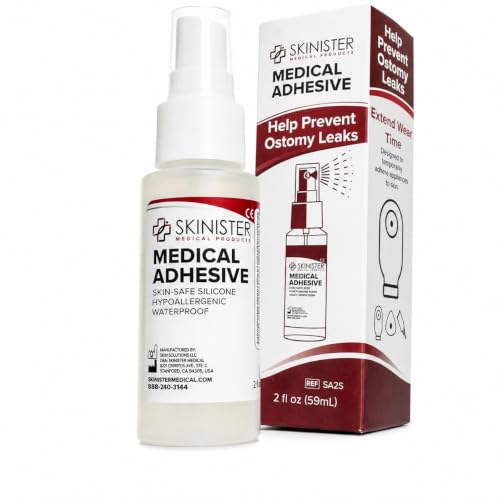
A silicone spray that anchors an ostomy wafer or breast form, then lets go without a fight.
Different job, different formula. This is a silicone-based skin glue in spray form, built to hold ostomy bags, barriers, and wafers, plus breast forms, condom catheters, tapes, bandages, prosthetics, and wig lace. It is listed with a full cure time of just 1 minute, so you spray, give it a moment, and apply — much faster than the 24-hour liquid above. The maker lists it as up to 50% stronger when sprayed on both the skin and the appliance.
The standout trait is what it does for skin under a device: the odor-free silicone barrier shields skin from stoma output, sparing ostomy users a separate barrier step. It resists moisture, so showering, swimming, and sweating do not loosen the wafer. There is also a practical travel detail — the 1oz and 2oz bottles are listed as airline approved. And because it is silicone rather than cyanoacrylate, it holds with a gentler release, which is exactly what you want under a daily-wear appliance.
The catch is that silicone does not bond skin edges the way the tissue adhesive above does, so do not buy this for closing a cut. It is built to hold medical gear and prosthetics, which is overkill for anchoring a bandage. If an ostomy barrier or a breast form is your daily reality, this is the most specialized tool in the lineup, and it is made by a licensed medical device manufacturer.
Where it shines: a 1-minute cure and a moisture-resistant silicone bond make it the fastest way to re-secure an ostomy wafer or breast form.
Trade-off to weigh: it is a holding adhesive, not a wound closer — buy it for gear, not for cuts.
Made for: ostomy users and prosthetic or breast-form wearers who want a spray that cures in a minute and shrugs off moisture.
skip it if: your need is sealing a small cut — that calls for a tissue adhesive, not a silicone hold.
Know the Specs
Item form: liquid versus spray
Liquid adhesives let you place a precise amount with an applicator tip or swab, which suits wound closure and tacking dressings. Sprays cover an area evenly in one pass, which suits an ostomy wafer or a breast form where you need consistent coverage. Neither is better — match the form to how you apply it.
Full cure time
This is how long the adhesive needs to reach its final grip. A listed cure time of 0.08 days sets fast, while 24 hours is a slow build you plan around. Read this number before your first use so your expectations match reality on day one.
Non-water soluble
A non-water soluble formula resists sweat and water rather than dissolving in them. That makes it the right choice for a dressing or device that must survive showering and a sweaty day, and the reason it shows up in long-wear medical settings.
Cyanoacrylate versus silicone
Cyanoacrylate bonds skin edges into a flexible film, so it closes a small cut. Silicone acts as a tack layer that grips a device or dressing to skin and releases more gently. Choosing between them is really choosing between closing a wound and holding gear.
Common Questions
Is liquid bandage the same as medical skin glue?
Can I use Mastisol on sweaty skin?
How long does a skin adhesive take to fully cure?
Is silicone skin glue safe for ostomy supplies?
Will these adhesives work under a dressing in high-moisture areas?
How long does a 3ml bottle of tissue adhesive last?
Are these skin glues latex-free?
Can I use a medical adhesive spray for a breast form or prosthetic?
Do these adhesives travel well on a plane?
The Bottom Line
To seal a small cut on your hands without touching the wound, the New-Skin Liquid Bandage Spray is the clear winner — a sterile spray in a two-pack, so one lives in a bag and one in a drawer. If your dressing sits in a high-moisture spot and must survive sweat, the Liquid Medical Adhesive is the steadiest. For a fast-setting tissue bond in a pocket-sized bottle, grab the 3M Vetbond. And if an ostomy wafer (the adhesive patch that holds a pouch to your skin) or breast form is your daily reality, the Skinister silicone spray is the one to reach for. One honest nudge: match the formula to the job before you buy, because a tack agent will never close a cut and a tissue adhesive will never anchor a wafer.
How we choose
We do not accept paid placement. Every pick is matched to a real buyer and a real use-case; we do not hands-on test units.
Sources
Specifications: manufacturer listings and product documentation. Review insights: verified customer reviews, as of November 2026. Pricing: not shown on this page (it changes often); check the current price via the retailer link.
As an Amazon Associate, My Heart Lives Here earns from qualifying purchases. This does not affect which products we feature.