Heads up: This post contains affiliate links. As an Amazon Associate I earn from qualifying purchases, at no extra cost to you. Learn more
Specs are compiled from manufacturer listings and verified buyer reviews and can change over time — please confirm the key details on the product page before buying.
Your model is only as good as the join holding it together. The wrong glue leaves a milky white smear across a canopy or lets a wing seam split a week after the show. This shortlist covers the cements that melt the plastic and fuse it properly, plus one fast cyanoacrylate for mixed materials, so you can pick the right bottle for the job in a minute.
This guide is built by comparing the manufacturers’ published specifications and the patterns across verified customer reviews, so you get each pick’s real strengths and trade-offs instead of marketing spin.
Below are the five bottles and kits worth your bench time, sorted by what each one does best. glue for plastic models works best when you match the bottle to the material, not to the price tag.
Top Picks
How To Choose Glue for Plastic Models
Start with the material: a solvent cement fuses polystyrene kit plastic, while a cyanoacrylate (CA) super glue bridges resin, metal, and mixed parts.
Match the cure speed to the job
A 10-second bond locks a fiddly sub-assembly in place, while a slower 3-hour full cure gives you time to nudge a fuselage half into alignment.
Check the thickness before you buy
A low-viscosity (thin) cement flows into seams by capillary action, while a medium-viscosity (syrup-like) glue stays put on larger contact points.
Plan for clear and painted parts
Ordinary solvent cement fogs a transparent canopy, so a clear-drying formula is the one to reach for when glass or painted surfaces are in play.
Side-by-Side Comparison
| Model | Best For | Format | Full Cure | Type | Amazon |
|---|---|---|---|---|---|
| Tamiya 87012 Plastic Cement 3pc★ Best Overall | All-round kit building | 3 × 20ml tubes | 3 hours | Solvent cement | Amazon |
| CAMALEAO Medium Super CA Glue KitFastest Bond | Mixed materials and 3D prints | 2 bottles, 4.6 oz | 30 seconds | Cyanoacrylate | Amazon |
| TAMIYA 87038 Extra Thin 2 Pack | Hair-thin seams | 2 × 40ml bottles | 10 seconds | Solvent cement | Amazon |
| Tamiya 87188 Multipurpose Cement | Clear and painted parts | 1 tube | 24 hours | Clear cement | Amazon |
| The Army Painter Hobby Tool Kit | Starter tool bundle | Box with 5g super glue | — | Kit + CA glue | Amazon |
Detailed Reviews
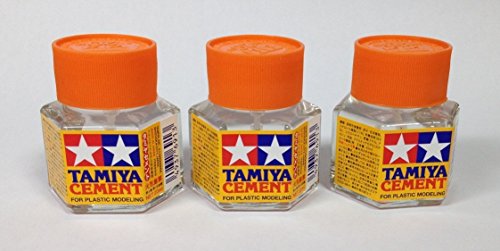
1. Tamiya 87012 Plastic Cement 20ml 3pcs Set [Japan Import]
Our pick — 4.5+★ from 450+ verified ratings; the strongest balance of quality and price.
Three tubes of the solvent cement that fuses kit plastic into one piece.
This is the steady everyday cement for anyone who builds standard polystyrene kits. It comes as a 3-pack of 20ml tubes, so you get spare bottles for the shelf instead of hunting for a refill mid-build. The full cure runs 3 hours — long enough to slide a fuselage half into alignment before it locks — and the solvent-evaporation method actually melts the surfaces together rather than sitting between them.
The catch is the packaging: the retail box and manual are Japanese-only, so the instructions are not written for an English reader.
Where it earns its place
- Three 20ml tubes mean a spare always on hand
- Slow 3-hour cure forgives small alignment mistakes
Worth knowing first
- Japanese-market packaging with Japanese-only instructions
The safe default: a good fit for the builder who wants a dependable main cement and spare bottles.
Look elsewhere if: you want English instructions in the box or need a fast-locking bond.
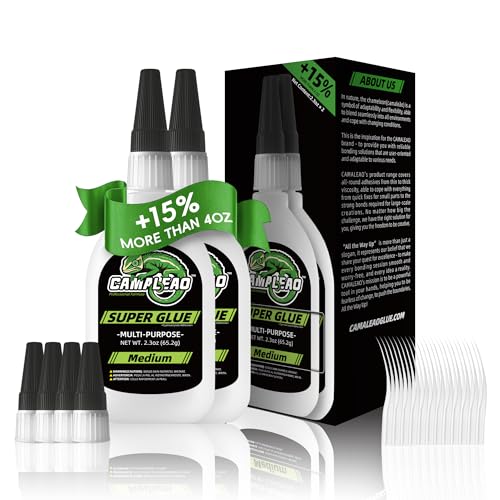
2. Medium Super CA Glue Kit 4.6 oz
When the kit is resin or metal, this is the bottle that grabs in half a minute.
A cyanoacrylate is not a plastic-melting solvent, and that is the point here: it bridges ceramic, metal, plastic, wood, and 3D-printed parts instead of relying on one plastic type. The medium-viscosity formula sits between runny and thick, at a syrup-like feel, so it stays where you put it on a larger contact patch. The 30-second full cure is three times quicker than the Tamiya 87012’s 3-hour cure, which matters when you are holding two parts together by hand. It works well on 3D-printed plastics, and the built-in steel pin in the cap keeps the nozzle from clogging between sessions.
What wins people over is the overall quality and the fast, no-run application, helped by the extra spouts and straws in the kit.
The honest limit: 30 seconds is unforgiving — once the parts touch, repositioning is over.
Reach for this if: you glue resin, metal, or printed parts and want a bond that sets almost instantly.
Think twice if: you like to slide a seam into place slowly before it grabs.
3. TAMIYA 87038 Extra Thin Cement Glue 2 Pack

The extra-thin cement that wicks into a pressed seam and locks it in ten seconds.
Two 40ml bottles of an acrylic-based solvent cement, and the thinness is the whole story: you press the parts together, touch the fine tip to the joint, and the liquid runs in by capillary action. Ten seconds and the bond is set — the quickest solvent cure here, ahead of the 30-second CAMALEAO and far ahead of the 3-hour Tamiya 87012. For landing gear, cockpit frames, and tight little gaps where a thicker cement would smear, this is the tool.
The trade-off is real: the bottles feel fragile, and the thinness that makes it flow also means loose lids and the odd delivery arriving broken. Seal it properly between builds.
Built for speed: a 10-second cure and a fine tip for precision seams on plastic kits.
Handle with care: the thin formula evaporates quickly and the lids need to be screwed down firmly.
Best for: the detail builder doing hairline seams who wants a nearly instant, invisible join.
Not for: anyone who wants one grab-and-go bottle with a rugged, spill-proof cap.
4. Tamiya 87188 Multipurpose Cement (Clear)

The clear-drying cement for canopies, plating, and anything already painted.
Clear parts and finished surfaces are where ordinary solvent cement does damage, and this formula is built to avoid it. It dries transparent, so a windscreen or a chrome bumper keeps its finish, and the low viscosity means minimal stringing as you draw it along a joint. It is gentle on painted surfaces. One tube means you are not stocking spares, and the 24-hour full cure is a slow, patient process — far slower than the 3-hour Tamiya 87012, so plan to leave the part alone overnight.
Where it fits: the niche job of clear and plated parts, and a painted surface you refuse to ruin.
Pick this one if: you are gluing a canopy, clear lens, or painted trim and want the join to stay invisible.
Skip the splurge if: you need a fast build — the 24-hour cure demands patience.
5. The Army Painter Hobby Tool Kit
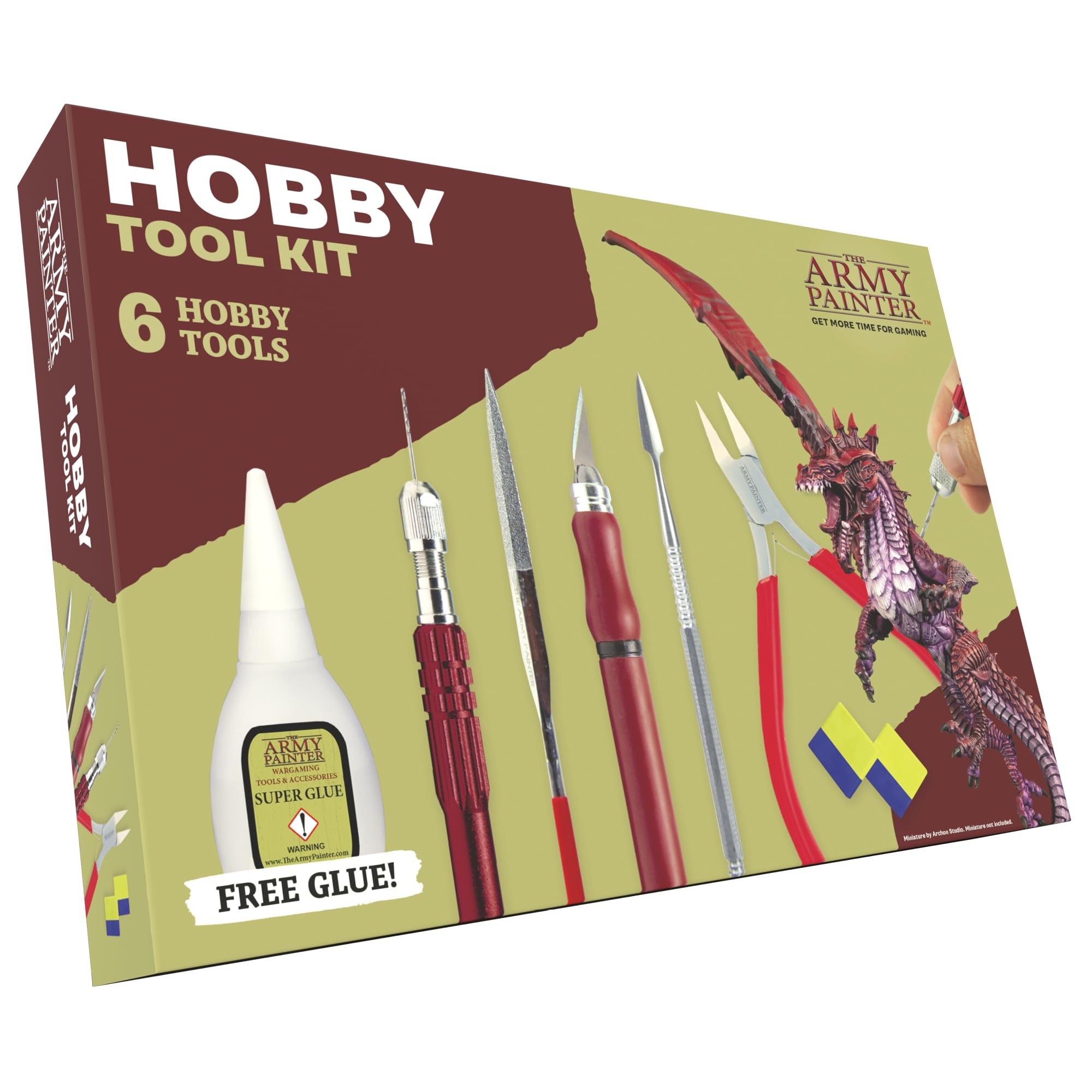
A whole bench in one box — though the glue inside is the weakest part.
This is less a bottle of glue and more a starting point for someone with no tools at all. The box holds a hobby file, knife, side cutter, a hand drill with 3 drill bits, a sculpting tool, 2 pieces of Green Stuff epoxy putty, and a 5g tube of super glue, plus a safety guide and a painting guide. The glue works with plastic, resin, and metal miniatures. It is a great starter set that covers cutting, cleaning, drilling, gap-filling, and gluing in one purchase.
Buy it for the tools, not the glue — the tube inside has a reputation for arriving dried up, hardened, or empty, and the cutters divide opinion on sharpness. Treat the 5g glue as a spare and keep a proper cement on the bench.
Reach for this if: you are brand new to miniature wargaming and want every essential tool in one box.
Look elsewhere if: glue is your main need — buy a dedicated cement and skip the bundle.
Know the Specs
Viscosity (Thin vs Medium)
Viscosity is how readily the liquid flows: thin cement wicks into a pressed seam by capillary action, while medium, syrup-like glue stays put on a wider contact patch.
Full Cure Time
Full cure time is how long before the bond reaches full strength — 10 seconds to 24 hours across these picks — so a fast cure demands steady hands and a slow cure rewards patience.
Common Questions
Will solvent cement work on resin or metal miniatures?
Why does my canopy turn foggy after gluing?
How long should I leave a joint before handling the model?
The Bottom Line
For most kit builders the Tamiya 87012 Plastic Cement 3-tube set is the one to buy — a proven all-rounder with spare bottles in the box. If you mostly glue hairline seams, the extra-thin TAMIYA 87038 is the faster, finer choice. And when clear or painted parts are on the bench, reach for the Tamiya 87188.
How we choose
We do not accept paid placement. Every pick is matched to a real buyer and a real use-case; we do not hands-on test units.
Sources
Specifications: manufacturer listings and product documentation. Review insights: verified customer reviews, as of November 2026. Pricing: not shown on this page (it changes often); check the current price via the retailer link.
As an Amazon Associate, My Heart Lives Here earns from qualifying purchases. This does not affect which products we feature.