Heads up: This post contains affiliate links. As an Amazon Associate I earn from qualifying purchases, at no extra cost to you. Learn more
Specs are compiled from manufacturer listings and verified buyer reviews and can change over time — please confirm the key details on the product page before buying.
You want cork to stay flat and stay stuck — on a coaster, a noticeboard, a tabletop, a speaker baffle. The trick is matching the adhesive to the job: cork is porous and spongy, so a glue that soaks in and dries brittle will lift at the edges, while a contact cement that bonds on touch will hold where nothing else will.
This guide is built by comparing the manufacturers’ published specifications and the patterns across verified customer reviews, so you get each pick’s real strengths and trade-offs instead of marketing spin.
The short version: Aleene’s Original Tacky Glue is the safest general-purpose choice for craft cork, but the right pick changes once you need waterproofing or an instant clamp-free bond. Below you’ll find the glue for cork that matches your project, from tacky craft bottles to solvent contact cement.
Top Picks
How To Choose The Best Glue for Cork
Three things decide whether your cork stays down or curls up at the corners.
Adhesive family
A water-based PVA craft glue like Aleene’s Tacky Glue is the gentle choice for paper, felt and thin craft cork, while a neoprene contact cement is the pick for cork floor tiles, headliners and anything that must bond on contact.
Open time and cure time
Contact cement gives you a window to position the cork before it grabs — DAP lists a 2-hour open time and a 2.5-hour full cure, while S-18 needs a full 24 hours to cure.
Water and heat exposure
If the cork sits under a drink, near a window or on a car headliner, choose a formula advertised as water resistant rather than a craft PVA that softens when wet.
Side-by-Side Comparison
| Model | Best For | Type | Full Cure | Size | Amazon |
|---|---|---|---|---|---|
| Aleene’s Original Tacky Glue 16 fl oz 3-Pack★ Best Overall | Craft cork and paper | PVA craft glue | — | 16 fl oz × 3 | Amazon |
| RH Adhesives S-18 All-Purpose AdhesiveBest for Headliners | Headliners and upholstery | Neoprene, water resistant | 24 hours | 4 oz | Amazon |
| Arroyner 110 Pack Self Adhesive Cork Squares | Coasters and DIY crafts | Pre-glued cork | — | 4 x 4 in, 110 pcs | Amazon |
| Weldbond Multi-Surface Glue | Mosaic and mixed media | PVA, non-toxic | 20 minutes | 14.2 oz | Amazon |
| DAP Weldwood Original Contact Cement | Cork tiles and heavy bonds | Neoprene contact cement | 2.5 hours | 3 oz × 3 | Amazon |
Detailed Reviews
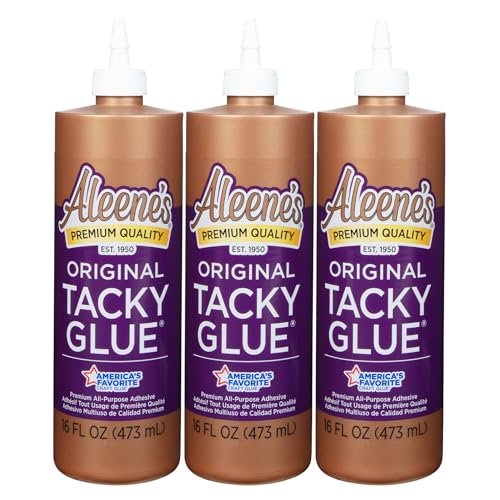
1. Aleene’s Original Tacky Glue, 16 fl oz 3-Pack
Our pick — 4.5+★ from 750+ verified ratings; the strongest balance of quality and price.
Three big bottles of the craft-room default that grabs cork instead of soaking into it.
Thin cork sheets and paper-backed cork drink a runny glue straight down into the grain. Aleene’s gets around that with a thick formula that holds materials on contact — so felt, foam, paper and light cork stay where you press them instead of sliding while the glue sets. It dries clear and permanent without yellowing, which matters when the cork edge is visible.
Seventy-five years of craft-room use explains why quality is the thing that wins people over most here, and the three-bottle pack adds real value if you go through glue on a schedule. The trade-off is honest: drying time splits opinion, since the grab is quick but some bottles arrive dried out at the neck. Buy from a seller with a return path and it is a non-issue.
Why crafters keep rebuying it
- Thick tacky grab holds cork on contact — no sliding while it sets
- Dries clear and permanent without yellowing on visible edges
- AP-certified non-toxic, and wet glue wipes off with water
The one snag to expect
- Bottles can arrive partly dried out at the tip, so check on arrival
Reach for this if: you are gluing craft cork, felt, paper or foam and want a forgiving glue you can clean up with water.
Look elsewhere if: the cork will sit in a wet or outdoor spot — a water-resistant contact cement handles that better.
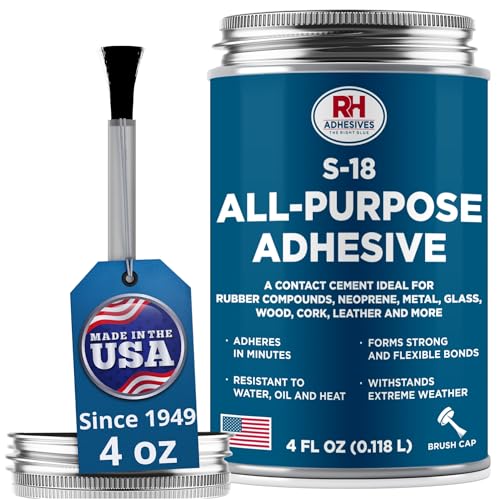
2. RH Adhesives S-18 All-Purpose Adhesive, 4 oz
A solvent adhesive built for the job cork usually fails at: a sagging car headliner.
This is a neoprene formula that glues both porous and non-porous surfaces, and cork is listed among its compatible materials. It bonds rubber to metal — the exact pairing behind an SBR rubber or cork-faced headliner held to a steel roof. The water resistance makes it the pick for covered outdoor cork work and for anything that sees temperature swings in a vehicle.
The catch is patience and ventilation. Full cure runs 24 hours, and the smell is the one thing people complain about most, so plan your work for a garage or an open window. Adhesion results are fair rather than universal — it rewards a clean, well-pressed surface and punishes a rushed one. Still, effectiveness is the quality that comes up most, and it is the reason this belongs in the toolbox for cork on a tricky substrate.
Where it earns its place: cork bonded to metal, rubber or a headliner shell that a craft PVA simply cannot hold.
Plan around this: the 24-hour cure and the strong solvent smell mean you want airflow and a full day of hands-off time.
Buy it for: car headliners, upholstery and small water-exposed cork jobs.
Skip it for: a kitchen-table craft afternoon with kids — the solvent odor rules that out.
3. Arroyner 110 Pack Self Adhesive Cork Squares

Cork squares with the adhesive already on the back — no bottle, no waiting.
If your project is coasters, drawer liners or mini wall tiles, there is nothing to glue at all here. Each square is 4 x 4 inches at 0.04 inches thick, sized to sit under most cups, pots and plants, and the anti-slip cork cuts with ordinary scissors. The 110-piece count is the headline number if you are batch-making gifts.
Adhesion out of the pack is the strong suit — the peel-and-stick backing holds on tile coaster projects. Two honest notes: at 0.04 inches these are thin, and a few corners lift over time. On a coaster under a glass of iced tea, a thin cork is exactly what you want anyway.
The value read: you skip mixing, clamping and cure time entirely, and 110 pieces covers a lot of coaster sets before you run out.
The limit to know: 0.04-inch cork will not add bulk or cushioning, so it is not a substitute for a thicker cork tile.
Reach for this if: you are making coasters or small craft cork pieces and want zero glue steps.
Look elsewhere if: you need thick, load-bearing cork under heavy furniture.
4. Weldbond Multi-Surface Glue, 14.2 oz

The clear-drying PVA that lets cork sit flush against tile and glass.
Weldbond’s advantage over a generic craft glue is the finish. It goes on white, dries crisp, and does not yellow or leave a cloudy halo — so a cork disc glued to a glazed tile loses its seam. A 20-minute set with no clamping keeps the work moving, and the 14.2 oz bottle lasts through a full mosaic panel or a season of repairs.
The clear advantage over smaller craft bottles shows in the numbers: 14.2 oz against the 3 oz cans of DAP contact cement. Add that it is a no-solvent, no-fumes PVA and it becomes the option you can use at the kitchen table. It does not bond metal to ceramic, and as a PVA it is a bonding adhesive rather than instant glue — let it sit undisturbed. Adhesive quality is far and away its loudest praise, and mosaic work is where that reputation was built.
The strong case
- Dries truly clear with no yellowing, so seams vanish on light surfaces
- Non-toxic with no fumes — safe for indoor and classroom use
What it will not do
- Will not bond metal to ceramic, and it needs undisturbed setting time
Best for: mosaic and mixed-media work where a visible joint or a yellowed bond would ruin the piece.
Not the pick if: you need a glue that sets instantly with no hold time.
5. DAP Weldwood Original Contact Cement, 3 oz 3-Pack
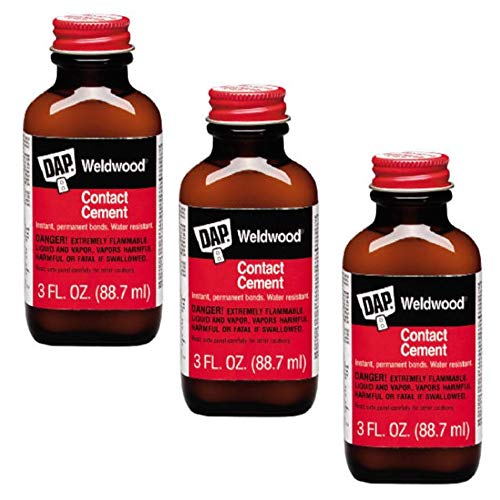
A neoprene contact cement that holds cork with no clamps and no long set time.
Cork is on the compatible list here, alongside wood, leather, tile, foam and paper. The neoprene rubber formula spreads easily and dries tack-free, with a 2-hour open time that gives you room to pre-fit your cork before you commit. Press the parts together and the bond forms on contact, so clamps and weights stay in the drawer. Full cure lands at 2.5 hours — the fastest of the solvent picks here.
Pre-fit every piece before you spread the cement, because the grab is instant and unforgiving of a misaligned cut. Effectiveness is the quality most praised, and it rates as a better hold than Shoe Goo for the people who pushed it hard. Each can is 3 oz across three cans, a modest size that suits small patches and repairs.
Where it wins: instant grab on cork tiles and foam means no clamps, and the 2-hour open time allows careful dry-fitting.
The catch to weigh: it is a low-VOC but still solvent-based cement, so you need ventilation and steady hands on the first press.
Pick this for: cork tiles, foam and veneer where a permanent, clamp-free high-strength bond is the whole point.
Think twice if: you want a repositionable or water-cleanup glue — this is neither.
Know the Specs
Full Cure Time
Cure time is how long the bond takes to reach its final strength — Weldbond sets in 20 minutes, DAP cures in 2.5 hours, and S-18 needs a full 24 hours before you trust weight to it.
Contact vs PVA
A PVA glue dries as water leaves it and needs a clean, still surface, while a contact cement grabs the moment two coated faces touch and needs no clamps at all.
Common Questions
Will regular wood glue work on cork?
Can I use contact cement on cork coasters?
Does cork glue need to be waterproof?
The Bottom Line
For most cork projects the glue for cork to start with is Aleene’s Original Tacky Glue, because its thick grab holds cork instead of soaking away and it cleans up with water. When the cork has to survive a car headliner or a tiled surface, step up to Weldbond for a clear, fume-free bond or DAP Weldwood for an instant clamp-free hold.
How we choose
We do not accept paid placement. Every pick is matched to a real buyer and a real use-case; we do not hands-on test units.
Sources
Specifications: manufacturer listings and product documentation. Review insights: verified customer reviews, as of November 2026. Pricing: not shown on this page (it changes often); check the current price via the retailer link.
As an Amazon Associate, My Heart Lives Here earns from qualifying purchases. This does not affect which products we feature.