Heads up: This post contains affiliate links. As an Amazon Associate I earn from qualifying purchases, at no extra cost to you. Learn more
Specs are compiled from manufacturer listings and verified buyer reviews and can change over time — please confirm the key details on the product page before buying.
If you have ever winced while easing a car into a tight garage bay, the fix is far simpler than chasing a dented door or a scuffed bumper. You want a device that tells you exactly where to stop, before you hit anything. The picks below fall into two camps. Some shoot a beam you line up on your dash, and some put a physical bump under your tire that you feel through the pedal. Both work. The trick is matching the approach to your garage: a beam guide for a clear wall and a dash mark, a wheel-stop mat for a rough floor and no wiring.
This guide is built by comparing the manufacturers’ published specifications and the patterns across verified customer reviews, so you get each pick’s real strengths and trade-offs instead of marketing spin.
You will see beam-style guides, wheel-stop mats, and side-clearance sensors rated for different ranges and different budgets. By the end you will know which one fits your bay with a single read, so here is a clean, honest buyer’s breakdown of the best garage laser parking system for everyday drivers.
Top Picks

How To Choose The Best Garage Laser Parking System
Start with the question that actually decides it: does your car need a visual cue, or a physical one? A beam guide lights a spot on your dash or wall so your eyes do the work. A wheel-stop mat puts two bumps under the tire so your foot feels the stop. Neither type wins outright. The right one depends on if you want a dot on the dash or a bump under the tire.
Beam versus bump: pick your sensing style
A beam unit like the ones below projects a dot you drive toward, then you brake when the dot lands on your pre-aimed mark. It is tidy and touches nothing. The catch is visibility. A beam that is faint in bright daylight means you may end up squinting to find your mark. A wheel-stop mat, by contrast, gives you a small first bump and a larger second bump, so you feel the cue through the pedal with no beam to chase. If you park with the family truck at dusk and at noon, the mat can be the friendlier option.
Range and detection width decide your fit
Beam guides include both a maximum range and a beam-detection distance, and you should match both to your bay. A unit built to span an outdoor perimeter will happily cross a long driveway, while a sensor tuned for a wall-mounted indoor application works best when the gap between the unit and its target is short. A wide detection angle helps compact cars, SUVs, and trucks alike, and an adjustable mount lets you aim the beam for your actual dash position rather than a generic one.
Power source and mounting method
Where you can run power decides where you can mount the device. An outlet-powered unit with a long cable works when there is a receptacle near your mounting point. A unit that runs on AA batteries frees you from cords but asks you to keep a fresh set on hand. Battery life matters, so a device with a motion-on, timer-off beam spends less time lit and stretches the cells. For mats, check how the underside holds. Screws last longer than peel-and-press tape when the floor is cold or dusty.
Wet floors, cold concrete, and alignment
Alignment is where owners of beam guides either win or struggle. The unit needs a firm, level mount, and the beam has to hit a repeatable spot on your dash or windshield. Take the time to aim it precisely on a calm afternoon. For mats, a wet or oily concrete floor can defeat even strong adhesive, so a mat with mounting holes you can screw down often proves the more stable choice over years of use.
Side-by-Side Comparison
| Model | Best For | Max Range / Detection | Type | Power / Weight | Amazon |
|---|---|---|---|---|---|
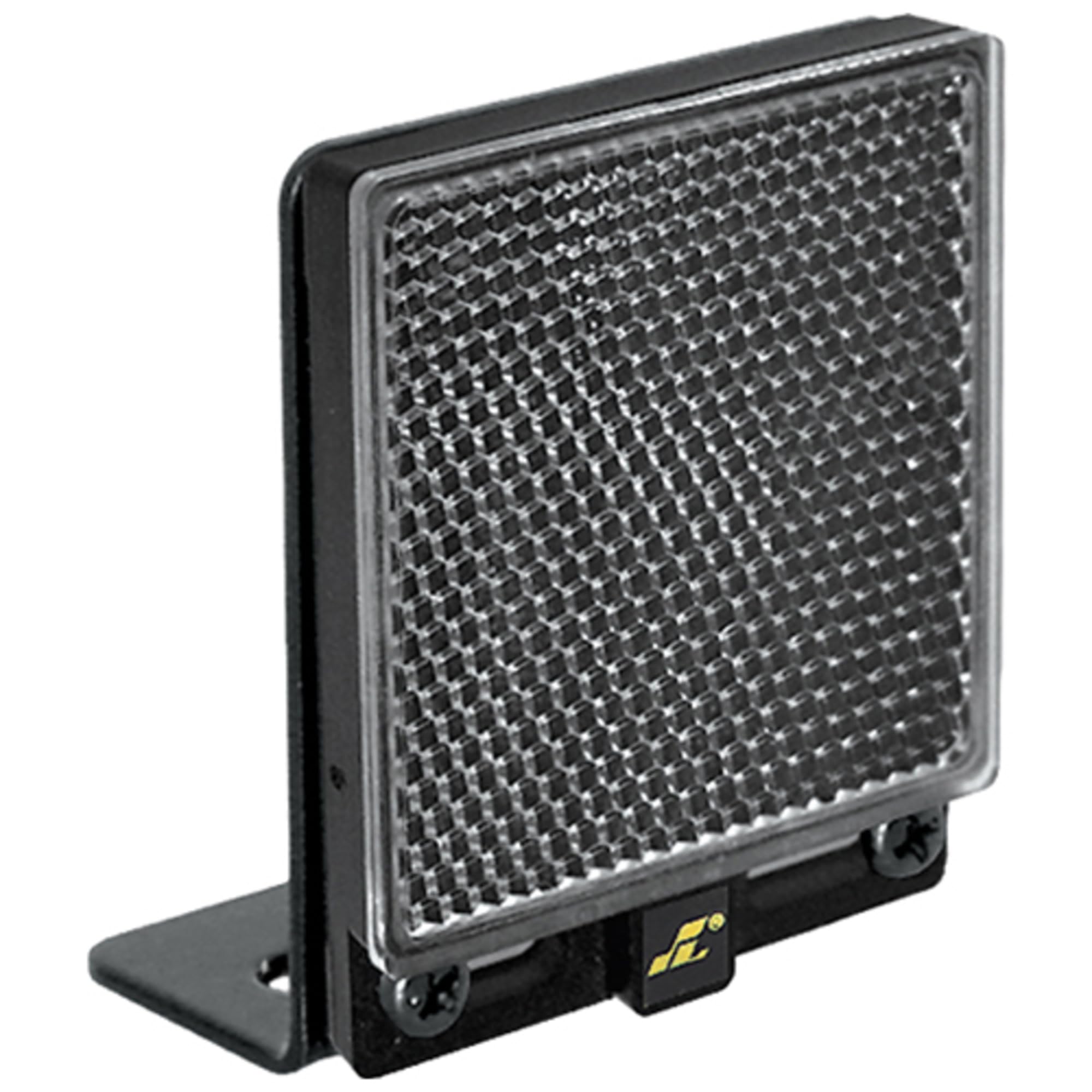
| Seco-Larm E-931-S35RRQ Enforcer★ Best Overall | Driveway and bay beam alert | 11 meters (35 ft) | Photoelectric beam sensor | Outlet plug, 11.2 oz | Amazon |
| MAXSA 37314 Park Right Dual LaserBest Dual Laser | Two-laser dash guide | Up to 15 ft detection | Dual laser + LED light | AC adapter / AA backup, 5 oz | Amazon |
| MAXSA 37359-2PK Parking Mat | Two-car fleets | 21.5 in length, 11 in width | Wheel-stop mat (2-pack) | Adhesive tape, 4.04 lb | Amazon |
| STKR Concepts Side Parking Sensor | Mirror and body clearance | 4 in to 24 in stop range | Side proximity sensor + siren | 4 AA or USB-C, 5.6 oz | Amazon |
| Dahszil Dual Laser Beam Detector | Long outdoor driveway alert | 300 meters (outdoor), 60 m infrared | Dual-beam perimeter detector | Requires power adapter | Amazon |
| F COME Rubber Parking Mat | Larger tires and SUVs | 23.6 in length, 15.7 in width | Rubber wheel-stop mat (2-pack) | Screw or adhesive, 7 lb | Amazon |
| Liftmaster Chamberlain 975LM | LiftMaster opener owners | 90-second pulsating beam | Laser park assist + IR tie-in | Powered, 1.76 oz | Amazon |
Detailed Reviews
1. Seco-Larm E-931-S35RRQ Enforcer Beam Sensor
Our pick — 4.5+★ from 900+ verified ratings; the strongest balance of quality and price.
The invisible tripwire that tells you the moment your bumper crosses the line.
The one number to know here is 11 meters, which is roughly 35 feet of sensing range. That means you can mount this unit on a wall or gate post and let its infrared beam — an invisible light path that you cannot see but the sensor can — sweep across your parking zone. When the beam breaks, the device fires the alert. Nothing touches your car, and there is no dot to chase on your dash. You just get told, plainly, that something crossed the line. It is the most versatile pick here because it works as a garage stop cue and an outdoor gate or driveway alert with the same box.
What wins people over is functionality — owner feedback returns again and again to the sensor simply doing its job in harsh environments. Setup is described as fairly easy, with complete, clearly written instructions, and it plugs into a standard power outlet. Temperatures and power are not fussy either: it accepts a wide input voltage range from 24 to 240VAC or 12 to 240VDC, so it is forgiving of whatever your garage or gate wiring offers.
The honest caveat is durability and alignment. Some buyers report the unit running for several years, while others mention it dying after 14 months — as buyers put it, the longevity picture is genuinely split. Alignment is the other finicky part: this beam is extremely sensitive to a proper mount, so take a calm afternoon to square it up. At 11.2 ounces it is light enough to wall-mount on its own, but plan on a firm, level fixing rather than a loose bracket. Compare that to the indoor wall-mount style aiming at a short gap and you can see why this one shines when you want a long, weatherproof run.
Where it earns its keep
- 35 feet / 11 meters of range lets you span a wide bay or gate opening with one unit.
- Weatherproof build handles indoor and outdoor mounting.
- Wide 24 to 240VAC or 12 to 240VDC input voltage eases wiring.
- Sets up fairly easily with complete, clearly written instructions.
What to plan around
- The beam must be mounted square and level; alignment is touchy.
- Some units last years, others report failure after 14 months.
- No wall bracket cleverness here — you supply a firm mount.
Best fit: anyone who wants a hands-off, long-range beam cue for a garage bay, gate, or driveway without a dot on the dash.
Think twice if: you want zero fuss with aiming — this one rewards careful mounting.
2. MAXSA 37314 Park Right Dual Laser Parking Guide
Two lasers that paint your dash with the exact spot to stop.
For a two-car garage, the trick is giving each driver a personal mark, and this unit does it with two independently adjustable lasers. Aim one dot at your dash, one at your partner’s, and drive until the dot meets the mark. The lasers swing a full 360 degrees, so you can aim them wherever your seating position puts your eyes. A built-in LED light adds visibility for walking to and from the car after dark. The motion sensor turns both the lasers and the light on when a vehicle or person enters, and they stay lit for roughly 15 seconds after motion stops.
Detection is rated up to 15 feet across a 130-degree angle, which covers compact cars, SUVs, and trucks in most garages. What earns this pick its place is the sheer consistency of function — owners count on the dual-laser performance and the motion-triggered light. Install is a breeze by all accounts, with included screws, anchors, or adhesive tape, and a 9-foot AC adapter in the box. Optional AA backup is there if you want the lasers to survive a power cut, though you supply those batteries. The whole housing weighs just 5 ounces, lighter than the 11.2-ounce Seco-Larm by more than half, so a single tape strip holds it fine.
Reliability is the recurring gripe — lasers that turn off right when you need them is the one theme that shows up more than any other. Motion detection also draws mixed marks: some drivers love the sensitivity and range, others find the sensor finicky. Treat the battery backup as your insurance policy here. And if you want the simplest possible fixture, this has more moving parts than a plain mat.
Why it beats a single-dot guide: two lasers mean two drivers, two marks, no re-aiming every time you swap cars. The 15-foot, 130-degree detection is generous for most bays. And the 9-foot adapter gives you real mounting freedom.
The honest limit: those lasers going dark mid-approach is the pattern to watch, so a fresh AA set in reserve is worth keeping on the shelf.
Reach for this if: you share your garage and want each driver to have a dedicated stop dot.
Look elsewhere if: you would rather not babysit a powered device — a wheel-stop mat needs no motion sensor.
3. MAXSA 37359-2PK Park Right Parking Mat, Red 2-Pack

No beam, no battery — just two bumps you feel through the pedal.
If you have ever overshot a beam and bumped the shelf anyway, this is the cure. Each mat gives the driver two sequential bumps. The small first bump tells you the tire is on the mat. The larger second bump is the hard stop, and the reflective tape edges make the mat easy to see when you pull in. There are two mats in the pack, so a pair of cars gets identical stop points — a genuine benefit over the one-mat boxes. At 21.5 inches long and 11 inches wide, they are sized for passenger vehicles up through pickups, minivans, and RVs.
You get a firm, repeatable stop without wiring anything in. Setup is a peel-and-press job: line the mat up where you want the car to stop, peel the anti-skid tape, and press it down hard. Owners mention it is genuinely easy to install, and the review pages keep coming back to how well it helps you park in the bay. Each two-pack weighs 4.04 pounds and holds by tape, not power, so there is nothing to plug in or replace.
Now the real talk. Adhesion is the most-discussed trade-off: some owners say the double-sided strip holds perfectly while others report it barely sticks to a cold or dusty floor. Stability and durability split similarly, with a rare mat breaking loose within a couple of weeks. If you park on bare, clean concrete, the tape can be enough. If your floor is rough or greasy, plan on adding screws. Screws are not in the box, so pick up a small set to be safe.
The case for grabbing it
- Two mats in one box means both cars get the same stop point.
- Two-bump design lets your foot feel the cue without a beam.
- Reflective tape improves visibility at night in a dim garage.
- 21.5 x 11 inch footprint fits most passenger vehicles.
Where it can let you down
- Adhesion is mixed; cold or dirty floors weaken the tape.
- A rare mat has been reported breaking loose within two weeks.
- No screws included, so rough floors need a hardware run.
Pick it when: you have two cars and want a power-free, feel-the-stop cue.
skip it if: you park on a broken-up or oily slab and want zero hardware fiddling.
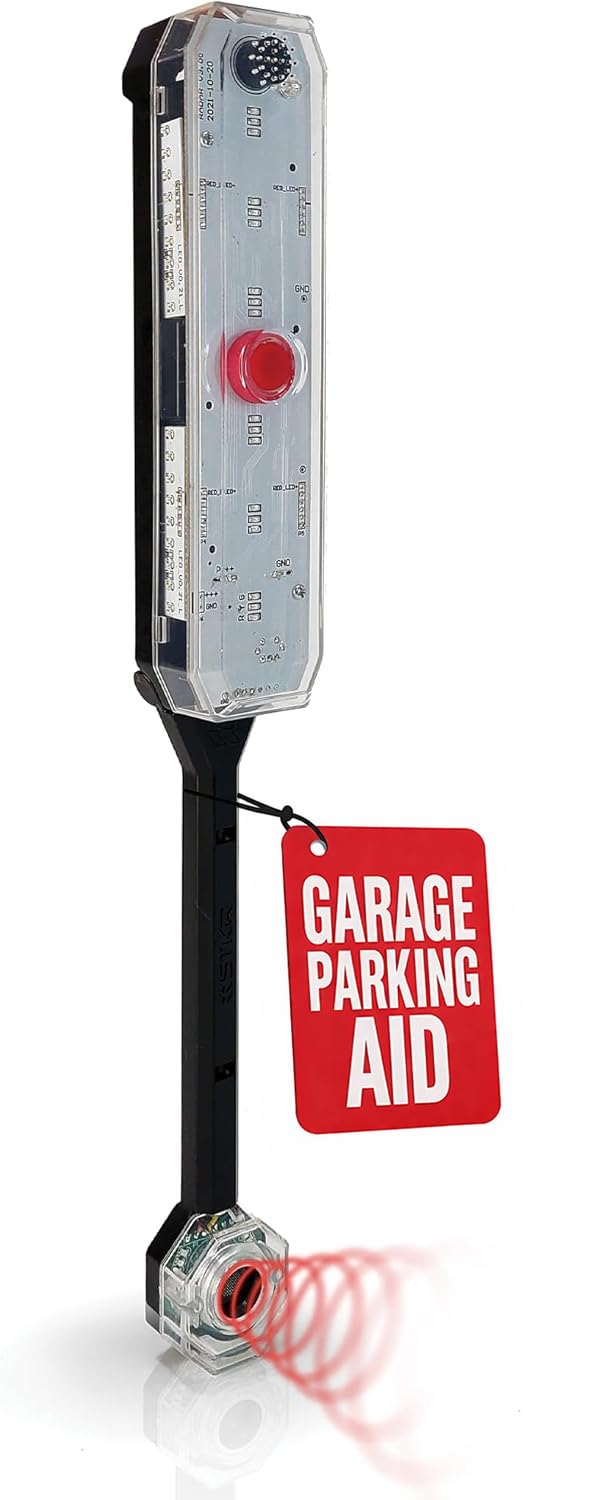
4. STKR Concepts Side Parking Sensor, 4″-24″ Adjustable
Guards the door mirror as you squeeze past the frame.
Most parking aids tell you when to stop going forward. This one watches the side gap as you slide past a door frame, so you are not clipping a mirror or scraping a body panel on the way in. The alert is a simple traffic-light for your ears and eyes: green means clear, yellow means close, red with a siren means stop. You set your trigger distance with a one-touch Set Distance button anywhere from 4 inches to 24 inches from the wall or frame. The sensor is made to clamp onto a standard garage door track, with no drilling or wiring needed for the mount itself.
Power can come from 4 AA batteries or USB-C, with the cable and charger sold separately — so battery light is fine, but plan on cords for long-term use. It weighs 5.6 ounces, light enough to stay put on the track clamp. Where it shines is straightforward: it helps guide a vehicle into and out of tight spots and protects the door frame area. The 1-year STKR warranty is a nice safety net that many rivals skip.
Reliability is the open question buyers keep raising: many report it working well, while others say it quit after 34 days. Battery life is a known drain too, with the cells running out quickly. The beep can also get annoying if the sensor sits in a high-traffic spot where every motion sets it off. Take the install slow and keep a spare set of AAs nearby.
What it does that others cannot: it watches the side gap, not the front wall. The adjustable 4-to-24-inch range lets you set a personal comfort buffer. And the track clamp means no drill, no wire for the sensor itself.
The one thing you need to know: battery drain is real, so treat rechargeables or a USB-C run as part of the plan.
Get it if: mirrors and door frames are your tightest squeeze and forward stop distance is already handled.
Think twice if: you want a set-and-forget cue — this one asks you to keep it fed with batteries.
5. Dahszil Dual Laser Alarm Beam Sensor

A twin-beam sentry built to watch a long driveway, not a single bay.
If your car and garage are far apart, this is the one to reach for. It claims 300 meters of maximum range outdoors, or 60 meters in its infrared mode, which is dramatically longer than the 11 meters the Seco-Larm covers. Two beams fire across the opening, and falling leaves or birds are the sort of false alarm this dual-beam design is meant to filter out. The receiving and transmitting units sit at opposite positions with an infrared zone between them, and a trip triggers a signal to your alarm host, which is not included.
What holds it up is reliability as the headline: owners describe it as working as advertised with no false alarms, and setup is easy by their account. The auto-adjust design is clever — the transmit power dials itself to the environment, which the maker says extends the life of the launching tube and lowers power consumption. Two units are in the box, so you get the matching pair the design calls for. It is a perimeter device first, so treat it as an outdoor sentry that also happens to tell you when a car arrives.
Do not buy this expecting a dash-dot parking guide. It is a perimeter alarm meant for gates, long driveways, and school or office entries. Quality draws mixed marks — some find it excellent, others raise concerns — and the listing notes you need to supply 2 power adapters, so factor those in. Motion it detects goes to a security host, not a bright local light. For tight indoor garages, a beam guide or a mat will serve you better.
Made for: long outdoor driveways, gates, or perimeters where a car arrives far from the door.
Not made for: precise indoor stop positioning in a tight garage bay — pair it with a mat or dash guide for that.
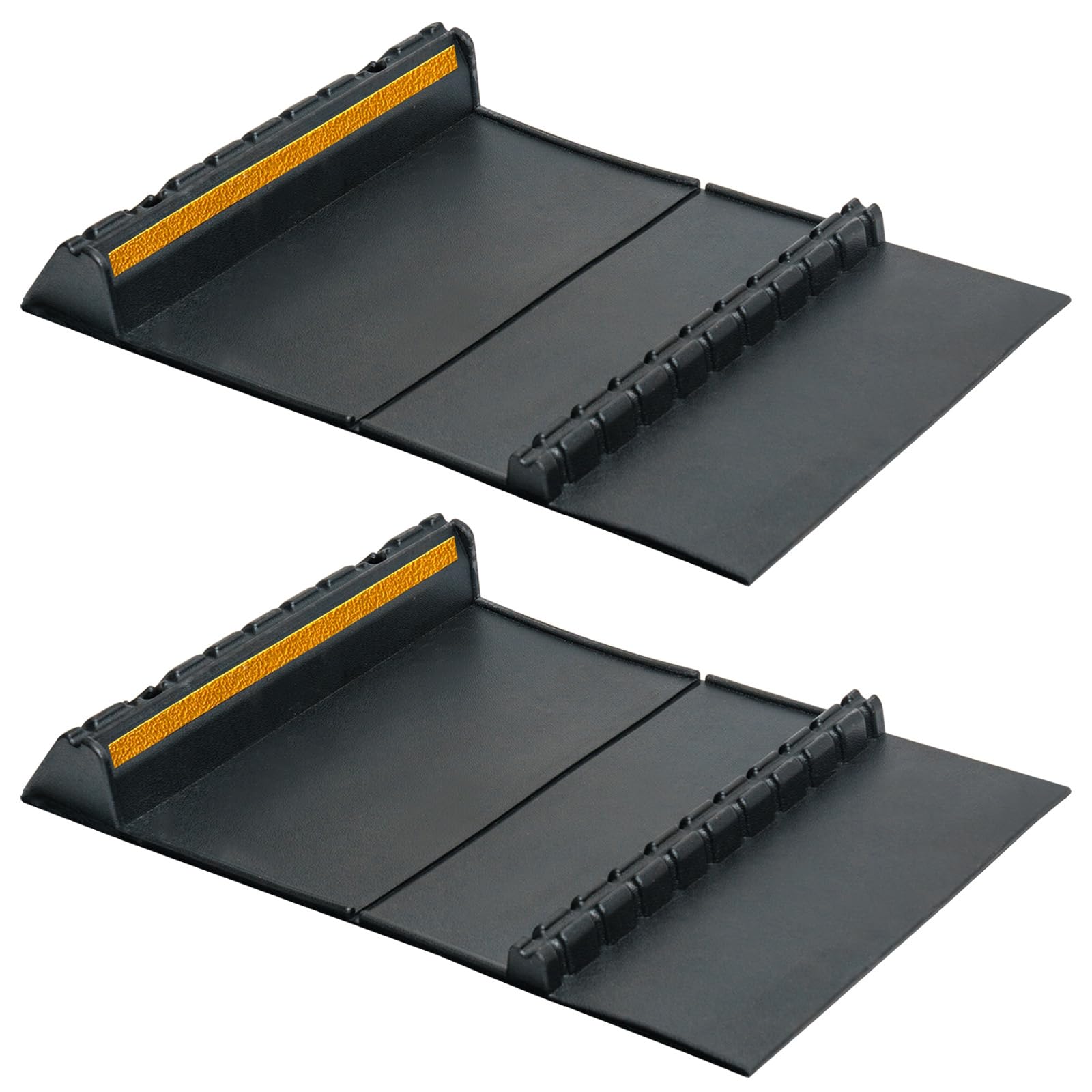
6. F COME Rubber Parking Mat Set, 23.6″ x 15.7″ x 2.8″
A heavier, wider rubber stop for the SUV that ate your last mat.
The number that sets this mat apart is its 15.7-inch width — an extra-wide footprint built to swallow larger SUV and truck tires that spill over narrower mats. It is 100% rubber, and at 7 pounds, it sits heavier on the slab than the 4.04-pound MAXSA pair. The two-bump design carries over: a small first bump tells you the tire is on, and the large second bump is the stop. You get two mats, 23.6 inches long and 2.8 inches thick, with reflective strips to catch headlights. The brand calls it universal fit for cars, pickups, SUVs, vans, RVs, golf carts, and riding mowers.
What wins people over here is the sheer material quality — owners describe the rubber as heavier grade than expected, and the 15.7-inch width is a genuine hit with big-tire drivers. The rubber is described as durable and the price-to-value ratio reads well for the grade of material. Install is peel-and-press tape, or use the mounting holes to screw it down for long-term parking.
The recurring gripe is adhesion and stability. The adhesive keeps some mats put while others slide on cold or worn concrete — that is the honest split. Durability itself is quite good. Plan on using the mounting holes for a rough floor. And if you only have one car, the two-pack is more mat than you strictly need.
Where it earns the premium: that 15.7-inch width is the wide-tire answer. The 100% rubber body and 7-pound weight make it a hefty, harder-to-shove mat. Screw-down mounting holes give it a second option beyond tape.
The catch to size up: on rough or cold floors, adhesive results swing — the screw holes are your reliable backup.
Best for: SUV, truck, and van owners wanting a wide, heavy rubber stop that stays put with screws.
Pass on it if: you drive a compact car or want the lightest tape-only mat.
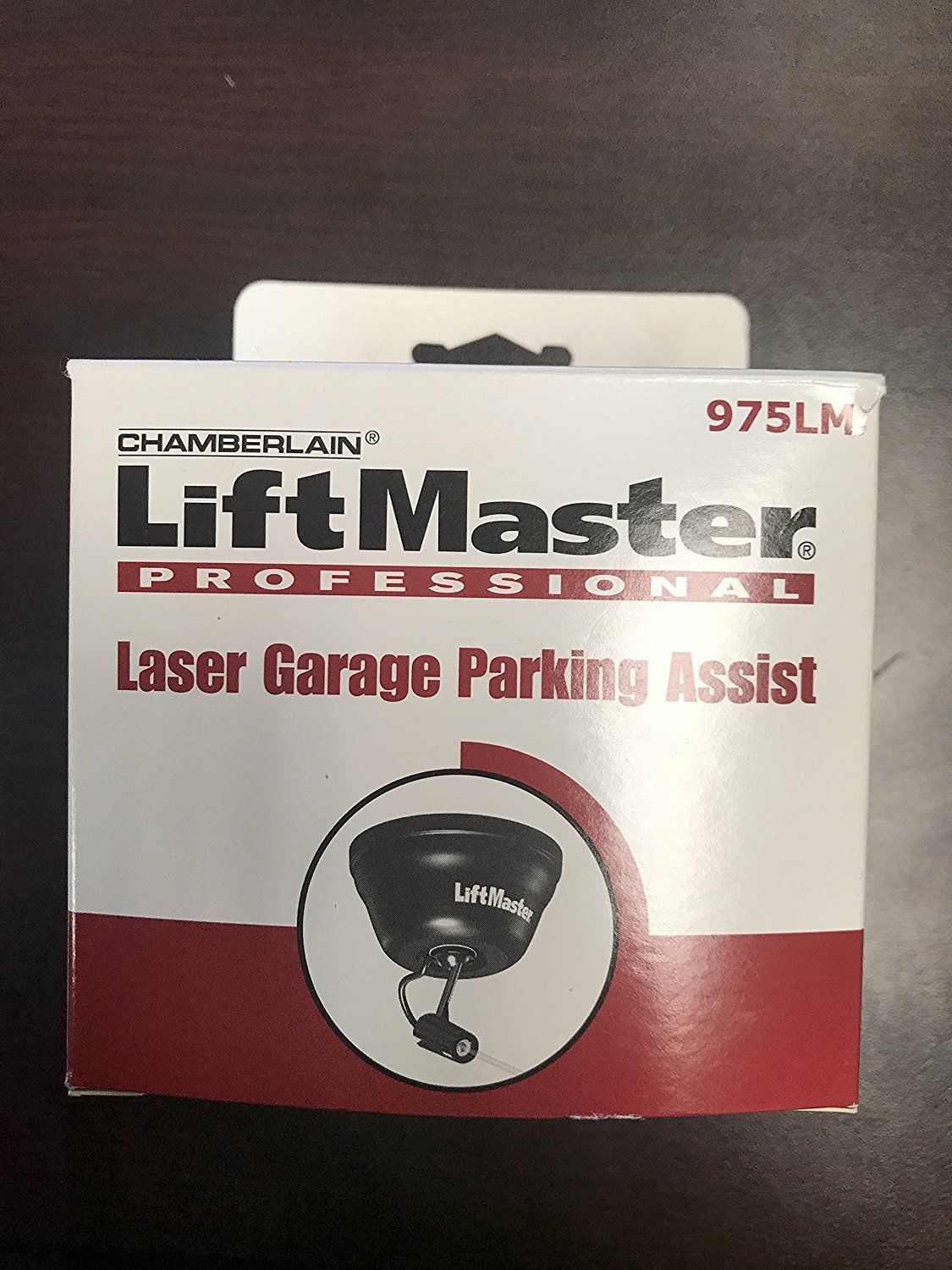
7. Liftmaster Chamberlain 975LM Laser Parking Assist
Runs off your garage door opener, aiming a red dot at your dash.
This one is purpose-built for a LiftMaster opener, because it draws its power from the opener’s photo-eye (IR) terminals rather than a wall outlet. When the IR beam is interrupted — your car breaking it — a pulsating red laser turns on for 90 seconds. You pull in until that dot lands on the mark you have pre-set on your dash. Two of these can be installed on a single opener, so a pair of cars can share the system. The setup is a Class 2 laser, which the maker describes as safe on the eyes yet clearly visible.
Function comes first for owners here — the unit works with garage door openers and sets up in roughly 15 minutes. Quality and installation get consistently warm treatment, with owners calling the install easy. It weighs just 1.76 ounces, so the light housing mounts with the opener hardware and no fuss. If you already have a LiftMaster, this is the least intrusive way to add a beam guide, because you are borrowing the opener’s wiring.
The honest caveat is visibility. The laser is hard to see in bright daylight and on dark surfaces, and the dot is small — that is the theme worth knowing before you buy. Aligning the beam to the exact dash spot takes patience. The indicator light also blinks rather than staying steadily on, which can puzzle a first-timer. If you park in a dim garage in the evening, you will find the dot far easier to spot than at high noon.
what separates it: you skip a new power run entirely, because the photo-eye terminals of your LiftMaster feed it. Setup takes about 15 minutes, and the 90-second pulsating beam makes it nearly invisible once it is in place.
The honest limit: that faint daylight dot is a real-day-use modifier, so it suits a shaded or evening bay far more than a bright open one.
Pick it if: you already have a LiftMaster opener and want a dash-dot guide wired straight into it.
Think twice if: you want a guide visible at high noon, or you don’t own a compatible opener.
Know the Specs
Beam range and detection distance
Range is how far a beam or sensor can reliably span, while detection distance is how close the target must be for the unit to read it. A perimeter-style unit like the Dahszil reaches 300 meters outdoors, whereas an indoor wall-mount like the Seco-Larm tops out at 11 meters. Match the range to your actual gap — long driveway versus short wall-to-dash. A beam designed for a long opening is overkill in a tight bay, and one tuned for close range may not bridge your garage.
Motion sensing and timed on/off
A motion sensor wakes the device when a vehicle or person enters, saving power and extending battery life. Some units stay lit for a set window — the MAXSA lasers and LED run roughly 15 seconds after motion stops, while the LiftMaster beam pulses for 90 seconds. A shorter window saves wear on the laser; a longer one gives slow drivers more time. Check the window and the power source together, because they decide how often you swap batteries.
Power source and voltage
How you power the unit decides where it can live. The Seco-Larm accepts a wide 24 to 240VAC or 12 to 240VDC input, so it fits most garage and gate wiring. The MAXSA uses a 9-foot AC adapter with optional AA backup, while STKR runs on 4 AA or USB-C. The LiftMaster borrows the opener’s photo-eye wiring. If your mounting spot has no outlet nearby, a battery or opener-powered unit saves a wiring run. Just know battery life: the STKR drains cells fast.
Mounting and alignment
Beam guides live or die on alignment. A unit mounted loosely on a rough bracket drifts, and you spend your mornings re-aiming. The Seco-Larm is notably touchy and rewards careful mounting. The STKR clamps to a standard garage door track without drilling, which removes one alignment headache. For wheel mats, the design question flips to adhesion. Tape holds on a clean, smooth slab, but cold or greasy concrete defeats it — mounting holes and screws solve that. Plan the mounting method before you buy.
Common Questions
Will a laser parking guide work in a two-car garage?
How far can a garage beam guide span?
Do I need to run new wiring for a beam guide?
How do I aim the beam so it hits the same spot every time?
Is a wheel-stop mat better than a laser for parking?
Why does my mat’s adhesive tape keep failing?
How long do AA batteries last in a battery-powered sensor?
Will a laser dot be visible during bright daylight?
Can I use an outdoor perimeter beam sensor as a parking guide?
What does the class of laser on a parking guide mean?
The Bottom Line
For most garages, the garage laser parking system that does the most work is the Seco-Larm E-931-S35RRQ Enforcer, thanks to its 11-meter range and weatherproof build that lets it serve both a bay and a driveway. If you share your garage and want two dash dots, the MAXSA 37314 dual-laser gives each driver their own mark. And for the simplest, power-free approach, the MAXSA 37359-2PK mats let your foot tell you when to stop. The honest nudge: pick a beam guide for a clean, level wall and a mat for a rough or greasy slab, and a reliable stop point will pay you back on the very next tight pull-in.
How we choose
We do not accept paid placement. Every pick is matched to a real buyer and a real use-case; we do not hands-on test units.
Sources
Specifications: manufacturer listings and product documentation. Review insights: verified customer reviews, as of November 2026. Pricing: not shown on this page (it changes often); check the current price via the retailer link.
As an Amazon Associate, My Heart Lives Here earns from qualifying purchases. This does not affect which products we feature.