Heads up: This post contains affiliate links. As an Amazon Associate I earn from qualifying purchases, at no extra cost to you. Learn more
Specs are compiled from manufacturer listings and verified buyer reviews and can change over time — please confirm the key details on the product page before buying.
If your armpits are raw and your wrists ache from leaning on underarm crutches, a forearm crutch moves the load off your armpit. A cuff wraps your forearm and your hand grips a handle, so your weight travels through your arm instead. For most people, the KMINA open-cuff pair is the one to buy: it holds up to 275 lb, has 11 height settings, and comes with washable pads at a mid-range price. The rest of this guide sorts seven real options by who each one actually fits.
This guide is built by comparing the manufacturers’ published specifications and the patterns across verified customer reviews, so you get each pick’s real strengths and trade-offs instead of marketing spin.
Forearm crutches are not one-size tools — height range, cuff style, and weight capacity decide whether a pair works for you or sits unused in a closet. Below you will find the height limits, cuff designs, and honest trade-offs spelled out in plain numbers for every pair of forearm crutches on this list.
Top Picks

How To Choose The Best Forearm Crutches
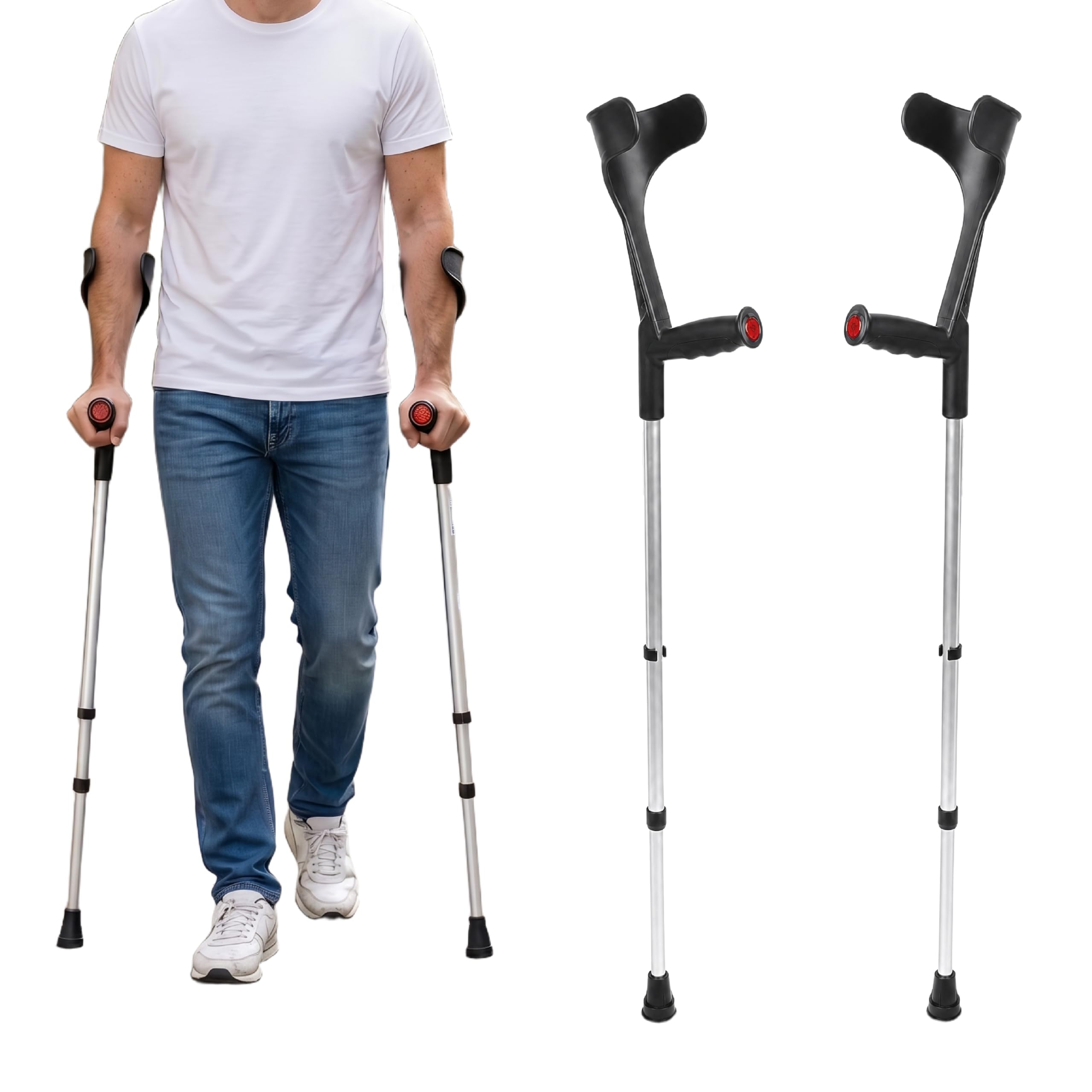
The mistake most first-time buyers make is ordering a pair before they measure anything. Forearm crutches only work when the cuff lands on your forearm and the handle sits at hip height, so a crutch that is too short makes you hunch and one that is too tall pushes your shoulder up. Measure from the floor to your forearm in the shoes you normally wear, then compare that number to the height range printed in the listing.
Height range beats every other spec
Every pair here lists a height window, and staying inside it matters more than any comfort feature. The Drive Medical pair covers 60 to 74 inches of user height. The PEPE Mobility pair adjusts from 36” to 46” in total crutch height, with a handle height of 28” to 38”. The folding pair fits 58inch-72.8inch. If your measurement falls outside a listing’s window, that pair is the wrong tool no matter how good the reviews are.
Open cuff or closed cuff
An open cuff is a C-shaped bracket that lets you pull your arm out sideways without unstrapping anything — handy when you reach for a door handle or carry a plate. A closed or semi-enclosed cuff wraps further around your forearm and shares wrist pressure, but your hand has to slide out the top. Neither is better; it depends on if you need quick exits or extra wrist relief.
Weight capacity and frame material
User weight capacity tells you how much the frame was engineered to carry. Options here range from a 275 lb limit on aluminum pairs up to a 500 lb bariatric rating on the Drive Medical steel model. Aluminum keeps the crutch light but flexes more; steel holds firm but adds heft. Match the capacity to your body with a little headroom, not exactly to your weight.
Tips, grips, and daily upkeep
Rubber tips are what keep you upright on tile and hardwood, so check how the tip attaches and whether it pivots or sits rigid. Grips matter just as much: a hard polypropylene handle can press into your palm over a long day, while a padded or rubber handle spreads that pressure. On the pairs with washable pads, you can pull the padding off and clean it, which keeps the handle hygienic through months of daily use.
Side-by-Side Comparison
| Model | Best For | Height Adjustment | User Weight Limit | Cuff Style | Amazon |
|---|---|---|---|---|---|
| KMINA Forearm Crutches for Adults★ Best Overall | Everyday all-round use | 11 regulations | 275 lb | Open cuff | Amazon |
| PEPE Mobility Forearm CrutchesCrowd Favorite | Long-term daily mobility | 11 settings, 36”–46” total | 275 lb | Open cuff | Amazon |
| VEVOR Forearm Crutches | Taller users needing a wide reach | 11-level height + 4-level cuff | 350 lbs | Adjustable upper cuff | Amazon |
| Folding Forearm Crutches Pair | Travel and storage | 10 buttons, 58–72.8 in | — | Semi-enclosed anti-drop cuff | Amazon |
| Ergobaum 7G Forearm Crutches | Feature-heavy recovery kit | Fits 5’–6’6″ | 360 lbs | Adjustable cuff height | Amazon |
| Drive Medical Bariatric Forearm Crutch | Higher weight support | 60–74 in | 500 lbs | Vinyl-coated contoured cuff | Amazon |
| in-Motion Pro Underarm Crutches | Tall users wanting underarm support | 15 positions, 5 handgrip settings | 350 lb | Underarm cradle (not forearm) | Amazon |
Detailed Reviews
1. KMINA Forearm Crutches
Our pick — 4.5+★ from 800+ verified ratings; the strongest balance of quality and price.
The aluminum pair that does the everyday job properly, with pads you can actually wash.
This is the pair to start with if you want one crutch set for recovery and beyond. The frame is silver-colored aluminum with a polypropylene grip and elbow cuff, and it is rated for a maximum user weight of 275 lb. At 2.49 pounds it is lighter than the VEVOR pair at 3 pounds, which matters every time you lift a crutch to open a door.
What wins people over is how it behaves as a walking aid rather than how it looks on paper. Owners consistently call it comfortable and good value, and the padded handles are the reason — those pads pull off for washing and swap out if they wear. The 11 height regulations let you dial in the cuff position rather than compromise. FSA/HSA eligibility is a real convenience if you are buying during convalescence or rehabilitation from an injury.
The honest catch is stability. Some owners find a forearm crutch of this style less planted than an underarm crutch, and the quality and sturdiness feedback splits rather than unites. For a normal-weight adult walking indoors and on pavement, this is the balanced choice.
What earns it first place
- 11 height regulations so the cuff sits where you need it
- Aluminum frame at 2.49 pounds — light enough to lift one-handed
- Padded handles that are washable and interchangeable
- 275 lb capacity with a polypropylene grip and elbow cuff
Where it asks you to compromise
- Some owners find it less stable than an underarm crutch
- Quality feedback is split, so check the frame on arrival
Reach for this if: you want one well-priced aluminum pair with washable pads for everyday walking.
Think twice if: you need more than 275 lb of capacity or want a bariatric-rated frame.
2. PEPE Mobility Forearm Crutches for Adults Open Cuff
Nearly ten thousand owners have walked on this pair, and the comfort grip is why.
If you are the kind of buyer who wants the option everyone else already chose, this is it — the most-reviewed pair on this list, and one of the highest rated. The spec that drives it is the open cuff, which lets you slip your arm out sideways to grab a door or carry something. It is made in Europe from aluminum with a polypropylene handle, and it is rated to 275 lb when correctly adjusted.
Comfort is what owners praise most: the open cuff and shaped grips keep pressure off the underarm on long walks. The hand grips and forearm cuffs are shaped so the crutch does not dig in under your arm, and buyers report long stretches of use without the soreness that underarm crutches bring. Stability, height adjustment, and ease of use all draw steady praise. The 11 height settings cover a total crutch height of 36” to 46”, with handle height from 28” to 38”, which suits a wide spread of body types.
Two things to know before you order. First, measure against that 36”–46” window — tall users outside it will find this pair too short, and the listing says so plainly. Second, the open cuff can feel wider than a closed cuff, and the polypropylene/TPE handles are firm rather than pillowy over a long day. Some owners also note a wobble when weight-bearing hard. None of that makes it a bad pair; it makes it a pair to fit carefully.
Best in show for comfort: the cuffs are built to keep pressure off the underarm, and that is the single biggest complaint traditional crutches earn.
The measuring rule: set both crutches to the same height and lock the adjustment clip fully into its matching hole before you put weight on them.
Pick this one: if you fall between 36” and 46” of total crutch height and want the most proven forearm pair here.
Look elsewhere if: you are tall enough to need more than 46” of total reach.
3. VEVOR Forearm Crutches

Two separate adjustments — one for your height, one for your forearm — so both ends fit.
Most forearm crutches give you height adjustment and stop there. This pair adds a 4-level adjustable upper arm cuff on top of 11-level height adjustment, which means the cuff itself can move to suit a different forearm length rather than only moving up and down the shaft. VEVOR rates it for users from 55.12″ to 67″ (140 – 170 cm) and up to 350 lbs, and the aluminum alloy frame carries that load while staying portable.
The balance support is the part people talk about — it keeps you steady during recovery, and the rubber non-slip foot pads add ground contact and absorb shock so the impact does not travel up into your joints. The soft PVC handle is shaped for a snug grip. Adjustability draws heavy praise, and the fit adjuster makes it a simple job to switch between two people’s settings if the pair is shared at home. For hospitals, rehab centers, and home use it is a straightforward tool.
The trade-off is length at the tall end and consistency. This pair is rated only to 67″, so it will not serve genuinely tall users. Height adjustment works well, but durability feedback splits between owners who find it sturdy and those who describe it as flimsy, and comfort divides the same way — some love the grippy PVC handle, some find it hard. The 3-pound weight also makes it heavier than the KMINA pair at 2.49 pounds, so lifting it one-handed takes a bit more effort. If you are tall-but-not-giant and want the cuff to fit your arm properly, this is the pick.
What makes it different
- 4-level upper cuff adjustment on top of 11-level height adjustment
- Rated for 350 lbs on an aluminum alloy frame
- Rubber non-slip foot pads that absorb shock
- Fits users from 55.12″ to 67″ (140 – 170 cm)
Where it falls short
- Rated only to 67″, so tall users are out of range
- Durability and grip comfort feedback splits between owners
Right call for: mid-height users who want the cuff to fit their forearm exactly, not just their overall height.
Not the one for: anyone taller than 67″ or looking for the lightest pair available.
4. Folding Forearm Crutches Pair

Folds to pack in a carry-on, so you are not leaving your crutches at the gate.
This pair folds down for storage and travel, and that is the whole point — owners mention folding it small enough to fit in a carry-on bag, which no rigid pair here can match. It has 10 adjustable buttons and fits people from 58inch to 72.8inch. At 10.4 ounces it is also the lightest pair in this guide, noticeably lighter than the Drive Medical bariatric crutch at 12.8 ounces.
Two design details earn their keep. The anti-drop cuff ties your arm to the crutch so you can lock a door or pick something up without the crutch clattering to the floor. The semi-enclosed arm section keeps your arm straight and shares pressure off the wrist. The bottom locks by rotating, and the Oxford base is wear-resistant and corrosion-resistant. Owners call it more comfortable than other forearm crutches, with rubber grips that are reasonably soft and a semi-enclosed band that is gentle on the skin.
Here is the split: traction. On hardwood and tile the rubber bottoms can slide, and owners flag that more than any other issue — the anti-drop cuff does not help you on a slick kitchen floor. Stability feedback is also mixed, with some owners feeling planted and others uneasy. If most of your walking is indoors on hard flooring and you do not travel, a rigid pair with pivoting tips will feel safer underfoot. If you are a frequent flyer or need crutches to tuck in a closet, the fold wins.
Why it earns a slot: portability is the standout, and the fold plus 10.4 ounces makes it the simplest pair here to carry and stow.
The real caution: hard flooring is slippery ground for these tips, so plan your routes or add grip before you lean on them.
It beats the rigid pairs on: travel and storage, with a fold that fits a carry-on and a cuff that keeps the crutch on your arm.
It gives up ground on: slippery floors, where the tips can slide on tile and hardwood.
5. Ergobaum 7G Forearm Crutches
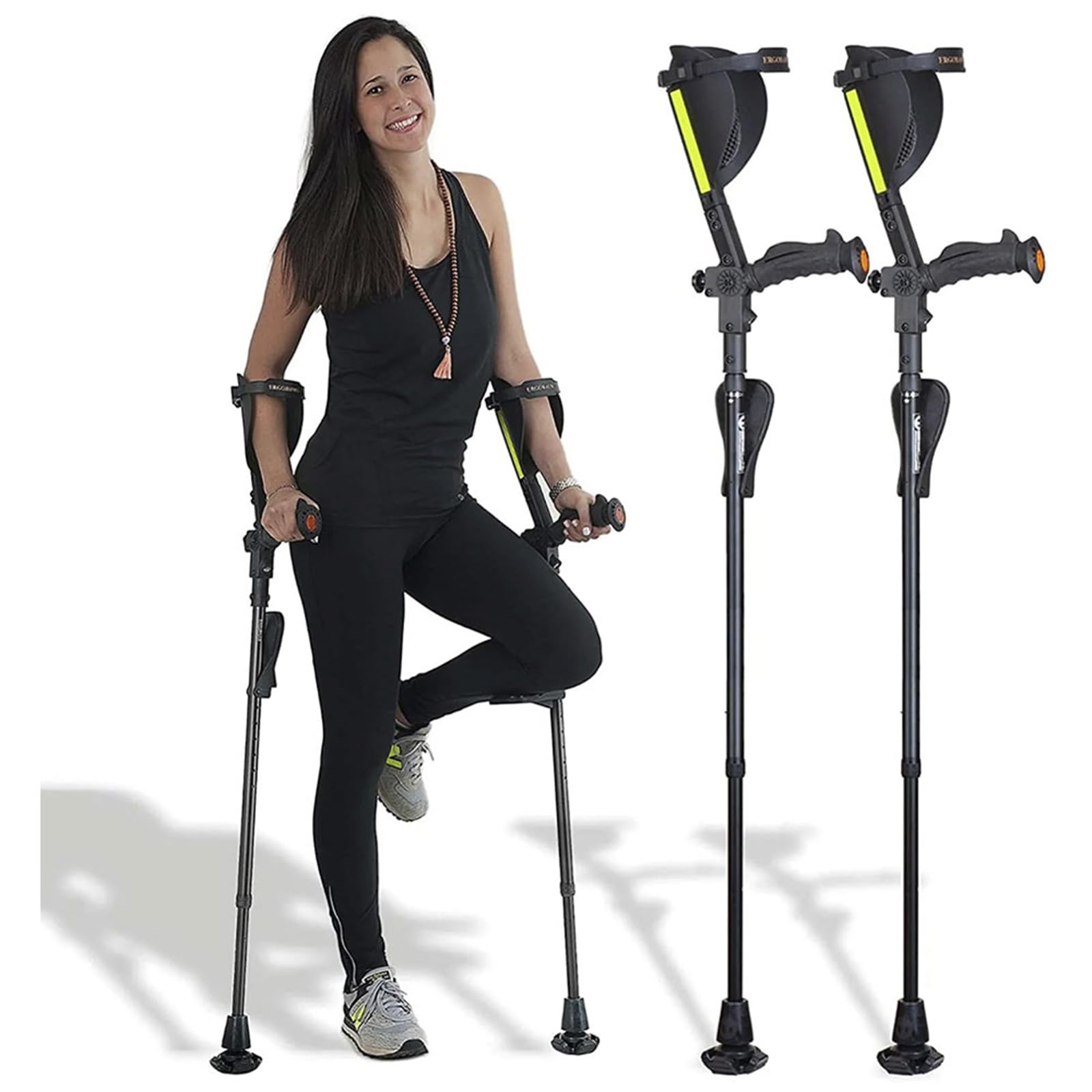
The premium option with a heel-to-toe tip, a night light, and a knee rest built in.
This is the pair for someone who wants everything on the crutch and nothing bought separately. It is made from medical-grade aluminum, fits users from 5′ to 6’6″, and supports up to 360 lbs. The patented ErgoCap tip is the piece worth understanding: it is shaped to mimic your foot’s natural heel-flat-toe roll, so the crutch keeps contact with the ground through the whole stride instead of stopping and starting. The built-in LED helps you see and be seen at night, and the alert button, knee rest, and fold-flat frame all come in the box.
What earns the price for the right buyer is the ride. The handle angle and cuff height adjust to your body, the integrated knee rest gives you somewhere to perch when you stop, and the fold-flat design fits in a car trunk or carry-on. Customers note the adjustable grips are easy on the hands, shoulders, and elbows, and that the ErgoCap tip keeps a natural stride. It is a one-purchase mobility kit.
The serious catch is weight and sturdiness. Owners describe it as somewhat heavy, and sturdiness is split — some find the aluminum frame rock-solid, some report the arm supports giving out over time. Value is a divided question too. If you are recovering for months and want every feature, the bundled LED, knee rest, and ergonomic tip justify it. If you just need a reliable walking aid for a few weeks, this is more crutch than the job requires. Note that it runs on 6 LR44 batteries, supplied with the unit.
The features that justify it
- Patented ErgoCap tip that follows a heel-flat-toe roll
- Built-in LED, alert button, and integrated knee rest
- Fits 5′ to 6’6″ and supports up to 360 lbs
- Folds flat for a car trunk or carry-on
The honest caveats
- Owners describe it as somewhat heavy to carry
- Sturdiness feedback splits, particularly on the arm supports
Built for: long recoveries and chronic mobility needs where the LED, knee rest, and shock-absorbing tip all earn their keep.
Overkill for: a short stint on crutches or a buyer who wants the lightest, simplest pair.
6. Drive Medical Bariatric Steel Forearm Crutch

One crutch, 500 lb of support, and the widest height range on this list.
If your priority is a frame that will not be the weak link, this is the one to look at. It is made of alloy steel and hard plastic and is rated for up to 500 lbs, the highest capacity here by a clear margin. The height range runs from 60 to 74 inches, with a handle height of 28 to 37 inches, and each section carries a push-button for independent adjustment. The extra-large contoured tips are sized for heavy-duty stability.
Sturdiness is the recurring positive — owners describe the steel frame as sturdy and steady, and the extra-large contoured tips add a planted feel. Value earns praise too: owners note the alloy steel build offers good quality and more support than a standard crutch. It also comes in near the lighter mid-range pairs on the scale at 12.8 ounces, so despite the steel build it does not feel like a brick in the hand.
Before you buy, check the cuff. The complaint that surfaces most is cuff size and arm fit — reviewers point out the cuffs are small and tight for larger forearms. That is a fit issue, not a build quality issue, and it is the one thing that can make this pair unusable for an otherwise well-suited buyer. Also plan to check it on arrival: durability feedback splits, with some owners reporting the second cuff tearing. If your forearms are on the larger side, measure before ordering, or consider a pair with a wider cuff.
The capacity story: at 500 lbs it is the strongest frame on this list, built from alloy steel with oversized contoured tips.
Check the cuff first: shoppers say the forearm cuffs run small and tight, so fit is the deciding factor.
Choose it if: you need the highest weight capacity here, with heights spanning 60 to 74 inches.
Measure first if: your forearms are large, since the cuffs are reported small and tight.
7. in-Motion Pro Underarm Crutches
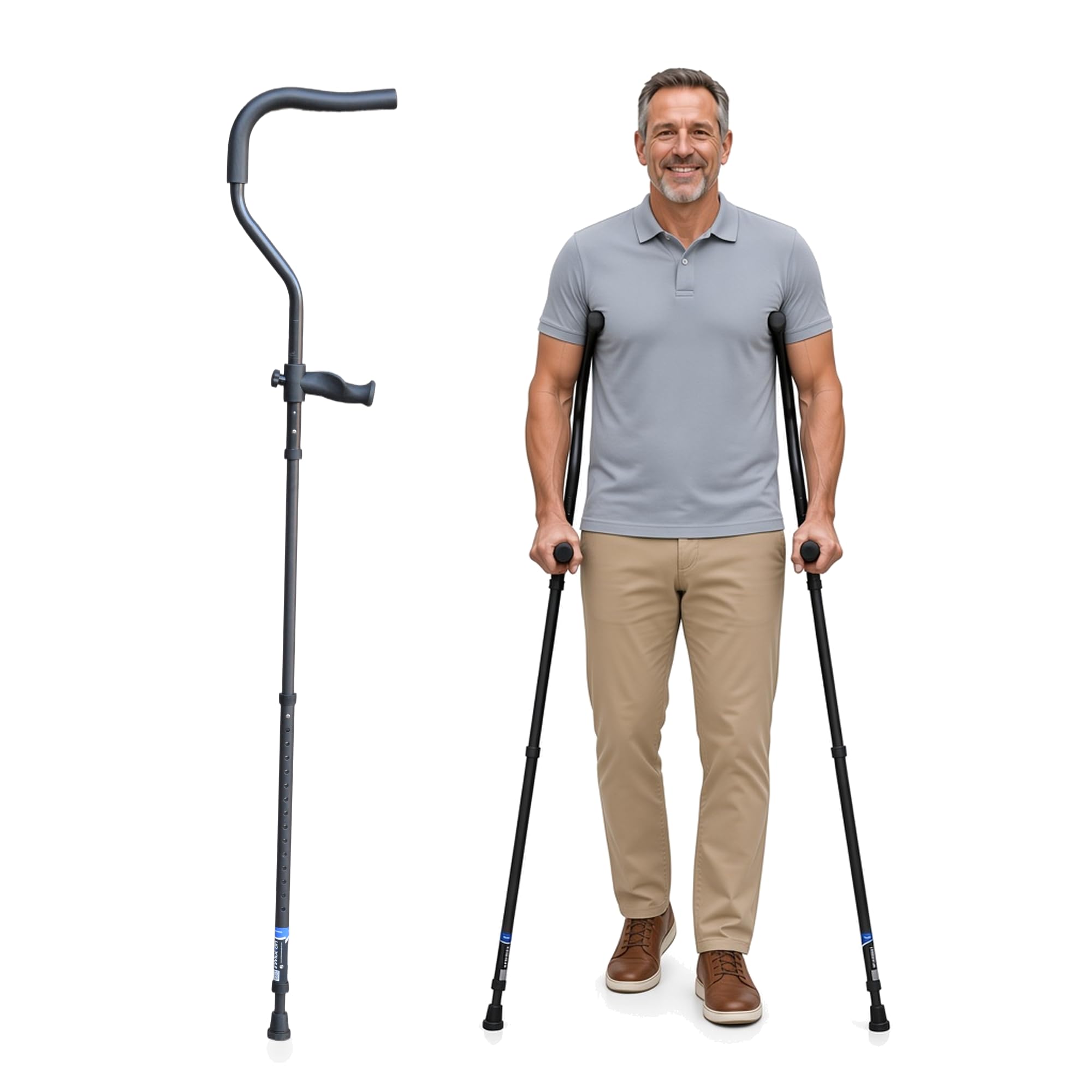
Underarm crutches for very tall users, with a spring in each post to soften each step.
This is the odd one out here, and that is why it earns a place — it is an underarm crutch rather than a forearm crutch, so it suits the buyer who cannot use a cuff or who needs the extra support of an underarm cradle. It fits adults about 5’10″–7’1″ tall, and the correct floor-to-underarm range is 52.5″ to 65.5″. The padded cradle adjusts across 15 positions, with 5 separate handgrip settings on top. Pair it with the 350 lb weight capacity and it is a serious underarm option.
The spring is the feature that earns repeated praise. A lower-post spring cushions each step and returns energy as you move forward, giving a firmer, less bouncy feel than rigid hospital crutches. The articulating rubber tips pivot to keep ground contact on carpet, pavement, grass, and gravel. It also folds in half for car storage without resetting your height. Owners call the spring-assist ride effective — several say it beats traditional underarm crutches, and the cushioning earns praise for taking strain off joints.
There are two honest limits. First, this is an underarm crutch, not a forearm crutch, so if your goal is to get the cuff off your armpit, this is not the pair for you. Second, the spring is a matter of taste — some owners love the rebound, some say the spring action and the handle ergonomics do not suit them, and the handles are reported hard enough to bruise a palm over a long day. It is also the bulkiest here at 5.2 pounds. If you are tall and want a shock-absorbing underarm crutch, it fits the bill.
Why it’s on the list: it brings the spring-assist ride and a 5’10″–7’1″ height window that no forearm pair here covers.
What you accept: underarm contact and a hard grip that can press on the palm during long days.
Best for: tall adults who prefer an underarm cradle and want shock absorption on each step.
Skip if: you want your weight off your armpits — that is the whole job of a forearm crutch.
Know the Specs
Height Adjustment Range
This is the window of user heights a crutch is built for, usually written as a total length and a handle height. The PEPE Mobility pair runs from 36” to 46” total with a 28” to 38” handle height. If you fall outside the range, the cuff will not land on your forearm properly and you will end up leaning. Measure floor to forearm in your normal shoes before you pick.
User Weight Limit
This is the maximum weight the frame is rated to carry, not the weight of the crutch itself. Options here run from 275 lb on the KMINA and PEPE pairs up to 500 lbs on the Drive Medical model. Aluminum frames keep the crutch light but flex more; steel holds firm but adds heft. Choose a limit with a little headroom above your own weight.
Open Cuff vs Closed Cuff
An open cuff is a C-shaped bracket that lets your arm come out sideways without unstrapping. A closed or semi-enclosed cuff wraps further around your forearm and shares wrist pressure, but your hand must slide out the top. If you need to reach for doors and dishes all day, the open cuff wins; if you want maximum pressure off your wrist, the semi-enclosed design wins.
Tip Type and Shock Absorption
The tip is where your crutch meets the floor, and it decides your traction. Rigid rubber tips are simple and cheap to replace. Pivoting or articulating tips keep contact as the crutch angle changes. A spring-loaded post, like the in-Motion Pro’s, cushions the jar of each step. On wet or uneven ground, check the tip and replace it when the tread wears smooth.
Common Questions
How do I know which height setting I need on a pair of forearm crutches?
Will forearm crutches work if I am very tall?
Is an open cuff better than a closed cuff for daily use?
What user weight capacity do I need?
Can I fold a forearm crutch to fit in a carry-on bag?
How often should I replace the rubber tips?
Are forearm crutches covered by FSA or HSA funds?
Why do my hands hurt after a long day on forearm crutches?
Can a forearm crutch support me if I am heavier than 350 lbs?
Should I set both crutches to the same height?
The Bottom Line
For most people, the forearm crutches answer is the KMINA pair, because it balances a 275 lb rating, 11 height settings, and washable padded grips at a mid-range price. If you want the pair with the deepest record of comfort and steadiness, the PEPE Mobility pair is the crowd favorite, with nearly ten thousand owners behind it. And if you travel or need to tuck your crutches in a closet, the folding pair is the one to reach for — just watch it on slick floors.
How we choose
We do not accept paid placement. Every pick is matched to a real buyer and a real use-case; we do not hands-on test units.
Sources
Specifications: manufacturer listings and product documentation. Review insights: verified customer reviews, as of November 2026. Pricing: not shown on this page (it changes often); check the current price via the retailer link.
As an Amazon Associate, My Heart Lives Here earns from qualifying purchases. This does not affect which products we feature.