Heads up: This post contains affiliate links. As an Amazon Associate I earn from qualifying purchases, at no extra cost to you. Learn more
Specs are compiled from manufacturer listings and verified buyer reviews and can change over time — please confirm the key details on the product page before buying.
The wrong cleaner is what turns a freshly waxed floor cloudy. Wax sits on top of the wood as a soft, protective layer, and a general-purpose cleaner can cut into that layer or leave a filmy haze you cannot buff away. The Swiffer WetJet solution is the pick for sealed and poly-finished floors — it’s the crowd favorite at 4.5+ stars, but it’s rated for sealed and finished surfaces only, so check whether your floor is wax or poly before you buy. Answer that one question and the rest of this list sorts itself out.
This guide is built by comparing the manufacturers’ published specifications and the patterns across verified customer reviews, so you get each pick’s real strengths and trade-offs instead of marketing spin.
A few of these products exist for wax and most exist for polyurethane and laminate — the gap between the two groups is the whole game when you’re shopping for the floor cleaner for waxed floors that won’t cut into your wax layer.
Top Picks

How To Choose The Best Floor Cleaner for Waxed Floors
Start by turning the whole question into one: what is actually on top of your wood? A wax finish is a soft coat you can usually feel slightly tacky or see buffing swirls in, and it wears down over months. Polyurethane is a hard plastic-feeling shell that stays glossy and resists water. Almost every cleaner on a shelf is built for that second group, so read the label’s “do not use on” line before you read the scent, the size, or the star rating.
Read the exclusion line first, not the headline
The most useful sentence on any bottle of floor cleaner is the one telling you where it must not go. A cleaner labelled safe for “hard sealed and finished surfaces” is not the same product as one labelled safe for wood with a wax layer. If the label names wax under the do-not-use list, that product is not your answer no matter how it’s marketed. Reading the do-not-use line filters the shelf faster than any star rating.
Residue is the real difference between shiny and dull
Dullness on a waxed floor almost always comes from something left behind. A cleaner that dries into a film adds a hazy layer over the wax, and you read that as the floor going grey. Look for wording about residue, film, streaking, and no-rinse use. A product that is designed to be wiped off clean, with nothing left over, keeps the wax layer visible underneath.
Concentrate or ready-to-use is a refill question
A concentrate means you add water yourself and use a small amount of liquid per session, so one bottle lasts a very long time. A ready-to-use spray is faster on the day but you replace it more often. Either form works, but it changes your annual refill routine and the storage space you need. If you keep a refillable mop cartridge, check that the bottle you pick actually refills it.
Match the cleaner to how often you actually mop
Daily or every-other-day mopping on wax benefits from a mild formula you can use without thinking. A weekly session on a hard-working hallway can take something with more bite. Match the strength to the frequency and you avoid over-cleaning a delicate wax layer, which is often what strips the shine in the first place.
Side-by-Side Comparison
| Model | Best For | Volume | Form | Weight | Amazon |
|---|---|---|---|---|---|
| Swiffer WetJet Solution with Febreze★ Best Overall | Sealed floors, fastest routine | 42.2 fl oz (2-pack) | Pre-mixed liquid | 5.84 pounds | Amazon |
| Rejuvenate Stone, Tile & Laminate RefillGentlest Formula | Stone and tile, big refills | 1 gallon (128 oz) | Liquid refill | 8 pounds | Amazon |
| Parker & Bailey Wood Floor Cleaner | Wood and faux finishes, no residue | 64 fl oz | Liquid refill | 4 pounds | Amazon |
| Bruce Laminate and Hardwood Cleaner | Laminate and hardwood upkeep | 32 fl oz each (2-pack) | Spray | 2 pounds | Amazon |
| Basic Coatings Squeaky Concentrate | Large homes, mix-your-own economy | 1 gallon concentrate | Concentrate | 8 pounds | Amazon |
Detailed Reviews
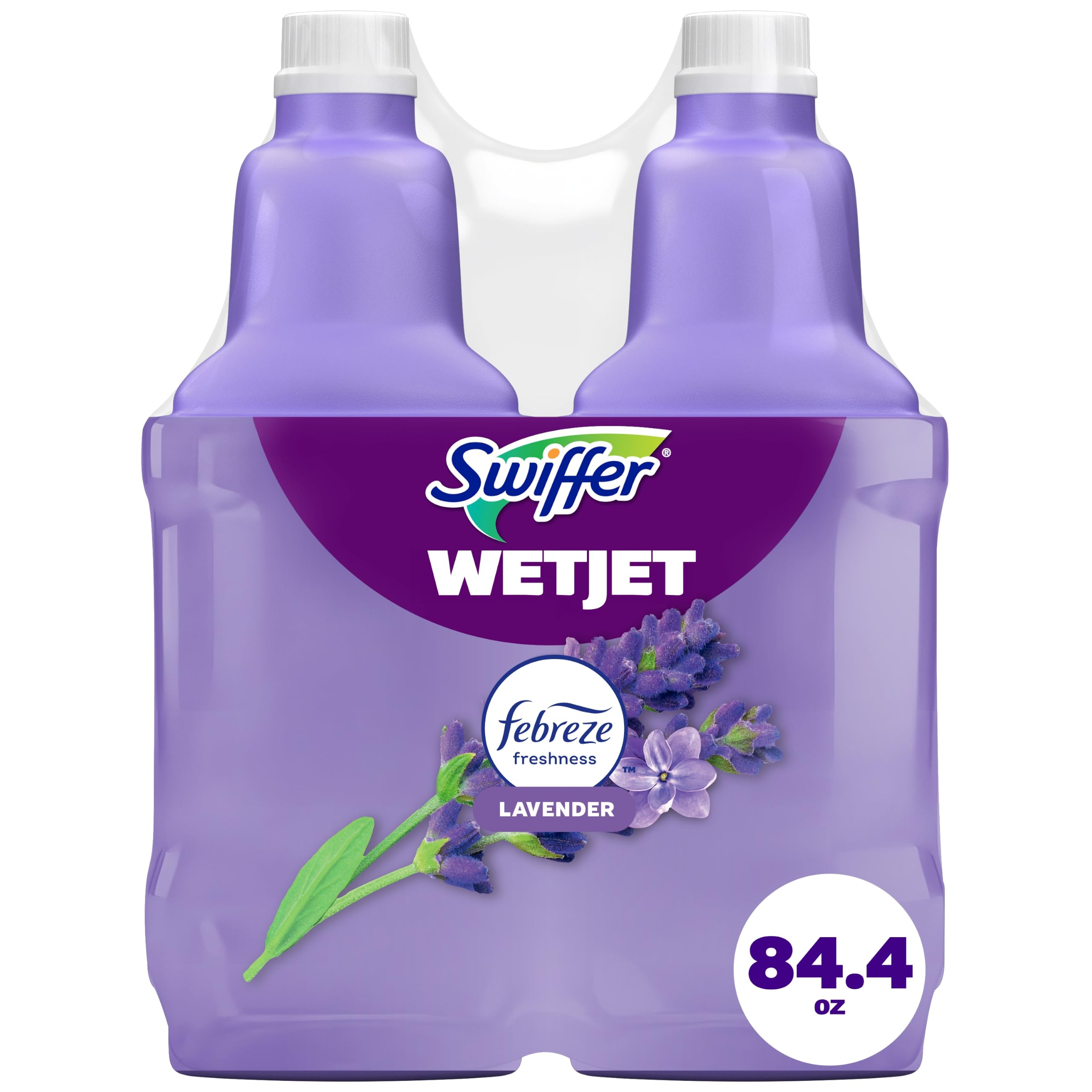
1. Swiffer WetJet Multi-Purpose Floor Cleaner Solution
Our pick — 4.5+★ from 142,000+ verified ratings; the strongest balance of quality and price.
The bottle that has mop-duty down to a two-minute routine
Here is the part most buyers miss: this solution is explicitly not for unfinished, oiled, or waxed wood. Swiffer’s own instructions say to skip it on those surfaces because they can be water-sensitive. So why is it the top pick? Because the majority of floors in most homes are sealed and finished, and on those this is the simplest, quickest clean you can buy — a pre-mixed liquid you pour straight into the WetJet and run without thinking.
The two things buyers respond to most are the clean itself and the smell. The quality of the finished floor is the aspect people talk about far more than anything else, and the Febreze Lavender fragrance runs close behind — this is a bottle that makes the room smell handled, not just the floor. Drying speed gets consistent praise too, which is the difference between mopping at night and living in a wet kitchen. The 42.2 fluid ounces across a two-pack also explains why household restockers keep coming back; it sits at 5.84 pounds on the shelf, so it is not a featherweight but it is not a chore to carry either.
The honest catch is film. Streak-free results are a genuinely mixed bag on this bottle — some floors come up clean and some end up with a faint haze. That’s a finish-mismatch signal, not a bad product, and it is the reason the wax crowd should look further down this list. For sealed wood, tile, and laminate, the fast-drying formula is exactly what you want underfoot.
Where it earns its keep
- Pre-mixed formula — no measuring, no mixing bowl, straight into the WetJet
- Fast drying, so the floor is walkable soon after you finish a pass
- Lavender Febreze scent that carries through the room without being heavy
- Comes as a 2-pack of 42.2 fluid ounce bottles, so you restock less often
The parts to know before you buy
- Not for waxed, oiled, or unfinished wood — Swiffer says so on the label
- Streak-free results split both ways depending on your floor finish
Reach for this if: your floors are sealed or poly-finished and you want the fastest mop routine in the house.
Leave it on the shelf if: you have a real wax layer — this is the one pick that openly tells you it is not built for you.
2. Rejuvenate Stone, Tile & Laminate Floor Cleaner Refill
A gallon you decant once and forget about for months
What makes this one worth a look is the chemistry, not the bottle: it is ammonia free and built to be gentle enough for daily use on delicate stone and laminate. If your concern is a cleaner that keeps stripping the finish away with every mop, a mild formula used often is a smarter routine than a harsh one used rarely. The 8-pound jug holds a full gallon that refills a 32-ounce bottle, so the pouring happens a handful of times a year.
On the surfaces it names — granite, limestone, marble, stone, tile, and laminate — it stays out of the way. There is no harsh smell to live through while you work, and the no-streak formula dries quickly enough that you are not waiting on a wet floor. The cleaning performance carries the conversation more than any other topic, and effectiveness runs second, which lines up with the picture of a bottle that quietly does the job.
Here is the honest bit: shine is genuinely split. Some floors come up looking polished and others read dull afterwards, and it depends heavily on what your floor already is underneath. Treat this as a stone-and-tile-and-laminate cleaner and it behaves; expect it to build a shine on bare wax and you may be disappointed. Check the label against your floor finish before you commit a whole room to it.
What it’s actually for: granite, limestone, marble, stone, tile, and laminate — surfaces where a gentle ammonia-free liquid is the right call, used as a refill for a 32-ounce bottle rather than a standalone sprayer.
Where it can surprise you: the shine result is uneven, so plan to test it on a small patch before you commit a whole room.
The best match: homes with stone or tile floors that want a mild, no-ammonia gallon refill and don’t mind pouring.
The mismatch to skip: anyone who needs a full gallon’s worth of shine restored on wax — that is not what this bottle promises.
3. Parker & Bailey Wood Floor Cleaner

Built to lift grease and grime without leaving anything behind
The spec that matters here is what it does not contain: no wax, no silicone, no petrochemicals, no harmful solvents. On a finished wood floor that is the combination you want, because every one of those ingredients is something that can build up into a fog over time. The 64-ounce refill is 2 pounds lighter than the 8-pound Squeaky jug, so it is easier to handle when you are topping up a spray bottle or a refillable mop cartridge.
Its reputation rests on cleaning performance above everything else, and the second-most-discussed strength is plain effectiveness. Floors come up clean of dirt and spots, and the residue-free finish is a real, repeated strength rather than a lucky hit — owners note the floor is left fresh with no trail behind. Shine gets its own steady stream of praise too. On top of that, this formula is odorless, so there is no scent fighting your room while you mop, and it wipes away clean enough to pick up dust from a dust mop.
The trade-off is speed versus care. You spray, then buff with a mop, cotton toweling, or paper towel, and you change the towel as it lifts dirt. That extra step is what keeps the finish clean, but it is more work than a pre-mixed mop pass. If you want a one-pass routine, this is not that. If you want a floor that comes up genuinely clean without film, it is exactly that.
The standout detail: a formula with no wax, silicone, petrochemicals, or harmful solvents — the ingredients most likely to dull a finished floor over repeated use.
The everyday rhythm: spray a section, buff it off with a mop or towel, change the towel as you go. That is the routine, and it is what the clean result depends on.
Best for: hardwood, laminate, and faux-finish owners who want a residue-free clean and don’t mind a spray-and-buff pass.
Not the one if: you want to spray and walk away — this formula rewards the buffing step.
4. Bruce Laminate And Hardwood Floor Cleaner

The easiest bottle to carry up a staircase, and the easiest to spill
At 2 pounds this is the lightest jug on the list — a full 6 pounds lighter than the Squeaky concentrate, which matters if your floors are upstairs and you are doing the carry every week. The 32-ounce spray bottles come as a pair, 64 ounces in total, and the oak scent is a subtle touch rather than a candle-store blast. It’s a straightforward hardwood and laminate cleaner with no pretence about being more.
Quality is the topic buyers raise most here, with cleaning performance close behind, and the streak-free finish draws steady praise for the way it leaves floors shiny and clean rather than smeared. On laminate and hardwood it does what it says. The spray bottle form makes it quick to target a scuffed spot without soaking a whole section, which is genuinely useful on a busy hallway.
Two things to plan around. First, leakage — a minority of units arrive with a packaging problem that turns into a mess in transit, so check the box before you store it. Second, wax. Nothing in the label promises it is safe on a wax layer, so treat it as a laminate and poly-finished wood product. If that matches your floor, the light bottle and the spray control are worth the trade.
Make it your pick: two-storey homes and laminate owners who want a light spray bottle they can carry anywhere.
Give it a pass: if your floor has a wax layer, or if a leaky delivery would set your project back — inspect the packaging on arrival.
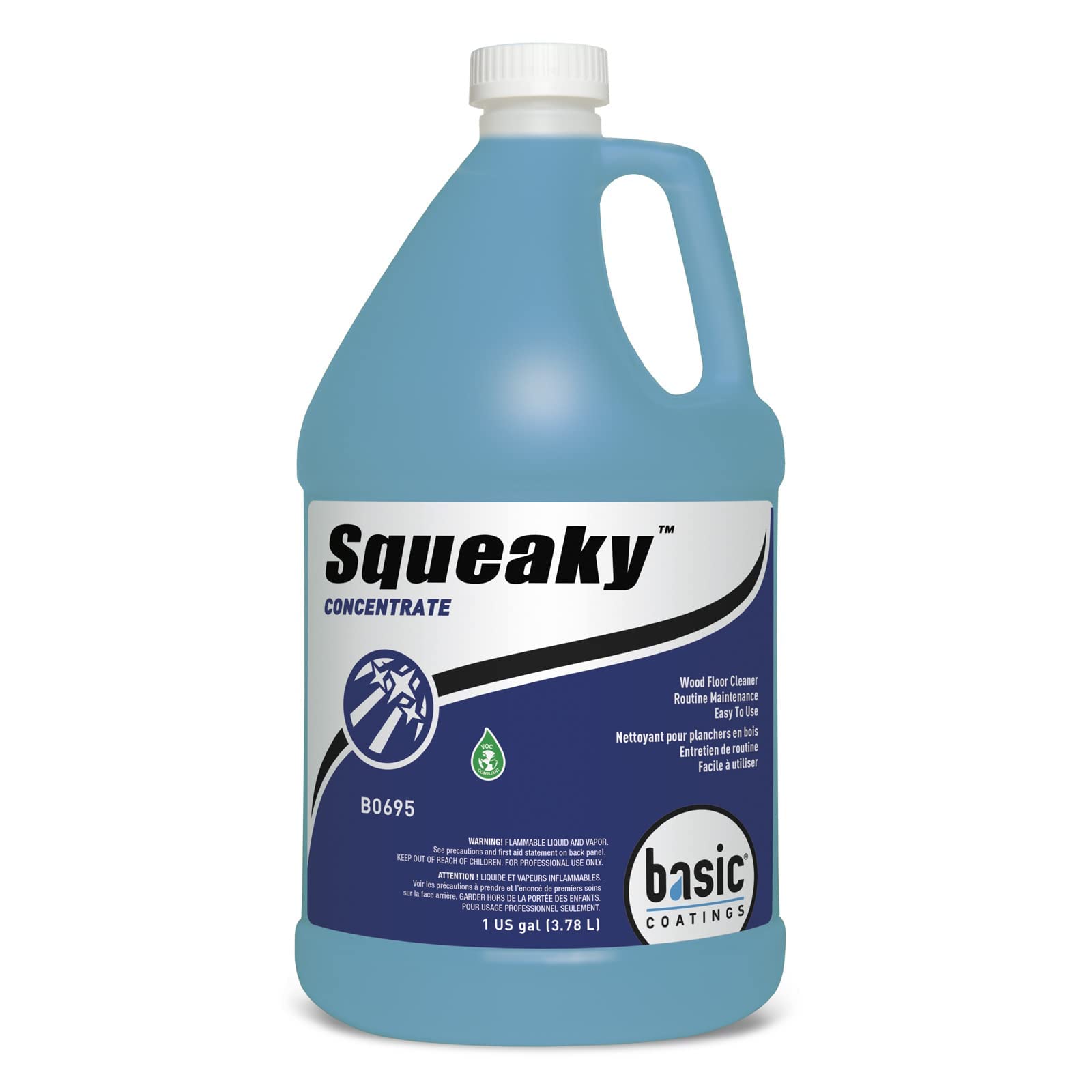
5. Basic Coatings Squeaky Hardwood Laminate Floor Cleaner Concentrate
One gallon of concentrate that refills a spray bottle for a very long time
The pitch is simple: add water. This is a concentrate, so you mix a small amount into your Squeaky spray bottle and refill it again and again instead of buying fresh bottles. The jug holds a full gallon and weighs 8 pounds, and it stands 12 by 6.1 by 6.1 inches — about twice the footprint of a Swiffer solution bottle, so give it a shelf corner rather than a cupboard gap.
The residue-free promise is the heart of it. This formula is built to leave no sticky film and no dulling deposit, and that is what most owners talk about after residue concerns — floors come up clean and stay that way. Effectiveness is the standout area by a wide margin, and the second-biggest strength is that no-residue finish, which matters most on the surfaces this is meant for. Floors read as looking brand new and sparkling when you get the mix right.
Where the value argument wobbles is cost-per-use against the up-front jug — the concentrate divides opinion on value even though the cleaning performance is well liked. And it is built around hardwood and poly-coated surfaces, not a living wax layer. Use it on the right floor and the economics work out over a year; use it on wax and the mixed value talk will feel justified.
Why people keep buying the jug: it is a concentrate you dilute yourself, so a single gallon runs through a spray bottle a dozen-plus times instead of a single mop session.
The honest tension: the up-front jug feels expensive to some, and the formula is aimed at hardwood and poly-coated finishes — a wax layer is not its target.
The pick for: larger homes and refill-minded owners who want to mix their own and stop buying bottles.
The case to look elsewhere: wax-floor households and anyone who wants a light, ready-to-spray bottle from day one.
Know the Specs
Finish Compatibility — the Only Spec That Matters First
Every cleaner carries a note about which surfaces it’s built for, and that note decides everything else. “Sealed and finished” floors are coated with a hard top layer — polyurethane or a similar clear coat that resists water. Wax and oiled finishes are softer and can react with a water-based cleaner. If the label says not for waxed, oiled, or unfinished wood, that cleaner is not for you, no matter how good it is on tile. Read that line before you read the scent or the size.
Volume and Form — What You Actually Get
Volume tells you how many sessions a bottle covers, and form tells you how much setup each one needs. A pre-mixed bottle like the Swiffer 42.2-fluid-ounce pack is pour-and-go. A 64-ounce refill like Parker & Bailey tops up a sprayer you already own. A 1-gallon concentrate like Squeaky is diluted with water, so it stretches the furthest per jug but needs mixing each time. Match the form to the routine you’ll actually keep, not the one you wish you had.
Residue-Free and No-Rinse
Residue is what’s left on the floor after the water evaporates. On a waxed or finished floor, residue builds into a hazy film that reads as dullness even though the wood underneath is fine. Formulas built to leave nothing behind — and models sold as no-rinse — protect the finish you already have. A cleaner that requires a wipe-off step handles residue a different way: the buffing lifts it off with the towel, which is why some products ask for that extra pass.
Scent and Chemical Load
Scent is a comfort choice, not a cleaning one, but the chemical load behind it can matter on a delicate finish. An odorless, ammonia-free formula is easier on sensitive finishes and the air in the room. A scented formula is friendlier to live with during a mop session. Neither scent is wrong. What’s worth checking is whether the label lists wax, silicone, petrochemicals, or harsh solvents — those are the ingredients most likely to build up on a finished floor over time.
Common Questions
How do I know if my floor is actually waxed?
Can I use a cleaner labeled for sealed floors on wax?
Will a floor cleaner strip the wax off if I use too much?
Why does my floor look dull right after cleaning?
Is a concentrate better than a pre-mixed spray for waxed floors?
How often should I mop a waxed floor?
Does a scented cleaner hurt a wax finish?
Can I refill my mop cartridge with any of these cleaners?
What’s the difference between a “no-rinse” cleaner and a wipe-off cleaner?
The Bottom Line
The honest answer to a waxed-floor cleaner search is to buy for your finish, not for the star count. That is why the Parker & Bailey 64oz refill is the pick to start with if there is a wax layer or a finished faux-wood surface in your home — no wax, silicone, petrochemicals, or harmful solvents, and a residue-free clean that keeps the finish visible. If your floor is sealed polyurethane or laminate and you want the fastest mop in the house, the Swiffer WetJet solution is genuinely worth the crowd around it, even though it openly tells you to skip wax. And if you’re cleaning stone or tile alongside the wood, the Rejuvenate gallon refill handles the delicate surfaces without a harsh chemical load.
One last nudge: the concentrate route is the sleeper pick for anyone who mops often. A single gallon of Squeaky concentrate dilutes again and again, so the cost per session settles far below a fresh bottle every time — just check that your floor is a hardwood or poly-coated surface before you commit.
How we choose
We do not accept paid placement. Every pick is matched to a real buyer and a real use-case; we do not hands-on test units.
Sources
Specifications: manufacturer listings and product documentation. Review insights: verified customer reviews, as of November 2026. Pricing: not shown on this page (it changes often); check the current price via the retailer link.
As an Amazon Associate, My Heart Lives Here earns from qualifying purchases. This does not affect which products we feature.